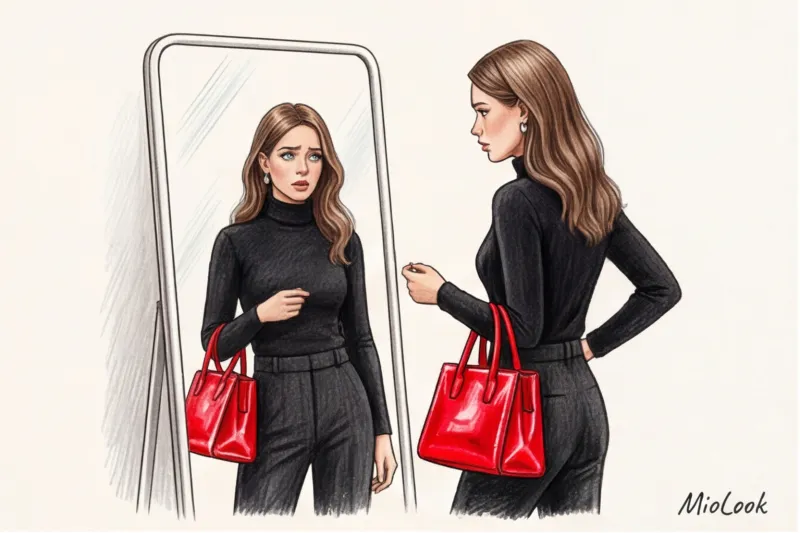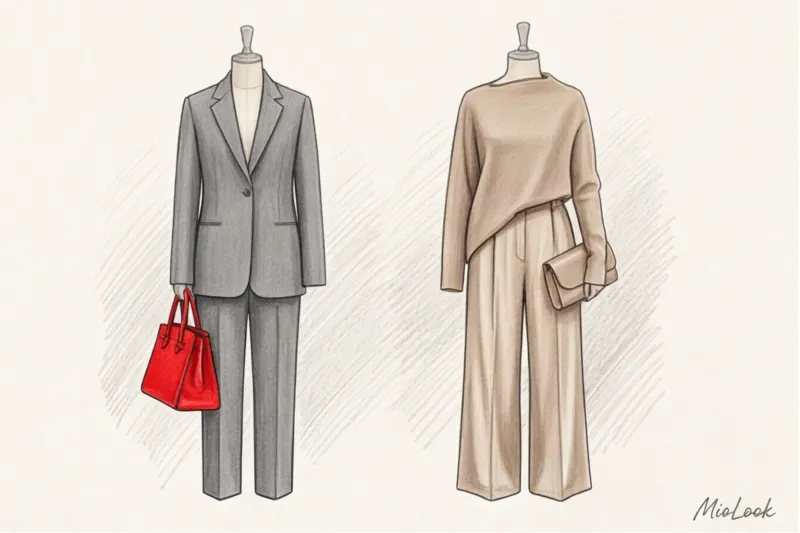
Every time I hear the advice, "Just add red lipstick or a bright scarf to a gray suit," my eye, as a colorist and stylist, starts twitching. Just last week, I had a client who was desperately trying to jazz up her formal office looks. She bought a neon fuchsia bag for €300 and wore it with flat, average-cut gray suits. Do you know how she felt? In her own words, "like a clown who forgot to change after a performance." And therein lies the main problem with... How to make a basic wardrobe less boring: We are trying to treat the symptoms, not the disease itself.
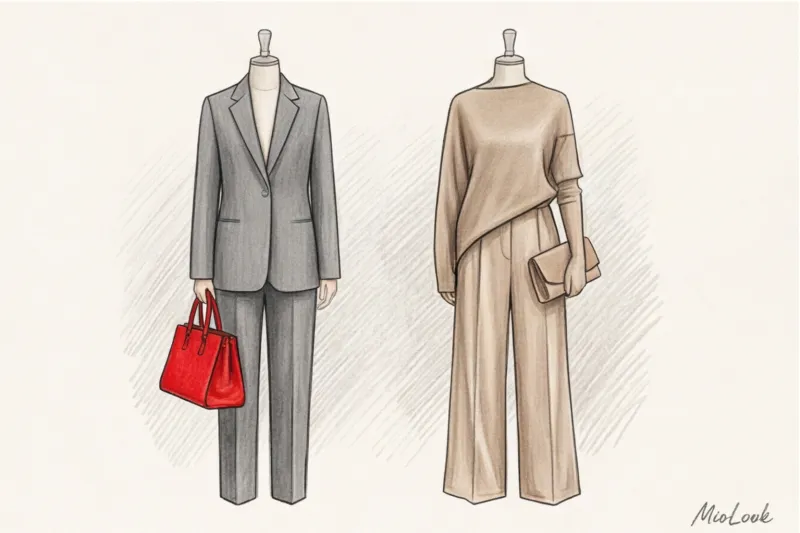
We've already discussed in more detail why old stylistic dogmas no longer work in our complete guide: How to Find Your Own Clothing Style: Forget the Rules Spoiler: true, "expensive" minimalism isn't built on the artificial introduction of foreign colors. It's based on the architecture of cuts, the clash of contrasting textures, and micro-styling. Let's figure out why your beige sweater looks dull and how to fix it today.
The "Bright Accent" Myth: Why Classic Tips Don't Work
The most popular glossy piece of advice from the 2000s—"wear red pumps with a boring outfit"—is hopelessly outdated today and, frankly, significantly cheapens the look. Why is this? Because a splash of color against a flat, stagnant base outfit feels like a stylistic patch. It's visual clutter that undermines the very aesthetic of minimalism.
It's important to distinguish between two concepts: a basic wardrobe (your everyday uniform) and minimalism (a conscious stylistic direction). The main reason a uniform looks dull isn't the lack of color. It's the flat fabrics and safe, basic cuts.
Over 12 years of working with color, I've noticed a paradox: women tire of constant "splashes of color" that don't align with their inner state. We buy a red bag because we're told it's fashionable, but it clashes with our need for calm. True individuality doesn't scream in neon—it speaks in a whisper of perfect lines.
Access to MioLook for €0.99 — one-time payment
A smart AI stylist will select the perfect look based on your preferences and help you create a fun capsule wardrobe.
Get access — €0.99 onceSilhouette Architecture: How to Make Your Basic Wardrobe Fun Without Prints
When you remove color and print from your look, shape takes center stage. A garment should become a statement in its own right. Forgo safe cuts in favor of asymmetry, exaggerated volume, or bold geometric shapes.
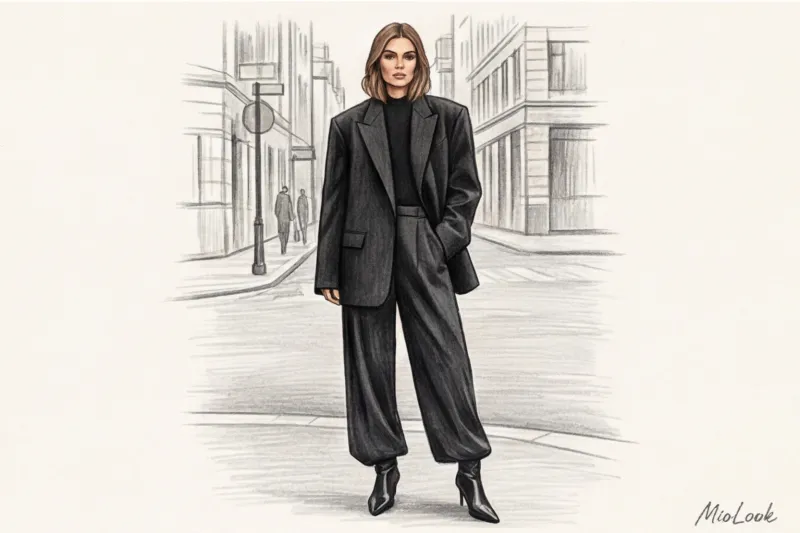
Instead of the usual fitted white shirt from the mass market, choose a heavy cotton shirt with exaggerated cuffs, a deconstructed collar, or accentuated shoulders. This is the concept of "intellectual minimalism," brilliantly conveyed by architectural brands. Look at the collections of The Row (the Olsen sisters) or Jil Sander (under the direction of Luke and Lucie Meier) in recent years—their pieces are worthy of being viewed as sculptures.
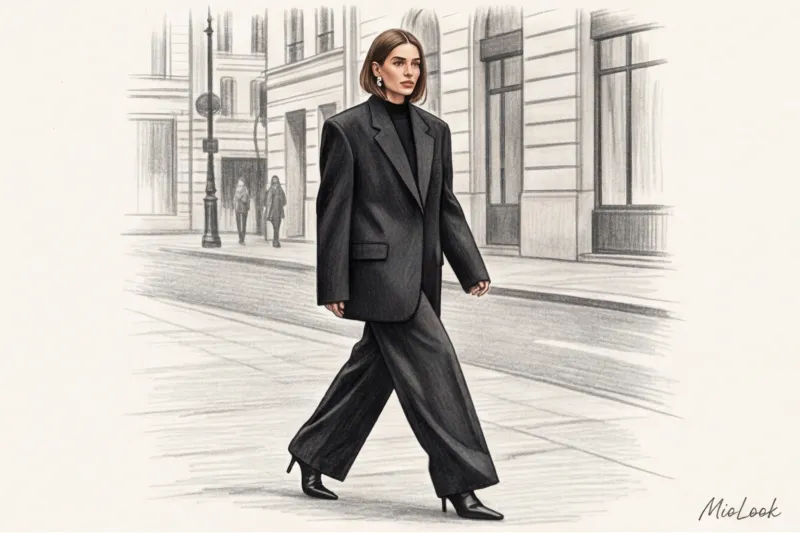
"Minimalism without architectural design is simply a lack of imagination. Form must compensate for the lack of color."
Of course, there are limitations here. Frankly, this technique with exaggerated volumes (like oversized, man-sized jackets) does NOT work if you're shorter than 160 cm and don't compensate for the width with the right proportions—you'll simply "drown" in the fabric. And here we come to the most important rule.
The golden rule of proportions is 70/30
Dividing the figure into a 50/50 ratio (for example, an untucked sweater that ends right at mid-thigh and straight-leg jeans) kills any dynamism and visually shortens the height. At the design institute, we were taught the rule of thirds, which in styling translates into a 70/30 ratio.
How can this be applied in practice? Create asymmetrical lengths. High-waisted trousers (70% visual height) and a cropped crop top (30%). Or vice versa: a long maxi coat (70%) over a miniskirt (30%). This disproportion is what draws the viewer's eye, making the look captivating.
Texture Theory: The Invisible Color That Changes Everything
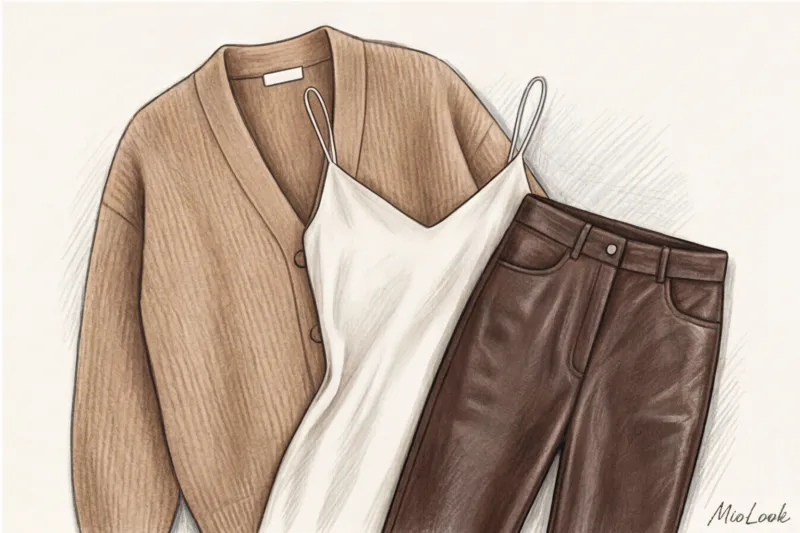
As a colorist, I often encounter complaints like, "Beige doesn't suit me; it makes me look pale and moth-eaten." And every time, I respond: it's not the beige, it's the fabric! According to the PANTONE Color Institute, the perception of the same shade can change beyond recognition depending on the texture of the wearer.
Matte surfaces (cotton, linen) absorb light, making the color flat and dull. Glossy surfaces (silk, satin, smooth leather) reflect light, creating highlights and a sense of multifacetedness. Fleecy textures (mohair, cashmere, suede) diffuse light, adding depth and softness to the hue.
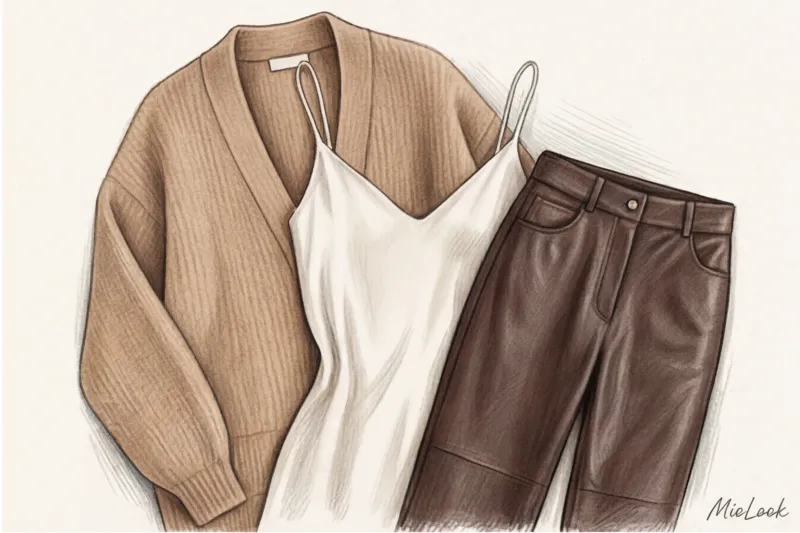
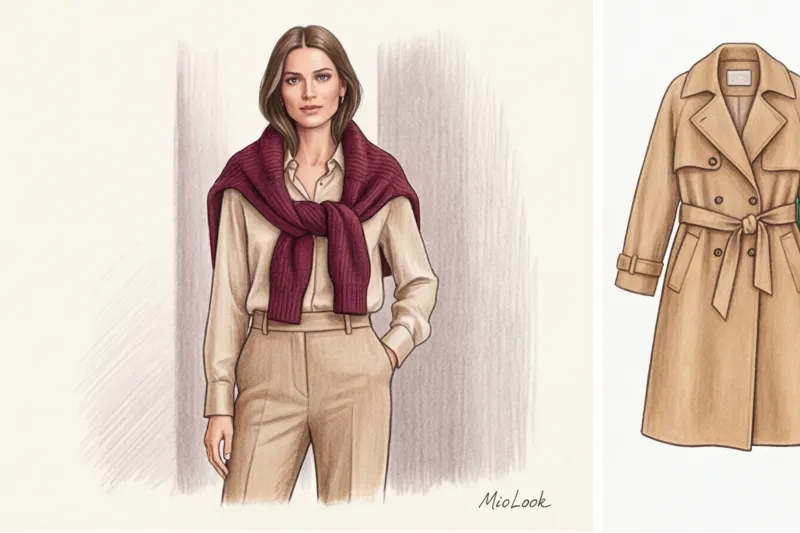
If you want to know, How to make a basic wardrobe less boring , use the monochrome layering formula: put together an outfit in one single color (for example, milky or chocolate), but use at least three, and preferably four, different textures.
- Successful contrast 1: Smooth, flowing silk (slip skirt) + coarse, textured wool (chunky knit sweater).
- Successful contrast 2: Matte dense suede + fluffy mohair.
- Successful contrast 3: Glossy leather jacket + loose matte cotton.
It is the clash of textures that creates that very “expensive” invisible color.
Your perfect look starts here
Join thousands of users who look flawless every day with MioLook. Digitize your wardrobe and create stylish texture combinations.
Get access — €0.99 onceMicro-styling: The devil is in the rolled-up sleeves
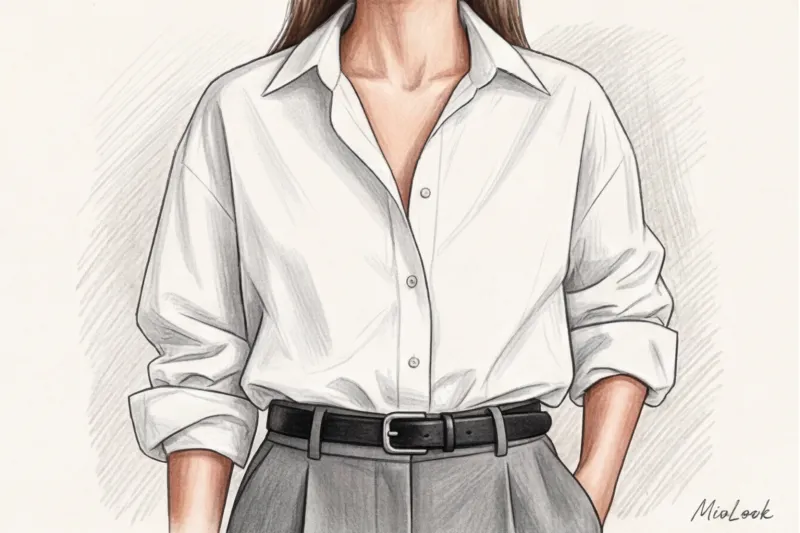
Clothing isn't just WHAT you wear, but HOW you wear it. On set, we rarely leave things "as the manufacturer intended." Micro-styling is those invisible touches that transform a boring clerk's shirt into a look of Parisian chic.
Master a few basic techniques:
- French tuck (French dressing): Tuck only the front edge of your sweater or shirt into your pants, leaving the back open. This defines your waist (the 70/30 rule!) but keeps things relaxed.
- Open wrists: Always roll up or pull up the sleeves of jackets and shirts. The wrist is the most graceful part of a woman's hand, and showing it off lightens any, even the most oversized, silhouette.
- Dropped shoulder: Wear cardigans or oversized shirts slung slightly over one shoulder, revealing your collarbone. This instantly elevates a daytime basic look into an evening one.
Signature jewelry as the DNA of your personal style
Have you noticed how many women wear five or six thin, discreet gold chains "for every day" at once, blending into a single visual noise? This doesn't work in minimalism. Instead of a dozen small details, you need one or two statement pieces.
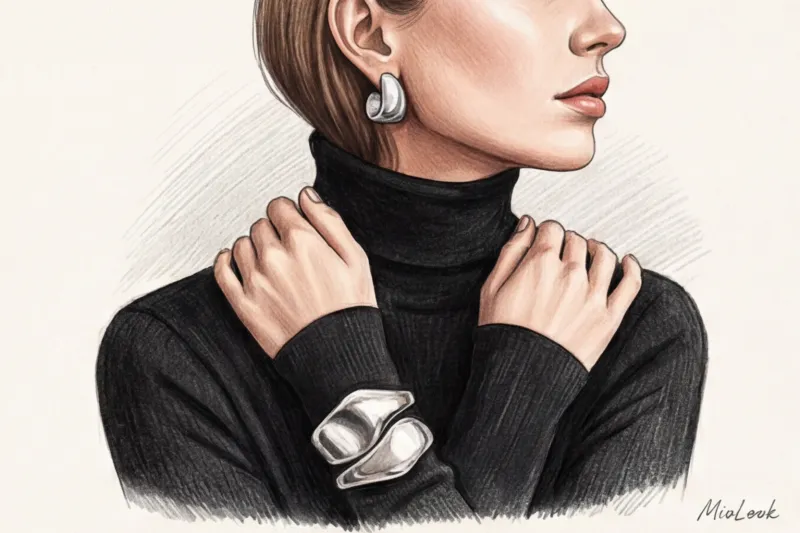
A sculptural silver ring, a massive ear cuff made of crushed metal, or a vintage brooch with a strict geometric shape—these pieces become your calling card. We wrote more about how accessories shape impressions in our articles about status accessories for experts The choice of metal and shape is directly related to your archetype: smooth, streamlined shapes convey softness and flexibility, while sharp angles and raw metal convey rebelliousness and inner strength.
Checklist: How to Make Your Basic Wardrobe Fun in 5 Steps
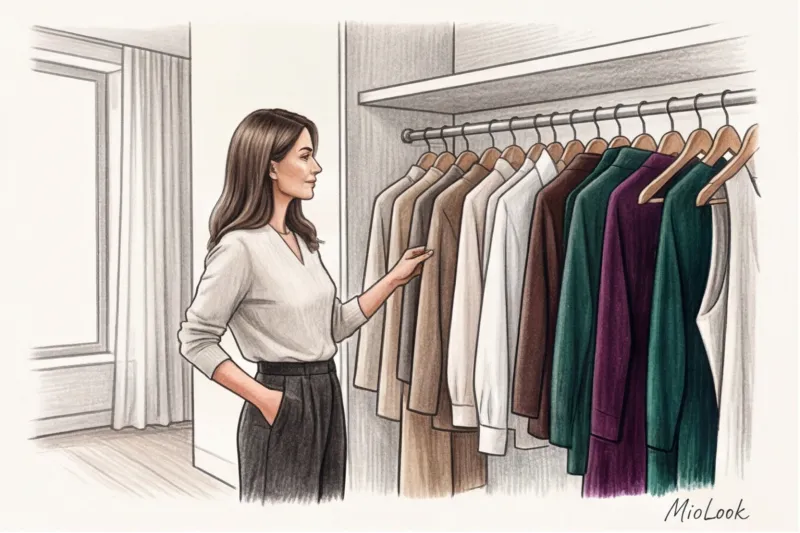
So, let's move from theory to practice. If tomorrow you open your closet and realize you have nothing to wear (even though you have plenty), do the following:
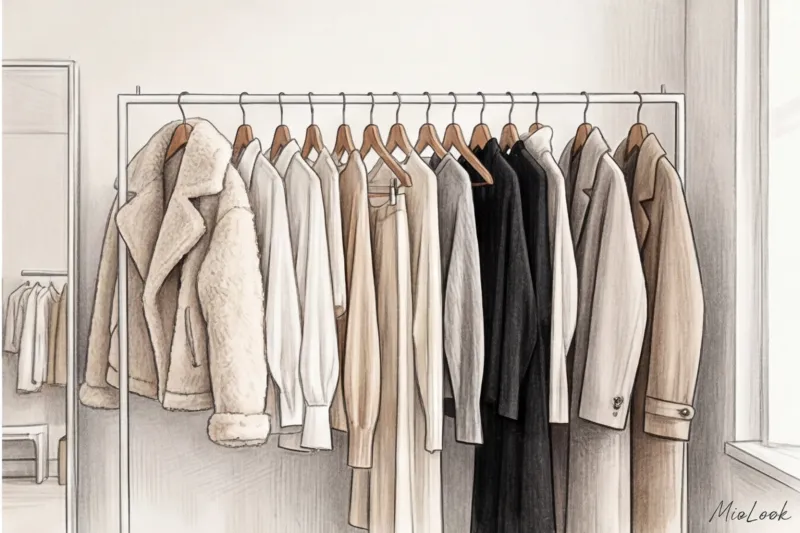
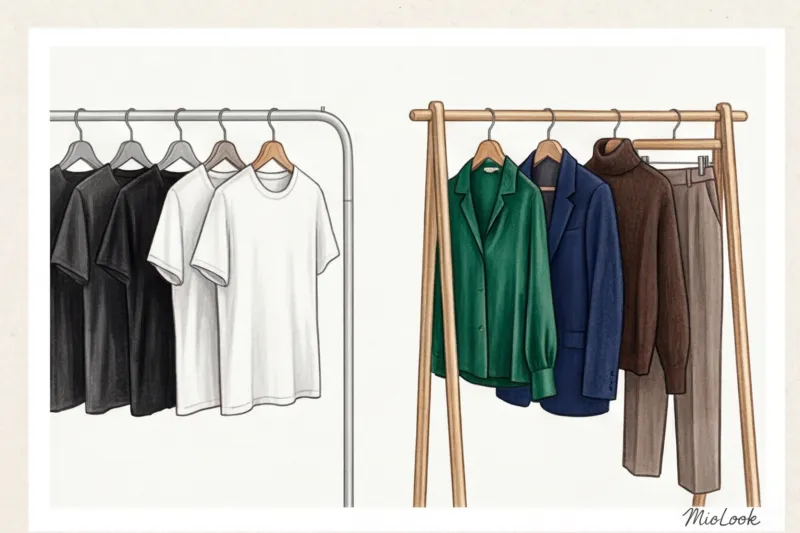
- Step 1. Conduct an invoice audit. Calculate how many smooth fabrics you have versus how many textured ones. If 90% of your wardrobe is smooth cotton and viscose, immediately introduce leather, suede, silk, or textured knits.
- Step 2: Define your signature item. Let it be a perfectly fitting asymmetrical top or a jacket with exaggerated shoulders.
- Step 3: Ditch the "safe" cut. Clothes that don't fit properly (they don't hug you, but they don't create a nice volume either) make your look look orphaned.
- Step 4: Apply micro-styling. Make it a rule to roll up your sleeves or raise the collar of your jacket before leaving the house.
- Step 5. Calculate Cost-per-wear. McKinsey's 2024 consumer research confirms the trend toward mindful consumption. A basic, sophisticated shirt from COS, for €150, that you'll wear 100 times (€1.50 per occasion) is more stylishly and financially advantageous than a boring €30 T-shirt bought on a whim and worn twice (€15 per occasion). Invest in architecture, not quantity.
Individuality in style isn't about trying to wear every trend at once or desperately throwing in bright colors to attract attention. It's about creating complex visual stories from seemingly simple items. Remember: true minimalism isn't about having fewer things. It's about making every piece count.