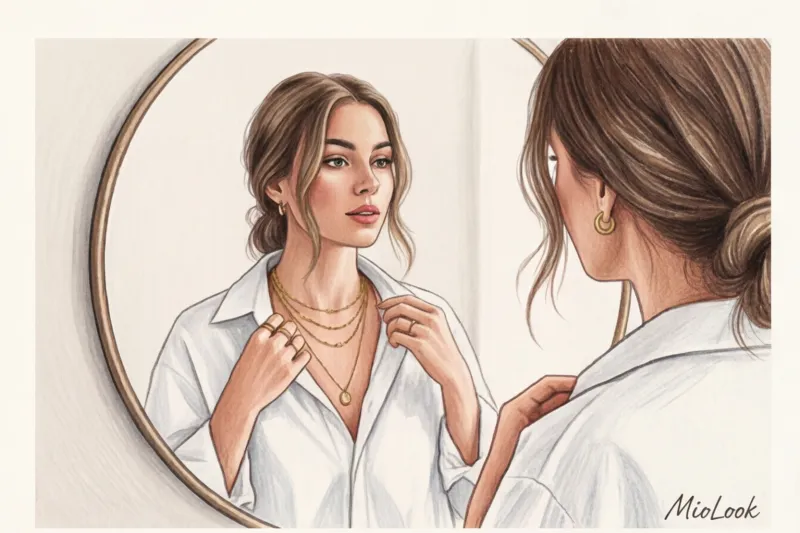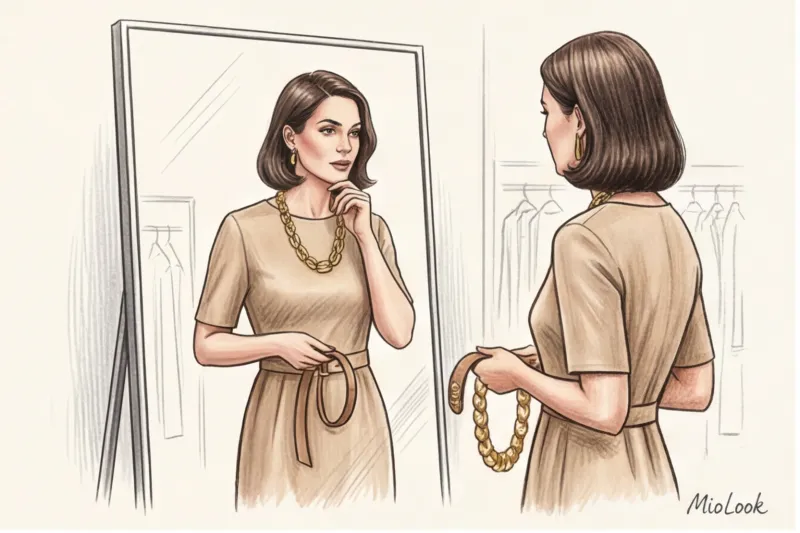
The Mathematics of Style: Why the Old Rules No Longer Work
Have you ever wondered why influencers with dozens of bracelets and three necklaces look stylish in street style photos, but in real life, trying to replicate this trick often ends in fashion disaster? The question of how to combine accessories has been a major concern for my clients for years.
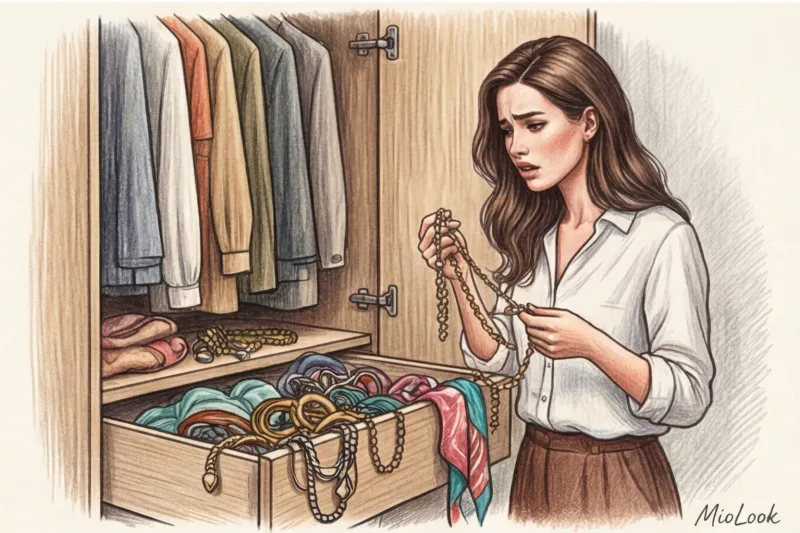
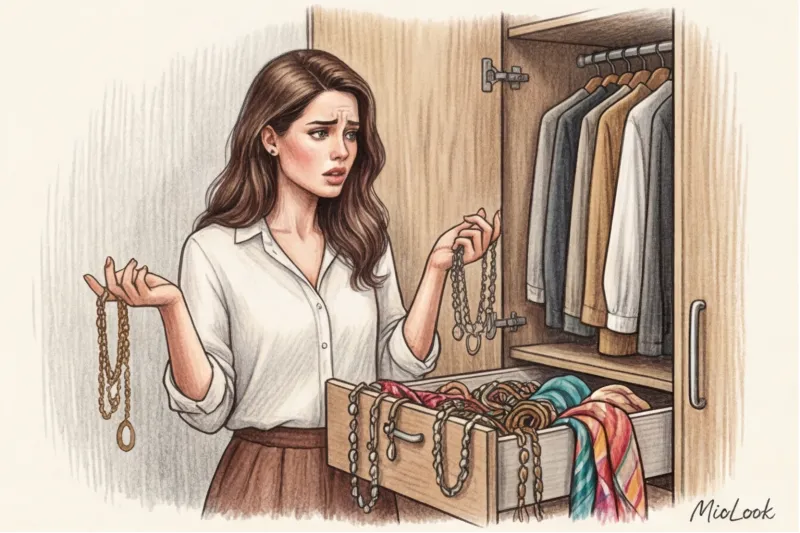
I understand them perfectly. About ten years ago, at the start of my career as a stylist, I myself would spend 40 minutes in front of the mirror, painfully removing and putting on rings, pendants, and belts. It became a daily lottery. My problem was solved only when I stopped relying on an ephemeral "sense of beauty" and translated style into clear, understandable mathematical algorithms.
Today, in the era of minimalism and conscious consumption, our attitude toward jewelry has changed dramatically. We no longer buy cheap costume jewelry by the kilo at the checkout counters of mass-market stores. According to the Business of Fashion analytical report (2023), consumers are increasingly investing in high-quality mid- and premium-priced pieces (ranging from €150 to €500) that last for years. In wardrobes comprised of simple basics in the spirit of brands like The Row or COS, accessories are no longer just the icing on the cake. They are now the primary styling tool, transforming a simple white shirt into a formal office uniform or a relaxed evening cocktail outfit.
But this is precisely where the trap lies. Trying to add details intuitively often leads to the "Christmas tree" effect. Why does this happen? Because our brain, lacking a frame of reference, tries to compensate for a simplistic base with excessive embellishment. You put on an accent belt, add chunky earrings, then a watch, a couple of bracelets—and the look falls apart. Incidentally, an excess of shiny hardware and low-quality metal is one of the 10 Key Signs of Cheap Clothing , which is often a failure when trying to look "expensive." To avoid visual chaos, I recommend digitizing your wardrobe. Using an app MioLook , you can pre-create accessory sets on a virtual canvas, evaluating their harmony before you start getting dressed.
To make the system work, we need to introduce a key concept - Visual weight This is the key metric in modern styling. The visual weight of an accessory is determined not by its physical dimensions in centimeters, but by the level of attention it attracts through its color, texture, and geometry.
For example, a thin yet vibrant neon choker made of glossy resin has tremendous visual weight. It instantly draws the eye to the portrait area. Meanwhile, a wide yet matte silver watch, which almost blends with a cool skin tone, has low visual weight. By evaluating jewelry on this scale, you begin to understand why two "heavy" elements placed next to each other will inevitably clash and create visual noise.
The Myth of Coco Chanel's Rule
A famous quote attributed to Coco Chanel: "Before leaving the house, look in the mirror and take off the last thing you put on." For decades, this was considered the gold standard of elegance. But let's be honest—in the realities of modern architectural approaches to style, this advice is hopelessly outdated.
Why doesn't the "take off the last thing" method work anymore? When you're creating your look consciously, every detail has a functional or aesthetic purpose. Imagine you've put together a simple outfit: straight-leg jeans, a cashmere sweater, and loafers. Then you add a sculptural, asymmetrical brooch to create a focal point in the portrait area and draw attention away from the hip line (a particularly useful technique, which we discussed in the article about Basic wardrobe for short women ). If you remove this brooch simply because it was the "last" one you put on, the look won't become more elegant—it will become unfinished and bland.
It is extremely important to understand the difference between intentional maximalism And random overload Maximalism, as seen in Schiaparelli's couture shows or the looks of the legendary Iris Apfel, is a deeply considered strategy. Every element, be it exaggerated gold buttons, massive glasses, or multi-tiered necklaces, supports the overall grotesque aesthetic. Accidental overload, however, occurs when mismatched accessories are layered on top of each other without purpose, simply out of fear of looking "too boring."
Tricks: How to Combine Accessories Without Mistakes
In 2022, I was developing a styling concept for a lookbook for a European minimalist brand. During the shoot, we struck up a conversation with their chief visual merchandising specialist, and she said something that became an insight for me: "If a window display has more than two focal points, the buyer's brain becomes overloaded, they stop processing the structure, and simply pass it by." The exact same principle applies to developing a personal style.
According to the laws of perception psychology and cognitive load theory, the human eye is physically incapable of focusing on multiple details simultaneously and equally. When we look at someone we're talking to, our brain tries to find the structural center in a split second. This is why the main secret of How to combine accessories , lies in strictly adhering to the concept of a focal point: a well-constructed image can have only one, or at most two, main accents. This is your visual anchor.
To make this technique work in practice, I teach my clients to view their figure not as a single canvas to be decorated, but as a well-thought-out design of an outfit. Draw horizontal lines in your mind's eye and divide your silhouette into four key zones:
- Portrait zone: head, neck, shoulders and décolleté (glasses, earrings, necklaces, scarves).
- Waist area: belts, sashes, corset inserts, decorative elements on trousers.
- Hands and wrists: watches, bracelets, accent rings and, often forgotten, the bag you hold in your hands.
- Leg area: shoes, anklets, tights with complex patterns.
The mistake most people make is trying to fill each of these architectural zones simultaneously. You put on a wide-brimmed hat, tie a leather belt with a large buckle, add a chunky watch to your wrist, and top it all off with heavily embellished shoes. As a result, the zones begin to fiercely compete for the viewer's attention, creating that very "Christmas tree" effect.
My favorite formula helps to avoid this. "Protagonist + Support Group" The essence of this approach lies in a strict division of roles between jewelry pieces. If your "star" today is a sculptural cuff bracelet (for example, in the Saint Laurent aesthetic, priced around €800), it should be the star. It dictates the rules of the game. The remaining elements act as a soft backdrop. The "supporting element" in this case is a sleek, minimalist ring without stones or simple stud earrings in the same tone as the metal. They don't steal the show, but rather complete the composition, maintaining the rhythm.
Access to MioLook for €0.99 — one-time payment
A smart AI stylist will help you digitize your wardrobe and select the perfect accessory combinations without visual noise.
Get access — €0.99 once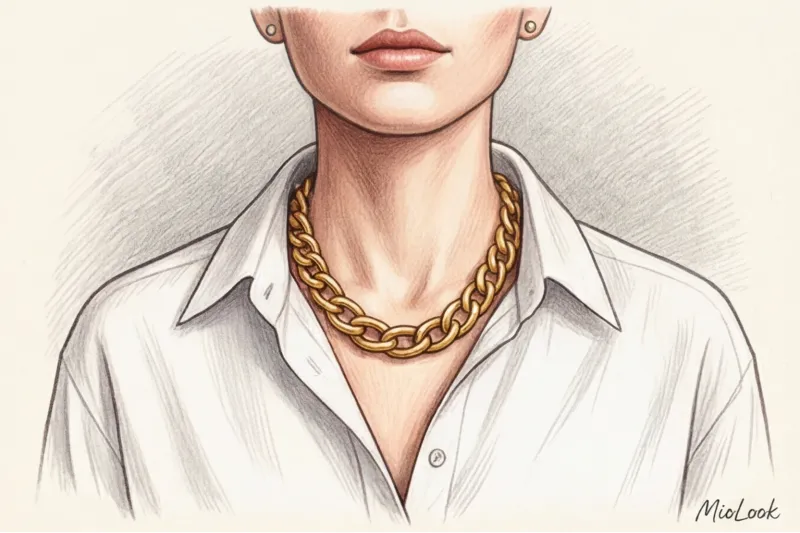
Portrait Zone: The Most Important Space
Of all the architectural layers listed, the portrait zone is the absolute leader in importance. The reason is physiological: this is where nonverbal communication occurs. According to research by the Pease Institute on body language, during a business or personal conversation, the person's gaze is focused on the "eyes-nose-chin" triangle 80% of the time. Consequently, any facial accessories are not simply decorative; they directly influence how your message is perceived.
Did you know that thick-framed glasses are also a full-fledged accessory with enormous visual weight? Many people forget this when pairing massive horn-rimmed glasses (like these from Celine for €350) with large hoop earrings. This is a serious mistake that distorts facial proportions and makes the eyes appear heavier.
This is where the harsh rules come into play. conflict rule The portrait zone is a very limited physical space (on average, about 30 centimeters from the earlobe to the collarbone), and two large elements will inevitably clash. This is why it's absolutely forbidden to wear statement earrings (large, long, sparkling) and a massive necklace at the same time. It's a zero-sum game: one element will inevitably "kill" the beauty of the other.
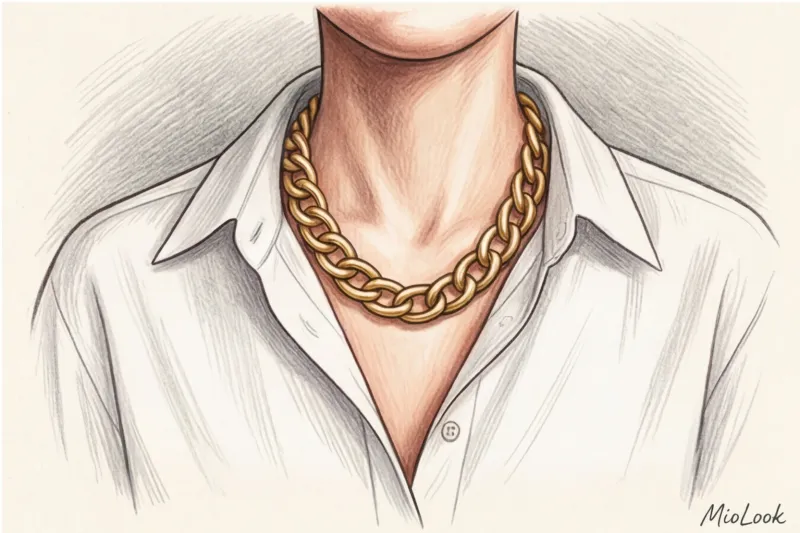
Imagine you've chosen a pair of statement vintage Dior clip-on earrings for €450. They already create a powerful, luxurious frame for your face. Adding a thick chain or layered necklace will visually shorten your neck by several centimeters, making your look heavier. The choice should always be one of "either/or": either focus on the ears (in which case the neck remains free, the turtleneck is closed, or a thin chain is acceptable), or focus on the collarbones (in which case the ears should have barely noticeable "dots" or none at all).
"The space around your face is your calling card. Leave it open. One strong accessory will say much more about your taste than three worn at once."
To avoid wasting your morning time agonizing over choosing in front of the mirror, I recommend adopting a technological approach. By uploading your basic and accent pieces to the virtual fitting room feature in MioLook , you can pre-create outfits on your smartphone screen. The digital format instantly highlights conflicts: you can immediately see if the portrait area is overloaded and remove any unnecessary details with a single click before you even start getting dressed.
Practical step: Take stock of your outfit today before you go out. Find your "star accessory." If you can't immediately identify your star accessory, it means you either don't have any, or they're competing with each other. Stick to just one, and you'll be surprised how much more classy and put-together your outfit becomes.
Metals, Textures, and Colors: Debunking the Myth of the "Perfect Match"
Have you noticed that classic sets have practically disappeared from the displays of modern jewelry brands—from the basic Mejuri to the conceptual Marni? According to a 2023 WGSN analytical report, sales of ready-to-wear sets (where earrings, necklaces, and rings are identical in design) fell by almost 40%.
Historically, a perfect parure (a complete set of jewelry) was considered a status symbol. Today, wearing identical earrings and a ring "from the same box" is considered a stylistic faux pas. This approach conveys rigidity, a complete lack of imagination, and visually adds age. Buying a set used to be a simple way to demonstrate wealth, but today, modern styling is built on curation. You're not buying a ready-made, safe solution for €500, but assembling a unique puzzle from different eras, textures, and meanings. And here, the ability to skillfully break old rules comes to the fore.
Bridge Theory: How to Bring Gold and Silver Together
The most common fear I encounter during personal wardrobe reviews is the strict prohibition against mixing warm gold and cool silver. One of my clients, a top manager at an IT company, experienced real stylistic stress over this for a long time. She adored her massive watch made of cool, polished steel, but was terrified of wearing it with her classic yellow gold wedding ring. Because of this self-imposed "fashion taboo," she simply left her beloved, expensive accessory at home for years.
We solved this problem in literally 15 minutes by using transition element rule (or a visual bridge). The essence of the method is simple: for two contrasting metals to look harmonious, the look must include a detail that physically unites both shades. I suggested the client wear a thin bimetallic chain bracelet, intertwining gold and silver links, on the same wrist as the watch. This tiny detail worked flawlessly: the metals no longer clashed, creating a thoughtful composition.
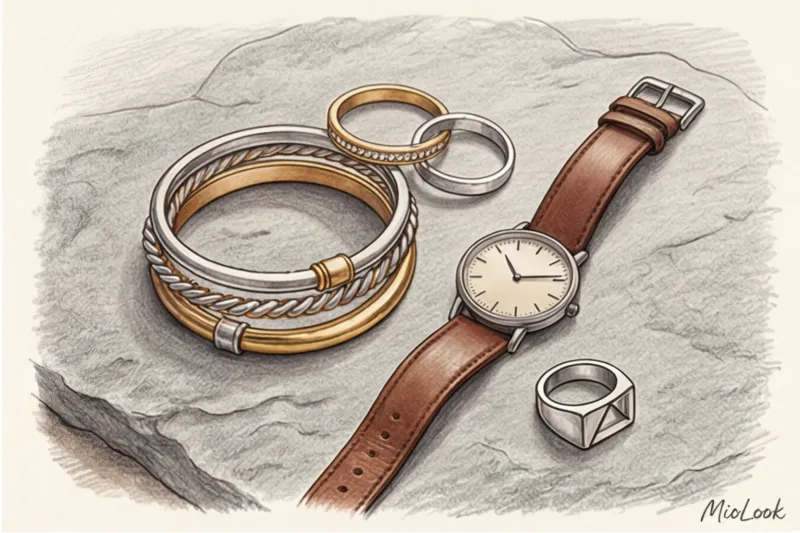
If you don't have bimetallic jewelry, use asymmetric layering method When combining multiple necklaces or finger rings, avoid a 50/50 ratio—it always looks like a random mistake. An 80/20 ratio is much more effective, where, for example, cool metal serves as the main background and warm gold serves as a subtle accent. It's also important to ensure that the pieces match in thickness or weave style.
A play on contrasts: pearls, leather and resin
The pinnacle of accessory design is the combination of seemingly incompatible textures. It's the juxtaposition of opposing materials that strips jewelry of its pretentiousness and makes it applicable to the fast-paced everyday world.
- Baroque pearls and smooth metal. Forget about perfect round pearls on a thin strand—save them for formal events with a strict dress code. Today, we're taking asymmetrical baroque pearls, with their natural imperfections, and setting them on a rugged, chunky chain. The smooth, almost mirror-like surface of the metal (for example, rhodium-plated silver) beautifully highlights the organic, uneven nature of the pearl.
- Jewelry alloys and rough leather. Leather laces, instead of traditional chains, are experiencing a major renaissance. Just think of the Bottega Veneta shows of recent seasons: chunky gold droplets on matte black leather laces were a hit. A heavy metal pendant on leather instantly takes the edge off the formality. It's the perfect way to incorporate statement jewelry into relaxed looks with simple knitwear.
- Precious metals and textured plastic. Resin, cellulose acetate, or recycled plastic in vibrant shades work beautifully with minimalist gold. A large translucent ring made of colored epoxy resin, paired with delicate gold track rings, creates a complex play of light and demonstrates your sense of humor in your personal style.
When you start experimenting with such complex combinations, it's very easy to forget those perfect proportions you achieved in front of the mirror on a successful day. To avoid losing those brilliant ideas, I recommend digitizing them through MioLook Take a photo of your best bracelet mix or tiered neckpiece and save it as a separate, ready-made "set" in your smart wardrobe. The next time you only have five minutes to get ready before heading out, the app will suggest a tried-and-true accessory combination guaranteed to work without overwhelming your look.
Smart Wardrobe Integration: Assembling an Accessory Capsule
I recently analyzed the wardrobe statistics of fifty of my regular clients. The numbers we found were astounding: on average, women buy about twelve new pieces of jewelry and accessories a year, but regularly wear only three. The rest sits in their jewelry drawers as dead weight, creating the illusion of choice and morning frustration.
The key to combining accessories without overthinking is to avoid random purchases in favor of a clearly defined system. And this system begins with creating a jewelry base.
Anatomy of the base capsule
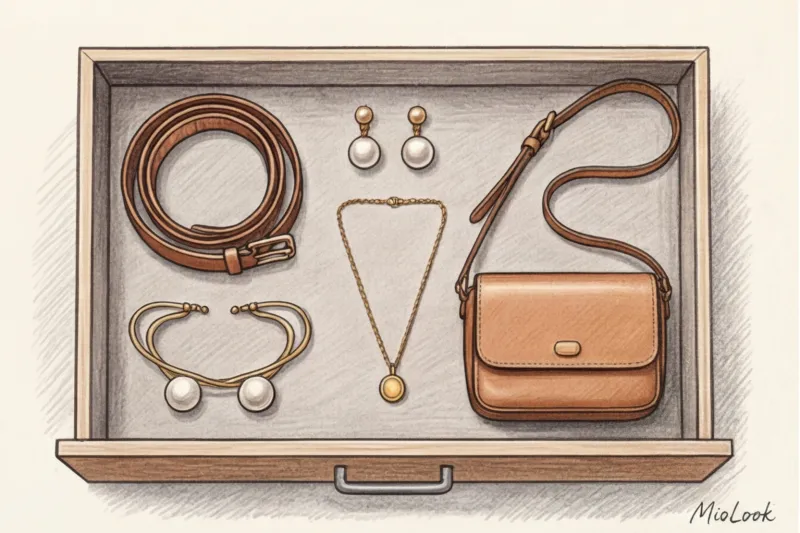
A basic jewelry capsule is a fundamental set of universal elements that work like a high-quality makeup primer. They harmonize the overall style of an outfit, making it complete without stealing the show. In my experience, the ideal formula has long been mathematically proven: 5 basic jewelry items cover 90% of everyday needs Here is the gold standard:
- Hoop earrings of medium diameter (up to 2 cm) or simple stud earrings;
- A thin chain with a minimalist geometric pendant;
- Classic watches on a leather strap or metal bracelet;
- A smooth signet ring or band without inlays;
- A structured leather belt, 3-4 cm wide, with a simple matte buckle.
By investing once in quality materials (sterling silver, gold vermeil, or high-quality leather in the €150–€300 range), you gain a framework that's easy to layer with any seasonal trend.
"Invisible" base versus style-forming accents
To avoid visual clutter, I always ask my clients to physically separate their accessories into two categories: basic and accent. This completely changes the way they approach getting ready in the morning.
Basic (invisible) accessories They blend seamlessly with your appearance. You put them on in the morning and forget they're there. They work on the micro-detail level: a subtle metallic sheen near the face, a defined waistline. They lack a distinct character or complex texture.
Accent (style-forming) details — these are statement pieces. A chunky cuff, a printed silk scarf, large vintage clip earrings, or a statement bag with an unusual shape. They set the mood for the entire look.
The secret to perfect balance: your outfit can consist solely of an invisible base, but never solely of accents. My working ratio for everyday wear is 2-3 basic pieces + a maximum of 1 accent piece.
The multiplier effect in business dress code
In a strict corporate context, where clothing is often regulated, a capsule collection of accessories becomes a key tool for impression management. See how accessories multiply the number of looks in a business wardrobe using this classic navy pantsuit as an example.
On Monday, you're going to a board meeting: a suit and "invisible" essentials (stud earrings, a thin watch, and a classic belt). The look conveys conservatism and reliability. On Tuesday evening, you're having dinner with partners at a restaurant: the same suit, but instead of a leather belt, you tie a silk foulard around your waist, and swap the stud earrings for large, architectural earrings made of crushed metal. On Friday, when it's casual Friday at the office, you wear the same suit with a white T-shirt, adding tiered chains and a hobo bag in a vibrant wine shade.
One basic outfit and cleverly rotated accessories create three completely different outfits. To avoid having to remember all these combinations, I recommend digitizing them in an app. MioLook — this way you will clearly see which combinations work best and will stop buying duplicate items.
Access to MioLook for €0.99 — one-time payment
Start creating perfect images with the help of artificial intelligence
Get access — €0.99 onceStylist's Secrets: Common Mistakes That Lead to Visual Noise
Observing guests at recent Copenhagen Fashion Weeks, I discovered a curious pattern: the most elegant and visually "expensive" looks weren't distinguished by the number of logos, but by a complete lack of visual conflict. There's a strict rule in styling: the more details compete for the viewer's attention, the cheaper and more fussy the final result appears. Let's explore the three main pitfalls that even seasoned fashionistas regularly fall into.
Competition between prints and accessories
The first contributor to visual chaos is the attempt to wear "the best of everything at once." If you're wearing a blouse with a complex pattern (for example, abstract geometric, classic paisley, or a dense floral print), the fabric itself has already captured 80% of the viewer's attention. By adding an accent necklace with inlays of colored enamel or complex textured stones, you make the elements literally scream at each other.

Complex, detailed clothing physically demands simple, minimalist accessories. If the print is bold, choose a smooth, solid metal. A simple gold hemisphere or a strict geometric line on the ears will calm the look, while filigree or a scattering of small crystals will transform it into a meaningless kaleidoscope.
Ignoring proportions: small on large
Let's move on to the physics of volume. My personal pet peeve every fall is choosing a thin, delicate necklace over a chunky knit sweater. Against the backdrop of bulky yarn (especially textured alpaca, merino, or fluffy mohair), the delicate jewelry piece completely loses its meaning. From a distance, such a gossamer chain looks less like jewelry and more like a light thread accidentally stuck to it.
The scale of any accessory should match the fabric's density and the silhouette's overall dimensions. Small details disappear against an oversized backdrop. A voluminous, oversized jacket or down jacket calls for proportionate pieces: puffy drop earrings, chunky hoop earrings, or geometrically shaped bags. Save your favorite stud earrings with tiny stones and delicate strand bracelets for flowing silk, fine viscose, and open wrists.
Inconsistency with context: the status trap
The third noise generator is stylistic dissonance, or "status item syndrome." Imagine: you're wearing a relaxed tracksuit made of thick cotton and chunky sneakers, but on your wrist sparkles a €12,000 jewelry watch and a diamond necklace. Status items, rudely taken out of context, don't make the outfit luxurious. On the contrary, they look out of place.
Appropriateness is the main hallmark of good taste. Expensive complicated watches require structured clothing (a shirt, jacket, or high-quality smooth cashmere), while a high-tech smartband on a matte strap or a simple leather cord is a much better choice for relaxed knitwear.
"The secret to a clean look is ruthless editing. If your eye constantly darts from your bag to your belt, and from your belt to your earrings, without stopping at your face, you've crossed the line."
To check an outfit for "noise," use an objective, outside perspective. A smartphone camera instantly flattens the image and mercilessly reveals unnecessary details. I recommend saving your daily looks for the "smart wardrobe" feature in MioLook Scrolling through your feed a few days later with fresh eyes, you'll be able to pinpoint those days when a complex belt stole the spotlight, or a bold print ate up your favorite pendant.
A Technological Approach: How to Digitize Jewelry and Increase Its ROI
According to a 2023 McKinsey research report, up to 70% of purchased jewelry and small accessories spend their entire lives in a dark box. We buy a trendy necklace for €150, wear it twice to special events, and then return to our usual minimalist necklace for everyday wear. The problem isn't a lack of taste, but rather the human brain's physical inability to retain all these small details in its working memory.
This is where the concept comes into play Accessory ROI (return on investment for an accessory) and the strict Cost Per Wear metric. The formula is ruthless but effective: the price of an item is divided by the number of days you actually wear it. My personal experience: when I first uploaded my entire collection to the app and started tracking the stats, the results stunned me. Data analysis showed that my most "boring" smooth leather belts, bought for €80, had the highest return on investment—their Cost Per Wear was less than €0.50. They worked every day, bringing together relaxed jeans and tailored jackets. Meanwhile, I wore a striking printed silk scarf from a famous fashion house for €350 exactly three times this year (its ROI turned out to be catastrophically low—over €116 per wear!).
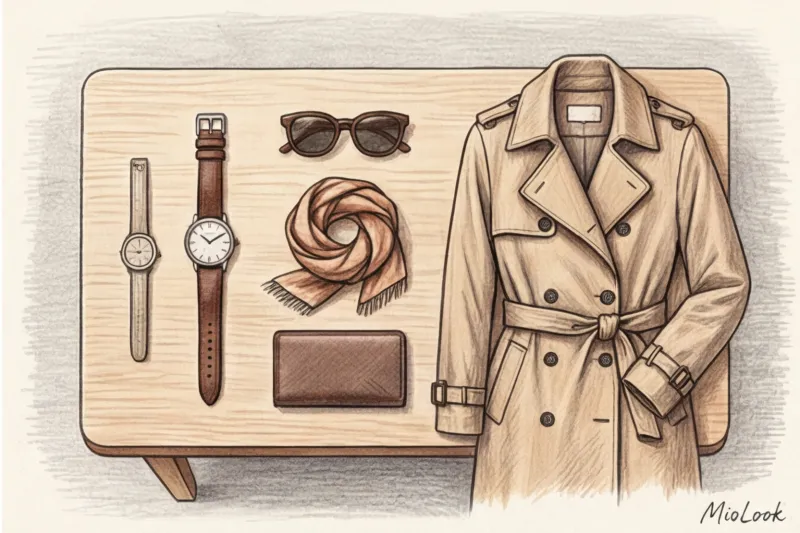
How does adding scarves, belts, glasses, and jewelry to a planning app change your approach to style? Radically. The digitization process forces you to take physical inventory and move items from your blind spot to your digital database. When you see your accessories on the same screen as your basic wardrobe, the magic happens during the evening planning stage, not in front of the mirror five minutes before going out.
IN MioLook I create virtual mood boards: I take a simple office outfit and start trying on different watches, layered pendants, or statement bags with just one click. This greatly develops stylistic awareness. You can clearly see how to combine accessories without creating morning chaos or worrying about upsetting the visual balance.
And most importantly, unbiased data analysis saves you from impulse buying. Tracking how often you wear your earrings works like a cold shower for your inner shopaholic. Imagine this: you're standing in a boutique, your hand reaching for those chunky €120 hoop earrings. You open your statistics and see that of the five pairs of large earrings you already own, you only regularly wear one. The numbers don't lie—your brain automatically blocks this transaction. You begin investing your budget exclusively in categories that truly earn their price. A technologically advanced approach transforms your collection from a storehouse of forgotten treasures into a mathematically calibrated impression management tool.
Your ideal image
it begins Here
Join thousands of users who look flawless every day with MioLook.
Get access — €0.99 onceChecklist: Audit your look before leaving home
In my styling practice, there's an unspoken but very strict rule: a look is created in the dressing room, but the final touches are made in the hallway. Over 12 years of working with businesswomen and top managers, I've learned one important thing: the morning rush completely ignores your complex stylistic ideas. It's in the last 30 seconds before leaving the house that 90% of mistakes are made. Your hand automatically reaches for "just one more bracelet" or your favorite but completely inappropriate scarf, and the carefully crafted harmony is ruined.
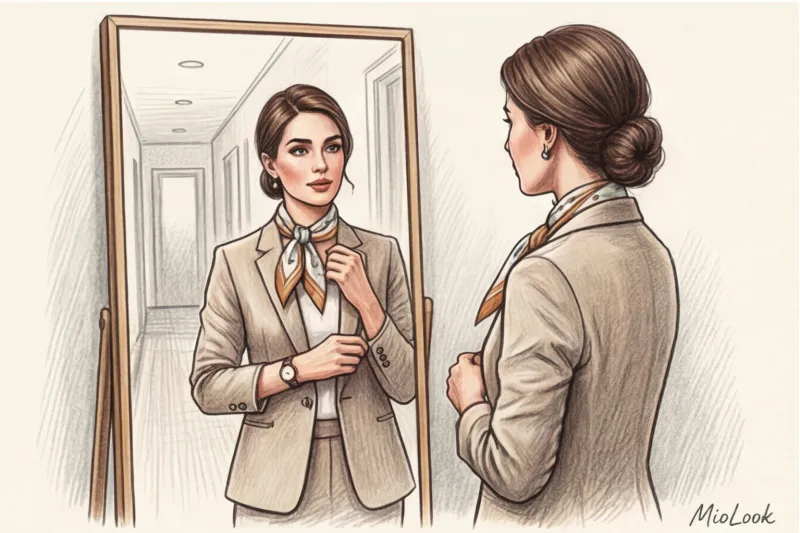
To avoid the effect of overload and accidental maximalism, I developed an express algorithm for my clients. It's a step-by-step audit that takes exactly 15 seconds but guarantees a completely clean silhouette.
The 15-Second Algorithm: 4 Steps to Perfect Balance
- Evaluation of the base layer (canvas). Look at your outfit without any accessories. If you're wearing a complex print (such as a bold houndstooth print or floral print) or textured fabric (tweed, bouclé, chunky knit), your base layer already creates a high level of visual noise. In this case, accessories should be subtle and structured—smooth metal, clean geometric shapes, and no stray stones. A complex base requires a simple frame.
- Checking for "visual weight". This is a critical aspect of the outfit's design. Visual weight isn't about the weight of the garment, but its ability to draw the eye. Ask yourself: is the top or bottom overweight? For example, if you're wearing heavy boots with chunky soles (a heavy bottom) and a statement necklace paired with large earrings (a heavy top), your figure will appear torn in two, and your waist will disappear. Balance the volumes: add a medium-height belt to the heavy shoes, and keep the portrait section light.
- Director's rule (distribution of roles). The key question to ask yourself when deciding how to combine accessories is simple: who's the star today? Choose one "star." If it's a €250 architectural cuff, let it steal the show. Rings on this hand should be either invisible (thin, basic bands) or absent altogether.
- Squint test. My favorite styling trick: Step five feet away from the mirror and squint hard until the details blur, revealing only the color and light. What catches your eye first? If it's a random, contrasting belt buckle, when you intended to accentuate your face, the overall look is compromised. Remove or replace the offending element.
If you pass the test and are happy with your reflection in the mirror, don't miss out on this formula. I always strongly recommend taking a quick photo and saving it in MioLook Your personal digital database of successful combinations is your best asset and a major time-saver for those mornings when you only have a couple of minutes to get ready.
Final Summary: Navigation, Not Decor
It's time to abandon the outdated paradigm that views jewelry as mere "embellishments" or a banal way to demonstrate the status of a branded item. In a modern, conscious wardrobe, accessories are a pragmatic tool for managing others' attention.
"You're not just putting on earrings or a belt. You're programming your interlocutor's gaze, creating a path for their eyes to follow."
Want to be heard during important negotiations? Remove any jingling or shiny jewelry from your wrists (to avoid distracting from your gesticulation) and keep simple but confident studs near your face. Need to counteract signs of fatigue or lack of sleep? Shift the focus downwards: wear statement shoes or accentuate your waist with an interesting belt.
Clothes are your foundation. Accessories are your punctuation, your intonation, and your meaning. Treat them not as finishing touches to be added as an afterthought, but as a navigation system. Place commas and periods consciously, and your style will speak for itself even before you utter a single word.
Guide Chapters
How to Pair Glasses and Earrings: Secrets from an Image Maker
Small stud earrings paired with statement frames are no longer suitable. We'll explore the visual weight algorithm to help you perfectly coordinate accessories around your face.
How to Wear Chunky Jewelry: Rings and Bracelets
Knowing how to style statement rings and chunky bracelets isn't a matter of innate taste, but rather a matter of style. Learn how to pair chunky accessories correctly.
How to Pair a Hat and Scarf: Forget Matching Sets
Matching hats and scarves are long out of fashion and mercilessly cheapen your winter look. Learn the secrets of a premium stylist for choosing the right accessories.
How to wear leopard print shoes without looking vulgar
Afraid of looking vulgar in leopard print? We'll explore the architecture of complex combinations and learn how to stylishly incorporate animal print into your wardrobe.
Bright Accessories for Your Look: Secrets of Color Accents
Adding color requires careful calculation, not intuition. Learn how to stylishly integrate statement bags and shoes into a basic wardrobe without fashion faux pas.
Combining Textures in Clothing and Accessories: A Style Guide
The secret to "quiet luxury" lies not in color, but in the physics of light. We explore the rules for stylishly combining suede, patent leather, and smooth leather.
Layering: How to Combine Necklaces Without Mistakes
The art of layering jewelry isn't a creative impulse, but rather strict mathematics. We'll break down the anatomy of the perfect neckpiece, eliminating confusion and mistakes.
Should the hardware on the bag match the jewelry?
Matching all the metals in an outfit is no longer considered a rule of good taste. Let's explore how to stylishly mix bag hardware with your jewelry.
Should You Match Your Bag to Your Shoes? Trends and Tips
The days of strict rules where accessories had to match perfectly are long gone. Let's explore the new math of style and learn how to pair shoes and bags to create an expensive and modern look.
Can you combine gold and silver: tips
Forget strict rules and outdated taboos. We reveal stylists' algorithms that will help you wear different metals together effectively.
The Three-Accent Rule: The Secret to Perfect Style
Adding unnecessary accessories often creates visual clutter. Learn how to use style math and command attention with just three details.
What to wear with a women's belt: new rules
The perfect match of bag, shoes, and belt is outdated and only adds to one's age. Let's figure out how to wear this accessory stylishly and avoid making fashion mistakes.