Recently, during a wardrobe review in Paris, my client sadly set aside a stunning vintage silver bracelet. The reason? A gold wedding band sparkled on her ring finger. She looked at me and asked a question I've been hearing from women for over a decade: Can gold and silver be combined? in one look, or is it still a strict fashion taboo?
Spoiler: it's not just possible, it's necessary. A visceral fear of mixing metals robs your looks of depth and character. Today, stylists use a strict "metal mathematics"—a system of proportions and textures that makes it easy to pair warm gold with cool silver. We've covered the architecture of stylish combinations in more detail in our article. The complete guide to combining accessories without overloading.
In this article, I'll share behind-the-scenes secrets from Fashion Week and the algorithms we use to create luxurious, layered looks. You'll learn why perfect jewelry sets add age and how the right ring can solve the problem of metal incompatibility forever.
A myth from the past: where did the ban come from and is it possible to combine gold and silver today?
The "wear only one metal" rule is a relic of the conservative etiquette of the mid-20th century. In an era when women's status was emphasized through obvious, heavy luxury, mixing metals was considered a sign that you simply didn't have the money for a full set.
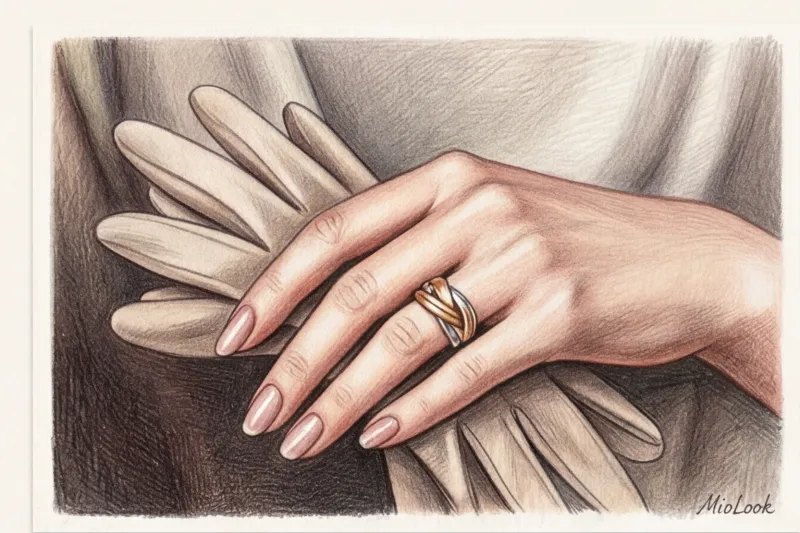
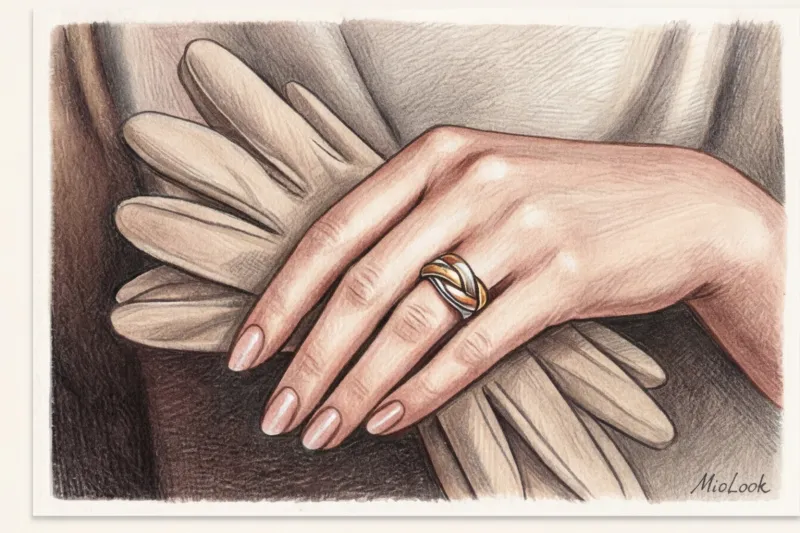
But history knows of brilliant exceptions. In 1924, Cartier created the iconic Trinity ring, commissioned by writer and artist Jean Cocteau. Three intertwined bands of yellow, white, and rose gold became the first legitimate example of mixing metals in high jewelry. Cocteau wore it on his little finger constantly, forever changing the rules of the game.
Today, working backstage at Paris Fashion Week, I constantly observe stylists deliberately juxtaposing icy silver with hot yellow gold. At Schiaparelli or Paco Rabanne shows, breaking old rules is the new standard. Modern luxury has moved away from intuitive selection to a conscious system. If you want to bring this runway approach into real life, start digitizing your wardrobe. For example, put all your jewelry in MioLook — Artificial intelligence will help you see non-obvious combinations that you might have missed.
The 80/20 Rule: The Mathematics of the Perfect Metal Mix
The main mistake beginners make when mixing metals is trying to divide them equally. A 50/50 ratio visually appears to the human eye as chaos. It feels like you got dressed in the dark and put on whatever was at hand.
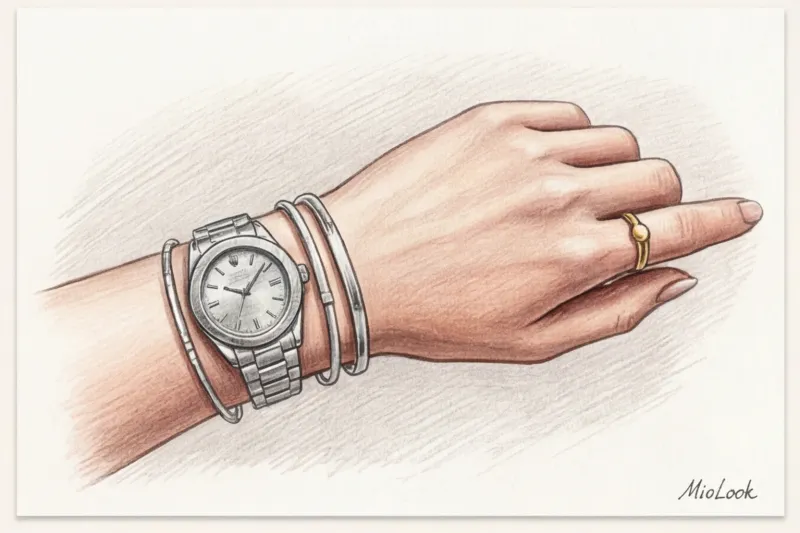
The secret to harmony lies in the 80/20 rule. You should choose a dominant metal to set the tone (80%) and add an accent metal (20%).
- How to choose a base (80%): Consider your skin tone or the color palette of your clothing. A silver base will look great with a cool gray sweater.
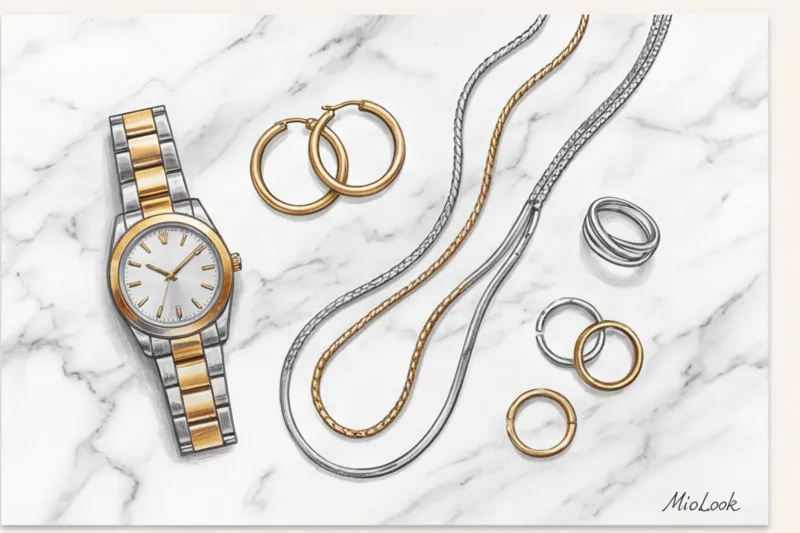
- How to add emphasis (20%): It's a deliberate touch. For example, a chunky silver watch and a pair of silver rings (the base) plus a thin gold choker chain around the neck (the accent).
This asymmetry shows that the mix was intentional and not just a coincidence.
Bridge Piece: The Stylists' Secret
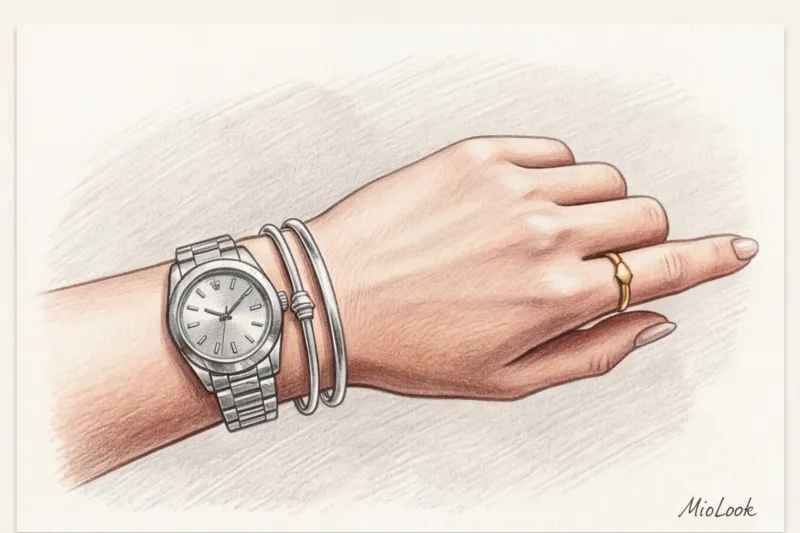
If you're having trouble jumping straight into contrasts, try a "bridge piece." This is a single piece that already blends two metallic colors. It legitimizes everything else you wear.
Two-tone watches are a great example. According to The Lyst Index, searches for two-tone watches (such as the classic Rolex Datejust or Cartier Panthère) increased by 42% in 2023. Wearing such a watch gives you the right to accessorize it with either gold or silver bracelets. Business of Fashion research (2024) shows that the €150–€500 price range is optimal for investing in a long-lasting, essential jewelry collection, which should definitely include at least one such link.
Ready to update your style?
Try the MioLook free plan—no commitments required. Artificial intelligence will analyze your items and suggest ready-to-wear looks for every day.
Get access — €0.99 onceTexture Contrast: How Gloss Temperature Saves a Look
Metals clash not only in color but also in texture. If you wear glossy, mirror-polished gold next to equally sparkling silver, they will begin to visually "shout" at each other.
"To reconcile contrasting colors, contrast their textures. Matte silver sits perfectly next to polished gold, while creased, hammered metal takes the edge off smooth surfaces," is a rule I always use when shooting commercials.
Mistakes that turn an image into chaos
In my practice, I regularly encounter clients who spend huge sums on perfectly coordinated sets (earrings, a necklace, and a ring, all made from the same metal and in a single design). I have a counterintuitive insight for you: today, such sets are not only out of fashion, they mercilessly add age and cheapen an image. They betray a lack of individual style and a fear of making mistakes.
But when you decide to experiment, it's important not to go to the other extreme. Here's what really ruins a mix:
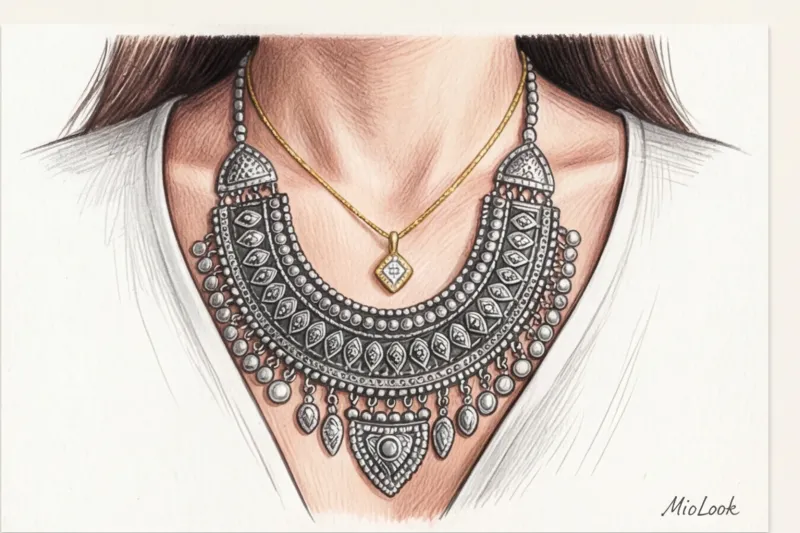
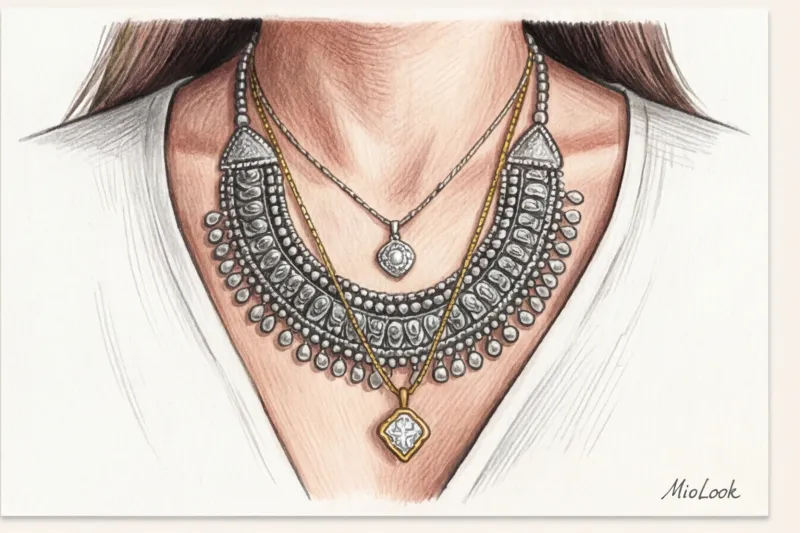
- Mixing styles, not metals. Heavy, blackened, boho-style ethnic silver next to a thin, classic gold chain with a diamond creates a stylistic clash. The metals may be different, but the era and mood must match.
- Failure to comply with scale. A chunky, puffy gold chain will visually overwhelm a delicate, thin silver ring. Choose pieces of comparable weight and volume.
- Lack of air. When there are too many ornaments and they're tightly packed together, a "Christmas tree" effect can occur. Give the metals some breathing room.
A practical guide to the zones: arms, neck, ears
Let's move from theory to specifics. How exactly should jewelry be placed on the body so that gold and silver can be combined without looking ridiculous?
Ears: Asymmetry rules
If you have multiple piercings, use them to their full potential. Basic gold studs in the main piercings look great with a sleek silver cartilage cuff. The key is to maintain a consistent geometry (for example, only minimalist, sleek shapes).
Neck: Cascade Rule
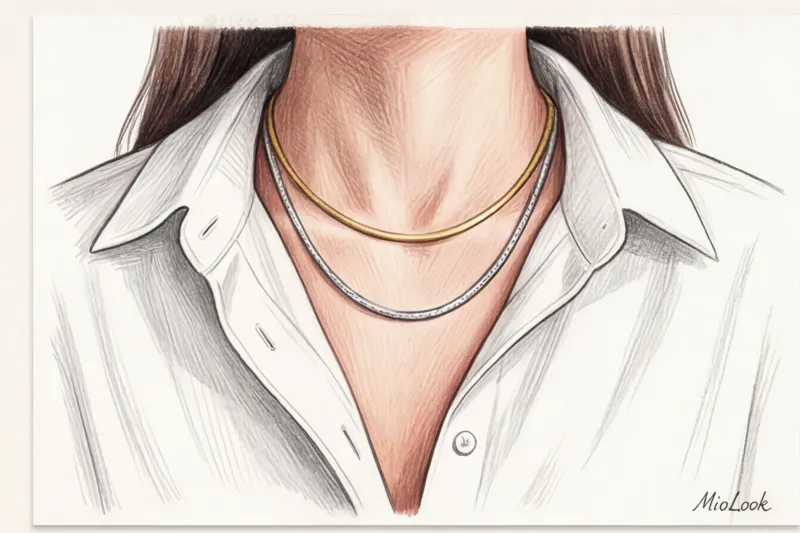
The metals on the neck shouldn't be clumped together. Use the cascade rule: keep chains of different colors at least 2-3 centimeters apart. For example, a short gold choker (35 cm), a medium silver chain (40 cm), and a long gold pendant (50 cm).
Hands: The Art of Stacking
I once had a client who had inherited a luxurious gold watch from her grandmother. She had completely given up her beloved silver rings for fear of "breaking the rules." We solved the problem in five minutes using a stacking technique.
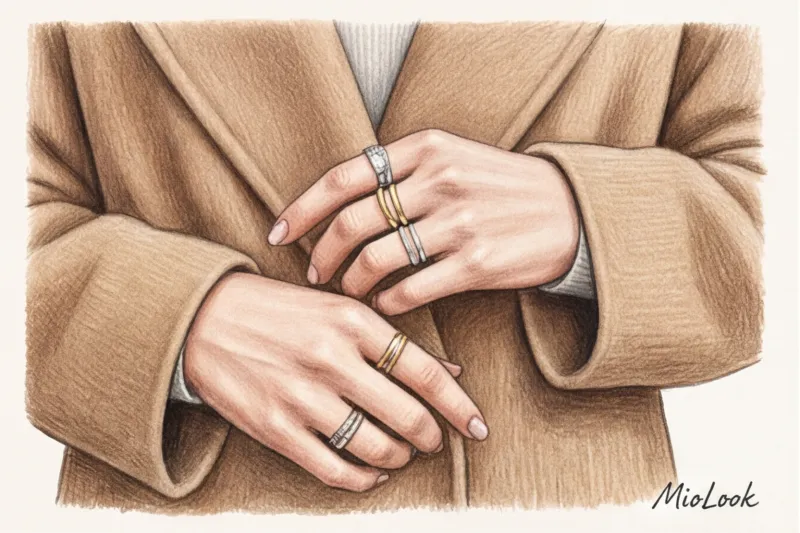
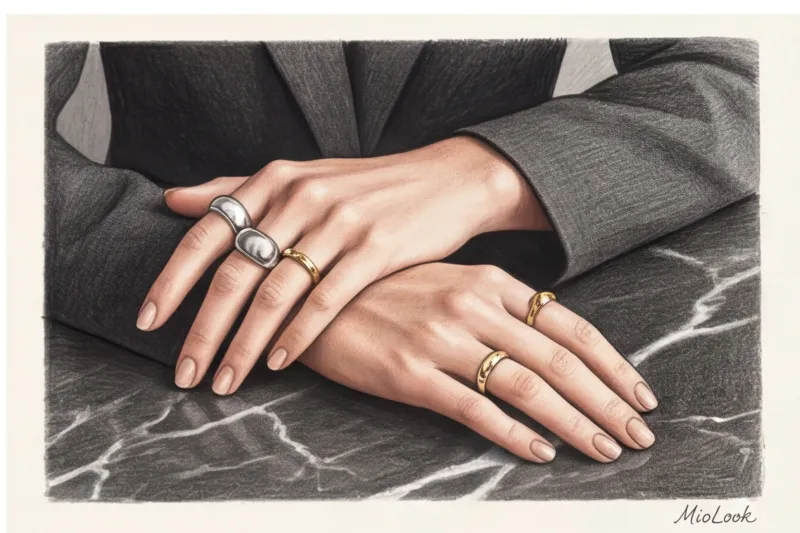
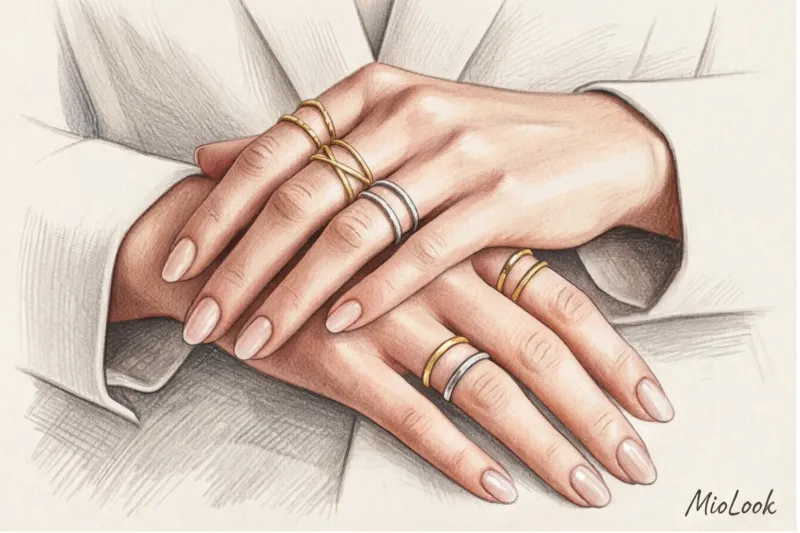
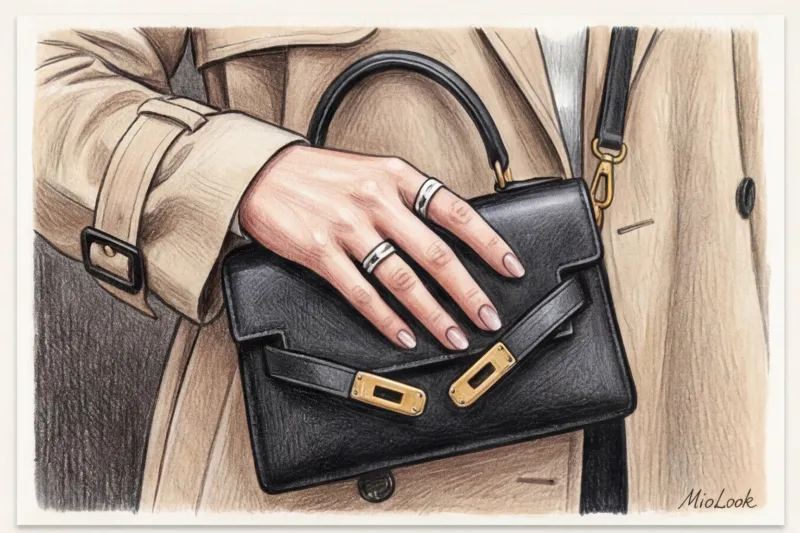
The rule is simple: one metal, one finger. On your index finger, you wear a set of three thin silver rings, and on your ring finger, one accent gold ring.
Fair Limit: Stacking wide rings doesn't work on women with short finger lengths. In this case, it's best to wear one thin ring on each hand to avoid visually weighing down the wrist.
Create your perfect jewelry capsule
Upload photos of your jewelry to MioLook. Our smart AI stylist will suggest how to pair it with your wardrobe.
Get access — €0.99 onceHardware on clothes and bags: should you match jewelry to them?
"Camilla, I have a gold buckle on my bag and a silver zipper on my jacket. Should I not wear jewelry at all now?" is a typical question during a fitting before a business photo shoot.
Remember: the hardware on your accessories (bags, belts, shoes) no longer dictates the color of your jewelry. Modern stylists view hardware as a neutral element. However, if you're preparing a high-status look for a performance or important negotiations where a flawless portrait is essential, use buffer rule.
A buffer is a neutral zone (usually the fabric of a garment) that separates clashing metals. If you have a belt with a large gold buckle at your waist, you can confidently wear silver earrings and a necklace. The distance between them is sufficiently large, and the fabric of the shirt acts as a visual buffer, defusing the conflict.
Checklist: How to Wear Gold and Silver Stylishly Every Day
To reinforce this material, I've put together a short, actionable algorithm for you. Review it every time before leaving the house:
- Choose a leader: Which metal will be more abundant today? Remember the 80/20 ratio.
- Find the bridge: Do you have a piece that combines two colors (a bicolor watch, a Trinity ring, a gossip bracelet)? If so, you're safe.
- Check the styles: Make sure that all the pieces belong to the same stylistic universe (minimalism to minimalism, vintage to vintage).
- Rate the air: Do the metals rub against each other, creating an annoying ringing sound? Is there a 2-3 cm gap between the layers on the neck?
- Final test in the mirror: Take a full-length mirror selfie. A phone camera is emotionless—it detects visual clutter much better than our eyes. If your décolleté or wrists look heavy and untidy in the photo, remove one (the smallest) piece of jewelry.
Mixing metals isn't an innate gift, but a practiced skill. Stop treating your jewelry box like a museum archive with rigid rules. Start with a single bridge piece, indulge in subtle asymmetry, and you'll notice how your everyday looks instantly gain a polish and individuality that can't be bought with a ready-made set.