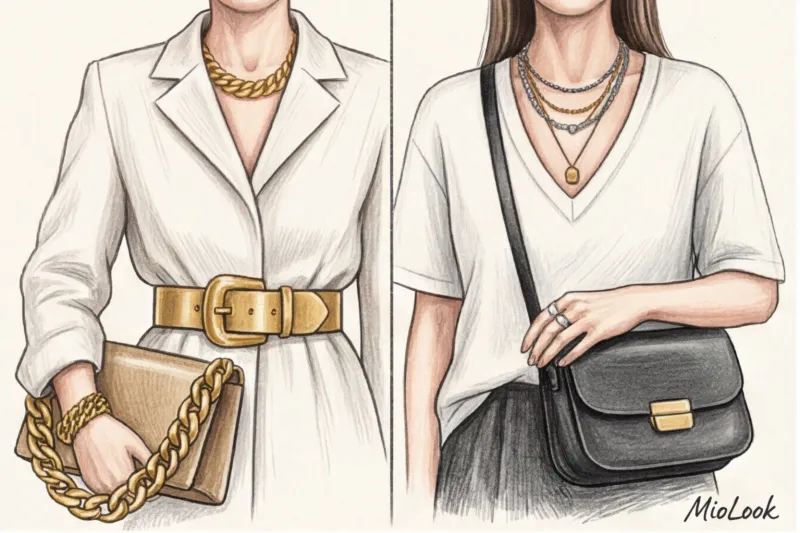
I had a client who had been holding off on her dream bag for exactly five years. It was a classic quilted model with a chunky gold chain, costing a hefty €8,500. The problem wasn't her budget, but one small but stubborn fact: her wedding ring was white gold. "I can't wear a gold bag with silver jewelry; it's bad taste," she sighed during our first consultation. Spoiler alert: she eventually bought the bag, and the outdated fashion rule was forever banished from her mind.
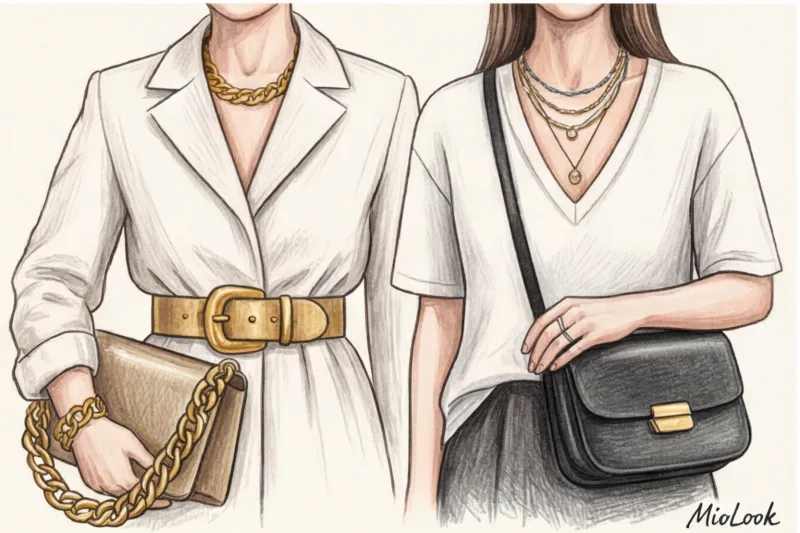
Question, Should the hardware on the bag match the jewelry? , plagues thousands of women in front of the mirror every day. We spend 40 minutes trying to sync the buttons on our jacket, the zipper on our favorite crossbody bag, and the clasp on our earrings. But the truth is, perfectly matching every metal in your outfit doesn't make you look elegant these days. On the contrary, it ages you, looks plasticky, and betrays excessive effort.
The myth of the perfect bag set: should the hardware on your bag match your jewelry?
Let's take a quick historical detour. The "one metal per look" rule originated in the 1950s, during the era of Dior's New Look. Back then, perfectly matching accessories (a set of accessories) was a marker of high social status. It literally screamed, "I have enough money to order shoes, a bag, and a belt with matching buckles to match my earrings."
But today's "Style Mathematics" works differently. According to Lyst's 2024 data, over 70% of influencers' and editors' looks at Fashion Weeks intentionally feature a mix of metals. A perfectly chosen outfit today creates a striking effect. excessive effort - that very excessive effort that completely kills the lightness and dynamism of the image.
We have already talked about the art of relaxed styling in more detail in our The complete guide to combining accessories without overloading The main conclusion from this is that slight carelessness is worth more than precise symmetry.
Color Theory in Metals: Gold and Silver as Temperatures
As a certified colorist, I encourage my clients to stop thinking of hardware as just "shiny things." Think of metals as foundational colors in your wardrobe, each with its own temperature.
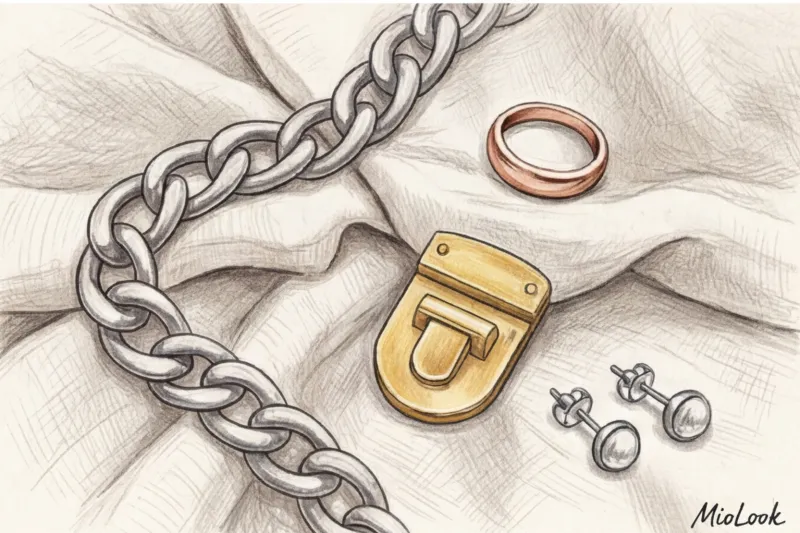
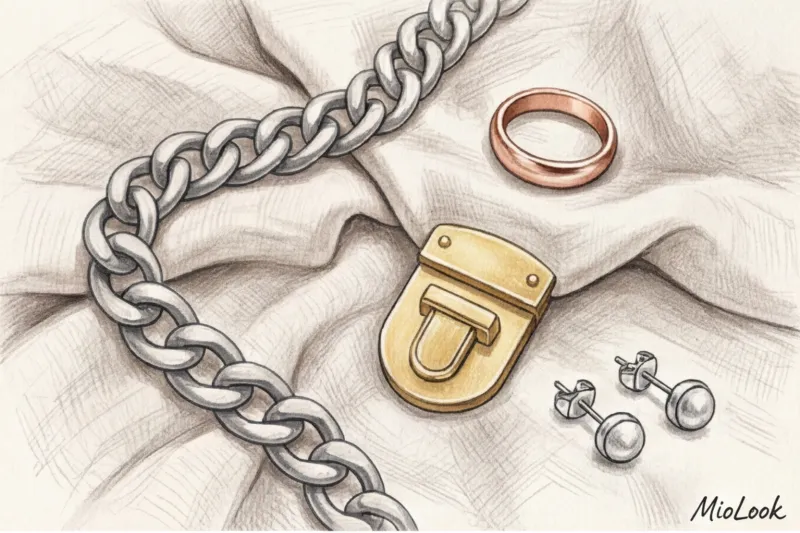
If we turn to Johannes Itten's classic color theory (1961), we'll see how temperature contrast works. Gold, brass, and bronze are warm accents with yellow or orange undertones. Silver, white gold, and platinum are cool accents with blue or gray undertones.
"The monotony of a single metal flattens the image. While the clash of warm and cold creates a visual sparkle, drawing the eye to the details."
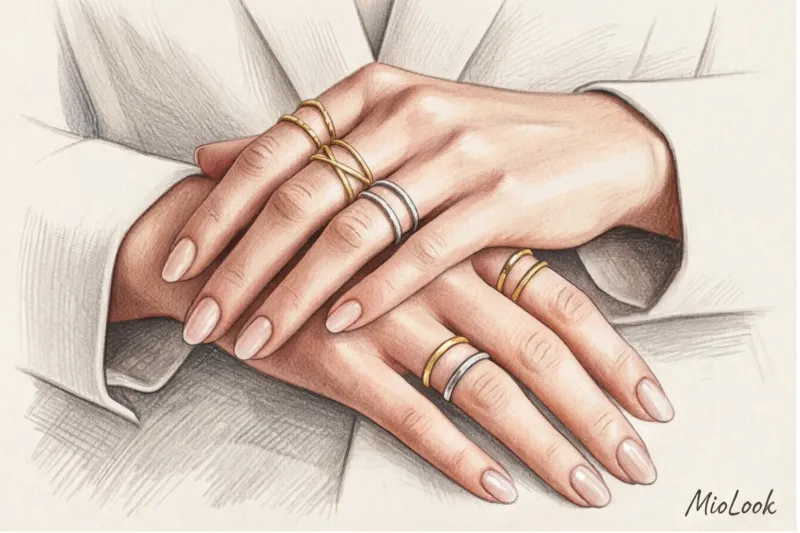
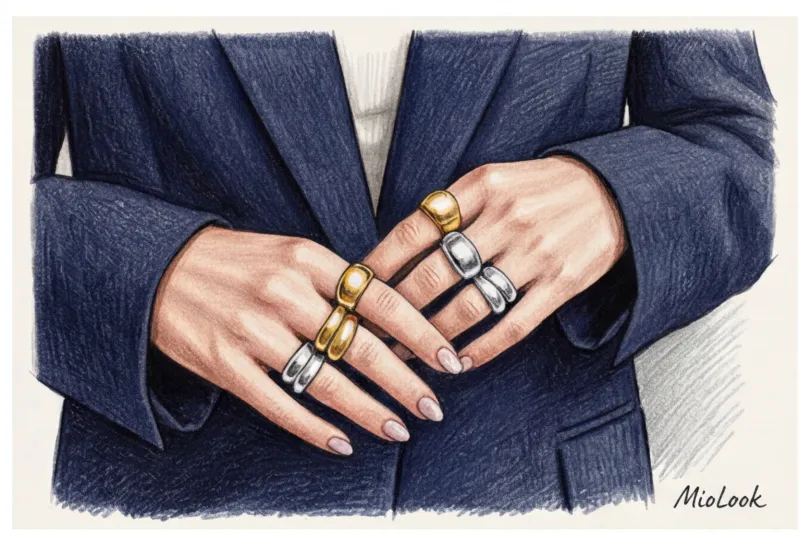
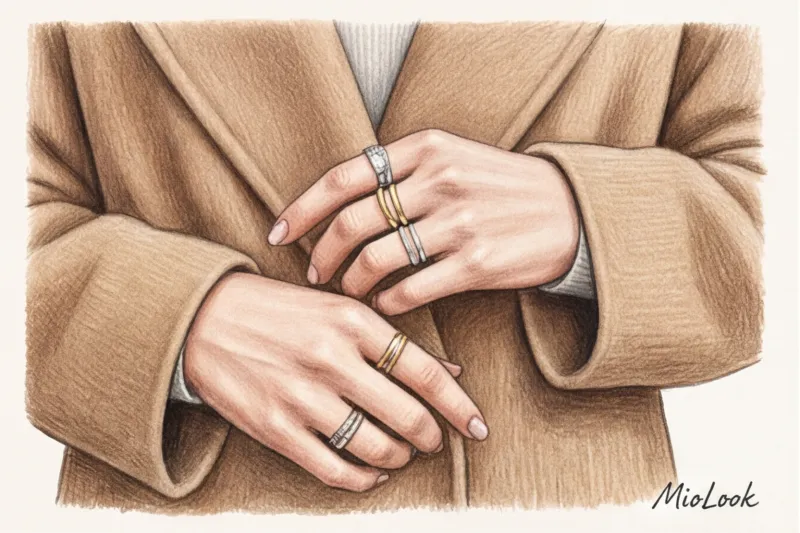
This is why a completely "gold" or completely "silver" look often looks boring, while their clever mixing creates that very complex texture that we see on street style icons.
Your perfect look starts here
Join thousands of users who look flawless every day with the help of the smart MioLook algorithm.
Get access — €0.99 onceTexture is more important than color: gloss versus matte
There is one nuance when mixing metals can actually look cheap. This happens when the image clashes glossy yellow gold and glossy silver Two bright flashes of light begin to compete for attention.
A stylist's secret: de-emphasize the conflict through texture. If you're buying a bag in the entry-level or mid-price range (for example, in the €150-€250 range from brands like COS or Massimo Dutti), look for matte, brushed, or aged brass hardware. Matte textures absorb light rather than reflect it. Silver rings will look great next to a matte gold bag clasp because they reflect light differently. If the metals are different colors, match their textures (or at least have one of them be muted).
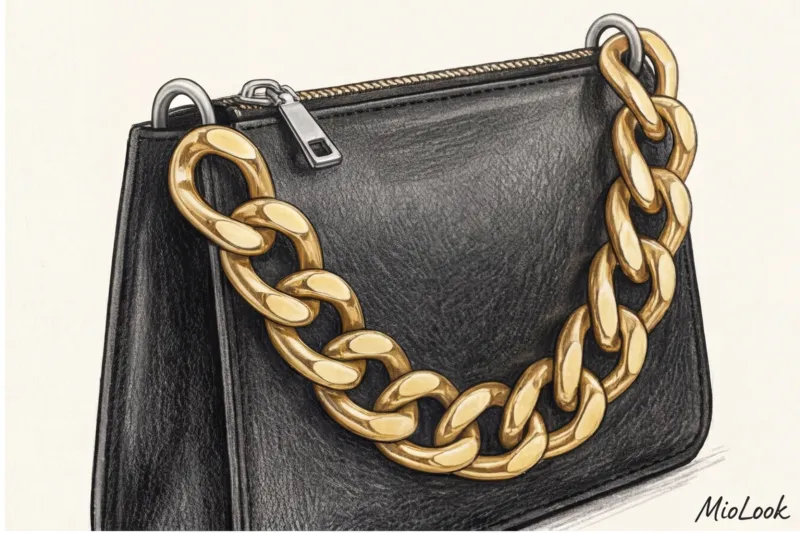
Mass Index: When a Bag's Hardware Becomes the Main Accent
In my practice I use the author's concept - Hardware mass index Before you panic over a mismatch, check the size of the metal piece on the bag.
- Micro-fittings: Zipper pulls, tiny rivets on the handles, metal feet on the bottom of the bag. Their mass index is close to zero. You can completely ignore their color. No one will be looking with a magnifying glass at the color of the dog on your bag to compare it to your earrings.
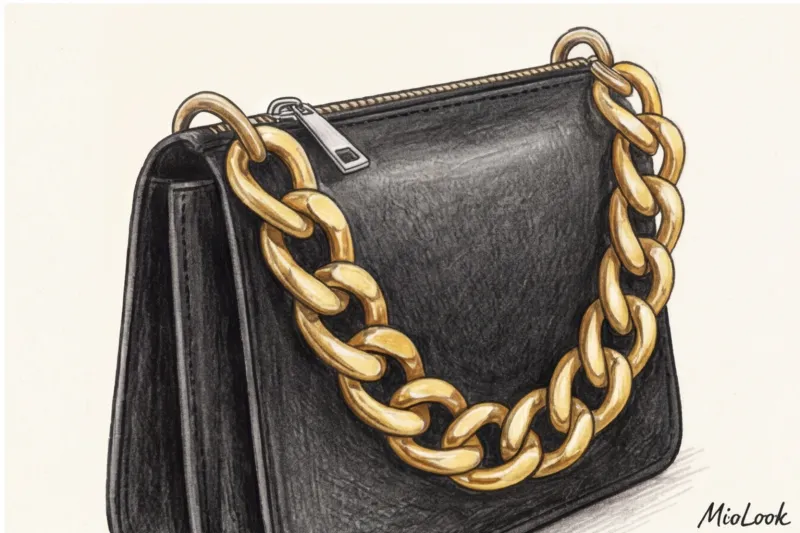
- Macro fittings: Chunky chains, large logo buckles (think of the famous Bottega Veneta Cassette bags or Dior Saddle clasps). Here, the bag ceases to be simply a utilitarian object.
If your bag has a thick gold chain strap, treat it like a chunky necklace. Fair Limit: This is one case where the rule of mixing things up doesn't work. If you're wearing a heavy gold bag chain over your shoulder, don't wear a massive silver choker around your neck—they'll physically clash with each other and overwhelm the portrait area. In this case, it's best to leave your neck free or choose a barely-there chain.
Ready to clean out your wardrobe?
Try it MioLook Free: A smart AI stylist will digitize your items and suggest new, unobvious combinations.
Digitize your wardrobeThe Bridge Rule: How to Mix Metals Like a Pro
How can you combine the silver hardware of your favorite leather bag with your love of gold rings? We'll need a "bridge."
In styling, this is a piece that legitimizes the presence of both metals in a single look. Historically, the first and most ingenious bridge ring was the Cartier Trinity ring, created in 1924. The blending of three types of gold in a single piece forever changed jewelry fashion, proving that metals can coexist.
My personal lifeline in my clients' wardrobes is a bicolor watch. A bracelet alternating steel and gold links (whether premium or affordable models priced at €100–200) works like a diplomat during negotiations. Once you have such a watch on your wrist, any bag, whether with gold or silver hardware, automatically complements the look.

3 working formulas: combine accessories and jewelry without stress
Stop relying on intuition. Here are three mathematically proven formulas that work without fail.
- Proportion 80/20. Never split metals 50/50; it looks random rather than a stylistic choice. Choose a dominant element. For example, 80% silver (earrings, necklace, watch) and 20% gold (bag clasp). The bag will become the focal point.
- Breeding by zones. Conflict only arises when in close contact. Wear gold earrings and a necklace in the portrait zone, and carry a bag with a chunky silver chain on a long strap across your hips (crossbody). The physical distance between the metals neutralizes any dissonance.
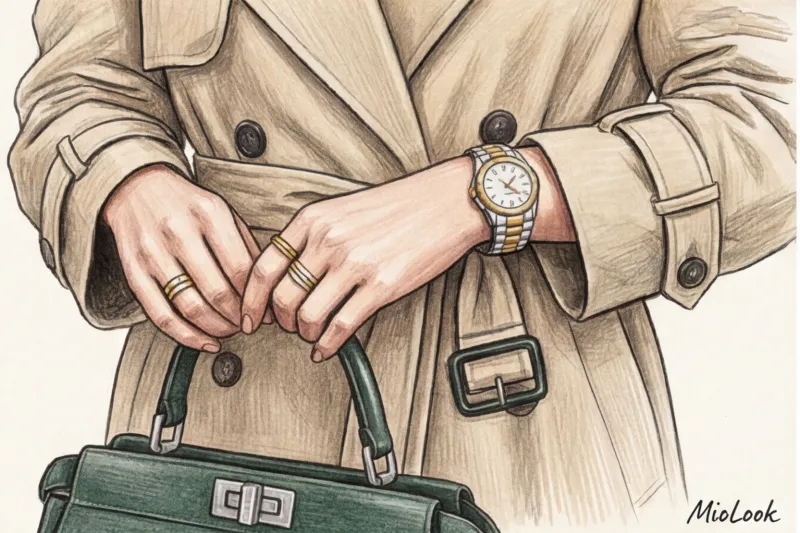
- Buffer zone of neutral textures. If metals are placed close together (for example, rings on your hand and a bag handle), add a buffer. A pearl bracelet, a black enamel ring, or a watch with a leather strap will visually break the metallic contact and soften the transition.
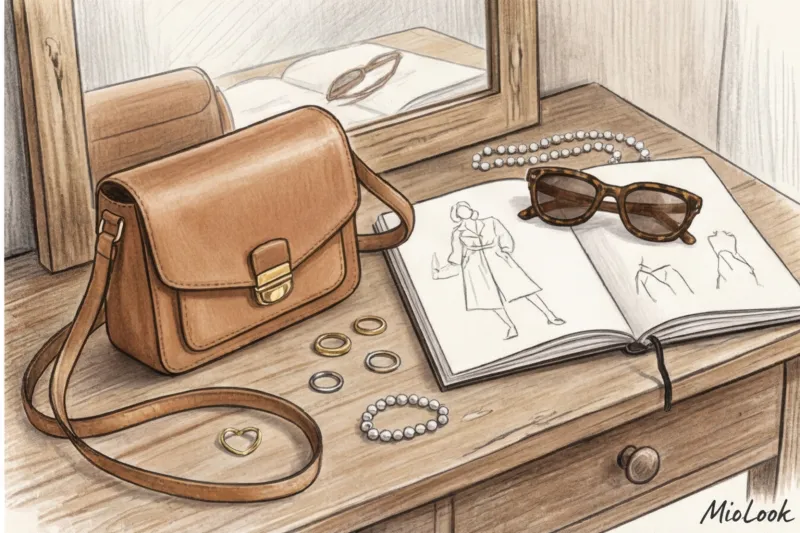
Checklist: Checking Your Look Before You Go
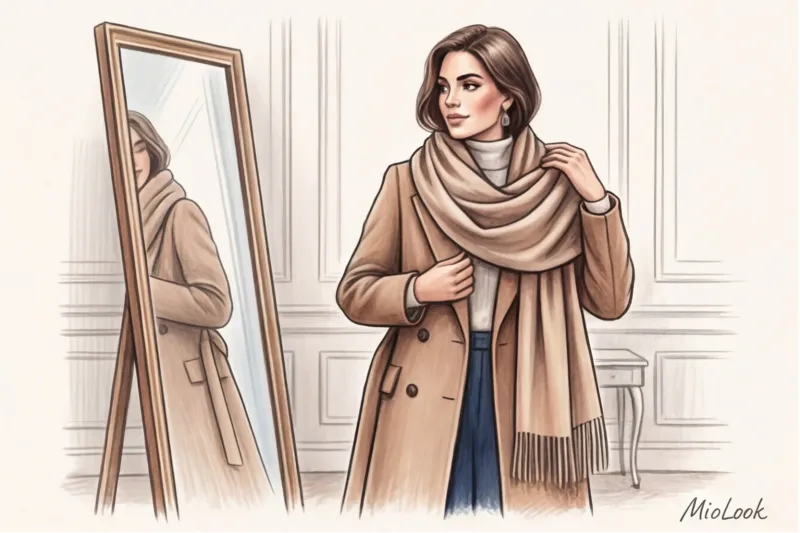
Before you leave the house, take a quick look in the mirror and check yourself on three points:
First of all, do the fittings compete with the wedding ring? Remember: a wedding ring is not an accessory, it is an extension of you. It completely outside the rules and has stylistic immunity. Matching a wardrobe to an engagement ring is the most common mistake.
Secondly, is one area of your outfit overloaded? If you're carrying a bag with a heavy gold chain handle, remove any bulky bracelets from the same wrist. Let the bag do the talking.
Third, is the brightness consistent? Try mixing bright yellow gold with blackened (aged) silver, and bright rhodium-plated silver with muted brass.
Your personal style emerges where rigid templates end. Next time you're choosing a bag, consider the shape, the quality of the leather, and how it complements your silhouette. And the color of the clasp? Let it be an excuse to add another unexpected ring to your look, not a reason to pass on the purchase.