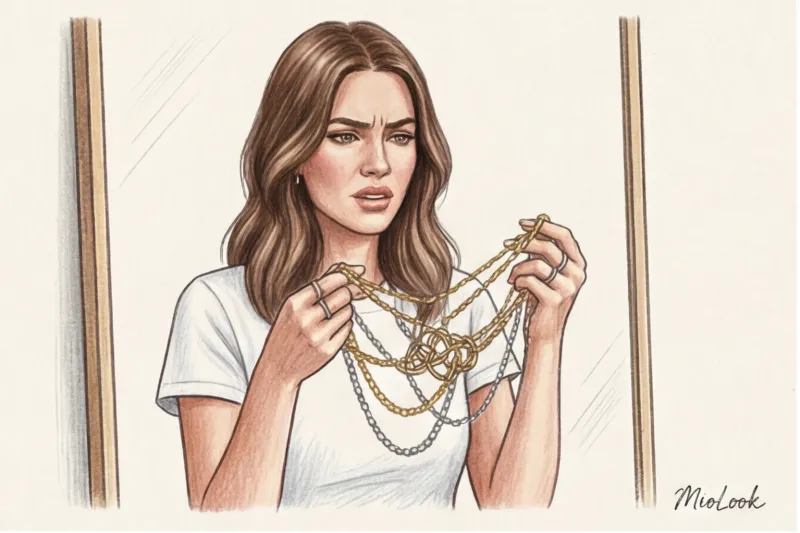
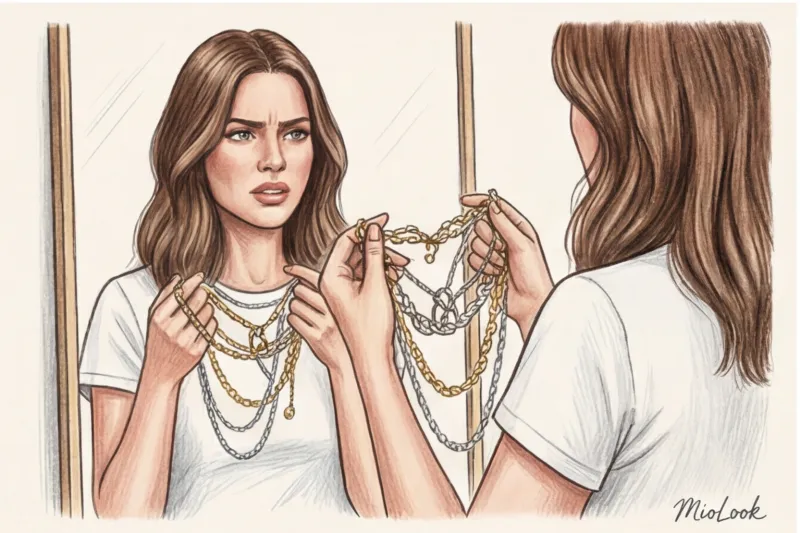
I remember my first major styling disappointment. I was 22 years old, getting ready for an important party in Milan, and stood in front of the mirror for exactly 40 minutes. In my hands was a hopelessly tangled mess of five thin chains, which I was trying to arrange gracefully on my collarbones. Instead of the expected Italian casualness, I got a Christmas tree effect and a ruined mood. That's when I realized: intuitive approach doesn't work here. The art of How to combine necklaces , is not a creative impulse, but strict mathematics.
We have already discussed in more detail the basic principles of creating a harmonious image without visual noise in our A complete guide to how to combine accessories without overloading Today, we'll narrow our focus and explore the anatomy of the ideal neck set. No fluff, just algorithms tested on hundreds of clients.
Why the Intuitive Approach Doesn't Work (and Leads to the Christmas Tree Effect)
Our brains are clever. When we put on simple, basic clothing—say, a white, heavy cotton T-shirt or a tailored jacket—we subconsciously want to "compensate" for this simplicity. We throw on all our favorite accessories. The result? Visual chaos.
According to the Business of Fashion (2023) analytical report, the industry has undergone a tectonic shift in recent years. Consumers are massively abandoning cheap plastic jewelry in favor of the segment demi-fine (Jewelry priced between €100 and €300, made of gold-plated silver or 9-14 karat gold). We've started investing in quality. But here's the paradox: buying three expensive chains doesn't automatically make you look classy if they overlap.
"Layering isn't about wearing everything you're good at at once. It's an architectural calculation, where each element has its own function: a base, a backdrop, or an accent."
The Mathematics of Style: 3 Golden Rules for Combining Necklaces
Over 12 years of working as a stylist, I've developed a formula that saves my clients from morning panic. It's based on the rule of three layers. Why three? In a classic composition, an odd number of elements always feels like a complete, dynamic picture. Four or more layers create visual noise (of course, this rule doesn't work for boho-chic style, where chaos is part of the aesthetic, but for elegant casual, three layers is the absolute limit).
The spacing rule: a step of 2-4 centimeters
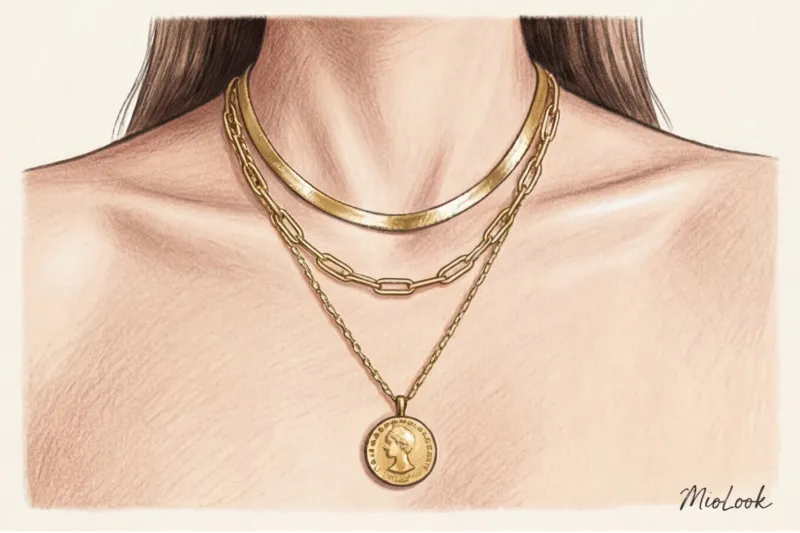
The most common mistake I see on the street is two pendants hanging at the same level, knocking against each other and scratching the metal. For the layers to be visible, there should be a "golden step" between them—2 to 4 centimeters.
Follow jewelry length standards:
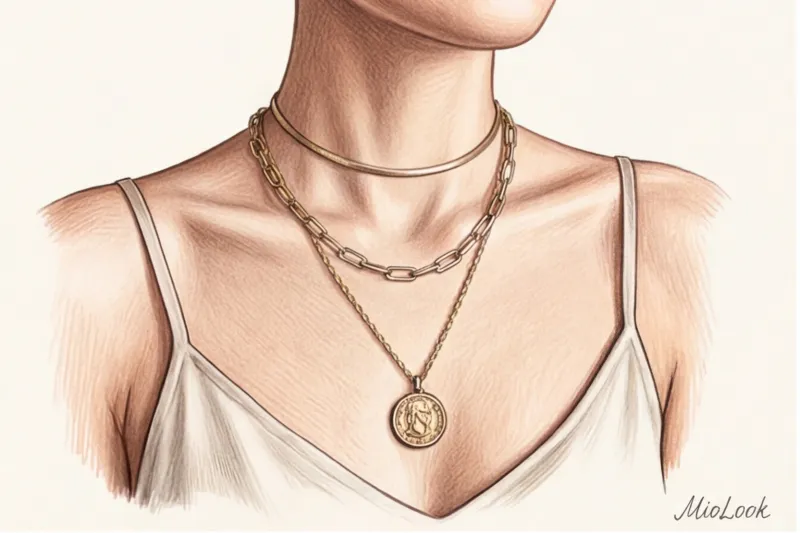
- Choker (35-40 cm): fits snugly around the base of your neck. This is your first tier.
- Princess (45 cm): Fits smoothly across the collarbones. Ideal for the second tier.
- Matinee (50-60 cm): goes down to the décolleté area. This is where your emphasis should be.
If your favorite jewelry is all the same length, you'll have to invest in extenders (small chain extensions for €10-15) to achieve the perfect ladder look.
Texture architecture: snake, links and pendant
Now, about choosing the chains themselves. Never wear three identical chains. Three thin anchor chains will inevitably tangle into a nautical knot within an hour.
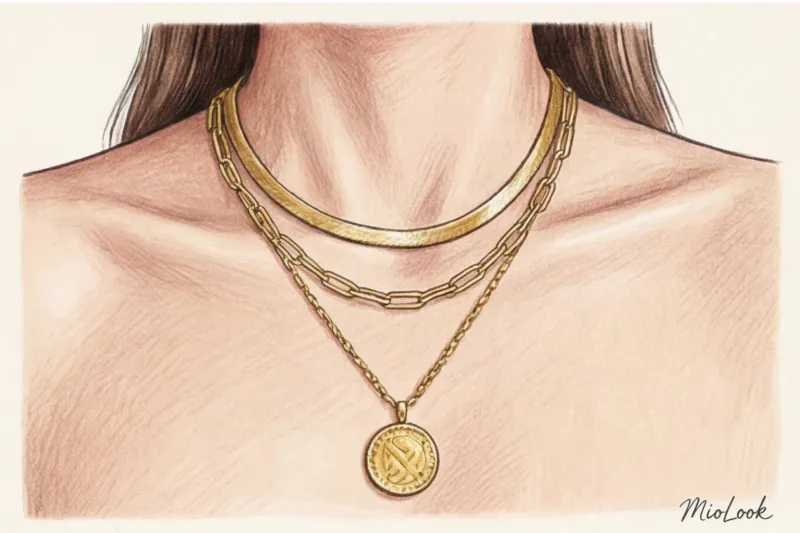
The ideal Mediterranean formula looks like this:
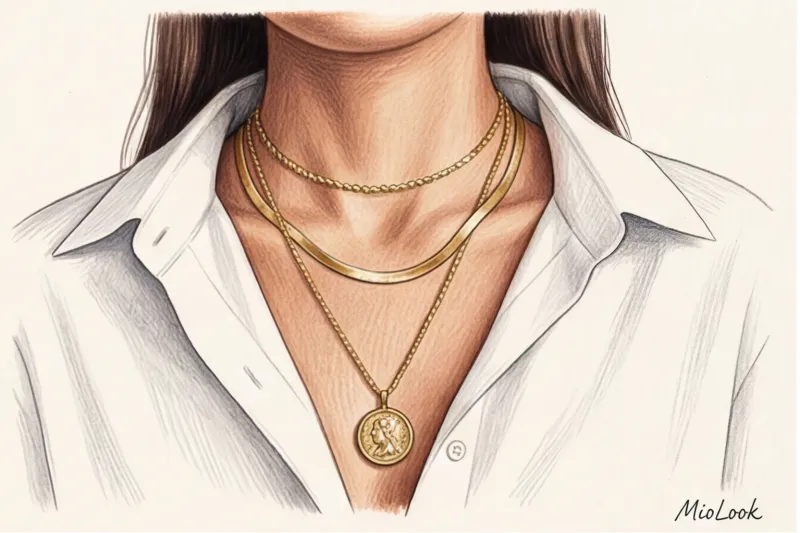
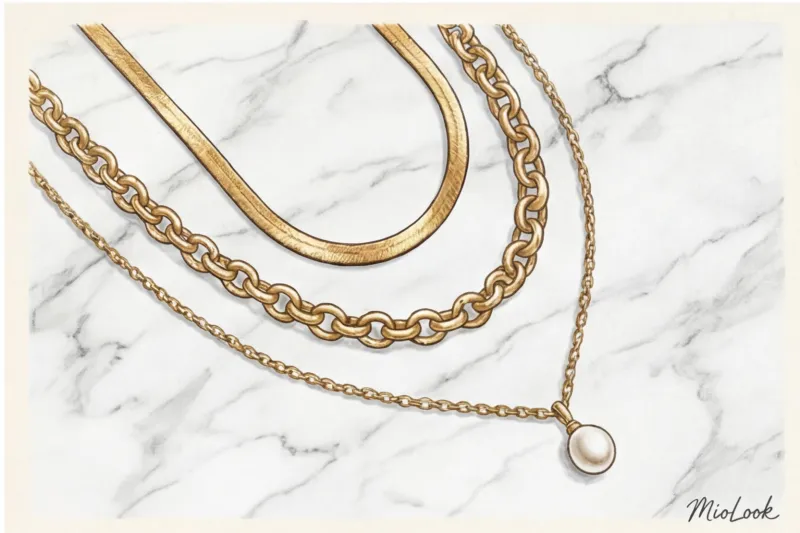
- Base: A flat weave that sits on the skin like a ribbon (such as snake or herringbone). It creates a beautiful metallic sheen.
- Air: A voluminous yet transparent weave. The trendy paperclip or large anchor weave works great. It creates a contrasting volume.
- Accent: a thin, graceful thread with a pendant that draws the eye downwards.
The Anchor Rule: Who's in Charge?
Every composition needs a star. If you're wearing a massive pendant in the shape of an ancient coin, the other elements should be supportive. Have you ever noticed how heavy an outfit looks when you're wearing a cross, a zodiac sign, and a medallion all at once? It creates the effect of a suit of armor.
Access to MioLook for €0.99 — one-time payment
A smart AI stylist will select the perfect look based on your wardrobe and suggest accessories to complement it.
Get access — €0.99 onceThe main myth: is it necessary to mix metals?
Open any glossy magazine and you'll read: "Mix gold and silver, bicolor will save any look." I hate this lazy advice.
In my experience, blindly mixing metals often looks like you've simply thrown on everything you forgot to take off. Want truly classy layering? Use monochrome metal with radically different textures.
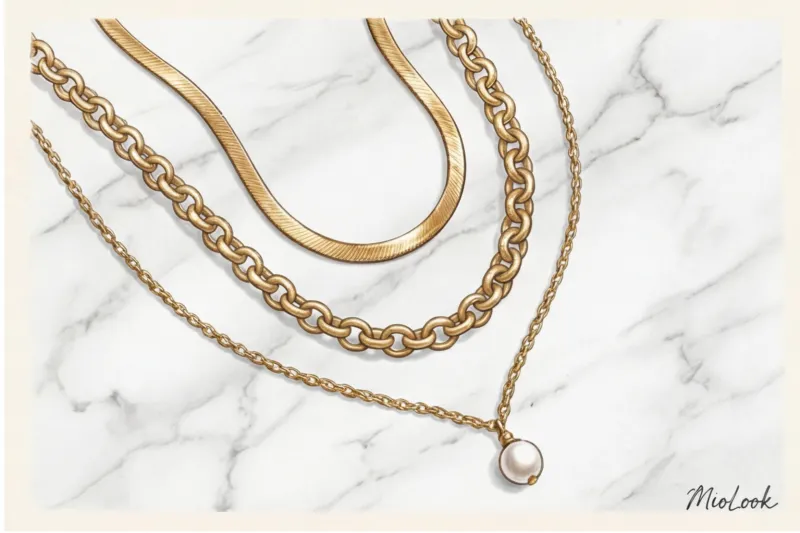
Imagine: a smooth, almost liquid gold snake paired with rough, chopped gold links and a matte-finished pendant. It looks like a million euros. The play of light on the different surfaces of the same metal (gloss versus brushed, flat versus volume) always wins out over the chaotic mix of silver and gold of the same texture.
Neckline Geometry: How to Pair Necklaces with Different Outfits
Jewelry doesn't exist in a vacuum. Its main purpose is to interact with the line of your clothing. If you're unsure how neckline affects the perception of proportions, check out our article on How to visually lengthen your neck: the best necklines.
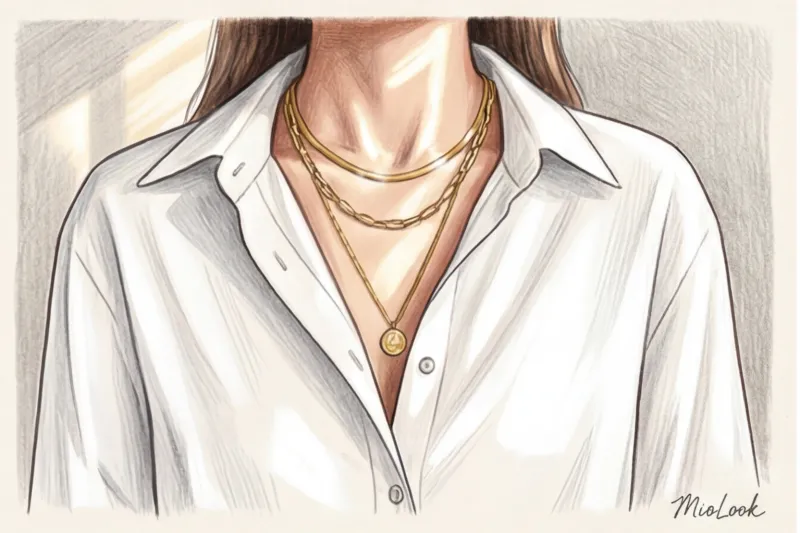
Under a basic white shirt and a V-neck
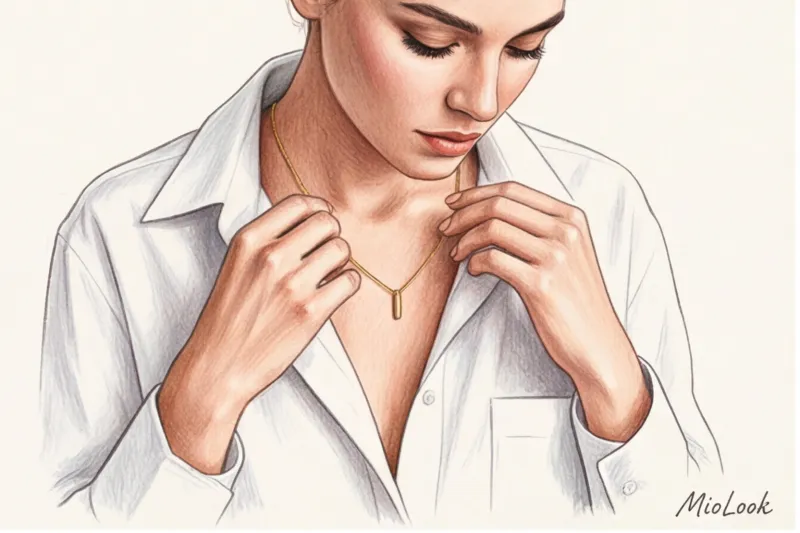
Take a crisp poplin shirt (for example, from COS or Massimo Dutti) and unbutton the top three buttons. Our goal here is to fill out the resulting V-shaped triangle.
The longest pendant chain should precisely follow the contours of the neckline, ending a couple of centimeters before the edge of the fabric. The pendant should never be hidden under the collar or awkwardly resting on the hem of the shirt—this disrupts the overall design.
Under a closed collar, turtleneck and crew-neck T-shirts
When working with dense fabrics (cashmere, merino wool, or heavy cotton over 180 g/m²), the fine web-like chains become invisible. They simply disappear against the texture of the sweater.
In this case, we put the chokers away and bring out the heavy artillery: large links and a length of at least 50 cm (matinee). A chunky chain over a closed collar creates the desired vertical line and makes the look visually more expensive.
Your perfect look starts here
Join thousands of users who look flawless every day with the MioLook AI assistant.
Get access — €0.99 onceInsider Trick: How to Keep Chains from Getting Tangled
One of my clients, top manager Elena, once ruined a premium silk blouse worth about €250 right in front of a board meeting. Two of its chains got twisted, caught in the silk microfibers, and left a telltale snag.
How can this be avoided? There are two insider methods.
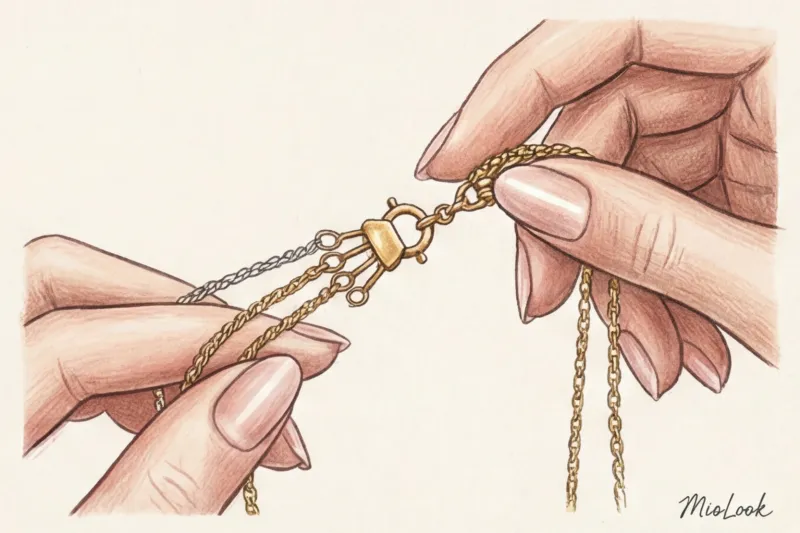
The first one is mechanical. Buy it. detangler (multi-link divider clasp). This is a small carabiner consisting of two magnetic or sliding parts. You attach all three of your chains to it, and they physically cannot twist around the back of your neck.
The second method is a trick stylists use on shoots when you have two chains of different lengths, but they constantly tangle. Unclasp them both. Attach the clasp of the first chain to the ring of the second, and the clasp of the second chain to the ring of the first. You'll have one giant chain. Place it around your neck, wrapping it twice. Now, if one layer starts to slide up, the other will automatically fall down, and they'll never tangle.
MioLook Checklist: Your Essential Neck Jewelry Capsule
To create dozens of perfect combinations, you don't need to buy out half a jewelry store. We wrote about the aesthetics of minimalism in detail in the article about clean girl jewelry You will only need 3-4 correct units.
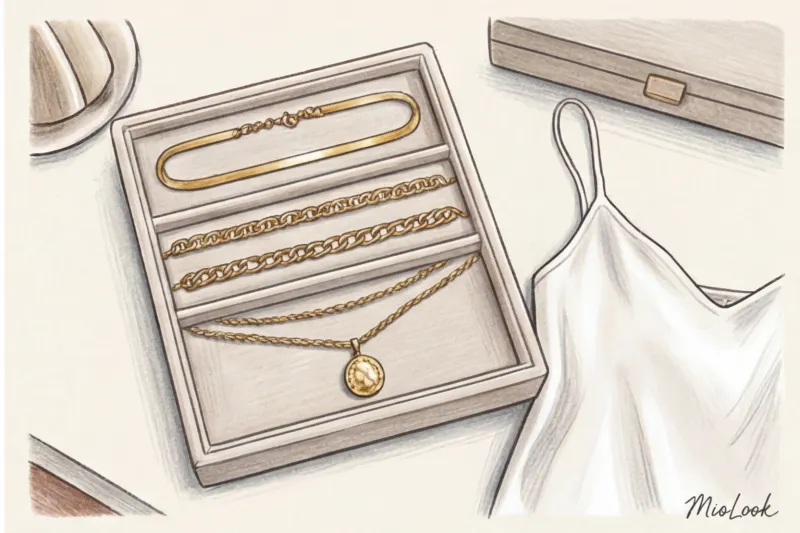
Check your box. It should contain:
- Flat snake chain (38-40 cm) - to create a shiny base.
- Medium link chain (45 cm) – for volume and airiness.
- A thin chain with an accent pendant (50-55 cm) - to create a vertical line.
- Chunky chain (optional) - for wearing over sweaters and turtlenecks.
In the appendix MioLook I often help clients digitize their jewelry boxes. Once you've uploaded your jewelry to a virtual wardrobe, you'll be surprised at how many new combinations you can create from what you already own, simply by following the "2-4 centimeter increment" rule.
Layering isn't about how much money you spend on gold, it's about managing your attention. Take 15 minutes today, lay out your necklaces on a table, find the perfect piece, and add the right base and accents. You'll immediately see how your everyday look takes on a whole new meaning.