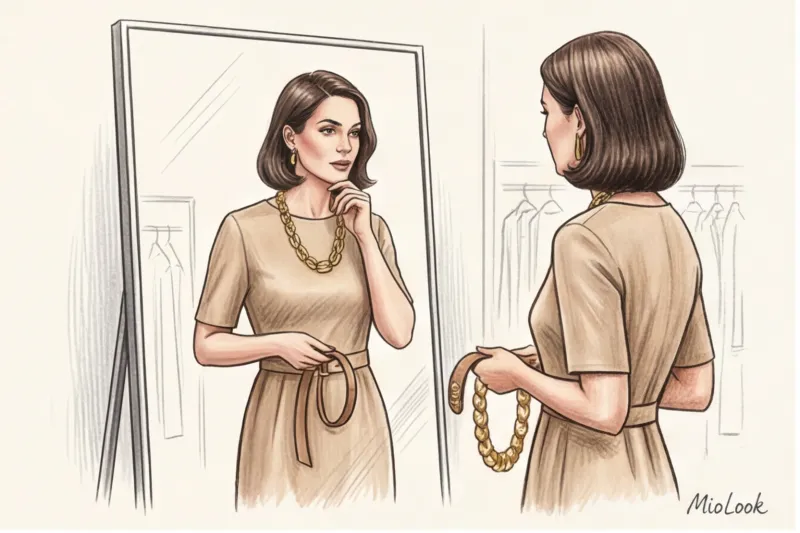
Sitting at a table in a cafe near the Duomo in Milan, I often observe the local women. There is that very sprezzatura — a studied casualness that makes heads turn. They can wear simple jeans and a basic shirt, but look like they just stepped out of the pages of Vogue. The secret to this magic lies not in innate talent or an unlimited credit card. It's the pure mathematics of style. More precisely, the rule of three accents in clothing , which is masterfully mastered by European stylists.
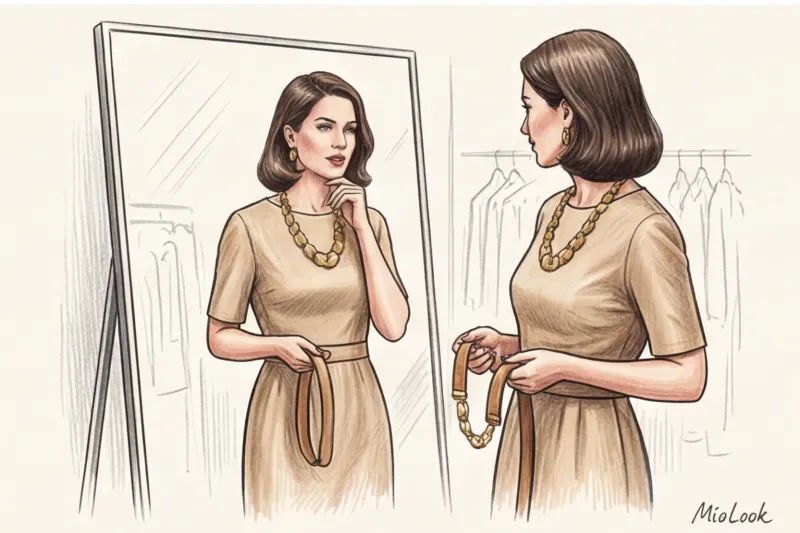
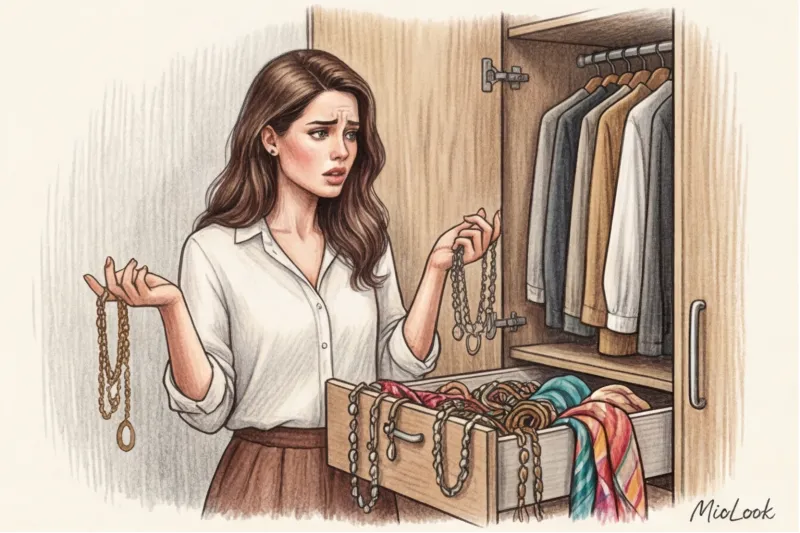
Intuition in styling often fails: we think that adding another ring or a bright scarf will make the look more “interesting.” In reality, we’re simply creating visual noise. In our The complete guide to combining accessories without overloading We've already mentioned the importance of balance. Today, I want to break this topic down to its molecule-by-molecule level and show you how to control the attention of others using just three details.
What is the rule of three accents in clothing, really?
If you think this rule prohibits wearing more than three pieces of jewelry at a time, forget it. Counting pieces individually is the biggest mistake beginners make. True luxury styling focuses not on the number of pieces, but on eye-catching focal points.
This principle is based on cognitive psychology, specifically Miller's law (the 7±2 formula), discovered back in 1956. The human brain can easily retain a limited number of elements in short-term memory. In the context of visual image perception, this number is reduced to 3–4 dominant elements. The brain interprets three focal points as perfect harmony and a complete composition. Five or more are perceived as chaos, making one want to avert their eyes.
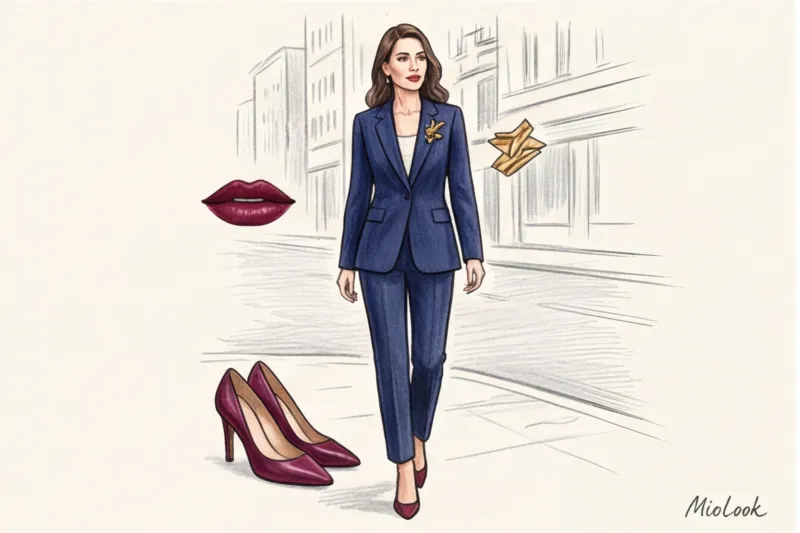
"An accent isn't necessarily a Bottega Veneta bag or diamond earrings. An asymmetrical jacket, a neon manicure, wine-colored lipstick, or even an intricately shaped button—all of these things draw visual attention and are considered an accent."
When I studied visual merchandising principles at LVMH, we were taught the "golden triangle" rule. When viewing a mannequin in a premium boutique, the customer's gaze should always travel along three points that form an invisible triangle. The same principle applies to a living person. We create a path along which the viewer will "read" our image.
The Anatomy of an Accent: How We Weigh Details (and Why 5 Rings Are One Accent)
For this rule to work, you need to learn to determine the visual weight of each detail. One of my executive clients genuinely couldn't understand why her image seemed overloaded. “Julia, I’m only wearing a Cartier watch, a Van Cleef bracelet, and one necklace!” " she complained. The problem was that all these objects were massive, contrasting, and competing with each other for the main role.
It's a paradox, but a set of five thin, elegant gold rings worn on the fingers of one hand is perceived by the eye as a single textured blob. It's just one accent. But one massive, architecturally shaped mono-earring draws so much attention that it easily counts as two.
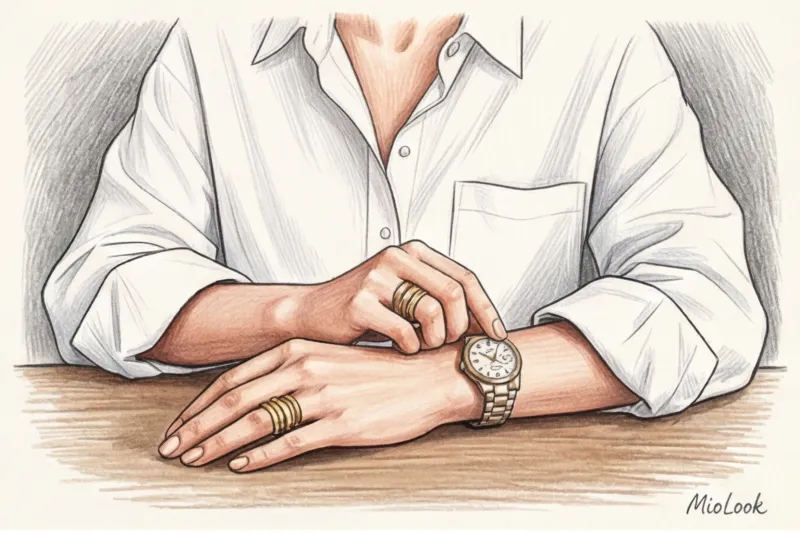
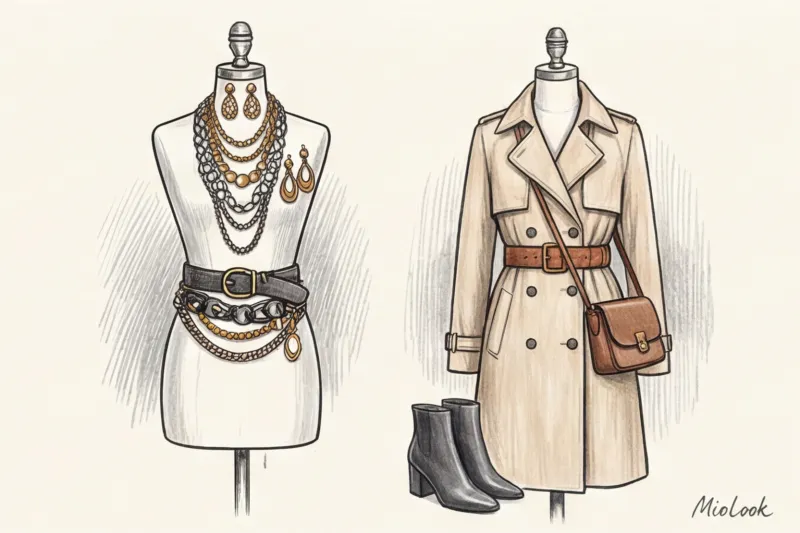
Grouping small elements always reduces their overall visual noise. If you distribute the same five rings across different hands, add a chain around your neck, and a brooch to your lapel, you'll create a "Christmas tree" effect. Concentrating details in one area is more elegant than spreading them evenly across the body.
Three Main Attention Triggers
How do you know if something is an accent piece? It must have at least one of three triggers:
- Color: Burgundy pumps against a grey suit, a contrasting silk scarf on a bag, or bright lipstick.
- Texture: It's something you want to touch. A suede hobo bag against a smooth silk dress, patent leather, chunky knitting, or a chunky gold chain.
- Architecture: Items that break the traditional silhouette. Exaggerated jacket shoulders, asymmetrical hemlines, unusual heel geometry, or oversized hardware.
Access to MioLook for €0.99 — one-time payment
A smart AI stylist will create the perfect look with the right balance of accents right on your smartphone.
Get access — €0.99 once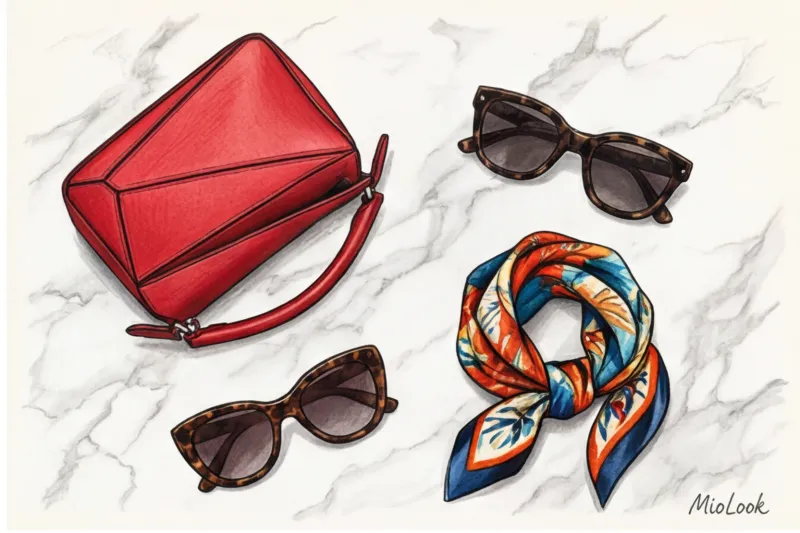
The formula for perfect balance: 1 main + 2 secondary
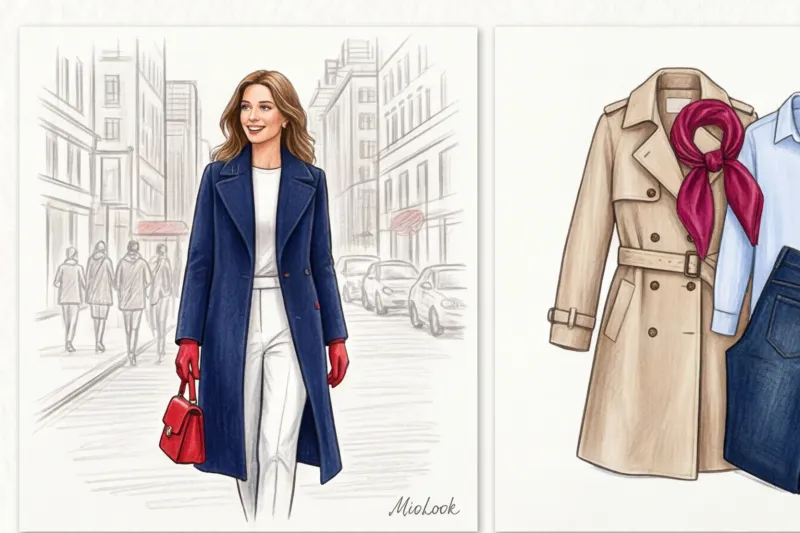
So, we've chosen three accents. But they shouldn't "shout" equally loudly. I always use the cinematography formula with my clients: we appoint one "star" and select two "assistants" who support the lead role without stealing the show.
Example of an evening look: The base is a simple black slip dress made of thick silk. The star of the look (the main accent) is the large, sculptural Schiaparelli-style earrings. The first assistant is a deep berry shade of lipstick. The second assistant is a smooth, rigid cuff on the wrist. The gaze glides from the face to the hand, unhindered.
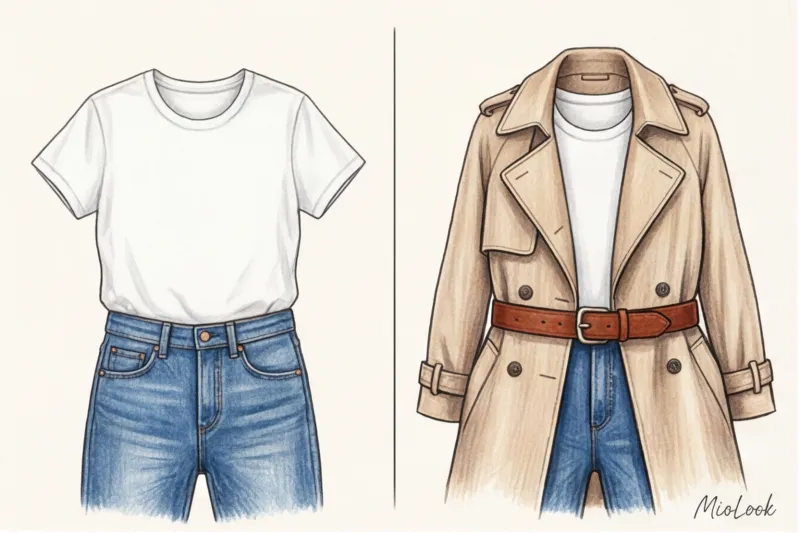
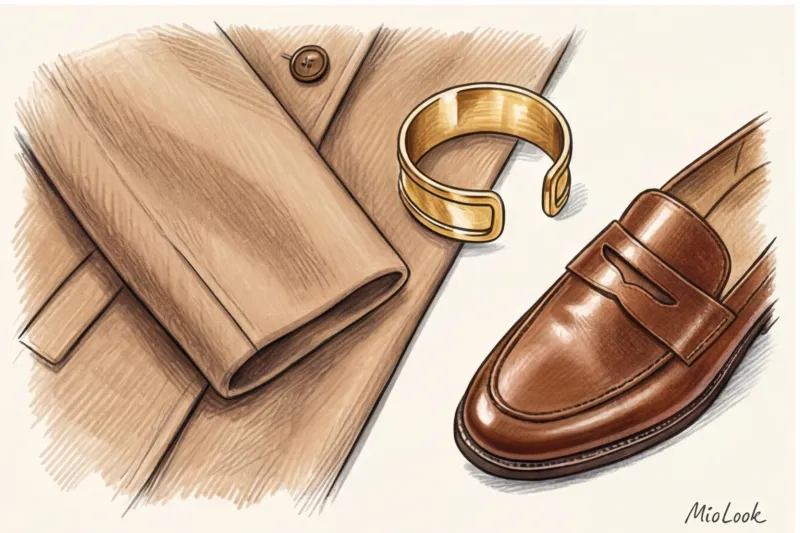
Example of everyday look: You put on straight jeans and a white shirt (this is your canvas). The star of the show is a Bottega Veneta bag with Intrecciato weave (textured accent 1). The assistants are suede loafers (textured accent 2) and a leather belt with a brass buckle (architectural accent 3).
This is where the most important thing comes into play. distance rule Accents should be distributed across different areas. The classic pattern is the face/neck area, the waist/arms area, and the legs area. If you wear a chunky necklace, large earrings, and bright lipstick all at once, you'll overload the portrait area, leaving the rest of your body "empty."
Common Mistakes: When the Three-Accent Rule Ruins an Image
Even flawless mathematics fails if context is not taken into account. Over 12 years of practice, I've identified three scenarios in which images fall apart.
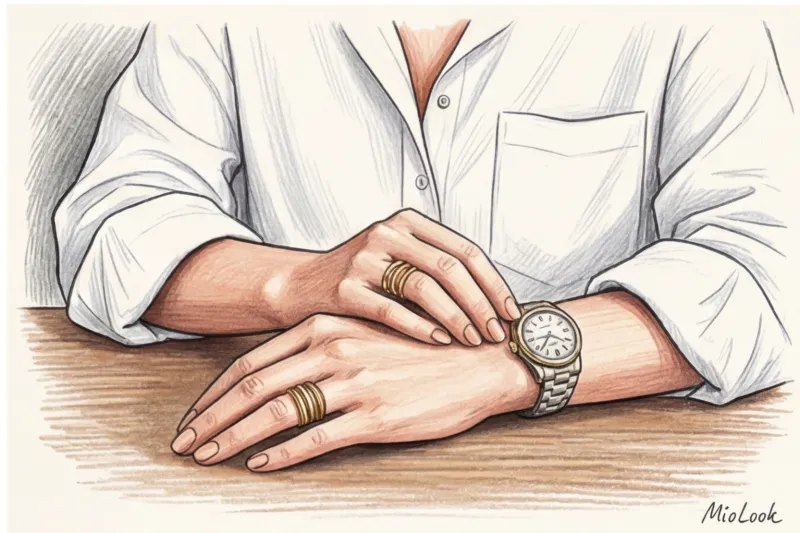
Mistake 1: Ignoring the "canvas". If your base is a leopard print dress or a complex asymmetrical blouse, the outfit has already captured two of the three accents. All you need to add is one detail, like a crisp, rigid bag. Trying to layer three more accessories on top of a bold print is a fatal mistake.
Error 2: The disputing metals are of the same mass. I'm not a fan of the outdated rule "you can't mix gold and silver." It's possible. But there's a catch. This doesn't work if the metals have equal visual weight. A thin silver chain and a chunky gold watch will look like you're wearing everything you own. One metal should always dominate (80%), while the other should only subtly complement it (20%).
Mistake 3: Trying to save a bad base. I once had a woman come to me trying to "elevate" a downright cheap polyester suit with a Gucci belt, a Prada bag, and a Chanel brooch. The effect was counterproductive: the high-class hardware only accentuated the crooked seams and cheap sheen of the suit's fabric. If you're unsure about the quality of the base, read our article about 10 Signs of Cheap Clothing Accents decorate only a good canvas.
Adaptation for experts: the rule of three accents in business dress code
For women building a career or personal brand, the details of their image are a communication tool. According to research on image perception published by Princeton University psychologists, an overload of details reduces an expert's perceived competence by 30%. The other person's brain becomes distracted by your rings and stops listening to your arguments.
Within a smart casual or business formal dress code, status accessories work in your favor only if you wear no more than three. The ideal expert's kit: an expensive watch with a leather strap (conveys respect for time), quality shoes (speaks to attention to detail), and, for example, a silk bob or neat stud earrings.
What you should absolutely avoid during negotiations: jingling bracelets (audible noise is irritating), overly bright eyeglass frames that take the focus away from your eyes, and an abundance of logos. This is especially true if you're building a style after 40 , where noble minimalism always wins over excessive decorativeness.
Your perfect look starts here
Join thousands of users who look flawless every day with the MioLook AI assistant.
Get access — €0.99 once
Investing in details: what accents make a look "expensive"
The Business of Fashion 2023 report revealed a global shift: consumers are abandoning dozens of cheap accessories from fast-fashion brands in favor of investment pieces. And this is the smartest approach to building a wardrobe.
Let's count Cost-per-wear (cost per outing). A trendy €80 mass-market bag that you'll wear five times a season will cost you €16 per outing. A basic €1,200 Italian vegetable-tanned leather bag that you'll wear 250 days a year for five years will cost you just €0.96 per outing. The math is ruthless.
To create a truly luxurious look, your three accents should be crafted with a touch of artisanship. These will never go out of style and will elevate even the simplest Zara or Uniqlo outfit:
- Swiss or high-quality Japanese movements: classic watch with a laconic dial.
- French silk work: Hand-stitched scarves (roulotté) that add color to the face.
- Italian leather and suede: Shoes and belts with perfect stitching and heavy, cast brass fittings.
- Baroque pearls: Its imperfect shape adds that Italian carelessness to the image.
Stylist checklist: test your look before going out
Theory is great, but let's get practical. Before you leave the house, run through this short routine for your outfit. It'll only take a minute.
- Step 1: Assess the canvas. Look at your clothes. Do they feature bold prints, complex draping, deep necklines, or bright colors? If so, subtract one or two accents from the available three.
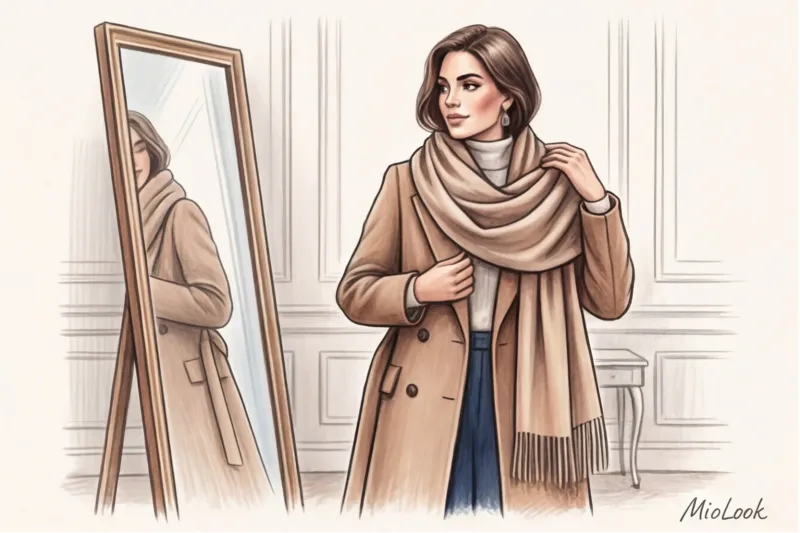
- Step 2: Mirror Test (3 seconds). Stand in front of a full-length mirror, close your eyes, count to three, and open them. Notice where your first glance fell. That's your main focus. Where did your gaze slide next? Those are secondary ones.
- Step 3: Recalculation. If your gaze starts darting between bright lips, large earrings, a shiny belt, and a printed bag, you've gone too far. Let's apply Coco Chanel's updated rule.
- Step 4: Smart reduction. Chanel advised taking off the last thing you put on. I suggest a more precise method: remove the accent that is closest A different accent. Do earrings and a necklace clash? Stick with one or the other. Is the belt clashing with the bold texture of the crossbody bag hanging on your hip? Replace the bag with a more minimalist one.
Style isn't something you add to an outfit. True class is revealed in what you're willing to let go of. Keep only those details that work for you, and you'll see how not only your reflection changes, but also how others perceive you.