What are capsule wardrobe formulas and why intuitive shopping is losing out?
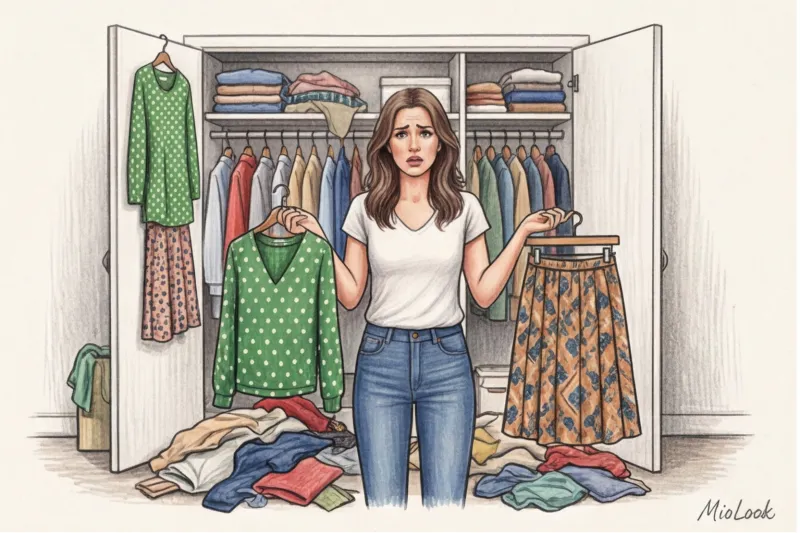
Have you ever noticed the paradox: the more we buy things emotionally, the harder it is to get dressed in the morning? Clients often come to me with closets that resemble boutique warehouses, but with the same daily request: "I have absolutely nothing to wear." This is where capsule wardrobe formulas — not as a strict, restrictive diet for your closet, but as an elegant mathematical solution to your daily routine.

Let's clarify the basic concept. A formula isn't an ascetic limitation like "throw away everything and keep only 10 black and white items." It's an algorithm of predictable combinations. Imagine an architectural code in which every variable (from a basic white COS shirt to complex statement trousers) fits perfectly with every other. You're not buying an isolated item, but a functional element of an equation that automatically generates 3 to 5 ready-made looks for you. I discussed this conceptual approach in more detail in the article about Step-by-step creation of a capsule wardrobe.
Intuitive shopping—when we buy "just a really nice sweater" without thinking about its complementary items—always loses out to math. And statistics confirm this.
According to the global WRAP study (2023), the average woman regularly wears only 20% of her wardrobe 80% of the time. This is the classic Pareto principle in action.
The remaining 80% of items hang in the closet like dead weight: there is no suitable pair for them in terms of cut, fabric density, or temperature.
Challenges like Project 333 (wearing 33 items for 3 months) are still popular online. But let's be realistic: for a woman with an active lifestyle, strict limits simply don't work. If you manage projects, attend client meetings, go to a theater premiere in the evening, and take the kids out of town on the weekend, limiting yourself to 30 items will only cause frustration and stress. Wardrobe math solves this problem differently: we don't artificially reduce quantities, we calculate correct proportions so that every thing fits into your schedule.
In 12 years of working with fabrics, I've made one counterintuitive observation: When girls try to become minimalists and drastically reduce their wardrobe, without having built a formula , their clothes wear out much faster. Why is this? If you only have two basic T-shirts and one thick cashmere cardigan that you wear constantly, the fibers simply don't have time to recover after wear and washing.
Clothes need a "rest." You wash the same unsynchronized items every day. The result: your favorite basic €80 long sleeve shirt becomes misshapen and the seams become uneven after a month. A well-designed formula distributes the stress evenly across the fabric, extending the life of every fiber.
To avoid manually calculating compatibility and wear factors, I strongly recommend digitizing your database. Upload your items to MioLook — Artificial intelligence will analyze your personal matrix and clearly show which elements of the formula are overloaded, and where the gaping holes are, leaving you with "nothing to wear."
The Mathematics of Style: How to Count Combinations, Not Things
When a new client shows me her overflowing closet and despairingly utters the sacramental "I have nothing to wear," I suggest we play a game. We stop counting hangers and start counting finished outfits. In 90% of cases, for every 150 isolated items, there are barely 12–15 workable outfits. This is a clear example of how the wardrobe operates on linear addition, while we need multiplication.
The foundations of combination in styling are built on a simple principle: each new item shouldn't add one look (+1), but rather multiply existing ones. If you buy a dress with a complex print, you get exactly one outfit option. But if you invest €120 in a high-quality midi skirt made of thick silk or wool that pairs with five of your blouses and three sweaters, you instantly get fifteen new looks.
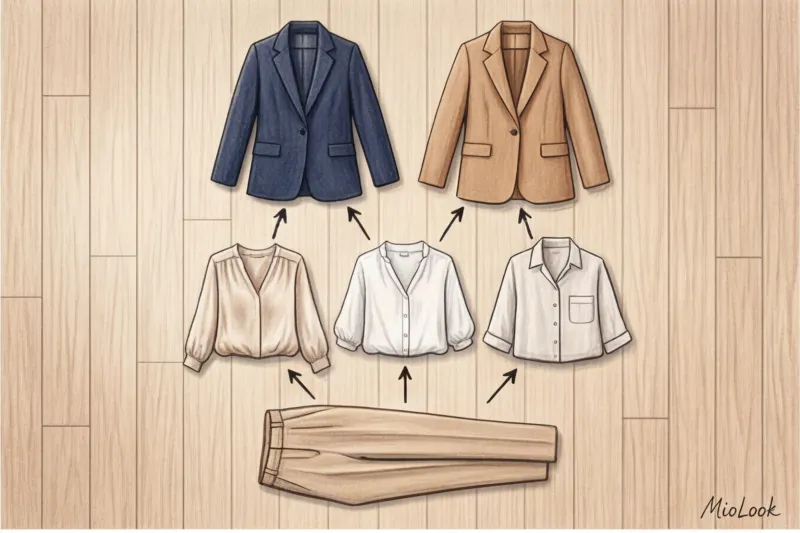
This approach is based on the concept “core wardrobe” and connecting elements. The core is the workhorses: impeccably tailored trousers, simple jumpers made from blended yarns, and basic plain T-shirts from trusted brands like COS or Uniqlo. They may look boring on the hanger, but they carry the main stylistic weight. Connecting elements are statement shoes, textured belts, or scarves, which bind the core into a cohesive, fun capsule.
The industry gold standard for building such a core is considered to be the rule: there should be three tops for every bottom Why is this so? The answer lies in the psychology of perception and physiology. Firstly, when communicating, people focus on our facial features, so changing your top or shirt creates the illusion of a completely new outfit. Secondly, high-quality jeans or suit pants get dirty less often and don't require washing after each wear, unlike undershirts.
"People remember your silhouette and what's around your face. You can wear the same perfectly fitting black pants three days in a row, swapping out the turtleneck for a silk shirt and then a chunky sweater, and none of your coworkers will notice the hem is the same."
Let's get down to some pure math. Look at the actual calculation for a properly assembled capsule: 3 bottoms + 9 tops + 3 layers = 81 combinations That is, with just 15 carefully chosen items, you can wear them for two and a half months without ever repeating yourself. In its global consumer habits report (2024), the Pantone Color Institute noted that shoppers are increasingly shifting to this kind of "mathematical" clothing consumption, preferring high functionality to excess.
Access to MioLook for €0.99 — one-time payment
A smart AI stylist will select the perfect look based on the mathematics of your wardrobe.
Get access — €0.99 onceThe Top-Bottom-Layer Formula (Image Architecture)
To ensure that multiplication works without stylistic glitches, it's essential to understand the architecture of the look. The "Top-Bottom-Layer" formula divides your clothing into three functional layers, each fulfilling its own technical purpose within the ensemble.
- Basic level (closer to the body) — this is your foundation. Ribbed tank tops, thin merino long sleeves, smooth cotton tees. Their main purpose is absorbency, comfort, and creating a clean background without visual noise.
- Formative level (silhouette) — these are bottoms (skirts, trousers) and separate tops (shirts). It is this level that determines the geometry of your figure: whether it will be a high waist, a relaxed oversized fit, or a strict straight cut.
- The final level (third layer) — blazers, structured cardigans, vests, and oversized shirts. These are like filters through which we filter the basic outfit.
The real stylistic magic begins at the third level. This layer multiplies the wardrobe exponentially. A basic white T-shirt and straight-leg jeans look like comfortable weekend attire. But add a structured, heavy wool blazer (around €150-200 in the mid-range) on top, and you've got business casual put together. Swap the blazer for a voluminous aviator jacket, and you've got yourself a trendy street style look.
In my experience, when clients begin to consciously implement the third layer rule, their Cost Per Wear (CPR) for basic items drops to a few cents, because the same item begins to work in completely different contexts, earning back every euro invested.
Top capsule wardrobe formulas for different needs
If you take a popular capsule wardrobe from Pinterest and try to mindlessly apply it to your life, half of the items you buy will remain hanging in your closet with the tags still attached. Capsule wardrobe formulas only work when their coefficients are precisely tuned to your daily routine and climate.
I had a clear example in my practice of how lifestyle dictates style math. In the same month, two clients approached me with radically different needs: a corporate lawyer with a strict office dress code and a Senior Product Manager in the IT sector. For the lawyer, we radically shifted the proportions toward tops. In her formula, for every basic bottom (formal trousers or a pencil skirt), there were four to five tops (silk blouses, cotton shirts, thin turtlenecks). The reason is purely practical: in the office, you spend 80% of your time at a desk or in a conference room. People around you only read your profile, so changing blouses under the same jacket creates the complete feeling of a new outfit.
For the IT professional, whose dress code is relaxed smart-casual with a hybrid work format, we focused on layering. We balanced the number of tops and bottoms, but added as many formative elements as possible: voluminous merino wool cardigans, thick corduroy overshirts, and structured blazers. Creative professions and freelancing require visual dynamism, which is best achieved through layering.
Similarly, mathematics adapts to other periods of life:
- Decree: The focus shifts to easy-to-wash bottoms and tactilely safe materials without complex hardware. The weight of first-layer tops (T-shirts, long sleeves) doubles due to the need for frequent changes.
- Frequent business trips: Priority is given to items with a zero wrinkle coefficient and multifunctional footwear.
The 5-4-3-2-1 Method: Ideal for Mini Capsules and Travel
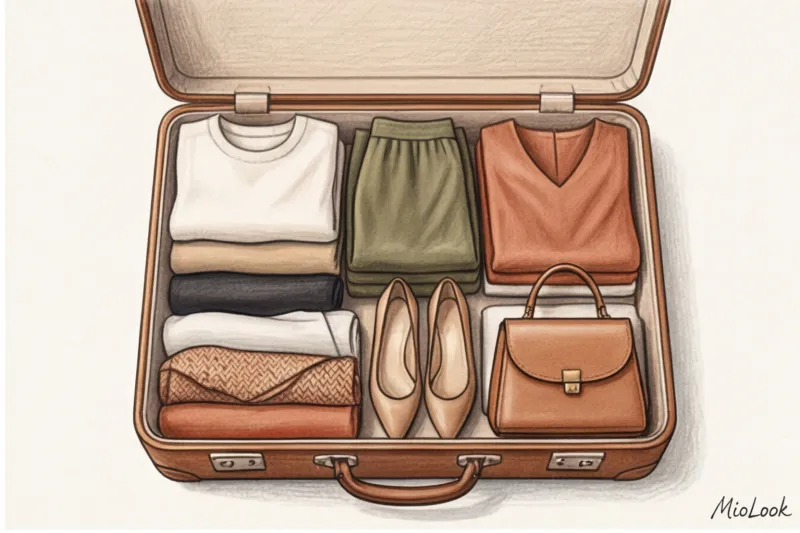
This elegant formula was originally created for frequent flyers in carry-on format, but it's proven so viable that many of my clients have adapted it for seasonal mini capsules. The breakdown is simple: 5 tops, 4 bottoms, 3 layers/dresses, 2 pairs of shoes, and 1 bag.
Let's calculate the real return on these 15 items. Multiply 5 tops by 4 bottoms, and you get 20 basic combinations. If we have two jackets and one dress in category "3," the math gets even more interesting. Multiply 20 basic sets by 2 top layer options, and you get 40 looks. Add a dress (which can be worn alone or with a jacket), and you get 20 to 45 completely different, functional looks from a minimal set of items.
When we plan vacations with clients, we often include these 15 elements in MioLook To visualize each combination, even if you've limited your wardrobe budget to €200–€300, it's smarter to invest that amount in a high-quality core piece using the 5-4-3-2-1 method, opting for heavy-duty linen, lyocell, and cotton blends that will withstand heavy wear.
The 70/30 Ratio: A Formula for Sustainable Balance
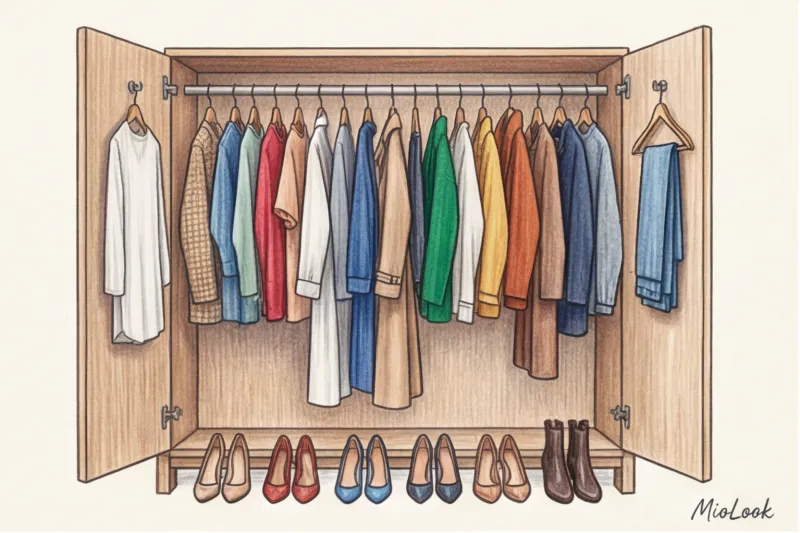
While the previous method answered the question "how much?", the 70/30 ratio answers the question "what exactly?" The gold standard for a sustainable wardrobe is: 70% of your capsule wardrobe should be made up of timeless essentials (core wardrobe), and only 30% should be devoted to trendy, statement pieces.
According to the Business of Fashion analytical report (2023), an imbalance in this balance is the main cause of morning wardrobe paralysis. If your wardrobe is 60% complex cuts, sequins, bold prints, and neon shades, items begin to clash. This creates an unbearable visual noise: a leopard-print skirt physically cannot be paired with a floral blouse without the risk of looking ridiculous (unless, of course, you're a professional stylist working in a maximalist aesthetic).
Base at 70% A vibrant look doesn't mean dull gray and black tones. If you adore navy blue, deep burgundy, or olive, let them become your foundation. The remaining 30% of accents are a safe "sandbox" where you can test seasonal colors (like the trendy Peach Fuzz), unusual shoe textures, or bold accessories, knowing you'll always have something to tame them with.
Micro step: Take stock of your sweaters and blouses today. Calculate how many of them are basic and how many are bold accents. If more than half are accents, your stylistic math needs adjusting.
Textile compatibility: the hidden variable in wardrobe formulas
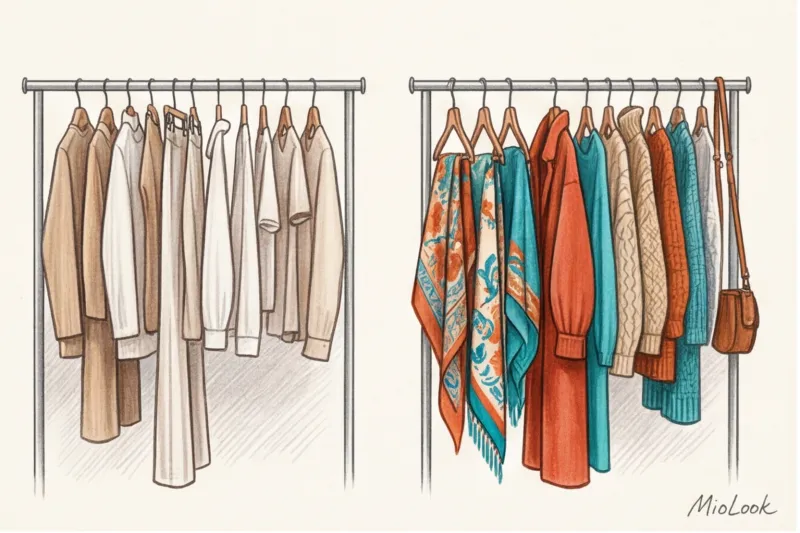
You can perfectly coordinate your capsule wardrobe using the PANTONE palette and select reference styles based on your body type, but in practice, the pieces will simply refuse to work together. This is because most style guides ignore the physics of materials. Textile compatibility and texture clashes are the hidden variables that determine whether you'll wear a look with pleasure or want to change in five minutes.
When studying the properties of fibers and their dynamic behavior, I always draw my clients' attention to the mechanics of fabric interaction. Let's look at a classic example: a flowing silk blouse worn under a chunky knit lambswool cardigan not only creates a beautiful visual contrast but also impeccable comfort. But trying to wear a thick cotton long-sleeve top under a tight fleece sweatshirt will be a disaster. The latter will inevitably result in rough folds, tight armholes, and a persistent feeling of tightness.
Why does this happen? The answer lies in the term coefficient of friction When we construct multilayered images (and it is precisely the multilayered nature that makes the capsule mathematically variable), things must interact according to the principle of sliding, not adhesion.
- Smooth, low-friction fibers (silk, cupra, tencel, high-quality viscose) are ideal for a base layer. They allow any outerwear to slide easily over them without distorting the silhouette. A high-quality basic tencel turtleneck in the €60–€80 range will pay for itself thanks to this versatility.
- Rough textures with high adhesion (fleece, flannel, bouclé, textured cotton) act like micro-hooks. When you layer cotton on top of cotton, a Velcro effect occurs. The fabrics cling to each other, bunching up with every movement, and disrupting the cut's geometric shape.

The second golden rule of wardrobe physics concerns the density of materials. To avoid the infamous "cabbage effect," where layering visually adds a couple of sizes, strictly adhere to the vector "from thin to dense".
Each subsequent layer should be objectively heavier and denser than the one before. A thin turtleneck made of smooth merino wool will work perfectly under a heavy tweed jacket weighing at least 300 g/m². However, this rule doesn't work the other way around. If the bottom layer is stiffer or denser than the top layer—for example, if you try to layer a stiff denim or oxford shirt under a thin cashmere jumper—the seams, cuffs, and buttons will show through unattractively, creating a visual clutter.
Micro-compatibility test: Before adding a new item to your capsule wardrobe, layer it with a potential companion and rub the fabrics together. Does it slide? Feel free to layer it. Does it get stuck or cling? This item will only work solo.
According to research by retail consulting agencies, physical discomfort from fit is the reason why over 60% of purchased items end up at the bottom of the closet after the first try-on at home. Therefore, the math of your wardrobe should always be tested by tactile testing.
Access to MioLook for €0.99 — one-time payment
Start creating perfect images with the help of artificial intelligence
Get access — €0.99 onceCost Per Wear (CPW) Calculation and Sustainability Index Formula
The mathematics of the perfect wardrobe doesn't end with calculating combinations of tops and bottoms. The true test of any assembled capsule wardrobe's durability occurs not in front of the mirror, but in the washing machine. When we reduce the number of items to a minimum, the load on each remaining item increases dramatically.
According to reports from the non-profit organization Textile Exchange (2023), which evaluates the life cycle of textiles, mass-market acrylic and short-staple cotton fibers lose their structural integrity after just 5-7 aggressive washing cycles. In a typical overstuffed closet, you might not notice this for years, wearing a blouse once a season. But capsule wardrobe formulas assume active, almost continuous use. If you only have three basic long-sleeved T-shirts, you'll be washing them every week. Cheap fabric will quickly pill, shrink, and your mathematically calibrated capsule wardrobe will begin to visibly fall apart.
This is where the main financial rule of stylists comes into play - the index Cost Per Wear (CPW) , or the cost of one wear.
CPW formula: Original cost of the item ÷ Actual number of wears
Let's look at some specific numbers. Let's say you buy a trendy loose acrylic jumper for €30. Because it quickly loses its presentable appearance, you wear it a maximum of five times per season, after which it's either sent to the country house or becomes covered in snags. Your CPW is €6. Alternatively, consider a basic sweater made of high-quality 100% merino wool in a smooth knit for €150. With proper care (natural wool has natural antibacterial properties and requires infrequent washing), you'll wear it at least 100 times over three years. Its CPW is only €1.50. In the long run, a quality item will have cost you four times less!
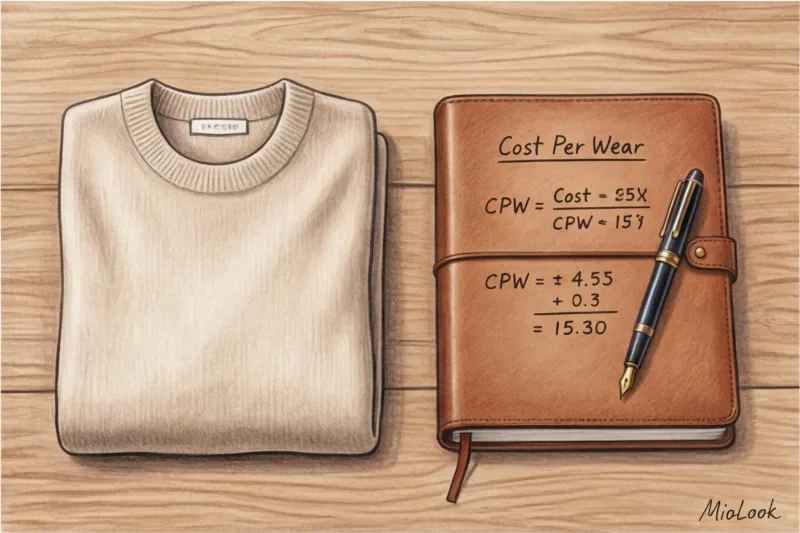
Understanding the CPW index dictates a strict budgeting rule. In a capsule wardrobe, there are two categories that absolutely cannot be skimped on: footwear and base layer knitwear.
- Shoes: It bears your entire body weight and takes the brunt of the weather. Cheap lasts and stiff leatherette don't just wear out quickly—they disrupt the biomechanics of your stride, cheapening the feel and fit of even the most expensive coat.
- First layer knitwear (T-shirts, tank tops, turtlenecks): These items come into direct contact with the skin, absorb sebum, and are subject to maximum friction—especially in the armpits and where the strap of a crossbody bag meets the body. A €10 T-shirt made of loosely twisted yarns will warp along the side seam after the first wash, irrevocably ruining the geometry of a layered outfit.
To avoid the hassle of keeping complicated calculations in a notebook, I recommend my clients entrust this task to technology. By digitizing their closet through MioLook , you can automatically track how often you use each item. The app will clearly show which items are worth every cent spent, and which are just creating the illusion of savings.
Practical step: Think of purchasing a basic item not as a one-time expense, but as an investment that pays dividends in the form of daily comfort. If you plan to wear a piece of clothing two to three times a week, feel free to double your usual budget for that item.
Checklist: Developing Your Personal Capsule Wardrobe Formula
Drawing on data from the Sustainable Fashion Institute (2022), I often share a sobering statistic with my clients: over 60% of women give up on creating a capsule wardrobe within the first month. The reason is simple: we build a wardrobe for a "fantasy" version of ourselves, stubbornly ignoring the real-life routine. For the theory of combinations to work in practice, it's necessary to translate your daily tasks into hard numbers. Let's put together your personal formula step by step.
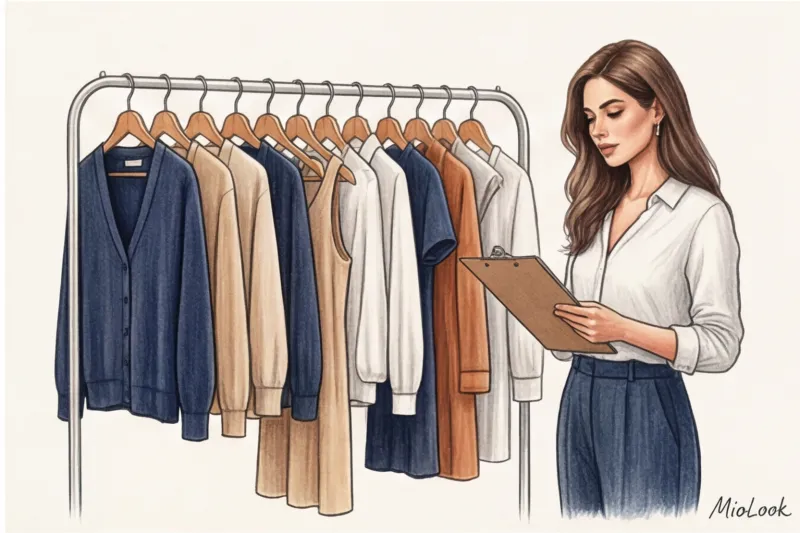
- Step 1: Lifestyle Chart Audit (in percentages). Take a piece of paper and draw a circle. Divide it into sections that reflect your actual activities over the past month. Not the ones you dream of (for example, 20% spent on social events, even though you only go to the theater once every six months), but the real ones. If you spend 70% of your time on your laptop in a coworking space, 20% walking the dog, and 10% meeting with friends, your closet should mirror these proportions. This is the answer to the question of why a closet full of silk blouses doesn't save you when you just need to walk to the nearest coffee shop on a chilly day.
- Step 2: Selecting base colors and accents (color palette). At this stage, the foundation for mathematical combinations is laid. Choose 2-3 deep neutral base shades (for example, dark chocolate, graphite, and sand) and 1-2 accent colors (say, cobalt or burgundy). The main criterion for a working palette-coupling: any accent top should physically and coloristically match each base bottom. If the palette is assembled correctly, you can literally dress in the dark, confident that your pieces will not clash.
- Step 3: Calculate the amount of lows and highs for your activity. Now let's apply the math to your diagram. Let's say your ideal ratio for the office is 4 bottoms and 12 tops. If workdays take up 60% of your life, then exactly 60% of all shoulder items must fit this dress code. If you're a freelancer and prefer relaxed casual 80% of the time, your focus shifts to high-quality jeans and layered tops, while a tailored pencil skirt remains a one-off.
- Step 4: Test the formula in a sandbox (for 1-2 weeks). I strictly forbid going shopping immediately after calculating your budget. Take a test drive: select 12-15 items from your existing inventory that fit into the new formula. Put the rest out of sight. Live with this mini-capsule for 10-14 days. Psychologically, limiting your choices seems stressful, but in practice, it gives you an incredible sense of freedom in the morning. This "sandbox" will reveal real gaps and protect you from impulsive spending, saving you hundreds of euros in the long run.
Your ideal image begins Here
Join thousands of users who look flawless every day with MioLook.
Get access — €0.99 onceDigitizing Your Wardrobe: How AI Automates the Math of Style
According to Miller's Law in cognitive psychology, human short-term memory can only hold about seven elements at a time. This is why, even with a perfectly curated wardrobe, we physically cannot mentally calculate all 30–40 possible combinations. As noted in the Business of Fashion (2024) analytical report, the future of personal style lies in delegating this cognitive load to smart algorithms. Sooner or later, manually calculating a capsule wardrobe formula becomes too time-consuming, and this is where fashion technology comes into play.
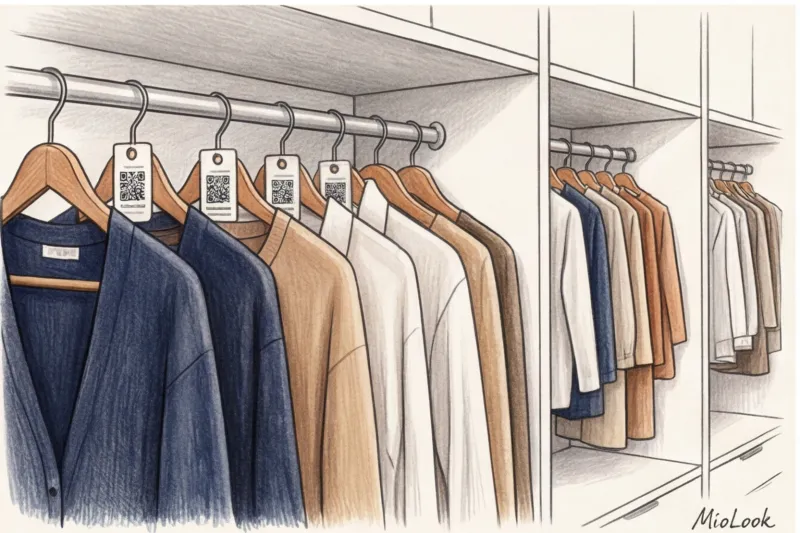
Modern wardrobe apps have long outgrown the format of simple photo catalogs on your phone. Artificial intelligence, embedded in the architecture of services such as MioLook , continuously analyzes the loaded database and takes on complex combinatorics. The algorithm doesn't simply shuffle random objects; it mathematically identifies stylistic "blind spots."
For example, the system can highlight a paradoxical situation: your favorite €220 wool palazzo pants were worn only three times this winter. The AI will impartially detect the cause: a lack of proportions—your wardrobe is critically short of coordinating tops with a suitable, smooth texture. Instead of buying more jeans "because you have nothing else to wear," the program will suggest which top will unlock the potential of those idle items.
But the real magic of technology unfolds during the pre-shopping stage, when the virtual fitting room begins to function as a strict financial auditor. Adding a photo of the desired item to the app before paying at checkout is the best way to test the formula's robustness. If the AI shows that a new, trendy jacket easily integrates into at least five ready-to-wear outfits with your current core, the purchase is justified. This automatically guarantees a low Cost Per Wear (CPW) even before you cut the tags and hang the item in your closet.
A micro-rule of modern smart shopping: never buy a statement piece without trying it on in a digital fitting room. Algorithms see a mathematical lack of layers where we're blinded by the momentary emotion of a beautiful cut.
Summary: When Mathematics Becomes Intuition
One of my European clients, a graphic designer, resisted a systematic approach for a long time during our consultations. "Sofia, your cost-per-wear (CPW) calculations, percentages, and strict guidelines are killing the magic of fashion! I want to dress according to my mood, not a schedule," she protested. I understand this fear perfectly. Mathematics seems cold and soulless, while style is pure self-expression. But let's look at this through the lens of cognitive psychology.
Noam Chomsky, in his work on linguistics, demonstrated that we can create an infinite number of unique sentences only if we have firmly mastered the strict rules of grammar. It works exactly the same with style. Capsule wardrobe formulas are your style training wheels.
You use patterns like 5-4-3-2-1 or a strict 70/30 ratio only at the start to reset your old shopping habits and stop the uncontrolled cluttering of shelves. Once new neural connections are formed, magic happens: analytics move to the subconscious level.

You'll stop frantically calculating pairing factors while standing in the fitting room. You'll simply touch a textured merino sweater and, in a split second, intuitively understand: it'll perfectly complement those €150 wide-leg wool trousers already hanging in your closet, and it won't clash with the thickness of your favorite trench coat.
The most valuable thing about the mathematical approach is that A deep knowledge of the rules gives you incredible freedom to break them. When your basic wardrobe is built without blind spots, you can indulge in absolute fashion hooliganism. Want a crazy vintage jacket with an asymmetrical cut from the Japanese avant-garde? Go for it! It won't end up a solitary item on the hanger because it's guaranteed to sit atop a solid foundation of carefully chosen neutral tops and trousers. You'll be breaking the rules not out of desperation ("nothing to wear again"), but out of an abundance of creative energy.
I'll be honest with you: for the first couple of weeks, the mathematical approach will feel like a chore. Creating a life chart, analyzing textures—all of this requires focus. But to avoid perfectionist paralysis, I strongly advise against dumping the entire contents of your closets on your bed right now.
Practical micro-task: This weekend, set aside exactly 20 minutes. Take out exactly 15 of your favorite items from your closet that you wear most often anyway (for example: 3 bottoms, 5 tops, 2 jackets/cardigans, 3 pairs of shoes, 2 bags).
Take pictures of them in natural daylight and upload them to MioLook smart wardrobe Don't try to create images yourself—leave it to artificial intelligence. The algorithm will analyze your mini-capsule and reveal those subtle combinations you might have missed due to simple visual confusion.
In my experience, 15 well-chosen items generate 25 to 40 complete looks. Once you see this mathematical multiplier in action on your smartphone screen, intuitive, emotional shopping will forever lose its appeal. You'll no longer buy things—you'll start collecting looks.
Guide Chapters
10x10 Challenge: A 10-piece wardrobe for 10 days
Tired of an overflowing closet and the constant problem of "nothing to wear"? Learn how to create 10 unique everyday looks using just 10 items.
The perfect formula for a basic business wardrobe from scratch
Got a closet full of clothes but nothing to wear to the office? Discover the mathematical algorithm for creating a business capsule wardrobe that will eliminate morning panic forever.
Vacation Capsule: A Formula for Packing Without Overweight
Statistically, we only wear 45% of the things we pack on vacation. Learn how to properly pack a capsule for your trip to avoid overweight.
The Pareto Rule in Wardrobe: How to Create a Smart Closet
Is your closet overflowing with clothes, but you're still wearing the same pair of jeans? Learn how the 80/20 math principle can help you solve the "nothing to wear" problem once and for all.
Project 333 Wardrobe: 33 Stress-Free Items for 3 Months
Find out how a rigorous yet effective fashion detox will help you assemble a premium capsule wardrobe. Here are the rules of the experiment, where 33 items solve the "nothing to wear" problem.
Smart Capsule Calculation App: How AI Works
Digitizing your closet won't solve the "nothing to wear" problem. Find out how artificial intelligence analyzes your clothes and helps you create the perfect capsule wardrobe.
Method 333 in clothing: how to create 27 stylish looks
This viral TikTok trend promises 27 looks from just 9 items. Learn how to master this formula without any styling fails.
Wardrobe Matrix: 100% Compatibility Chart
Tired of an overcrowded closet where items don't go together? Learn how the wardrobe matrix works and learn how to create the perfect outfit.
Cost per wear formula: calculating the real cost of an item
Tired of a cluttered closet and impulse purchases on sales? We'll break down how to calculate the cost of each item to invest wisely in your wardrobe.
The perfect balance of tops and bottoms in your wardrobe
Full closet, but nothing to wear? Discover the stylists' golden rule that will help you create dozens of new looks from a minimum of items.
The 60 30 10 Rule in Clothing: The Formula for Perfect Colors
The mathematics of perfect style: how to correctly distribute colors in an image to always look expensive and harmonious.
The 5 4 3 2 1 Wardrobe Rule: The Perfect Basics
Full closet, but nothing to wear? Discover a mathematically proven capsule wardrobe system that will solve this problem once and for all.