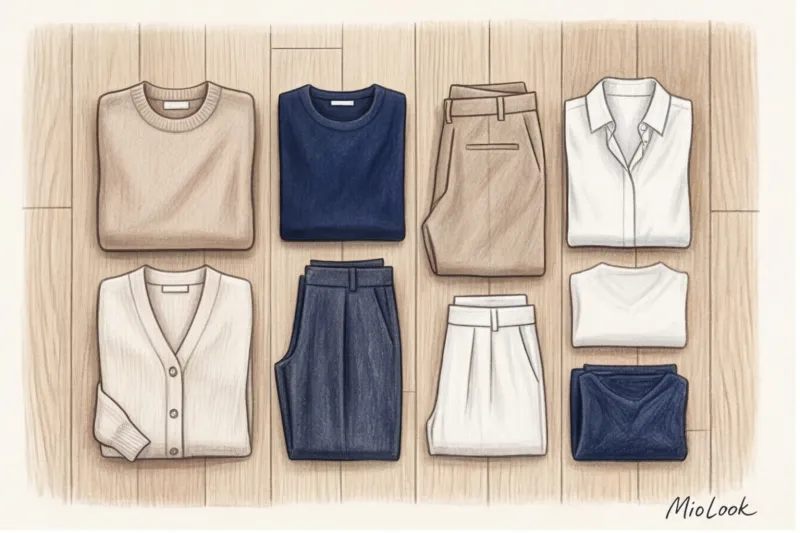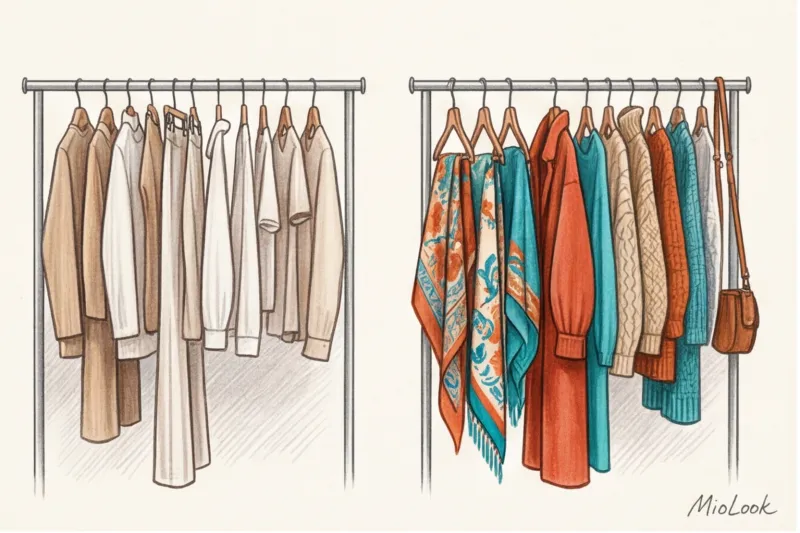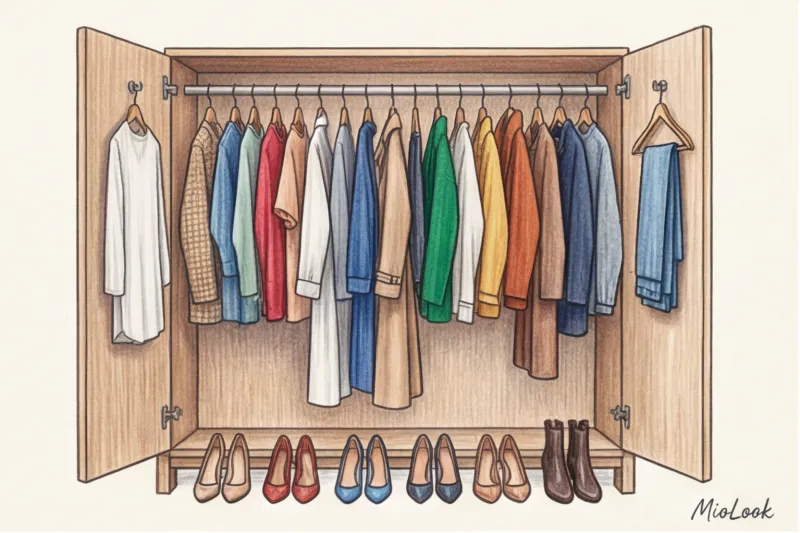
What is a wardrobe matrix and why do capsule wardrobes fall apart without it?
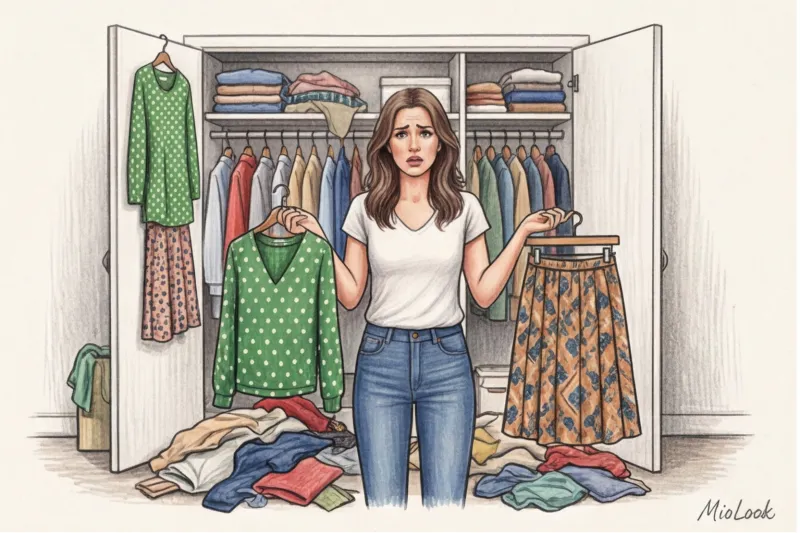
One day, a client came to me with a closet that resembled a branch of a fine European boutique. Dozens of hangers filled with COS cashmere, Massimo Dutti silk blouses, and impeccable jackets. The total cost of the items exceeded several thousand euros. Yet, her morning verdict was standard: "I have absolutely nothing to wear." The problem wasn't the quality of the clothes, but the complete lack of cohesion between them. At that moment, I was once again convinced: a collection of beautiful clothes is not a wardrobe. A wardrobe begins where you put them. wardrobe matrix.
According to the 2023 global report by environmental organization WRAP, the average woman regularly wears only 20% of her closet, leaving 80% of the items sitting idle. Why is this? Because most of us practice "intuitive shopping"—we buy a star item, falling in love with its color or cut, but forget to factor it into the equation.
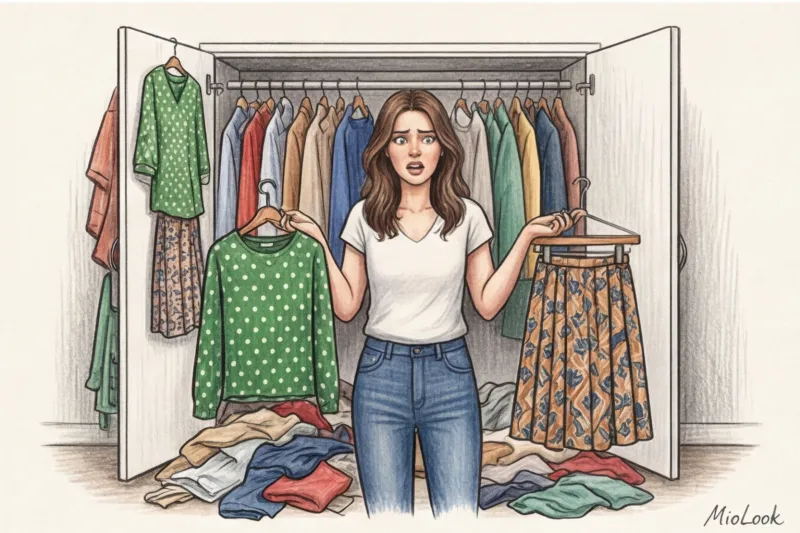
The matrix isn't just a boring list of basic t-shirts. It's a mathematical algorithm for predictable combinations. Imagine a crossword puzzle where each new word must intersect with the letters already written. We've already discussed the architecture of basic items in more detail in our The complete guide to capsule wardrobe formulas , but today we'll go deeper. We'll learn to buy not things, but elements of a system.
Access to MioLook for €0.99 — one-time payment
A smart AI stylist will select the perfect look based on your wardrobe matrix.
Get access — €0.99 onceThe Anatomy of a Perfect Compatibility Chart: From 2D to 3D
If you've ever read closet organizing tips, you've probably seen the classic 2D charts: vertical for tops, horizontal for bottoms, and a check mark at the intersection indicating a color match. Forget it. Classic 2D charts are hopelessly outdated.
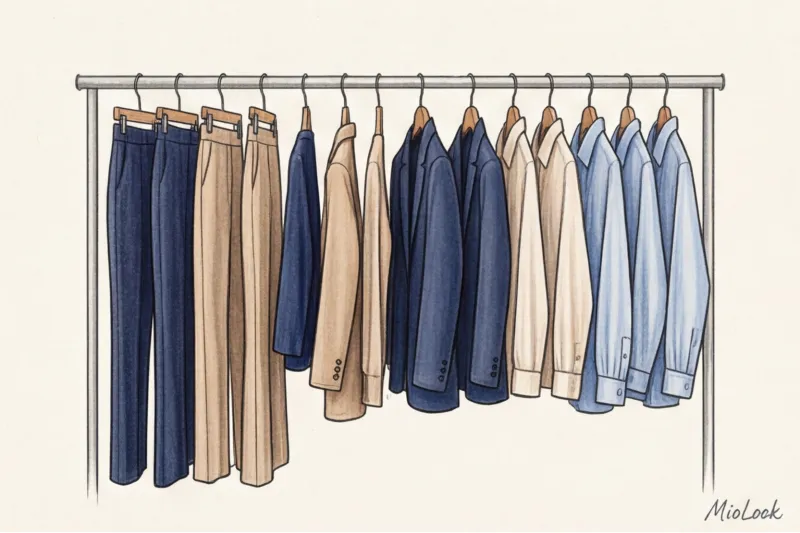
In my stylistic practice I use the concept 3D matrices It's built on three axes: Color + Cut Architecture (Volumes) + Textile Density. This is the only way to avoid flat, inexpressive looks. The foundation of this design is the golden rule of balance: for every structured bottom, there should always be three to four tops of varying degrees of insulation. We stain trousers less often, while portraiture demands more variety.
X-axis: Color harmony and temperature contrast
The color axis begins with choosing 2-3 anchor neutrals. For some, this will be deep navy and graphite, while for others, it's warm camel and off-white. These colors will serve as the background. We then add 1-2 accent colors that complement your complexion. The key is that all the anchor colors should complement each other, and the accent colors should complement each of the anchor colors. If you bought a magenta skirt, it should pair well with both your gray sweater and your beige trench coat.
Y-axis: Textile weight and fabric architecture
This is where the fun begins—textile science. Fabrics have a weight, measured in ounces (oz) for denim or grams per square meter (gsm) for knits and cotton. Classic jeans weigh 12–14 oz, while a summer poplin shirt weighs around 4 oz. Why do you need to know this?
Wardrobe architecture follows a strict law of layering: each subsequent item in the matrix (the one closest to the outside) must be denser and heavier than the one before it. Otherwise, your matrix will break down the first time you try to dress warmly.
The main mistake when creating a matrix: the color trap and ignoring textures
Let's bust the biggest fashion myth: "If the colors match, things go together." This is a dangerous trap. Two items from the same ideal palette will look cheap and sloppy if their fabrics clash physically.
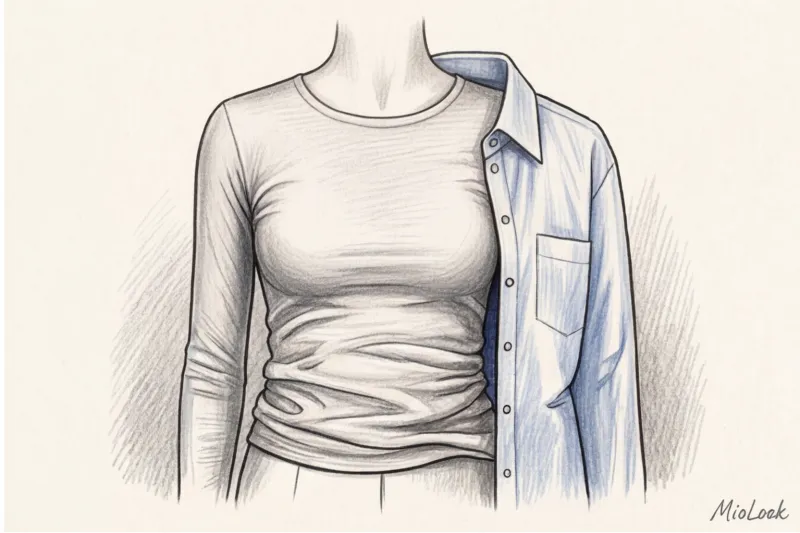
I call this "lumpy layering" syndrome. Imagine wearing a thin viscose knit cardigan over a stiff, heavy cotton office shirt. The colors might be perfectly coordinated, but the buttons, seams, collar, and folds of the shirt will show through the thin knit. The silhouette will be broken, and the look will be sloppy. The matrix has failed because the fabric density rule has been violated.
How do you combine textures correctly? Use the principle of polar contrast. If the bottom is flowing, light, and smooth (for example, a silk midi skirt), the top should be heavy, loose, or matte (a chunky, chunky-knit sweater with a weight of 500 gsm or more). The combination of heavy and weightless creates that very "complexity" of the look that street style photographers love to capture in fashion editors. When creating a matrix, always check for texture contrasts.
Your perfect look starts here
Join thousands of users who look flawless every day with MioLook. Artificial intelligence will help you account for every nuance of texture.
Get access — €0.99 onceStep-by-step algorithm: how to create a wardrobe matrix from scratch
Let's return to my client Katya, the IT director. When we unloaded all her things on the bed, it turned out she had exactly 40 beautiful tops (blouses, T-shirts, thin sweaters) and only two pairs of basic trousers, one of which was hopelessly faded. Her matrix resembled an inverted pyramid, ready to collapse. To prevent this from happening, follow a clear algorithm.
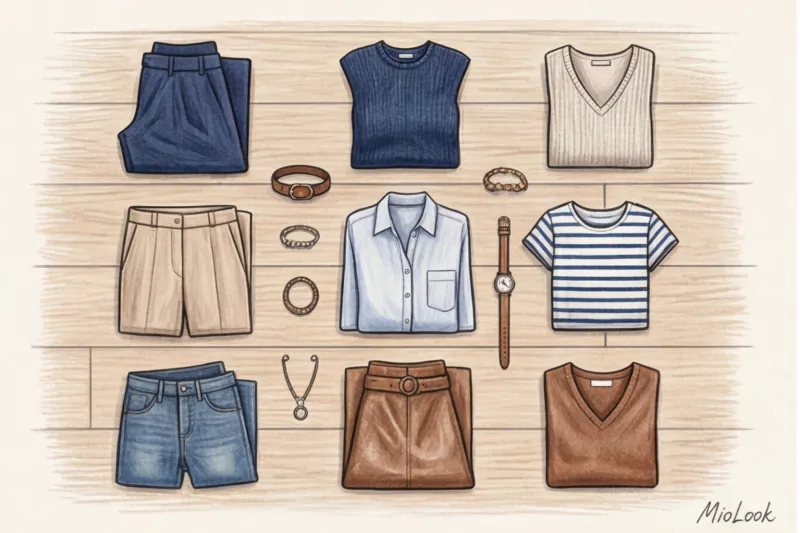
Step 1: Inventory and core selection. Get out all your bottoms (pants, jeans, skirts), outerwear, and basic shoes. This is your framework. If you don't have 3-4 perfectly fitting bottoms made of a dense fabric (for example, wool with elastane or high-quality denim), the matrix creation stops. You go to the store for the basics.
Step 2: Distribution of tops along the temperature gradient. Divide all shoulder garments into three groups: base layers (tops, t-shirts, thin turtlenecks), mid layers (shirts, cardigans, jackets), and warm layers (heavy sweaters). Make sure the mid layer fits under the outerwear without straining the armholes.
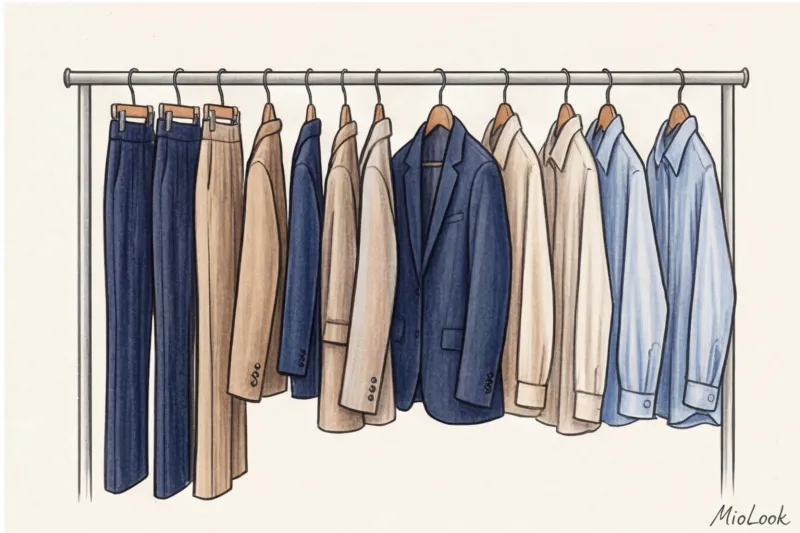
Step 3: Intersection test. Draw a grid. Write your bottoms vertically, your tops horizontally. Start mentally (or physically) connecting them. If a pair of tailored palazzos looks great with a white T-shirt (casual), a silk blouse (office), and an oversized sweater (weekend), tick three boxes. Your goal is to fill at least 80% of the boxes. If an item gets fewer than three boxes, it's quarantined.
The Productivity Formula: How to Make Decisions About New Purchases
Conscious consumption doesn't necessarily mean buying clothes made from recycled plastic. It's primarily about predictable closet math. Before you take an item to the checkout, calculate its Coefficient of Performance (COP). A new purchase should fit into at least three to four existing cells of your matrix without requiring additional investment.
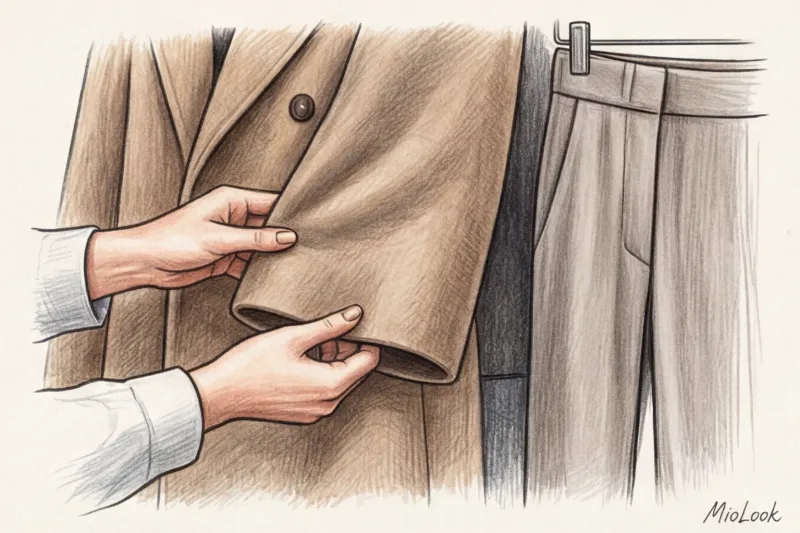
Let's calculate the Cost Per Wear (CPOW). Let's say you buy a great wool blazer for €150. With a well-designed matrix, you'll wear it over a dress, jeans, office trousers, and a silk top. You'll wear it at least 50 times per season. The cost per wear will be only €3.
Now let's take a trendy sequin crop top for €30. It only goes with one skirt. You'll wear it exactly once to a party. The cost per outing is €30. The efficient matrix ruthlessly eliminates items with a high CPW, saving you hundreds of euros per year.
Checklist: Testing Your Matrix for Viability
Is the matrix ready? Excellent. Now let's subject it to the crash tests I regularly conduct during wardrobe reviews.
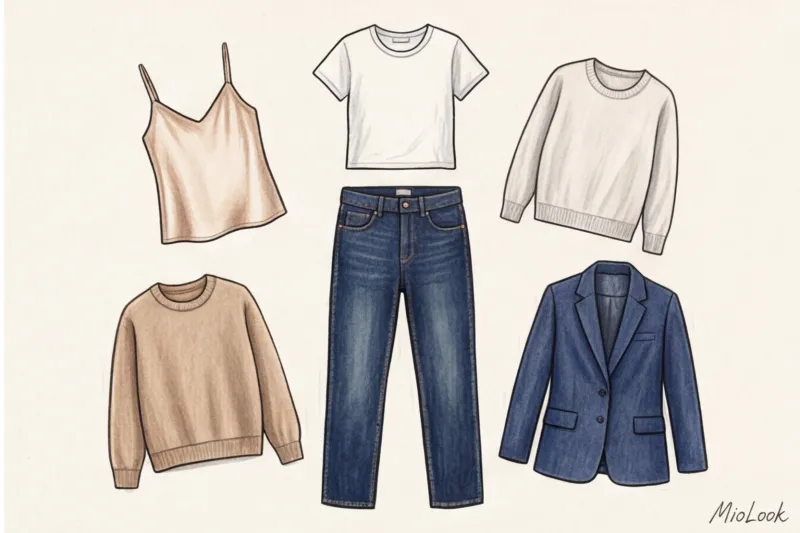
- Blindfold test: Blindfold yourself or close your eyes. Reach into your closet and pull out two random items—a top and a bottom. Touch them. Can you determine by touch that their textures match? If the closet has the correct matrix, the chance of error is minimal.
- 15 Second Test: That's exactly how much time you should spend putting together your look early in the morning. Just grab the first bottom you find and any top in the right temperature range. If you stand in front of the mirror for 10 minutes changing, your mind isn't working.
- Search for "dead zones": Carefully inspect your closet for any odd items. This could be a beautiful dress that requires special shoes, special underwear, or a coat of a certain length. These items are the black holes in your budget.
I'll be honest: there are situations when this DOESN'T work. The matrix approach is ineffective when it comes to wardrobe for a highly specialized hobby (equestrianism, for example), a black-tie dress code, or if you're an artist for whom outrageousness and chaos are part of your professional image. In all other life scenarios, the matrix is your salvation.
From Excel spreadsheets to smart technology: the evolution of the wardrobe
Ten years ago, the most organized of my clients kept their wardrobe matrices in Excel spreadsheets. It worked, but it was excruciatingly boring and lacked visual representation. Keeping that entire layout in mind, taking into account textures, fabric densities, and color nuances, was a task only someone with a photographic memory could handle.
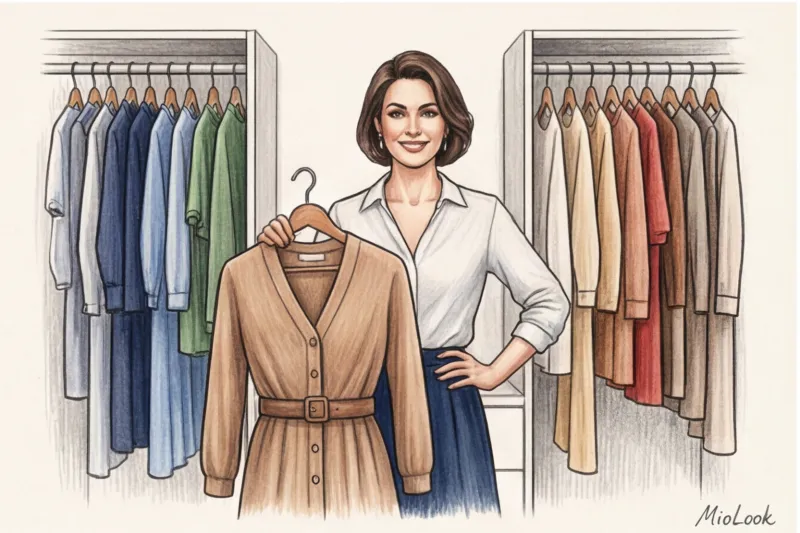
Today we've taken things to the next level. To automate the intersection process, I recommend using the digitization function in the MioLook app You simply upload your items, and the AI stylist builds that 3D matrix for you, suggesting where the "dead zones" are and how to pair that tricky cardigan so as not to break the texture rule.
A wardrobe matrix isn't a restriction of freedom, as many mistakenly believe. It's a way to eliminate daily micro-stress. Remember the main rule: the ideal wardrobe isn't one with too many items, but one where items complement each other, freeing up your time for what's truly important.