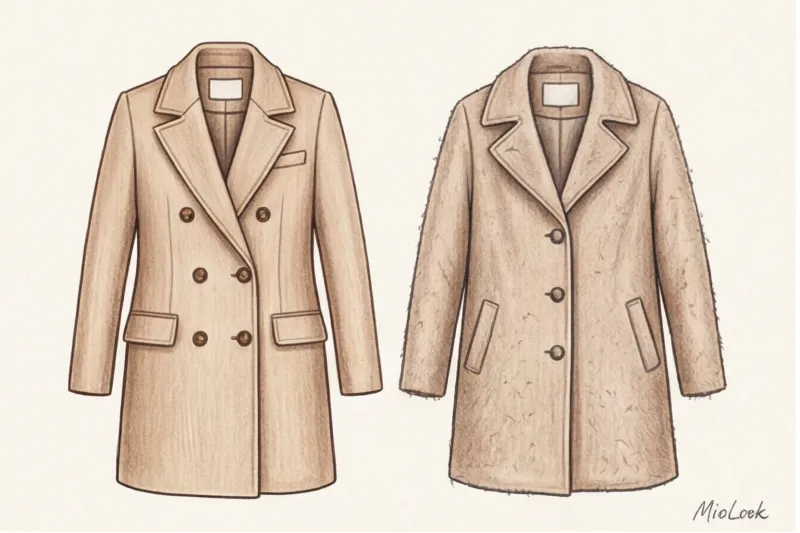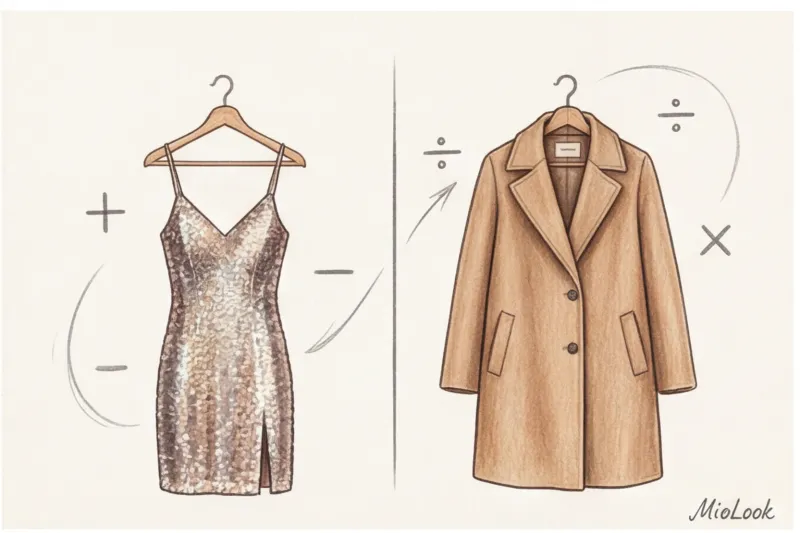
Have you ever noticed how an item with a red "Sale for €15" price tag instantly shuts down your critical thinking? We take it to the checkout with a feeling of absolute victory. But six months later, that "bargain" hangs forlornly in the far corner of the closet, worn exactly once. Meanwhile, that smart €250 wool jacket you spent a week thinking about buying saves you every other morning.
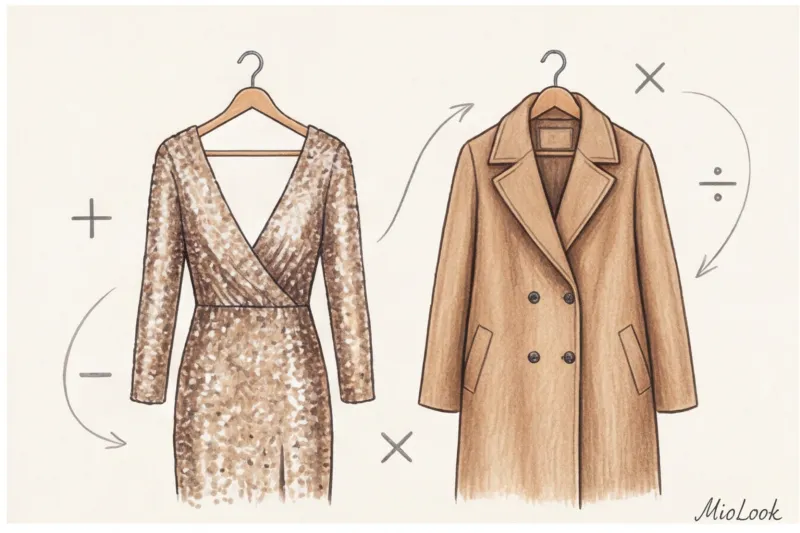
As a personal stylist with many years of experience, I regularly sort through wardrobes filled to the brim with items that "cost pennies" but ultimately cost their owners a fortune. The difference between an impulsive shopaholic and a woman with impeccable style lies in one simple tool: the ability to count. And that's where the math comes in. cost per wear (CPW) formula , or the cost of one output.
Today we're not just dividing the price by the number of days. I wrote more about how math helps you build the perfect closet in The complete guide to capsule wardrobe formulas In this article, I will share my own methodology. True CPW , which takes into account dry cleaning, emotional burnout, and destroys the main myth of fashion magazines about “investing in a basic white T-shirt.”
What is the Cost Per Wear (CPW) formula and why math beats intuition?
The basic Cost Per Wear formula is simple: you take the price of an item and divide it by the number of times you plan to wear it. Sounds logical, right?
"A cheap item on sale often turns out to be the most expensive purchase in your wardrobe if you only wear it once in your life."
According to a large-scale study by WRAP (2023), the average woman wears only 20% of her wardrobe 80% of the time. The remaining 80% simply sits on hangers, creating visual clutter and that feeling of "a full closet, but nothing to wear." Intuitive shopping is based on emotion: we buy a lifestyle, a fantasy of a party, or a vacation on the Riviera. A mathematical approach brings us back to reality.
Let's compare. You buy a trendy neon dress from Zara for €40 for a single party. You wear it once, take a photo for social media, and never wear it again. Cost per outing (CPW) = €40.
That same month, you buy a pair of basic genuine leather loafers from Massimo Dutti for €120. Over the course of a year, you wear them to work, walks, and meetings at least 80 times. Your CPW = €1.50. The loafers, which seemed three times more expensive at the checkout, actually cost you 26 times less than the dress.
A classic CPW error: why the online formula is wrong
The problem with the classic CPW calculator is that it exists in a vacuum. As a stylist, I'm categorically against blindly dividing the price into days. It creates a dangerous illusion.
Firstly, fabrics have different tensile strengths - depreciation Thick polyester can survive 100 cycles of aggressive washing, but a thin cashmere sweater, if improperly cared for (or accidentally thrown into the washing machine at 40 degrees), will lose its appearance after three washes. Research Ellen MacArthur Foundation confirms the frightening fact that, on average, a modern item of clothing is worn only 7–10 times before being thrown away.
Secondly, there is emotional wear and tear One of my clients loved buying sequined and intricately cut items, justifying it by saying, "The CPW will be low, and I'll wear it every weekend!" But you'll get tired of an ultra-trendy item long before it rips. The human psyche is such that bright, colorful items quickly become boring, both for us and for those around us.

Hidden costs: dry cleaning, repairs and maintenance
Another blind spot in the classic formula is the cost of maintenance. You can't calculate the true cost of an item without budgeting for its upkeep.
I had a client who bought a stunning light-colored coat (wool and 10% cashmere) for €300. A great price for such a blend! But the color was so easily soiled, and the fabric picked up lint so quickly in the machine, that she had to dry clean it every month. With dry cleaning at €25, she spent €100 on care per season. Over three years, the cost of care exceeded the cost of the coat itself. The same goes for light-colored suede shoes or delicate silk blouses. Every cleaning inexorably lowers your CPW.

Stylist's Formula (True CPW): How to Calculate the Real Cost
Over the years of working with women's wardrobes, I have developed my own, more honest formula, which I call True CPW This is what it looks like:
True CPW = (Item Price + Expected Care Cost) / (Number of Outlets × Compatibility Factor)
What's happened Compatibility coefficient It's an architectural approach to wardrobe. A garment doesn't exist in isolation; it always works as part of a team. If a luxurious skirt doesn't coordinate with what's already in your closet, its coefficient approaches zero, meaning True CPW goes to hell.
Compatibility coefficient: the rule of three images
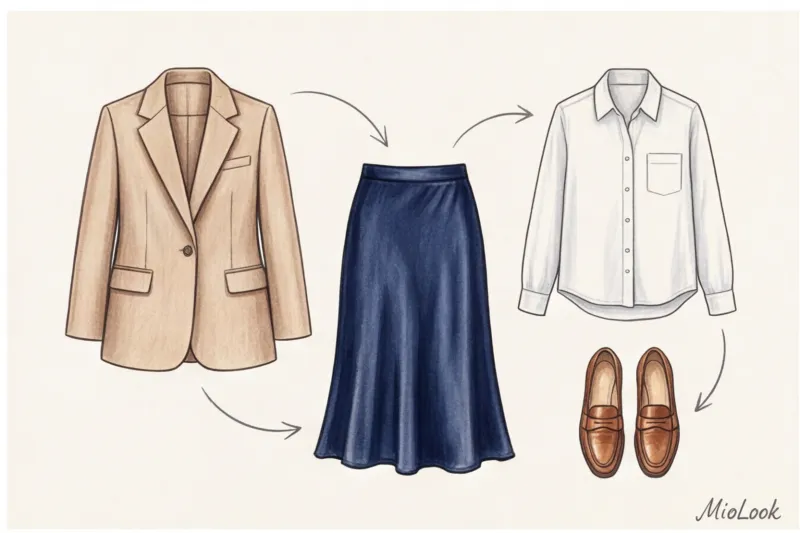
I always teach girls a strict rule: standing in front of the checkout, close your eyes and mentally create at least three completely different looks with this item, using ONLY the clothes you already have at home.
For example, you buy a tweed jacket.
1. Jacket + your favorite blue jeans + white sneakers = casual for the weekend.
2. Jacket + silk midi skirt + loafers = classy casualness for the office.
3. Jacket + black classic trousers + pumps = evening out.
Got it? Bingo! The compatibility factor is high. But if in order to wear this jacket you need buy more A special top, a matching bag, and new ankle boots—return them to the hanger immediately. This isn't an investment, it's a financial black hole.
Your ideal image
it begins Here
Join thousands of users who look flawless every day with MioLook, choosing items with the highest combination coefficient.
Get access — €0.99 onceDebunking the Myths: What's Really Worth Investing In?
And now I will say something for which my colleagues in the industry often criticize me. Stop investing huge amounts of money in basic white t-shirts! For years, fashion magazines have been telling us: "Buy one perfect T-shirt for €150 and it will last you forever."
This is a complete myth. White cotton—even the most premium Egyptian 200g/m²—yellows from sweat. It's broken down by the enzymes in your deodorants. It turns gray after the twentieth wash. A €20 T-shirt from COS or Uniqlo and a €150 T-shirt from a luxury brand will look equally bad after a year of heavy wear. This is where CPW from expensive brands fails miserably.

So where should the budget be directed? My golden rule is: The closer to the body, the cheaper; the further from the body, the more expensive..
- Underwear, T-shirts, tank tops: Consumables. Buy high-quality mass-market ones (20–40 €) and replace them once a season without regret.
- Knitwear and denim: Mid-range. Look for good wool and a good fit (€80–€150).
- Outerwear, bags, shoes and belts: Investment zone. They are what give an image status.
A leather belt with a simple buckle for €250 will last you 10 years and be worn thousands of times (CPW = €0.02). A perfectly tailored wool coat will set the tone for your entire winter wardrobe. These are true champions of style math!

Wardrobe Mathematics in Practice: 3 Visual Examples
To fully flesh out the theory, let's look at some real-life scenarios from my wardrobe review experience. The numbers speak for themselves.
Scenario 1: A "Cheap" Dress for New Year's
My client Anna bought a sequin dress for €100. She wore it once to a corporate event. Dry cleaning after the party cost €20. She felt awkward trying to wear the same look again the following year at the same company.
True CPW = (100 € + 20 €) / 1 = 120 €.
Scenario 2: A Perfectly Tailored Jacket
That same Anna, with a heavy heart, bought a heavy wool blend blazer for €300 on my recommendation. She wore it to the office, to parent-teacher conferences, and draped over her shoulders on summer evenings—about 150 times over two years. Dry cleaning twice a year (€40).
True CPW = (300 € + 40 €) / 150 = 2.26 €.
Scenario 3: Cheap Shoes, Expensive Price
Buying trendy faux leather boots for €50, they tore at the folds after 30 days. The last price seems pleasant—around €1.60. But that doesn't account for bloody feet, the unpleasant smell of synthetic materials, and a ruined mood. This is a case where math collides with physiology: you can't skimp on the last.
Of course, I have to be honest: the CPW formula doesn't work For targeted emotional purchases. A wedding dress or dream shoes for graduation don't have to pay for themselves mathematically. Their purpose is to give you a fortune that will remain forever in photographs. But such items should make up no more than 5-10% of your closet.
Instructions: Pre-purchase checklist based on the Cost Per Wear formula
Mindful shopping requires discipline. Livia Firth, founder of Eco-Age, launched a wonderful initiative. #30Wears This is the gold standard for an eco-friendly and cost-effective wardrobe. Before you take an item to the checkout, ask yourself four questions:
- Will I be able to wear this at least 30 times? If the answer is “no” (the item is too bright, uncomfortable, or not suitable for the climate) – leave it in the store.
- Does the item require complex care? Should I dry clean this silk, or is it easier for me to machine wash the viscose?
- Does it fill a gap in your wardrobe or duplicate what you already have? You don't need a fifth pair of straight-leg blue jeans, even if they're 70% off.
- Do I feel like a million bucks in it? A thing can be perfectly practical, but if it doesn't make you feel happy and confident, you won't wear it.

Access to MioLook for €0.99 — one-time payment
A smart AI stylist will create the perfect look based on the items you already own and help you reduce the cost of each purchase.
Get access — €0.99 onceAutomating Calculations: How MioLook Helps Build a Smart Wardrobe
I know what you're thinking: "Isabella, I don't want to walk around the mall with a calculator and a notepad!" Style math doesn't have to be boring. In 2024, you no longer need to remember every combination.
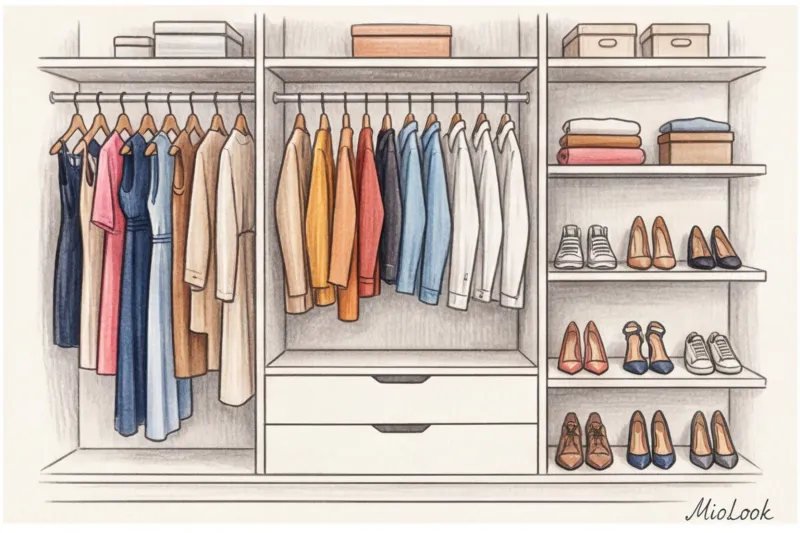
Digitizing your wardrobe is a transition from intuitive chaos to a clear, beautiful system. When you upload your items to the app MioLook , the magic happens automatically. You clearly see what you actually wear and what's just taking up space. Artificial intelligence generates new looks from your old items, automatically increasing the "combinability coefficient" and rapidly reducing the CPW of clothes you almost forgot about.
Calculating Cost Per Wear isn't about saving on yourself or boring, dull items. It's about respecting your money and your comfort. By buying clothes wisely, we free up our budget for what really matters—quality relaxation, luxurious perfumes, dinners with loved ones, and experiences.
Remember the main thing: in the store you pay for the fabric and the cut, but You always invest in the confidence with which you will wear this item every day And this is the currency that pays for itself the fastest.