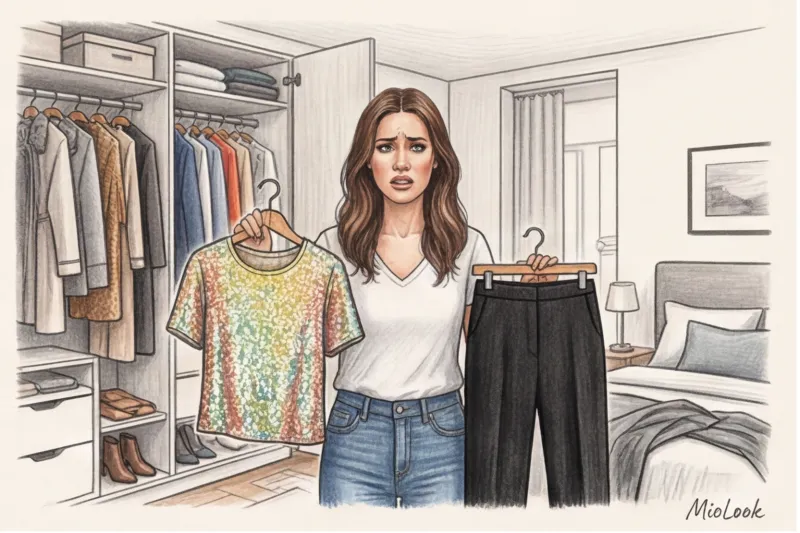
Last week, I was sorting through the closet of a new client, a top manager at an IT company. A mountain of 15 pairs of excellent jeans and trousers lay on the bed, and next to it, a forlorn stack of five T-shirts and a couple of shirts. Her main concern was the classic: "I have a full closet, but I have absolutely nothing to wear; I look the same every day."
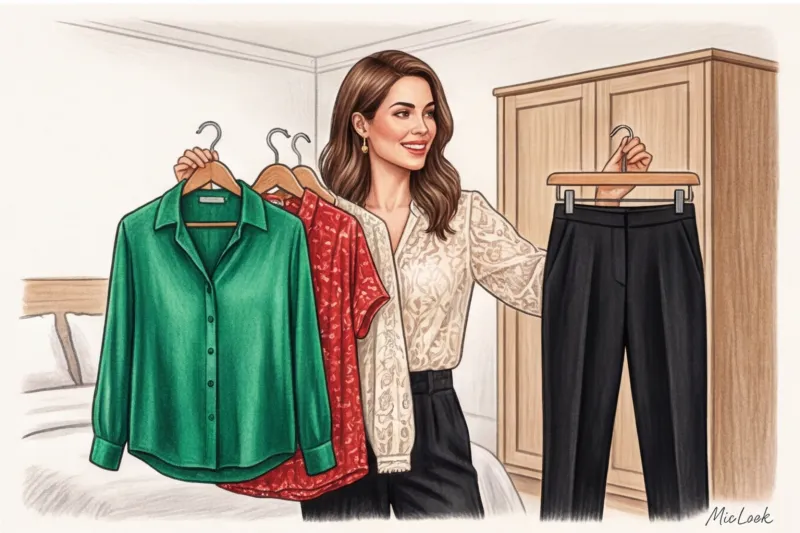
This situation is not the exception, but the rule. In 12 years of working as a stylist and colorist, I see this mistake in eight out of ten wardrobes. We intuitively buy bottoms, trying to find the perfect fit, and forget that it's the tops that provide visual variety.
In this article, we won't be talking about style in abstract terms. We'll be exploring the mathematics and psychology of wardrobe design. We've already covered the basic principles of wardrobe design in more detail in our The complete guide to capsule wardrobe formulas , and today we will focus on the most important rule that will forever rid you of the problem of “nothing to wear” - the right the ratio of tops to bottoms in the wardrobe.
What is the "golden ratio" and the ideal ratio of tops and bottoms in a wardrobe?
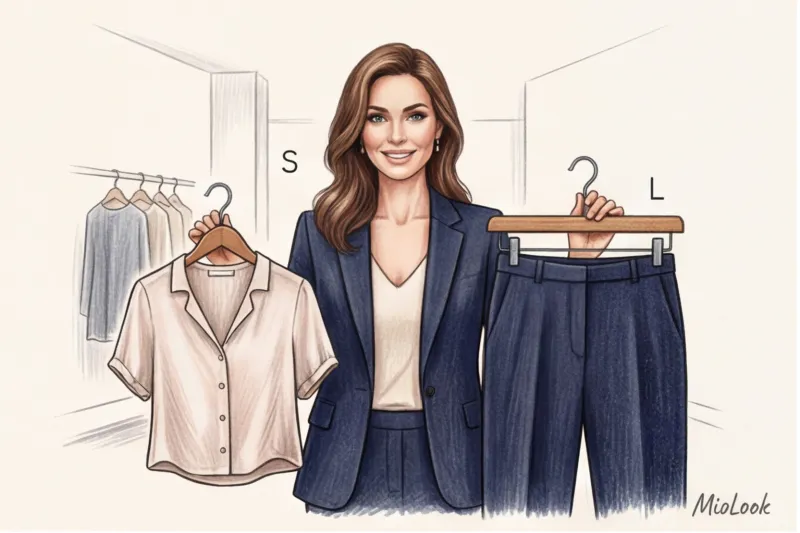
A wardrobe isn't a museum of beautiful things; it's a construction kit. And like any construction kit, the laws of mathematics apply. The "golden ratio" of a wardrobe is a ratio where there's one waist piece (bottom) for every three to five shoulder pieces (tops).
Why is the 1:1 formula guaranteed to fail? Imagine you have 5 pants and 5 blouses. Psychologically, you'll likely split them into 5 fixed pairs. Result: 5 looks. But if you have the same 10 items, but in a ratio of 2 bottoms to 8 tops, you get 16 unique combinations (2 x 8). The math works in your favor, saving closet space and budget.
"A smart wardrobe is when a minimum number of bottoms is served by a maximum number of tops, creating the illusion of endless choice."
Psychology of Perception: Why Do the Elites Play the Leading Role?
Have you ever noticed that colleagues rarely remember what pants you were wearing yesterday? According to a 2024 study by WGSN, which examined perception patterns in the era of hybrid work, 80% of a conversation's attention is focused on your "portrait zone"—from the chest up.
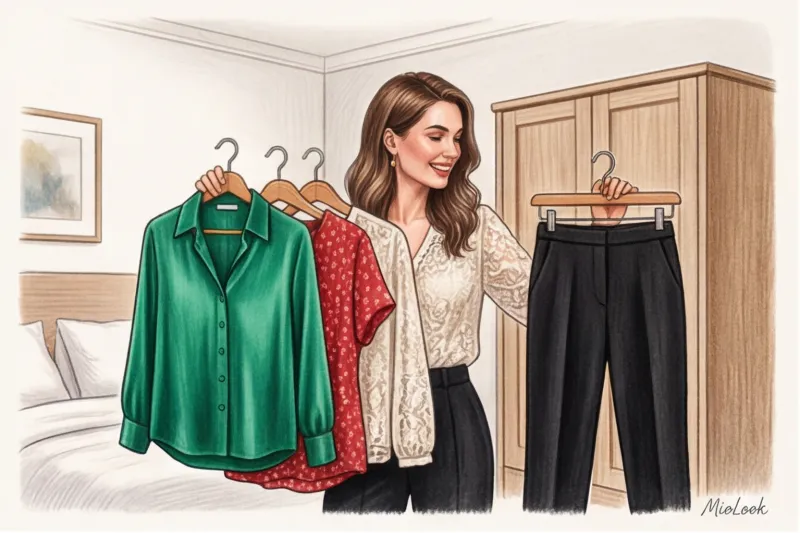
This is where the illusion of a new outfit is created. If you show up in the same navy blue palazzo pants three days in a row, but swap the white shirt for an emerald silk top, and then for a textured cardigan, to those around you, you'll appear to be wearing three completely different outfits. Switch things up (three pairs of trousers and one shirt), and people will think you haven't slept at home.
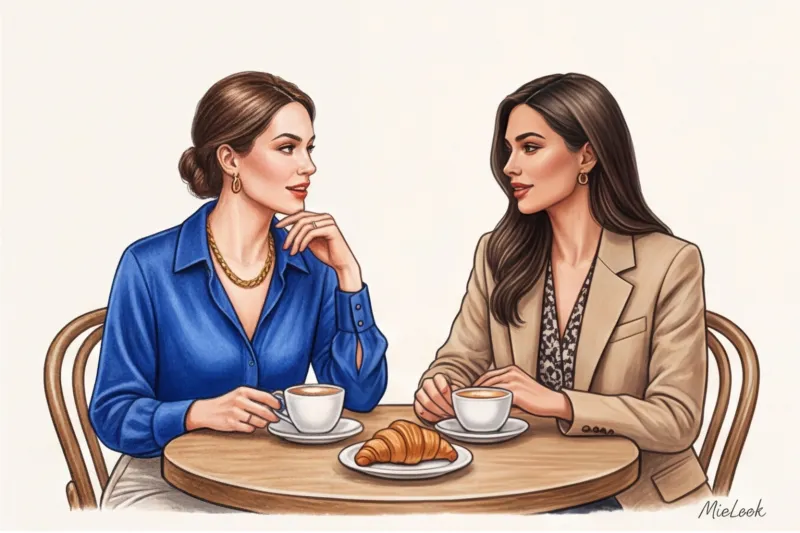
As a certified colorist, I always emphasize: the color of your bottoms doesn't affect the freshness of your complexion. It only affects your figure's proportions. But the shade of your face can visually "erase" wrinkles, conceal the signs of a sleepless night, or, conversely, highlight under-eye circles. Therefore, it's the tops that require the most variety and precision in your palette.
Practicality and wearability: the hidden factor that is often forgotten
There's also the harsh reality of everyday life—washing frequency. Blouses, shirts, and especially T-shirts that fit close to the body are washed after 1-2 wears. Heavyweight denim jeans (12 ounces and up) or wool suit pants can last 5-10 wears without washing (airing and steaming are sufficient).
Cotton with a density of 150–180 g/m² (a standard T-shirt) wears out and loses its appearance three times faster than heavy suit bottoms. Therefore, tops should mathematically be your "consumable material," physically requiring more of it.
Your ideal image begins Here
Join thousands of users who look flawless every day with MioLook. Our AI stylist will help you calculate the perfect proportions for your wardrobe.
Get access — €0.99 onceStylist's Practice: How to Calculate Your Formula (3:1, 4:1 or 5:1)?
The basic rule of "3 tops to 1 bottom" is just a starting point. Over the years, I've learned that the ideal ratio of tops to bottoms in your wardrobe should adapt to your lifestyle.
- Formula 3:1 (Smart Casual): A versatile essential. Perfect for those working in creative industries or with a relaxed dress code.
- Formula 4:1 (Corporate Office): If you sit at your desk for eight hours a day, or your work consists of endless Zoom calls, your bottom is hidden under your desk, so versatility in your portrait area is critical. I implemented this very formula for a lawyer client who complained about her "boring" work wardrobe.
- Formula 5:1 (Mothers on maternity leave and active professions): The risk of staining a T-shirt with baby food or paint is extremely high. This requires plenty of inexpensive, easily washable tops and two or three pairs of durable jeans and joggers.
Fair Limit: This rule doesn't work well for women whose wardrobe consists of 80% dresses. A dress is a self-sufficient unit (1:0), and different rules of layering and accessories apply there.
The role of the second layer (jackets, cardigans) in the formula
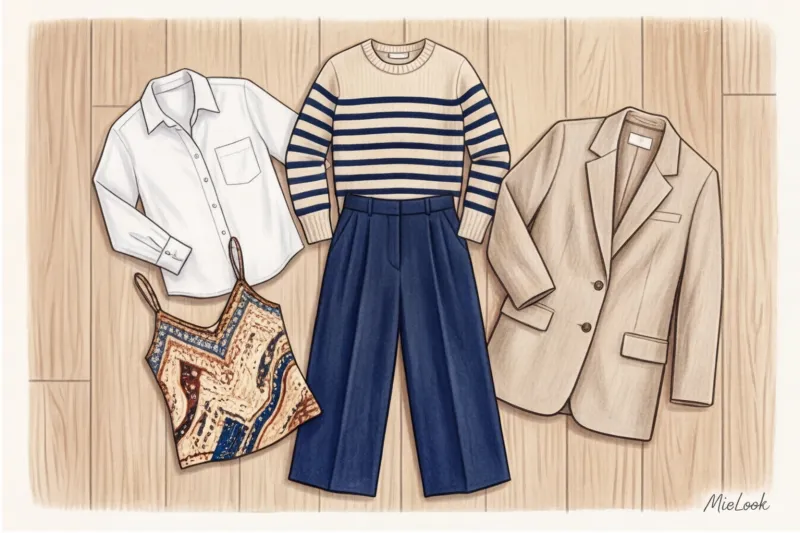
The second layer is a multiplier. If you have two bottoms and four first layers (tops, t-shirts), you get eight looks. Add just two jackets of different cuts, and the number of options skyrockets to 24. I give the second layer its own space: for every two or three basic tops, there should be one high-quality jacket, vest, or cardigan.
The biggest shopping mistake: where we invest our budget
There's a popular style myth: "Spend the most money on items that are close to your face." I'm willing to argue with that. In fact, the biggest mistake is buying cheap, ill-fitting pants and blowing your budget on expensive designer T-shirts.
The perfect fit of trousers or jeans requires complex cutting, darts, proper balance, and high-quality hardware. Budget-friendly mass-market clothing often skimps on patterns. Therefore, your bottoms should be the most expensive items in your closet. We wrote more about how to choose these investment pieces in our article about Basic wardrobe and checklists for creating it.
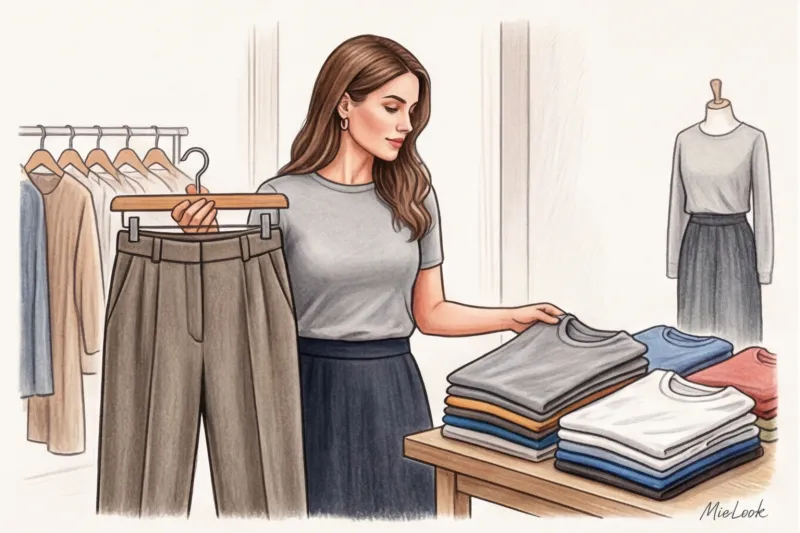
My advice, which often surprises my clients, is to spend €150–€200 on one perfect pair of wool trousers (e.g., Massimo Dutti or local premium brands) and pair them with six cotton tops for €25–€40 (e.g., Uniqlo, COS). The Cost Per Wear rule proves that expensive trousers worn 100 times a year will cost you €1.50 per occasion. Cheap trousers for €40 that will sit in your closet because they fit poorly are a waste of money.
Access to MioLook for €0.99 — one-time payment
A smart AI stylist will select the perfect look, suggest which items are missing for balance, and calculate the Cost Per Wear for each item.
Get access — €0.99 onceColor and Proportion: How Color Controls Attention
As we've already established, the balance of tops and bottoms in a wardrobe is not only about quantity but also about color. According to the PANTONE Color Institute, the correct distribution of color blocks can dramatically change the perception of a silhouette.
- Light top + dark bottom: A classic that always works. It visually broadens the shoulders and slims the hips, lightening the silhouette.
- Monochrome: If the top and bottom are the same tone (for example, a beige sweater and beige trousers), the line between them is blurred, which visually increases your height by a couple of centimeters.
- Prints and patterns: Geometric or floral patterns always draw the eye. If you want to draw attention away from wide hips, choose statement-making, brightly colored tops with complex cuts and minimalist, matte bottoms.
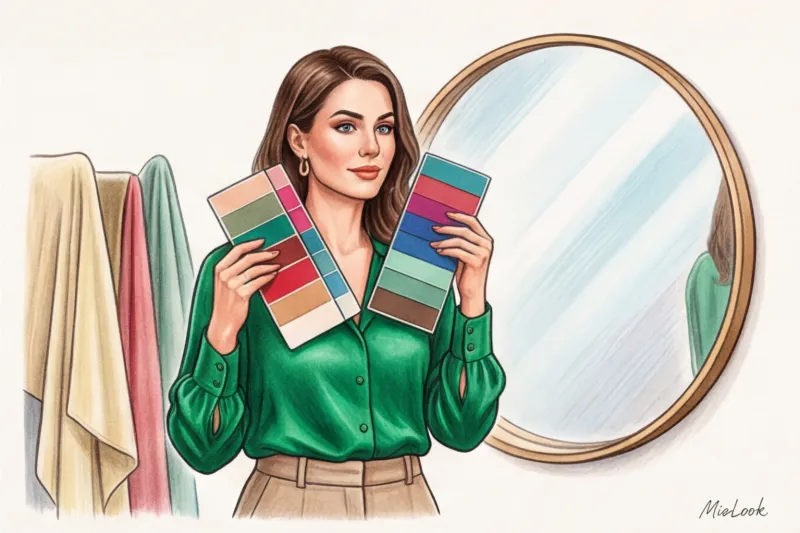
If you've bought a trendy item in a complex but objectively "not your" color (for example, a trendy neon lime that makes your face look sallow), always tone it down. Buy a skirt in that shade, and keep a tried-and-true base color around your face. Your face dictates the color palette for your tops, but your bottoms can be anything.
Checklist: Audit Your Current Wardrobe in 15 Minutes
Ready to test your closet math? No need to plan a spring cleaning all weekend. Do it tonight in 15 minutes:
- Put on your bed only those things that you wear in the current season (summer linen shorts in winter don’t count).
- Set the dresses aside - they are not included in this calculation.
- Place all bottoms (jeans, trousers, skirts) in one pile, and the first layers (tops, t-shirts, shirts, thin sweaters) in another.
- Calculate. What figure do you get?
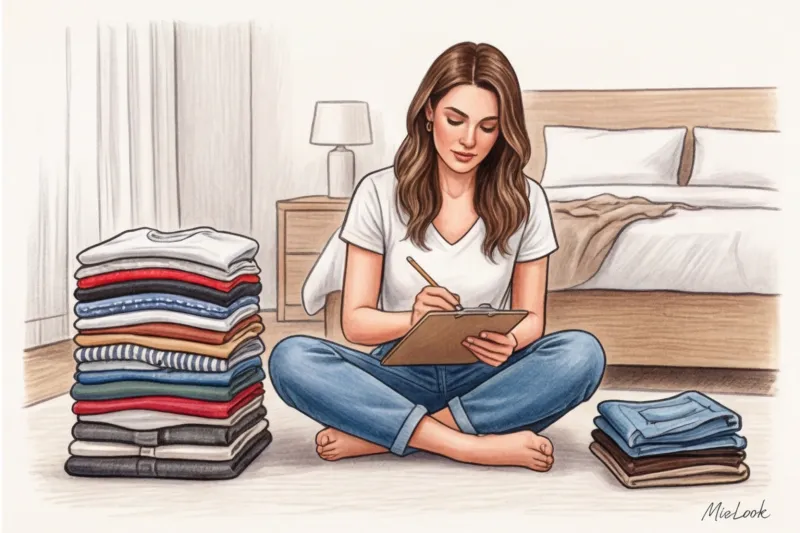
If you've reached a 1:1 ratio, or worse, more bottoms than tops, congratulations, you've found the root cause of your "nothing to wear" problem. For the next month, institute a strict rule: a complete ban on buying new jeans and skirts. Focus only on high-quality, interesting tops and second layers.
To avoid doing this manually, you can digitize your items. By uploading photos of your clothes to MioLook , you'll automatically receive statistics by category. The app will automatically alert you if your balance is out of balance and suggest new combinations based on what you already have.
Integration: How the Right Balance of Highs and Lows Builds a Capsule
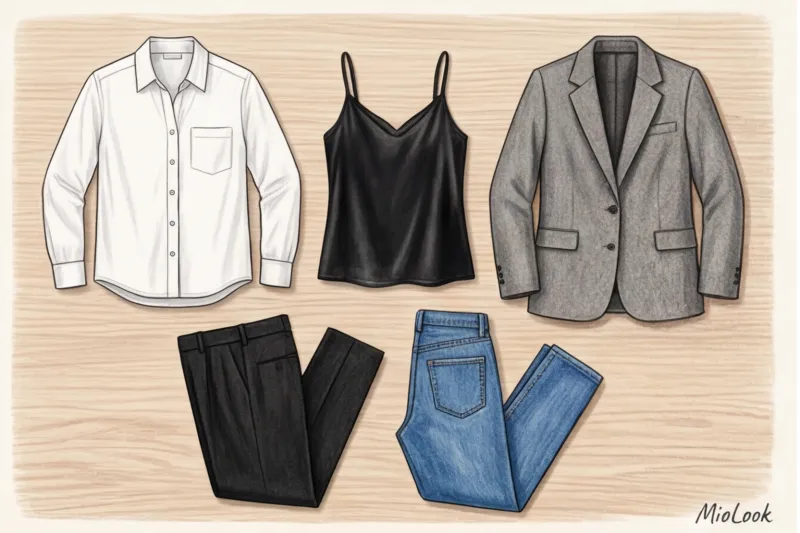
Building a capsule wardrobe always starts with the foundation. By choosing two perfectly fitting bottoms (for example, navy straight-leg jeans and graphite wool palazzo pants) and adding 6-8 different tops (from a basic white T-shirt to a statement silk blouse), you create a solid stylistic framework.
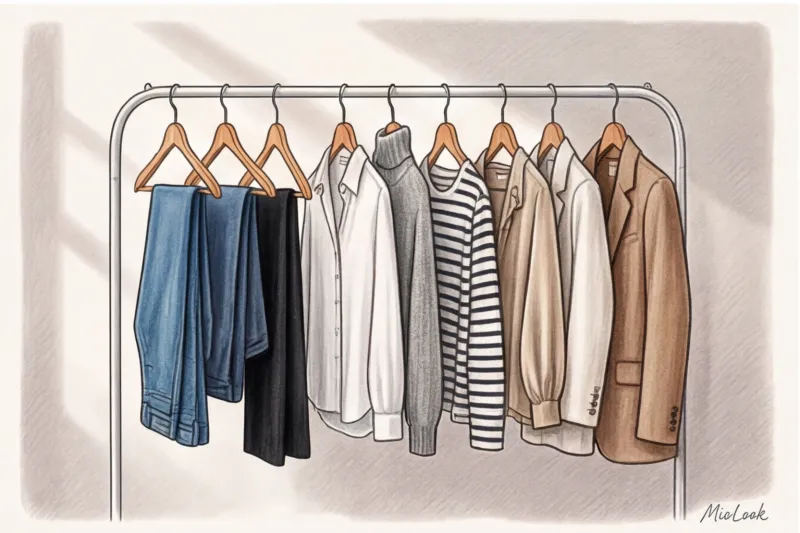
Intuitive, emotional shopping always disrupts the wardrobe math. We buy the tenth pair of jeans because "they're a little different," even though to others they look like the same thing. Discipline, on the other hand, creates impeccable style and saves you time in the morning.
The next time you're tempted to grab another pair of pants on sale, ask yourself this question: "Do I have three different tops to wear this with?" If the answer is no, feel free to return the item to the hanger.