Let's be honest. In twelve years of working as a personal stylist, I've seen hundreds of closets, and almost all of them suffer from the same problem. A typical scene: standing in front of me is a successful woman, say, a top manager or business owner. Her closet is overflowing with silk, cashmere, and hangers from Massimo Dutti. But when we start putting together looks for the week, a disastrous disparity emerges: twenty pairs of tailored trousers and only five shirts.
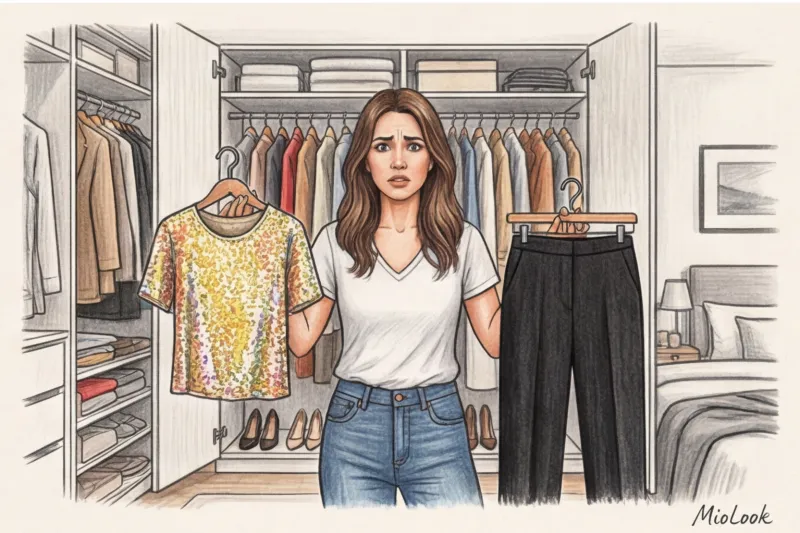
“I have absolutely nothing to wear,” she sighs, pulling out another pair of black pants with a tag.
This is where the right thing comes into play. formula for a basic business wardrobe This isn't a boring list like "10 things every woman must have" (I hate those lists). It's a mathematical algorithm that works like a LEGO set. You build a system once, and it eliminates morning panic forever. I discussed the architecture of such systems in more detail in our The complete guide to capsule wardrobe formulas.
Why Intuitive Shopping Loses to Math
Have you ever bought a stunning tweed jacket simply because it has "nice buttons" and fits you perfectly? You bring it home, and it sits in your closet for six months because you don't have the right bottoms to go with it. It's a classic victim of emotional shopping.
A global study by the British organization WRAP (2023) confirmed what stylists have long known: on average, women wear only 20% of their clothes 80% of the time. It's a classic example of the Pareto principle in your closet. The remaining 80% is that dead weight: single items, impulse buys, and clothes "for that ideal version of me who will lose weight by summer."
A business wardrobe doesn't tolerate intuition. It demands cold calculation. If you're tired of chaos, the first step is to digitize what you already have. My clients often use the virtual closet feature in MioLook to clearly see your purchasing imbalances. Once you transfer items into the app, the math becomes clear.
Access to MioLook for €0.99 — one-time payment
A smart AI stylist will select the perfect look for every day and help you organize your closet.
Get access — €0.99 onceThe main equation: the proportion of "Top" and "Bottom"
Let's get back to my client with the twenty pairs of pants. Why wasn't her wardrobe working? A rookie mistake is buying skirts, pants, and blouses in a 1:1 ratio. It's a mathematical dead end.
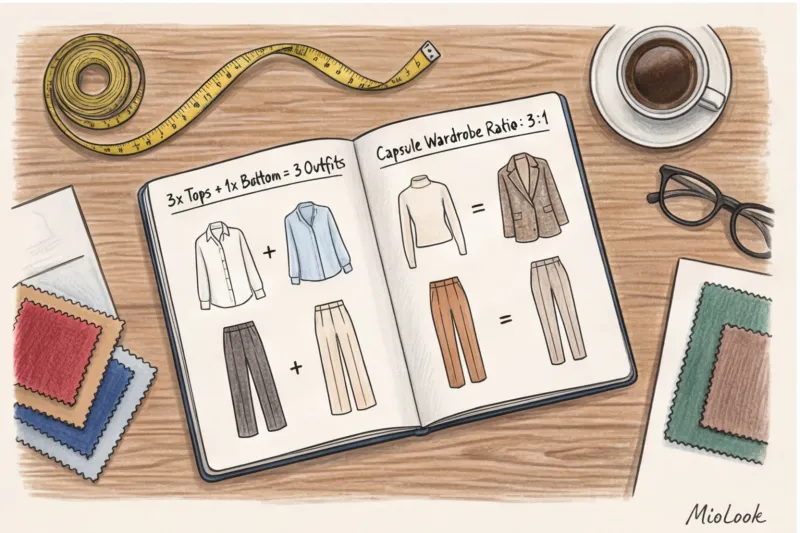
The golden ratio of office wardrobe is 3:1 rule For every "bottom" (pants or skirt) you buy, you should have at least three "tops" (blouses, shirts, thin jumpers).
Why does this work? It's all about the psychology of perception. People you interact with in the office or on Zoom focus on your portrait zone. They look at your face. No one (except the most meticulous colleagues) will notice that you wear the same perfect pair of graphite wool trousers three days in a row if you wore a light blue silk shirt on Monday and a light blue silk shirt on Tuesday. a smart top under a formal jacket , and on Wednesday - a cashmere turtleneck.
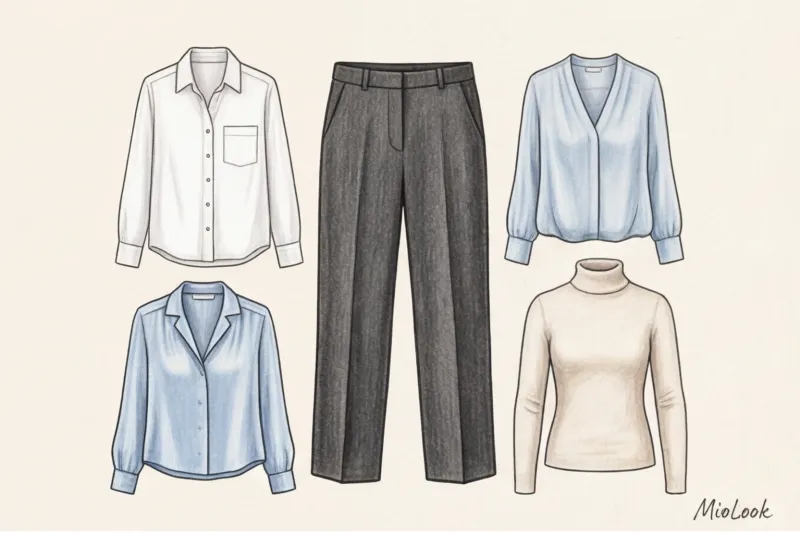
How the 3:1 rule works in practice
Let's do the math. Let's say you have two perfect pairs of trousers (black and camel). We buy six different tops to go with them.
2 x 6 = 12 unique combinations.
Now we add the magic of layering—just two "third layers" (a structured blazer and an elongated vest). Now each of the 12 combinations can be worn three ways: without a top layer, with a blazer, or with a vest.
12 x 3 = 36 looks from a basic set of 10 items. That's more than there are workdays in a month!
Your perfect look starts here
Join thousands of users who look flawless every day with MioLook. Upload your items and discover dozens of new combinations.
Get access — €0.99 onceWardrobe matrix: formula 50/30/20
If your basic business wardrobe consists exclusively of white shirts and black pencil skirts, you'll die of boredom within a week. The perfect closet requires a balance between formality and individuality.
- 50% - Rigid frame: This is your uniform. Impeccably tailored pieces in a neutral palette. Pleated suit trousers, midi skirts made of thick viscose, and blazers that hold their shape. Here, we look for fabric weight (for example, cotton from 180 g/m²) and a perfect fit.
- 30% - Adaptive elements: Smart casual softens the frame. These include colorful silk blouses, high-quality knitwear, and pinstriped shirts. They offer comfort and versatility.
- 20% - Accent variables: This is where your soul lives. It's micro-trends, bold shoes, and details that reflect your personal brand.
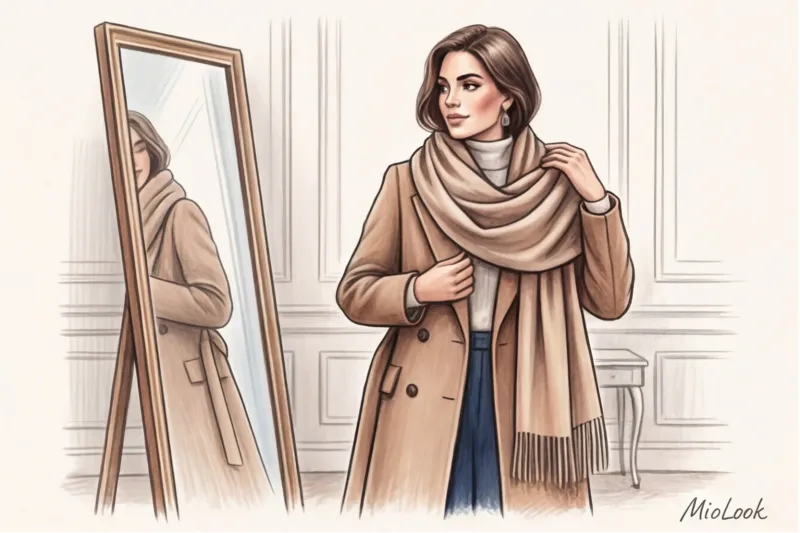
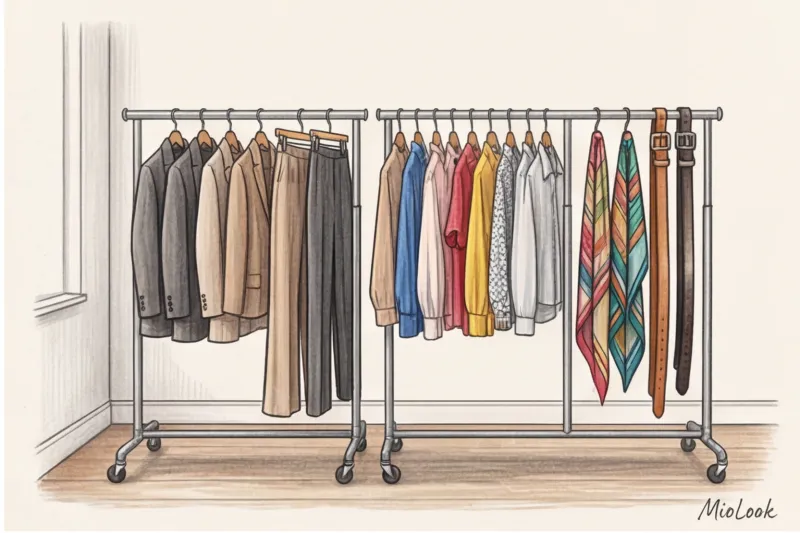
As a stylist with a Mediterranean temperament, I love playing with that twenty percent. A perfectly tailored but dry gray suit instantly comes to life with a vintage brooch and a bright scarf (be sure to read, How to style oversized scarves and shawls ) or wear a large bracelet. If you're worried about going overboard, check out the guide on How to wear chunky jewelry in the business environment.
Try MioLook: Smart AI Stylist
Finding it difficult to balance your base and trends? Artificial intelligence will find the perfect 50/30/20 ratio just for you.
Get access — €0.99 oncePayback Index: Calculating Cost Per Wear (CPW)
Now let's talk about budget. The biggest illusion in the fashion world is thinking that a cheap item saves money. In fashion economics, there's a hard-and-fast rule: Cost Per Wear. The formula is simple: the cost of the item + care costs (dry cleaning) divided by the number of times it's worn.
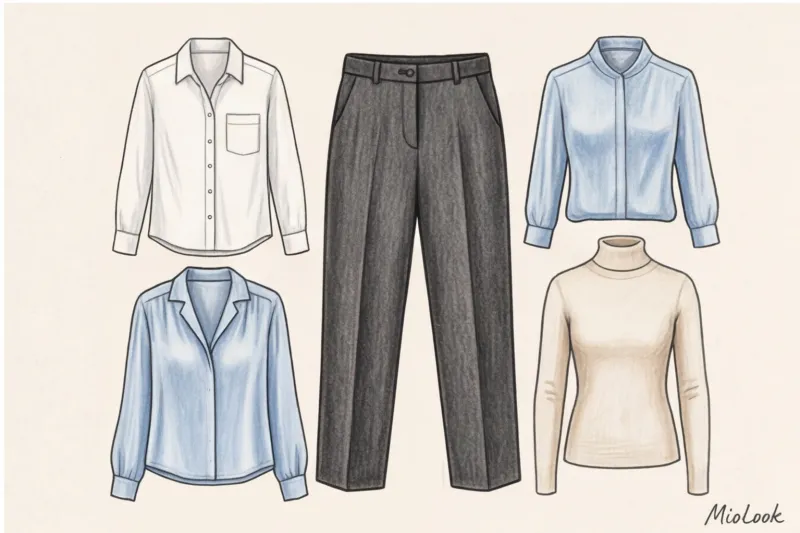
Let's look at some real numbers. Let's say you bought a trendy polyester blouse at a high-street store for €30. You wore it three times, after which it became covered in pills, and it turned out to be unbearably hot in the office. Your CPW = €10 per outing.
At the same time, you invested in a high-quality, thick silk blouse for €200. You wear it once a week year-round (52 times). Your CPW = €3.80 per outing. The expensive item turned out to be almost three times cheaper in use!
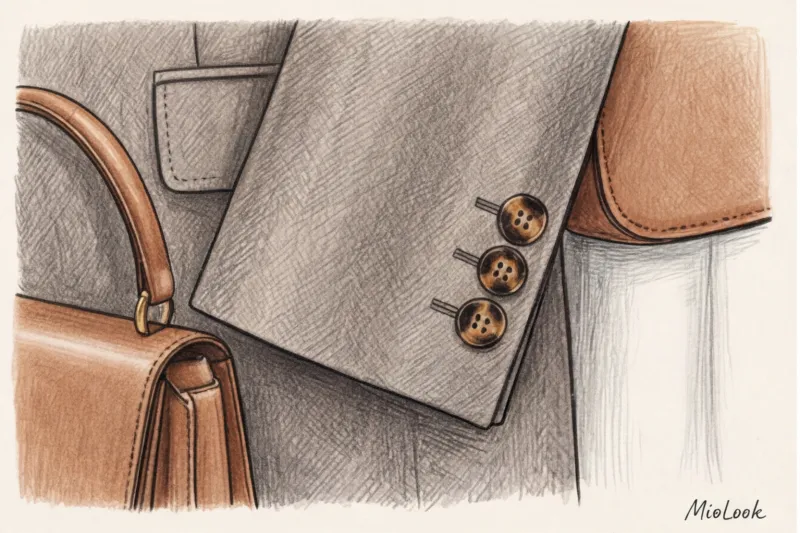
According to fashion platform Lyst's 2024 analytics, conscious consumers are increasingly opting for a "less, but better" strategy. My personal rule: Invest 70% of your budget in shoes, bags, outerwear, and jackets Basic T-shirts or turtlenecks can be found in the €30–€60 range, but €250 loafers made of soft leather will pay for themselves a hundredfold, unlike cheap €40 pumps that won't let you walk from your desk to the water cooler.
The Rule of Five: Compatibility Test
I have a favorite method of torturing clients in the fitting room. When a woman falls in love with something (like a fantastic asymmetrical fuchsia skirt) and begs me to buy it, I ask one question: "Name five things from your current closet that you would wear this with tomorrow?"
If she stumbles after the second item, the skirt stays in the store. Ruthless, but effective.
The Rule of Five is your strict filter for buying single items. Your mental fitting algorithm should include: two top options, shoes that fit without having to buy new ones, and outerwear that won't make the item stick out awkwardly.
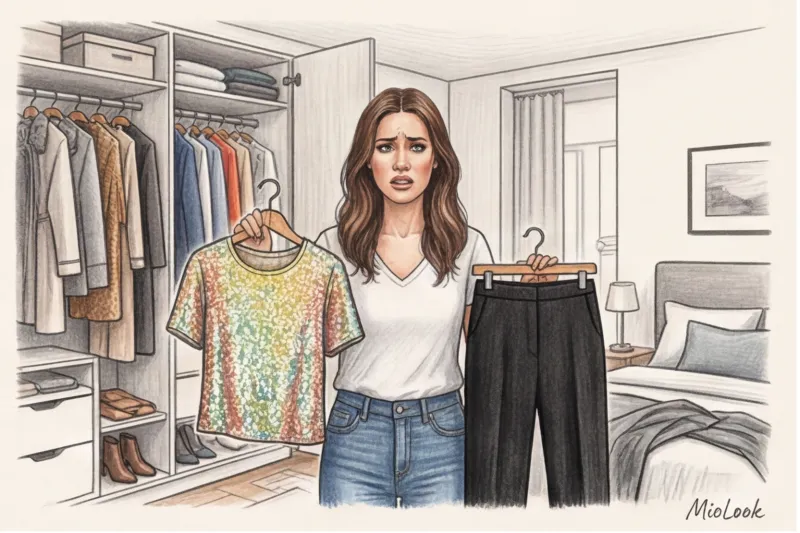
A stylist's honest confession: Does this rule always work? No. It is absolutely useless if we collect evening wardrobe A black tie dress or a sequined tuxedo can be worn once a year and not paired with your everyday sneakers. But for the office, the Rule of Five is law.
Common Mistakes in Office Math
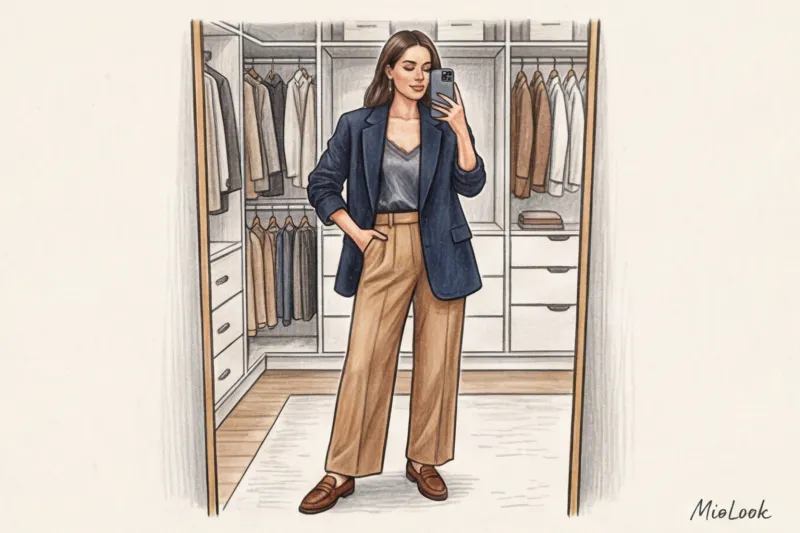
You know where the formula for a basic business wardrobe most often breaks down? It's because people try to simplify their lives by buying a classic two-piece suit. It sounds counterintuitive, but hear me out: Buying the same jacket and trousers for a start is a trap.
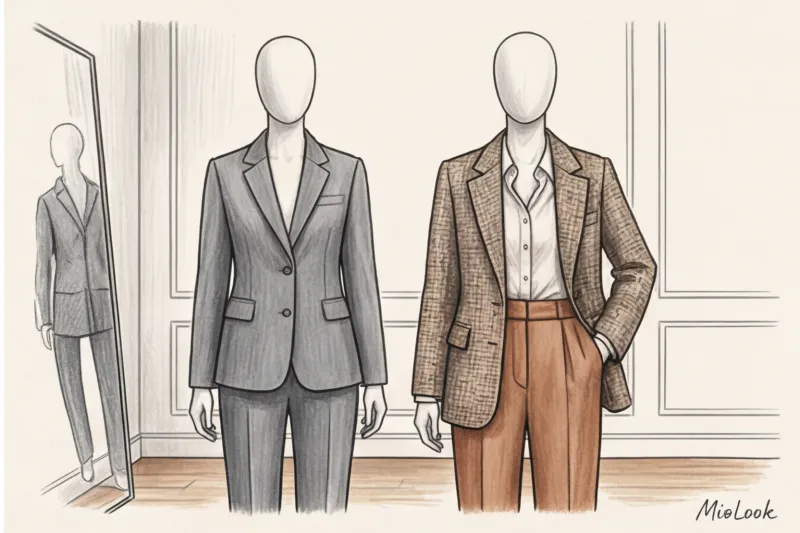
When you wear a tailored two-piece suit, you look like a 2010s bank clerk (unless it's a trendy oversized cut from The Row). But most importantly, the two-piece suit psychologically ties these pieces together. You start wearing them only as a pair.
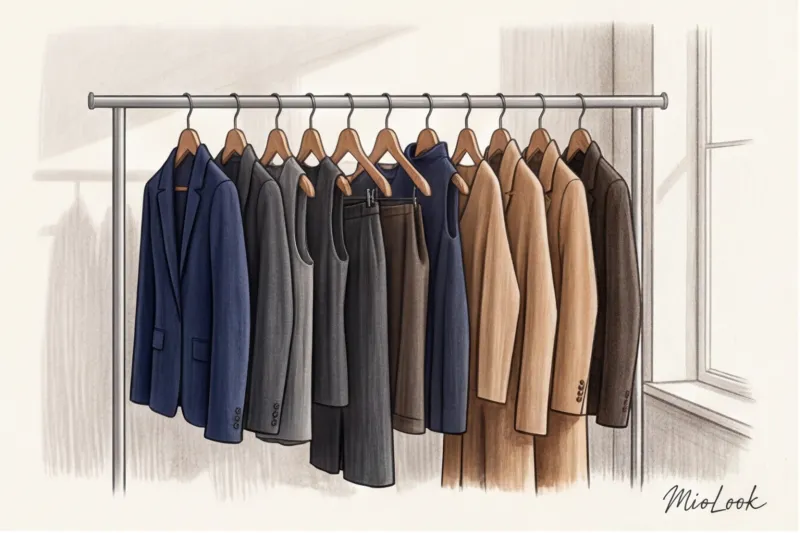
Mathematically, it is much more profitable to assemble a wardrobe from separatists — separate trousers and jackets that differ in color and, crucially, texture. For example: dark chocolate-colored ribbed wool trousers + a structured warm gray tweed jacket. This looks ten times more expensive and exponentially increases the number of looks. By the way, I wrote in detail about the art of combining materials in an article about a combination of textures in clothing and accessories.
Ready to get started?
Try the free plan—no commitments required. Upload your items to MioLook and see their compatibility index.
Get access — €0.99 onceChecklist: How to Build a Basic Business Wardrobe from Scratch
It's time to move from theory to practice. Here's your step-by-step action plan for the coming weekend:
- Digitization and audit. Take everything out of your closet. Donate or sell the items that don't fit you today. Keep only the rigid frame. Upload the base in MioLook for capsule generation.
- Selection of ideal "bottoms" (3 pcs.). Find trousers or skirts that fit perfectly. My advice: some dark, classic ones, some light or caramel ones (they instantly up the style ante), and some relaxed ones (like palazzo pants or quality dark jeans without any fading, if the dress code allows).
- Selection of "tops" (9-10 pcs.). Remember the 3:1 ratio. Include a white men's-cut shirt (cotton/poplin), a couple of silk blouses, basic tops (to tie under jackets), and a good cashmere or merino knit.
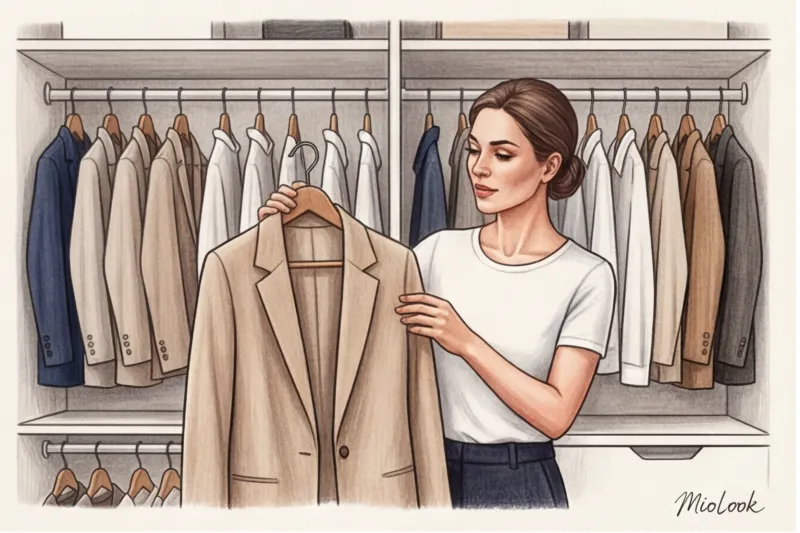
- Investment in the “third layer” (2-3 pcs.). A blazer that keeps the shoulder line in line, and perhaps a trendy suit vest.
- Accents. Pick up ideal accessories for your body type to breathe life into this mathematical model.
Math in your wardrobe doesn't kill creativity—it makes room for it. When you have a reliable, calculated foundation, you stop wasting your morning energy wondering "what to wear." You simply take the formula, plug in the variables, and go conquer the world. Confidently and incredibly stylishly.