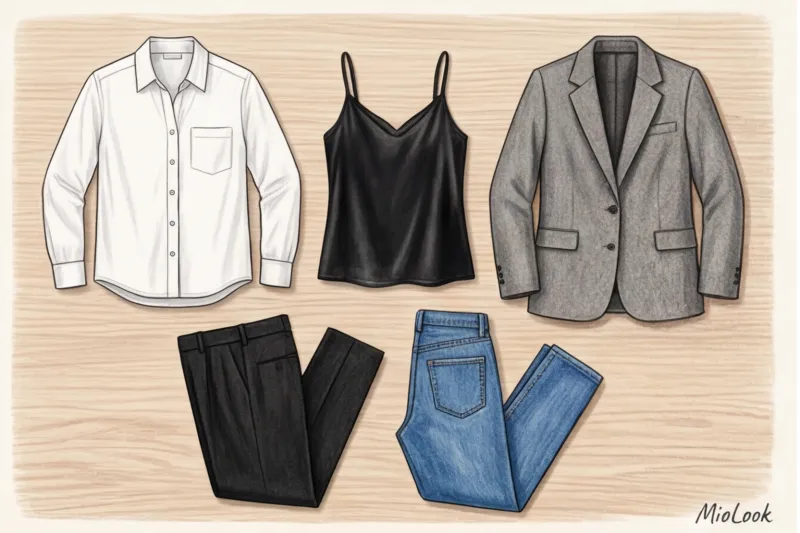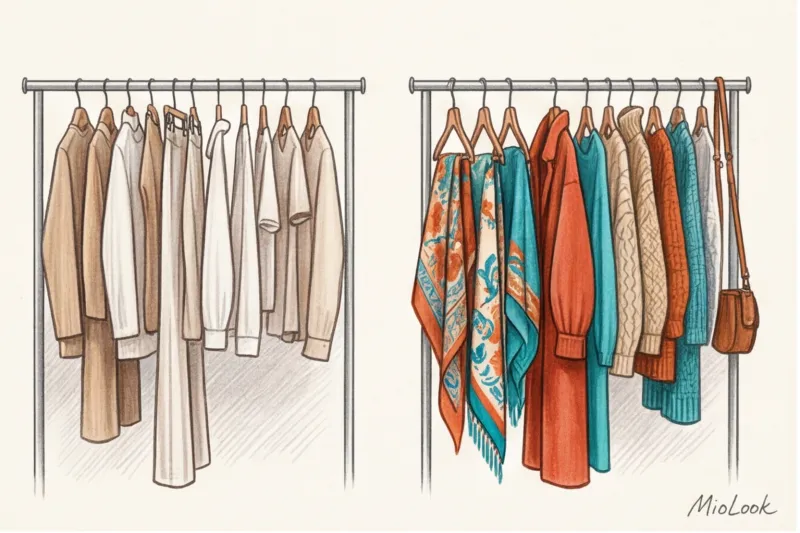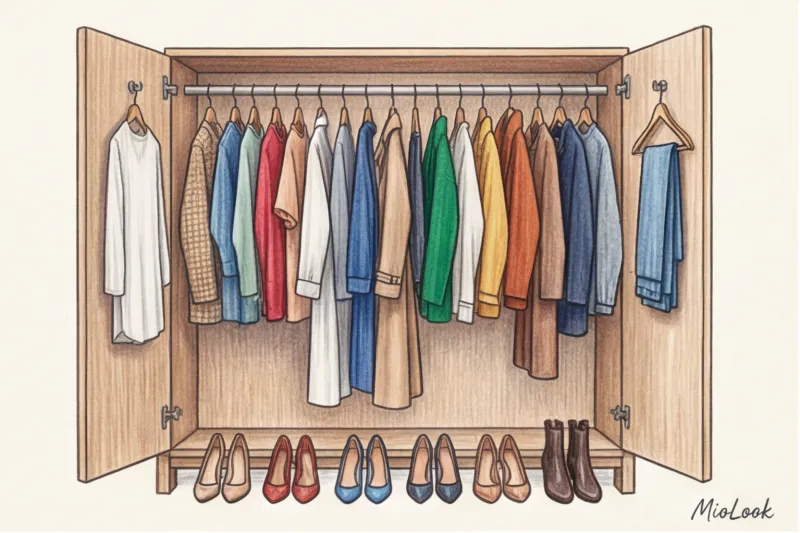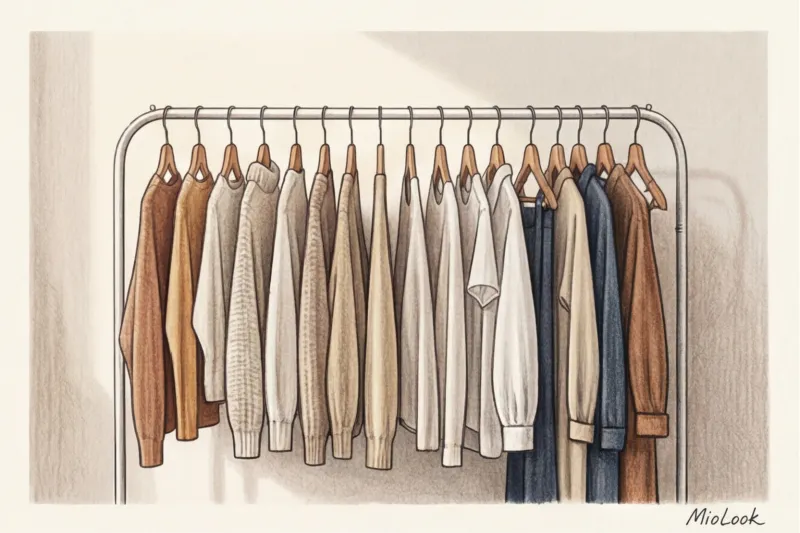
Have you ever felt like this: you're standing in front of an open closet with dozens of items crammed onto hangers, but your hand stubbornly reaches for the same pair of jeans and trusty sweater? According to the British organization WRAP, we wear only 20% of our wardrobe 80% of the time. The rest of our clothes wait for years for a "special occasion" or a special moment. To break this vicious cycle, I use... rule 5 4 3 2 1 wardrobe — a mathematically proven system that turns chaos on the shelves into a fail-safe mechanism.
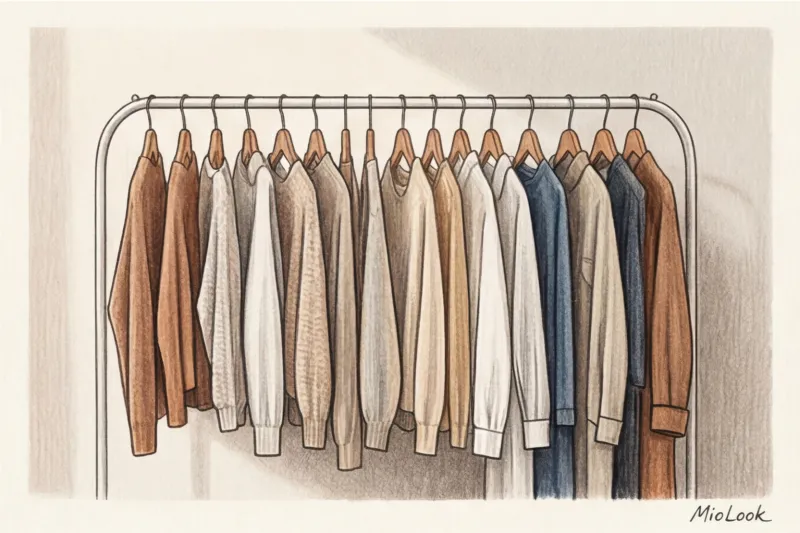
And no, this isn't another boring "just buy a white shirt and a beige trench coat" collection. As a textile expert, I'll teach you to look deeper: we'll talk about fabric density, seam durability, and textile synergy.
What is the 5-4-3-2-1 rule for a capsule wardrobe and why math beats intuition
Intuitive shopping is the main contributor to a closet full of "single items." You buy a beautiful blouse, but when you get home you realize you need a different pair of trousers, and then some new shoes. We covered this problem in more detail in our complete guide to capsule wardrobe formulas and the mathematics of ideal images.
The essence of the 5-4-3-2-1 formula is extremely specific. Your seasonal base consists of exactly 15 elements:
- 5 tops (tops, shirts, sweaters)
- 4 bottoms (trousers, jeans, skirts)
- 3 outer layers (jackets, cardigans, coats)
- 2 pairs of shoes (or 2 bags, depending on the focus)
- 1 accent (dress, belt or bright accessory)
Sound like austerity? Psychology says otherwise. Narrowing your options (the so-called paradox of choice) paradoxically expands your versatility. Simple math: 5 tops x 4 bottoms x 3 layers = at least 60 unique combinations. You could go to work for two months without repeating a single outfit using just 15 hangers.
Anatomy of the 5-4-3-2-1 Formula: Assembling the Capsule Base Without Errors
There are no universal "must-have" lists. This is the main misconception I constantly dispel during my consultations. The classic starched white shirt recommended by all fashion portals is absolutely useless in the 5-4-3-2-1 capsule wardrobe for a freelancer or a stay-at-home mom. The formula only defines a category, not a specific style. Your task is to choose items of varying volumes that can be layered.
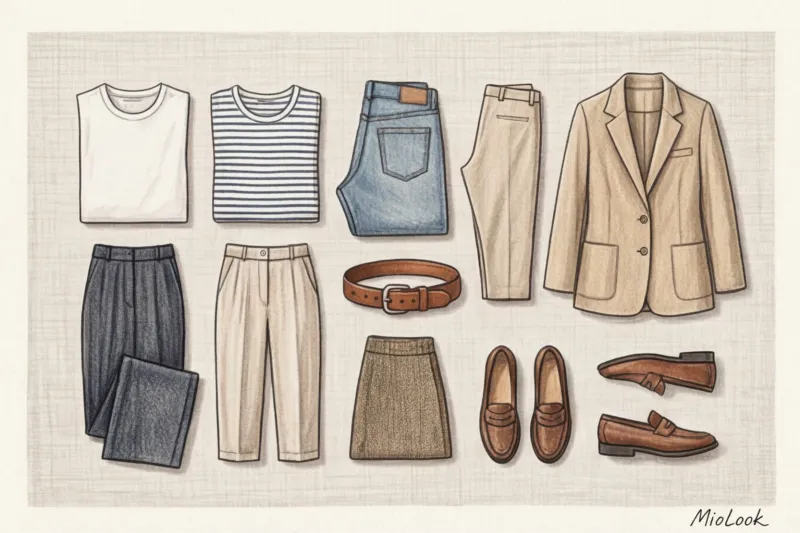
5 Tops: Playing with Density and Cut
Buying five identical cotton t-shirts in different colors is a recipe for disaster. Tops should address different temperature and style needs. The ideal breakdown looks like this:
- 2 base layers: thin and breathable (a T-shirt made of thick cotton from 180 g/m² or a silk top).
- 2 warming layers: textured and cozy (merino turtleneck, loose cashmere sweater).
- 1 accent top: A complex cut, asymmetry or a vibrant print for days when you want to stand out.
I always recommend exploring a variety of necklines in portrait areas. A V-neck elongates the neck, a round neck adds a sporty vibe, and a turtleneck adds a sophisticated edge. This instantly changes the mood of the look.
4 bottoms: silhouette balance
Bottoms bear the brunt of the mechanical stress: we sit in them, walk in them, and they rub against bags and outerwear. Therefore, the durability of the fabrics is paramount here. Choose heavyweight denim (12 oz and over), wool blends with 5% elastane to prevent stretching at the knees, or heavyweight twill.
You'll need a balance of silhouettes: one classic straight-leg trousers, one relaxed jeans, one flowy midi skirt (like a bias-cut, heavy viscose skirt), and one comfortable piece (joggers or shorts, depending on the season).
3, 2, 1: layers, shoes, and finishing touches
3 top layers: They're the stylistic glue. Wear jeans and a T-shirt. Add a structured wool jacket for smart casual office wear. Swap the jacket for a chunky knit cardigan for a weekend brunch look.
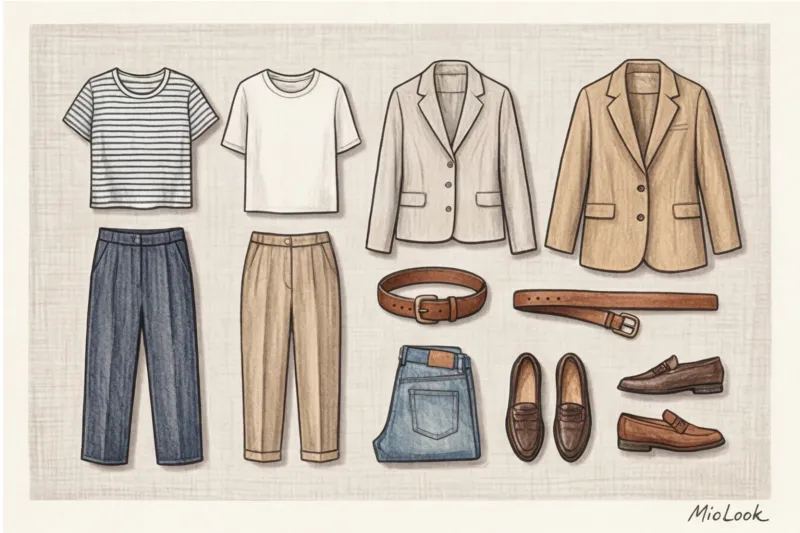
2 pairs of shoes: The rule of polarity applies here. One pair should be flat and as utilitarian as possible (loafers, white sneakers), while the other should be more formal or have a comfortable heel (ankle boots, Mary Janes).
1 accent: The focal point. This could be a self-contained slip dress, worn alone or over a T-shirt, or a statement leather belt with a chunky buckle.
Access to MioLook for €0.99 — one-time payment
A smart AI stylist will select the perfect look based on your items and suggest what's missing from your capsule collection.
Get access — €0.99 onceThe biggest mistake newbies make is ignoring "textile synergy."
I had a particularly revealing case. A client, a top manager at an IT company, put together a 5-4-3-2-1 capsule wardrobe for a two-week business trip to Berlin. The color palette (navy, beige, burgundy) was flawlessly chosen. But on the very first day, she wrote to me in a panic: the items couldn't be worn together. Why?
She tried wearing a thick cotton long-sleeve top under a thin viscose-blend jacket. The jacket bulged, the sleeves stuck, and the silhouette distorted. It's a classic example of texture clashing. Fifteen perfectly coordinated colors won't work if they clash on a tactile level.
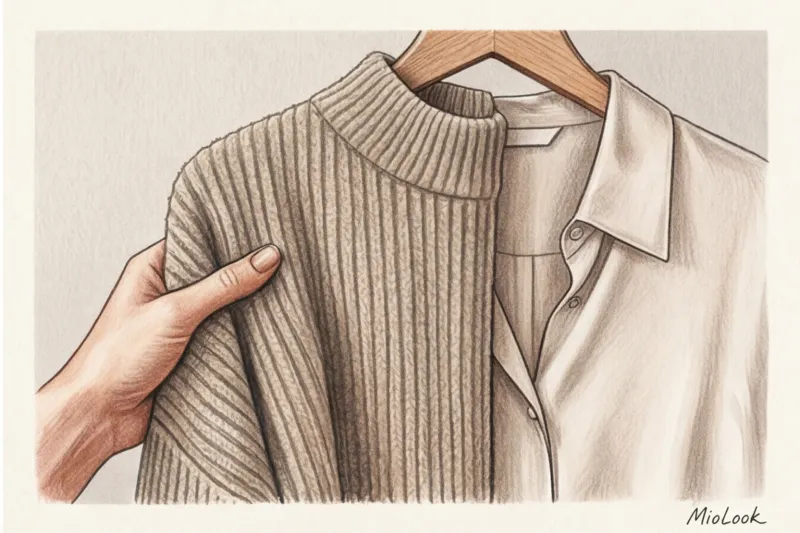
"The main rule of layering is that each layer should be thicker and heavier than the one before. You can't hide a voluminous texture under a smooth, thin fabric."
To avoid a sloppy look, play with contrasts:
- Matte with shiny: fluffy mohair sweater and smooth silk skirt.
- Smooth with relief: A smooth leather jacket over a chunky cable knit.
- Hard with soft: structured heavy denim and flowing cupro blouse.
How to Adapt the 5 4 3 2 1 Rule to Your Lifestyle (3 Real-Life Scenarios)
The formula is just a rigid framework. Its content depends entirely on your archetype and daily routine. If you copy the capsule of a fashion blogger whose life consists of presentations, while yours consists of working on a laptop and walking the dog, the system will collapse.

Scenario 1: "Business Capsule"
For corporate dress codes, the focus shifts to smooth, structured fabrics. Worsted (smooth) wool for trousers, heavy mulberry silk for blouses. Bottoms: palazzo pants, pencil skirt. Tops: loose-fitting shirt, heavy viscose top, thin turtleneck. Layers: double-breasted jacket, vest. The difference between this capsule and a regular base - in a strict hierarchy of layers.
Scenario 2: "Creative Freelancing"
Comfort and sophisticated casualness reign supreme here. Fabrics: stonewashed denim, softened linen, and heavyweight fleece. Bottoms: wide-leg jeans, cargo pants. Tops: oversized tees, textured long sleeves. Layers: loose denim jacket, oversized chunky knit cardigan.
Scenario 3: "The Perfect Travel Suitcase"
For travel, wrinkle-resistant materials are key. Look for Tencel, merino (it doesn't absorb odors), and high-quality viscose and nylon. Travel clothes The 5-4-3-2-1 format allows you to pack a full month's wardrobe in cabin-size carry-on luggage.
Your perfect look starts here
Join thousands of users who look flawless every day with MioLook's intelligent tips.
Get access — €0.99 onceEco-friendliness and quality: how to choose a base that can withstand the load
Within a mini capsule collection, slow fashion principles become more than just a trendy slogan, but a stark necessity. If you only own 15 items, each one will be worn and washed three to four times more often than usual. Cheap, mass-market fashion won't survive here. According to the Ellen MacArthur Foundation's 2021 report on the circular economy, extending the life of an item by just nine months reduces its carbon footprint by 20-30%.
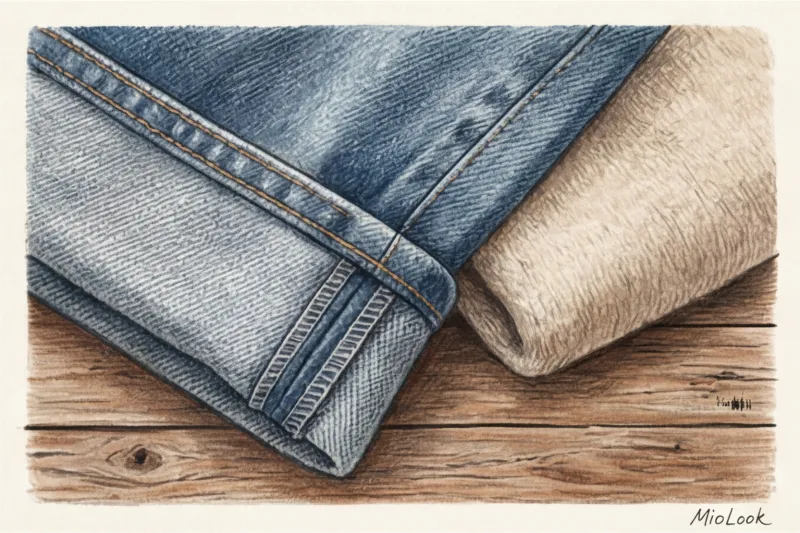
I always teach my clients to calculate Cost Per Wear. A basic cashmere sweater for €200 that you'll wear 100 times over three seasons costs you €2 per wear. A €30 acrylic sweater that will pill after three washes will cost you €10 per wear. High-quality basics are cheaper.
Quality markers to check in the store:
- Seams: Pull the fabric along the seam. If the threads are visible when held up to the light and the seam is coming apart, the item won't survive the season.
- Knitting density: When holding knitwear up to the light, hold it against the light. Loose knits tend to deform more quickly.
- Compound: Avoid 100% synthetics in layers that are close to the body. Look for natural fibers with 5-10% synthetics to maintain shape.
Of course, it's worth mentioning: the 5-4-3-2-1 rule doesn't work for everyone. If your weight fluctuates frequently due to medical reasons, a rigidly restrictive capsule will cause more stress than it's worth. In such cases, it's better to use more flexible systems that focus on oversized items or those with elastic waistbands.
Checklist: How to Implement the 5 4 3 2 1 Wardrobe Rule in One Weekend
Don't rush to the mall immediately after reading this article. 90% of the perfect capsule is already hanging in your closet, you just can't see it. Here's a step-by-step plan for this coming Saturday:

- Full audit (Step 1): Lay out absolutely everything you have on your bed. Select the 20% you've worn in the last two weeks. This is your real base, reflecting your current lifestyle.
- Choosing a Palette (Step 2): To make 15 items easy to combine, choose 2 neutral base colors (for example, graphite and milky) and 1-2 accent colors (burgundy or emerald).
- Assembling the layout (Step 3): Create a 5-4-3-2-1 formula from what you have. Sort items into categories and check them for textile compatibility.
- Test Drive (Step 4): Place the rest of your clothes in their bags and live exclusively with this 15-piece capsule for 7 days. Photograph each look in the mirror.
- Spot Shopping (Step 5): By day 8, you'll clearly understand what's missing (for example, you're missing a light-colored pair of thick bottoms or the right jacket). Add this to your shopping list.
From Mathematics to Personal Style: Conclusion
The 5-4-3-2-1 rule isn't a life sentence or a uniform. It's an excellent style guide. Once you learn to see the connections between the textures and weights of 15 items, you can apply this skill to a wardrobe of any size.

Digitizing this process and eliminating the need to keep all the combinations in your head helps MioLook You can upload your mini capsule to the app, and artificial intelligence will automatically create outfits for you for every day, taking into account the weather outside and layering guidelines.
Take the first step this evening: choose your favorite five tops and four bottoms from your closet. Feel their fabrics and appreciate how they work together. Wardrobe mindfulness doesn't start with buying new pieces, but with respecting the ones you already love.