The Mathematics of a Smart Wardrobe: Why Cheap Clothes Cost More
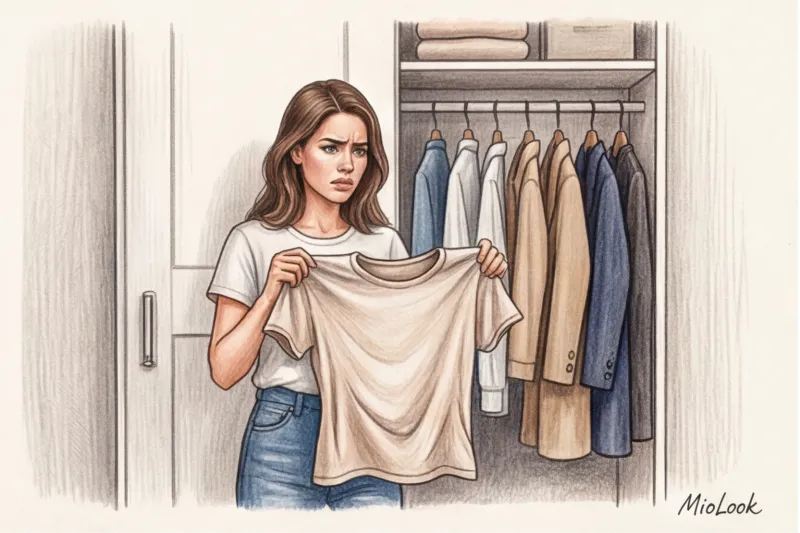
Last week, I audited a new client's closet. From the deepest recesses of the store, we pulled out 43 items with their tags still attached. Altogether, this "lucrative haul" from seasonal sales cost her approximately €1,300. Do you know how many times she wore these items? Exactly zero. That's why, when people ask me, How to build a basic wardrobe inexpensively , I always answer: start with a calculator, not by looking for red price tags.
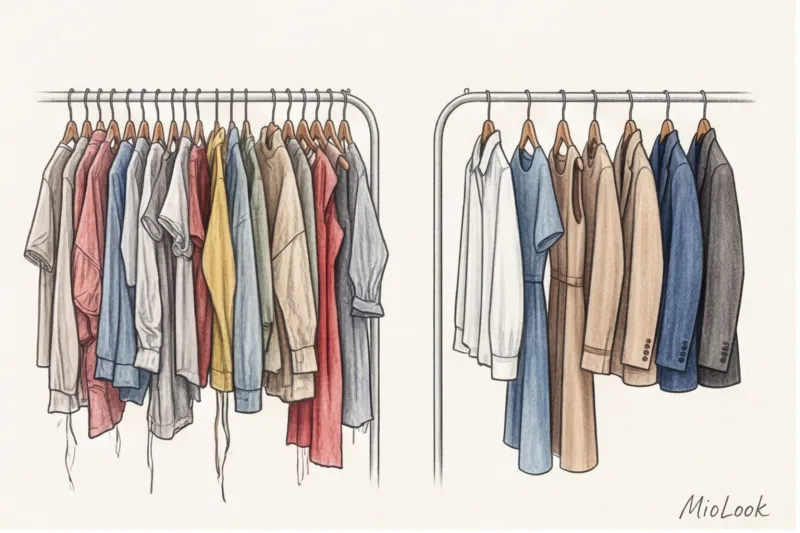
In my work as a stylist, the "buy cheap but buy a lot" paradigm is the main enemy of any budget. We think five T-shirts for €15 are a great deal, but in reality, we're simply funding the fast fashion industry by cluttering our space. A conscious approach to style begins with understanding that a wardrobe is an investment portfolio. Every item should pay dividends in the form of comfort, confidence, and time saved in the morning.
And I'm not just talking about beautiful philosophy, but about hard data. Our app's analytics MioLook This is confirmed by hard numbers: users who switch to a smart wardrobe system and start buying less but better quality clothing end up spending 40% less on clothing annually. They stop "putting out fires" with impulsive purchases and start building a database based on math.
Cost Per Wear (CPW) Formula as a Stylist's Main Tool
In the world of professional styling, we rarely operate in terms of absolute price on the tag. Our main metric is Cost Per Wear (CPW) or "cost per exit." This simple formula will forever change your attitude toward shopping.
CPW = (Item Cost + Care and Repair Costs) / Number of Wears
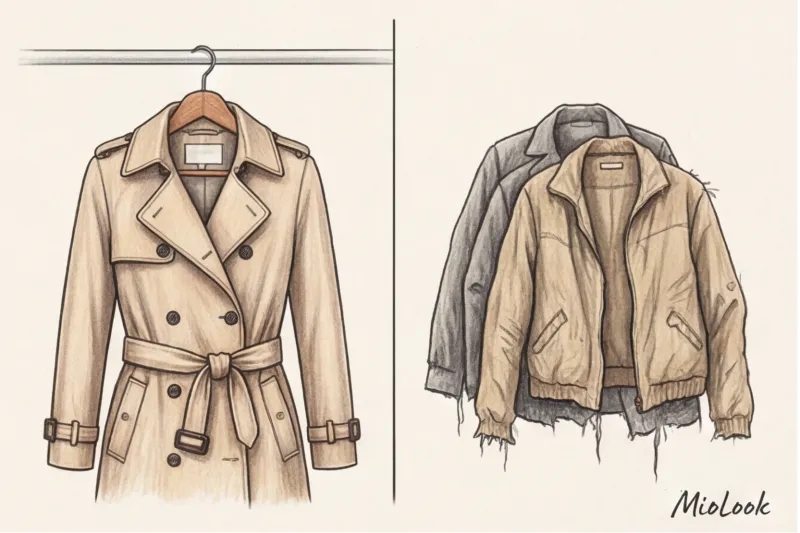
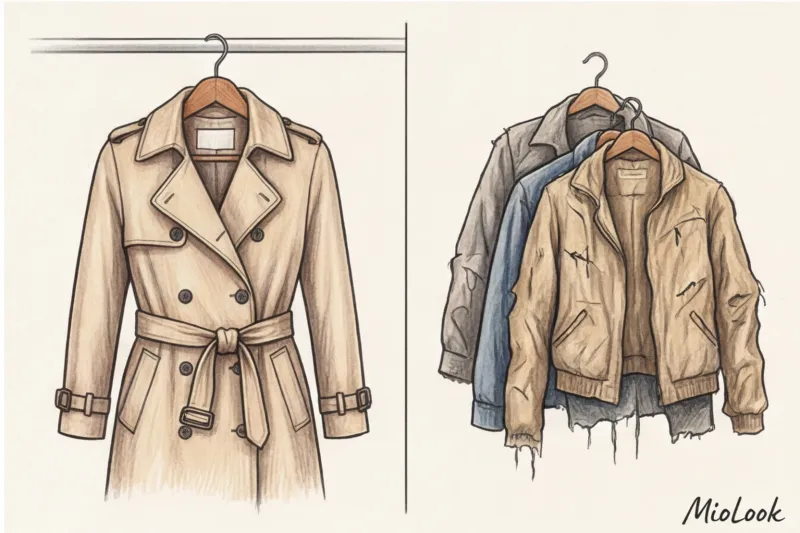
Let's look at a classic example from my practice. A client bought an ultra-fashionable but inexpensive 100% acrylic coat for €60. She wore it 15 times in the first month, after which it became covered in pills, lost its shape in the rain, and had to pay €20 for dry cleaning, which didn't save the situation. Total: (60 + 20) / 15 = 5.33 € per exit After that, the item went to the landfill.
As an alternative, we picked out a thick, classic trench coat made of high-quality gabardine for €220. She wore it at least 180 times over three spring and fall seasons. Dry cleaning during that time cost €50. The math: (220 + 50) / 180 = €1.50 per visit.
A trench coat that cost almost four times as much at checkout turned out to be three times cheaper in real life. Moreover, it held its shape perfectly and garnered compliments. This is precisely the factor that allows you to realistically assess the "expensiveness" of an item. Basic clothing that you wear two or three times a week simply must be high-quality, even if it requires a slightly larger investment at the start. I've covered in more detail which items are worth every penny in my guide. What to invest in your wardrobe: items that will pay off.
The Fast Fashion Trap and the Illusion of Savings
"It's only €19!" is the most dangerous phrase you can say to yourself in a fitting room. Mass-market clothing is brilliant at exploiting our dopamine system. Impulsively buying a cheap item gives a momentary rush of joy from a "great deal," but that joy evaporates after the first wash.
The hidden costs of fast fashion are colossal. According to a 2023 report by the Ellen MacArthur Foundation, the average number of times an item is worn has decreased by 36% over the past 15 years. We buy more but wear less. Why is this happening?
- Bad landing. Cheap patterns are based on a flat, average figure with a minimum number of darts to save on production costs. The garment only fits while you stand still in front of a mirror.
- Lack of confidence. When a €25 polyester blouse becomes staticky, makes you sweat, and its seams twist, your body language changes. You feel uncomfortable, constantly tug at the fabric, and eventually stop wearing it.
- A permanent need for renewal. Items made from low-quality fabrics lose their appearance after 3-5 washes, forcing you to go back to the store for a replacement.
The illusion of saving money is shattered when you realize that a cheap item is stealing not only your money but also your energy. You waste your mornings trying to iron unruly fabric or hide a ragged seam. To avoid these mistakes and learn to read an item's potential before paying at the checkout, I recommend reading this guide. Fabrics that look expensive: a stylist's secrets.
A smart budget wardrobe isn't about finding the cheapest T-shirt in town. It's about finding that one perfect T-shirt that will last you two years and become the perfect canvas for dozens of outfits.
How to Build a Basic Wardrobe on a Budget: A Budget Strategy
Have you noticed an interesting paradox? We meticulously plan our budgets for vacations, renovations, or buying a new laptop, but when it comes to clothes, most women act intuitively. Women often ask me during consultations: How to build a basic wardrobe inexpensively , if the prices of high-quality fabrics are constantly rising? My answer always begins not with a discussion of brands, but with a simple planning table.
The first and most difficult rule of smart shopping is hard refusal to buy everything at once Fast fashion marketers love to sell us the illusion of instant transformation: "Buy this ready-made capsule collection in one weekend, and your empty closet problem will disappear." In practice, trying to update your entire wardrobe in a couple of days on a limited budget inevitably leads to fatal compromises. You start choosing clothes not based on the quality of the cut and composition, but on how much money you have left on your card at the moment.
Instead of spontaneous raids on shopping centers, you need to Building a financial plan for updating your wardrobe Treat this as a long-term project. Create a shopping plan for 3-6 months in advance. Set aside a fixed, affordable amount (e.g., €100-€150 per month) and target one or two ideal items. This time-based strategy allows you to purchase higher-end items without breaking the bank.
The 70/30 Rule: Where to Invest and Where to Save
Over the years, I've developed a foolproof algorithm for my clients. Advice from a practicing stylist: use the 70/30 budget rule. This is the mathematical basis for managing your money in the dressing room to look expensive on a modest budget.
The method is simple: 70% of your allocated budget should go toward 3-5 key basic items with sophisticated cuts and premium quality. The remaining 30% is reserved for consumables (T-shirts, tank tops, socks) and fleeting seasonal trends.
Let's use a real-life example to calculate this. Let's say your budget for a seasonal update is €500. According to the rule, you'll invest €350 in the perfect wool jacket, quality loafers, and a pair of well-fitting, slim-fitting jeans. With the remaining €150, you'll buy a few basic cotton tees, a trendy evening top, and a few statement pieces.
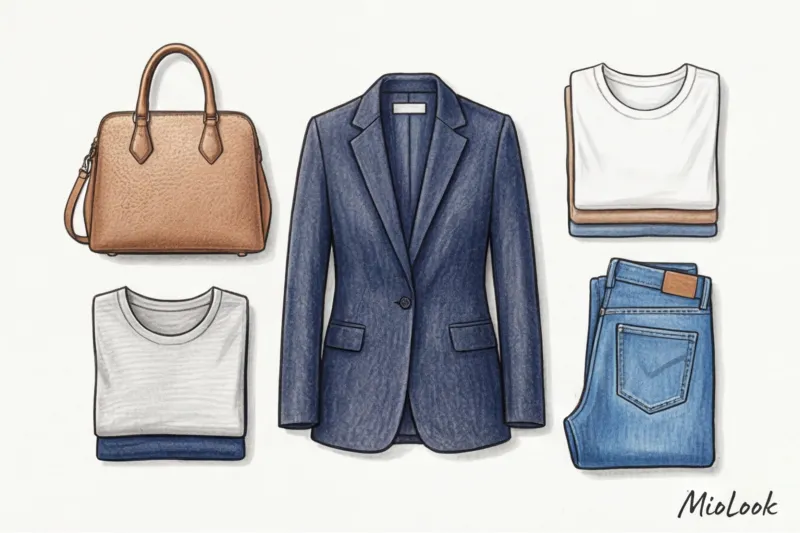
Why is this proportion so important? It's your main defense against the notorious "closet full, nothing to wear" effect. Cheap, poorly tailored basics drag the entire look down, making it appear sloppy. Meanwhile, expensive, structured pieces create a solid visual foundation. You can confidently wear a €10 T-shirt over a good jacket, and the entire outfit will feel premium.
Access to MioLook for €0.99 — one-time payment
A smart AI stylist will help you digitize your items, create new looks, and plan future purchases without unnecessary spending.
Get access — €0.99 onceThe "untouchable base" list (what you shouldn't skimp on)
According to WGSN's 2024 analytical report, the focus of conscious consumers has finally shifted from quantity to durability. Not all clothes in your closet are created equal. There are certain items on which skimping is strictly prohibited, because their quality is visible from several meters away.
- Outerwear (coat, trench coat, structured jacket). The cut architecture—the shoulder placement, the lapel shape, the back line—requires complex craftsmanship. Cheap fabric always reveals itself over a large area. A 75% wool coat for €200–€250 will last you five years, maintaining its shape. A polyester equivalent for €60 will pill and lose its shape after just a month of daily wear.
- Shoes and bags. It's the visual center of any outfit. A tightly structured bag and trendy, well-groomed shoes literally elevate even the simplest look. You can wear a basic knit dress from a mass-market store for €25, but if you complement it with good leather loafers and a shapely bag (in the €100-150 range from brands like COS or Massimo Dutti), the whole look will gain a touch of polish.
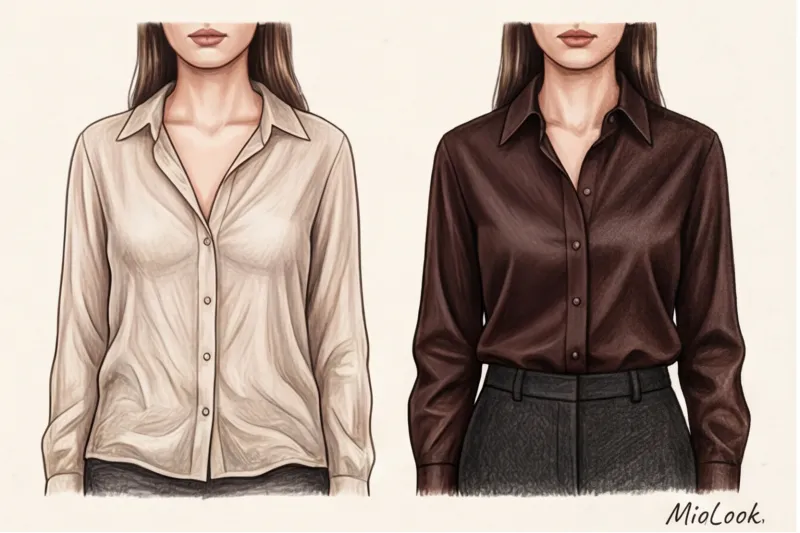
- Jeans or trousers with a perfect fit. A hem that bunches up at the groin, rolls at the seam, or distorts the hips will ruin the look of even an expensive silk blouse. Invest in heavyweight denim (at least 98% cotton) or high-quality suiting fabric that doesn't stretch out at the knees.
"Shoes and bags are the status markers of your outfit. They tell a story about you before you even utter a word. Skimping on them means devaluing the rest of your wardrobe"—this is the golden rule of visual perception that applies to any budget.
If a pair of trousers costs €80 but fits you perfectly and hides your flaws, it's a mathematically better investment than buying three pairs of compromised €25 options that you'll constantly be tugging and adjusting throughout the day.
Closet Review: How to Find New Looks Without Shopping
Over 12 years of styling, I've uncovered a stubborn statistic: most women don't physically remember about 30% of the items buried on the back shelves. The Pareto principle applies to wardrobes—we wear 20% of our clothes 80% of the time. We wear what's hanging at eye level, and the rest becomes a "blind spot." So, when I'm tasked with showing a client how to build a basic wardrobe on a budget, we never start with a trip to the mall. We dump absolutely everything out of the closet onto the bed. Remember the main rule: the cheapest shopping is shopping in your own closet.
To prevent this process from turning into a sentimental rummaging through old sweaters and memories, you need a strict, ruthless auditing process. I call it the "four-box method." Every item pulled from the depths of your closet must fall strictly into one of the following categories:
- Leave. Here you'll find items that fit you perfectly right now, suit your current lifestyle, and are in pristine condition. No "I'll lose weight someday" or "I'll wear it to the dacha" items.
- Fix it. A great cashmere turtleneck with pilling (you'll need a knit trimmer) or your favorite trousers that need to be shortened at a tailor's for €10-€15. These are your hidden assets, cheaper to restore than to replace.
- Sell. Designer items in good condition that you haven't worn in over a year. That jacket you bought on a whim for €120 could fund the purchase of the perfect pair of basic jeans if you list it on a resale platform.
- Give away. Stretched knits, items with stubborn stains, or hopelessly outdated styles are sent for recycling or donation. Dispose of them without the slightest regret.

Digitizing Your Wardrobe (A Smarter Approach to Clothes)
Physically sorting through your clothes is only half the battle. The real magic and savings begin when you transfer your closet from the physical world to the digital one. According to a global report by ThredUp, about half of the clothes we buy are worn only once or twice. Digitization completely breaks this consumption pattern.
How does photographing your clothes change the way you perceive your wardrobe? When you photograph every single item in good daylight and remove the background (modern smartphones do this with a single click), you strip the clothes of their emotional connection. You're left with bare data: colors, textures, silhouettes. You suddenly realize you have five nearly identical black cardigans, but not a single structured jacket. Creating a database of your clothes is an uncompromising visual diagnosis and the only way to identify real gaps.
"You can't manage what you can't measure. Your wardrobe is an investment portfolio, and you should know every asset in it by sight."
Instead of keeping all the combinations in your head, delegate this task to technology. By uploading your things to MioLook , you get a smart virtual fitting room. Creating capsule wardrobes based on an existing database becomes like building a building block. The golden rule of combinations states: for every bottom (pants, skirt), there should be three tops. In a digital format, you can check in just a few minutes whether this rule holds for your favorite gray palazzo pants. If not, you know exactly what to look for in the store, and your shopping becomes surgically precise.
Secrets of bargain shopping: where to find high-quality essentials for pennies
According to consumer behavior research (2023), 68% of purchases made in large malls on Saturday afternoons are consigned to the back of the closet within a month. Sensory overload, loud music, chaotic fitting rooms, and garish red price tags disable critical thinking. We buy an emotion, not a thing. That's why my smart shopper's map begins with one uncompromising rule: avoid shopping malls entirely on weekends. If you need to try something on in person, do it on Tuesday mornings.
If you truly want to understand how to build a basic wardrobe on a budget, you'll have to make a fundamental paradigm shift. Stop looking for cheap brands. Start looking for expensive brands on the cheap.
Let's say your budget for a warm layer is €80. You have two options. You can go to the nearest high-street store and buy a squeaky acrylic cardigan that will pill after three washes. Or you can spend half an hour on specialized platforms and find a brand-new 100% merino wool sweater from a premium brand. The price is the same, but the difference in fit, feel, and durability is astronomical. A quality item bought at a 70% discount or found on the secondary market always beats a compromised new item.
Resale Platforms and Vintage Stores: A Guide
Many people still have a prejudice against buying secondhand items, associating it with the chaotic secondhand shops of the 2000s with their distinctive smell. Forget it. Modern resale is a high-tech and crystal-clear process. In my experience, Oskelly, TSUM Collect, and even a well-configured Avito are the main suppliers of the perfect base for my clients.
The biggest mistake newbies make on these platforms is searching by brand name. Stylists search differently: we use filters based on fabric composition. Search for "100% cashmere," "heavy silk," "merino wool," or "alpaca," and be sure to filter for "new with tag" or "in excellent condition." You'd be surprised, but a luxurious cashmere jumper from a niche European brand can often be found for €40-€60, even though its retail price exceeds €300.
Before buying online, it's critical to ask the seller three things:
- Exact measurements in centimeters: Back length, half-chest circumference, shoulder width, and sleeve length measured from the shoulder seam. Size charts vary dramatically between brands, and relying on the letter "M" on the tag is a surefire way to return a garment.
- Photo of the label with the ingredients: No "it looks like wool" statements. Only documentary evidence. Also, check the care label.
- Macro photos of problem areas: Ask to take a photo of the underarms from the inside (deodorant stains are often hidden there), the collar for wear, the cuffs and all the fittings.
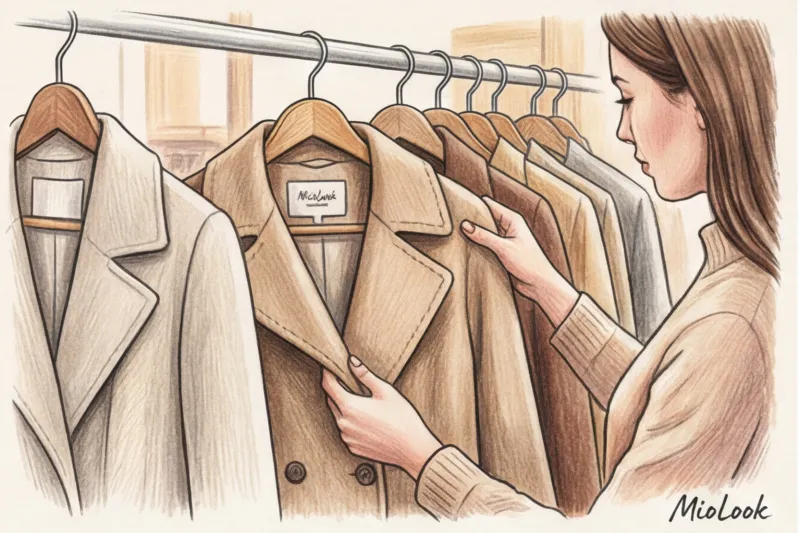
A unique life hack that changes everything is a vintage men's jacket. I often refer clients to men's vintage shops rather than modern women's departments. Why? Men's suit-making techniques in the 80s and 90s required the use of the correct canvas, which creates a rigid frame for the garment, ideal shoulder structure, and pure suit wool.
A modern women's jacket from a mass-market store for €80 is usually made of bonded polyester, which will wrinkle after the first dry cleaning. A well-made men's vintage jacket for the same €40–60 will fit you like a luxurious, architectural oversize. Just roll up the sleeves, wear it over a basic white T-shirt and straight jeans, and you'll have a look straight out of a fashion magazine cover.
Access to MioLook for €0.99 — one-time payment
Start creating your perfect looks with AI and integrate your best resale finds into your smart digital wardrobe.
Get access — €0.99 onceOutlets, sales, and closed sales
Another key to a budget-friendly yet high-quality wardrobe is seasonal discounts. However, this is where the biggest pitfall lies. According to industry reports (including McKinsey analysts), during major sales, brands often exploit the illusion of value: they can artificially inflate the starting price a couple of weeks before the sale begins.
To avoid accumulating textile waste under the influence of adrenaline, I implement a "list rule" for my clients. It goes like this: we only buy on sale what we planned and wrote down at least three months ago. If you included a dark blue double-breasted coat in your shopping plan in September and find it at the end of November for 50% off, that's a brilliant deal. However, if you went online just to check the sales and bought a neon green top for €25 because "well, it's practically free," that's a total loss.
How to distinguish a real discount from a marketing ploy and work with stocks correctly?
- Ignore outlet lines: Many famous brands produce clothes specifically for their outlets (the so-called made for outlet collections). They use cheaper fabrics, simplified patterns, and inexpensive fittings. Often, the tags of such items have special markings: three dots, stars, or diamonds next to the logo. The real finds are items from the main collection ( retail transfer ), which simply did not sell out in the boutique.
- Stay tuned for closed sales: Register on international platforms like YOOX or The Outnet, where remnants from previous seasons are available. Filter by your exact size and search exclusively for basic items.
Smart shopping isn't about running around stores with a "Sale" sign. It's a strategic hunt with carefully selected filters, cold calculations, and a complete understanding of exactly what your wardrobe capsule needs.
Essentials have no expiration date: a classic light blue Oxford cotton shirt from the 2021 collection is absolutely identical to the same one from 2024, but will cost you €45 instead of €150. Seek out timeless silhouettes, invest in texture, and remember that the most valuable treasures are found by those who patiently search beyond the standard shopping mall tourist routes.
What you can safely save on when creating a database
In economics, there's the concept of opportunity cost. In styling, this principle works exactly the same: wardrobe balance is based on the fact that investing in something fundamental (like a perfectly tailored wool jacket or a structured bag) requires you to consciously cut back on other items. The key to building a basic wardrobe on a budget lies in this ruthless yet mathematically sound compromise.
An open secret in the fashion industry is that there are items that wear out quickly, regardless of the price tag. Their lifespan is dictated not by the quality of the tailoring or the prestige of the brand, but by simple physics, chemistry, and daily wear and tear. Spending large sums on such items is literally throwing money away.
First layer knitwear (T-shirts, tank tops, long sleeves)
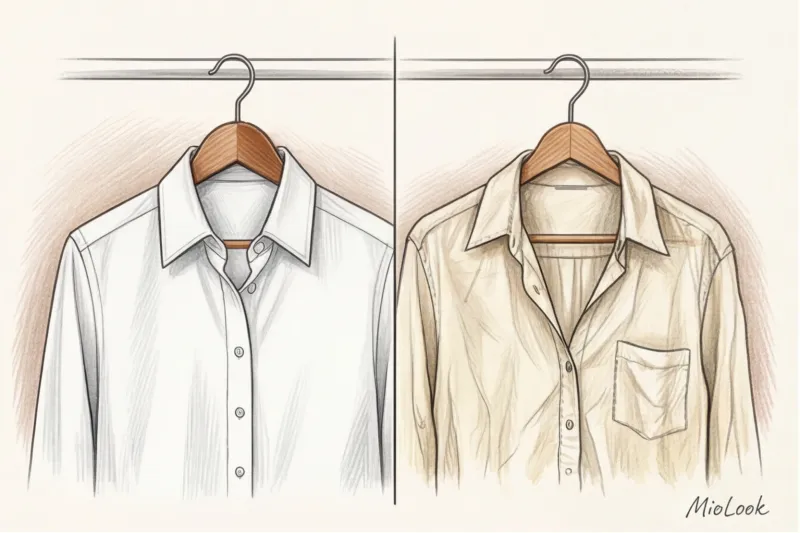
Let's start with the most painful and counterintuitive advice I give my clients. Buying a designer white T-shirt for €100-€150 is a financial crime against your wallet. Why? Because pure white cotton yellows from aluminum salts in deodorants and from natural sebum, regardless of whether it's a luxury handmade item or a basic €15 H&M piece.
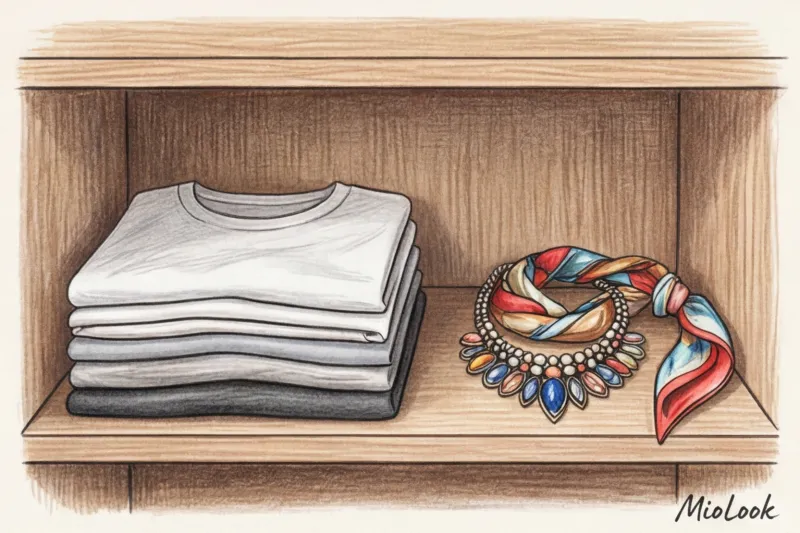
Knitwear that fits close to the body is a pure "consumable." Its purpose is to absorb moisture, protect outerwear, and create a hygienic barrier. The lifespan of a perfect white T-shirt with active wear is a maximum of one, rarely two, seasons. As soon as the collar loses its elasticity and the fabric acquires a subtle grayish tint, the item should be ruthlessly replaced or relegated to loungewear.
To make an inexpensive T-shirt look classy, pay attention to the technical details: the cotton density should be at least 180–200 g/m² (to hide the contours of your underwear), and the back of the collar should have a twill tape sewn in—this prevents the neckline from stretching after the third wash.
How to choose a good cotton shirt on a budget? Look for long-staple or combed cotton. Inexpensive brands (like Uniqlo or COS during sales) often use this for their basic lines. And be sure to check the side seams: if they're twisted while still on the hanger, the fabric was cut on the bias to save material. After the first wash, such a T-shirt will completely lose its shape.
Accent details and micro-trends
The fashion industry is programmed to constantly tempt us with "seasonal hits." Yesterday it was neon green Bottega, today it's wine-colored Cherry Red or leopard print. The golden rule of a smart shopper: if an item, color, or texture will only be in fashion for one or two seasons, don't spend more than 5% of your total wardrobe budget on it.
Let's say you've budgeted €400 for a seasonal update. Your signature trendy piece (for example, a trendy mesh ballet flat or an asymmetrical top) shouldn't cost more than €20. This is where mass-market brands excel, quickly copying runway looks for the general consumer.
Inexpensive costume jewelry deserves special attention. You can easily find stylish earrings for €12–€15 if you know how to choose a metal that looks classy. Here's my guide:
- Avoid bright yellow glossy finishes. This immediately gives away a cheap alloy. Look for matte, brushed (as if scratched) textures, or an aged gold color.
- Choose rhodium plating. The cool silvery shine of rhodium in the budget segment always looks more expensive and noble than imitation gold.
- Focus on geometry. Cast, heavy, minimalist shapes in the spirit of Celine's aesthetic always win out over a scattering of cheap rhinestones and intricate filigree.
When it comes to scarves, shawls, and belts, you can find gorgeous, stylish alternatives without breaking the bank. Instead of buying a cheap polyurethane belt (which will inevitably crack at the fold within a month), consider thick fabric belts or look for a genuine leather belt at vintage sales for the same €10-€15. Silk scarves can easily be replaced with high-quality viscose or cupro options—they flow and drape just as well as real silk, but at a fraction of the cost.
To visually balance these inexpensive accents with your quality bases and see how they fit into your current wardrobe, I recommend using the smart image designer feature in MioLook The app will clearly show you whether you should buy that statement leopard scarf, or whether it won't coordinate with your other outfits.
Shopping Planning: How Technology Protects You from Spending
The algorithms of modern online marketplaces are designed with one goal in mind: to get us to buy right here and now. Every day, interfaces nudge us toward impulsive decisions with flashing timers and alarming messages like "15 more in cart." In such an aggressive marketing environment, the answer to the question of how to build a basic wardrobe inexpensively lies not in searching for secret promo codes, but in strict digital hygiene. Our main goal is to transform shopping from an evening "therapy" after a hard day at work into a purely strategic, calculated task.
For this, I strongly recommend using planning apps, which create a protective barrier between momentary desire and financial transaction. Instead of randomly scattered screenshots in your smartphone gallery or endless aesthetically pleasing boards, I recommend switching to strict digital accounting. When you start tracking your wardrobe, magic happens: you suddenly notice that small, emotional purchases of €15–20 each add up to a budget that would have been enough for one prestigious, impeccably tailored item. Using technology instantly sobers you up.
My personal experience working with the ecosystem MioLook This astonishing statistic proves that when a customer uses the look preview feature before paying, the return rate for unsuitable items drops by 60%.
The secret is simple: you don't just fantasize in front of the dressing room mirror, hoping that your new outfit will match something at home. The app allows you to visually try on your potential purchase with your actual jeans and sweaters right on your smartphone screen. If an item doesn't fit with your current inventory on the digital canvas, you simply close the store tab, saving your money for items you actually need.
Wishlists and the 48-hour rule
Let's examine the mechanics of impulse buying from a neurobiological perspective. The surge of dopamine—the hormone that anticipates reward—doesn't occur the moment the money is debited from the card. We experience the peak of neurochemical pleasure the very second we click the coveted "Add to Cart" button. The irony is that this click is all it takes for our brain to experience a dose of the proverbial "retail therapy."
Professional stylists actively use this biohack. I teach my clients to create huge, unlimited wishlists in apps. Add absolutely everything that catches your eye: from simple cotton long-sleeved T-shirts for €40 to extravagant bags for €300. But there's one uncompromising condition: a total freeze of your shopping cart for 48 hours. No immediate payments, even if the discount seems phenomenal and the countdown is nervously flashing red.
Experience shows that after two days, the dopamine rush completely dissipates. We return to the saved basket with a cool head and painlessly delete up to 80% of the added "wish list" items, realizing they are impractical, of poor quality, or duplicate items already in the closet.
The 20% of items that successfully survived the digital freeze undergo a final crash test for compatibility. Before entering your card's CVV code, ask yourself one tough stylistic question: "Will I be able to create 5 completely different looks with this item from what I ALREADY have in my base?".
If you're looking at a statement jacket with a complex cut and realize you'll need to buy a basic top, the right trousers to match, and new shoes, it's not a smart investment, but a financial black hole that requires constant cash injections. If, however, you choose simple leather loafers for €110 and they instantly fit into a formal office look with a suit, a relaxed casual look with straight jeans, and a romantic set with a midi skirt, you've passed the test; the purchase is strategically justified.
Your ideal image begins Here
Join thousands of users who look flawless every day and save money on smart shopping with the help of MioLook algorithms.
Get access — €0.99 onceStep-by-step plan: building your first capsule on a budget
A month ago, at a minimalism workshop in Berlin, one of the participants sensibly remarked, "The theory is clear. But where do you physically start tomorrow morning?" We can endlessly discuss exit cost matrices and complex filters on resale platforms, but without a clear algorithm, the risk of falling into a trap and buying yet another random item on sale approaches 100%.
The transition from theory to practice is the most vulnerable stage for any budget. When people ask me how to put together a basic wardrobe on a budget without spending six months on it, I forbid them from going to the store without a solid strategy. Here's a concrete action plan for the next four weeks that I give my clients:
- Week 1: Ruthless Sanitation. We remove from sight anything that hasn't been worn for over a year, requires constant tugging, or doesn't fit right now. Freeing up space reduces "visual noise."
- Week 2: The Architecture of Color. Determine the color temperature. Choose two dark base shades (for example, deep navy and graphite), two light shades (ecru and camel), and one accent shade (burgundy or emerald).
- Week 3: Spot Hunting. We compile a list of the two or three most critical missing items. We begin a methodical search, setting a strict price limit—for example, no more than €80–€120 for a quality first layer or trousers.
- Week 4: Hard Integration. We bring the item home, leave the tags on, and try to put it together into at least five complete outfits from what's already hanging in the closet. No luck? Return it with no regrets.
A Universal Checklist for a Minimalist Base
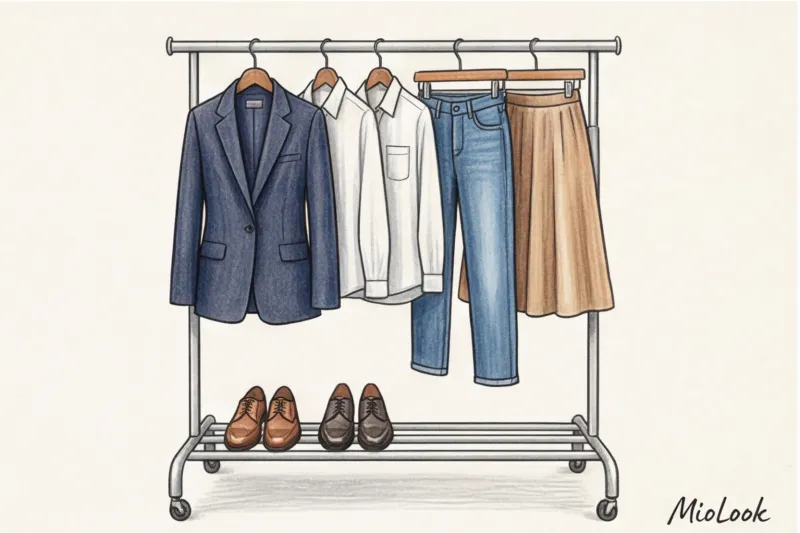
Here you won't find the outdated, abstract advice from glossy magazines of the 2000s about the essential "little black dress" or "beige pumps." The modern urban rhythm dictates completely different rules of utility. Based on an analysis of over 500 of my clients' wardrobes, I've compiled a structured list of 11 items that cover 90% of life scenarios.
- Structured Jacket: Straight, masculine cut, with a defined shoulder line. Shades: dark chocolate or wet asphalt. Look for thick wool-blend styles at vintage markets—they're a fraction of the price of modern mass-market options.
- Straight jeans: 100% heavy cotton (12oz denim) no elastane, mid to high rise, solid color with no fading.
- White shirt: A dense poplin that holds its shape (not see-through). Choose an oversized cut to wear it as a base layer or as a light cape over T-shirts.
- Midi skirt: An A-line silhouette or slip-skirt (silk texture, cut on the bias). It works beautifully when contrasted with oversized sweaters and chunky shoes.
- Trousers with an arrow (darts): Relaxed at the hips and full length, they instantly pull together a look and make it look more expensive.
- Oversized sweater: Cashmere, merino, or heavy cotton. The main rule is to leave air between you and the sweater (5-7 cm of space depending on your measurements).
- Thick basic t-shirt: Cotton with a density of 180 to 220 g/m2. The collar should fit snugly around the neck.
- Trench coat or robe coat: Classic cut, below-the-knee length (midi or maxi) to cover the length of skirts and dresses.
- Loafers or brogues: Leather, with a moderately chunky sole, they elevate any look, even the most relaxed, to a smart casual feel.
- Minimalist sneakers: Made of smooth leather, without logos, colored inserts or perforations.
- Hard bag: A framed crossbody or mid-size tote. Simple geometric designs always look more classy than soft, shapeless "bags."
For this capsule to work as a single unit, 80% of the items should be in your base neutral palette, and 20% in an accent color. To avoid getting confused in combinations and buying duplicates, I strongly recommend digitalizing the process. You can use MioLook — simply upload photos of your current items, and the built-in algorithm will help you visualize this checklist, clearly highlighting which database cells are empty.
How to gradually expand your wardrobe
Building a wardrobe doesn't mean spending your entire salary on 11 items from the list above in one weekend. On the contrary, a 2022 study by the Swedish RISE Institute proved that wardrobes purchased impulsively in a "lifetime update" become outdated three times faster than those built thoughtfully and gradually.
My favorite and most effective strategy for working on a limited budget is the "one item a month" method. It's incredibly pragmatic. Instead of buying three dubious polyester blouses for €30 each in a shopping frenzy, you save up that money and at the end of the month invest €90 in one flawless item—for example, the perfect pair of thick viscose trousers or high-quality leather loafers. The focus shifts from quantity to an uncompromising search for the perfect quality and fit.
This capsule approach breaks the traditional logic of consumption. You no longer buy clothes in isolation. Each new item becomes a functional unit that builds new looks around the existing core. In October, you add the perfect jacket, in November, a high-quality cashmere sweater. Thus, in just six months, your base will be replenished with six fundamental wardrobe items. They will not only cover all your daily needs but will also last you for seasons, saving you hundreds of euros in the long run.
Common mistakes beginners make when building a budget wardrobe
According to a 2023 McKinsey research report, approximately 40% of the average woman's clothes are never worn in the first year. But when we're discussing how to build a basic wardrobe on a budget, the cost of mistakes multiplies exponentially. A modest budget doesn't forgive mistakes. This is my main warning about the typical pitfalls that 90% of women fall into: trying to save money at the checkout, you often lose huge sums on unseen leaks. Let's examine the two main pitfalls that instantly ruin all your efforts to optimize your closet.
Buying clone items
I had a textbook case in my stylist practice. During an initial wardrobe audit of one of our clients, we discovered five identical black turtlenecks on the shelves. They were in varying states of wear—from washed and covered in pilling to brand new, still bearing the tags from a high-street store. The client bought a new one whenever she felt she had "nothing to wear to work," forgetting to get rid of the old ones.
Why do we subconsciously buy what's already in our closet? Neuroscientists explain it simply: the brain always strives for a zone of maximum comfort. We choose what we're already accustomed to wearing because it's a guaranteed "safe" choice that requires no stylistic effort. The problem is that cloning clothes freezes your style and eats up the budget that could otherwise be used for missing elements of your wardrobe—for example, a well-cut, structured jacket.
The only effective antidote to clones is complete visualization. Digitizing your wardrobe solves the duplicate problem instantly. When you use the virtual closet feature in MioLook , you literally have your base in your pocket. While in the fitting room, clutching yet another gray T-shirt, you open the app, see three identical ones, and calmly return the item to the rack.
Ignoring the cost of care
The second fatal mistake is to look only at the price tag, ignoring the sewn-in label on the inside seam.
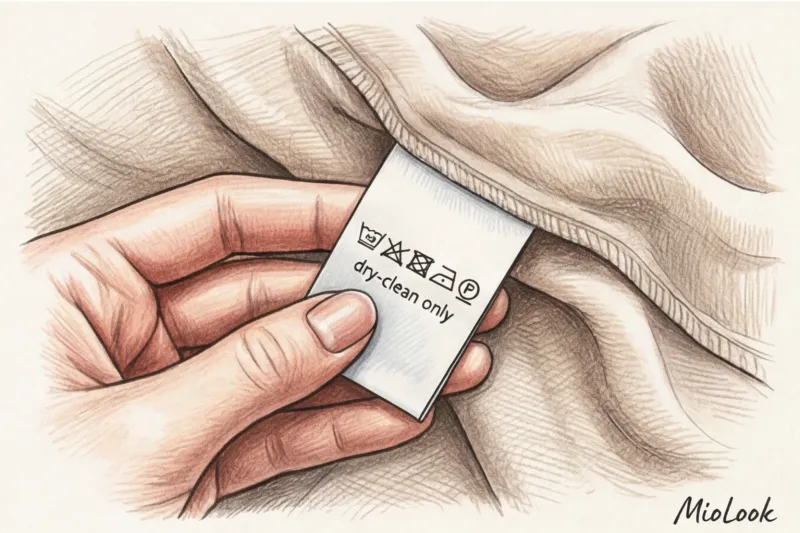
Imagine this: you find a gorgeous viscose blouse with a complex cut on sale for just €25. It seems like a triumph of smart shopping. But when you get home (and often after the item has shrunk two sizes after machine washing), you discover that the fabric requires only delicate dry cleaning. A single dry cleaning will cost you approximately €15–20. Over the course of a single season, you'll pay more in care costs than the item itself cost! These are classic hidden costs.
That's why pure linen and sophisticated, fine silk aren't ideal for an ultra-budget wardrobe. Linen wrinkles easily, cheap dyes fade quickly without professional care, and budget silk falls apart at the seams after just one home wash. If you're on a budget, opt for dense blended fabrics. High-quality cotton with 5% elastane or heavy Tencel look classy, retain their shape, and withstand regular machine washing at 30 degrees Celsius.
To sum up our guide, I want you to forever abandon the stereotype that impeccable style requires millions.
The secret to elegance is not in owning a huge number of things, but in making sure that every item in your closet is worth its investment 100%.
A smart basic wardrobe isn't the result of one successful foray into the mall with a credit card. It's the result of discipline, knowledge of your proportions, and a willingness to forego impulse purchases in favor of strategic goals. Tomorrow morning, before opening your favorite brand's app to search for deals, take one simple step: take 15 minutes, pull out 10 of your favorite items, and try creating three new combinations with them that you've never worn before. You'll be surprised, but your ideal wardrobe has already begun to take shape—all that's left is to organize it.
Guide Chapters
Stylist Secrets: How to Buy Clothes on Avito
The secondary market is a closed VIP boutique with high-quality items. Learn the buyer's algorithms to assemble a prestigious basic wardrobe at the resale market.
Wardrobe Clearing Before Shopping: How to Save Money
A proper closet review isn't just a simple tidying up; it's a full-fledged financial audit. Learn how to stop buying unnecessary items and create the perfect foundation.
How to create a clothing shopping list and avoid buying unnecessary items
Abstract shopping lists make us spend money on things we don't wear. We'll explore how to plan your shopping wisely and save on your budget.
How to Buy on Sale: Stylist Tips
Seasonal sales are a great chance to score premium essentials at a great price. We'll explain how to avoid impulse purchases and update your wardrobe wisely.
How to stop buying unnecessary clothes and save money
Standard advice from glossy magazines won't prevent impulse purchases. Learn a practical algorithm for smart shopping that will save you money.
How to Budget for Clothing: The 70/30 Rule
Stop buying things on sale that end up sitting idle. Learn practical financial strategies for creating a stylish and affordable wardrobe.
How to look expensive without spending a lot: style secrets
The secret to a prestigious wardrobe lies not in the price tag, but in the correct cut and texture of fabrics. Learn how to transform mass-market items into exclusive pieces.
Capsule wardrobe on a budget: basic items under 20,000 rubles
Putting together a stylish basic outfit in a mass-market store is a daunting task. A stylist shares a system for keeping your budget under 20,000 rubles and avoiding clothes that only last a couple of washes.
What clothes can you save on: investment rules
Mass-market shopping often sucks more money out of us than buying quality items. Learn how to budget wisely and avoid unnecessary spending.
How to Calculate the Cost per Garment: The CPW Formula
Learn what Cost Per Wear is and how to accurately calculate the true price of items. This sobering metric will forever change the way you shop.