The trap of false savings and how to plan a clothing budget differently
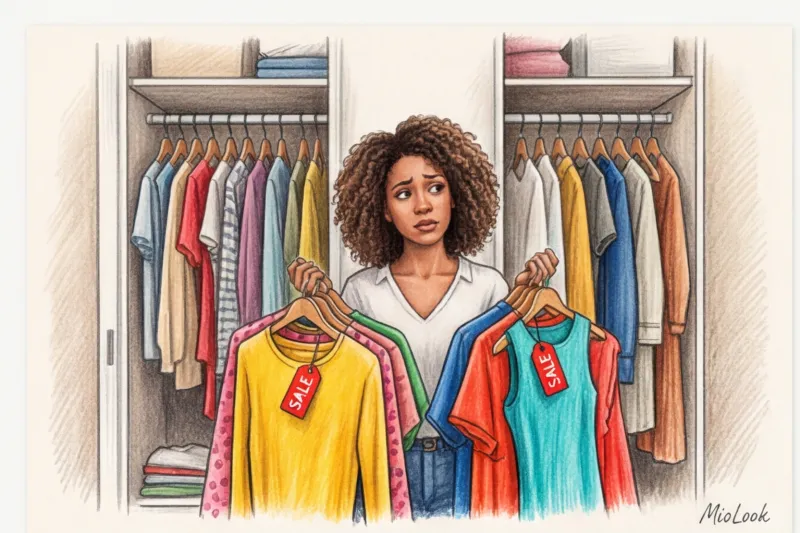
Do you know what the most expensive item in your wardrobe is? The one you bought for next to nothing on sale but never wore. A couple of years ago, a client named Marina came to me for a wardrobe review. We found 43 items with the tags still attached. The red price tags screamed bargains: "70% off!" "Last size!" We sat down with a calculator and calculated: the total of this "bargain" dead weight was €1,300.
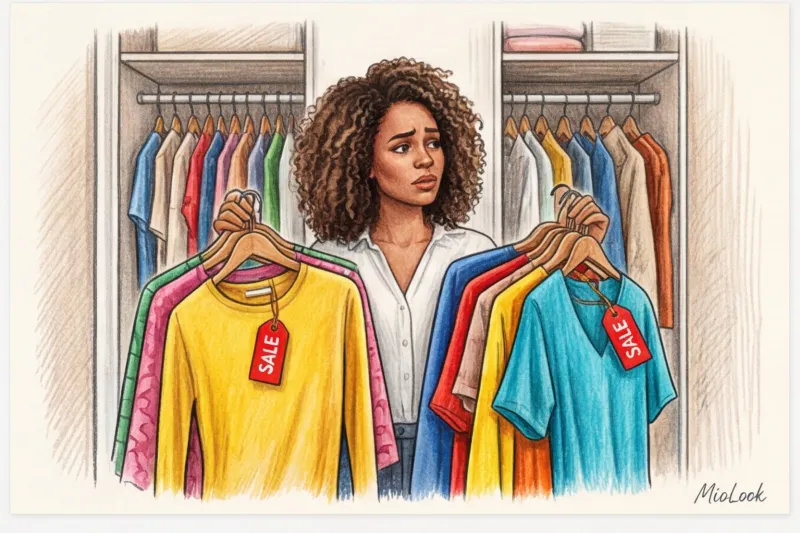
That's why the "buy cheap but buy a lot" paradigm kills your style and empties your wallet. The main secret, How to plan a clothing budget , is not about searching for the maximum discounts, but rather about a mathematical approach to your closet as an investment portfolio. We covered the basics of building a base in more detail in our A complete guide to creating a basic wardrobe on a budget , but today I want to give you specific financial tools.
Among professional stylists, we use a strict metric—Cost Per Wear (CPW). The formula is simple: the price of an item plus the cost of care, divided by the number of days you wear it.
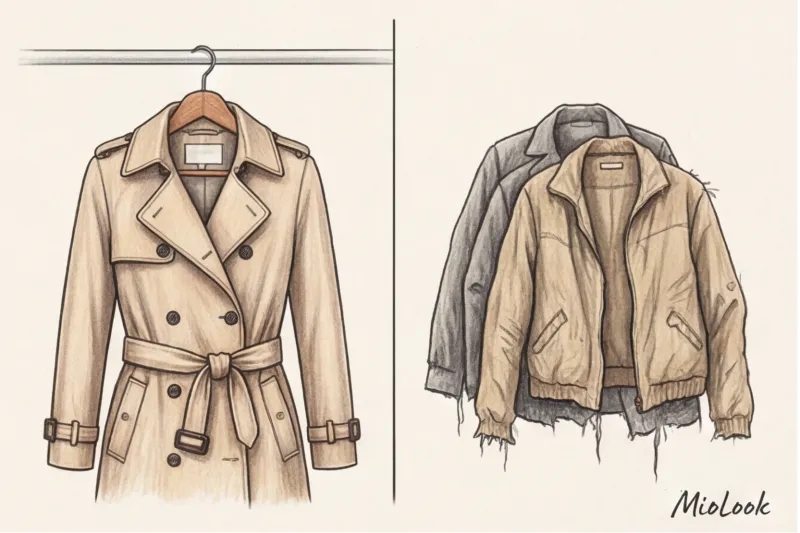
Let's do the math. You buy a trendy acrylic coat at a mass market for €60. It quickly becomes pilled, loses its shape, and you wear it a maximum of 15 times per season. Your CPW = €4. Alternatively, you buy a high-quality basic 100% wool coat for €300. You wear it three seasons in a row, at least 50 times per season (a total of 150 times). Your CPW = €2.
Mathematically, the expensive coat cost you half as much as the cheap one. Sales are the biggest budget black hole. Buying quality items at full price is mathematically more profitable than scooping up cheap "bargain" deals.
These figures are supported by global data. Internal analytics from the MioLook app for 2024 show that users of the smart wardrobe system who plan their purchases and track their CPW spend an average of 40% less on clothing per year, while also reporting higher satisfaction with their looks.
Access to MioLook for €0.99 — one-time payment
A smart AI stylist will select the perfect look and help calculate the cost of each outfit, saving you from impulse purchases.
Get access — €0.99 onceThe 70/30 Rule: The Classic Formula for a Perfect Closet
Over 14 years of working, I've noticed a consistent pattern: most women complain about the "closet full, but nothing to wear" problem because their wardrobe is completely upside down. They spend 70-80% of their budget on bright, statement pieces (a sequin dress, a blouse with a complex print, neon shoes) and leave a measly 20% for boring basics. The end result is nothing to wear with a bright blouse because they don't have the perfect pair of basic trousers.
The golden rule of wardrobe is: 70% of your budget and closet space should be taken up by basics, and only 30% by trendy or statement pieces.
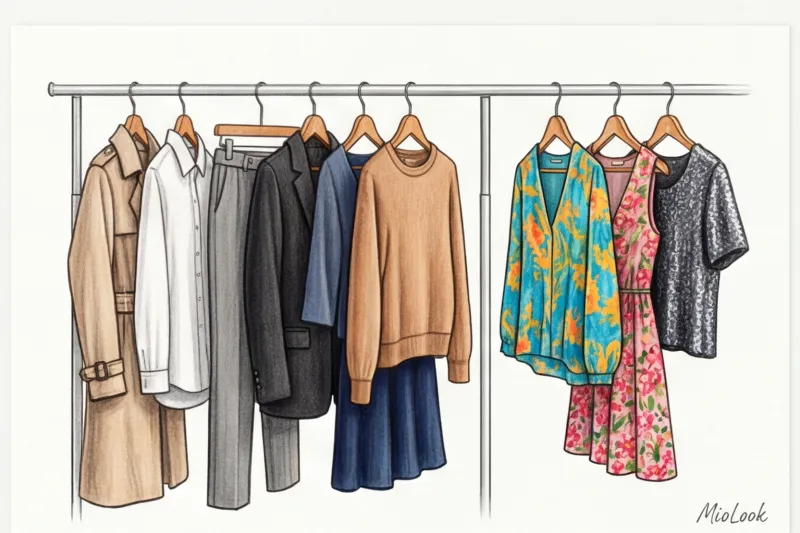
What is included in the basic 70% budget?
A basic outfit doesn't necessarily have to be a white T-shirt and blue jeans. Everyone has their own basics. For a corporate lawyer, a perfectly tailored wool-blend suit and a silk blouse would be the basics. For a creative director, it might be heavyweight graphite jeans and a high-quality leather jacket.
For these 70% you can't spare money Here, we look for a perfect fit, neutral shades (for your skin tone), and premium materials. For example, instead of thin knits that make your underwear see-through, choose cotton with a weight of at least 180 g/m² or viscose with 5% elastane for durability.
How to Safely Spend 30% on Trends
The remaining 30% is your emotions. They are what make your wardrobe modern and keep you from getting bored. This includes accent dresses for dates , leopard prints, current season's micro-trends or unusual jewelry.
The main rule of implementation: before buying a trendy item, make sure it pairs with at least three of your 70% basic items. If you need to buy new shoes and a top to go with a new skirt, it's a bad investment.
Your perfect look starts here
Join thousands of users who look flawless every day with the help of MioLook's smart algorithms.
Get access — €0.99 onceEvolution of the Method: The 70/20/10 Financial Scheme for Advanced Learners
The classic 70/30 rule works great for beginners, but for women with busy careers and complex lifestyles, it's outdated. I often use an adapted 50/30/20 financial rule with my clients, transforming it into a 70/20/10 wardrobe plan.
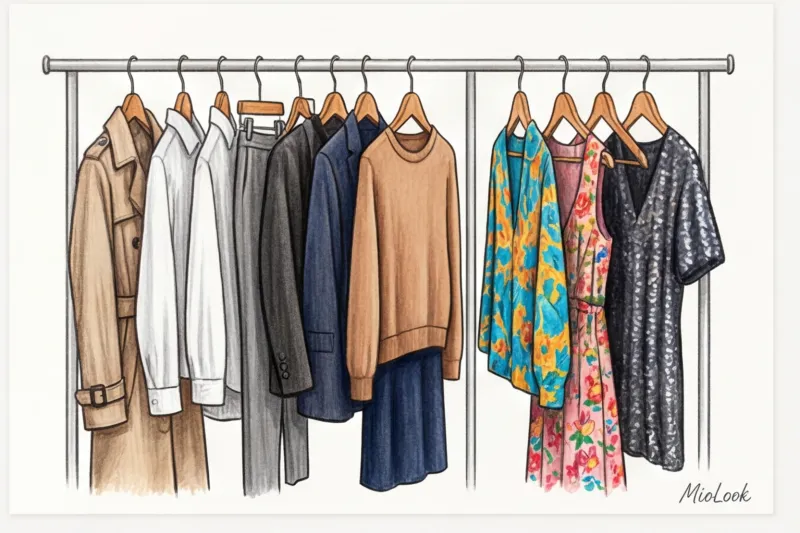
- 70% — Investment base: This is your foundation. High-quality items that you wear for years. Outerwear, shoes, classic bags.
- 20% - Specific lifestyle: A capsule tailored to your specific life right now. If you're on maternity leave, this comfortable shoes for walking and comfortable suits. If you're a top manager, there's a strict dress code.
- 10% - Pure experiments: A zone of absolute freedom. Fast trends, fun T-shirts, the season's trendiest colors. Here you can and should shop mass-market items (Zara, Mango, H&M).
But here I have to be honest: This method does NOT work. If your weight is fluctuating rapidly or you're transitioning to a completely new job, consider reducing your base weight. During periods of significant change, you should reduce your base weight to avoid buying expensive items that won't fit you in six months.

Wardrobe Investment Portfolio: Where's High and Where's Low
As the analytical agency WGSN notes in its 2024 report, consumers are shifting en masse from fast fashion to a hybrid consumption strategy (High-Low). This means skillfully mixing overtly expensive and affordable items in a single look.
To understand, How to plan a clothing budget As part of the High-Low strategy, you need to strictly divide your wardrobe into two categories.
Maximum investment categories (High):
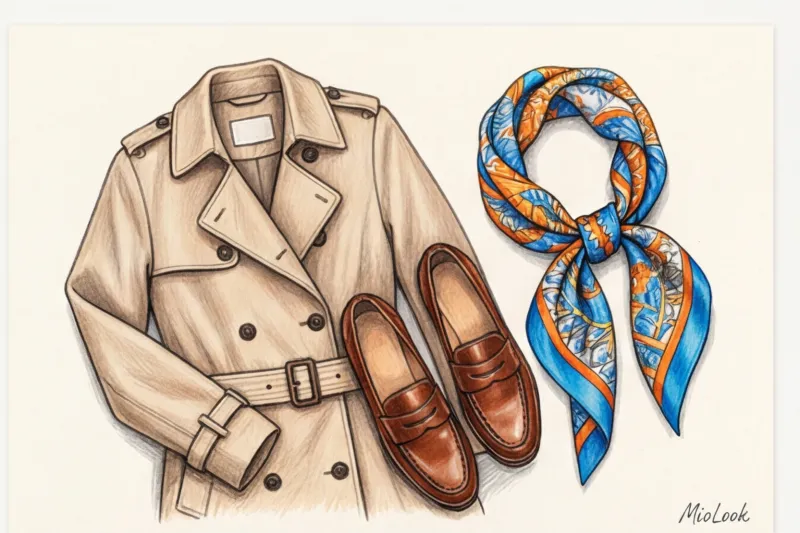
This is where your main budgets go. Essential bags for all times , structured shoes, outerwear, a watch, and a portrait zone (glasses). Pro tip: an expensive, well-made leather bag and quality loafers will visually elevate the entire look. No one will know you're wearing high-street pants if your shoes are impeccable.
Smart Savings Categories (Low):
There's no point in buying a basic white T-shirt for €150 if it'll lose its crystal whiteness within a season from deodorant and washing. Cotton tops, trendy jewelry for one season, and summer sundresses for vacation are perfect for saving.
Ready to get started?
Try the MioLook plan for free—no commitments required. Digitize your wardrobe and start saving right now.
Get access — €0.99 onceThe Annual Budget Method: Planning Seasonal Spending
The most common mistake my clients make is trying to budget their wardrobe monthly. For example, allocating €150 each month. This is ineffective. In July, you only need shorts for €30, and in October, winter boots and a down jacket for €400.
Wardrobe planning should be done on a six-month basis. The main financial investments occur in August (for the fall/winter capsule collection) and February (spring/summer). And most importantly, always allow 10-15% of your annual budget for "wardrobe depreciation."

Many people forget about hidden costs. A cashmere sweater requires dry cleaning (from €15 per session). Expensive leather shoes need a break-in and maintenance (from €20) before they're even worn outside. If you don't budget for these expenses, your expensive investment pieces will quickly turn into worn-out rags.
Checklist: 5 Steps to a Financial Detox of Your Closet
If you want to reframe your approach today, here's a step-by-step action plan I share in my personal consultations:
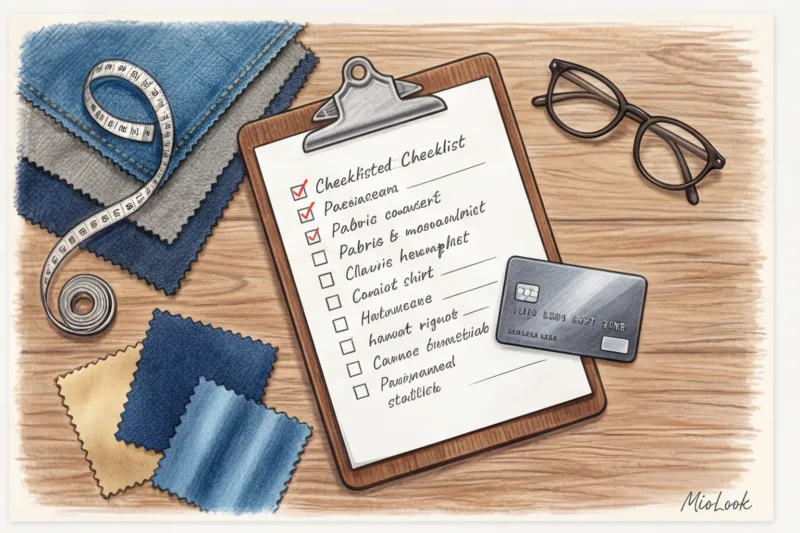
- Conduct an audit and count the “dead” money. Take out all the clothes you haven't worn in over a year. Estimate their approximate value. This figure will quickly sober you up and cure your shopping addiction.
- Define your personal uniform. What 3-4 look formulas do you wear most often? These are the 70% you should invest in.
- Calculate your Cost Per Wear limit. Before buying anything over €150, ask yourself honestly: "Will I wear this 30 times in the next year?" If the answer is "no," return it to the hanger.
- Create a strict shopping list before the sales start. Include only those items that fill the gaps in your basic wardrobe.
- Digitize your wardrobe. Visual inspection works wonders. Upload your items to MioLook When you see on your phone that you already have four gray sweaters, you won't be tempted to buy a fifth.
Summary: Transition to a conscious style of mathematics
A beautiful, functional wardrobe is built on strict numbers, not spontaneous impulses in front of a mirror at the mall. A systematic approach and formulas like 70/20/10 may seem boring at first, but they offer true freedom.

You no longer need to panic in front of your open closet or beat yourself up over yet another impulsive purchase. Every item in your portfolio will pay for itself in time, comfort, and, most importantly, confidence in your own irresistibility. Start small: calculate the CPW of your favorite item today—and you'll see how your shopping experience changes.