

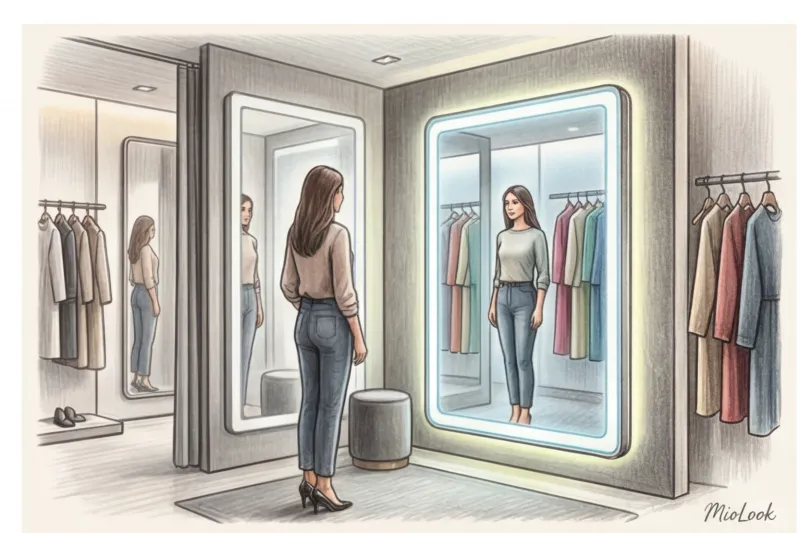
What are smart mirrors in stores and how do they work?
Do you remember that feeling? You're standing in a cramped fitting room, half-dressed, trying to button pants that are clearly too small. You peek out from behind the curtain, hoping to catch the consultant's eye, but there's no one in the showroom. You have to put your clothes back on, go out for another size, and start the whole process over again. In 14 years as a stylist, I've seen that tired, disappointed look in hundreds of clients. That's why, when people ask me about smart mirrors in stores , I always answer: this is not just an expensive gadget for show, it is the long-awaited end to the main shopping nightmare.
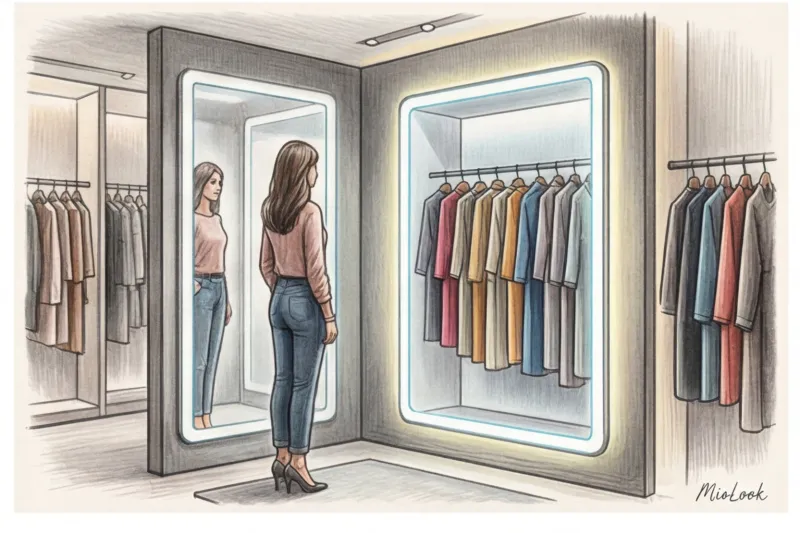
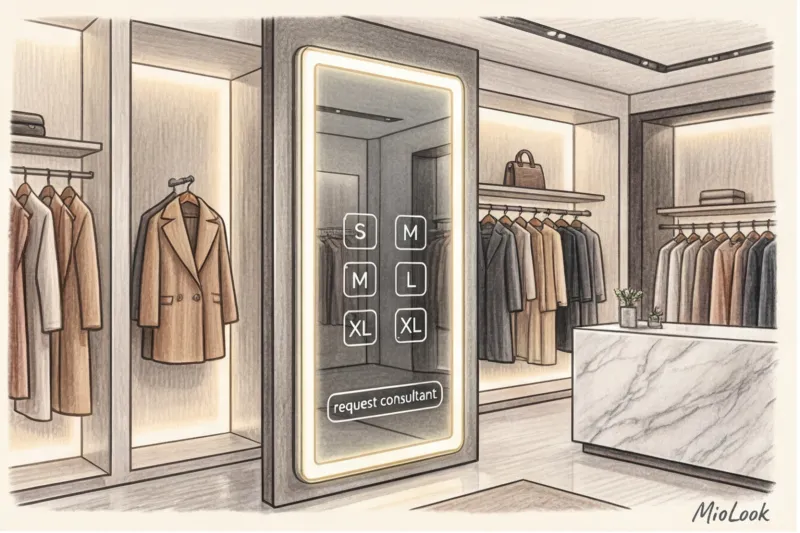
Simply put, a smart mirror is your personal virtual assistant, built right into the glass of your fitting room. When not in use, it looks like a perfectly ordinary, reflective surface. But once you step inside with your chosen items, its surface comes to life, transforming into an interactive style control panel.
The same applies to AI showcases (intelligent digital boutique façades). Unlike traditional mannequins, a smart display window analyzes the external environment. Using optical sensors, it detects when a person has stopped in front of it. The system doesn't collect biometrics and maintains privacy, but it does detect the general silhouette and the weather outside. If it's raining, the display window instantly switches from displaying light dresses to cozy trench coats and cashmere, displaying them on 3D avatars. You can read more about the evolution of these solutions in our review. Fashion tech technologies in 2024.
It's crucial to understand the difference between a basic interactive screen and a true AI mirror. Many business owners mistakenly believe that simply hanging a tablet with a product catalog on the wall will make their store "innovative." This is an illusion. A basic screen forces you to do the work of a consultant: manually search for SKUs, filter sizes, and enter data. A true AI mirror has "vision" and analytical algorithms.
The difference between a regular display and a smart mirror is the same as the difference between a paper map and a GPS. While one simply provides basic information, the other proactively guides you to your destination, analyzing the situation in real time and suggesting the best routes to your ideal look.
From AR Try-Ons to RFID Tags: Magic Beyond Hogwarts
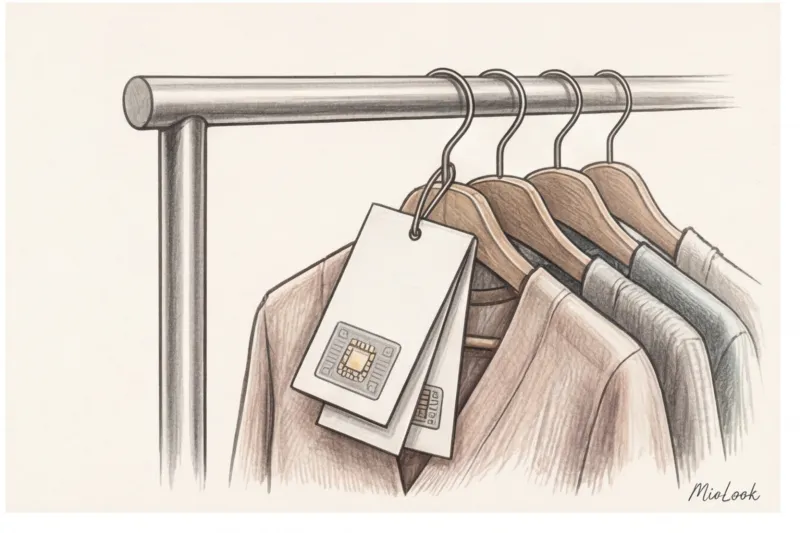
So how does this technology work "under the hood" and why does the mirror even know what you brought into the fitting room? It all starts with RFID tags (radio frequency chips). Today, brands are embedding these tiny sensors directly into cardboard tags or fabric labels on clothing.
As soon as you step into the fitting room, the mirror's sensors instantly read these tags. Before you've even hung your clothes, the screen displays a complete list of your items, their fabric composition, care instructions, and current price (for example, if a jacket costs €150 and there's a hidden discount on it today, you'll see it immediately).
Then the built-in ones come into play body scanners and technology augmented reality (AR) Scanners capture your body proportions in real time, creating a contour map. This activates the AR try-on feature. Imagine: you're wearing a basic white top. You look in the mirror, swipe the screen, and, using augmented reality, the top changes color right in your reflection, turning a deep emerald or stark black. The folds of the fabric, the shadows, and the texture move with your body.
According to a WGSN study (2024), such visualization reduces buyer hesitancy by 40%. I had a telling case with a client in Milan: she was hesitant about buying a €320 cashmere sweater. She didn't have to change clothes four times to compare shades. We simply switched colors on the screen until we were convinced that terracotta perfectly complemented her skin tone.
Another feature I, as a stylist, find absolutely brilliant is the ability to change the lighting in the fitting room. I always tell my clients, "The way you look under the harsh halogen lights of a retail store has nothing to do with real life." The smart mirror solves this problem with a single touch.
- Office mode: Turns on a cool, slightly dimmed fluorescent light. Perfect for checking if your new business suit is too gloomy.
- Street/Daylight mode: Simulates bright sunlight. Essential for summer clothes to ensure that the underwear on a linen dress doesn't show through.
- Evening Restaurant mode: Creates a warm, muted light with accent shadows. It helps you appreciate how sequins or silk will shimmer at dinner.
And finally, the most important thing for creating a stress-free service is real-time synchronization with warehouse availability If you need a different size or want to add a belt to a dress, you don't have to look for a consultant. You simply press a button on the mirror. The request is instantly sent to the attendant's smartwatch, and they bring the item right to your booth. You can read about how this impacts business economics in the article about Smart mirrors and saving sales in boutiques.
By the way, the algorithms that the mirror uses to suggest “what to wear with this item” work on the same principles as the smart wardrobe function in the app. MioLook The program analyzes a garment and instantly compiles dozens of ready-made stylish formulas from it, freeing you from the eternal problem of "nothing to wear."
Why Offline Boutiques Need Digital Technologies: Business Indicators
Let's be honest: few people go to the mall these days just to buy basic items. If I need a simple white T-shirt for €30, I'll order it online while stuck in traffic or waiting for my coffee. Shoppers come to physical boutiques for something completely different—a tactile experience, premium service, and the confidence to make a choice. This profound transformation of the customer experience is the main driver of sales growth for any offline retailer today.
We are witnessing a global shift in the industry towards the concept retailtainment (from the English words "retail" and "entertainment"). A modern clothing store can no longer be simply a beautifully decorated warehouse with racks. It must become an interactive, experiential space. Smart mirrors in stores are the technological anchor that compels shoppers to tear themselves away from their smartphones, linger in the fitting room, and ultimately leave a significantly larger receipt at the checkout.
But it's not just about the wow factor for visitors. For business owners, smart displays and interactive fitting rooms offer a powerful, unbiased analytics tool. According to a large-scale McKinsey study (2023), successful omnichannel and deeply personalized shopping experiences can increase customer lifetime value (LTV) by 10-15%. If a mirror is synchronized with a loyalty program, it can greet regular customers by name and suggest new items based on their past purchases. This creates the level of service that keeps people coming back.
At the same time, many boutique owners are apprehensive about the cost of implementing such systems. A fully-fledged AI booth can cost between €4,000 and €12,000. But I always explain during consultations that this technology pays for itself in a less obvious way—through refusal analytics. In traditional retail, the fitting room is a huge blind spot. You know exactly what the customer bought. But you have no idea why they left five other items on the ottoman.
With the introduction of RFID tags, the store begins to collect in real time big data About fittings. When I was consulting for a European mid-up brand, we analyzed this data and discovered a striking pattern. A luxurious silk blouse priced at €280 was being tried on dozens of times daily, but the conversion rate was less than 2%. It turned out that the specific cut of the collar made it uncomfortable to put on, and the buttons were too tight in the buttonholes. The brand promptly recalled the batch, made adjustments at production, and avoided significant losses. Mirror dispassionately records what is tried on but not purchased, giving businesses the opportunity to manage their product matrix based on precise data rather than intuition.
Increasing the average check through AI styling
One of the main principles of my work is to offer a woman a complete style solution, not a specific item. A skirt itself is worthless if the client has no idea how to wear it in everyday life. AI mirrors automate this styling process, brilliantly executing the scenario. Complete the look (collect the image).
What does this look like in practice? A woman tries on a pair of classic wide-leg wool trousers. A built-in algorithm instantly reads the tag's chip and displays a subtle hint: "These trousers pair perfectly with a cashmere cardigan from our new collection and this leather belt." It's a gentle, expert upsell that's far more effective than a salesperson's standard question: "Is there anything else you'd like to see?"
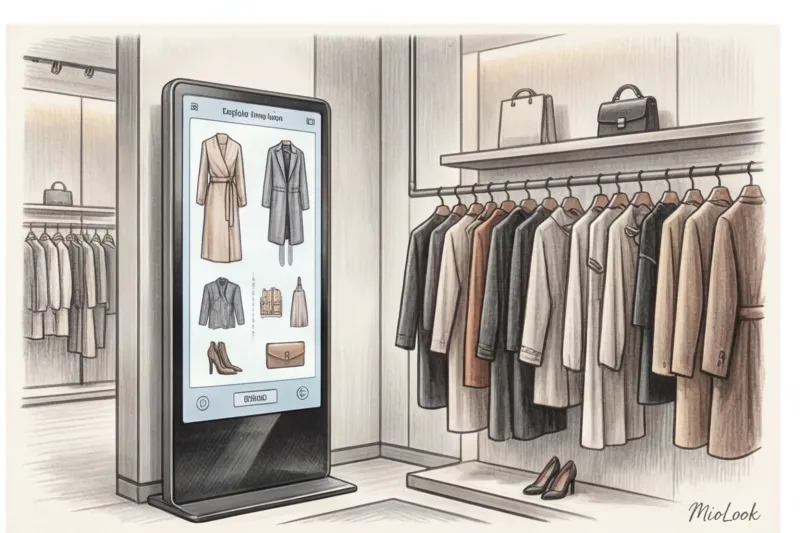
There's a psychological shift from selling a single item to selling a complete capsule collection. This works especially well during seasonal transitions. The algorithm can show how a light summer dress transforms into a fall look when paired with a heavy €150 jacket and the right shoes.
Integrating the smart mirror with the store's virtual catalogs allows customers to see the brand's entire available selection. Even if the jumper they want isn't on display but in stock, they can scroll through the catalog on the touchscreen and request it with a single click.
Access to MioLook for €0.99 — one-time payment
A smart AI stylist will select the perfect look for every day and help you organize your wardrobe.
Get access — €0.99 onceBy the way, if the buyer is already using the app MioLook With digital wardrobe management, the process becomes even more conscious. She can immediately assess how the look suggested by the store's artificial intelligence fits with the basics already waiting on the hangers at home.
Reducing the number of returns
Returns are a colossal financial drain on the fashion industry. When an item is returned, the brand loses money on double logistics, repackaging, and cleaning, and the item itself often loses its original marketable appearance beyond repair. Digital fitting room technologies help combat this problem even at the purchasing decision stage.
One common reason for returns is an impulsive purchase that's slightly tight or, conversely, too big. The customer simply couldn't be bothered to get dressed, go out into the noisy store, and search for the right size. A smart mirror guarantees accurate sizing without stress: simply press a button on the screen to request a larger or smaller size from the assistant, all while remaining in a private and comfortable space.
Of course, no algorithm can yet fully replace the empathy of an experienced stylist. However, AI creates a safe environment where clients don't feel pressured. You can request ten different sizes, and the mirror will never look at you with judgment or impatience.
Many advanced AI systems already offer visualizations of garment fit on different body types. If a retailer has uploaded high-quality 3D models of its collection, a customer can see on the screen how their favorite slip dress fits on plus-size models or on petite women. This immediately creates realistic expectations for fabric cut and fit.
The influence of light shouldn't be forgotten either. A huge percentage of returns stem from the phrase, "The color at home turned out completely different." Modern interactive panels allow you to change the lighting scenario in the cabin with a single touch: from bright midday sun to the subdued light of an evening restaurant or the cool lamps of an office.
As a result, customers leave the boutique with an informed purchase. They took the time to evaluate the item in the right light, analyzed the combinations suggested by the algorithm, and found the perfect size without fuss. Such thoughtful purchases are returned to the checkout much less often, saving the retailer profits and the customer valuable time and confidence in their wardrobe.
A Stylist's Perspective: How AI is Changing the Fitting Room Experience
A couple of years ago, I had a client, a financial director with a rigorous schedule. We went to a large flagship store to assemble a business capsule collection for the new season. We selected about fifteen items, she went into a booth, and the classic quest began. I spent exactly 40 minutes running between the fitting room and the main floor: searching for different sizes of a basic trench coat, swapping out trousers that were oddly baggy at the hips, asking for a blouse a shade lighter. "Listen, Olena, I feel like we're passing a shuttle run test rather than updating our wardrobe," she summed it up.
For women who shop without a stylist, this scenario often turns into a nightmare. Remember having to pull your clothes back on, throw away the ones that don't fit, walk to the store, search for the right label... Or worse, peeking out from behind the curtain half-dressed, trying to catch the eye of the perpetually busy salesperson. The interactive panel solves this problem with a single tap. Simply tap the desired size on the screen, and the seller receives a notification on their terminal, delivering the item right to your door. No stress or wasted time.
Another important insight from my experience: trying on the same item in three different shades can kill the enthusiasm of even the most avid shopaholics. Let's say we found the perfect structured jacket for €250 that fits perfectly. But we only have black, emerald, and camel available. Trying on and off a thick, layered item multiple times is a dubious pleasure. In new-generation booths, you put on the physical item once, then simply swipe on the mirror. The built-in augmented reality module instantly "recolors" the fabric in your reflection, preserving every fold, texture, and play of light. You can objectively assess how the shade interacts with your skin tone without any unnecessary movements.
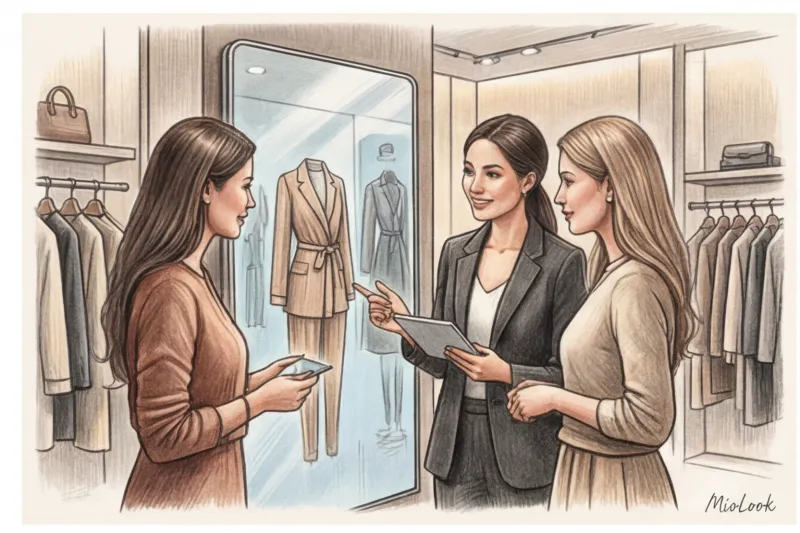
But the real revolution happens when a one-time offline purchase is linked to your smart wardrobe. Have you ever bought a gorgeous skirt, brought it home, and realized with horror that none of your tops go with it? The fashion tech industry is now actively implementing the connection between physical retail and digital organizers.
If you keep track of things through MioLook , the process of evaluating a new item becomes crystal clear. Standing in front of a smart mirror, you can visually compare the item you're trying on with the contents of your closet. This creates a fundamentally new approach to consumption:
- Reduced impulsivity: You buy only what forms at least 3-4 ready-made sets with the clothes you already have.
- Gap Analysis: The AI assistant in the mirror can suggest that you need a basic belt to complete your look (which you can request in the fitting room right there).
- 100% integration: The item is automatically added to your digital capsule after scanning or payment.
For me, as a practicing specialist, digitalizing fitting rooms is a transition from grueling physical labor to pure creativity. My clients and I no longer waste energy on arranging items around the sales floor and can finally focus on what matters most—finding a unique personal style.
The Biggest Myth: Will Smart Mirrors Kill the Consulting Profession?
Did you know that when the first large-scale implementations of AI technologies in offline boutiques were announced, the main problem was not technical bugs, but resistance from staff? According to a McKinsey report (2023), over 40% of sales staff initially perceived digitalization with outright fear, believing that smart mirrors in stores would simply destroy their jobs.
In practice, the exact opposite is happening. This is where a crucial, albeit counterintuitive, insight lies: technology doesn't replace humans, but rather, paradoxically, makes services more "human." AI takes over all the soulless mechanics, leaving humans with what algorithms lack—empathy, emotional intelligence, and a subtle sense of style.
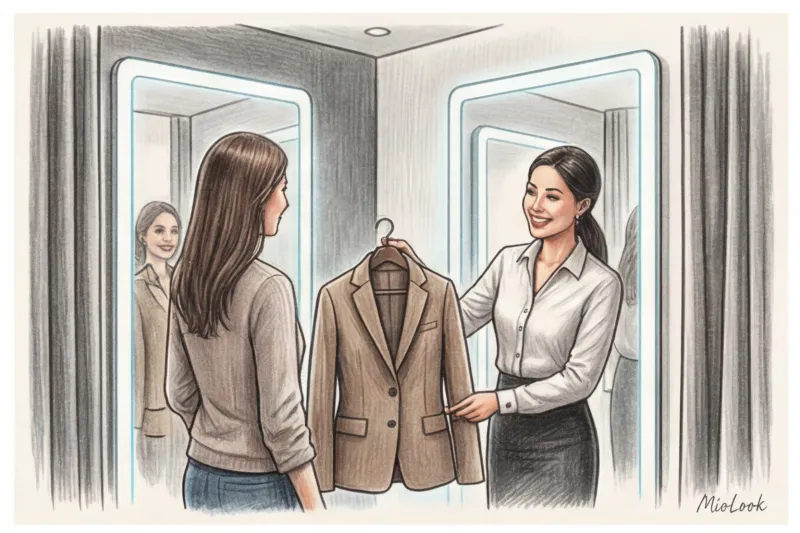
An interactive fitting room permanently frees salespeople from the outdated "bring it and get it" function. When I conduct training sessions for teams at European brands, we discuss this transformation in detail. Freed from the need to make dozens of empty runs to the warehouse to check the stock of a basic trench coat for €180, the employee evolves into a fully-fledged fashion advisor.
The consultant finally has the time to have a quality conversation. They can discuss the specifics of a cut, help you tuck in a shirt beautifully (that French tuck that instantly transforms the proportions of a silhouette), listen to your concerns, and professionally adjust your look. In this case, the client isn't just buying a piece of fabric; they're buying attention and expertise.
The magic of this process is ensured by the mirror's deep synchronization with the consultant's tablet. As soon as you press the "Request a different size" or "Need help" button, it doesn't just turn on a bland red light above the booth. The system ensures a completely seamless service: the signal is sent to the smart device of the available stylist.
The assistant sees the exact item number, your fitting room number, and—if the store is integrated with your loyalty program—your previous purchase history on the screen. When they approach the booth, they already know you're trying on wool palazzo pants and can grab the perfect leather belt or contrasting blouse to complete the look. You don't have to wait tensely, or search the sales floor for a savior—help arrives, prepared and personalized.
Access to MioLook for €0.99 — one-time payment
Start creating perfect images with the help of artificial intelligence
Get access — €0.99 onceThe result is a win-win: the buyer receives premium service without the hassle, and the seller increases their value as an expert, which directly and positively impacts their sales.
Case Studies: Brands Already Using AI-Based Storefronts
According to a recent analytical report by the authoritative publication Business of Fashion, by 2025, the integration of digital technologies into physical retail will no longer be a mere image experiment. Today, smart mirrors in stores are an established industry standard in developed markets. Brands no longer test hypotheses for the sake of slick press releases; they are scaling up their tools to increase sales and retain customers. Let's look at how this works in practice across different price segments, as the approaches differ dramatically.
Premium segment: personalization at Neiman Marcus and Nordstrom
Luxury department stores were the first to recognize the potential of AI interfaces, but they use them very differently than more affordable brands. For premium brands, the key metric isn't the speed of purchase, but exclusive service and impeccable attention to detail.
For example, the department store chain Neiman Marcus was one of the first to equip its fitting rooms with Memory Mirror technology. When my client tries on a €1,800 designer trench coat, the mirror doesn't just show her reflection. It records a short 360-degree video, allowing her to see the intricate design of the garment from behind in motion. This video can be instantly sent via messenger, so she can consult with me or her loved ones before making a purchase.
Nordstrom has gone even further, combining digital services with personal stylists. Customers reserve items via smartphone, and by the time they arrive, they're already hanging in a smart fitting room. A greeting with their name appears on the screen, and an algorithm suggests complementary accessories to complement their chosen essentials. This creates the atmosphere of a private, exclusive club, where technology enhances human empathy rather than replaces it.
Mass Market: Speed and Independence from Zara and H&M
While luxury technology focuses on premium service, mass-market technology focuses on throughput and reducing operational load. The key difference here is the minimal reduction in decision-making time.
At Zara's flagship stores, interactive panels are integrated directly into the walls of the fitting rooms. Bring in a basic dress for €45, and the system instantly recognizes it via a hidden RFID tag. Recommendations appear on the screen: which shoes from the current collection will look best with it. Need a different size? One touch of the screen, and an available consultant will bring it from the warehouse.
"The mass market strategy is to remove any barriers between the customer's desires and the checkout. H&M, for example, took a gamified approach: in their flagship stores, they installed mirrors with voice recognition that took selfies of customers and offered discounts for subscribing to their newsletter, right from the fitting room."
Smart storefronts (AI-based storefronts): how to stop passersby
But modern magic begins long before a person reaches the fitting area. The job of smart display windows (AI storefronts) is to snag shoppers from the stream of people rushing down the street.
Imagine this scenario: you're walking along a shopping street, looking into a boutique's glass display window, and it physically reacts to your presence. Computer vision cameras (without recording your face or invading your privacy) detect your clothing color palette, analyze weather conditions, and display a mannequin on a holographic screen wearing an outfit that visually resonates with your current style. Rain? The display window instantly adjusts and offers a stylish raincoat and umbrella.
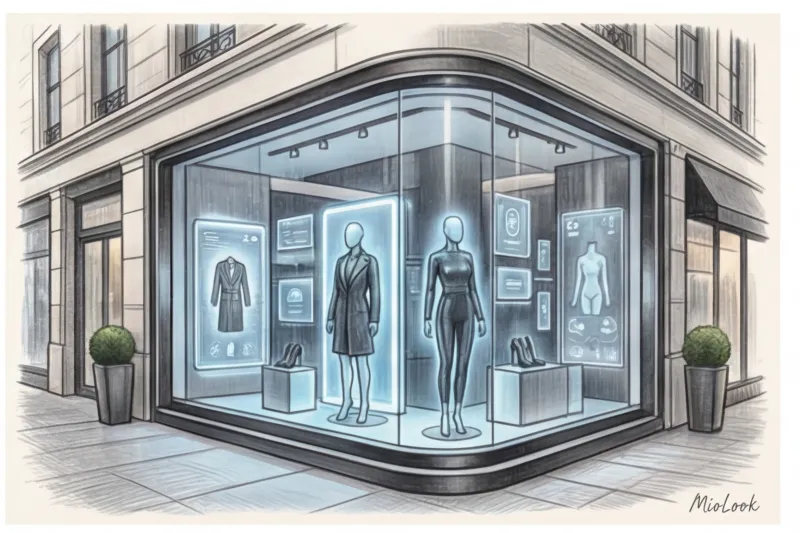
This deep interactive visualization works on the same principles as image selection function in the MioLook app , only brought to the street in real time. Interested passersby can scan the QR code for the set they like, save it on their phone, and enter the store with a ready-made request. This completely changes the rules of the game, turning passive window shopping into a passionate, targeted visit.
How to Implement Smart Mirrors in Clothing Stores: A Business Checklist
Last year, the owner of an independent premium concept store approached me for a customer service audit. She was completely disillusioned with the technology: the business had invested approximately €8,500 in two luxurious interactive panels for fitting rooms, but after six months, the average order hadn't increased by a cent. When I arrived at the store, the root of the problem became apparent within the first ten minutes.
The owner made the most typical and, unfortunately, most expensive mistake in the fashion business: she bought premium hardware but didn't integrate it with her inventory. As a result, the displays simply displayed the brand's beautiful advertising lookbooks. This isn't a smart mirror in a store; it's just a very expensive TV. For technology to truly drive sales, it needs to be seamlessly integrated into business processes.
1. IT infrastructure assessment and seamless integration
Digital magic begins not in a beautiful fitting room, but in a boring database. A smart mirror must "know" in real time exactly which items and in what sizes are physically available in the store right now. This requires full synchronization with your ERP system.
- Synchronization of balances: If an algorithm suggests a customer pair a basic skirt with a statement silk top, that top must be in stock in her size. There's nothing worse for loyalty than being offered the perfect item that's impossible to buy.
- RFID tagging: All merchandise must be equipped with RFID tags. These radio frequency sensors allow readers to recognize an item in a split second as soon as a customer steps into the fitting room.
- CRM integration: Connect mirrors to your customer database. The ideal scenario is as follows: a customer logs in using her phone number or QR code, the mirror pulls up her purchase history, and offers to try on a new cashmere cardigan that would perfectly match the palazzo pants she bought from you three months ago.
2. Training staff in new work standards
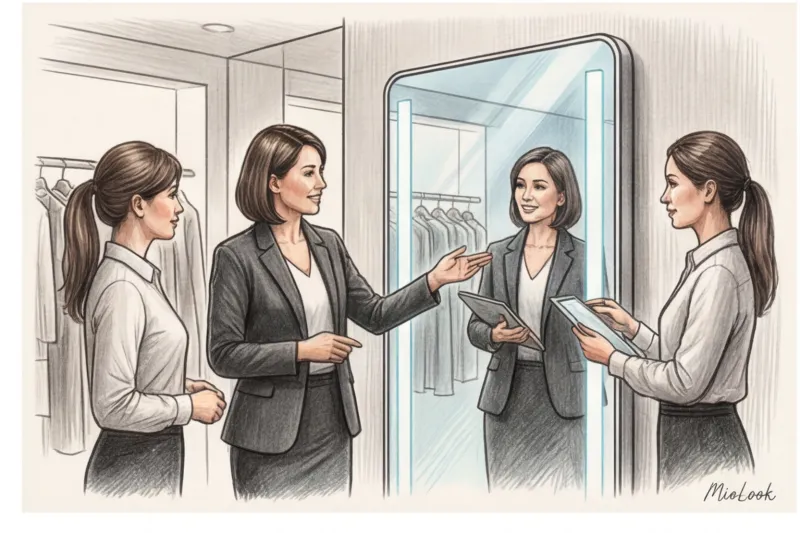
Any innovation is useless if line staff perceive it as a threat. I often hear from consultants the fear that machines are destined to replace them. It's important to convey to the team: an algorithm doesn't take away your work; it takes away routine tasks, freeing up time for real styling and service.
If your salesperson can't instantly receive notifications from the mirror on their work tablet, the entire chain collapses. Training should include strict speech scripts. When handing over an item to a client, the consultant shouldn't simply silently close the curtain. They should say: "I've prepared several options for you. When you put on this jacket, look at the screen—our brand's stylist has already selected three pairs of shoes from the new collection to go with it. If you'd like to try them on, just press the button on the mirror, and I'll bring them to you.".
3. Return on Investment (ROI) and Hidden Savings
How much does it cost and when will it return? A complete set of equipment and software for a single fitting room currently costs between €3,000 and €6,000. According to an industry study by the IHL Group (2023), when properly implemented, such solutions pay for themselves within an average of 11–14 months for mid- and premium-segment boutiques.
Where does the return on investment come from?
- Units Per Transaction (UPT) growth: Smart, unobtrusive cross-selling right at the moment of trying on consistently increases the number of items in the receipt by 15–20%.
- Staff optimization: Transparent fitting logistics mean you need fewer "runners" in the room during peak hours. Consultants move purposefully.
- Reducing losses: Mandatory implementation of RFID labeling automatically solves the headache of warehouse misplacement and significantly reduces the rate of theft.
Modern fashion retail demands a seamless integration of the offline experience with customers' digital habits. When customers can not only try on items, but also transfer their favorite looks to an app with a single click. MioLook on your smartphone, you turn a one-time purchase into a long-term relationship with her everyday wardrobe.
Your perfect look starts here
Join thousands of users who look flawless every day with MioLook. Plan capsule wardrobes, manage your wardrobe, and find your unique style with the help of artificial intelligence.
The Future of Fashion Retail: What Boutique Owners Should Prepare forDo you know what question I'm most often asked by independent brand owners at industry conferences? "Olena, when will this trend toward screens and virtual reality pass?" I always answer bluntly: it won't. According to McKinsey (2024), by the end of this decade blurring the boundaries between online and offline (phygital retail) will become the absolute industry standard. We are entering an era where customers refuse to choose between the speed of online shopping and the tactile pleasure of trying things on. They demand everything, now.
Phygital retail means that the digital and physical customer journeys are seamlessly intertwined. A woman adds a €150 silk blouse to her online shopping cart while drinking her morning coffee. In the evening, she walks into your boutique, and the smart mirror in the fitting room greets her by name, pre-preparing the item and suggesting pants in the right size to go with it.
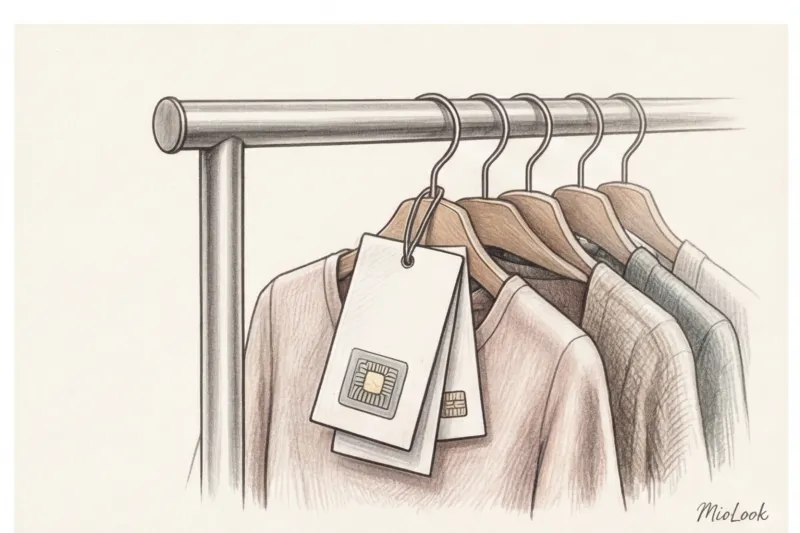
If today we are surprised by the recognition of things by chips, tomorrow it will seem like a basic function. In just a few years, it will become the norm. voice control of fitting rooms and personalized 3D avatars At a recent fashion innovations exhibition, I personally tested the beta version of such a booth. You step inside, the system scans your proportions in four seconds and creates a precise digital mannequin. You don't have to change your outfit ten times. You simply say to the mirror: "Show me that trench coat in sand." or "Change the lighting to bright sunlight" The algorithm renders the fabric physics on your 3D model with incredible precision. This completely solves the problem of "fitting fatigue"—you only physically put on the item you've already visually approved.
But the real revolution will happen when boutique technology learns to "talk" to customers' smartphones. Think about it: the most common reason for hesitation at the checkout is the thought, "What will I wear this with?" This is precisely where application MioLook It could become the perfect bridge between your home wardrobe and the AI mirror in the store..
Just imagine this scenario. Your client enters the fitting room and syncs her MioLook profile with the mirror via a QR code. The system instantly analyzes the digital database of her physical closet. And instead of suggesting abstract combinations, the AI showcase displays on the screen: "This jacket will pair perfectly with those gray palazzos you bought last fall and your favorite loafers." This is no longer just an attempt to increase the average order value through cross-selling. It's personalized styling that relieves women of cognitive overload and builds tremendous trust in your brand.
What should businesses do today?
Many boutique owners are now thinking, "This sounds like science fiction; we're still a long way off." But we need to adapt now. I always recommend a pragmatic approach to my entrepreneurial clients.
- Don't buy hardware just for the sake of it. Investing in a display costing several thousand euros won't save a store with poor service.
- Start by digitizing your database. Your first and most important step is to implement an ideal ERP system and migrate your entire product range to RFID tags. Without accurate, real-time data, no AI algorithm can function correctly.
- Train your team to be stylists, not storekeepers. As technology takes over logistics and inventory control, your employees' primary focus will be human empathy and expert advice.
The future of fashion isn't soulless machines replacing people. It's a smart environment that takes care of all the mundane, leaving us with what's most valuable: the joy of transformation, the confidence in our choices, and the time to simply be beautiful.
Guide Chapters
Innovation in Fashion Retail: How Technology is Changing the Experience
Why is poor fitting room lighting killing sales, and how are modern technologies saving brick-and-mortar boutiques? We explore the key customer experience trends.
RFID Tags in Clothing Stores: Secrets of Smart Fitting Rooms
Shopping burnout is a thing of the past thanks to innovation. Find out how smart fitting rooms make the shopping experience as comfortable as possible.
A clothing store without salespeople: How Just Walk Out works
Grab something and just go: how Just Walk Out technology is changing the way we shop. We explain how concept stores operate without queues or cash registers.
3D body scanner in stores: why take digital measurements?
Standardized sizing charts are often confusing and frustrating. Find out how ditching the tape measure and switching to digital measurements will transform your wardrobe.
Interactive fitting room: which stores to test it in
Fatigue from long fitting sessions often leads to unsuccessful purchases. We'll explain how smart technologies are changing shopping and where you can try them out today.
AI Stylist in Store: How Smart Screens Assemble a Capsule
Forget about fitting room stress. Discover how smart mirrors powered by artificial intelligence help you quickly assemble stylish capsule collections right on the sales floor.
AR Displays in Retail: How Holograms Are Replacing Mannequins
Traditional fashion presentations are becoming a thing of the past, giving way to digital technologies. We explore how augmented reality is replacing traditional mannequins.
Smart Try-On Mirror: How the Technology Works
Interactive technologies are changing the rules of shopping forever. Discover how digital mirrors are transforming cramped stalls into personal fashion studios.
Frequently Asked Questions
What style mistakes do you make?
Honest Quiz: Find Out Your Wardrobe Weaknesses and How to Fix Them
About the author
Unlock MioLook
for €0.99
Start creating perfect outfits with artificial intelligence
Get access — €0.99 onceRelated Articles
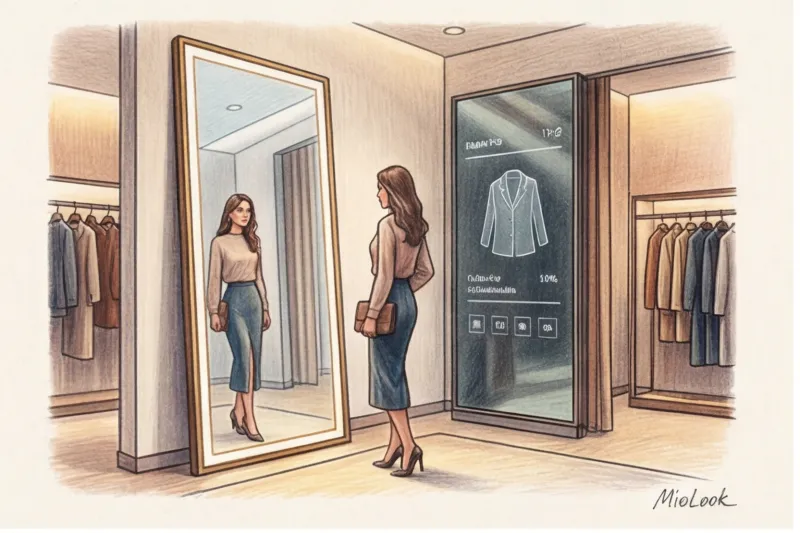
Smart Try-On Mirror: How to Save Boutique Sales
Are customers leaving the fitting room because they're wearing the wrong size? F...
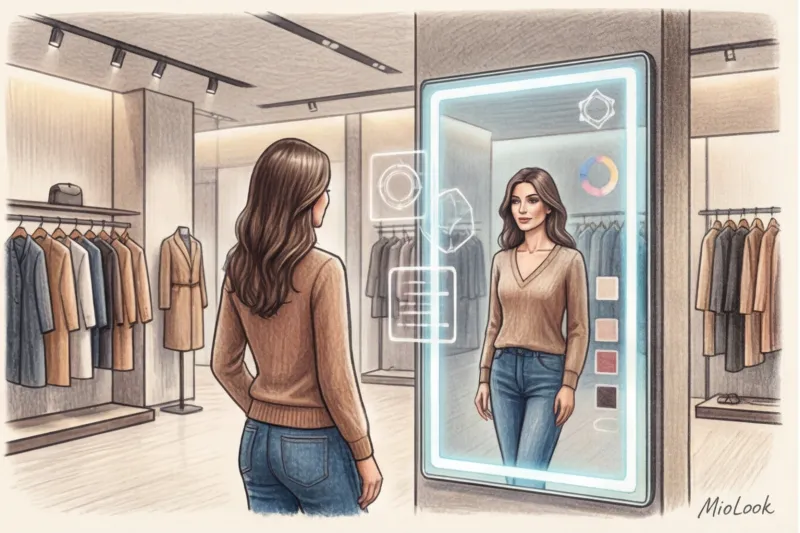
Smart Mirrors in a Clothing Store: How AR is Changing Shopping
Physical fittings often tire customers and lead to lost sales. Learn how augment...
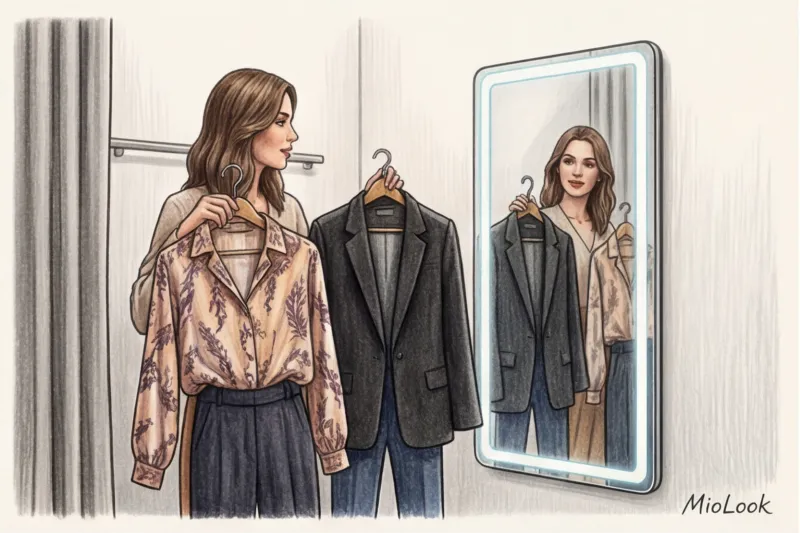
Interactive fitting room: which stores to test it in
Fatigue from long fitting sessions often leads to unsuccessful purchases. We'll ...
Innovation in Fashion Retail: How Technology is Changing the Experience
Why is poor fitting room lighting killing sales, and how are modern technologies...