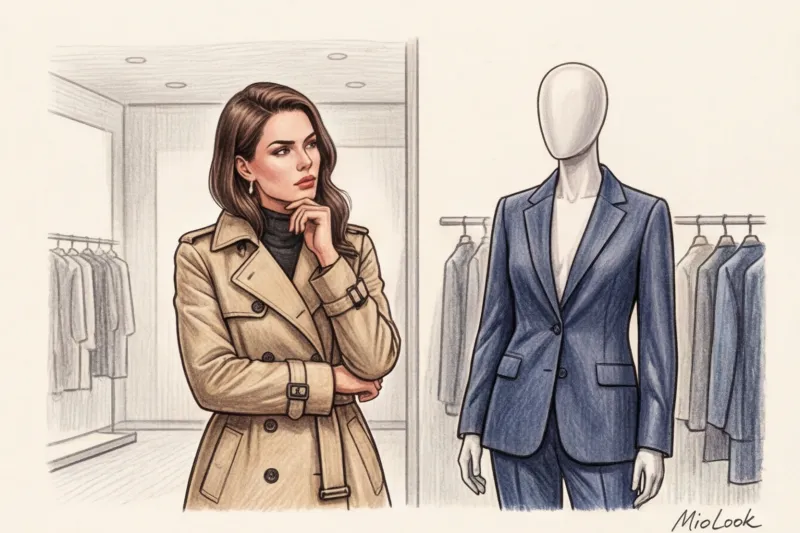
I'll never forget one incident in Milan. My client fell in love with a luxurious Tom Ford silk dress in a deep emerald shade, costing around €3,000. It sat perfectly on the mannequin in the window, flowing in perfect folds. But when the consultant took it off for a fitting, we discovered microscopic snags at the waist. It turned out that, to achieve that "perfect" fit on the rigid plastic, the merchandisers had pinned the delicate fabric.
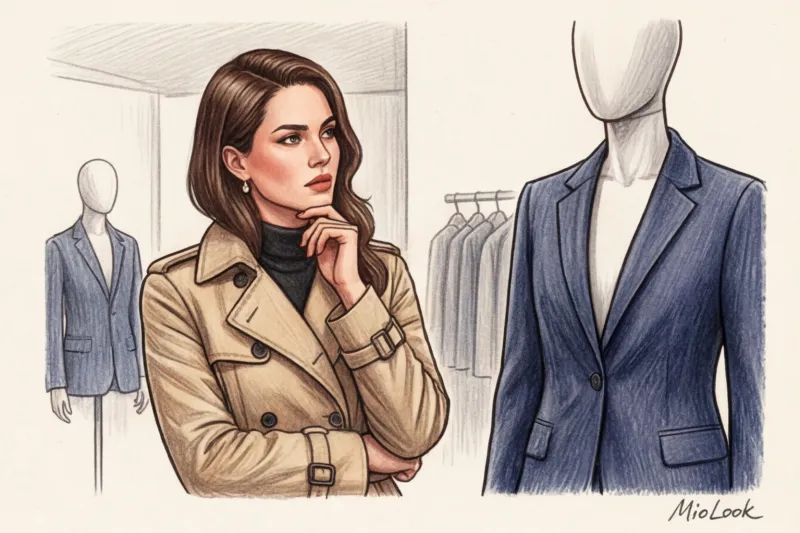
At that moment, I clearly understood: the classic presentation of clothes is hopelessly outdated. It damages clothes, distorts proportions, and disappoints buyers' expectations. That's why luxury retail is currently undergoing a tectonic shift—plastic is being replaced by AR showcases and holographic projections.
We have already written in more detail about this digital revolution and how it is integrated into the physical space of boutiques in our A complete guide to smart mirrors in stores Today, I'd like to introduce you to augmented reality through the eyes of a personal stylist. Why do we need digital mannequins, and how can they save you money when purchasing premium items?
The Evolution of Shopping: Why Plastic Mannequins Are Becoming a Thing of the Past
Let's be honest: classic mannequins are an illusion bordering on deception. The standard runway mannequin is 180 cm tall and wears a size XXS. Over 12 years of practice, I've seen hundreds of disappointed women who couldn't understand why a slip dress, which looked so luxurious in the window, looked like a shapeless sack on their normal, full-figured 165 cm tall frame.
But the problem isn't just proportions. Plastic is static. When you buy a jacket made of thick Italian wool or a bias-cut skirt, the key is movement. You don't stand still in the office. You need to see how the fabric moves as you walk, how it drapes when you sit down.
"The perfect silhouette on a mannequin is often created by pinning paper clips to the back. We stylists know this trick: pinning away excess volume in the back so that the front of the garment appears tailored. AR technology makes this deception impossible."
Let's not forget about hidden damage. Bright shop window lights burn out the pigment in natural fabrics. Just a week under a halogen lamp can permanently change the shade of expensive cashmere or delicate silk.
What are AR display windows and how do they work in luxury boutiques?
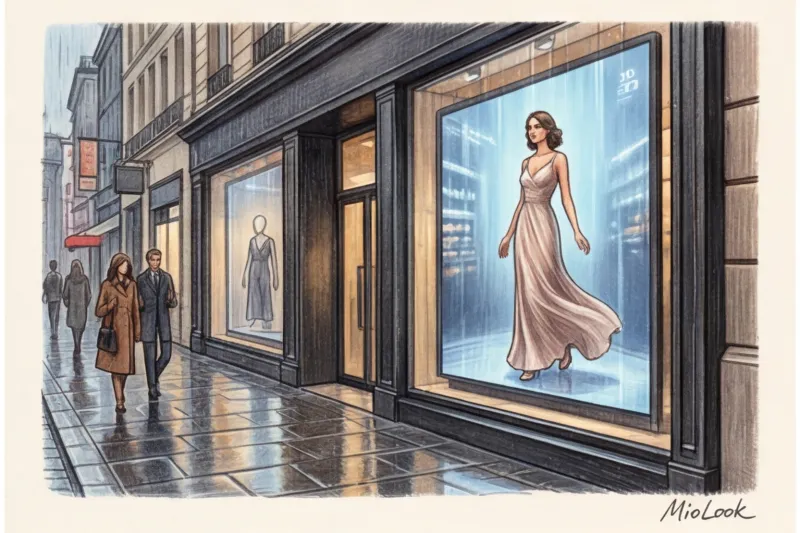
When I speak AR showcases By "Augmented Reality," I'm not talking about regular plasma screens with commercials. I'm talking about intelligent digital facades (Augmented Reality) that respond to context and the viewer in real time.
Imagine walking down the street on a cloudy October day. A typical store window displays what mannequins were wearing a week ago. An AR display, connected to weather sensors, instantly changes the display—a digital model dons a waterproof trench coat and ankle boots, and virtual raindrops "flow" down the display window. And as soon as the sun comes out, the system swaps the trench coat for a lightweight silk suit.
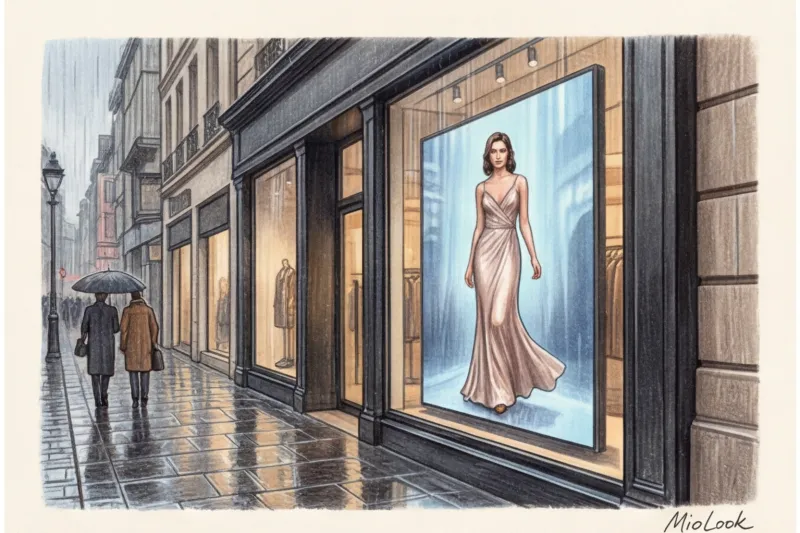
Moreover, embedded sensors capture passersby's silhouette (without compromising privacy, without facial recognition) and adapt the scale of the display. According to the Business of Fashion (BoF) 2024 report, such contextual displays increase the customer's interaction time with the boutique from a measly 5 seconds to an impressive 2-3 minutes.
Your perfect look starts here
Join thousands of users who look flawless every day with MioLook. Experience new styling technologies.
Get access — €0.99 onceHolograms are in fashion: from a wow effect to real benefits
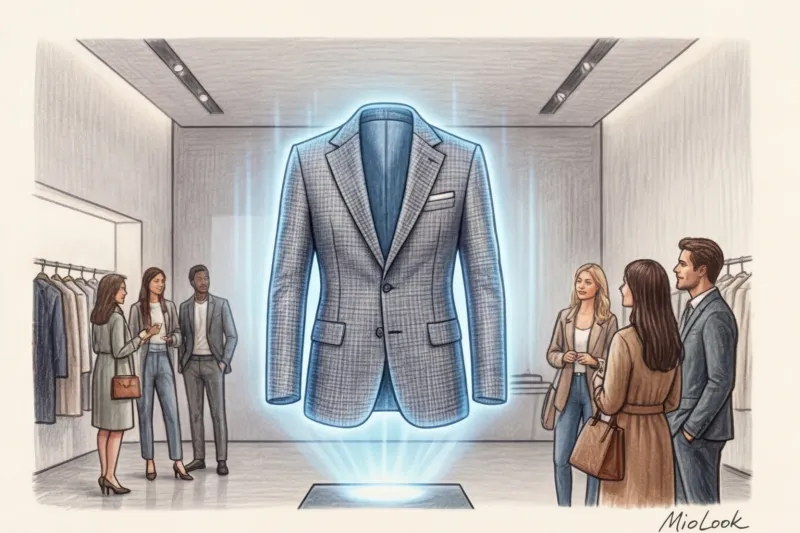
Beyond the facades, massive installations are increasingly giving way to holograms inside Milan and Paris flagship boutiques. And this isn't just a toy to attract Zoomers. For an investment wardrobe, a hologram is a tool for in-depth analysis of a garment.
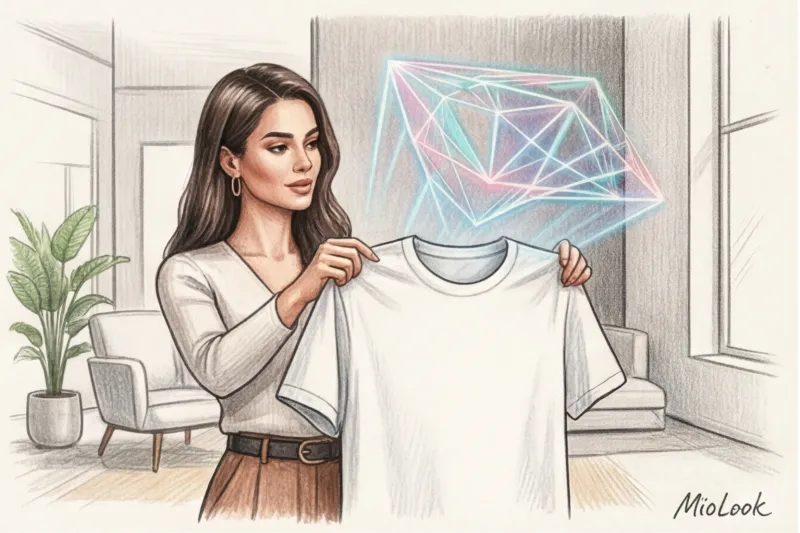
Complex architectural cuts—like Maison Margiela's deconstructed jackets or Burberry's layered trench coats—can't be appreciated from the front. A holographic 3D projection allows you to walk around the garment from all sides, zoom in on details, and examine the seam finishes and the layering of textures.
Dynamic Presentation: How AI Conveys the Texture of Expensive Fabrics
Have you ever noticed how difficult it is to distinguish cheap polyester from heavy silk crepe in a photo? When held statically, they can have a similar sheen. Modern 3D rendering in AR display cases simulates the physics of materials. Artificial intelligence calculates fabric weight: the density of cashmere (from 250 g/m²), the softness of viscose, and the stiffness of raw denim. The movement of a hologram conveys the quality of a garment better than any words from a consultant, because your eye subconsciously detects the correct amplitude of fabric vibration.
The Myth of the Loss of Live Shopping: Why AR Storefronts Remain Exclusive
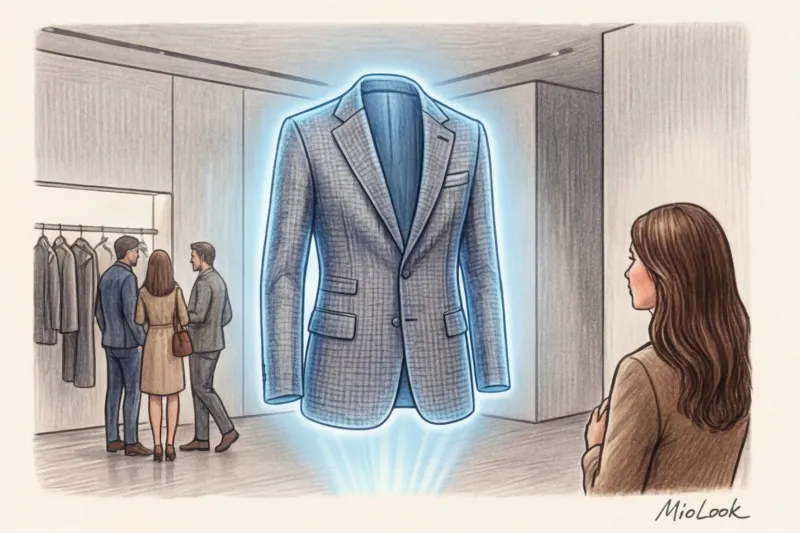
There's a common myth among conservative shoppers: "AR and holograms will kill the tactility and magic of luxury shopping. I want to touch things!" In fact, it's quite the opposite.
I call this the concept of "untouched luxury." In a traditional store, you often try on an item that's been touched, stretched, and accidentally stained with foundation by dozens of people before you. When an AR display or hologram takes over the presentation, you see the potential of an item in pristine condition. And when you decide to try it on, the consultant gives you a recommendation. absolutely new , an untouched item straight from the warehouse, packed in crisp paper.
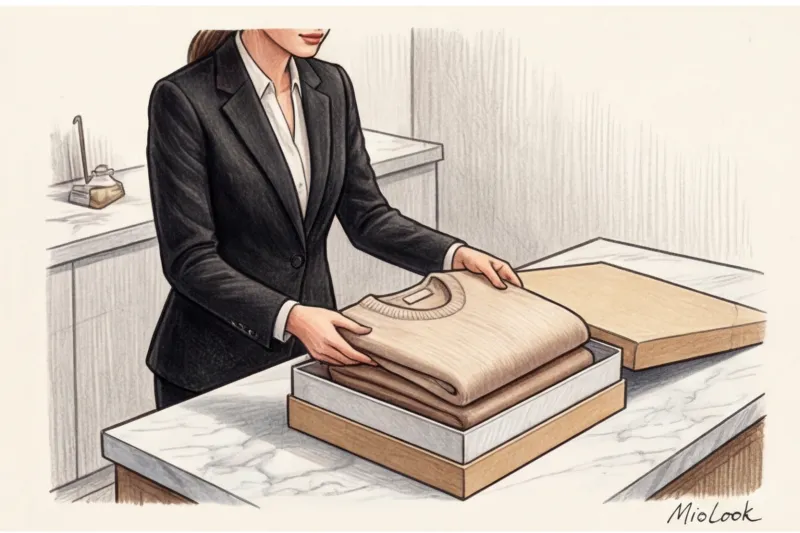
LVMH Innovation Award research shows that the implementation of AR visualization reduces the return rate of luxury clothing by 30–40%. Customers receive the quality they paid for—no dust, fading, or stretched collars.
Ready to start smart shopping?
Try the MioLook free plan—no commitments or hidden fees. Manage your wardrobe like a pro.
Get access — €0.99 onceHow augmented reality solves the problem of fit and proportions
Did you know that a large print can visually "crush" a petite woman, and a small floral pattern can look out of place on a tall, statuesque woman? The problem with traditional shopping is that we can't always accurately assess the scale of a pattern on ourselves when looking in the fitting room mirror.
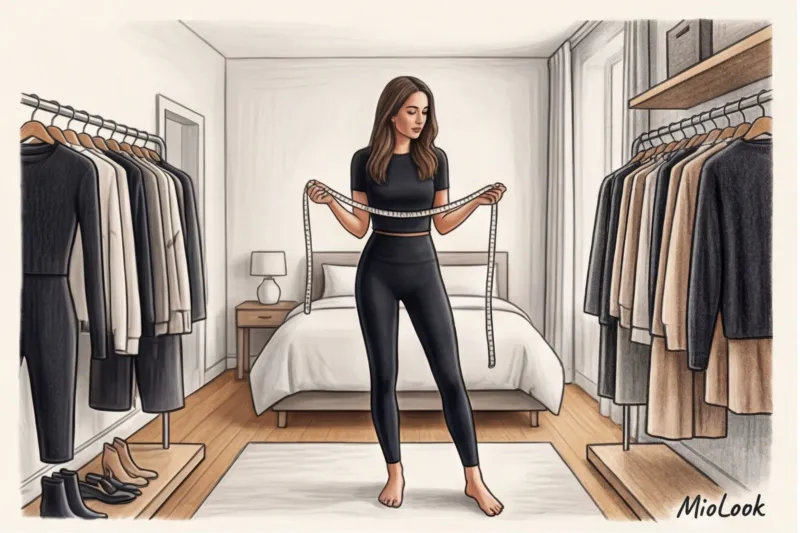
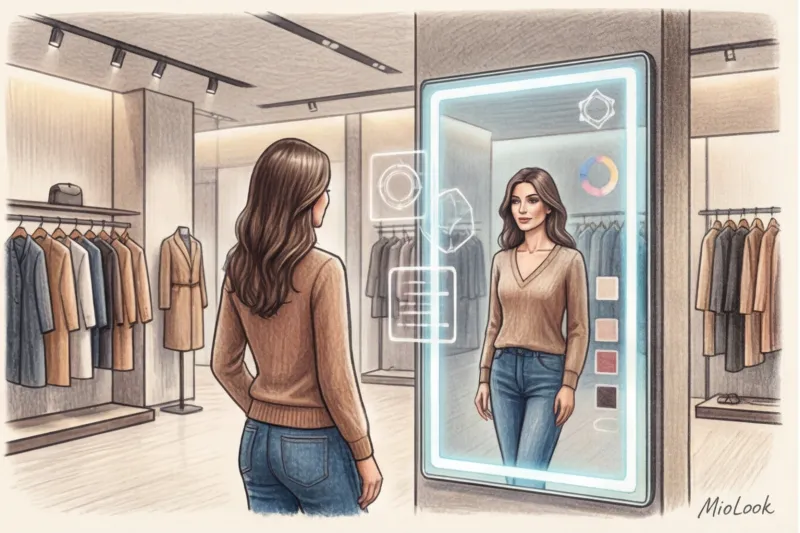
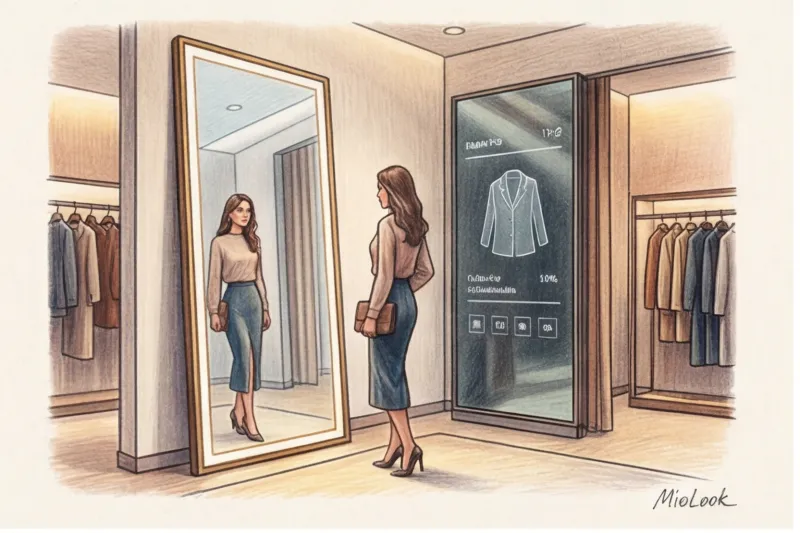
Syncing AR storefronts and smart mirrors with your personal digital avatar solves this problem. Artificial intelligence superimposes a digital replica of your clothes to your exact measurements. This is especially important for plus-size and petite women who are tired of collections being tailored to a single, ephemeral standard.
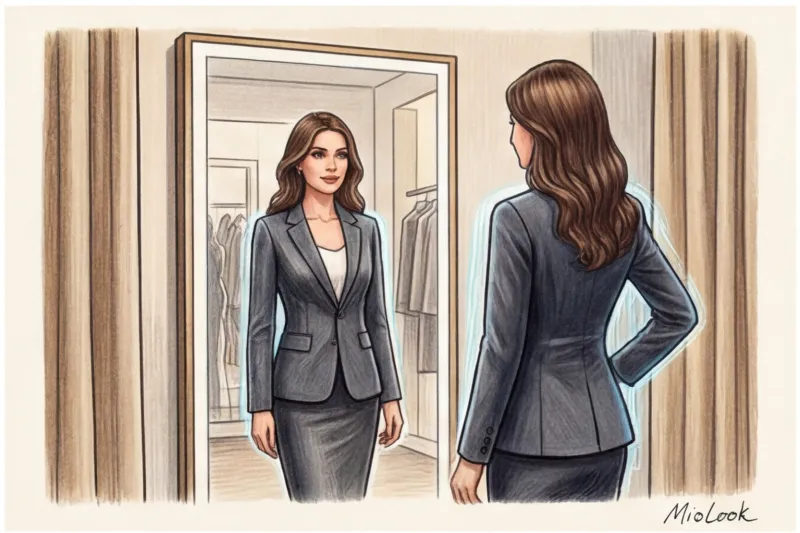
I must add an important caveat: AR technology has its limitations. Augmented reality can't yet convey the tactile sensation of prickly wool or the degree to which fabric will become staticky in winter. Your hands remain the final judge here. But in terms of the fit, length, and proportions of the prints, this is an absolute breakthrough.
The Future of Investment Wardrobes: Smart Shopping with MioLook
An investment wardrobe isn't just about expensive items. It's about pieces that truly earn their price. If you buy an €800 Prada skirt and wear it twice, your Cost Per Wear (CPOW) is €400. If you cleverly fit a jacket for the same price into your capsule wardrobe and wear it 80 times a year, your CPO drops to €10.
This is where it comes into play Smart wardrobe feature in the MioLook app When you stand in front of a stunning AR display and see the perfect cashmere sweater, the app allows you to integrate the item's appearance with your digital closet. You're not buying a single item that will hang with a tag. You can immediately see whether the sweater pairs well with your basic trousers and trench coat.
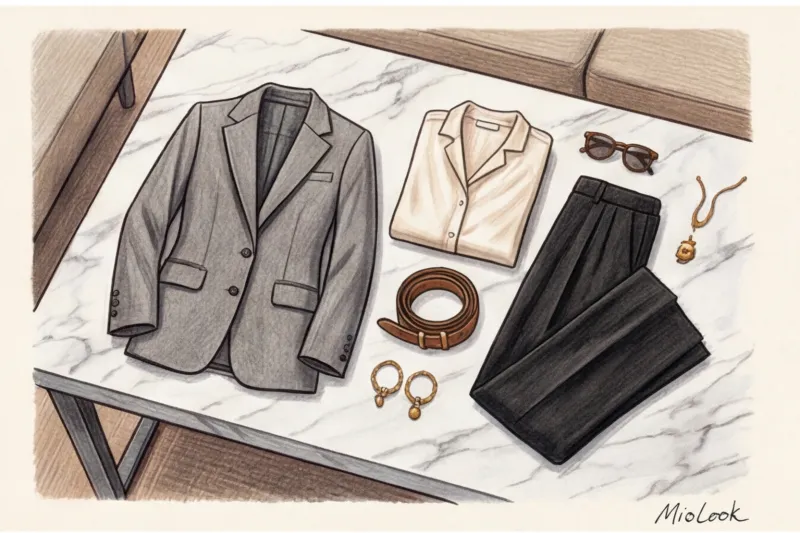
Checklist: How to Use AR Technology to Create a Capsule
- Watch in motion: Always ask for dynamic rendering on a smart display case or mirror. Fabric needs to "breathe."
- Apply to your avatar: Use a virtual try-on to estimate the length of a garment (for example, where the hem of a midi skirt ends in relation to your calf).
- The rule of three images: Before you go to the checkout, open MioLook and mentally (or virtually) create at least three outfits with the new item from what's already hanging in your closet.
In a world where the fashion industry produces millions of tons of clothing annually, the ability to select precisely and accurately is becoming the hallmark of good taste. AR display windows eliminate visual noise and protect premium fabrics, leaving you with what matters most—the opportunity to invest in quality that will last for years, not just until the first wash.