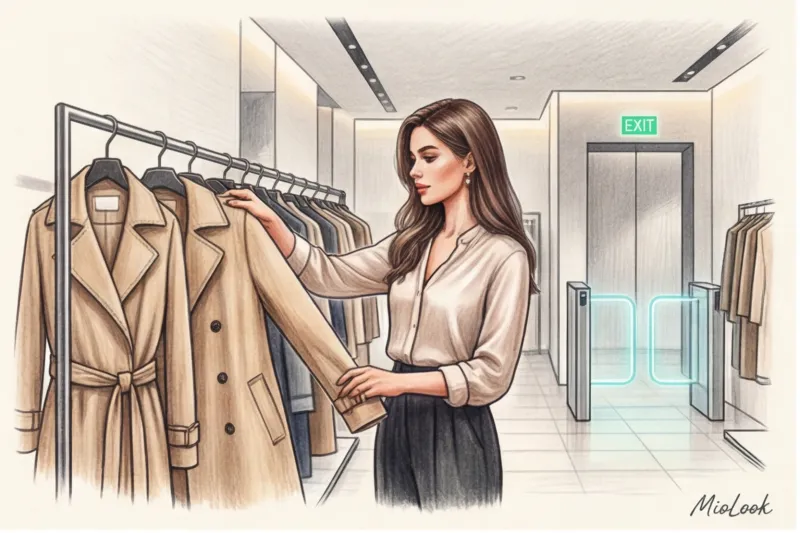
Imagine: you grab the perfect beige trench coat from the rack, try it on in front of the mirror, and... just walk out of the boutique. No one is chasing you, no siren is wailing, and the security guard politely wishes you a good day. It sounds like a scene from a perfect heist movie, but in reality, it's just a regular Tuesday at a modern concept store. The Just Walk Out format is a game-changer, and clothing store without sales assistants has transformed from a futuristic fantasy into a reality that we can test today.
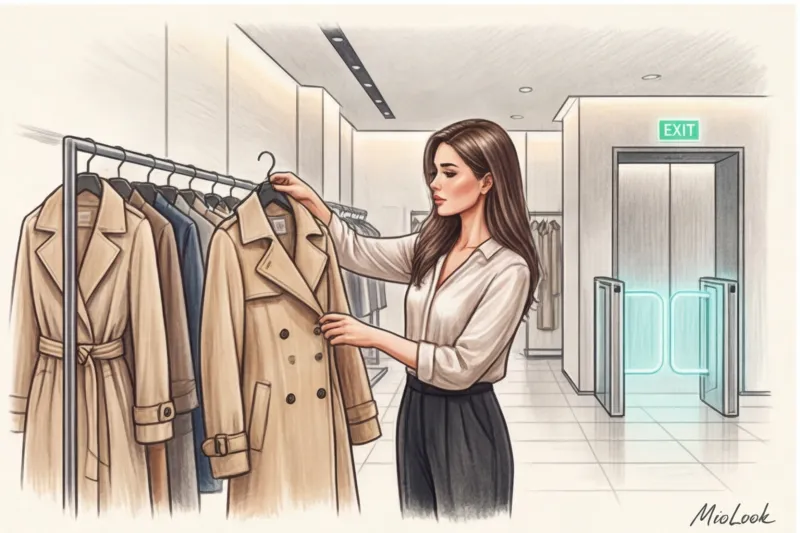
I remember my first visit to a similar flagship in Madrid a couple of years ago. It was a mixed bag: on the one hand, delight at the lack of fuss, on the other, a slight paranoia that I was doing something wrong. Tired consultants and queues are being replaced by technology—I wrote about this transition in more detail in our A complete guide to smart mirrors and AI in brick-and-mortar boutiques.
But how exactly do these technologies work? Is it safe for our wallets? In 12 years of working as a personal stylist, I've learned one thing: marketers don't create any new shopping format to save money. yours Money. Let's break this process down to its molecule and understand how to use automated boutiques to intelligently replenish your capsule, rather than to spontaneously splurge.
What is a clothing store without salespeople and checkouts: from Zara to Amazon Style
If you've ever bought a sandwich at Amazon Go, you know the basic principle: cameras on the ceiling monitor what you put in your bag. But fashion is more complicated. Clothes need to be tried on, combined, and sometimes thrown onto a ottoman in the fitting room. Cameras can't distinguish a black viscose jumper from an identical cashmere jumper when they're crumpled in your hands.
That's why fashion retail has taken a different path. Technology is at the core. RFID (Radio Frequency Identification) These are tiny radio-frequency tags sewn directly into the tag of each item. According to a McKinsey report State of Fashion (2024), RFID implementation has become the absolute standard for giants like Inditex (Zara, Massimo Dutti) and H&M Group. This allows them to conduct a floor inventory in 15 minutes instead of three days.
"A cashierless store isn't just about having no one behind the counter. It's a seamless ecosystem where clothes communicate with the fitting room, and your smartphone communicates with the exit door."
We've seen this process evolve: first, self-checkout machines appeared (think COS or Uniqlo, where you simply throw items in a basket and the scanner instantly reads all the tags). Now we're reaching a point where even these baskets are becoming obsolete.
How a cashierless store works in practice: a step-by-step guide
Many of my clients over forty admit to avoiding innovative boutiques for fear of "doing something wrong and embarrassing themselves." Let's take a step-by-step approach from the front door to the back door to remove this barrier. It's not that difficult.
Entry and contactless selection of items
At the entrance, you're greeted by a turnstile similar to those found in the subway. You open the brand's app on your smartphone (or tap your bank card) and scan the QR code. The doors open. From this point on, the system "links" you to your virtual account.
You can freely wander around the store, pick up items from the hangers, try them on, change your mind, and then hang them back up. Unlike grocery stores without salespeople, where weight sensors on the shelves strictly record your pickup, RFID antennas here simply track the tags' movements throughout the store in real time.
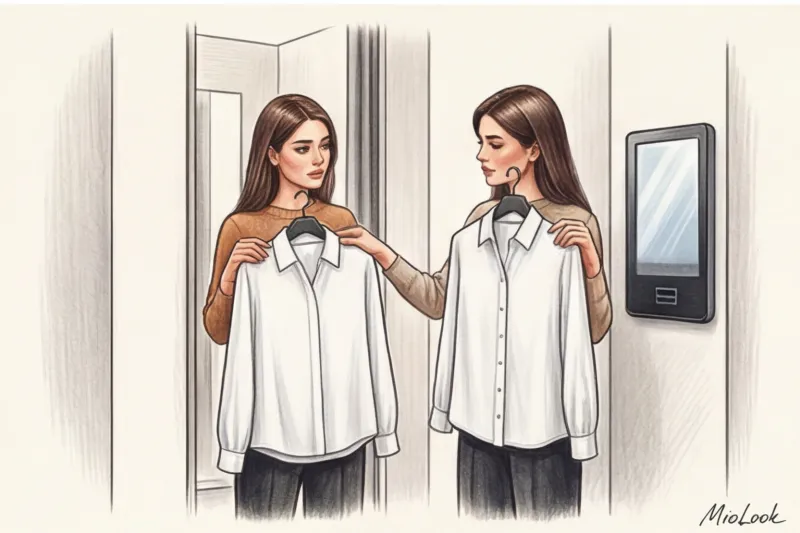
Interactive Fitting Room: Your Personal Digital Assistant
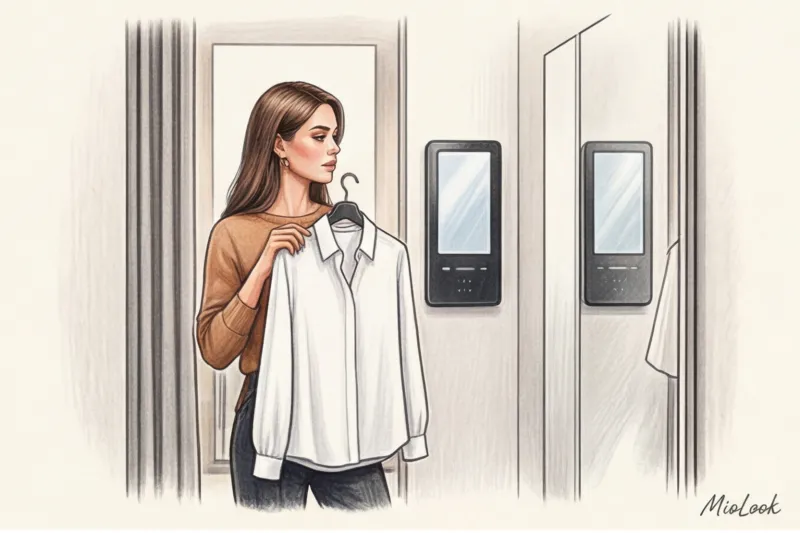
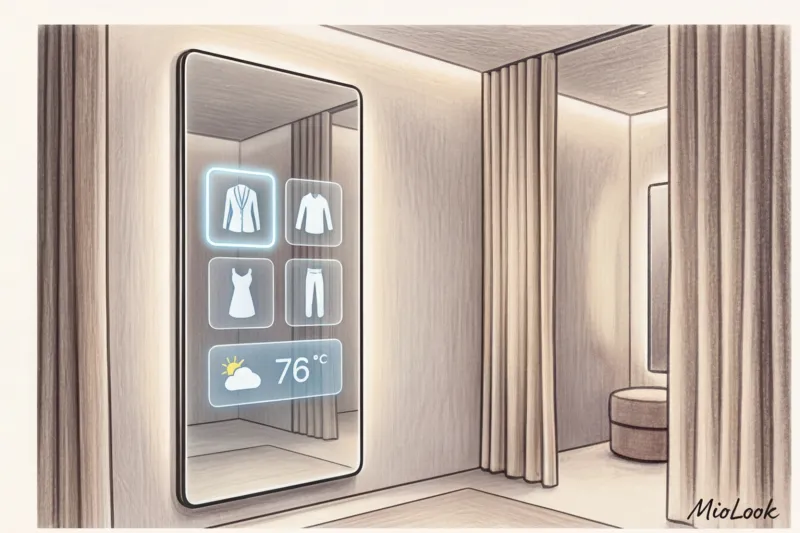
This is my favorite part, and it's what truly changes the fitting experience. When you enter the booth, sensors instantly read all the RFID tags on the items in your hands. Product cards for these items immediately appear on the interactive screen on the wall.
Now, think of that classic pain: you put on pants, but they're too small. What do we usually do? We put them back on, go out into the store, look for the right size, and then come back... Or we cry out piteously through the curtain, "Miss, bring me a size 38!" In a smart fitting room, you simply press the button for the desired size on the screen. A warehouse employee (who is out of sight of customers) receives the signal and, within a minute, hands you the item through a special window or brings it to the door.
Just Walk Out: Skip the Lines
Have you found the perfect white shirt made of heavy cotton (remember, we're looking for at least 180 g/m² to ensure no see-through)? Great. Just put on your coat, pick up the shirt or put it in your shopping bag, and head out the door.
When you pass through the turnstiles, RFID readers at the exit scan your shirt's tag, the system matches it with your profile, and automatically debits the card linked at the entrance. An electronic receipt arrives in your email within seconds. If you don't like the item at home, you can return it through the app and simply send it via courier or drop it off at a special parcel locker.
Access to MioLook for €0.99 — one-time payment
Start creating your perfect looks with AI before you go shopping.
Get access — €0.99 onceThe Main Trap: Why a Clothing Store Without Salespeople Makes You Spend More
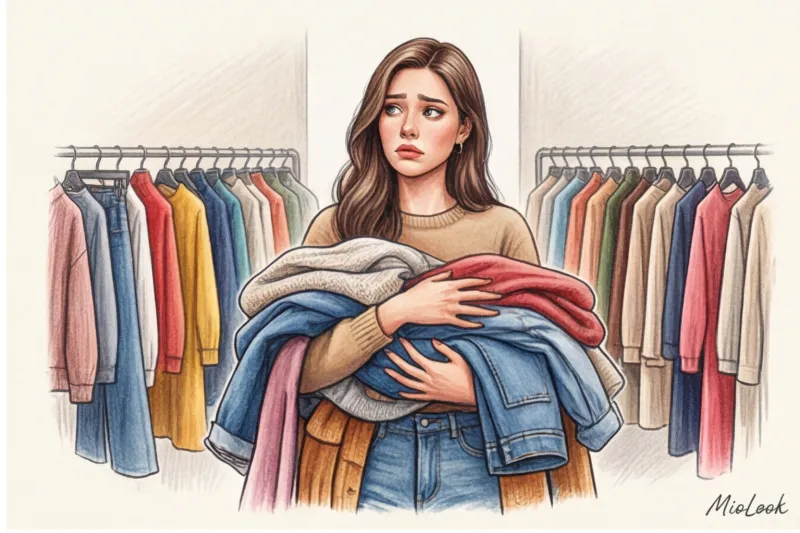
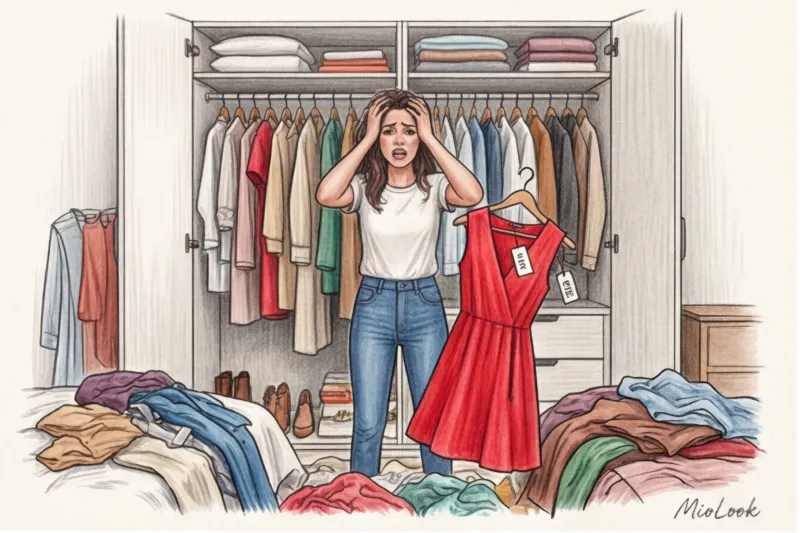
It's commonly believed that the absence of lines is a net benefit for the client. As a stylist who advocates for conscious consumption, I'm forced to shatter this illusion. The checkout line has always been your best financial filter.
Have you ever noticed how this works? You pick up five items and line up with ten other people during a sales period. Five minutes pass. You start to get bored, look at the items in your hands, and think, "Why do I need this neon T-shirt? It doesn't go with anything." And you put it on the nearest rack (yes, merchandisers hate it, but it's true).
In behavioral economics there is a term Pain of Paying ("Pain of Payment"). When we physically take out banknotes or even simply swipe our card to the terminal while looking the cashier in the eye, our brain registers the parting of resources. With the Just Walk Out format, this psychological barrier is erased. The statistics are merciless: in seamless retail formats, the average check increases by 15-20%.
If your limit for a basic sweater was €60, you can easily buy one for €85 in a store like this because the payment process is spread out. No one will ask, "That's €85, do you need a bag?" You just walk out.
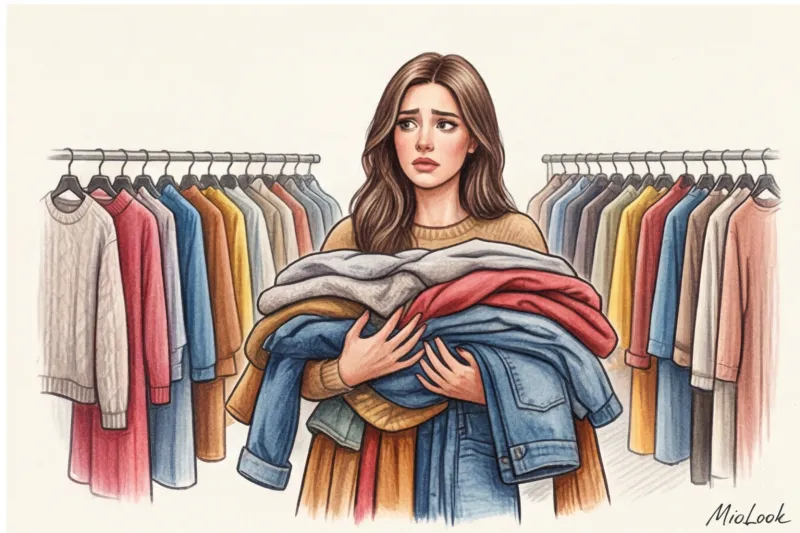
An Introvert's Paradise: The Benefits of Unattended Shopping
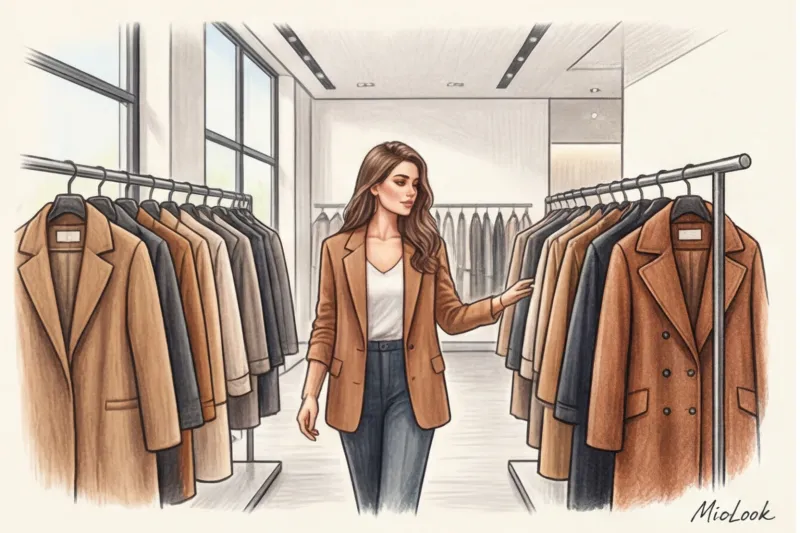
Despite the risks of impulsive spending, I consider this format a salvation for a huge segment of women. In my experience, one in three clients admits to hating shopping because of pushy salespeople.
One of my clients, Anna (an IT executive and a confirmed introvert), wore the same pair of jeans for years because going to the store was stressful. Judgmental glances, questions like, "We only have classics in your size," or, conversely, false compliments like, "Oh, they look so slimming!" when the item is objectively atrocious—all of this kills the desire to update her wardrobe.
A clothing store without salespeople offers the most important thing: freedom from other people's opinions. It's the perfect space for practicing complex tasks. For example, to find the perfect pair of palazzo pants, you need to try on 10-12 pairs. In a traditional boutique, you'd start to feel awkward in front of the salesperson who carries those mountains of clothes for you. In an automated store, you simply work toward the desired result.
A Stylist's Checklist: How to Shop Mindfully in an Automated Boutique
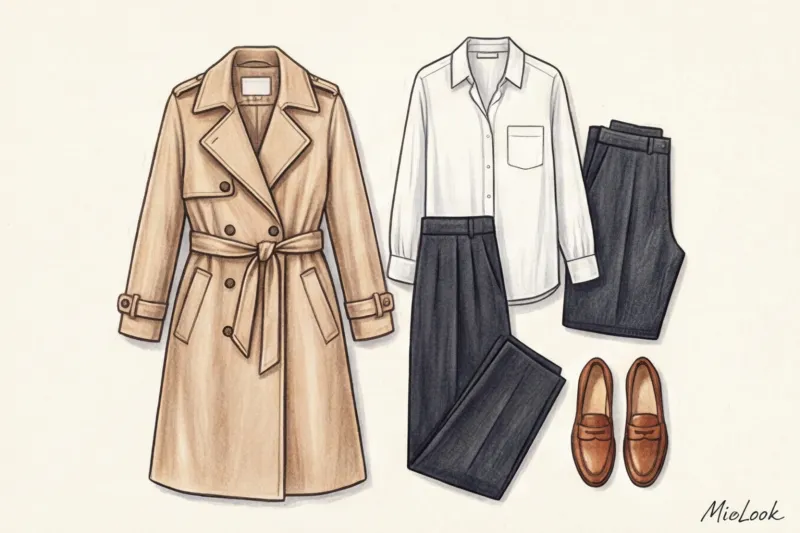
So, how can you get the best out of technology without losing half your salary? I've created strict guidelines for my clients on working in such spaces. Here they are:
- Closed list rule. We only go to a cashier-less store with a specific purpose. Does the list say "straight, dark blue jeans with no fading"? You don't even look at the sweater rack. At all.
- Endowment effect. Don't pick up an item "just to feel it" if you don't plan to try it on. Psychologically, once you've walked around the room with the item for five minutes, your brain begins to consider it yours.
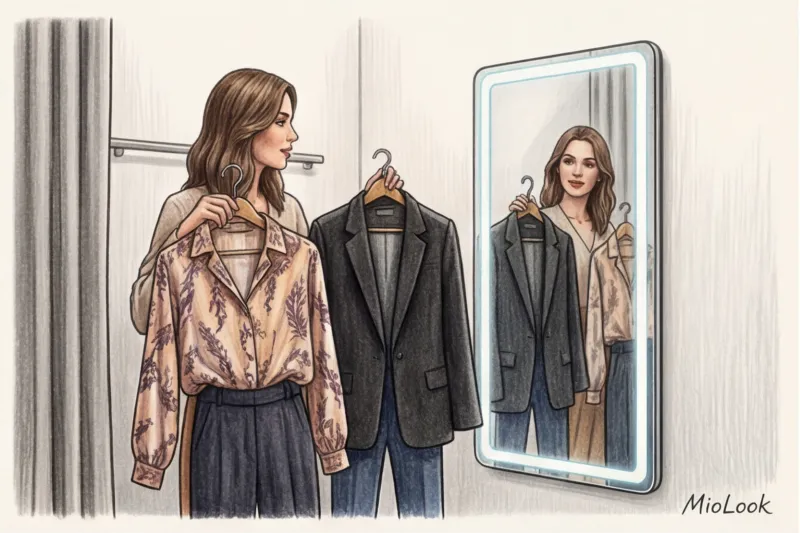
- 15 minute test in the fitting room. Since no one's rushing you at the checkout, allow yourself some time to reflect right there in the booth. Put the item on? Take a photo, sit on the ottoman, check your email. Live in it for ten minutes. Are there any creases? Does the fabric bite?
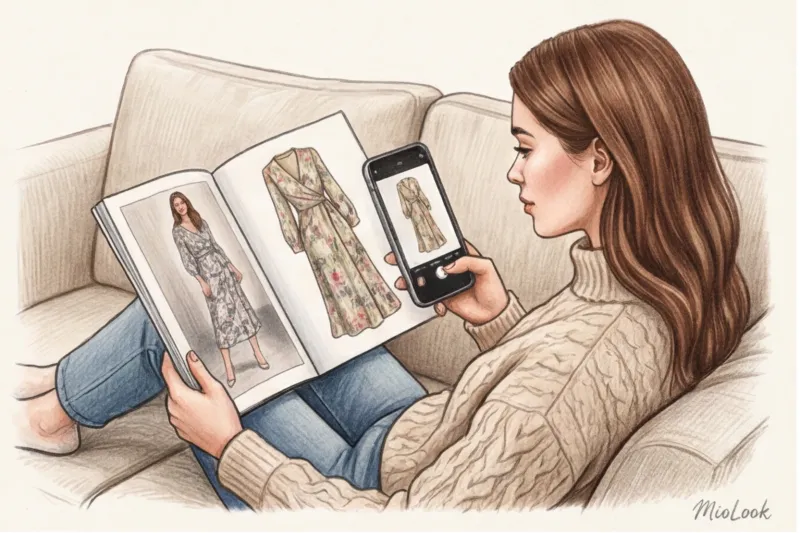
- Digital verification before exit. Before you cross the turnstile, take out your phone. I always recommend using the "smart wardrobe" feature. MioLook Take a photo of the item right in the fitting room and use the app to see if it matches your current skirts and shoes. If you can't create at least three looks with it on your smartphone, leave it in the store.
Your perfect look starts here
Join thousands of users who look flawless every day with MioLook. Digitize your wardrobe in 10 minutes.
Get access — €0.99 onceWill technology be able to completely replace a live stylist?
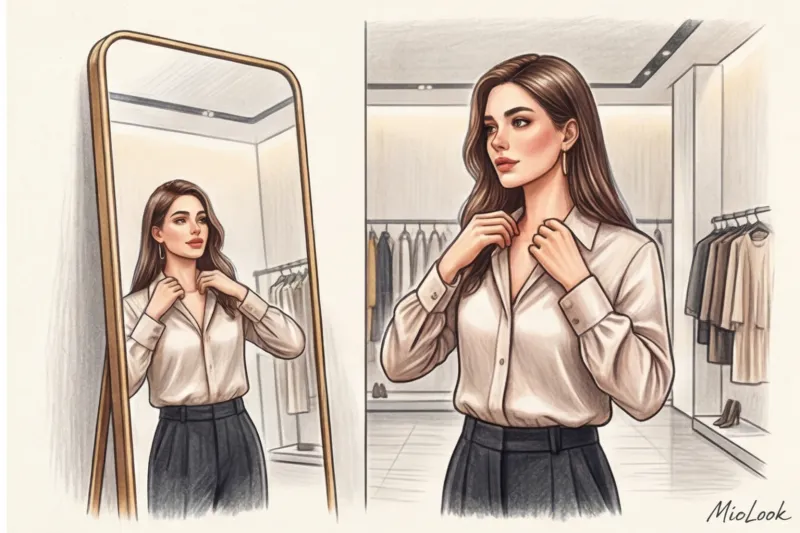
Looking at the empty, sterile halls of innovative boutiques, it's easy to think that the stylist profession will soon disappear. But let's be honest: automation is a great solution to logistics and inventory issues. It saves us time. But it's absolutely powerless when it comes to taste and body image.
An algorithm will select a size 38 for you with millimeter-precision. A smart mirror will recommend a white sweatshirt to pair with blue jeans (a basic, code-prescribed item). But no scanner can yet say, "Katarzyna, this particular cool khaki shade makes your face look tired, while that warm olive will make your eyes sparkle."
Technology doesn't understand the context of your life. It doesn't know that you're buying that €150 jacket not just for the office, but for that crucial pitch to the board of directors, where you need to project fierce confidence.
Conclusion: The future of fashion is a hybrid. A sales-free clothing store will become your perfect, quick-fix dressing room with a limitless selection. But you will remain the filter between this ocean of clothing and your personality—armed with knowledge of your styles, a clear shopping list, and a pocket-sized AI assistant on your smartphone. Don't be afraid of smart stores; just enter them with a smart plan.