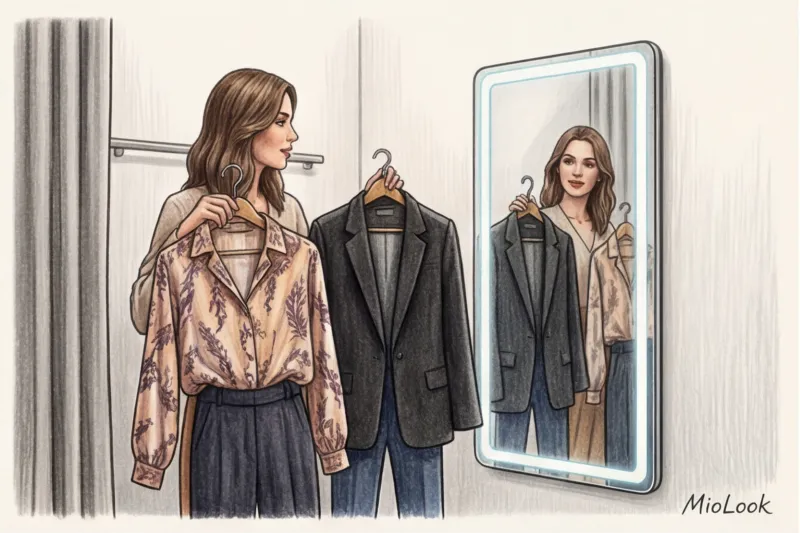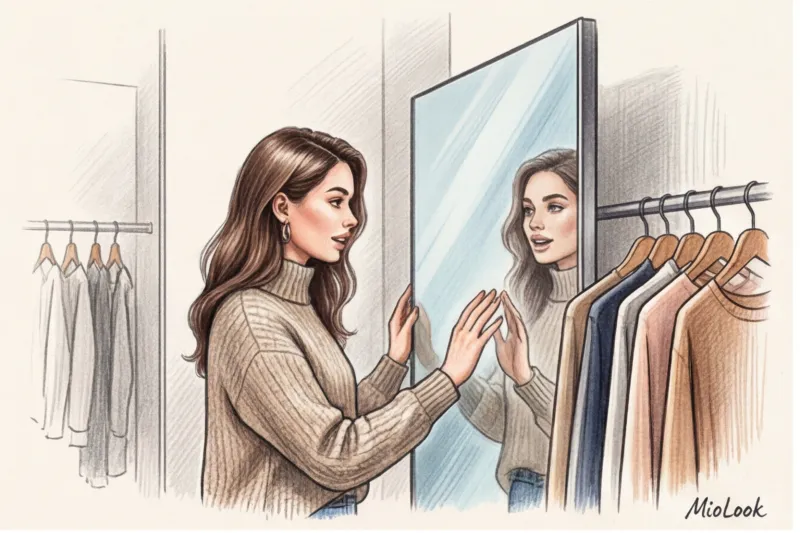
It's a familiar scene: you're standing in a cramped stall wearing nothing but tights, desperately peering through the narrow slit in the curtain to catch the assistant's eye. The pants you tried on are way too small. The fluorescent light is so harsh it highlights every shadow on your face, and your favorite cashmere sweater somehow doesn't go with your new jacket. Try-on stress is the main reason we abandon our clothes on the ottoman and leave the store empty-handed.
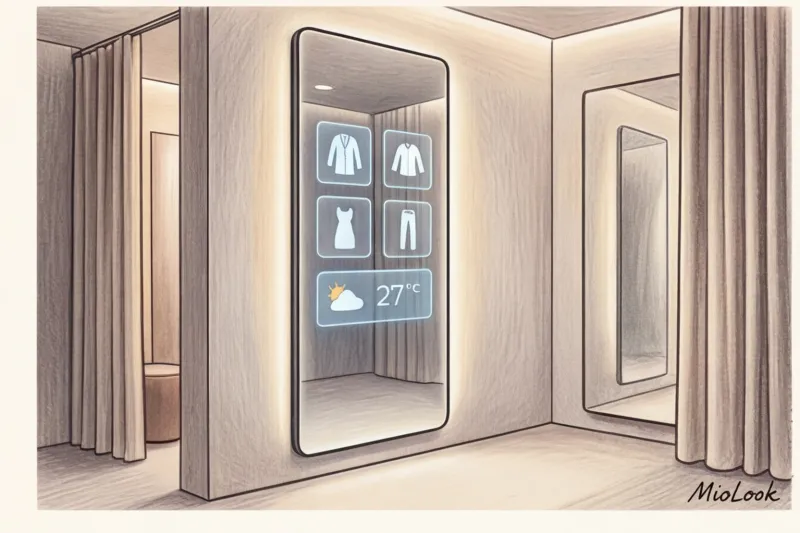
But today, retail architecture is changing the rules of the game. Interactive smart try-on mirror Transforms a cramped, dark cubicle into your personal fashion studio. Over 12 years as a stylist, I've tested dozens of digital innovations at fashion weeks from Paris to New York, and I can confidently say: this isn't just an expensive attraction for boutiques. It's a working technology that saves us nerves, saves time, and guarantees a precise fit.
By the way, if you're interested in how algorithms are globally changing the shopping landscape, we talked about this in more detail in our A complete guide to smart mirrors in stores In this article, we'll examine the technology from the perspective of your personal comfort: how it works for you, why AI doesn't violate your privacy, and how to get the most out of this system.
The Anatomy of Innovation: How a Smart Try-On Mirror Works
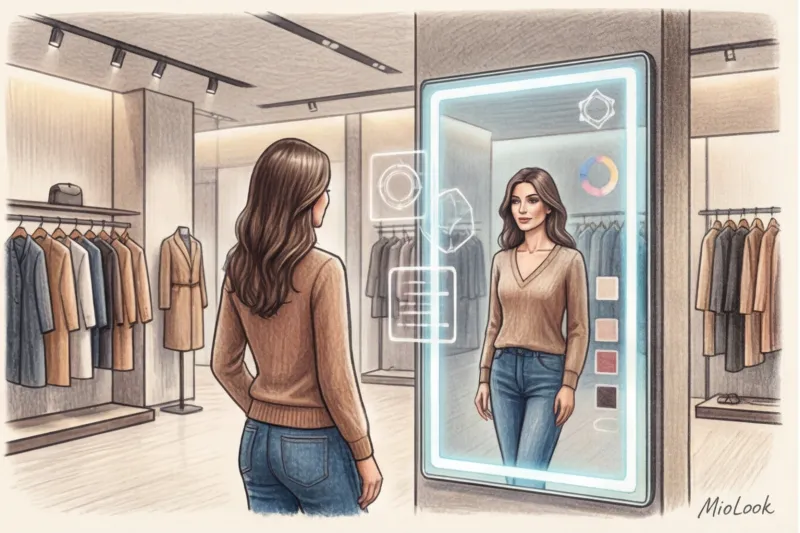
My first hands-on experience with this technology was at Burberry's flagship boutique in London. I approached the mirror to adjust my scarf, and suddenly an elegant interface lit up right on the glass. It offered me ideas for pairing my trench coat with their new collection. It was as if a giant iPad had been seamlessly integrated into the reflective surface.
The secret to this magic lies in its complex, multilayered architecture. What we perceive as a single piece of glass is actually translucent mirror glass with a special transmittance factor (typically, about 30–40% of the light goes to the internal display, while the rest is reflected). Hidden behind it is a bright, high-resolution OLED panel and an array of sensors invisible to the naked eye.
An important detail from my experience: for a stylist and client, the quality of the glass itself is more critical than the resolution of the hidden screen. Cheap hardware alternatives on the mass market often distort the color rendition of fabric, giving it a muddy or bluish tint. A true premium AI mirror must maintain an ideal color rendering index (CRI > 90). Only then will you see the true shade of complex silk or textured wool, not a distorted digital image.
From Hanger to Screen: The Magic of RFID Tags
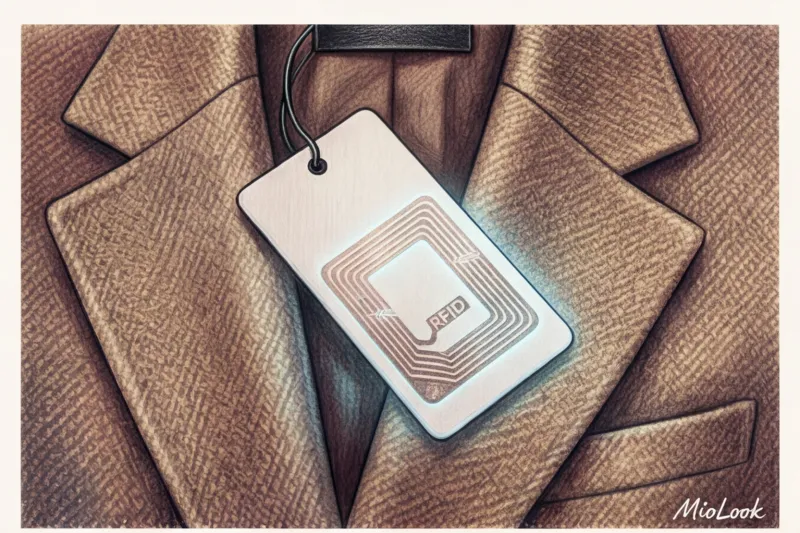
You step into the fitting room, before you've even hung your clothes, and the mirror already greets you with the brand name and displays all three items you've brought. No beeping or manual barcode scanning. How does this instant recognition happen?
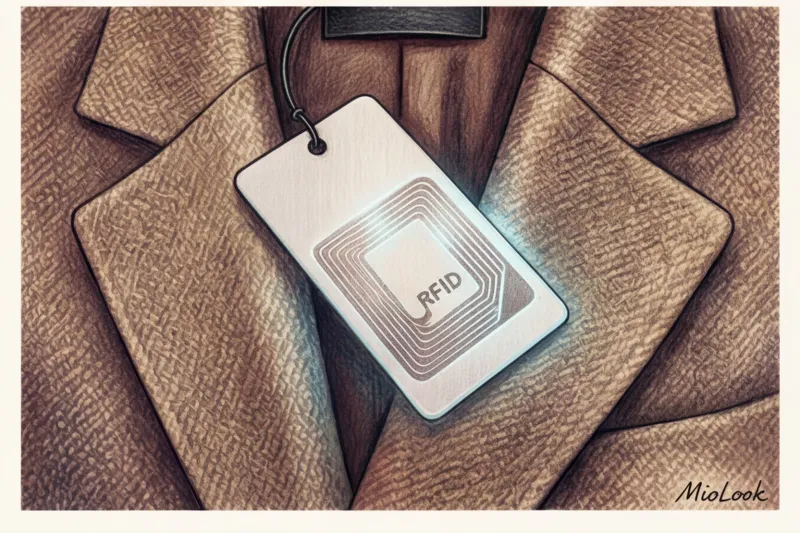
The answer is sewn right into the clothes—RFID (Radio Frequency Identification). If you look closely at a modern multilayer care label from giants like Zara or COS, you'll notice a tiny metal outline inside. This is a passive radio frequency tag. Antennas, discreetly embedded in the ceiling of the booth, emit a weak signal, the tag instantly responds, and the mirror connects to the store's cloud database.
Why this technology is replacing barcodes
According to RFID Journal technical standards, the accuracy of tag reading in a confined space like a fitting room reaches 99.9%. For us, the end customer, this means the complete elimination of human error.
- The mirror sees your entire set of things at once, understanding the stylistic context of the fitting.
- It analyses prices: it understands that you bought a blazer for €180, and immediately checks the database to offer you matching trousers for €90.
- The system immediately eliminates models that are currently physically out of stock, eliminating false hopes.
Access to MioLook for €0.99 — one-time payment
A smart AI stylist will select the perfect look based on your wardrobe and current trends.
Get access — €0.99 onceAugmented Reality (AR) and AI: How a Mirror "Sees" Your Figure
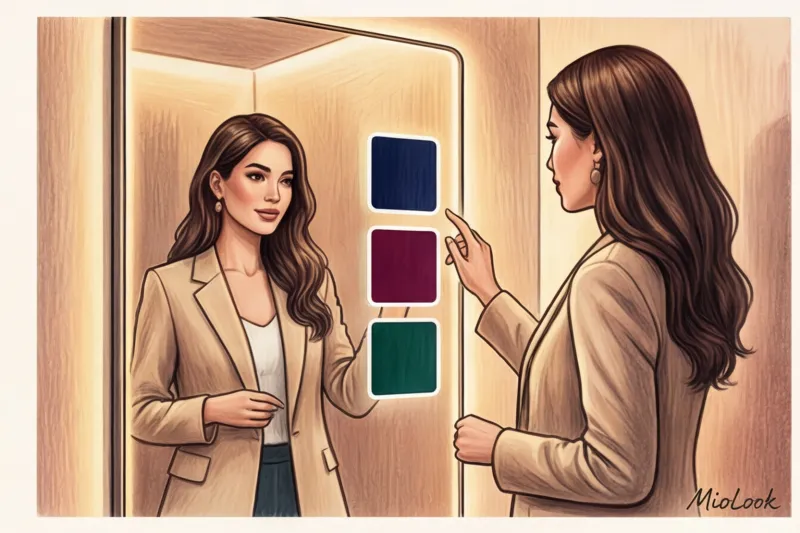
One of the biggest disappointments when shopping is finding a gorgeous cut, but in a completely unsuitable shade for your skin tone. At the NRF Retail's Big Show in New York, I spent hours testing prototypes of AR fitting rooms that solve this problem with a simple wave of my hand.
Artificial intelligence algorithms, tightly coupled with augmented reality (AR), can virtually "recolor" the dress you're wearing. The AI doesn't simply fill your silhouette with a flat blob of color, like a crude Photoshop. The system meticulously analyzes the drape of the fabric, the play of highlights and shadows on the folds, and the texture of the material—whether it's stiff Japanese denim or flowing viscose with added elastane.
I regularly use this feature with my clients to safely demonstrate color blocking. For example, when we try on a basic sand-colored trench coat, I can display the same coat in a deep burgundy shade on the mirror. This allows me to instantly demonstrate how the contrast of the face changes without having to change clothes. According to Vogue Business (2024), implementing such precise AR try-ons reduces clothing returns by 20-30%.
Debunking the Myth: Privacy in the Fitting Room
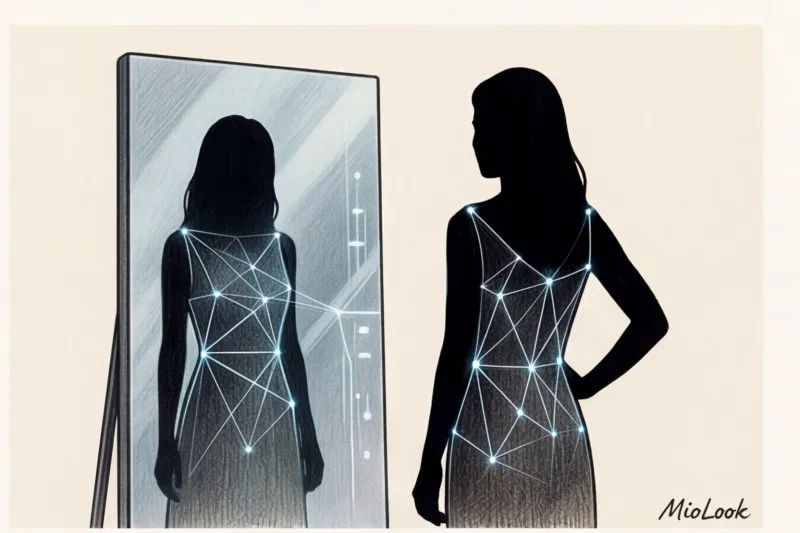
"What if someone is watching me on the other side of the screen while I'm undressing?" is a question I get asked by every other client who encounters a smart mirror for the first time. The widespread fear of hidden cameras is understandable, but it has no basis in either technology or law (assuming we're in a boutique with a certified system from a major brand).
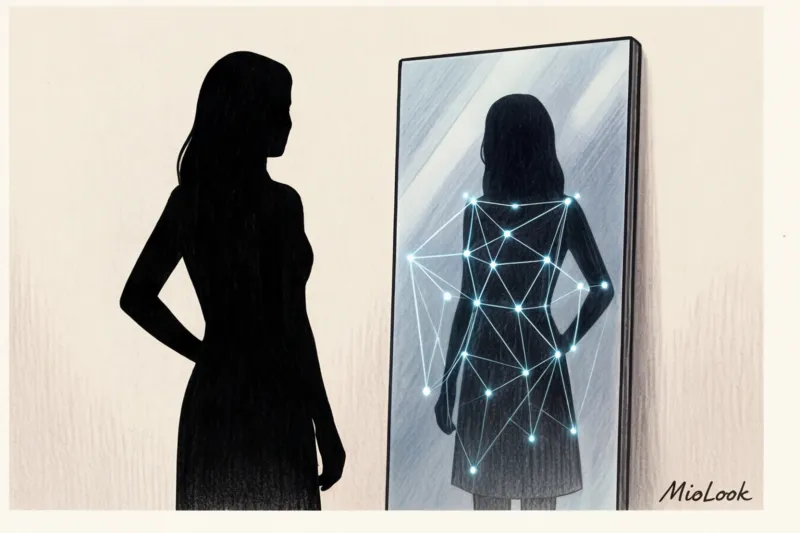
Counterintuitive fact: 90% of smart mirrors don't even have the usual RGB cameras that can capture color video. Instead, they use ToF (Time-of-Flight) sensors—depth sensors similar to those that scan your face for FaceID on your smartphone.
A smart mirror isn't physically capable of seeing the anatomical details of your body. The sensor emits infrared pulses and records their return time, creating an abstract "cloud of 30,000 points." To the AI, you're not a naked person, but simply a dynamic 3D matrix onto which the texture of digital fabric needs to be projected.
Moreover, the privacy architecture is designed in such a way that the system's operational cache is irreversibly erased the moment the built-in motion sensor detects that you have opened the door and left the booth.
Smart Try-On Mirror as an Interactive Stylist: Lighting and Tips
Overhead, cold light is the main enemy of female beauty in retail. It mercilessly kills the freshness of the skin, creates dark circles under the eyes, and makes the face look haggard. In my practice, I constantly encounter clients who reject a perfectly fitting pantsuit simply because the lighting in the booth was improper.
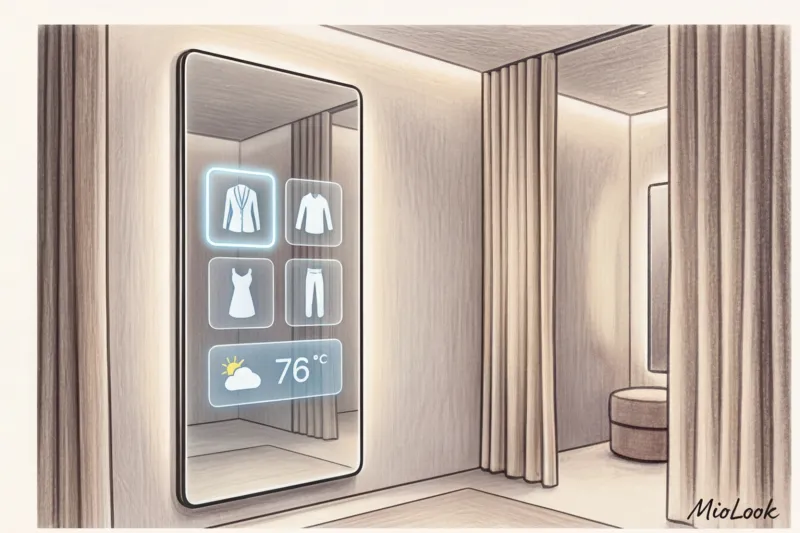
The smart mirror elegantly solves this pain by allowing you to switch lighting scenes directly on the touch screen.
- Office mode: Neutral white light (color temperature around 4000K) accurately mimics the lamps found in corporate open-plan offices. Ideal for checking the density of fabric and transparency of a business white shirt.
- Street mode: Simulating diffused daylight. A must-have scenario for assessing the true shade of a wool coat or the wash on jeans.
- Evening mode: Warm, slightly subdued light (2700K) is ideal for testing flowing silk, vibrant sequins, and deep velvet.
In addition to smart lighting, the mirror functions as a subtle cross-selling machine. The authoritative McKinsey report "State of Fashion 2024" records an impressive 35% increase in fitting room conversions with interactive panels. The algorithm analyzes your item and subtly suggests on the screen: "This graphic midi dress would pair perfectly with leather ankle boots and the structured baguette bag from the showroom."
Request a different size without going to the showroom: end the fitting room stress
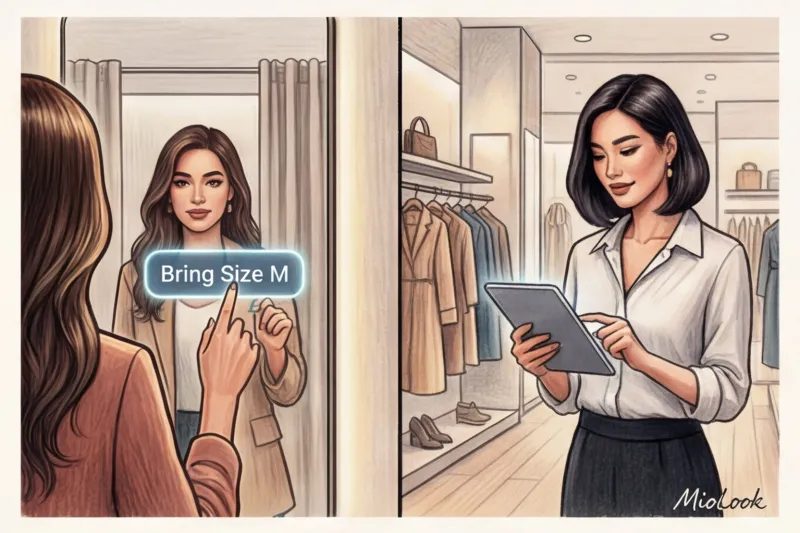
If you ask me what one feature is worth specifically seeking out at stores with smart mirrors, I'd say the direct size button. It's a total game-changer.
I was once putting together a capsule wardrobe for a very shy client, Maria. Due to her significant waist-to-hip difference, finding the perfect pair of basic trousers usually required us to try on five or six pairs. The classic process of "take off clothes, put on your own, go out to the store, find the right size on the rail, and return to the booth" completely killed the joy of shopping for her after just two rounds.
In the smart fitting room, everything was different. Maria stood in front of the mirror, tapped on the screen to select size "L" instead of "M," and her digital request was instantly sent to the available consultant's smartwatch or tablet. A couple of minutes later, there was a polite knock on the door and the desired item was handed over. For introverts, this is a true revolution. Statistics from leading retailers show that the time it takes to find the final size is reduced by 40% thanks to this seamless digital communication.
Your perfect look starts here
Join thousands of users who look flawless every day and manage their wardrobe with MioLook.
Get access — €0.99 onceA stylist's checklist: how to get the most out of a smart fitting room

If this is your first time in a modern boutique equipped with this technology, don't be too quick to ignore the screen. Here's my tried-and-true step-by-step guide on how to fully utilize the potential of a smart mirror:
- Bring more textures into the booth: Buy 2-3 more items than you planned (add textured knits or smooth leather). Give the AI a rich source of information to analyze—this will give you much more interesting and complex outfit recommendations.
- Always play with light: This is my golden rule. Never take an item to the checkout without changing the light settings. A dress that looks luxurious and expensive in the evening light may look flat and cheap in the harsh office lighting.
- Sync your apps: If you have the brand's app installed, scan the QR code on the mirror. You can save your favorite looks to your favorites in one click or send a digital copy of the item directly to your personal account. MioLook smart wardrobe for further planning of the capsule.
- Delegate the routine: Don't be afraid to request other items through the interface. Use the mirror as your personal fashion assistant, whose only job is to make your fitting experience comfortable.
A smart try-on mirror isn't technological wizardry. It's brilliantly calibrated mathematics elegantly combined with a deep understanding of consumer psychology. Algorithms don't dictate your style; they simply relieve you of the logistical burden and stress. When technology takes care of finding the right size and setting the right light, you finally have time for what matters most: the true joy of finding the perfect piece.