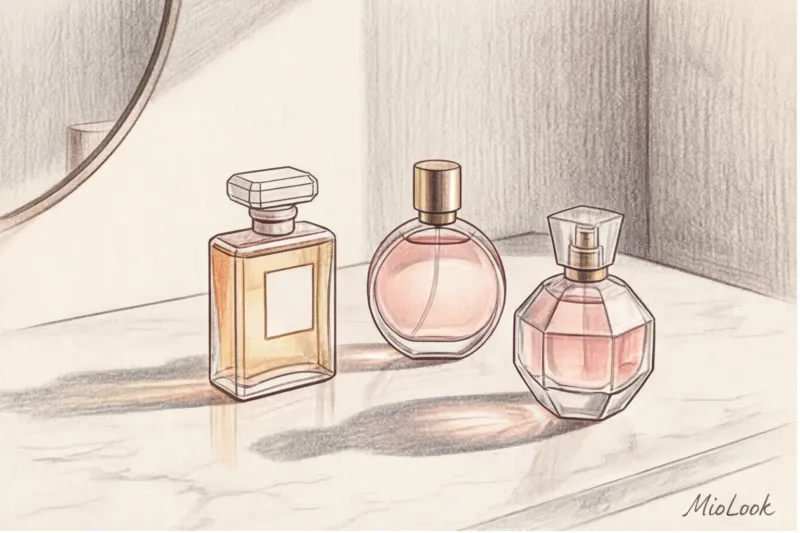
What is perfume layering and why has blending perfumes on the skin become a trend?
Have you ever noticed that the details of someone else's outfit fade from your memory by the end of the day, but a person's scent can haunt you for years? Olfactory memory is our brain's most powerful trigger. And when clients come to me with the request, "I want to smell expensive and unique, but I don't want to buy half a perfume boutique," I always offer one proven tool. mixing perfume on skin , or perfume layering (from English layering - layering).
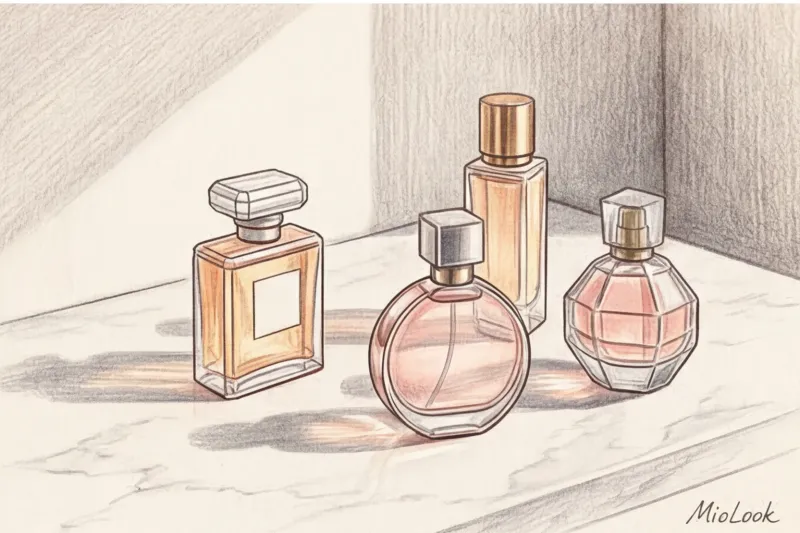
The idea of layering fragrances is far from new. In the Middle East, it's a centuries-old tradition: first, thick oud or musk oils (attars) are applied to the body, then the clothes are fumigated with resinous bakhoor, and then light floral water is sprayed on top. But today, layering has undergone a radical transformation. From an excessive ritual of luxury, it has evolved into an elegant tool for modern, conscious consumption.
According to a global report McKinsey State of Beauty The main driver of the industry today is hyper-personalization. Women are tired of smelling the same, recognizing commercial hits like Baccarat Rouge or Santal 33 in every elevator. We no longer need 50 bottles to smell different every day. This is where the concept perfume capsule.
It works exactly the same way as with a basic wardrobe: a well-assembled foundation yields the maximum number of combinations. In my experience, with just 3-4 well-chosen bottles (for example, a dry woody base, a crisp citrus topper, a molecular enhancer, and a bright floral accent), you can create up to 15 completely unique combinations. This is true perfume minimalism, which not only protects the environment but also saves hundreds of euros. Incidentally, the capsule approach to clothing is perfectly implemented in Smart wardrobe features in the MioLook app , where algorithms help to create the maximum number of looks from a minimum number of things.
"Your unique, distinctive sillage is your olfactory anchor. It works on a subconscious level far more powerfully than a perfectly tailored jacket or a prestigious bag."
Why is this anchor so important for a personal brand? Anatomically, our olfactory receptors are directly connected to the brain's limbic system, which is responsible for emotions and memory. You leave a meeting room, and your presence is still lingering in the air. One of my clients, a project manager, spent a long time searching for her signature style. We decided against buying another heavy, niche perfume for 250 euros and simply layered her favorite, but too frivolous, fruity scent with a masculine cedarwood. The result exceeded expectations—colleagues constantly asked for the name of her "exclusive" perfume.
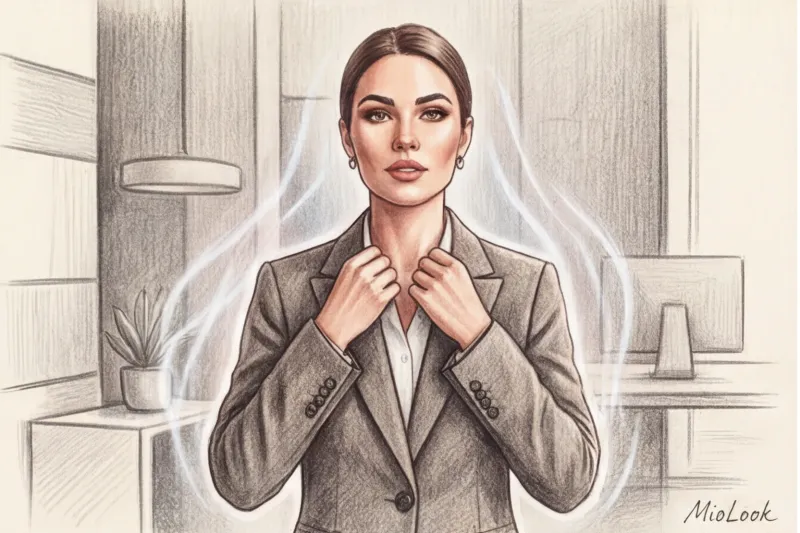
At the same time, the scent should seamlessly integrate into the overall concept of your image, changing along with your goals. For strict corporate everyday life, we layer crisp aldehydes over vetiver—this conveys composure and focus (a well-designed scent would be an excellent visual complement to such a trail). business makeup ). And if you're planning a creative challenge or an informal meeting, you can indulge in a more relaxed blend: fig warmed with soft sandalwood. Layering gives you the power to control your impression without changing your entire fragrance wardrobe.
Body Chemistry: How to Properly Prepare a Base for Blending Perfume on Your Skin
According to dermatological studies, up to a million bacteria inhabit every square centimeter of our skin. It is this unique microbiome, combined with the hydrolipidic mantle, that determines how a perfume composition will physically unfold. When we mix perfume on our skin, we essentially initiate a complex chemical reaction, in which your body acts as the primary and most unpredictable catalyst.
My clients often wonder why the perfect combination of heavy rose and oud, spotted on a colleague, yields a flat, metallic note on their own wrist. The answer lies in biochemistry. The composition of our sweat, body temperature, stress level, and even the amount of water we drink shape our individual olfactory profile. The lipid (fat) layer of the epidermis traps fragrance molecules, and the microbiome subtly modifies their aroma. Therefore, layering is always an experiment with an unknown variable.
This is where rigorous science comes into play. Healthy skin has a slightly acidic pH—ranging from 4.7 to 5.5. Research by specialists at the Perfume Institute in Grasse shows that this pH allows volatile essential oils to evaporate evenly, revealing the note pyramid step by step, as the perfumer intended. If skin is dehydrated, its barrier is compromised, and the pH often shifts toward the alkaline side. As a result, the fragile top notes are instantly destroyed, and the perfume itself literally "fade away" within a couple of hours.
This explains the golden rule of moisturizing: dry skin greedily absorbs moisture from the alcohol base of a perfume, leaving no chance for a beautiful trail. Applying perfume to dry skin is like trying to paint with watercolors on a dry paper towel: the pigment will immediately absorb and fade. Skin needs to be prepped immediately after a shower, while it's still slightly damp. And here we encounter the main mistake—fragrance clashes. Using a regular shower gel with a tropical fruit scent and then a thick lotion with a bright, synthetic vanilla creates a dirty, noisy background. When you apply two different perfumes on top of this chaos, the result resembles a cacophony of scents in a cheap beauty store.
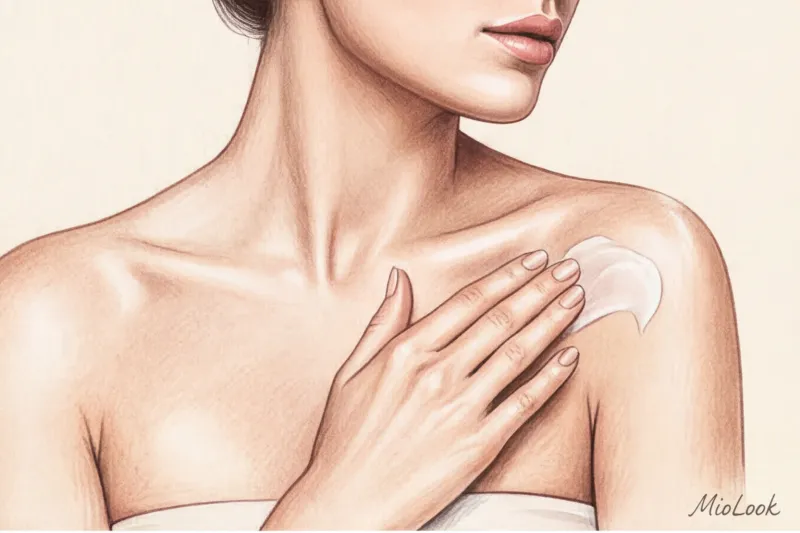
My strict advice as a stylist: if you're planning a complex, multi-layered look, your base treatment should be completely silent. Use fragrance-free, pharmacy-grade emollients with ceramides or squalane.
Apply them 15-20 minutes before spraying perfume to allow the product to fully absorb. They restore the lipid barrier, seal in moisture, and create the perfect neutral canvas for your fragrances to smell pure and luxurious.
Perfume Primers: Marketing Trick or Necessity?
In recent years, a unique product has appeared on the market: perfume primers. Marketers promise they will prolong the longevity and enhance the performance of any mix. Sounds like an excuse to splurge an extra 60-90 euros per bottle, doesn't it? But in reality, this term conceals a highly effective, scientifically proven chemical compound.
Most of these primers (or base molecular fragrances, popularized by the brand Escentric Molecules) are built around large synthetic molecules such as Iso E Super or Ambroxan. Due to their colossal size and heavy molecular weight, they evaporate extremely slowly, blending with the skin's natural scent.
By applying such a molecule as the first, base layer, you create a kind of "anchor" or fixative for subsequent, more volatile compositions. In layering, molecular fragrances act as an amplifier (booster): they don't overpower other perfumes, but rather impart three-dimensional volume, warm woody-amber depth, and that alluring "clean body" effect.
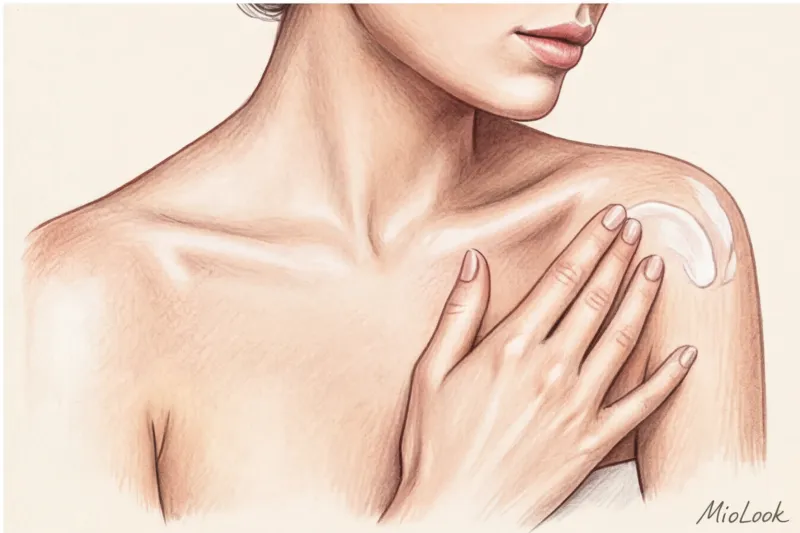
Is it necessary to buy a specialized primer? Absolutely not. In my practice, I often recommend a natural and very affordable alternative to my clients. Apply a drop of high-quality, cold-pressed carrier oil—jojoba or sweet almond—to pulse points (wrists, sternal notch, elbows, back of the neck). Jojoba oil is very similar in composition to human sebum. It has virtually no scent of its own, but its molecular structure perfectly binds and retains volatile essential oils, extending the life of your unique blend for at least 3-4 hours.
Access to MioLook for €0.99 — one-time payment
A smart AI stylist will select the perfect look that will perfectly complement your unique fragrance trail.
Get access — €0.99 onceFragrance Architecture: Basic Rules for Creating a Harmonious Trail
Jean-Claude Ellena, the legendary perfumer and creator of iconic Hermès compositions, often compared the creation of a fragrance to the construction of a building, where each brick has its own precisely measured weight. In perfume chemistry, this isn't a beautiful metaphor, but a dry law of physics. The success of a fragrance depends on how well it turns out. mixing perfume on skin , directly depends on the molecular weight of the components you are trying to combine.

The volatility of any note is determined by the size of its molecule. Citrus essential oils (bergamot, bitter orange, yuzu) are composed of tiny, lightweight molecules—they evaporate instantly from body heat, forming vibrant top notes. But resins, wood absolutes, oud, oakmoss, and musk are true heavyweights with a huge, unwieldy molecular structure. They sit close to the epidermis for hours, forming the base. If you disrupt this natural balance when layering, instead of an elegant, multifaceted composition, you'll end up with a flat, suffocating mess.
This leads to the golden rule of any leering: "Heavy down, light up" First, we apply dense, woody, gourmand, or leathery bases. They create the foundation. If you do the opposite and spray a thick, ambery perfume over a fragile green tea, the heavy molecules will literally crush the delicate accords, preventing them from unfolding. I once had a client complain about the "dirty" and dusty scent of her favorite perfume. Upon examination, it turned out she had applied a thick, Baccarat-like base over a delicate, citrusy cologne, disrupting the entire pyramid structure.
But simply maintaining order isn't enough—architecture requires pauses. The main technical mistake I see everywhere is spraying bottles one after another without a break. Exactly 10-15 minutes should pass between layers. Why this strict timing? The first fragrance needs time to evaporate the alcohol base (which is an aggressive solvent) and react with your lipid mantle. If you apply a second layer immediately, the liquid alcohol from the top layer will dissolve and destroy the essential oils of the base, creating unpredictable chemical chaos on your skin.
Besides time, it's crucial to consider the mathematics of concentration. How can different formats be effectively combined to avoid triggering migraines in yourself and your colleagues? The principle of diminishing density applies here:
- Extrait de Parfum (perfume, 20-40% aromatic substances): Apply microdoses, literally one drop, to pulse points (wrists, sternal notch). This is your unbending framework.
- Eau de Parfum (eau de parfum, 15-20%): We use it as a connecting link, spraying a light cloud slightly wider than the area where the extract is applied.
- Eau de Toilette (toilet water, 5-15%): The lightest layer. It can be applied more generously, spraying onto the shoulders or back of the neck to create that flowing, diffuse trail.
It's practically impossible to memorize all the successful and unsuccessful combinations in your head. To avoid wasting expensive bottles (and the cost of a good niche fragrance can easily exceed 200-250 euros these days), I strongly recommend keeping an olfactory diary. It's very convenient to use this for this purpose. the "smart wardrobe" feature in MioLook Simply add photos of your bottles to the accessories category and associate specific perfume combinations with specific outfits. This way, you'll know exactly which fragrance architecture perfectly complements your current look.
Proven Combinations: A Fragrance Wardrobe Builder
Theory is great, but let's get practical. Treat the bottles on your shelf like a basic wardrobe: you have structured jackets (woody base notes), silk blouses (floral notes), and accent accessories (citrus and spices). Properly blending perfume on your skin allows you to create dozens of different looks from these elements, adapting them to a specific occasion, dress code, and even the temperature outside.
If you are just starting to experiment and are afraid of making mistakes, your surefire start is molecular minimalism plus bright soliflore (a fragrance built around the scent of a single flower). Synthetic molecules like Ambroxan or Iso E Super act as a perfect white canvas on the body. Apply the base molecule, let it sit for 10-15 minutes, and then add a single-scent fragrance of pure rose, tuberose, or jasmine. The molecule won't distort the natural scent of the flower, but will add volume, modernity, and, most importantly, extend its life on the skin for several hours. This is a completely safe method for beginners, eliminating the risk of creating a vague, perfume-like "mud."
To create a working mood I use the formula freshness enhancement: citrus plus dry woody notes Cedar, sandalwood, or vetiver in the base establish a sense of class and inner strength, while a top layer of grapefruit, yuzu, or bitter orange adds dynamism. This is the perfect solution for a strict business dress code, when the fragrance should convey poise rather than distraction.
Here I'd like to share an illustrative case from my styling practice. I had a client, the CFO of a large company, who adored a heavy, dense oud perfume (incidentally, one that cost around 280 euros). The problem was that in the confined space of a conference room at 11 a.m., this thick oriental scent literally suffocated her colleagues and seemed out of place. We didn't hide the beloved bottle until winter. Instead, we adapted this heavy evening scent for daytime business meetings by layering it with cool, sparkling bergamot. The citrus instantly “discharged” the density of the oud, added air to the composition and transformed the aggressive oriental into an elegant, restrained base.
When evening comes, we use the technique easing of severity The combination of leather or oud plus vanilla or rose is a classy evening option that sounds both expensive and intriguing. A rough, animalic leather base (think of the scent of a new, expensive, handcrafted bag) can seem too masculine. But spray a drop of Bourbon Vanilla Absolute or Honeyed Damask Rose over it, and the composition acquires a luxurious velvety finish and depth.
And finally, the reception deepening frivolity It saves fruity and berry compositions from associations with cheap teenage body sprays. Juicy notes of peach, cherry, or fig often sound flat and overly sweet. To add a touch of maturity and texture, use earthy patchouli or smoky vetiver as a base. A dark, slightly damp base creates a beautiful contrast with the sweet fruits, transforming the banal scent of fruity bubblegum into a complex, multifaceted story with character.
Access to MioLook for €0.99 — one-time payment
Start creating your perfect looks with AI. Sync your perfume and clothing wardrobe in one convenient app.
Get access — €0.99 onceSpatial Layering: A Stylist's Secrets for Working with Fabrics
According to the International Fragrance Association (IFRA) 2023 reports, up to 15% of people experience mild contact dermatitis when using complex, highly concentrated fragrances. This is why classic mixing perfume on skin This isn't suitable for everyone. If you have sensitive skin, are prone to allergies, have an unstable pH, or live in a hot climate where perfume literally "boils" on your skin, I suggest using an alternative method—spatial layering, or the "skin + clothing" approach.
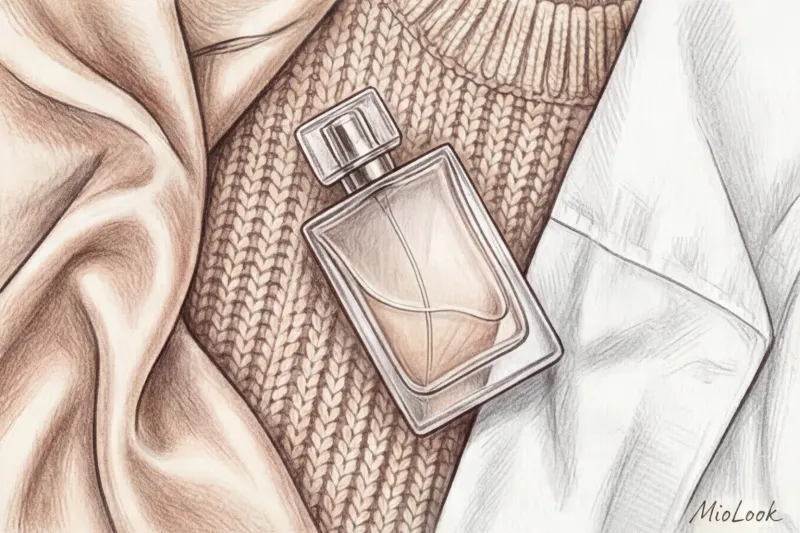
As a materials scientist, I often explain in my lectures on sustainable fashion: fabric isn't just a backdrop for your look; it actively participates in the development of your fragrance. The length and beauty of a fragrance's sillage directly depends on the porosity of the fiber and its chemical nature. Textiles lack a lipid mantle, but they possess a unique physical structure that can be both your fragrance's best friend and its worst enemy.
Silk and viscose: a trap for musk
Smooth threads of natural silk and rayon have minimal porosity. There's literally nothing for aromatic molecules to cling to. I had a telling case: a client complained that an expensive musk extract (costing around 320 euros) left a sharp, metallic, almost sour note on her favorite silk blouse, even though it smelled divine on a blotter.
The secret lies in the physics of the fiber. Smooth fabrics mercilessly distort heavy animalic and musky notes, depriving them of their corporeal warmth. Large musk molecules cannot penetrate deep into the fiber and quickly oxidize on the surface. It's best to apply only light floral or fruity mists to such delicate materials, and only with extreme caution.
Wool and cashmere: ideal base keepers
Animal fibers are made of keratin (like our hair) and have a scaly, loose structure. This makes them ingenious "keepers" of heavy molecules. If you want to prolong the life of your favorite fragrance, there's no better canvas.
"Amber, bourbon vanilla, sandalwood, oud, and tonka bean can live on a quality cashmere sweater for weeks, unfolding softly and gracefully, without harsh initial alcohol notes."
To create a spatial layering effect, apply a dense woody base to the collar of a wool coat and a sparkling citrus scent to the skin of your wrists. As you walk, these layers will blend in the air around you, creating an incredibly voluminous and luxurious trail.
Cotton and linen: the territory of freshness
Plant-based cellulose fibers breathe well. Cotton and linen are ideal for emphasizing the crisp purity of a look. Fresh, aquatic, and aldehyde-based compositions work best on these materials. Thick cotton prevents volatile citrus notes from evaporating within half an hour (as inevitably happens on hot skin), extending the life of bergamot, neroli, and grapefruit by two to three times. If you're heading into a difficult meeting, spray rigorous aldehydes on the cuffs of a starched cotton shirt—the scent will project composure throughout the workday.
Safety rules: how to avoid damaging things
Spraying perfume on expensive fabrics should be done wisely. Concentrations Eau de Parfum And Extrait de Parfum Contain 15% to 40% essential oils, which can easily leave permanent marks. To avoid yellow oil stains on a light-colored trench coat, follow three ironclad stylist rules:
- Keep your distance: Spray the fragrance from a distance of at least 20-30 centimeters. Step into the "perfume cloud" rather than spraying it directly at the target.
- Use the back side: Apply perfume to the inside of clothing (jacket lining, inseam of skirt hem). This will prevent stains on the outside and protect the fragrance from damaging UV rays.
- Consider the color of the liquid: Never apply dark-colored perfumes (such as thick, resinous ouds or rich vanilla extracts) to white collars. Dry cleaning such a stain will cost more than the bottle itself.
To avoid confusion about which perfume you've already applied to a particular jacket (after all, layering three different base coats on one item in a week is a surefire recipe for olfactory disaster), I recommend digitizing your looks. In the app MioLook You can not only collect capsules but also add notes to items: for example, you can mark that this cashmere cardigan is "assigned" to the vanilla-tobacco profile. This saves time in the morning and helps you develop an impeccable personal style.
The Main Mistakes When Layering: How to Avoid Turning Your Sillage into a Cacophony
There's a dangerous myth: the more different bottles you use at once, the more unique and rich the result. In practice, a mindless thirst for experimentation often ends in olfactory disaster. In a business environment, an inappropriate, loud perfume is as damaging to one's reputation as dirty shoes or a wrinkled shirt. According to modern business etiquette, your scent is an intimate zone that shouldn't intrude on your colleagues' personal space. Let's examine four fatal mistakes that turn an exquisite scent into an unbearable cacophony.
Mistake 1: Clash of the Titans, or mixing two complex niche compositions. Imagine wearing a massive diamond necklace and large ruby chandelier earrings at the same time. The same rule applies to perfumery. If you combine two complex fragrances—for example, a rich oriental oud extract and a rich, animalic tuberose—they won't blend into a single symphony. They will aggressively compete for dominance. Let a complex, 200-300 euro fragrance stand alone. For effective layering, always use the rule of contrast: one complex fragrance serves as the base, while the second, monocomponent (clean musk, molecular, or light citrus) serves as a subtle accent.
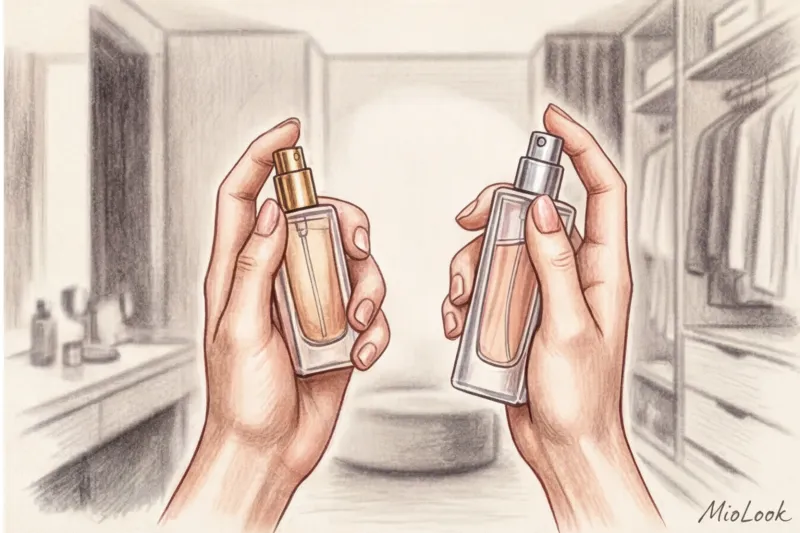
Mistake 2: Applying wet on wet without pausing. Direct mixing perfume on skin It's not just the merging of liquids; it's a complex physical and chemical process. If you spray a second perfume on the same spot while the alcohol base of the first hasn't evaporated, a violent chemical conflict of volatile compounds occurs. The molecules literally break each other's structure, producing an unpredictable scent: from burnt rubber to rancid soap.
My golden rule: let the first layer settle and warm up on your body for at least 10-15 minutes. An even safer option is to apply fragrances to different pulse points. For example, apply a thick base to the back of your neck and a light citrus topper to your wrists.
Mistake 3: Ignoring seasonality and room temperature. This is especially critical for speakers and those working in open-plan offices. In the cool street air, heavy resins, patchouli, and gourmand notes sound noble and restrained. But as soon as you enter a heated room or stand under the spotlight on stage, your body temperature rises. The aroma begins to evaporate quickly and aggressively. What seemed like a light odor in the morning fills the entire conference room by lunchtime, giving colleagues a migraine. Always consider the microclimate of the space where you'll spend most of the day.
Mistake 4: The insidious “olfactory blindness”. The scientific term for this phenomenon is olfactory adaptation (or macrosthetic fatigue). Our receptors are designed to block out constant background stimuli so the brain can recognize new, potentially dangerous scents. This is an ancient evolutionary survival mechanism. An hour after applying a scent, you begin to feel like the layering is too weak, and you reach for a fresh coat. At this point, you completely lose track of your scent, while those around you literally suffocate. Trust the initial dosage (no more than 2-3 sprays total), even if by mid-day you don't smell anything.
To avoid such embarrassments and not overload your look, I recommend planning your perfume wardrobe as carefully as your clothing capsule. MioLook The app lets you digitize not only your clothes but also your favorite bottles, creating tried-and-true combinations for the office, a date, or a vacation ahead of time, without relying on the morning rush.
Your perfect look starts here
Join thousands of users who look flawless every day with MioLook.
Get access — €0.99 onceCreating a Personal Olfactory Brand: A Step-by-Step Checklist
Get out all your bottles. Yes, even those that have been gathering dust in the back of your closet for years because they seemed like masterpieces in the store, but "too boring" or "too stifling" at home. Conscious consumption in perfumery doesn't start with not buying anything, but with learning how to manage your assets. Building a fragrance wardrobe isn't about endless shopping sprees, spending €150-200 on a new niche fragrance each season. It's about taking inventory. Over 12 years of working with personal style, I've developed a clear algorithm that helps my clients assemble a functional olfactory capsule in literally one free evening, without spending a cent.
Step 1: Audit your current perfume shelf
Divide your collection into two polar categories. The first is the "foundation" (your bases). Dense, heavy, resinous scents go here: oud wood, rich bourbon vanilla, earthy patchouli, animalic leather, tobacco, and heavy musks. The second category is the "accessories" (accents). These are volatile, crisp, and light compositions: citrusy colonies, white floral monoaromas, aquatics, green tea, and crisp aldehydes.
In my experience, nine out of ten women show a serious bias: for example, they exclusively buy light floral waters that disappear without a trace within an hour. You don't need to throw out such a collection. It's enough to invest in one high-quality base fragrance (for example, pure molecular sandalwood), which will serve as a fixing base for all your frivolous "accessories."
Step 2: Test on blotters before applying to the body
Never try your first bold experiments on yourself—removing a bad mix from your wrist can be extremely difficult. Professional perfume evaluators in Grasse use the "fan" method. Spray candidate fragrances onto different paper blotters (strictly one spray on each). Take them in one hand, fan them, and gently wave them in front of your nose from a distance of 15-20 centimeters. Want to figure out how to change the ratio? Simply move the blotter with a light scent a couple of centimeters closer to you—this will simulate the formula of "one spray of base to two sprays of accent."
Step 3: Test drive in the field
Only when you are completely satisfied with the paper sketch, move on to practice. Remember that the direct mixing perfume on skin Always produces a warmer, sweeter, and deeper result due to your natural lipid mantle. Apply your chosen combination on a weekend morning. Your goal is to track three key points: a sharp start (the first 15 minutes), the opening of the heart (after 2 hours), and the lingering base (after 6-8 hours). Be sure to perform the "elevator test": ask your loved ones if your sillage is filling the entire space. The ideal layering should be felt at an intimate arm's length, not shout out your presence from ten feet away.
Step 4: Creating a perfume chart for different purposes
The final step is to align successful combinations with your lifestyle and dress code. I recommend creating a matrix of three or four foolproof formulas for specific needs:
- For tough negotiations: Dry vetiver in the base with pungent bergamot or pink pepper on top. This combination conveys distance, intellectual focus, and absolute authority.
- For creative tasks and networking: molecular amber base + green fig or rhubarb. It sounds modern, dynamic and subconsciously invites the interlocutor to dialogue.
- For rest and recharge: Soft cashmere + cool lavender. Works as a therapeutic stress-relief cocoon on a weekend.
To remember the right proportions, be sure to record them. You can add photos of your favorite perfume combinations to MioLook Directly into the accessories section, linking a specific olfactory trail to ready-made capsule wardrobes. A smart wardrobe is not only about the impeccable cut of a jacket, but also about the invisible aftertaste you leave behind. Layer, experiment, and remember: your perfect, 100% unique scent is likely not yet bottled at the factory. It's waiting for you to create it yourself.
Guide Chapters
What perfumes can be mixed: a table of notes
Perfume layering is a powerful tool for creating a unique look. Learn the rules of note combinations and build your own exclusive olfactory wardrobe.
Mistakes: Which notes in perfumery should not be mixed?
Have you ever mixed your favorite perfumes and ended up with a repulsive scent? We'll explore the most common layering mistakes and discover which scents are completely incompatible.
How to Make Perfume Last Longer on Your Skin: Layering Secrets
Is your expensive perfume fading quickly? Learn how proper skin prep and layering can help your favorite scent last all day.
What perfumes can you mix the molecule with: the best ideas
Escentric Molecules is the perfect canvas for your fragrance wardrobe. We'll show you how to layer fragrances to create a unique trail.
Where to spray perfume to mix: skin, hair, clothes
Perfume is invisible clothing. Learn how to properly distribute different fragrances onto skin, hair, and fabric to create a unique 3D trail.
Jo Malone: How to Mix Fragrances for the Perfect Sillage
How to create your own unique olfactory code with Jo Malone perfumes. We explore layering rules and the best fragrance combinations for a prestigious trail.
How to dilute heavy perfume with citrus
Is your high-status perfume too heavy and inappropriate for daytime wear? We'll tell you how to salvage your favorite scent and lighten it with citrus notes.
Oil and alcohol perfumes together: how to mix
Is your expensive perfume fading quickly? Learn the secrets of masterful layering and how to mix different textures to create a long-lasting scent.
How to apply another perfume over the old one without a shower
No time to shower before an evening event? We'll show you how to layer fragrances correctly to avoid smelling like a perfume shop.
How to Mix Perfume in Summer: Secrets to Layering in the Heat
Applying perfume to your pulse points in 30-degree heat is a grave mistake. Learn the rules of summer layering and keep your favorite scents lasting.
Can you mix men's and women's perfumes? Yes!
Gender-based perfumery is just a marketing ploy. Learn how to pair fragrances to create a unique scent for you and your partner.
How to Mix Cheap and Expensive Perfumes: Secrets of Layering
Is your budget perfume fading quickly? Learn how to use layering to make inexpensive fragrances smell like premium fragrances.