One of my clients, a top manager at an IT corporation, once confessed in despair: "I bought a luxurious bottle of Tom Ford Oud Wood, but it's literally driving me out of the conference room. My colleagues tactfully open the windows, but by lunchtime I'm starting to get a headache." Sound familiar? We spend hundreds of euros on prestigious oriental, woody, or gourmand fragrances, only to tuck them away on a back shelf because they smell too thick and out of place in daylight.
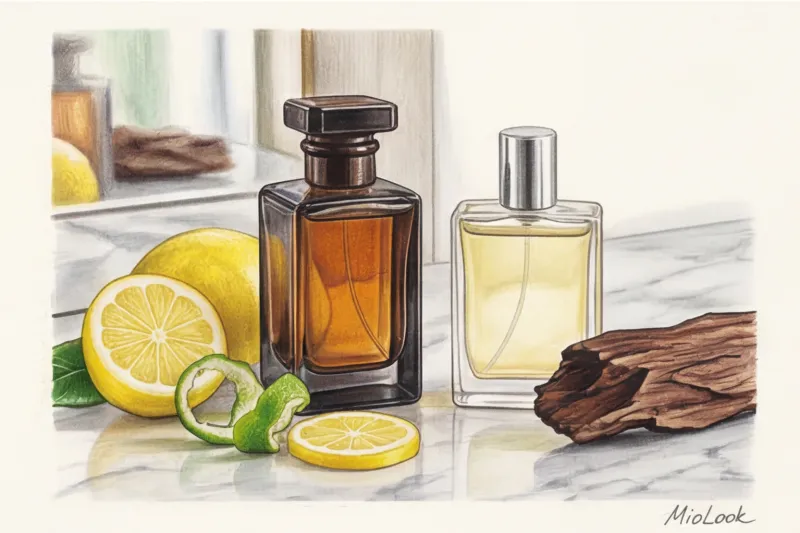
Today we will take a detailed look at How to dilute heavy perfume and adapt them to any dress code without destroying the complex DNA of the fragrance. We've already discussed the basic principles of note combinations in more detail in our The Complete Guide to Blending Perfume on Skin: The Art of Layering But in this article, I want to go further and show you an advanced method used by professional perfume stylists. We'll use citrus scents not just as a complement, but as a true olfactory scalpel.
The Anatomy of Fragrance: Why High-State Perfumes Are Stifling and How Citrus Works
To understand how to save your beloved but overly dense perfume, you need to delve a little deeper into chemistry. Why do expensive fragrances often cause the phenomenon of "olfactory fatigue"—a condition where the receptors become blocked, and the perfume begins to feel like a suffocating monolith?
The answer lies in molecular physics. According to the classification of the eminent perfumer Jean-Claude Ellena, perfume notes are classified by their volatility. Heavy base ingredients—natural oud, patchouli, ambergris, vanilla absolute—have enormous molecular weights. They evaporate from the skin extremely slowly, with a lifespan of 12 to 24 hours. Imagine a heavy velvet curtain: beautiful, but completely impermeable to air.
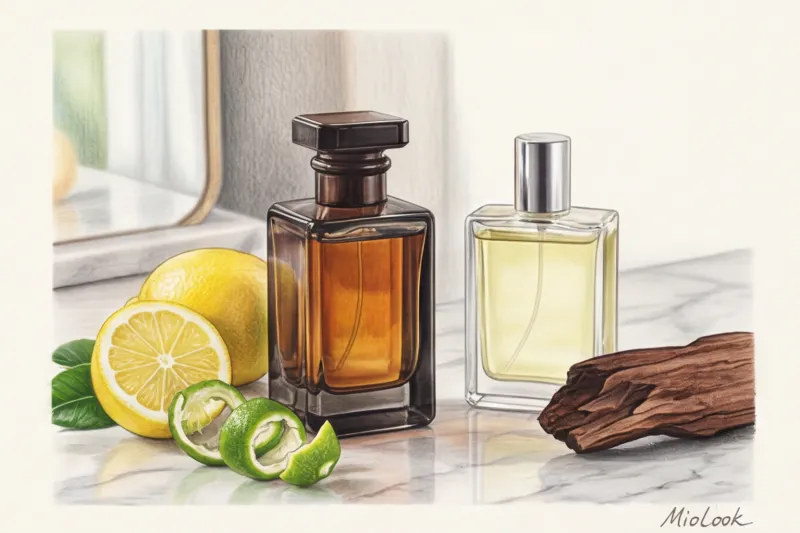
This is where hesperides—citrus notes—come into play. Their molecules (like limonene) are tiny and incredibly mobile. They last only 15–30 minutes on the skin, but possess phenomenal penetrating power. Citrus acts like a perfume scalpel: their fine, volatile esters can literally "cut" through the dense trail of a heavy base, adding air, light, and diffusion to the composition.
"Citrus top notes are windows into the dark room of a heavy oriental scent. Open them, and the space instantly changes," perfumers often repeat in the corridors of Grasse's laboratories.
Access to MioLook for €0.99 — one-time payment
A smart AI stylist will select the perfect look to complement your updated perfume.
Get access — €0.99 oncePerfume Physics Rules: How to Dilute Heavy Perfumes Without Creating a "Mud"
Forget the popular advice from glossy magazines of the 2000s: "Apply a heavy fragrance and then spray a lighter one directly on top." This is a fundamentally flawed approach that is guaranteed to ruin both compositions.
The main principle of smart layering is: never mix two complex, multi-component fragrances. One should always be the main focus (your heavy base), and the other should be purely an accent (a citrusy mono-fragrance or a simple cologne). This works exactly like the concept of a smart wardrobe app. MioLook You take a complex, structured base and refresh it with a simple accessory. Two complex prints in one look will create a visual buzz, and two complex perfumes will create an olfactory cacophony.
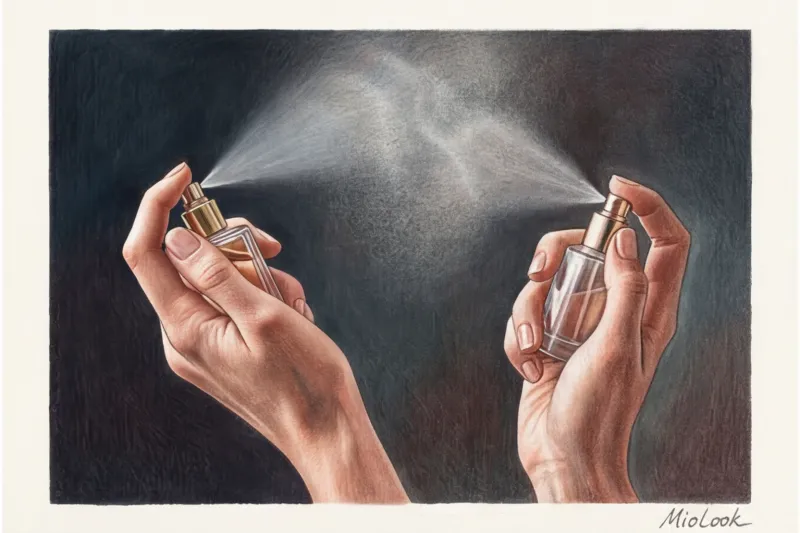
Moreover, in 12 years of working as a stylist, I've learned the golden 80/20 rule. Your final finish should be 80% heavy base (applied to your pulse points) and only 20% citrus (on your hair or clothes). But why is this so? Let's look at the top mistakes beginners make.
Mistake #1: Spraying Spot-on
When you apply lemon essential oil directly over oud extract on the same wrist, a molecular clash occurs. The resins and musks of the heavy base literally absorb the fragile citrus esters. At a chemical level, the molecular structure is disrupted.
Instead of a beautiful, fresh trail, you risk smelling like stale soap, acidic rubber, or an old powder compact. Molecules should blend together, not react chemically on your skin.
Mistake #2: Mismatched aroma temperatures
Citruses come in many forms. Sweet orange and mandarin are warm, sunny notes. Bergamot, grapefruit, lemon, and yuzu are cool, sharp, and crisp. If your heavy perfume is overtly hot (for example, a rich, gourmand vanilla with cinnamon), adding warm orange will make it even more sultry, turning it into a sticky syrup.
The rule of contrasts applies here. Hot vanilla needs to be "cooled" by icy, bitter bergamot. But cold, distant incense can be warmed slightly by sweet mandarin.
Spatial layering: where to apply the base and where to apply a fresh accent
If you can't mix fragrances on the same area of your skin, how can you make them smell together? The answer: use the "spatial sillage" method. The idea is to distribute the fragrances across different temperature zones of your body.
Backstage at Paris Fashion Week, I often observed stylists at work in cramped dressing rooms. Models showing evening collections often wear thick, ambery fragrances. In the confined space, heated by spotlights and hair straighteners, such a smell could become overpowering. What do the stylists do? They spray the heavy perfume only on the model's back or behind her knees, and before she walks down the runway, they spray a cloud of citrus mist into the air, through which the model simply walks.
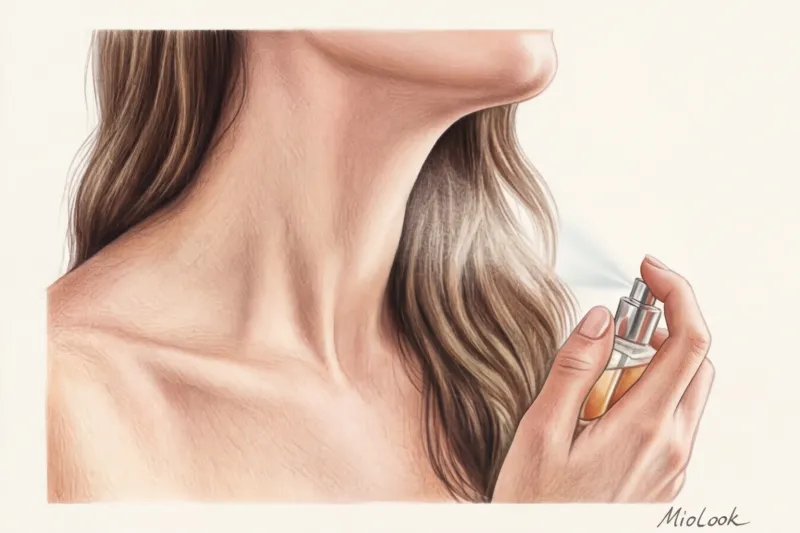
How to apply this in real life:
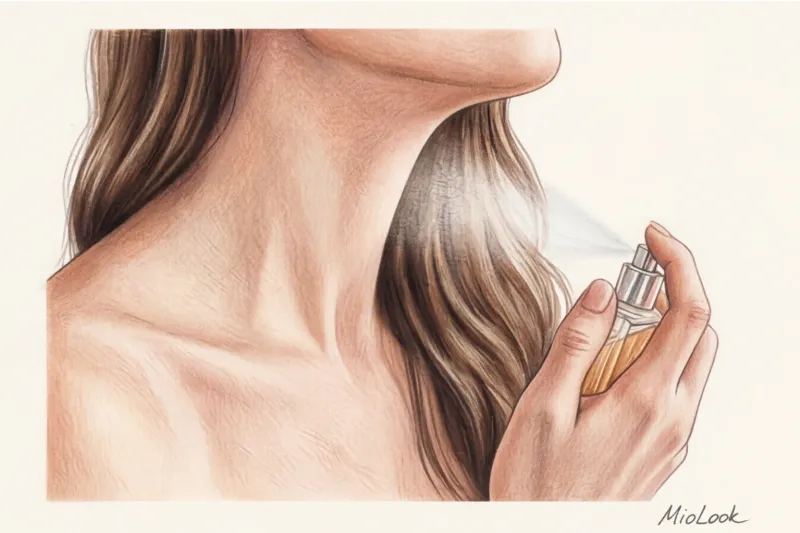
- Heavy artillery: Apply your rich perfume to the hottest spots on your body—the back of your neck (under your hair), the hollow of your chest, or behind your knees. There, it will warm and unfold softly, intimately, without being offensive to you or anyone else.
- Citrus Veil: Spray a light single-scent scent on cooler areas—the outer forearms, the ends of your hair, or the collar of a cotton shirt.
The magic happens dynamically. As you walk or turn your head, the two scents mingle in the air. You create the illusion of an incredibly complex, playful perfume that alternately wafts freshness across your conversation partner and intrigues with a deep, woody base.
Your perfect look starts here
Join thousands of users who look flawless every day with MioLook.
Get access — €0.99 onceA Perfume Stylist's Guide: The Best Citruses for Taming Complex Notes
For the spatial trail method to work flawlessly, it's important to choose the right pair. In my experience, eight out of ten clients completely changed their attitude toward abandoned bottles when we found the right citrus "diluent" for them.
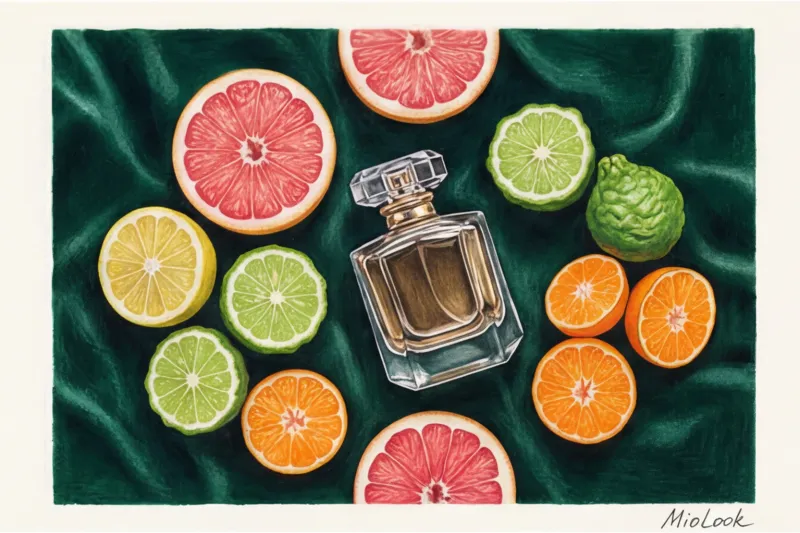
Here are a few tried and tested combinations you can use as a cheat sheet:
- Bergamot + Gourmand. Bergamot possesses a unique, tart bitterness reminiscent of strong Earl Grey tea. It's the perfect companion for the cloying notes of praline, tonka bean, burnt sugar, and vanilla. The bitterness instantly cuts through any excess sweetness, lending a refined aroma.
- Grapefruit/Pomelo + Agarwood and Leather. Heavy animalic notes (leather, tobacco, castoreum) often sound harsh. Grapefruit has a slightly sulfurous aspect in its profile that brilliantly rhymes with the animalic notes, making them more modern and dynamic.
- Neroli/Mandarin + White Flowers. Dense white floral compositions (predatory tuberose, indolic jasmine, oily gardenia) can trigger headaches. The green, slightly soapy freshness of neroli (bitter orange blossom) restores the morning dew and lightness of these flowers.
Important limitation: This tip does NOT work with aquatic and ozone-based scents. They are highly diffused and contain harsh synthetic ingredients (like calone). Layering citrus over them will create a bathroom air freshener effect.
Capsule approach: how 2 bottles replace 5
Perfume layering is closely linked to the concept of conscious consumption. According to the extensive McKinsey State of Beauty (2024) report, the global trend in the beauty industry has shifted from purchasing dozens of different products to hyper-personalization and multifunctionality. Modern women no longer want to smell like a recognizable commercial scent—they want to create their own code.
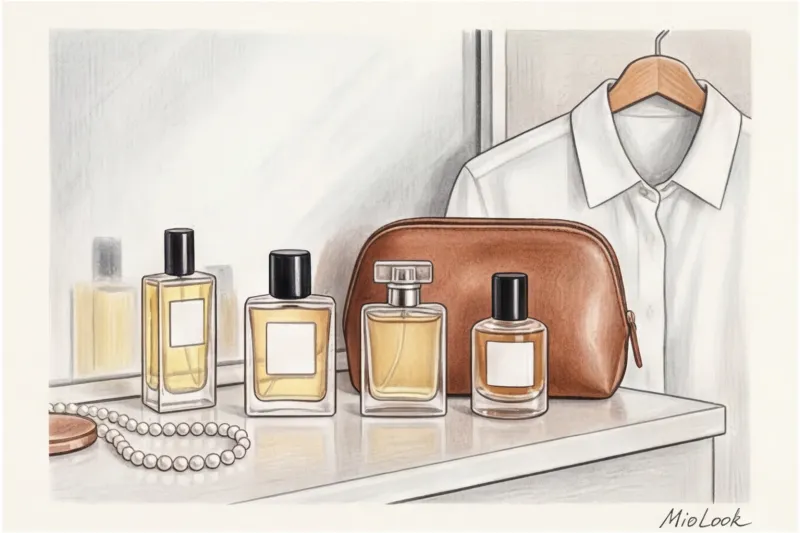
Instead of buying separate perfumes for the office, one for a date, and one for the weekend, you can create a perfume capsule. With just one luxurious, heavy evening scent and one high-quality citrus cologne (Eau de Cologne), you get three completely different scents.
In the morning, you apply a drop of the base to your neck and generously spray your hair with citrus—the result is a sophisticated, fresh, yet distinctive scent perfect for a business meeting (even if you're wearing casual jeans to the office on Friday, this perfume will pull your look together). In the evening, before dinner, you simply refresh the heavy base on your wrists, letting it shine. It's eco-friendly, economical, and incredibly stylish.
Checklist: How to save your favorite but overly strong fragrance right now
Ready to give it a try? Here's a stylist's step-by-step guide on how to apply the spatial layering method before your next outing:

- Step 1: Evaluate the base. Smell your heavy perfume. Which note is overwhelming? If it's sweet, go for bergamot. If it's heavy with wood or leather, look for grapefruit.
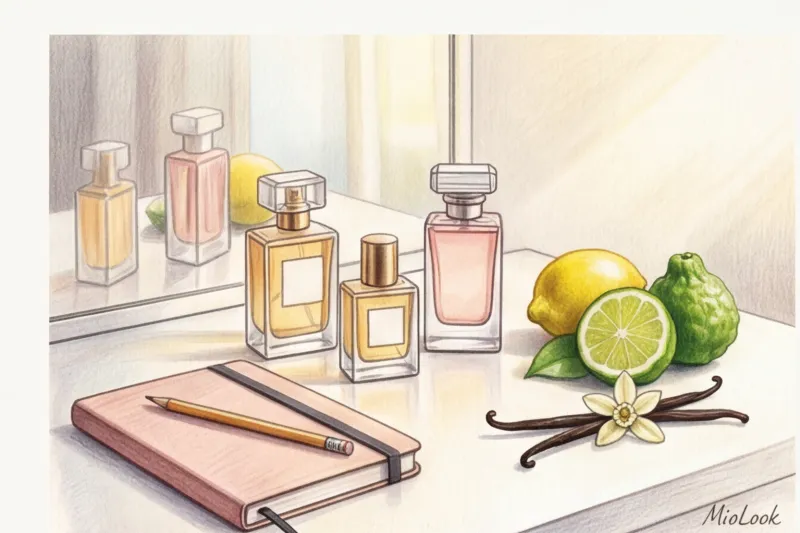
- Step 2: Adjust the contrast. Find the simplest, most monotonous citrus scent possible. A classic cologne or an inexpensive eau de toilette with a prominent lemon or mandarin note will do. The simpler the formula of the "diluent," the better.
- Step 3: Apply base coat beforehand. 20-30 minutes before going out, apply exactly one micro-spray of heavy perfume to the back of your neck under your hair. Allow the alcohol to evaporate and the resins to warm up.
- Step 4: Spray freshness. Just before you leave the door, spray a cloud of citrus scent in front of you and step into it, or apply it to the collar of your outerwear.
- Step 5: Test in motion. Don't try to press your nose against your skin to test the results. Instead, evaluate how the scent behaves as you walk down the street or turn your head.
Perfume isn't a tattoo to be worn in its original form; it's your aura. By learning to control the density of your scent with citrus, you'll never again be held hostage by heavy bottles, and your sillage will always evoke questions like, "My God, what is this incredible perfume?"