Image Architecture: Why Accessories Are More Important Than Clothes Themselves
Over 12 years of working as a stylist, I've constantly observed the same picture: wardrobes are overflowing with items spent thousands of euros on, but the look still looks unfinished and... frankly boring. Girls buy dozens of dresses and jackets, forgetting the most important thing. The secret to a prestigious appearance doesn't lie in logos on the chest. Understanding that... How to choose the right accessories for your clothes , can save even the most modest budget and completely transform your visual presentation.
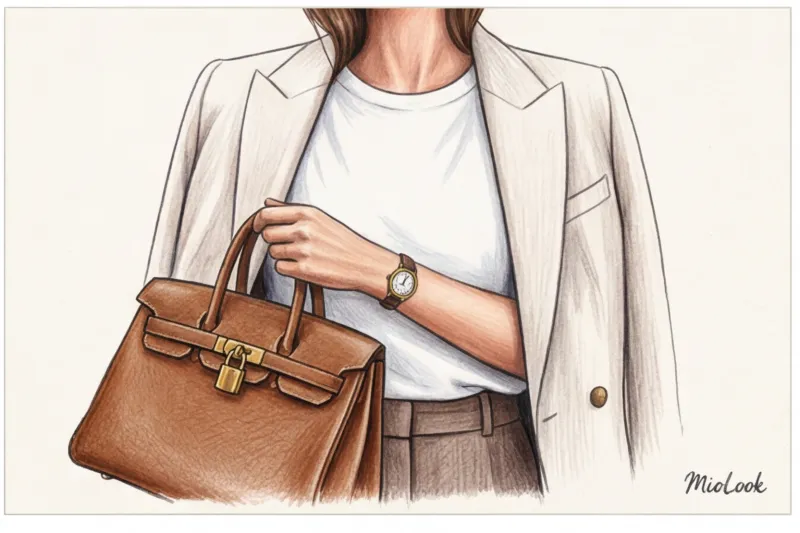
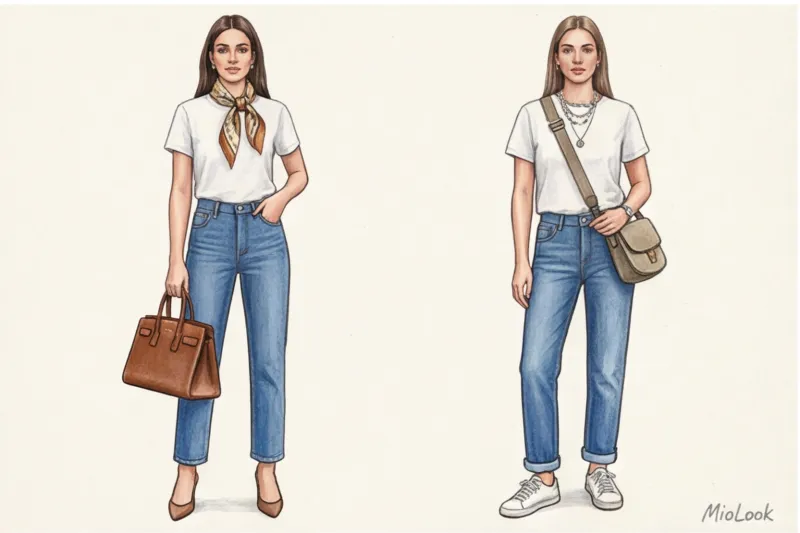
Let's get this straight: clothes are just a canvas, a backdrop. Accessories act as the rigid "skeleton" of your style. You can wear the simplest white shirt and straight blue jeans, but the bag you carry, the belt you tie, and the watch you wear will define the entire character and status of your outfit. Without a well-thought-out architecture of details, an outfit literally falls apart. Trust me, it's the lack of attention to detail that often leads to failure. cheapens the image , nullifying all efforts in the mirror.
This is where a powerful psychological mechanism known in the fashion world as the "Halo Effect" comes into play. Our brains are lazy: when assessing someone's appearance, they latch onto the one most striking, flawless detail and automatically project its premium status onto the rest of the outfit. If you're carrying a luxurious, structured bag with a perfect geometry or an expensive Swiss watch on your wrist, those around you will subconsciously perceive your basic cotton T-shirt from Zara or H&M as a heavy luxury item. Conversely, peeling hardware on a cheap belt will instantly "kill" even a Loro Piana cashmere coat. This is a fundamental rule of How to look expensive without buying up catwalk collections.
It's time to shift from a consumer mindset to an investor's. You can and should save on the basics—a white T-shirt lasts one season, whether it costs €20 or €200. But you can't skimp on the details. Invest in quality that speaks for itself. For example, Florentine leather processing standards (vegetable tanning without harsh chemicals, hand-polished edges with beeswax) guarantee that a bag or belt will acquire a noble patina over the years, rather than becoming covered in cheap cracks. Such an item becomes your calling card.
To understand the true value of a purchase, I always teach my clients to count Cost-per-wear — the cost per wear. The mathematics of style is merciless, but fair.
Let me give you an example from my personal experience. One of my clients was hesitant for a long time to buy a classic leather belt from Celine for €450. Previously, she regularly bought "disposable" belts from mass-market stores for €30-40 each season, which would wear out and lose their shape within a month. We calculated that the premium belt, which she wore on average four times a week for three years (about 600 times), cost her only €0.75 per occasion. Meanwhile, a cheaper alternative cost €3-4 per occasion, visually simplifying her wardrobe every day. The numbers speak for themselves.
To clearly see your personal statistics and understand which details are working, I recommend digitizing your investments. Upload your bags, watches, and jewelry to MioLook smart wardrobe — the app will help you easily create stylish outfits and track which investment pieces truly pay off every day, and which ones were bought on the spur of the moment and are just sitting there.
How to choose the right accessories for your clothes: 5 golden rules of a stylist
If basic clothing is your canvas, accessories are your colors, shades, and tones. According to research by the Pantone Color Institute, accent details account for 60% of the unconscious first impression of a person's status and taste. But buying a €2,500 bag alone doesn't guarantee impeccable style if the item lives independently of you and doesn't fit into the overall silhouette.
The styling taught at Milan's Istituto Marangoni has its own strict geometry—mathematics artfully disguised as creativity. To make this mathematics work for you, I always ask my clients to apply five immutable principles.
1. Adaptation to the natural scale and lines of the face.
Your appearance literally dictates the caliber of your jewelry. If you have delicate, graceful features (like Jane Birkin, for example), massive, sculptural earrings in the style of early Balenciaga will simply overwhelm your appearance—people will notice the metal, not your eyes. Conversely, large, expressive features require adequate, supportive volume. A thin, invisible chain will look lost on such a woman, while a massive choker or large stud earrings will seamlessly accentuate her stately figure. Of course, in avant-garde styling this rule is sometimes broken intentionally, but when it comes to creating an expensive and elegant everyday base, proportionality is paramount.
2. Focal points: controlling the interlocutor’s gaze.
Accessories work like powerful visual magnets. Last fall, I put together a capsule collection for Anna, a top manager at a large IT company. Her main stylistic "pain point" was her heavy hips and rather fragile top (a classic pear-shaped figure). For years, she'd been hiding her curves in shapeless black clothes, and at our first meeting, she asked me point-blank, How to choose the right accessories for your clothes to shift that focus. My solution was simple yet radical: we kept the bottoms as minimal as possible, but added a chunky vintage Yves Saint Laurent necklace (an investment of about €450) and oversized horn-rimmed glasses to the portrait area. The result? Every person's gaze is now automatically drawn to her face and collarbones. The "bottom-heavy" problem was solved without dieting—solely by a clever focal point.
3. The rule of proportionality between print and cut.
The law of communicating vessels applies here. If you're wearing a complex asymmetrical cut (in the spirit of Maison Margiela's deconstruction) or a silk blouse with a vibrant floral pattern from Dries Van Noten, accessories must take a back seat. Utmost minimalism is required: a sleek leather clutch without hardware or logos, thin geometric rings. Conversely, if your basic canvas is a strict gray pantsuit made of thick wool (like COS or Jil Sander), the look desperately needs an accent: a structured bag in a complex, deep shade or a striking brooch.
4. Balance visual weight.
A common mistake is to overload one part of the silhouette. If you're wearing heavy, chunky boots with a tractor sole (like The Row or Prada) and carrying a bulky leather tote bag, adding a chunky, chunky knit scarf and a wide-brimmed hat will make you look like a "knight in armor." The visual weight should be distributed evenly. For heavy shoes, pair them with a medium-sized, rigid bag and a simple top to allow the look to breathe.
5. Integration with personal brand DNA and context.
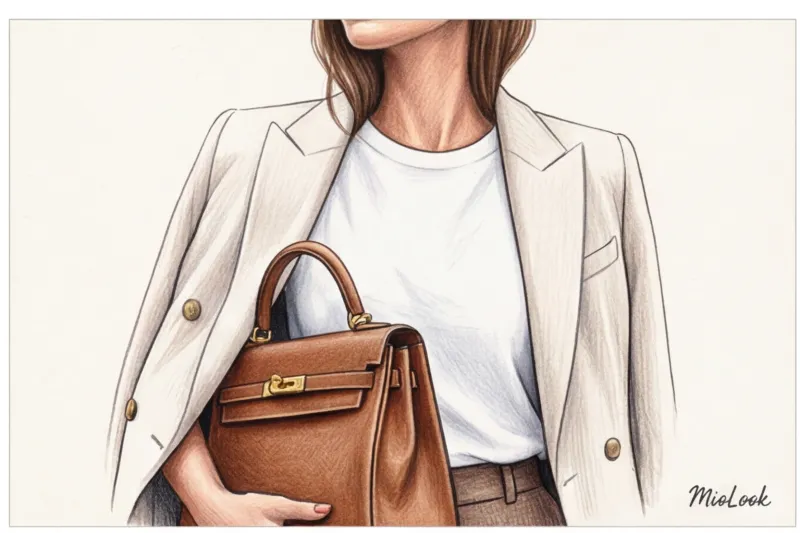
Accessories speak for you before you utter a word. A rigid, impeccably formed satchel (like the iconic Hermès Kelly silhouette) conveys distance, composure, and firm control. A soft suede hobo bag conveys relaxed confidence, a flexible approach, and a quiet luxury aesthetic. Choose details that support the story you want to tell today in your specific work or social context.
Access to MioLook for €0.99 — one-time payment
A smart AI stylist will select the perfect look and help you intelligently integrate accessories into your everyday wardrobe.
Get access — €0.99 onceTemperature Contrast: Why You Can and Should Mix Gold and Silver
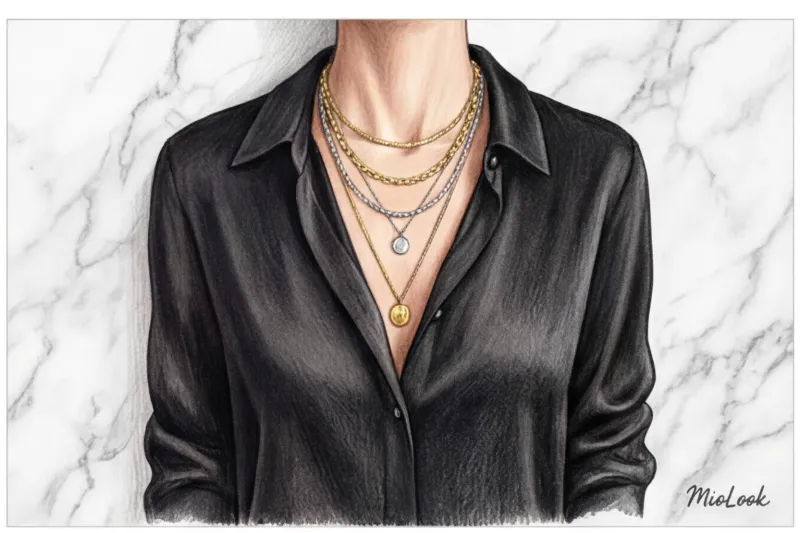
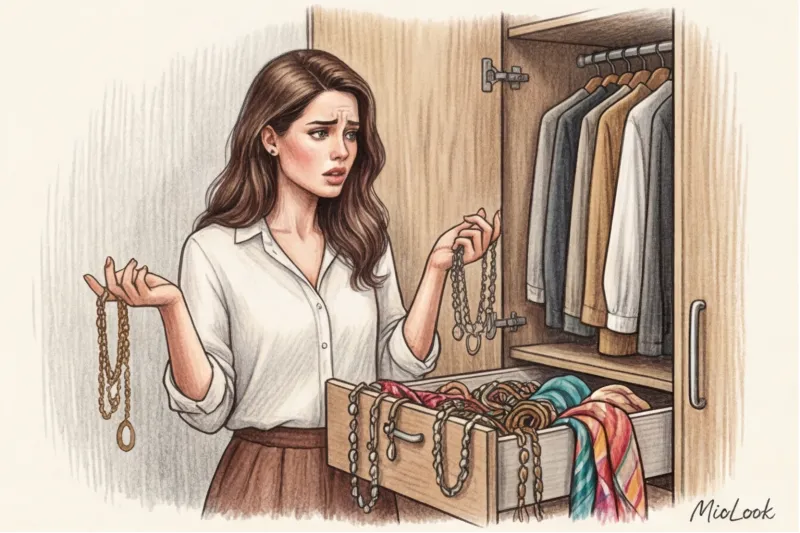
For a long time, an unspoken rule reigned in conservative fashion: either only gold or only silver. Glossy magazines of the 2000s convinced us that mixing metals of different temperatures was absolute bad form. Today, I can confidently say: this myth is hopelessly outdated. Moreover, perfectly matched jewelry (when a ring, earrings, and necklace are all purchased from the same set) now looks flat, deprives your look of individuality, and often adds a few years to your age.
Mixing warm and cold metals, on the other hand, creates a complex, multidimensional, and truly modern look. But it requires masterful execution.
The main secret of the stylists here is bridge technique To aesthetically reconcile disparate gold and silver elements, you need a single connecting link that combines both metals. A perfect example of such a "bridge" is a bicolor watch (for example, the classic Cartier Panthère or Rolex Datejust in steel and yellow gold, which start at €4,000 on the secondary market) or the legendary Cartier Trinity ring, woven from different shades of metal. Once you put on such a bridge piece, it instantly legitimizes any other metallic accents in your outfit.
The second important rule for temperature contrast is single invoice If you're still worried about mixing different metals, make sure their finishes are identical. Matte, slightly rough gold pairs beautifully with similarly matte, blackened silver. However, a mix of textured, aged bronze and mirror-polished chrome almost always looks sloppy and cheap. By choosing a consistent texture (either high gloss or matte), you establish a common thread that allows even metals with radically different temperatures to blend into a harmonious symphony.
A Basic Jewelry and Accessories Wardrobe: What's Really Worth Investing In
The paradox of women's wardrobes is that budgets are often allocated according to the Pareto principle, but in reverse: 80% of funds are spent on occasional clothes, and only 20% on accessories. As an investment wardrobe expert, I insist on the opposite approach. Details have the highest return on investment, are unaffected by weight fluctuations, and define the entire look. Let's examine four fundamental categories where compromising on quality is unacceptable.
Bags: The Architecture of Form and Hidden Status Markers
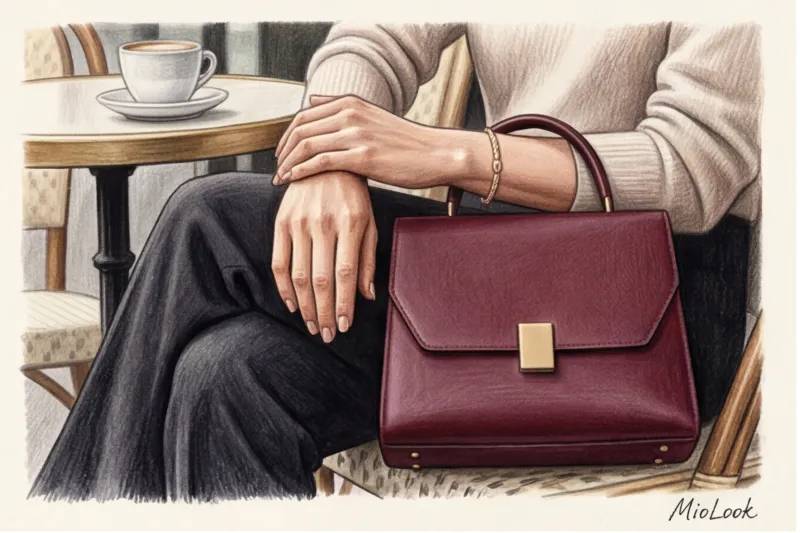
Soft hobo bags and shapeless tote bags can be incredibly cozy, but when it comes to a high-status wardrobe staple, a rigid, structured shape wins. A bag with a clear geometric shape always looks more expensive because it maintains the "architecture" of the outfit, even when simply placed on a cafe table.
When assessing a bag's investment potential, I always look at the seams and hardware. Take the Hermès aesthetic: they have two iconic assembly methods— Retourne (when the bag is sewn inside out and turned inside out, resulting in a softer bag) and Sellier (outer seam with a tightly sealed edge). It is the technique seller makes the product visually strict, expensive and resistant to deformation over time.
The second most important indicator is the quality of the hardware. Cheap silumin with a bright yellow "samovar" coating will give away a budget item. Look for solid brass or palladium-plated steel. A high-quality lock should close with a dull, heavy click, not a clanking sound.
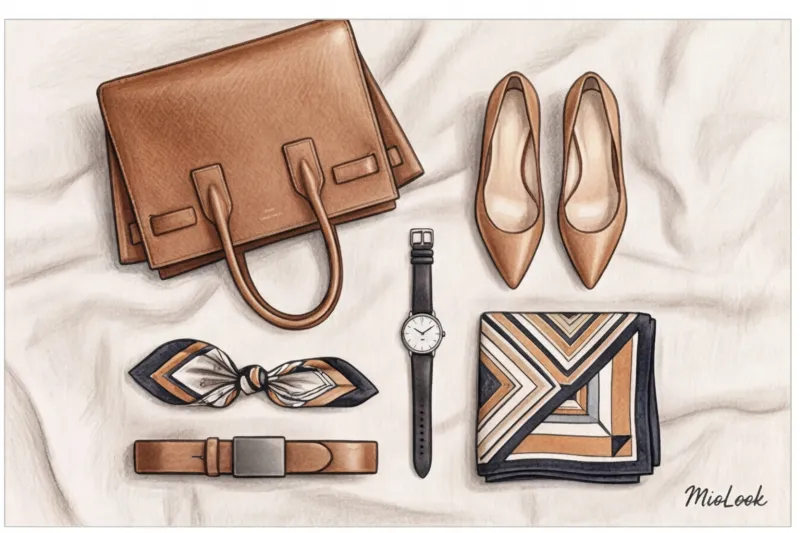
Shoes as the foundation of a look: geometry and last
The secret of premium footwear lies not only in the grain leather but also in what's hidden from view. The Italian last is renowned for perfectly distributing weight across the foot, supporting the arch. You can wear these heels for 10 hours without losing your ease of gait.
Beyond comfort, shoes are the geometry of your style. The shape of your toe directly influences how others perceive your mood:
- Sharp Cape: Visually elongates the silhouette, adding dynamism and a touch of aggression. Ideal for power dressing and business negotiations.
- Almond-shaped cape: A timeless, safe classic. It softens the look, making it more feminine and elegant.
- Square Cape: An architectural, avant-garde accent. A great way to show your keen eye for modern proportions.
Belts: Why Logomania Has Given Way to "Quiet Luxury"
The era of giant buckles with recognizable letters is a thing of the past. Enormous logos on the waist cut into the silhouette and cheapen the look. Today, the Old Money aesthetic ("quiet luxury") reigns supreme.
A perfect investment is a belt made of thick, smooth leather, exactly 3 cm wide (this width fits perfectly through the belt loops of classic trousers and jeans) with a simple matte buckle. A basic belt without flashy identifying marks, priced between €150 and €300, will last for decades and easily complement both a formal suit and a relaxed look with a cardigan.
Silk scarves (square): historical heritage squared
A classic silk square (usually 90x90 cm) is more than just a piece of fabric. It's an element with a deep historical heritage. The true sign of a luxury scarf is a hand-rolled design ( roulotté main ), when the edges of the silk are folded to the front side and sewn by hand with microscopic stitches.
This accessory is incredibly versatile. How you choose to accessorize with a bob depends on the context: you can tie it around your neck for a touch of French chic, wrap it around the handles of a hard bag (protecting your hands from sweat and adding a pop of color), or even thread it through the belt loops of light-colored summer trousers in place of a leather belt.
To properly build your accessory base and avoid buying too much, I recommend taking stock of your current accessories. Load up your bags, shoes, and belts MioLook The app's visualization will immediately show you whether you have a bias toward shapeless items or a lack of structure that needs to be addressed with smart investment.
The Art of Contrast: How to Avoid a Boring "Set"
Have you ever noticed how perfectly coordinated pieces can sometimes paradoxically cheapen an outfit? The desire to look neat and polished is the main enemy of modern, truly luxurious style.
In the past, purchasing a jewelry set—the so-called "parnura"—was considered an absolute status symbol. Today, a complete set (earrings, necklace, and ring from a single set) mercilessly ages and dulls one's appearance. It looks as if you bought a ready-made, "boxed" solution because you were afraid to express your personal taste. Modern luxury demands an intelligent approach. We blend eras and styles: we take vintage stud earrings, add a modern, intricate chain, and finish the set with a statement cocktail ring. This creates a unique story, not a faceless jewelry store window.
The same goes for the age-old rule "bag and shoes must match." Forget it. A perfect match of shoe and bag color is now seen as over-effort. There's a wonderful term in style. sprezzatura — the art of effortless, studied nonchalance that distinguishes true French and Italian chic. When your €1,500 bag perfectly matches your leather pumps, it feels like you've been standing in front of the mirror for too long. This pretentiousness instantly kills natural elegance.
So how do you create stylish color combinations? The answer lies in color theory. Use the principle of the color wheel. Analogous harmony allows you to elegantly combine adjacent shades: for example, an olive clutch looks stunning with emerald or pistachio shoes. For a more dynamic look, turn to complementary harmony—a bold contrast of opposing colors. Deep burgundy shoes make a luxurious pair with a navy or bottle green bag.
To hone your observation skills and juggle such combinations without the risk of making a mistake, I recommend using the "smart wardrobe" feature in MioLook You can digitize your accessories and virtually mix and match pairs right on your phone, saving your favorite combinations.
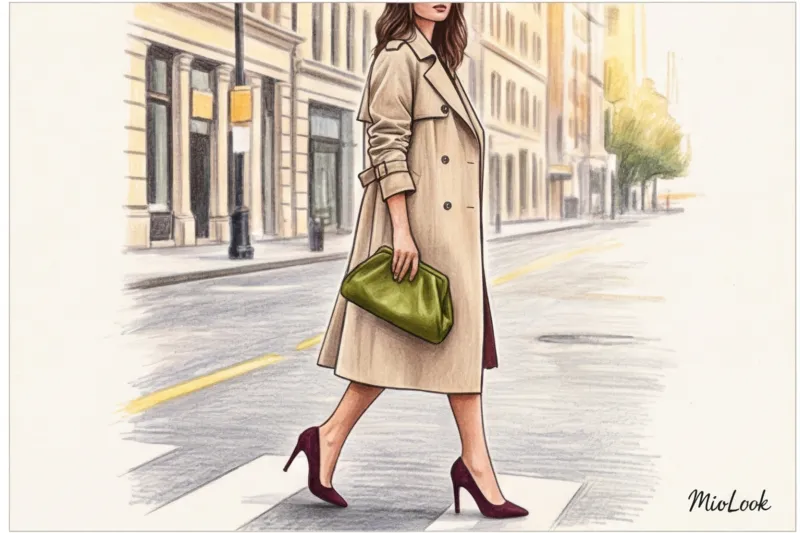
But what if you're a die-hard monochrome fan and bold color blocking isn't your thing? This is where texture plays a key role. The combination of smooth leather, velvety suede, flowing silk, and chunky wool knits is styling at its finest. The secret is that texture physically alters the depth of color.
Black on glossy calfskin will reflect the light and appear sharp. On matte suede, it will absorb the rays and become deep, almost charcoal. And on silk, it will take on a soft graphite shimmer. Combine suede ankle boots with a smooth leather bag and a silk bodice on the handle. A €250 bag made of textured embossed leather paired with suede shoes will always look more classy and sophisticated than a glossy matching set.
Even if all these pieces are kept in a single beige color scheme, it's the difference in texture that will draw the eye across the outfit, adding a multidimensional feel. Eschewing rigid ensembles in favor of complex textured combinations is the step that elevates your wardrobe from "just clothes" to "personal style."
Access to MioLook for €0.99 — one-time payment
Start creating perfect looks with the help of artificial intelligence and assemble your flawless capsule of accessories.
Get access — €0.99 onceAccessories and dress code: from business formal to smart casual
The infamous 44-page corporate rules of the Swiss bank UBS caused quite a stir in the business press in 2010. They regulated literally everything: from the width of a tie knot to an absolute ban on jingling bracelets for female employees. Today, the boundaries of business attire have become noticeably more relaxed, but don't be fooled—appropriateness still reigns supreme. Inappropriately chosen details can instantly ruin even the most carefully crafted and expensive outfit.
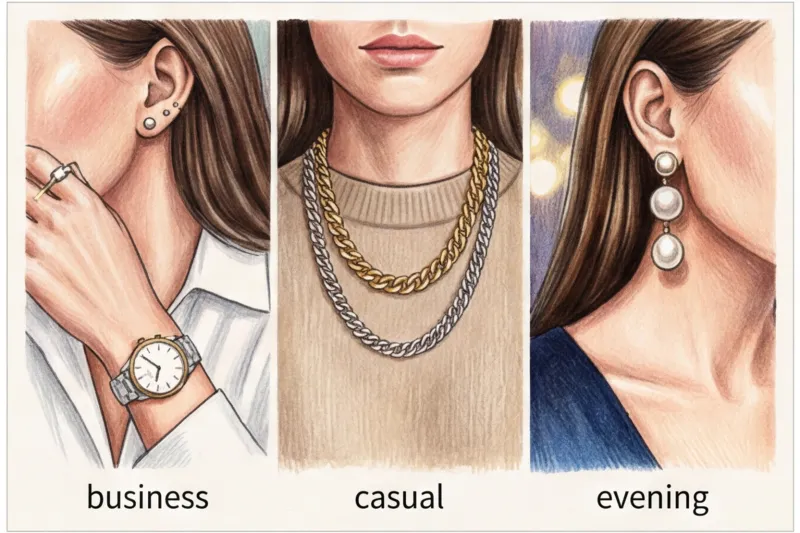
When preparing clients for board meetings or important high-profile negotiations, I always remind them of one unspoken rule: in a business environment, your accessories should be "quiet." This applies not only to the absence of loud logos but also to physical noise.
- Business Formal (strict purism): Any jingling items are strictly prohibited here. Metal bracelets banging on the table while gesturing or signing a contract are irritating and distracting. Choose simple stud earrings (pearls or small diamonds) and a thin chain. Only closed-toe shoes with a stable medium heel (5-7 cm) are allowed—no open toes or heels, even if it's hot outside. Complete the look with a sturdy satchel bag, the geometric shape of which subconsciously conveys composure.
- Clock Rule: British Handbook of Etiquette Debrett's is unequivocal about this: wearing a smartwatch with a classic business suit is unacceptable. Save fitness trackers for the gym. For high-profile meetings, a smartwatch with a leather strap or thin metal bracelet is a must (decent basic models from Swiss brands can be found in the €2,000–€5,000 range).
Smart Casual: Conscious Freedom
This style is my favorite compromise between comfort and elegance. It offers a welcome freedom in texture. Smart Casual allows for sneakers, but with one important caveat: they must be clean, basic sneakers made of smooth leather, without flashy neon accents or running soles.
We boldly trade in the formal briefcase for soft hobo bags—their flexible, flowing shape perfectly complements relaxed knitwear and denim. And in your jewelry wardrobe, you can indulge in light, bohemian layering: for example, wear a set of several thin chains in different weaves over a basic cashmere turtleneck.
Evening Out: The Art of Shine
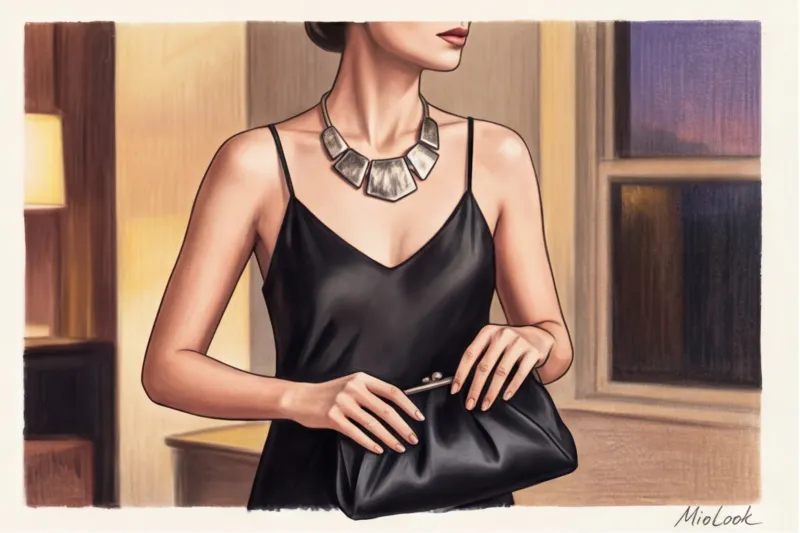
The biggest style mistake I regularly see at social events is a woman in a luxurious silk dress clutching a voluminous daytime tote bag. Remember: after 6:00 PM, large leather goods are out. A sleek clutch or a crisp minaudière is a must.
Evening dress codes (whether cocktail or black tie) require a certain amount of drama. This is the time when the emphasis is on sparkle—the clarity of diamonds or the refraction of light in high-quality crystals come into play. Statement jewelry is especially appropriate here: statement chandelier earrings or a large cocktail ring will take center stage in the look.
Practical advice: To avoid chaos when getting ready for an event after work, plan transformable outfits in advance. I highly recommend digitizing your items. MioLook smart wardrobe features The app will help you visualize how simply swapping loafers for stilettos and a tote bag for a minaudière instantly elevates your business attire to evening chic.
Typical mistakes when styling details
Nothing betrays compromises in creating an image more mercilessly than the telltale shine of low-quality metal. Working in the premium segment, I've developed a professional distortion: my gaze automatically scans not brand logos, but the quality of the hardware and edge finish. Excessively yellow, so-called "samovar" gold on bag clasps or rapidly peeling chrome on belt buckles can irrevocably ruin the impression of even a perfectly tailored cashmere coat.
This is a perfectionist's perspective—when evaluating a piece, I always pay close attention to the cut of a leather belt. A quality belt should be meticulously sealed with a special polymer or carefully stitched, without the slightest trace of protruding lint. The buckle's finish should also be uniform, weighty, and cool to the touch. Cheap, flimsy hardware is the main enemy of a high-status silhouette. If your budget is limited, it's always better to choose a simple, thick leather belt for €40–€60 with matte, slightly aged brass than a glossy, jingling counterfeit that mimics a heavy luxury item.
The second critical mistake women make day after day is ignoring natural proportions and mismatching scales. Any accessory operates by optical illusion, creating a visual contrast with your figure. If a petite woman 155 cm tall picks up a huge, shapeless shopping bag, she visually appears even smaller and shorter, like a child with her mother's purse. The exact opposite effect occurs when a curvy plus-size woman accessorizes with a tiny clutch. Such a disproportionate detail will only emphasize your size through a sharp dissonance. Understanding how to properly select accessories for clothing always begins with an objective assessment of your frame: your details should harmoniously complement your body structure, not clash with it.
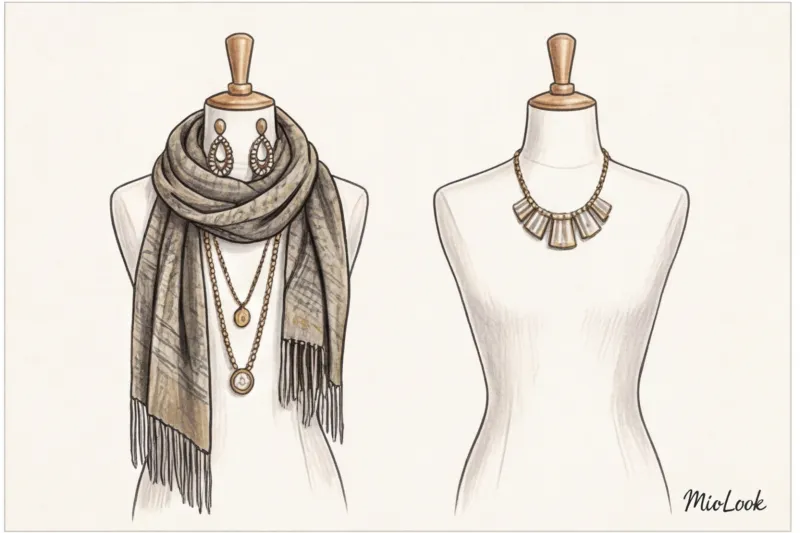
Finally, the most annoying oversight is a complete lack of care for shoes and leather goods. You can invest in magnificent Italian loafers made of premium calfskin, but scuffed toes and worn heels instantly ruin even the most expensive outfit. Frayed straps, dry, cracked leather on bags, and scratched hardware are telltale signs of neglect. True elegance requires rigorous care.
To ensure you're getting your items restored in a timely manner and keeping track of your investment inventory, it's very convenient to use digital wardrobe cataloging. For example, by uploading your favorite accessories to MioLook , you'll always know exactly which pair of shoes require a visit to the shoemaker before the new season begins, and which bag is time for a leather spa treatment.
Your ideal image
it begins Here
Join thousands of users who look flawless every day with MioLook.
Get access — €0.99 onceChecklist: Auditing Your Accessories Collection
According to a 2023 Bain & Company research report, women regularly use only about 20% of the contents of their closets. The rest is just visual clutter, which only complicates their morning routine. Before learning how to properly accessorize, a ruthless inventory is essential. As a stylist, I always begin my work with clients not with a shopping spree, but with an audit following a strict algorithm.
Step 1: Get rid of worn-out items that cannot be restored. Put away anything that has lost its original shine. Frayed hardware, cracked edges on belts, worn-out shoe toes, or irreversibly oxidized metal on jewelry instantly devalue your look. If professional restoration at a good skin spa costs more than €50–€100 or is technically impossible, say goodbye to the item without regret.
Step 2: Analyze the trend to base ratio. The ideal ratio for a functional collection is 80/20. Eighty percent should be timeless staples (structured totes, silk bobs, simple watches), and the other 20% should be cutting-edge, statement pieces. If your jewelry box is dominated by neon micro-bags, oversized chandelier earrings, and rhinestone-encrusted belts, you'll always be short of connecting elements for elegant everyday looks.
Step 3: Create a wish list based on empty niches. An audit is guaranteed to reveal exactly what you're missing. The main rule for an investor is to avoid abstractions. Formulate your request like a professional buyer: for example, "I need a basic 3-cm-wide belt in a deep chocolate brown with a matte silver buckle." This level of detail is the best way to prevent impulsive spending. To make the process visual, I recommend digitizing your items in an app. MioLook It's convenient to keep a virtual wishlist and immediately evaluate how a potential purchase will fit into your current look.
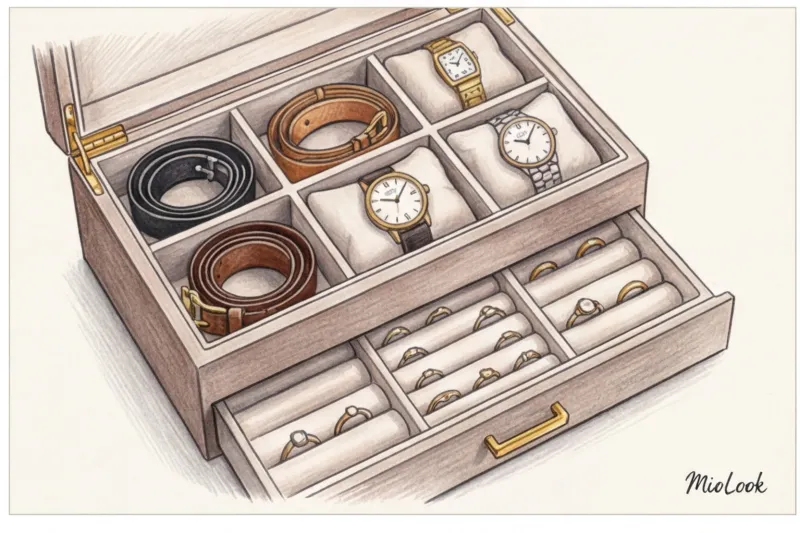
Step 4: Organize storage. Buying a premium item is only half the battle; the other half is proper care. Bags should be stored in breathable dust bags (never plastic bags!) with special shoe trees inside to prevent the leather from creasing. For shoes, unvarnished cedar shoe trees are critical—they gently draw out excess moisture and maintain the shape of the Italian shoe last. Jewelry and metal fittings should be placed in special boxes lined with soft microfiber or Alcantara to prevent micro-scratches and oxidation of the metal from exposure to oxygen.
Summary: Your Personal Handwriting in Detail
The great Diana Vreeland loved to say that without details there is no style. Over the years of working with premium aesthetics, I've come to realize that building your wardrobe is like curating your own art exhibition. You don't just hang random posters on the gallery walls. You carefully select each piece, assessing its provenance, texture, and meaning.
Every morning, when you put on a Swiss watch, tie a vintage bob, or choose a tailored frame, you send a message to the world. If you're wondering how to choose the right accessories for your outfit, start by understanding this simple truth: Accessories are your personal language, a way to express yourself without words. A sleek geometric bag with matte hardware whispers of your poise and business acumen, while an asymmetrical single earring proclaims creative boldness and independence from conventional wisdom. Clothing is often merely a backdrop, a practical necessity, but it's the details that reveal your character, your ambitions, and your taste.
I always encourage my clients to be brutally honest when window shopping. Stop buying disposable items in an attempt to catch microtrends. Start building your base with high-quality, albeit expensive, items—they will pay for themselves many times over. It's better to have one impeccable bag with hand-welded edges and cast brass hardware for €600 than ten mediocre compromises made of thin polyurethane for €60 each. High-quality Italian vegetable-tanned leather develops a noble patina over the years, telling the story of its owner, while a cheap substitute simply cracks and ends up in the trash. This is the pure mathematics of elegance: by investing in exceptional quality, you instantly elevate your visual status.
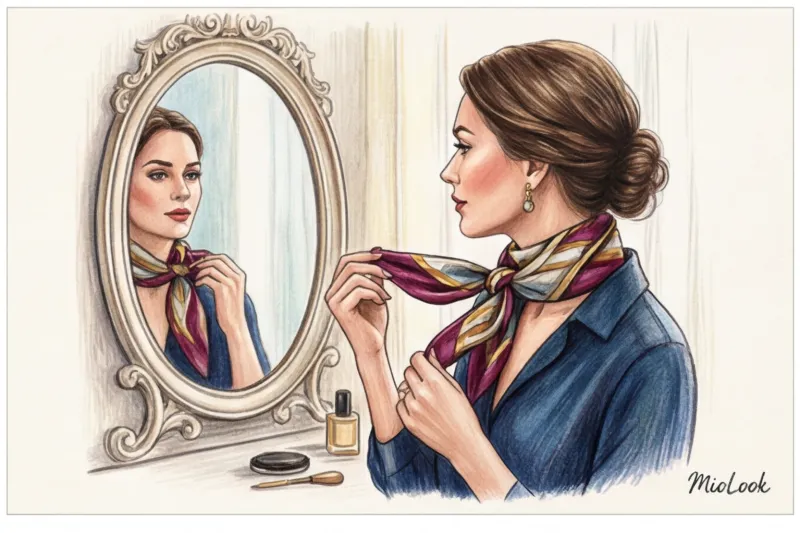
Once the fundamental base is in place, the fun part begins – the art of styling. Don't be afraid to experiment with textures and metals, relying on the rules of proportionality and harmony. Forget the outdated "bag with shoes" rule or the fear of mixing warm and cool colors. Mix smooth rhodium with textured, wrinkled yellow gold. Pair the rugged suede of a wide belt with the weightless, flowing silk of a blouse. It is at the intersection of these deliberate contradictions that that infamous "personal style" is born, one that cannot simply be copied from a mannequin.
Right now, before you leave the house, try a one-minute experiment. Go to the mirror in your usual, "safe" outfit and swap out just one detail for a contrasting one. If you're wearing a tailored wool jacket, remove the simple stud earrings and add accent vintage clip-on earrings or a large brooch to your lapel. If you're wearing a relaxed cashmere sweater, add a crisp leather belt over the top to add structure. See how one small change dramatically transforms the silhouette.
To avoid having to think about all these nuances and buying duplicate items, start approaching your collection systematically. I strongly recommend digitizing your jewelry, bags, and belts. MioLook Seeing all your stylistic options on a single smartphone screen will allow you to create new, innovative combinations in just a few clicks. Getting ready in the morning will transform from a chore into an exciting creative process.
Fashion is fleeting. Trends change every six months, making store windows sparkle with new colors. But your eye for detail, your keen eye, and your taste will remain with you forever. Be discerning about what touches your skin and completes your look. Choose what makes your heart beat faster, and wear it with your head held high.
Guide Chapters
How to choose the right women's belt: tips
A belt isn't just a utilitarian item, it's a powerful styling tool. Let's explore how to choose the perfect accessory to pull your look together.
AI-powered eyewear and accessory selection software
Virtual try-ons aren't just fun, they're a precise stylist's tool. Learn how neural networks help you choose the perfect glasses and save money.
How to match a scarf to your coat: stylist tips
The perfect scarf can transform your coat, while the wrong one can instantly cheapen your look. Learn the key rules for working with texture and color from a professional stylist.
How Much Jewelry Can You Wear at Once: Tips
Forget the outdated "rule of three." Discover how the mathematics of visual weight allows you to stylishly combine any number of your favorite pieces.
How to match accessories to your clothes: tips
Tired of the same old black bags and belts? Let's explore the concept of "color bridging" and learn how to stylishly add bright accents to your wardrobe.
How to match tights to a dress and shoes: a style guide
Black or nude? Learn the key rules for pairing tights with shoes and dresses to ensure your look always looks luxurious and flawless.
How to choose a bag size based on your height: stylist tips
The size of accessories can both visually elongate your silhouette and add extra pounds. Learn the secret to choosing the right bag from a professional stylist.
The Rule of Third Things in Clothing: A Stylists' Secret
Do basics seem boring? Discover a stylist's secret that will transform your everyday looks with just one detail.
Can You Wear Gold and Silver Together? Styling Tips
We're debunking a major fashion myth: mixing different metals isn't a mistake, but a modern styling technique. Learn how to pair hardware correctly.
How to choose glasses for a woman's face shape: stylist tips
Why are classic frame-choosing tips no longer effective? Learn how facial features, brow line, and eye position influence choosing the perfect glasses.
Should you match your bag to your shoes? Combination rules
Is matching your bag and shoes an outdated rule or a timeless classic? Learn how to pair accessories correctly for a modern look.
How to Match Jewelry to Your Dress Neckline: A Style Guide
The price of jewelry doesn't matter if it's chosen incorrectly. Learn the secrets of geometry and learn how to perfectly pair necklaces with necklines.