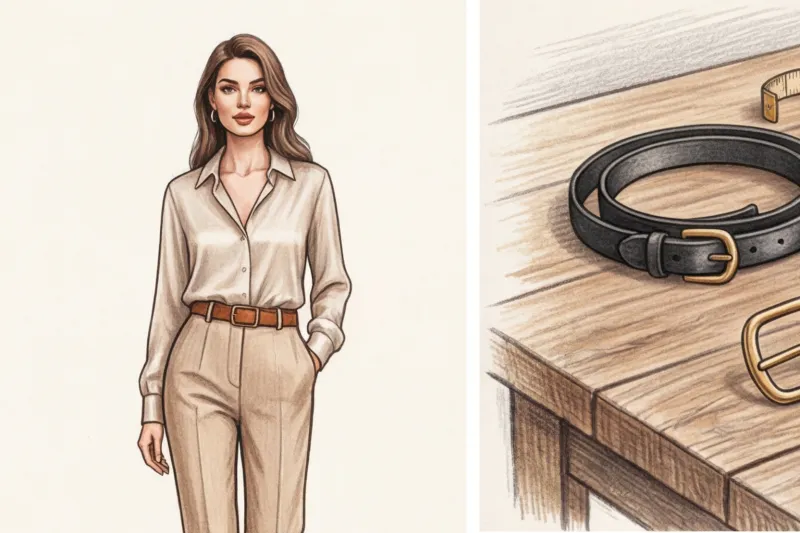
I recently did a wardrobe review with a new client. She put on a gorgeous pair of fine wool trousers bought for €250, a cashmere sweater, and... ruined all this heavy luxury with a shiny, mass-market belt with a flimsy buckle. The look instantly fell apart. A belt isn't just a utilitarian item to keep jeans from slipping down. In the hands of a skilled stylist, it's an engineering tool capable of manipulating visual weight, adjusting proportions, and integrating disparate pieces into a cohesive silhouette.
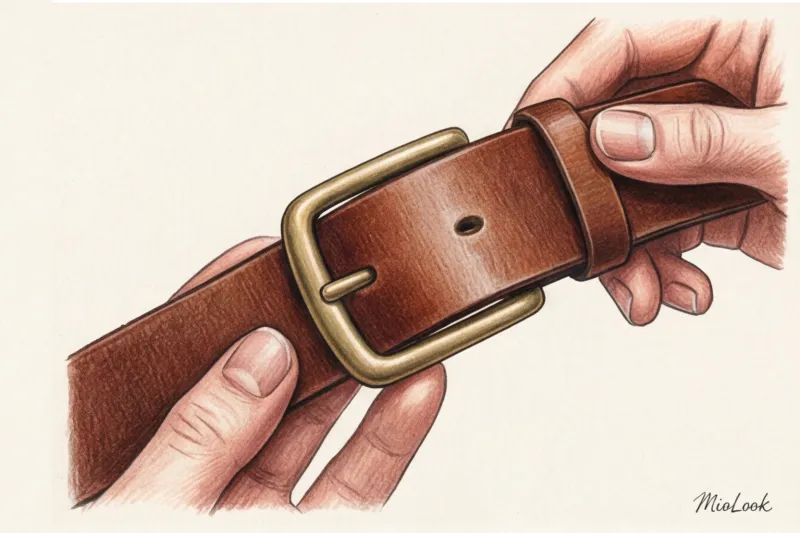
We talked in more detail about how details control the overall impression in our a complete guide to choosing the right accessories for your clothes.
Today, we'll move away from clichéd lists of microtrends that will be outdated within a season. Instead, I suggest looking at accessories through the lens of quality, sustainable fashion, and the mathematics of proportion. If you want to know how to choose the right women's belt so it lasts for decades and complements your figure, rather than undermines it, let's explore the anatomy of this accessory.
The Anatomy of Quality: How to Choose the Right Women's Belt and Avoid Overpaying
A belt works by creating a "halo effect." Because it's positioned at the geometric center of your figure (your waist or hips), your conversation partner's gaze inevitably lingers there. High-quality leather and fine hardware can visually elevate the value of even inexpensive basic jeans. Conversely, a poor-quality belt will cheapen a premium suit.
Brands often manipulate terminology. Just because a label says "100% leather" doesn't mean anything. According to the standards of the international organization Leatherworking Guild , raw materials are divided into strict categories:
- Full-grain leather: The top, most durable layer of hide is unsanded. Its natural pores are visible. This belt costs between €80 and €200 and is a respectable 3–4 mm thick. It lasts 10 years or more. Over time, it develops a beautiful patina.
- Top-grain: The top layer is lightly sanded to remove imperfections. It's softer and looks perfectly smooth, but wears faster.
- Genuine leather: This is a marketing ploy. In fact, these are the loose lower layers of the hide, generously coated with polyurethane and paint to imitate the texture. The lifespan of such a product is 1–2 years, after which the coating inevitably cracks at the folds.
If you're committed to ethical fashion, the industry is finally offering worthy alternatives. I've personally tested belts made from apple leather (AppleSkin) and cactus leather (Desserto). Unlike cheap PVC faux leather, these materials are breathable and hold their shape well, although they're still not as durable as high-quality full-grain.
Your perfect look starts here
Join thousands of users who look flawless every day with a smart assistant.
Get access — €0.99 onceHardware and edge finishing: Heavy luxury markers
In my master classes, I often conduct a blind test: I ask clients to close their eyes and identify an expensive belt by touch. The secret lies in the finishing of the edge.
In the budget segment (under €40), the edge is usually finished with a rubber filler. It looks neat on display, but after a couple of months of heavy use, it starts to peel off in chunks. A premium marker— burnished edges (polished edge). The leather is repeatedly sanded and waxed until the edge becomes smooth and glossy on its own, without a drop of paint.
Another enemy of durability is glue. If you look at a belt's cross-section and see a "sandwich" of several layers with a cardboard layer inside, you can safely return it to the shelf. A high-quality everyday belt is always cut from a single, thick piece of leather.
"Cheap, shiny hardware can ruin any outfit. Avoid buckles coated in a thin, shiny galvanic layer, which will peel off to the copper core. Look for solid, matte brass or steel—they're heavy, cold, and will only tarnish elegantly over time."
Silhouette Mathematics: Belt Width and Body Proportions
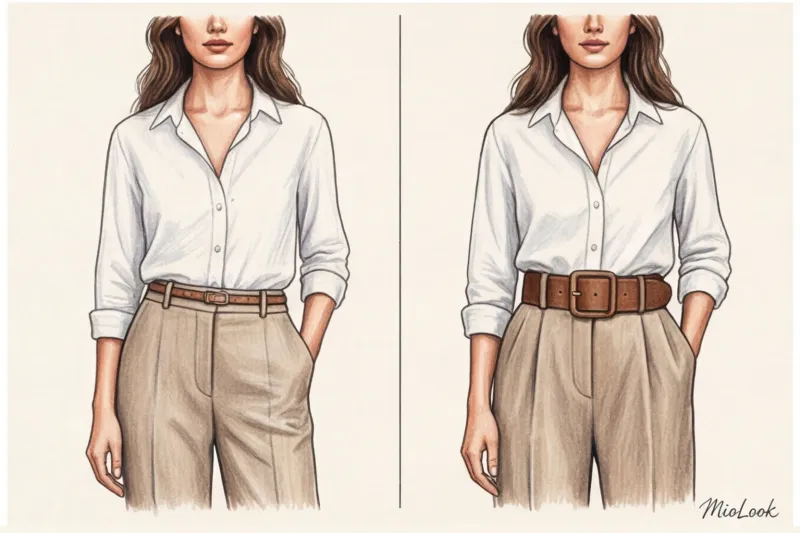
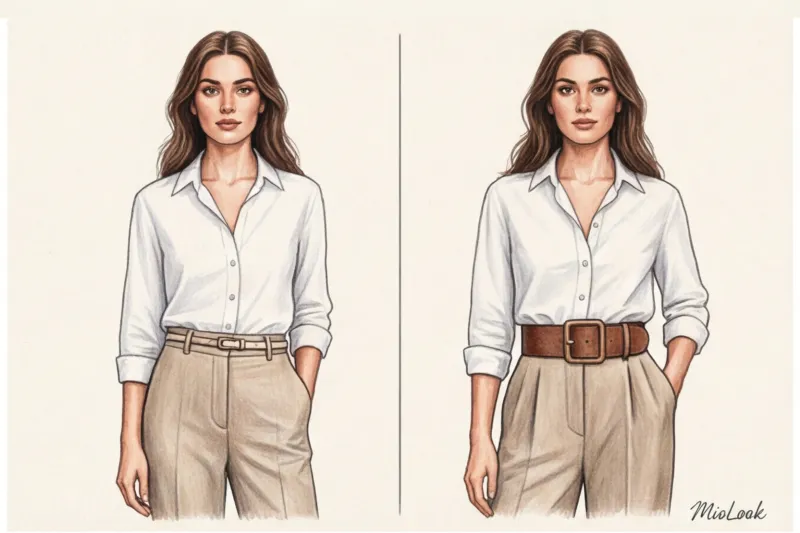
Belt width isn't a matter of fashion, but of your body shape. The rule of proportionality dictates that the larger your facial features, height, and build, the larger your accessories should be.
- Thin belts (1–2 cm): Ideal for petite girls (up to 160 cm tall) and for delicately accentuating flowing dresses.
- Classic (3–4 cm): Universal soldier. This is the standard belt loop width for most jeans and trousers. It suits almost everyone.
- Wide (from 5 cm) and corset: A powerful architectural tool. They physically shift the focus of attention.
A case from my practice: I had a client with an apple-shaped figure (a full waist and slender legs). For years, she'd been trying to emphasize her waist with thin, contrasting belts, which only made things worse—the thin line was digging into her stomach, accentuating her fullness. We replaced the belt with a thick, wide belt (6 cm) that matched the dress. The wide band of leather acted like a corset, visually cinching her silhouette and creating the illusion of a waist where none physically existed.
But there is an important limitation here: Wide belts are absolutely unsuitable for women with a short torso (when the distance from the lowest rib to the pelvic bone is minimal). In this case, a wide belt will simply "eat up" the space between the bust and hips, making the figure appear boxy.
Access to MioLook for €0.99 — one-time payment
A smart AI stylist will select the perfect look based on your individual proportions and body type.
Get access — €0.99 onceDebunking myths: should you match your belt to your shoes or bag?
If you still firmly believe in the rule "black shoes require a black belt and a black bag," forget it. This style rule is fifteen years out of date. Today, the perfect match of color and texture (for example, everything in smooth red leather) makes a look flat, artificial, and too "effortless." In modern fashion, effortless chic - casual chic.
Instead of color matching, today we are looking for a match visual weight What does this mean? Research by the Pantone Color Institute confirms that our eyes react not only to hue but also to color density and texture.
Imagine wearing heavy, chunky black leather Chelsea boots with a tractor sole. Adding a thin black strap with rhinestones will ruin the look—the bottom is too heavy and the waist is too light. But if you add a thick, deliberately chunky 4cm-wide belt made of brown suede or dark green leather, the balance will be perfect. Heavy shoes require a visually heavy belt, even if they're from different color palettes.
The same goes for mixing metals. Pairing a gold belt buckle with silver bag hardware or jewelry is no longer a crime, but a sign of sophisticated styling. The key is to match the metals' "temperature" (for example, muted aged gold and matte silver work well together).
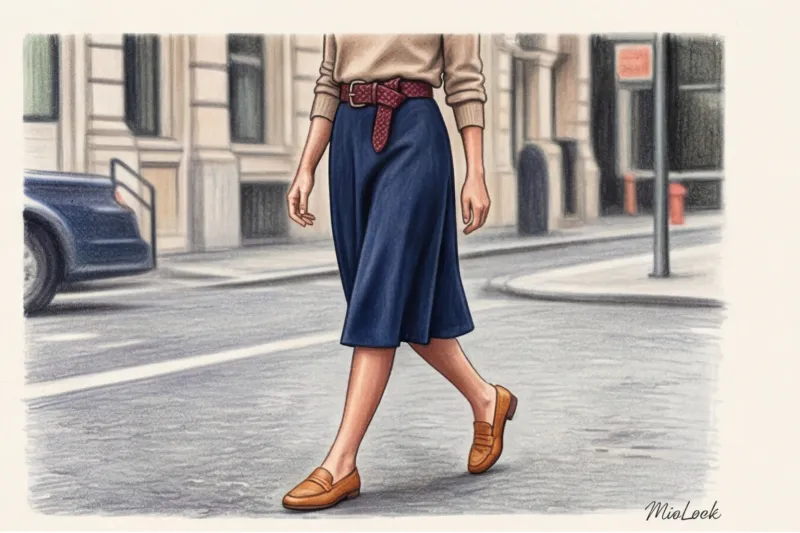
Investment minimum: 3 belts for a flawless capsule wardrobe
The philosophy of conscious consumption (slow fashion) teaches us: it's better to buy three perfect pieces for the next 10 years than to buy one cheap belt for each season. If you're just building your wardrobe, here's a minimum investment that will cover 90% of your wardrobe needs.
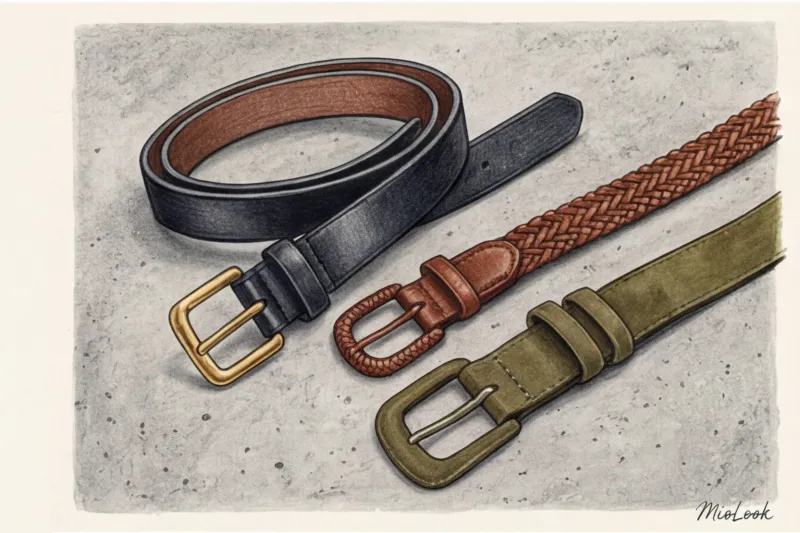
- Basic trouser belt. Smooth matte leather, 3-3.5 cm wide, geometric solid buckle (rectangle or semicircle). Colors: dark chocolate, caramel, or deep black. Wear with jeans, tailored trousers, and Bermuda shorts.
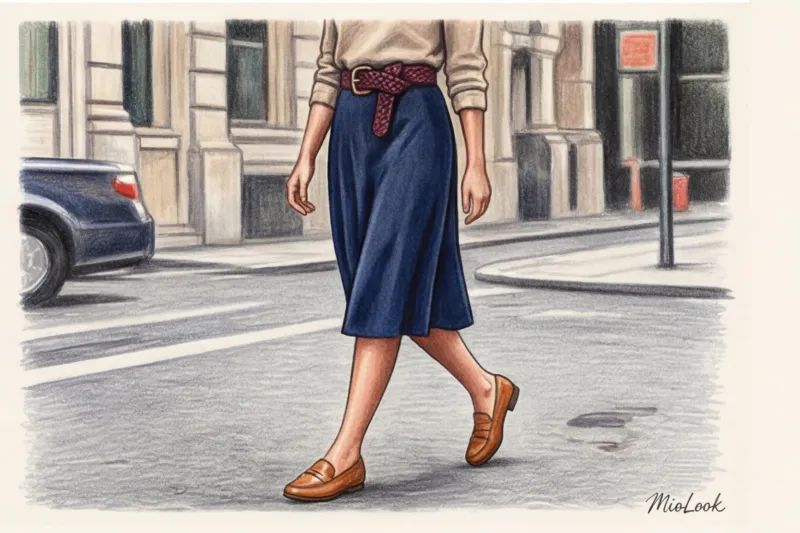
- Accent belt for dresses. It's not the color that matters here, but the texture. Crocodile- or snakeskin-embossed leather, or fine suede. The colors can be sophisticated: burgundy, emerald, deep blue. It adds just the right amount of contrast to monochrome looks.
- A soft belt without a buckle (a cord belt or obi). A long strip of the softest leather that ties into a knot. Indispensable for complex layered looks, shirt dresses, and knitwear.
If you're having trouble imagining how these accessories will fit into your current wardrobe, try visualization function in the MioLook app An AI assistant will help you create a capsule wardrobe and show you which accessories will tie your items together.
Ready to get started?
Try the MioLook plan for free—no commitments required. Organize your smart wardrobe in just a few clicks.
Get access — €0.99 onceHidden Styling Rules: How to Wear a Belt Over Jackets and Coats
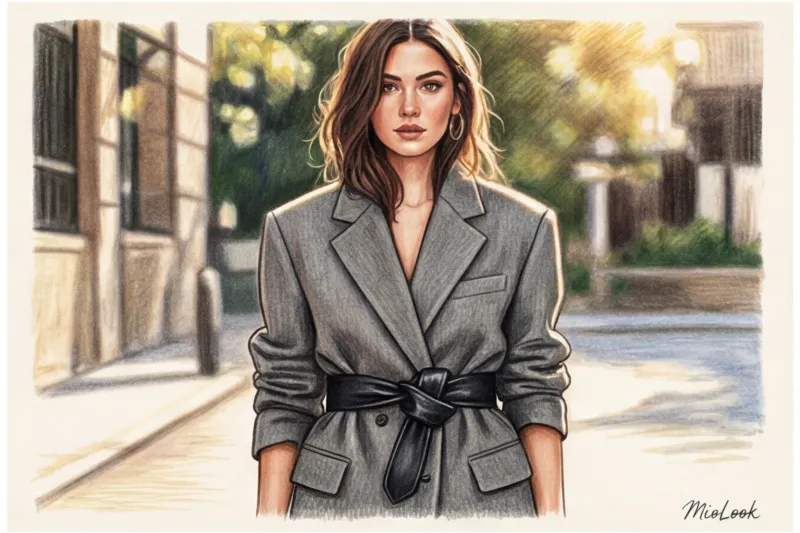
Belts over voluminous jackets and light coats are a favorite trick of street photographers. But when women try to replicate this at home, the result often ends up looking like an over-stretched sausage. Why?
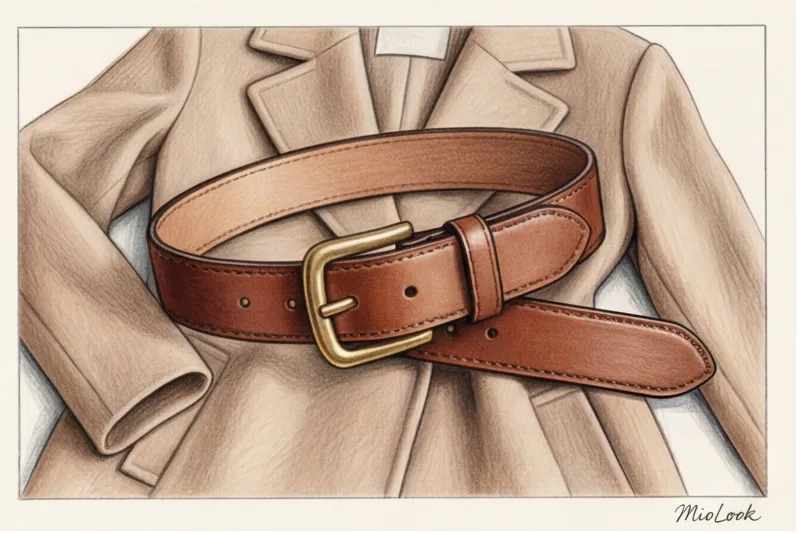
It's all about layering. Not every belt can be worn over a jacket. A stiff, classic belt made of thick, 4mm leather will be too stiff, creating creases in the jacket's fabric. For this style, a belt made of very soft leather (often calfskin or sheepskin) or suede is needed. It should hug the fabric, following the curves of the body.
My favorite styling trick for long belts is Italian knot If the loose end of your belt is too long (or you're wearing it over a jacket without belt loops), don't let it dangle. Fasten the buckle, thread the long tail under the belt from the bottom up, and then through the resulting loop from the top down. The knot will secure the belt and add a casual, bohemian flair to the look.
MioLook Checklist: 5 Steps to Check a Belt Before Buying
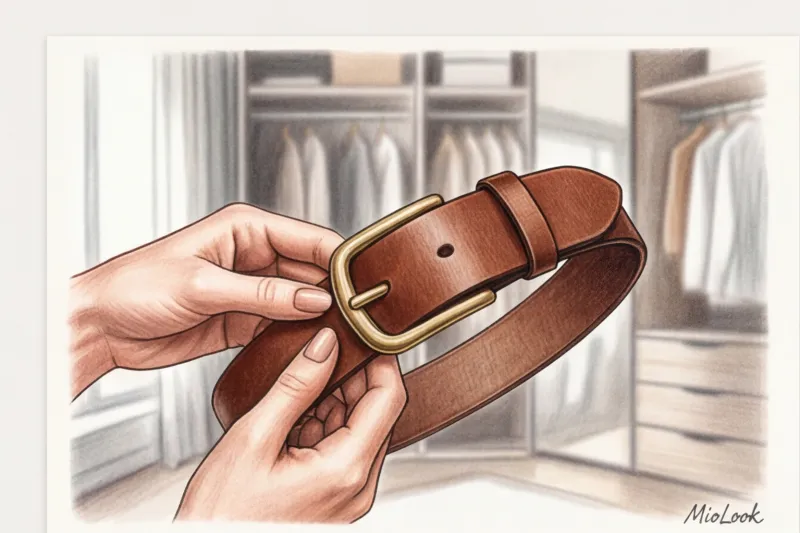
Before you spend your money on an accessory, do a quick check right in the store. I use this checklist myself when shopping for clients.
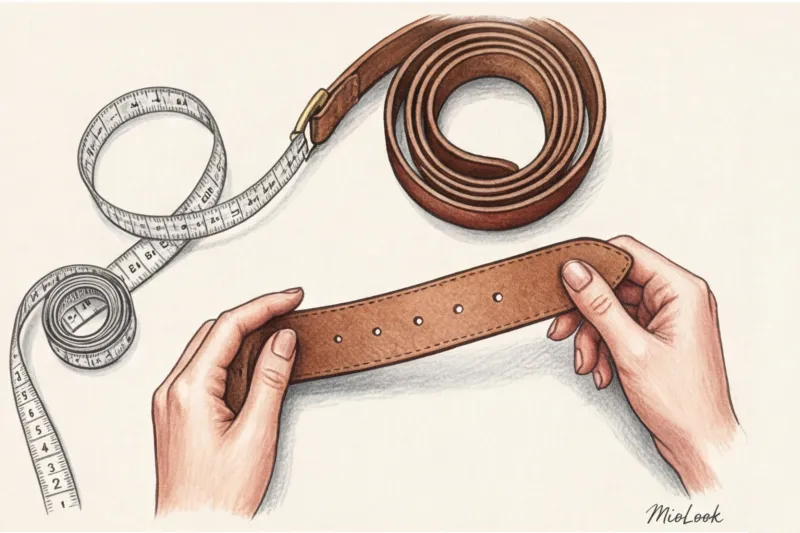
- Flexibility test. Bend the belt in half (without creasing it!). Good leather will resist elastically and immediately return to its shape without wrinkling. Pressed leather will crease or develop small creases in the coating.
- Inspection of the inside. Turn the belt over. A high-quality single-layer leather product will have a flesh side (velvety, fuzzy surface) on the inside. If a smooth synthetic lining is glued to it, the belt will quickly delaminate.
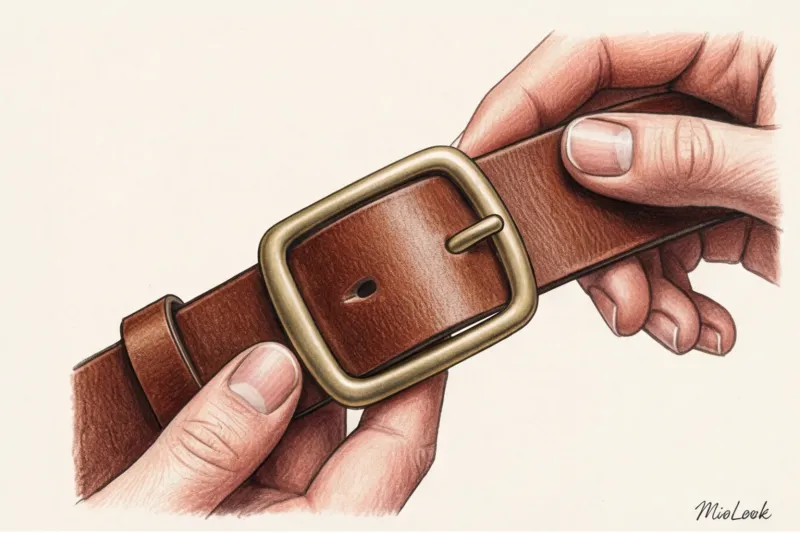
- Checking the holes. Look at the tongue holes. The cuts should be smooth and tight, with no loose fibers or cracks at the edges. This is the most vulnerable part of the product.
- Weight category. According to the report Global Fashion Agenda Regarding the environmental footprint of hardware, cheap alloys (such as silumin) are not only harmful to manufacture but also lightweight. A good brass buckle should feel pleasantly taut in your hand.
- Landing rule. The ideal belt size is one that fastens exactly at the center hole. This leaves you room to adjust for weight changes and ensures the correct amount of free edge (approximately 10–15 cm behind the buckle).
Choosing the right belt requires a little more time and knowledge than a spontaneous purchase at the checkout. But by investing in quality materials and the right width, you're getting more than just a strip of leather. You're acquiring a powerful tool for manipulating proportions, which will add visual value and polish to your everyday looks. Check the hem finish, don't be afraid to mix different textures, and remember: your style is always the result of deliberate detail.