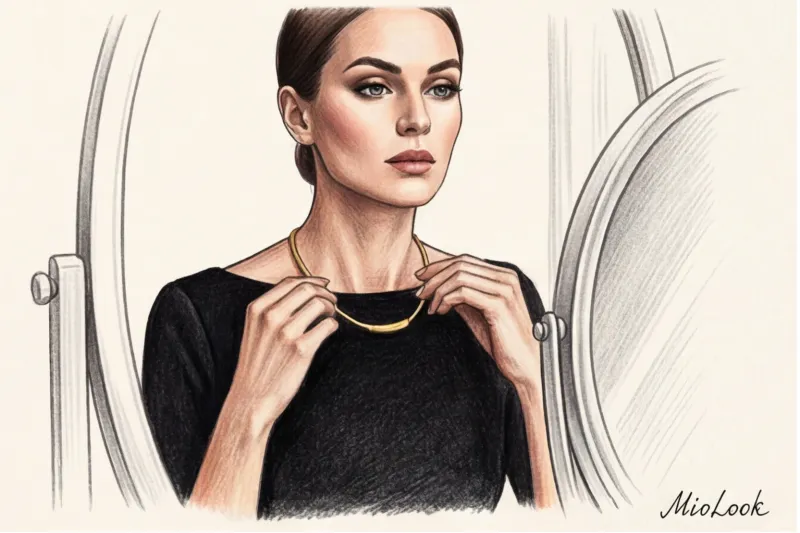
Have you ever noticed how one small detail can ruin even the most carefully crafted outfit? Last Friday, a client approached me about an important dinner. She was wearing a flawless silk slip dress from Loro Piana and… a luxurious diamond pendant. It seemed like it couldn't have been more classy. But the chain was just the right length for the heavy stone to constantly fall to the edge of her neckline, sink under the fabric, and ruin the entire design. All the glamour instantly vanished.
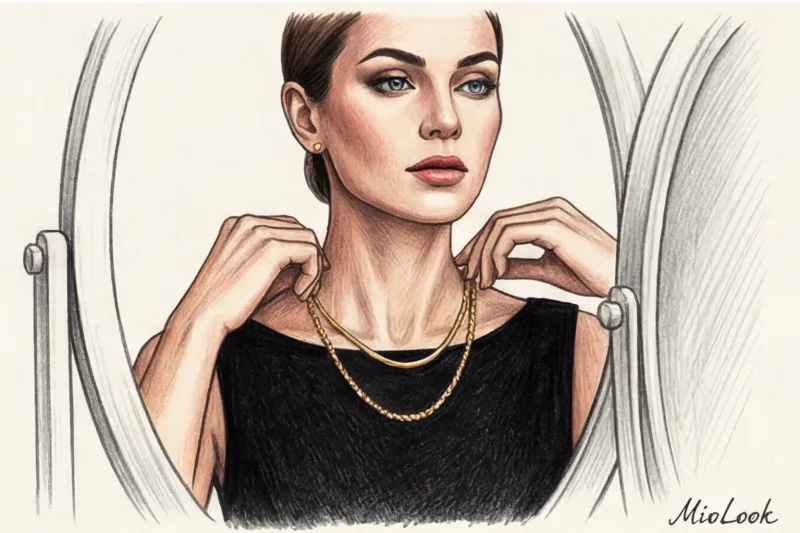
We removed the diamonds and replaced them with a smooth metal snake choker from Zara's basic collection for €15. The look instantly came together and looked like something out of a Vogue cover. That's the key to styling: it's not about the price of your jewelry. It's about understanding how to match the jewelry to the neckline of your dress, based on geometric design.
I always say that accessories aren't just shiny trinkets, but a rigid framework that directs the viewer's gaze. We discussed the concept of creating such lines in more detail in our a complete guide to choosing the right accessories for your clothes Forget the hackneyed internet tricks. Today, we'll explore the optical illusions used by professional personal shoppers.
Geometry of Style: Why It's Important to Know How to Match Jewelry to a Dress's Neckline
At European styling institutes (particularly at Milan's Istituto Marangoni, whose materials I often rely on), the concept of the "halo effect" is drilled into students' heads from their first year. The neck and collarbone area is the portrait zone. What you see here sets the tone for your entire appearance.
The main rule I've learned over years of working with wardrobes is that the shape of the jewelry should either perfectly match the cut or radically contrast with it. It should never "conflict."
"The most serious mistake is the 'borderline'. Your pendant or bottom row of beads should never fall exactly on the border between the fabric and your skin. The jewelry should either lie completely on your body or completely on the fabric of the dress."
If your pendant constantly catches on your collar, you'll spend the entire evening adjusting it, conveying a sense of insecurity and fussiness. No designer bag will save the situation if your portrait area is in disarray.
Basic rules of combination: scale, length and lines
According to the WGSN (2024) analytical report on jewelry trends, approximately 80% of women wear necklaces of the wrong length. The reason is simple: we buy standard factory sizes and try to fit them into any outfit, ignoring our own proportions.
Before we talk about neckline shapes, let's get some scale. In my practice, I use a simple equation: the visual weight of the fabric is equal to the weight of the decoration.
- Light flowing silk, satin, and fine viscose call for delicate, thin chains or weightless pearls.
- Thick tweed, textured wool, and suit crepe (from 200 g/m²) can easily withstand and even require massive links, large plastic, or heavy metal.
- The one-accent-zone rule: if the dress has a complex collar (jabot, active ruffles, large print on the chest), a necklace is not needed at all.
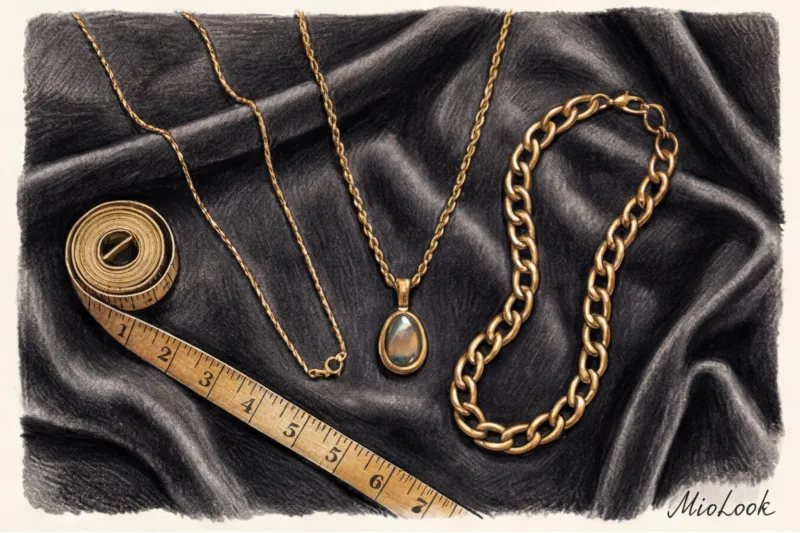
Chain Length Matters: A Cheat Sheet in Centimeters
To control proportions, you need to understand where exactly the shiny line ends on your body:
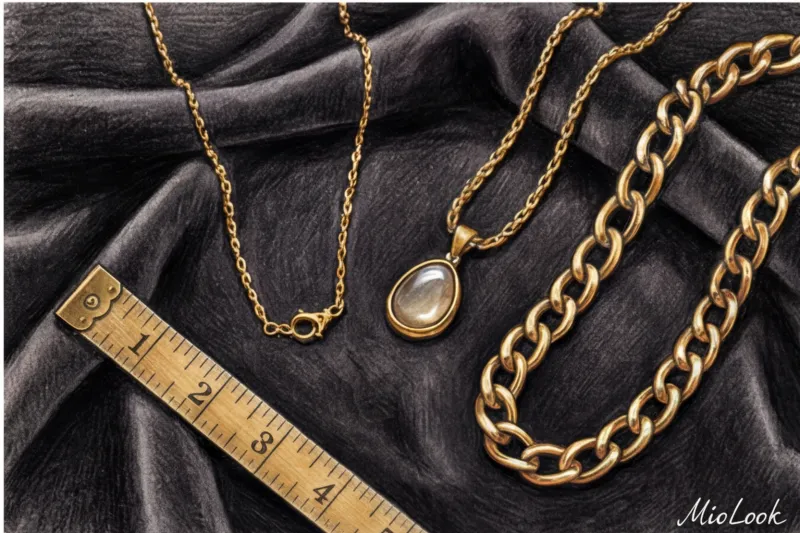
- 40 cm (Choker): Sits at the very base of the neck, just above the collarbones. Ideal for off-the-shoulder looks and deep V-necklines.
- 45 cm (Princess): An absolute classic that sits perfectly on the collarbone. It's the savior of most basic round necklines.
- 50–60 cm (Matinee): Lies on the chest or slightly lower. A lifesaver for tight, closed dresses and thick turtlenecks.
Life hack from a stylist: Don't rush to buy dozens of new pendants. Order a set of metal extenders (chain extenders) from a marketplace for €5–7. This tiny detail will solve 90% of fit issues, allowing you to adjust the length with millimeter precision.
Your perfect look starts here
Join thousands of users who look flawless every day with MioLook. The smart algorithm will help you evaluate how jewelry will look with a specific dress before you even leave the house.
Get access — €0.99 onceNeckline Breakdown: A Stylist's Complete Guide
We've reached the most important part—creating optical illusions. Remember: the same necklace can dramatically elongate a sheath dress, but hopelessly ruin the proportions of a shirt dress.
V-neck and wrap dress
A V-neckline is a powerful vertical line that slims and elongates the neck. Our goal is to avoid canceling out this effect with horizontal lines.
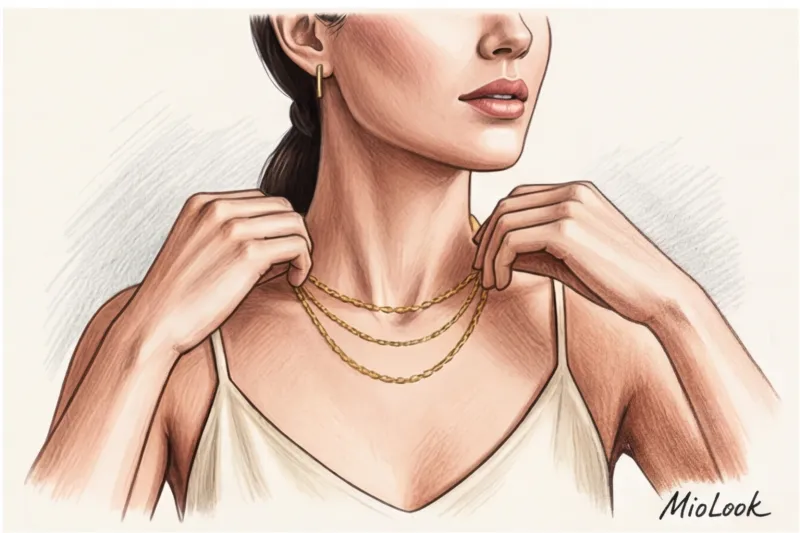
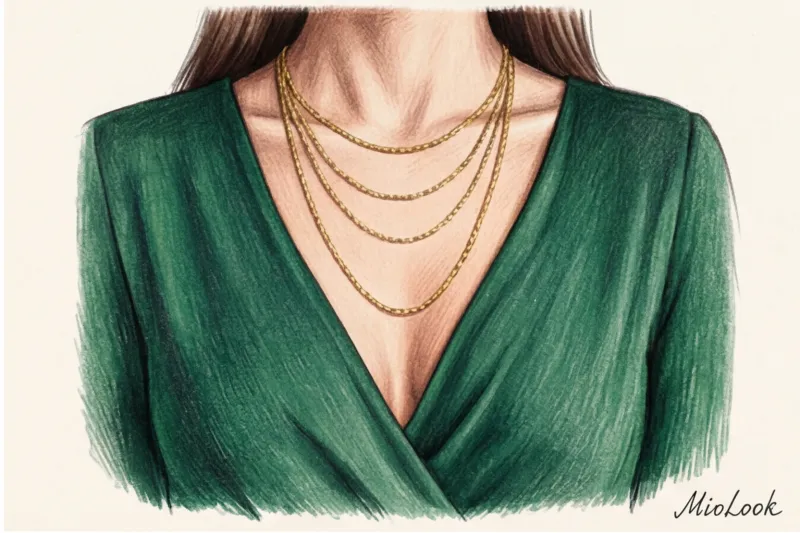
The perfect combination: Pendants of the same V-shape. Thin, multi-layered chains work beautifully (that very Parisian chic style). The main rule of geometry: the longest chain should end at least 2-3 cm above the corner of the neckline, leaving a little space.
What to avoid: Short, large, round necklaces (for example, massive necklaces worn under the throat). They visually "cut" the neck, completely destroying the elegance of the scent.
Round neckline and boat neckline (Bateau)
The classic crew neck is capricious. Collar necklaces or chains that fit perfectly here strictly along the fabric line If a dress feels like a boring, basic canvas, layer a statement chain over it—it'll instantly elevate the look from simple to stylish.
A boat neckline (a wide horizontal line from shoulder to shoulder) often visually widens the upper body. To balance this width, we need a strong vertical line. Long necklaces with a sautoir pendant (60+ cm long) that hang below the bust are ideal.
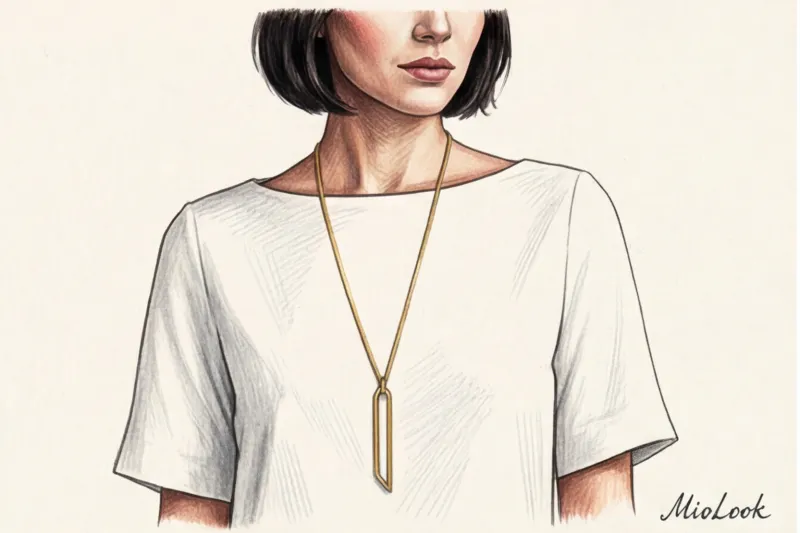
Square Neckline and Corset Dresses
The square demands strict geometry. It's one of the few cuts that tolerates horizontal lines.
Metal chokers or short pendants with a distinct shape (diamond, square) are excellent choices. However, there's an important no-no: the bottom point of your decoration should under no circumstances cross the bottom straight line of the bob Leave some air between the pendant and the dress.
Fair warning: Wide velvet or leather chokers are trendy, but they don't work if you have a naturally short neck. Such a piece will visually "cut off" your head from your torso. If you don't have a swan-like neck, replace the wide band with a nearly invisible jewelry line with a micro pendant.
Turtleneck, stand-up collar and closed neck
Solid, dense fabric from the chin down is the most luxurious blank canvas for bold experiments.
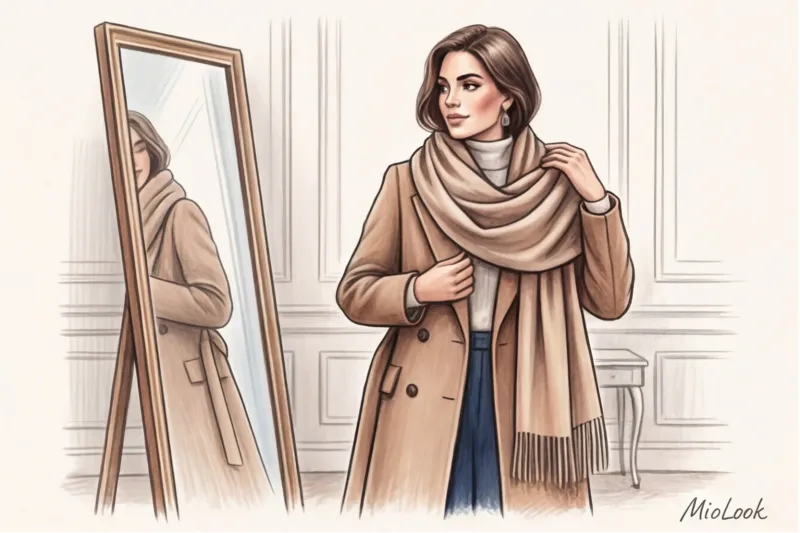
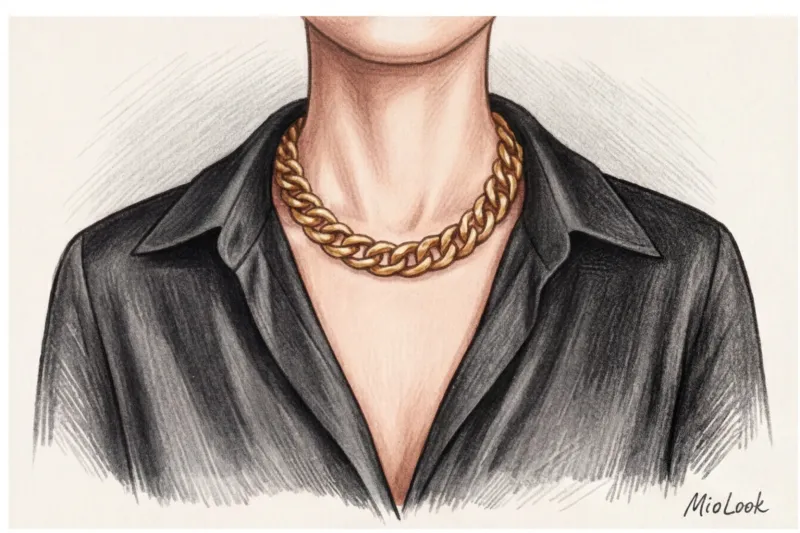
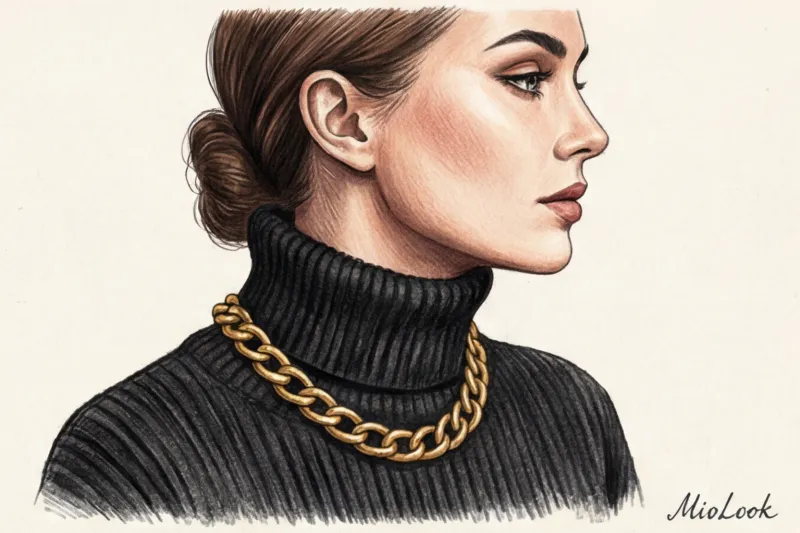
Look at the latest Bottega Veneta or Jil Sander shows: chunky, bold gold chains worn directly over thick knitwear. It looks expensive and very European. Long sautoirs and large pendants on leather cords also work beautifully.
But thin, delicate chains (those 45 cm ones) worn over a sweater are a disaster. They get lost in the texture of the fabric, look lonely, and create a sloppy effect.
The Myth of the Obligatory Necklace: When is it Best to Leave Your Neck Free?
I'm ready to stage a small professional rebellion against the outdated rules of the Soviet dress code that dictate, "If you're wearing an evening dress, you have to wear a necklace." It's a myth that cheapens thousands of looks.
The most prestigious and expensive option for some outfits is a completely bare neck. The aesthetics of European minimalism often embrace the principle of "less is more."
When to remove the necklace:
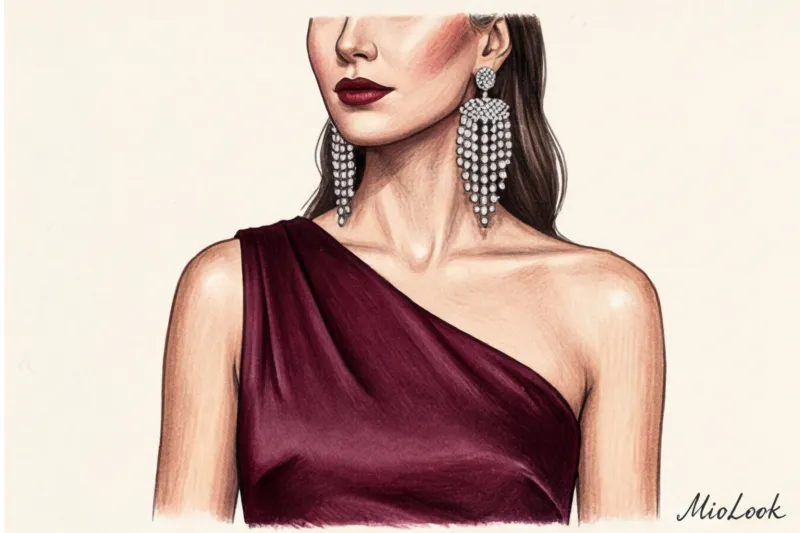
- Asymmetrical dresses (one shoulder): The diagonal cut itself is a complex architectural element. Any chain will ruin this line. Focus on large chandelier earrings or a chunky cuff.
- Dresses with active decoration on the chest: Ruffles, sequins, large embroidery, bows. If the fabric already has texture, metal on the neck will transform you into a Christmas tree.
- Complex halters (loop over the neck): The fabric already fits around your neck, so there's no need to choke it with extra accessories.
Ready to get started?
Having trouble judging your proportions in the mirror? Add photos of your clothes to your smart wardrobe, and the neural network will help you create harmonious looks from what you already own.
Get access — €0.99 onceSmart Shopping: How to Build a Basic Jewelry Wardrobe (Without Breaking the Bank)
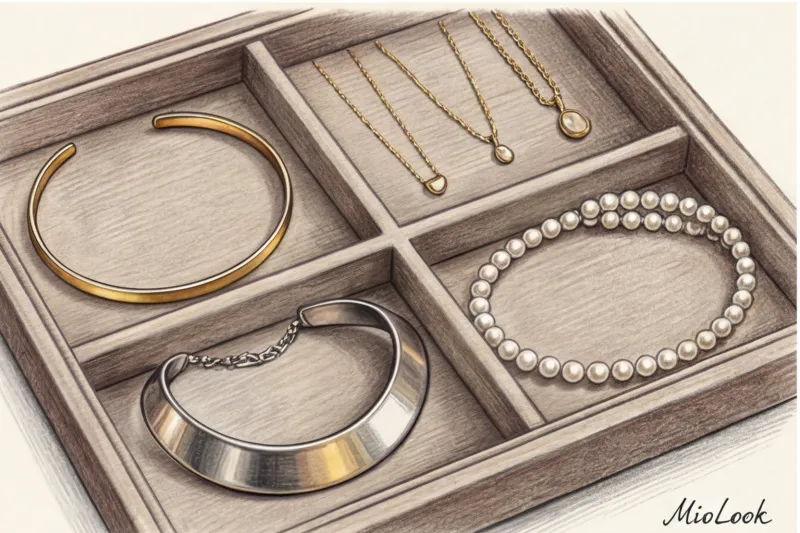
A huge jewelry box filled with random, shiny trinkets won't solve the "nothing to wear" problem. I strongly recommend clients build a jewelry capsule collection. You don't need diamonds to look like a million bucks. The right mass-market jewelry often beats the old-fashioned, heavy gold from neighborhood stores.
Here is a minimal list (must-have) that will cover the needs of 95% of your dresses:
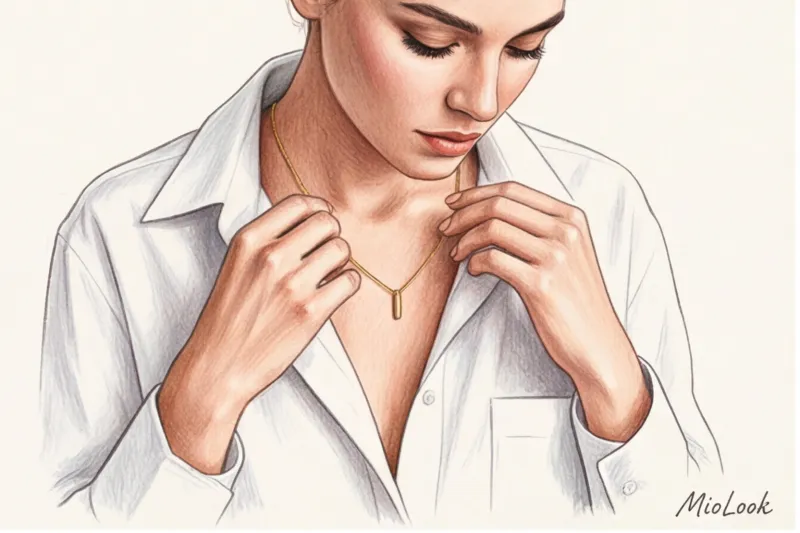
- Thin chain with a minimalist pendant (45 cm) - for basic V-necks and unbuttoned shirts.
- Smooth, rigid choker or snake chain — for evening dresses with thin straps and a bob neckline.
- Chunky accent chain — for turtlenecks, thick sweaters and round closed necklines.
- Long sautoir (from 60 cm) — for a boat neckline and creating a vertical line over closed midi dresses.
Where to look for quality costume jewelry? Forget cheap yellow "samovar" glitter. Excellent sculptural minimalism is always available at COS (average price €30-€50). For elegant classics with excellent fittings, look for Massimo Dutti (€40-€70) or &Other Stories. Pay attention to the weight of the piece: expensive jewelry should feel pleasantly heavy, not like weightless plastic.
Stylist checklist: check your look before you go out
To reinforce this material, I've put together a short algorithm. Run through it with your outfit every time before leaving the house:
- Step 1: Where does the pendant hang? Is it on skin or fabric? If it's treacherously hitting the edge of your cleavage, change the length (use an extender) or remove the necklace.
- Step 2: Does the shape match the cut? When wearing a V-neck dress, avoid short, round necklaces that fit under the neck. The lines should be harmonious.
- Step 3: Does the weight match? Light chiffon requires thin chains, heavy wool requires large links.
- Step 4: Where is the emphasis? If you're already wearing huge, sparkling earrings, just leave your collarbones free.
- Step 5: Test in motion. Take a few quick steps, bend over. Does the chain flip over and lock forward? Does the pendant get caught in the folds? If everything is in place, you look flawless.
Knowing how to wear accessories isn't an innate gift, but rather a practiced eye and understanding of the physics of line. Start viewing jewelry not as standalone, beautiful objects, but as tools that complete the architecture of your body. Then, even the simplest, basic necklace for €15 will make your look classy, put-together, and truly luxurious.