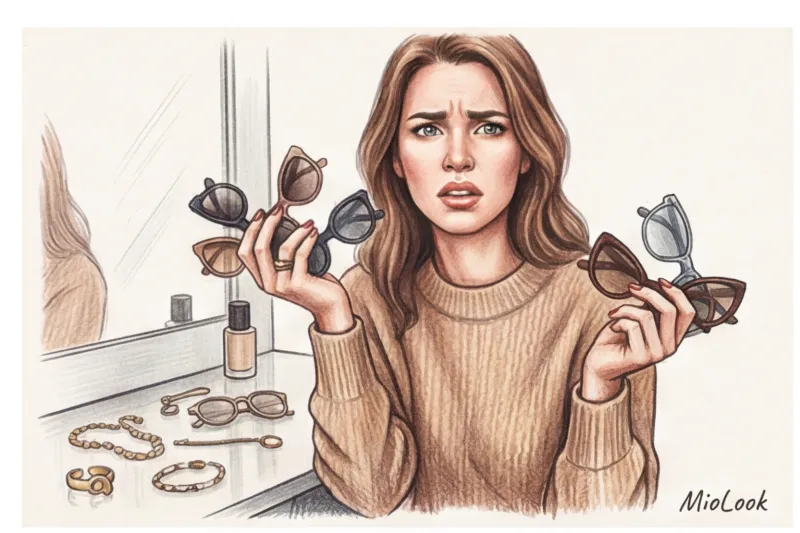
One of my clients, let's call her Marina, once showed up for a wardrobe review completely distraught. She'd just spent almost €500 on ultra-trendy narrow Prada sunglasses from the new collection. On the model in the magazine, they looked bold and stylish. On Marina, with her soft jawline and square face, they acted like a distorting mirror—visibly widening her cheekbones and making her jaw appear heavy. In my 14 years as a stylist, I've seen this scene hundreds of times. A trendy item is bought on impulse, the receipt is thrown away, and the reflection in the mirror is treacherously disappointing.
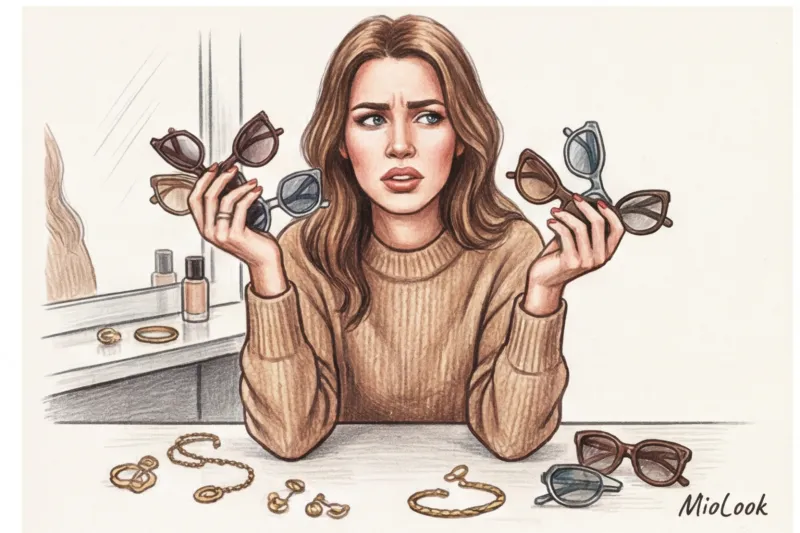
That's why today program for selecting glasses and accessories — it's not just a fun five-minute mask game, but a rigorous mathematical tool. It protects us from impulse purchases and helps us build that all-important "skeleton" of an image without spending an extra euro. We discussed style architecture in more detail in our a complete guide to choosing accessories for clothing , and today I want to show you the inside story of a modern AI stylist.
Facial Architecture: Why Choosing the Right Accessories Can Be So Costly
There's a psychological phenomenon called the "halo effect." Our perception of the overall appearance is shaped by the most striking detail of the face. According to a 2024 study by the WGSN agency, facial accessories occupy only 10–15% of our physical body surface area, but they capture up to 80% of our interlocutor's attention in the first few seconds of a conversation.
What does this mean in practice? We can forgive someone for wearing a basic €20 cotton T-shirt if their frame fits perfectly. But no silk blouse from Celine will save your image if the glasses or earrings clash with the natural contours of your face, making it look tired. That's the price of a mistake.
"Accessories are the architectural framework of your face. The right line can replace a full facelift, while the wrong one can add five years to your age."
I had a striking case in my practice. A 45-year-old client had been wearing perfectly round frames (Harry Potter-style) for years, believing they made her look more "creative." We simply changed the shape to a soft cat-eye, with the corners slanted upward according to David Kibby's line theory. Her face instantly lifted, and puffiness was visibly reduced. We tested this effect first in the app before going to the optician.
Access to MioLook for €0.99 — one-time payment
A smart AI stylist will select the perfect look.
Get access — €0.99 onceEyewear and Accessories Selector: From Snapchat Filter to Styling Tool
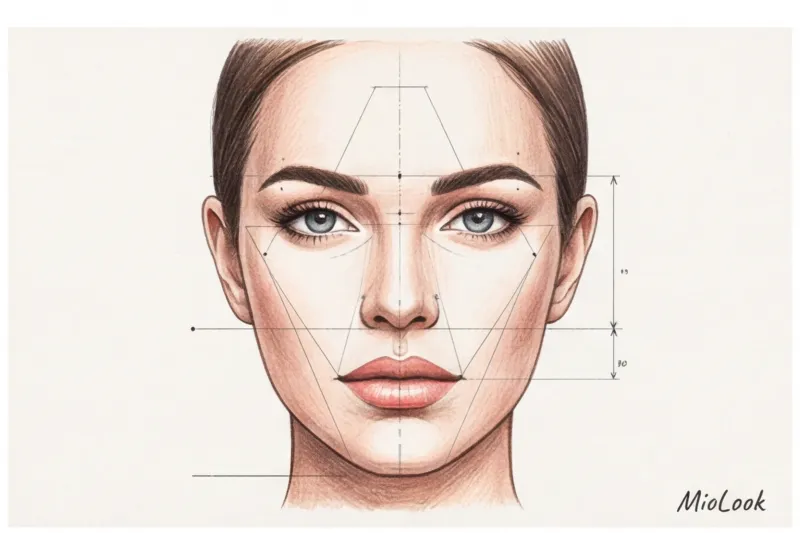
Let's draw a distinction between entertaining AR masks on social media and professional AI. Instagram masks simply "glue" a 3D model over a video, often distorting proportions to suit beauty standards (smaller noses, larger lips). Professional software for choosing glasses and accessories works like a precise scanner.
Modern neural networks read up to 120 points on your face. They measure your interpupillary distance (PD), correlate the width of your cheekbones with your jawline, and calculate your forehead height with millimeter accuracy. Furthermore, the AI analyzes the contrast of your appearance and skin tone to determine which metal will make your face glow—cool silver, warm yellow gold, or neutral rose gold.
When I was just starting out, before shopping, I'd bring clients 20 pairs of glasses and jewelry in a huge suitcase so they could try them on at home. Today, I save everyone's time: we do a basic selection through a neural network in 10 minutes, and then we go to the boutique to buy two or three specific models. I trust math more than the "smart eyes" of a store consultant whose main goal is to meet sales targets.
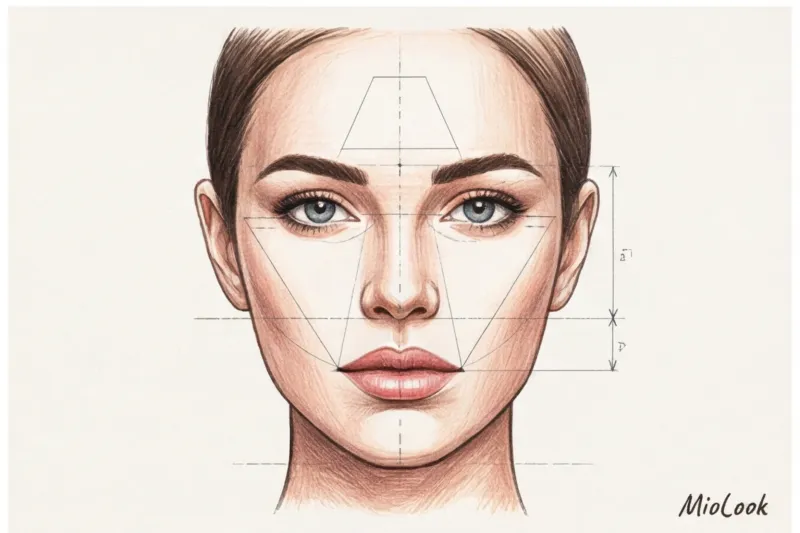
How a neural network determines your natural geometry
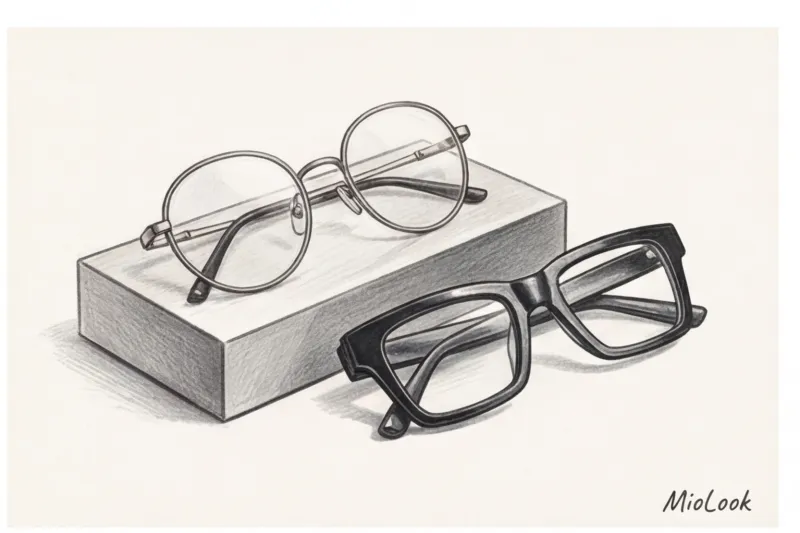
The algorithm is devoid of emotion. It doesn't know that rectangular glasses are trendy right now; it only sees proportions based on the golden ratio. The AI's job is to create balance. If you have pronounced, sharp cheekbones and a strong chin (square or diamond-shaped), the program will suggest rounded shapes—panto or aviator frames—to soften the lines. Conversely, for those with soft cheekbones and a round face, the neural network will categorically prescribe geometric frames—hard rectangular or graphic square frames—to add structure to the face.
Top 3 Myths About Dress Fittings Debunked by a Virtual AI Stylist
The fashion industry is shrouded in stereotypes. Here are three of the most common myths my clients bring to me, which we quickly dispel with the harsh reality of virtual fittings.
Myth 1: “I need to try it on in person in a store to understand.”
It sounds logical, but it's counterintuitive. Trying on clothes in person in a boutique is sometimes the worst idea for those prone to doubt. High-end opticians and jewelry stores use special lighting (around 4000K) to soften shadows on the face. Mirrors are often angled slightly, elongating the silhouette. Add to this the pressure of a polite consultant. AI, however, eliminates this emotional background. You look at yourself in natural light, without retouching, seeing the pure geometry of the fit.
Myth 2: “Black frames are classic and suit everyone.”
Nothing of the sort. On women with a soft summer or autumn complexion, thick black plastic creates the effect of "heavy shadows" under the eyes. The face appears tired and unwell. When trying it on online, the program will immediately show how replacing charcoal black with deep tortoiseshell, burgundy, or wet asphalt instantly brightens up the portrait area.
Myth 3: “Hats/big earrings/glasses don’t suit me at all.”
This is my favorite. The problem is never the accessory's shape, it's always the scale. According to McKinsey (2023), up to 30% of all online accessory purchases are returned with the "wrong size or style" note. People buy hoop earrings that fall on their shoulders, or hats with brims that make them look like mushrooms. AI clearly shows the correct scale for your specific bone structure.
Not just glasses: try on hats, scarves, and jewelry
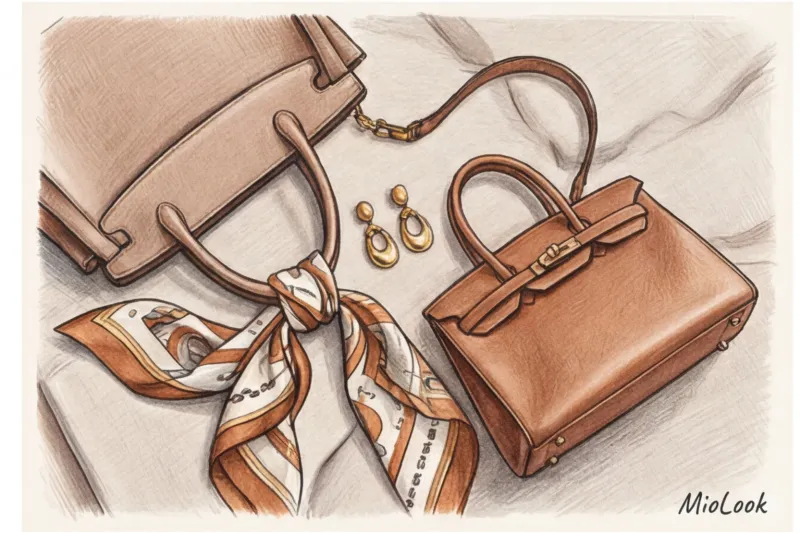
The mathematics of proportions doesn't just apply at eye level. Neck length is crucial when choosing jewelry. The program can estimate this distance and show how long tassel earrings will visually elongate a short neck, while round, chunky clip-on earrings, on the contrary, will "eat up" those precious inches.
The same goes for prints on scarves. If you have fine, chiseled, and delicate features, a large, contrasting print on silk (like huge flowers or wide stripes) will overpower your appearance—people will see the scarf, not you. Virtual try-ons allow you to layer different patterns and find the perfect balance.
And I can't help but mention bags in augmented reality. Recently, a petite woman (158 cm tall) contacted me after purchasing a luxurious Loewe tote for €1,800. Removed from her body, the bag was a masterpiece. In my client's hands, it transformed into a shuttle duffel bag, visually "pinning" her to the ground, robbing her of any remaining height. If we had estimated the accessory's dimensions in relation to her height in AR beforehand, the money would have been spent on a perfect crossbody or baguette bag.
Your perfect look starts here
Join thousands of users who look flawless every day with MioLook.
Get access — €0.99 onceStep-by-step guide: how to use AI try-on before shopping
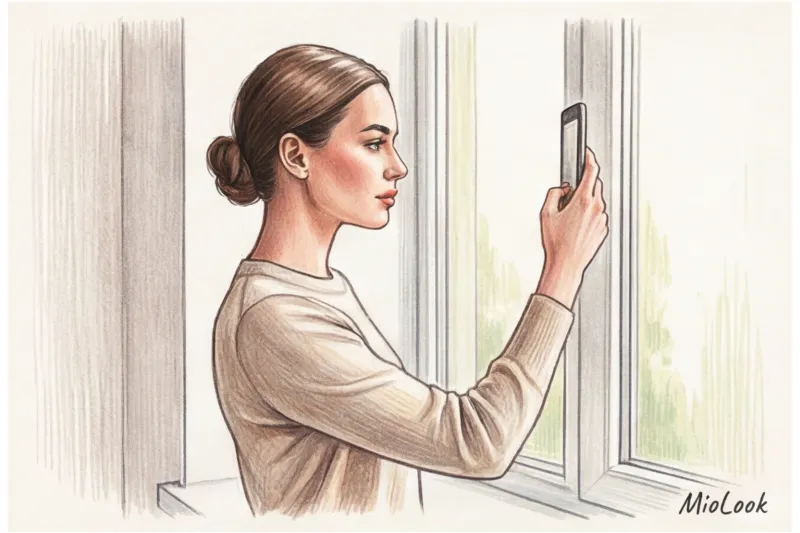
To ensure any eyewear and accessory selection program gives you results comparable to a live stylist consultation, you need to enter your initial data correctly. Here's my working checklist:
- Prepare your face. Pull your hair back into a sleek ponytail or bun. Keep your ears and jawline completely exposed. Any sagging bangs will skew the algorithm's assessment of forehead width.
- Provide proper lighting. Never scan under a yellow bathroom lamp! Stand facing a window in even daylight. Harsh shadows on half your face will throw off the color analysis.
- Fix the camera angle. Hold your phone strictly parallel to your face, at eye level. Raise your chin, and the AI will assume you have a large jawline. Lower it, and the program will "see" a large forehead and a narrow chin.
- Do a crash test. This is my favorite life hack. Try on shapes that are clearly not yours (for example, giant round frames on a round face). Once you see how cartoonish it looks, you'll never want to buy unflattering trends again.
Of course, I have to be honest with you: technology has its limitations. No program will appreciate the weight and ergonomics of an accessory. A neural network might show that chunky vintage earrings are geometrically perfect, but if you have a thin earlobe, the heavy metal will pull it down, making them unwearable. Common sense and an understanding of your own physical characteristics are essential.
The Future of Smart Wardrobes with MioLook
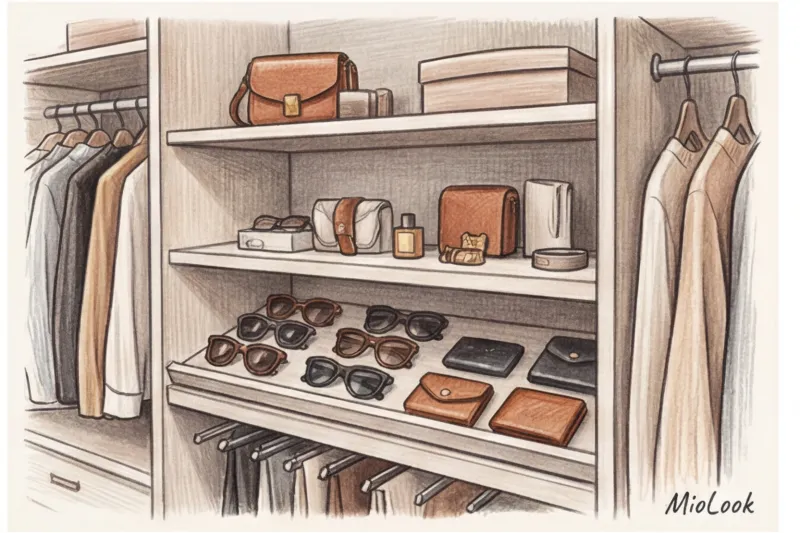
It's important to understand: artificial intelligence doesn't replace your personal taste; it simply does the grunt work. It saves you dozens of hours wandering through shopping malls and hundreds of euros spent on throwaway items. Once you find your perfect foundation—that perfect frame, that perfect watch, the right strap width—you can build the rest of your collection around it.
IN MioLook We take a systematic approach to style creation. Accessories found through AI become the starting point for the "smart wardrobe" feature, where the program helps you mix and match these status items with your existing clothes, creating dozens of new outfits for any scenario—from a strict boardroom gathering to a relaxed brunch with friends.
Remember the main rule: it's better to buy one flawless, mathematically precise statement piece for €150 than five random trinkets for €30 each that will overlook your appearance. Invest in something that frames your face, and you'll never go unnoticed.