The Illusion of a Blank Slate: The Psychology and Ecology of Style Change
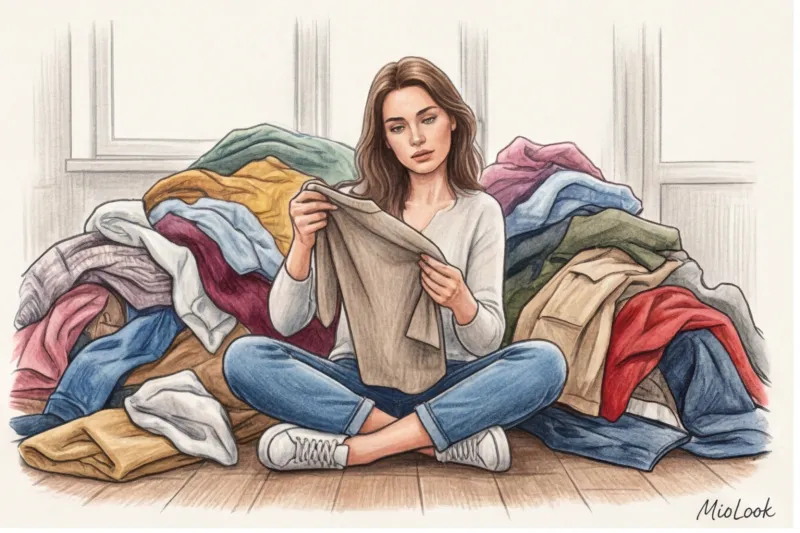
Over 12 years of practice, I've learned one ironclad rule: the phrase "I want to put my things in a huge bag and take it to the trash" is heard at least twice a week in my consultations. When a woman thinks about How to completely change your clothing style , her first reaction is almost always a thirst for total destruction. We think that by getting rid of old sweaters and jeans, we'll magically wake up a "new person."
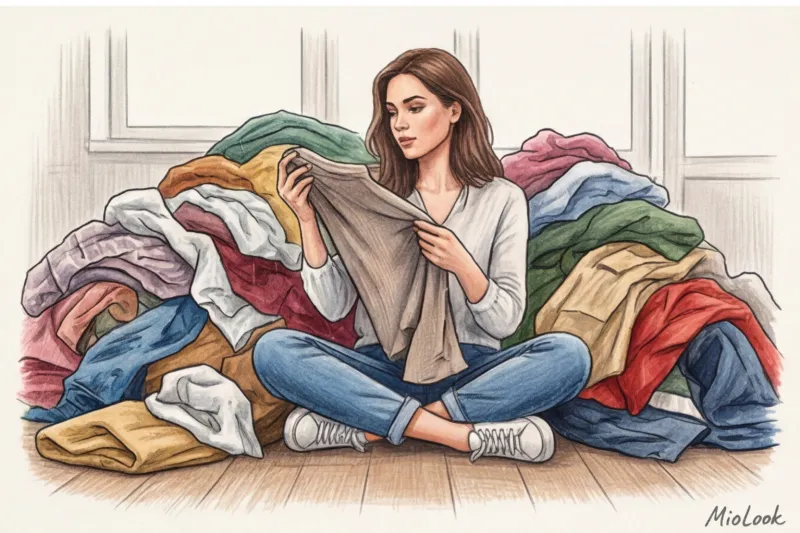
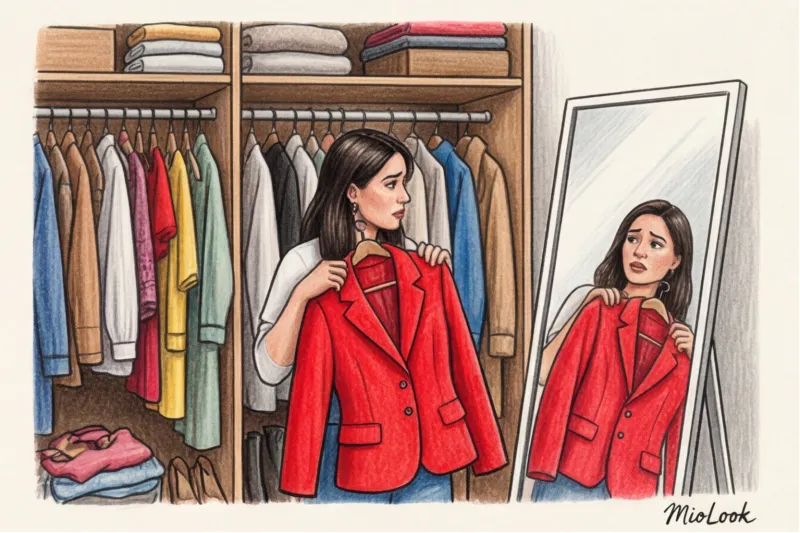
This urge has little to do with fashion—it's deeply psychological. Our wardrobe is inextricably linked to our life stages. The overwhelming urge to clear out our closet usually hits us during moments of profound life changes: coming out of prolonged maternity leave, a dramatic career leap, a painful breakup, a move to a new climate, or simply profound inner growth. Clothes act as an emotional anchor. One of my clients, after being appointed CFO, tried to give away 80% of her wardrobe in one weekend. She physically felt like her soft, cozy cardigans were dragging her back to her past and preventing her from projecting authority in her new, demanding role.
But this illusion of a "clean slate" has a dark side—a catastrophic textile footprint. Massive wardrobe discards have become one of the biggest environmental problems of our time. According to a shocking study Ellen MacArthur Foundation (2020) Every second, the equivalent of an entire garbage truck's worth of clothing is sent to landfills or incinerated worldwide. Moreover, statistics show that today we wear clothes on average 36% less often than we did 15 years ago. By throwing a blended fabric blouse or a high-quality €200 wool coat in the trash just because we're "bored," we trigger a decomposition process that will take hundreds of years.
A change of image should be an evolution, not an amputation. Your old, high-quality foundation often deserves a second chance with a new interpretation.
Therefore, transforming your image shouldn't start with trash bags, but with a conscious inventory. Before making radical decisions about the fate of your items, I strongly recommend my clients digitize their current collection using an app. MioLook Visualizing your wardrobe in a smart way immediately reduces anxiety: you see concrete assets you can work with, not a shapeless pile of junk.
If an item has clearly outlived its usefulness and no longer fits into your new aesthetic, dispose of it sustainably. I advise my clients to incorporate three simple recycling habits:
- Resale: Sell brand-name items and items made from high-quality fabrics in good condition on specialized platforms. This will recoup some of your investment.
- Swap and charity: Organize a clothes swap party with your friends or donate your items to reputable charities where they can get a second life.
- Processing: Donate worn-out knitwear, old underwear, and unsaleable items to textile recycling bins—modern factories can turn them into furniture padding or industrial fiber.
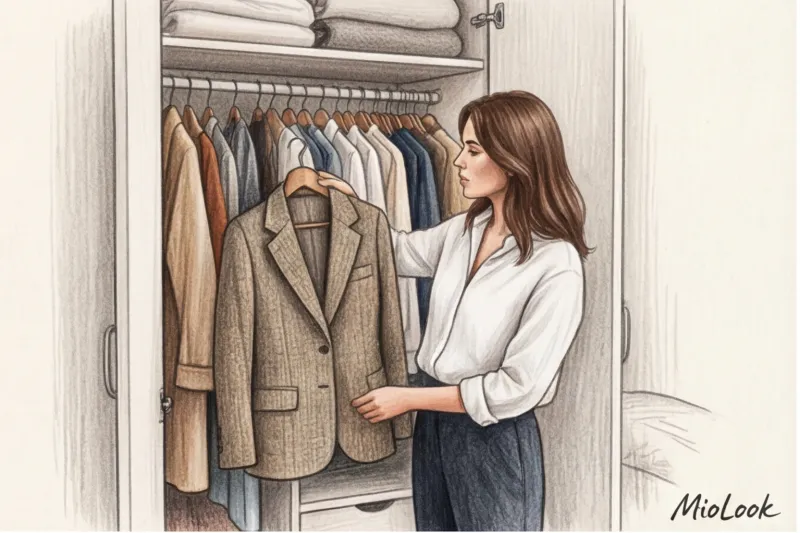
Never forget that many old items can be salvaged with clever styling. A familiar basic shirtdress from your "past life" will take on a completely new look if you simply explore it. How to choose a belt according to your body type , and radically change the geometry of your silhouette. Taking care of what you already own is the first and most important step to a truly conscious and treasured look.
The Biggest Mistake: Why You Shouldn't Get Rid of Old Things on the First Day
When women ask me, How to completely change your clothing style , they most often expect to hear a blunt command: "Pack everything in bags and take it out of the house!" After watching too many makeover shows, we begin to believe the myth of the "global purge." It seems that once you empty the hangers, perfect cashmere sweaters and impeccably fitting trousers materialize.
However, in real life, total decluttering on the very first day is a direct path to financial loss and deep disappointment.
Abruptly discarding your old wardrobe before the core of your new one is formed inevitably leads to impulse buying. You start buying things not because they fit perfectly into your new concept, but because you need something to wear to work the next morning.
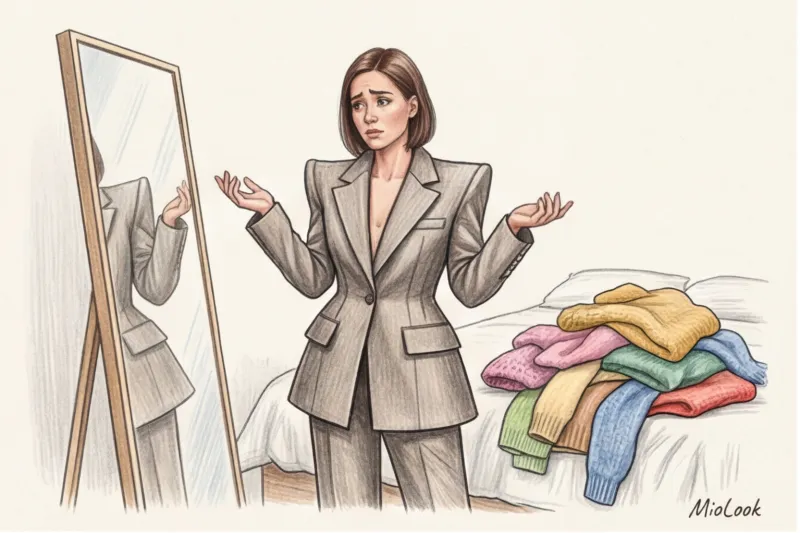
To understand how this mechanism works, I'll tell you the story of my client Anna. Having decided to radically change her image to "elegant minimalism," she donated and recycled almost 80% of her belongings in one weekend. On Monday morning, she realized the weather had suddenly turned nasty, and her only remaining coat was at the dry cleaners. In a state of desperation, Anna ran to the high-street store near her office. The result? €280 less on a trendy but completely ungainly polyester jacket with exaggerated shoulders (in which she couldn't even lift her arms while driving) and a pair of skinny trousers that mercilessly dug into her waist. Her new style hadn't yet been established, so in her stressed state, her brain simply chose whatever was on the nearest mannequin.
In fashion psychology this phenomenon is called wardrobe anxiety This acute stressful state occurs when the old "uniform" has been destroyed and a new one hasn't yet been created. You literally have nothing to wear right now to accomplish routine tasks—walk the dog, get to the office, attend a parent-teacher conference. Consumer behavior studies show that 90% of shopping experiences under stress result in purchases of items that will only last a day and remain dead in your closet.
The concept of a "buffer zone" in the closet
So what should you do if your old things are already annoying, and you don't have a concept or budget for new ones? The answer lies in creating a transitional space.
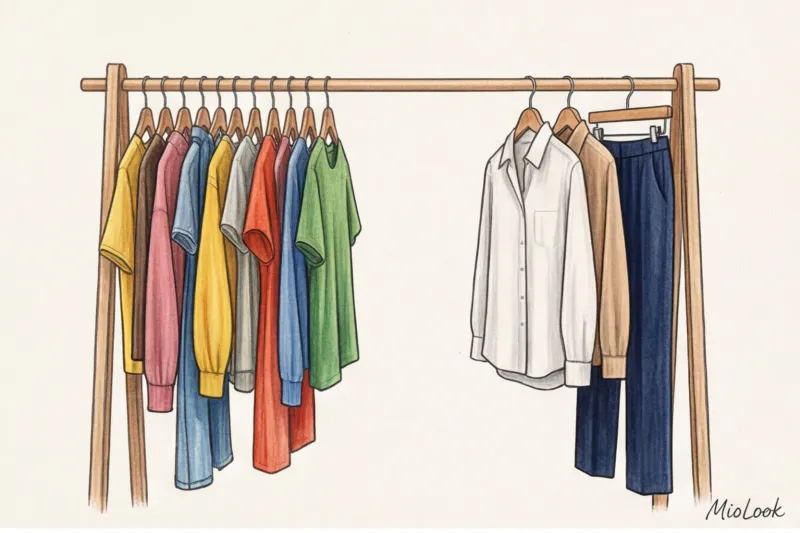
Divide your current closet into three categories: "past," "present," and "future." "Past" are items that are too small, stained beyond repair, or have irreversibly lost their shape. These are truly worth saying goodbye to immediately. "Future" are empty hangers that will slowly, week after week, be filled with carefully considered purchases.
But the “real” is yours buffer zone My golden rule: when changing styles, you need to keep about 30% of your basic, even if incredibly boring, but comfortable items as a lifeline.
- Regular blue straight-leg jeans. Even if you've decided to embrace flowing silk skirts, jeans will save you on moving day or a trip to the countryside.
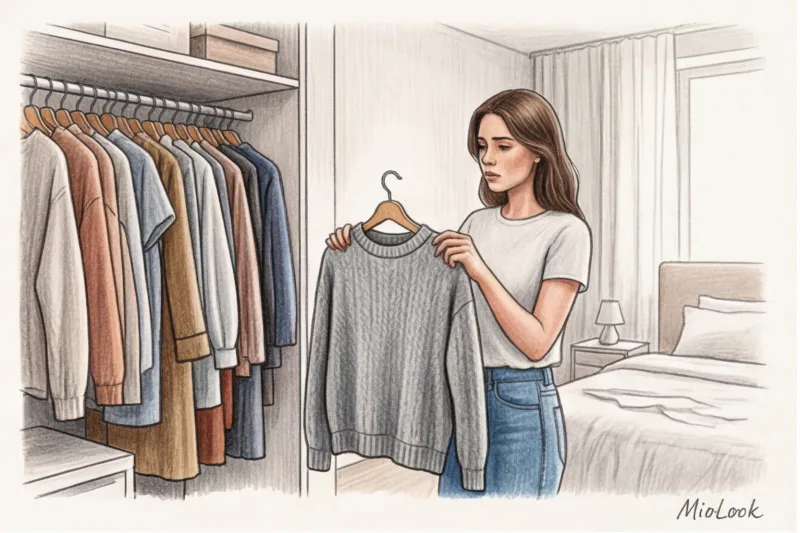
- Neutral knitwear. A simple grey or black jumper will serve as a backdrop while you experiment with new, more complex textures.
- Proven footwear. Worn-in boots are essential for those days when you'll spend hours shopping for that perfect €150 pair, instead of grabbing those pinching €40 shoes out of desperation.
Access to MioLook for €0.99 — one-time payment
A smart AI stylist will find the perfect look and help digitize your "buffer zone" to make the transition to a new style stress-free.
Get access — €0.99 onceThe buffer zone gives you the most important luxury when it comes to styling - time It's time to read labels, order items for fitting, and analyze how the fabric performs under the artificial light of the fitting room. Knowing you'll have something to wear to work tomorrow means you're protected from panic buying and can create your new look consciously.
How to Completely Change Your Clothing Style: A Step-by-Step Plan
According to a 2023 consumer behavior study by the analytical agency WGSN, approximately 40% of the clothes in our closets are left unused for one simple reason: we buy clothes for our "fantasy" lives, not for the real world. When asked to completely change our style, most people start by scrolling through trends or going to the mall. This is a grave mistake. The foundation of a new look is built not on window displays, but on a rigorous analysis of your everyday life.
The first and most important step is lifestyle audit You need to create an honest timeline of your workload. Take a piece of paper, draw a circle, and divide it into sections based on percentages: how much of your time is spent in the office with a strict dress code, how much is spent working remotely from home, taking walks with your children, playing sports, attending social events, or dating.
I had a client, an executive, who loved to buy luxurious silk dresses and stiletto heels costing between €300 and €500. The problem was that she spent 80% of her time traveling to construction sites and informal coworking spaces. Her chart clearly demonstrated this imbalance: the lion's share of her budget was spent on a sector that took up barely 5% of her time. Your new wardrobe should mathematically align with your chart.
The next step is - choosing a vector through unpacking the personality Clothes that make you feel dissonant will never be "yours," no matter how fashionable they are. Integrating Carl Jung's theory of 12 archetypes into personal style is a great way to achieve this.
- If your leading archetype is "Ruler" , you'll feel physically uncomfortable in relaxed boho. Your style will require clean lines, structured merino wool, thick cotton, and strict symmetry.
- If you The Seeker Stiff three-piece suits will create a feeling of constriction. Layers, freedom of movement, cupra, raw linen, and natural shades are essential.
- Archetype "Esthete" will require tactilely complex textures: cashmere, flowing silk and elegant details that emphasize the line of the neck or wrists.
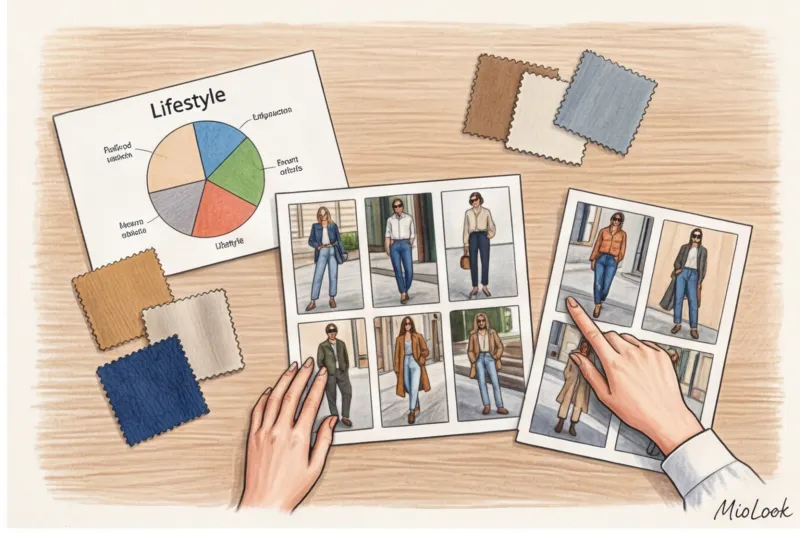
Having defined our vector, we move on to visualization - creating a mood board that actually works Most women collect aesthetically pleasing but completely unviable images on Pinterest—for example, images of top models in crop tops and micro shorts—forgetting that they themselves live in climates with long winters and work in the corporate sector.
A working reference differs from a simple, pretty picture in that you can break it down into its technical components. Save the photo not for the model's face or the Parisian atmosphere in the background. Capture specific styling techniques: how the sleeves are rolled (a casual roll or a formal French cuff), how volumes are combined (an oversized jacket with straight, flowing trousers), how the "French tuck" technique is used (when a sweater is tucked into jeans only at the front).
Finding the DNA of your new style
To avoid getting lost in the thousands of saved photos, you need to formulate the DNA of your future wardrobe. For this, I use the keyword method. Choose 3-4 anchor adjectives that will describe your ideal look.
For example, your combination might sound like: "relaxed, status-conscious, minimalist" From now on, these three words become your strict filter for any purchase. You see a stunning skirt with a complex asymmetrical print and ruffles in the store. Is it classy? Okay. Minimalist? Nope. Relaxed? Definitely not. This means this item doesn't fit your DNA and there's a 99% chance it'll remain hanging in your closet with the tag still attached.
Once you have your words selected, go back to your mood board and start look for visual patterns Analyze 30-40 saved looks and note any recurring elements. You may be surprised to discover that 80% of the photos feature models wearing monochrome beige and gray outfits, deep V-necks, or structured square-toe shoes. Patterns extend not only to cuts but also to fabrics. Notice the abundance of matte, dense fabrics and the complete lack of shine? This means that when shopping, we immediately ignore satin and shimmery viscose, focusing on matte wool, gabardine, and thick denim without any elastane.
To digitize these stylistic finds and test them without risking your wallet, I highly recommend using MioLook By uploading your references and current "buffer zone" collection, you can use Smart Wardrobe mode to see how new silhouettes and color schemes will pair with what you already own. This is an incredibly powerful tool for preventing chaotic shopping during the most vulnerable phase of the transition, when the old style has already been discarded and the new one is just beginning to take shape.
Smart Shopping Strategy: Update Your Wardrobe Without Spending Extra Money
The surest way to go broke when changing your look is to buy only cheap items. There's a hard and fast rule in fashion economics: the price tag rarely reflects the actual cost of clothing. When we start building a new wardrobe from scratch, there's a huge temptation to buy a ton of inexpensive items to instantly fill the empty space on our hangers. This trap leads to a cluttered closet and a persistent "nothing to wear" syndrome within a month.
To truly update your wardrobe without breaking the bank, I implement the Cost Per Wear (CPW) formula with my clients. The calculation is simple: divide the price of an item by the number of days you wear it.
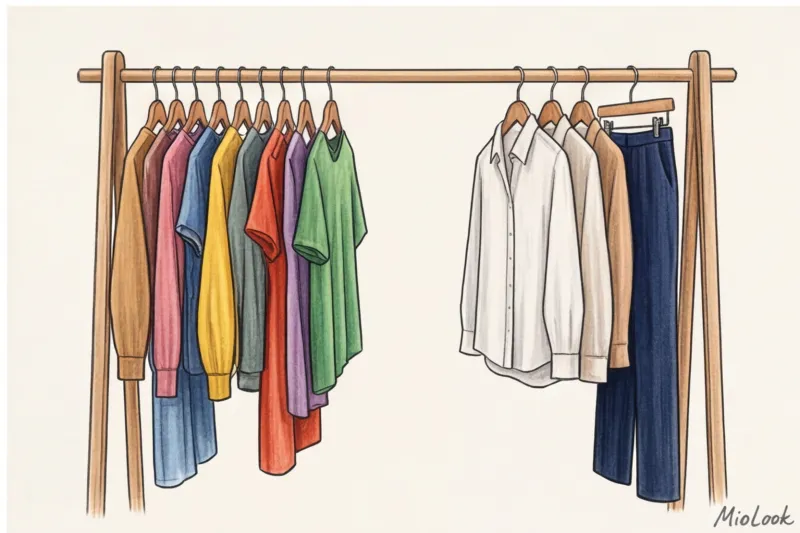
Let's look at wardrobe math using a specific example from my practice. Let's say you need a basic black turtleneck.
- Scenario A: You buy an acrylic blouse at a high-street store for €35. It looks good on the mannequin, but after the fifth wash, it's covered in permanent pilling, the collar loses its elasticity, and starts to smell bad by the middle of the workday due to its 100% synthetic material. You wear it five times and put it away on the back shelf. CPW = €7 per wash.
- Scenario B: You invest €180 in a high-quality cashmere-silk turtleneck. You wear it at least twice a week for three cold seasons—that's about 70 times. CPW = €2.50 per time.
The math is relentless: an expensive cashmere turtleneck cost you almost three times less than an acrylic one, yet you looked classy and felt comfortable for every one of the 70 days.
Of course, I always give a fair warning: applying CPW to a sequined anniversary dress is pointless—different emotional laws apply there. But for a basic wardrobe, this formula is flawless.
For those looking for a way to completely change their wardrobe systematically, the 70/30 principle becomes the main financial compass. Exactly 70% of your shopping budget should go toward durable, perfectly tailored essentials: a structured coat, quality shoes, impeccably fitted jeans, and well-designed bags. The remaining 30% is your reserve for stylistic experiments, trendy statement pieces, and unusual textures, where you can afford a slight compromise in terms of durability.
But the main enemy of the new aesthetic is impulse buying. You go into a store, see a stunning terracotta jacket, buy it, and when you get home, you realize it doesn't go with any pants. To protect your budget, I recommend using technology, namely— MioLook smart AI wardrobe Before taking an item to the checkout, take a photo of it right in the fitting room and upload it to the app. A virtual try-on and the system's algorithms will show you in just a few seconds whether you can create at least three or four looks with this new item based on your current items. If the AI returns a compatibility error or you simply have nothing to wear it with, feel free to return the item to the rail; you just saved money.
Textile Checklist: How to Choose Fabric That Will Last
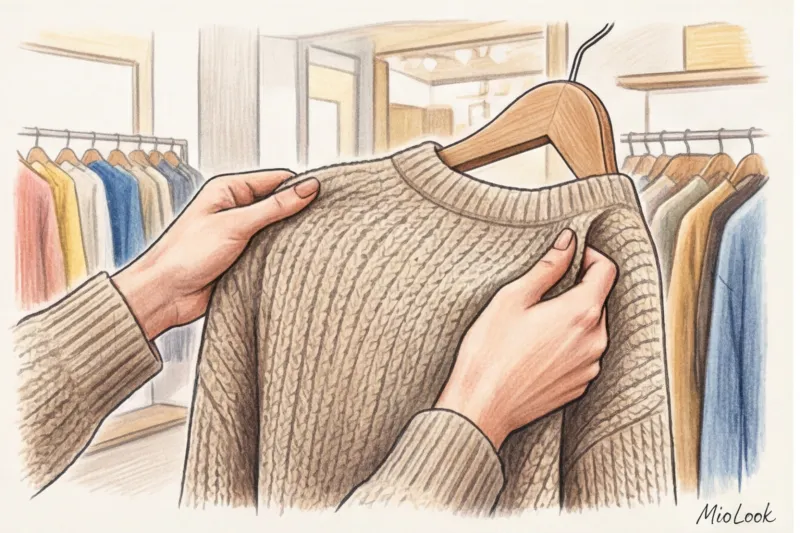
No financial strategy will save you if you can't physically assess the quality of materials. First and foremost, you need to learn to distinguish a well-blended fabric from cheap synthetics by touch. I always ask my clients to perform a simple test: squeeze the edge of the fabric tightly in your fist for 10 seconds, then release.
A high-quality blended fabric (for example, 80% wool and 20% polyamide for dimensional stability) will quickly straighten out, leaving only a soft wave. It feels dry and springy. Cheap 100% polyester or acrylic often produces a microscopic "squeak" under the fingers, is uncomfortably slippery, has a cheap shine under artificial light, and instantly heats up the palm, creating a greenhouse effect.
The quality of the workmanship should be checked directly in the fitting room. Gently tug the fabric sideways along the side seam. If you see threads or tiny needle holes when held up to the light, the garment will unravel after the first wash; the weave density is critically low. Be sure to check the inside. Buying a luxurious wool coat with a stiff polyester lining means dooming yourself to constant thermoregulation problems and static electricity. Look for viscose or cupra in the lining.
To create a classy, "expensive" silhouette that won't deform by evening, choose fabrics with high density and structural memory:
- Merino wool: Unlike loose sheep's wool, it has a smooth, almost silky texture, retains heat well, does not create excess volume, and practically does not pill when washed correctly.
- Thick cotton: Ideal for basic shirts and trench coats. Conduct the "light test": if you can read a text message on your phone screen through the shirt, it will never hold a crisp, architectural cut.
- Cupra: A brilliant alternative to natural silk, this fabric made from recycled cellulose fibers has a luxurious matte sheen and drapes beautifully, creating that fluid luxury without the static.
Try MioLook
for free
Start creating perfect looks with the help of artificial intelligence and get rid of impulse purchases forever.
Get access — €0.99 onceThe Capsule-Nucleus Method: Where to Start
Architects don't start building a house by buying decorative pillows. The same principle applies to personal styling. When we solve a problem, How to completely change your clothing style The first physical purchase is always a "core capsule." You don't need 50 new items. For one of my clients, a top manager in the IT sector, we put together a starting base of just 12 items, and her colleagues were convinced she'd updated her wardrobe for thousands of euros. The secret lay in the strict mathematics of combinations.
The golden rule of style: For every bottom, there should be 3-4 tops. The human eye primarily scans the portrait zone (from the chest to the face). If you wear the same perfect graphite trousers three days in a row, but change between a thick shirt, a cashmere turtleneck, and a structured jacket, everyone around you will see three completely different looks. If you change skirts every day but stick to the same jumper, everyone will think you're wearing the same one.
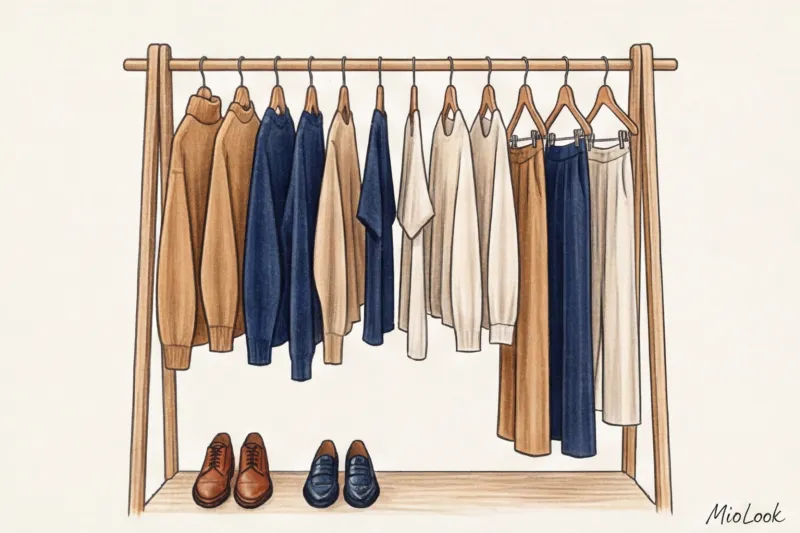
To make outfits look effortless, I use the "2+1" color formula. Choose two deep base shades (for example, dark chocolate and cream, or deep navy and gray melange) and one accent color that complements your appearance (burgundy, sage, or muted mustard). No random prints at this stage—only solid fabrics with expressive textures.
Let's move from theory to practice. Here's a universal list of 10 items for a smart-casual capsule collection, which can be assembled for €400–€600 if you cleverly mix mid-market (like COS or Arket) and high-quality local brands:
- Wool palazzo or straight trousers (base color 1: graphite or chocolate).
- Straight-leg jeans made of thick denim without abrasions (indigo or dark gray).
- A-line midi skirt or a thick slip skirt (made of cupra or matte viscose).
- Structured jacket straight cut, holding the shape of the shoulders (base color 2).
- Thick cotton shirt men's cut (white or light blue).
- A thin cashmere or merino turtleneck (base color 1).
- Basic top or t-shirt made of thick, opaque cotton.
- A voluminous cardigan or jumper textured knitting (for layering).
- Silk or viscose blouse (accent color: eg wine).
- Accent long sleeve with an interesting architectural cut (bob or asymmetry).
Complete this ten-piece collection with two pairs of shoes (leather loafers and minimalist logo-free sneakers) and two bags (a roomy hard tote and a simple crossbody). This set easily creates over 35 unique combinations.
Before you go shopping and spend your budget, upload references of the items you want to MioLook smart wardrobe feature The virtual fitting room will immediately show you whether the blouse styles you've chosen really match your trousers, or if the proportions are off and the color scheme needs adjusting.
A Second Life for Old Things: Stylization Instead of Recycling
According to a 2022 report by the Ellen MacArthur Foundation, extending the life of clothing by just nine months reduces its carbon and water footprint by 20-30%. However, my job as a stylist is to ensure you wear the items in your closet not out of environmental guilt, but because they genuinely look great. Preserving old staples and incorporating them into a new aesthetic is absolutely possible with a little creativity.
Upcycling and light alterations can work wonders. Take, for example, your old jacket or a basic knit cardigan from a mass-market store. Often, it's the hardware that makes such a garment look cheap. I regularly use this technique in my work: we take a regular €30 cardigan, rip out the flat, shiny plastic buttons, and sew on heavy metal or accent horn buttons bought for €5-8 at a local haberdashery. The garment's visual value instantly increases exponentially! And if you take your tired oversized jacket to a tailor to have the shoulders slightly tapered or the length shortened to a trendy crop, it will become a fully fledged and very stylish addition to your updated wardrobe.
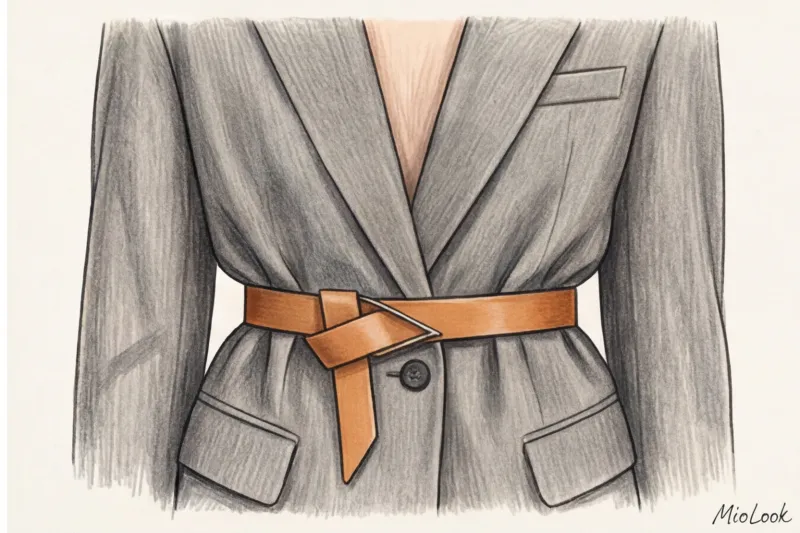
If you're currently searching for an answer to the question of how to completely change your style without a major shopping spree, pay close attention to the power of accessories. They can instantly change the DNA of familiar pieces, acting as strong style markers. A simple, seemingly shapeless shirtdress from past seasons becomes less boring when worn with a thick leather belt with a minimalist geometric buckle and a statement, rigid bag. Smooth, high-quality leather and statement jewelry—for example, sculptural earrings in the spirit of Bottega Veneta—dramatically steal the show. Your old clothes, in this case, act as the perfect neutral canvas.
Your ideal image
it begins Here
Join thousands of users who look flawless every day with MioLook.
Get access — €0.99 onceThe key to seamlessly integrating old and new lies in clever layering. In professional settings, we often employ the "textured sandwich" rule. The idea is to hide basic, slightly tired pieces from your old wardrobe beneath new, structured elements. Your old, thin turtleneck will gain a new lease of life if you layer it with a crisp, crisp cotton shirt, leaving the collar open, and then layer it with a structured blazer. The secret to successful integration lies in contrasting materials: mix old, smooth knits with new, textured wool or crisp denim. In this layered ensemble, only 30% of the look consists of new purchases, but the overall effect is dramatically altered.
Checklist: 30 Days to Transform Your Wardrobe
Have you ever noticed that after an impulse shopping spree, the euphoria from finding radically new things often evaporates just as you're about to head out the door? Research in cognitive psychology (in particular, data from University College London on behavioral patterns) proves that it takes about a month for the brain to fully adapt to a new visual image of itself. That's why a weekend shopping spree almost always ends with the bags being returned to the store.
The only working answer to the question, How to completely change your clothing style The key to staying healthy and not emptying your bank account is discipline. I've developed a 30-day protocol that will help you rebuild your look in a sustainable and stress-free way.
Week 1: Lifestyle Analysis and Mood Board Creation
For the first seven days, we don't buy or throw anything away. Your task is to honestly document your reality. Record every time you leave the house: how many hours you sit at your desk, how long you walk the dog, how often you attend evening events. If 80% of your life is smart-casual, you don't need three rhinestone-studded evening dresses, no matter how beautiful they look in the picture.
At the same time, create a mood board. Don't use abstract runway shots, but rather functional references for your body type and climate. Look for recurring patterns: for example, you might notice that you're constantly gravitating toward looks featuring chunky, chunky knit sweaters and straight midi skirts. This is your vector.
Week 2: Closet Review and Shopping List
It's time to take physical action—creating a "buffer zone." Select 30% of your old, boring, but extremely comfortable basics (those perfect jeans, simple turtlenecks, neutral coats). Leave them in plain sight. The remaining 70% of the items that irritate you, vacuum-seal them and put them out of sight.
Digitize the remaining base through MioLook smart wardrobe Once you can clearly see your "lifesaving" items on your smartphone screen, it will be much easier for you to create a strict, uncompromising shopping list for new purchases. Be specific: not “any shirt,” but “a structured shirt made of thick ecru cotton.”
Week 3: Selecting the first capsule-core (tissue and budget control)
Go shopping exclusively with the list from the previous step. Your goal now is to buy just 3-5 key items that will become the core of your new style. Here, we turn on the ruthless quality filter.
Carefully check the tactile properties and composition. The jacket's lining should be breathable viscose or cupra, not squeaky polyester that will leave you sweating in 15 minutes. If your starting budget is, say, €500, invest €350 in perfectly fitting trousers and quality leather shoes, and allocate the remaining €150 to cotton tops. This is when we're building the foundation.
Week 4: Accessories Integration and Real-Life Test Drive
The final week is dedicated to combat testing. Start incorporating the new items you've purchased into your life, mixing them with items from your "buffer zone." Pair your new structured pants with your old favorite sweater.
At this point, new accessories come into play. A crisp belt, a modern geometric bag, or statement shoes can elevate even the simplest basics to a new stylistic level. Give them a thorough test drive: check how they perform while driving, how they wrinkle after eight hours at the office, and how comfortable they feel in this new "skin."
Style is a marathon, not a sprint. A gradual, thoughtful wardrobe overhaul not only protects you from panic buying and financial ruin, but also gives your psyche the time it needs to connect with your new, confident reflection in the mirror.
Don't demand instant transformations from yourself. Allow your new style to develop naturally, piece by piece, and in just a few months, you'll hardly recognize your wardrobe.
Guide Chapters
How to decide on a change of image and not regret it
The desire to radically change your appearance often arises from stress. Learn how to update your style sustainably, without unnecessary expense or regret.
How to choose clothing colors based on your color type without sacrifice
A color type isn't a strict framework, but a tool for managing attention. Learn how to eco-friendly update your palette when changing your look without throwing away your favorite items.
How to Change Your Style at 30 Without Looking Older
Thirty is a dangerous age for a woman's wardrobe. Learn how to find your new elegant look without looking like a conservative auntie.
How to Change Your Style After Maternity Leave: A Wardrobe for Moms
A new mom's look isn't about reverting to her old jeans, but rather creating a smart and stylish capsule wardrobe. Learn how to look chic while getting ready in just 3 minutes.
How to transition to a feminine style of clothing and maintain comfort
Dreaming of dressing femininely, but not ready to put up with stiletto heels and tight skirts? We'll show you how to seamlessly transition your style while maintaining your comfort.
Where to donate old clothes: eco-friendly methods
Your wardrobe is sorted, but what to do with unwanted items? We explore eco-friendly recycling methods and common mistakes when donating clothing to charities.
How to Build a Basic Wardrobe from Scratch: A Shopping List
Throwing away old items is just the first step. Learn how to create the perfect essentials for your lifestyle and avoid wasting money on unnecessary classics.
Makeover App: AI for Style Finding
A complete wardrobe overhaul is a recipe for wasted money. Learn how smart AI apps can help you find your unique style and invest wisely in clothing.
How to Make a Clothing Mood Board: Mapping Your Style
A mood board isn't just a wish list, but a rigorous blueprint of your future wardrobe. We'll explore how to visualize your new style and avoid impulse purchases.
How to try a new clothing style without breaking the bank
70% of attempts at a radical image makeover end up with unworn items in the closet. We'll tell you how to safely try out a new look and save money.
Image Change Mistakes: Why Your Wardrobe Doesn't Work
Have you spent a fortune on new clothes, but they're just hanging in your closet? Find out how psychology is holding you back from wearing your new wardrobe and how to make a style change comfortable.
How to Find Your Clothing Style: A Step-by-Step Guide
Dreaming of throwing out everything and starting over? Find out why this is the biggest mistake when finding your personal style and how to approach your wardrobe analytically.
How to properly sort out your wardrobe before a makeover
Planning a style change? Discover the secrets of a personal stylist to help you properly clean out your closet and avoid emotional financial losses.
How to Update Your Wardrobe Without Spending Extra Money: 10 Life Hacks
Got a full closet but nothing to wear? Discover 10 effective ways to refresh your style and create new looks without shopping.