The Illusion of a Blank Slate: Where to Start with a Basic Wardrobe
Over my 12 years as a stylist, I've seen this scene dozens of times. A client, in a fit of inspiration (or despair), gathers all her things into huge trash bags, leaves her closet empty, and solemnly declares, "That's it, I'm starting my life over!" One of my clients, 32-year-old Anna, spent €1,500 on the "perfect classic essentials." She bought a crisp beige trench coat, a pencil skirt, silk blouses, and pumps. Three weeks later, she was crying in front of the mirror, wearing her old gray sweatshirt, which she miraculously didn't manage to throw out. The reason? Anna works remotely as a UX designer, and she simply couldn't wear her crisp trench coat.
The desire to throw everything away and start collecting basic wardrobe from scratch is often dictated by psychology rather than fashion. We think that new clothes will automatically give us a new, more organized life. I wrote more about this psychological phenomenon in our a guide on how to completely change your clothing style without spending too much.
But this "zeroing out" approach has a dark side—an environmental and financial trap. According to a 2023 report by the Ellen MacArthur Foundation, today we wear a new item on average only seven times before putting it away. When we throw everything out, a "bare closet panic" ensues. We rush to the mass market and buy cheap substitutes.
My main advice before starting: don't build a wardrobe from scratch. Conduct an inventory audit. Often, the perfect basic T-shirt is hidden behind bright cardigans you bought in a shopping frenzy. You're simply tired of the chaos in your closet and no longer see its potential.
The One-Stop List Myth: Why You (Probably) Don't Need a White Shirt
Let's be honest: the myth of the "universal list of 10 essential items" is a brilliant marketing ploy. For decades, glossy magazines have been telling us that every woman needs a white shirt, a little black dress, and a classic beige trench coat.
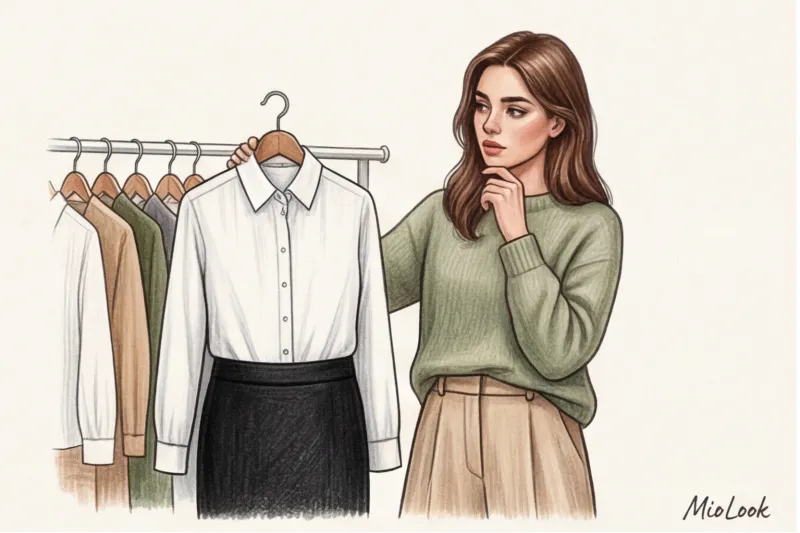
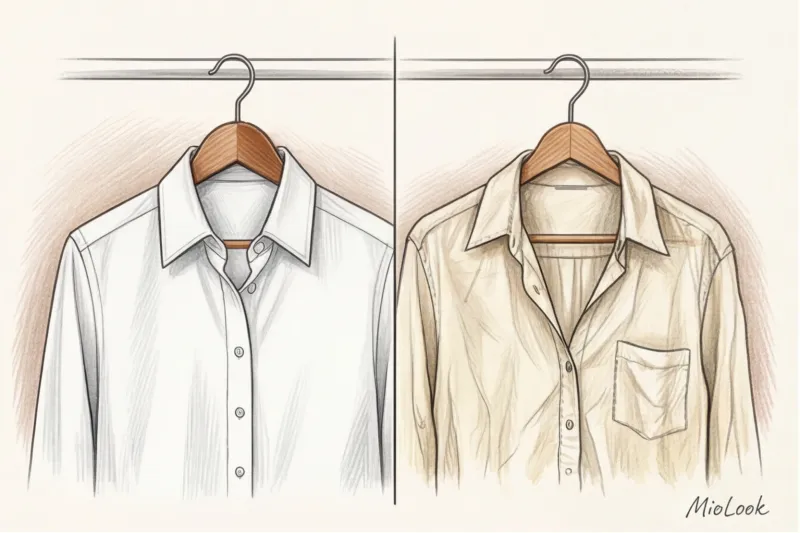
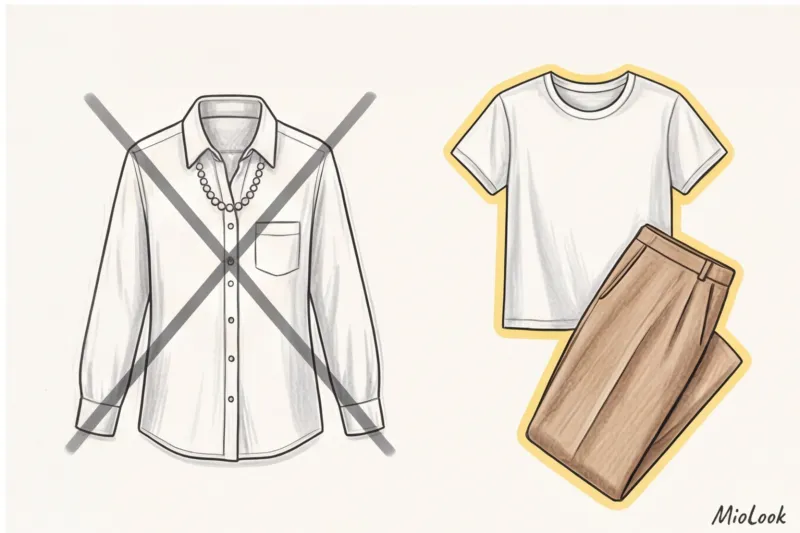
I'm officially stating: these outdated fashion dogmas don't work for 70% of modern women. If you're a young mother, a freelancer, or an IT professional with a casual dress code, a crisp white shirt for €150 will be a monument to your ambitions on the hanger.
Instead of making up lists, I use the concept of a "Personal Denominator." Your personal baseline should be based on your actual routine. If you spend 80% of your time on your laptop or walking the dog, your "white shirt" would be a high-quality, heavy cotton long-sleeve top, and your "creased trousers" would be heavy cashmere joggers or well-fitting, loose-fitting jeans.
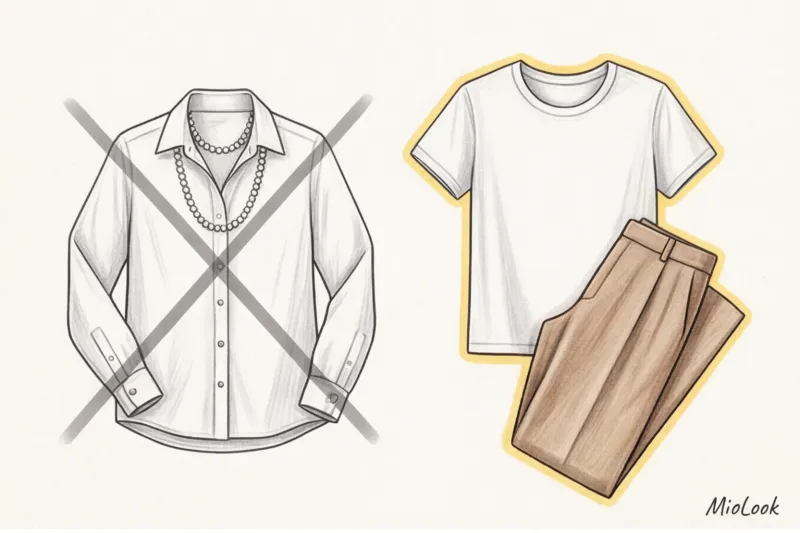
Research by the analytics platform WGSN (2024) confirms this shift: demand for rigid, formal silhouettes has fallen by 34% in favor of "structured comfort." Therefore, when searching for essentials, focus not on the names of items, but on their functions in your real life.
Access to MioLook for €0.99 — one-time payment
A smart AI stylist will select the perfect look based on your preferences and lifestyle.
Get access — €0.99 onceModular shopping system: a smart framework for your new style
When building a basic wardrobe from scratch, avoid buying individual pieces. Forget the "oh, what a pretty skirt, I'll take it" mentality. Instead, focus on creating capsule wardrobes. To get started, I always recommend the mathematical formula 3-3-2-2 to my clients. It's minimal, yet incredibly effective.
- 3 bottoms: for example, straight jeans, loose trousers and a midi skirt (or shorts/second trousers if you don't wear skirts).
- 3 tops: a basic T-shirt, a thick long sleeve, a loose-fitting shirt or a turtleneck.
- 2 second layers: structured jacket and thick cardigan.
- 2 pairs of shoes: comfortable leather sneakers and loafers/ankle boots.
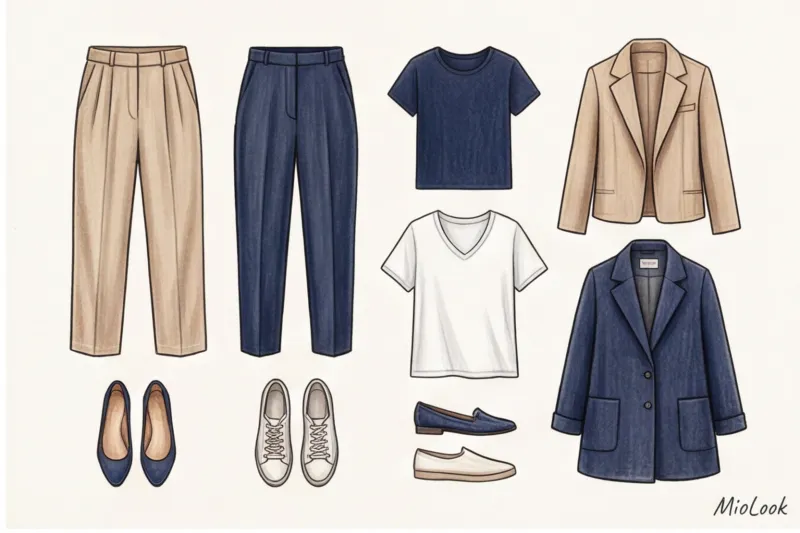
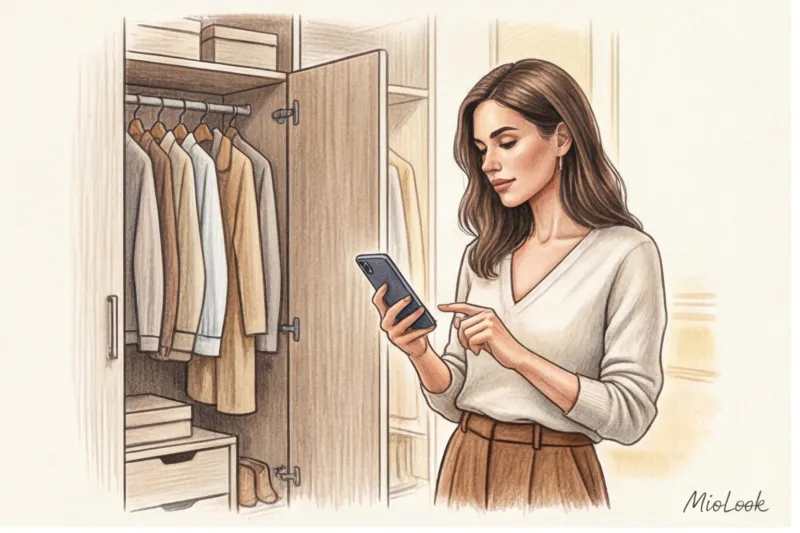
This matrix yields over 40 unique combinations. To ensure they work together, choose 2-3 neutral shades. For example, navy blue, milk chocolate, and dark chocolate. To avoid having to keep all this math in my head, I use MioLook — the app allows you to upload your planned purchases and visualize their compatibility even before you go to the checkout.
The foundation of images: the right "bottoms"
The ironclad rule of style: one bottom should be paired with at least three tops. It's the bottoms (trousers, jeans, skirts) that shape the silhouette and establish proportions. When choosing between jeans and trousers, consider your activity level.
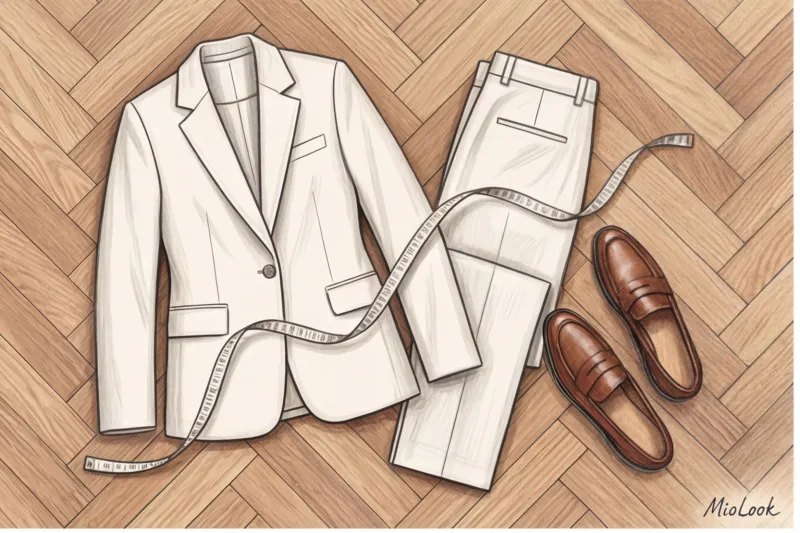
The main secret is that fit is always more important than trends. Pleated trousers may be all the rage, but if they create unwanted bulk around the midsection, ditch them for straight, pleated styles. If you're gathering budget capsule wardrobe , it's better to save on a T-shirt, but find trousers with the perfect fit.
Layering and versatility: tops, knits, and jackets
Distinguish between the base layer (what we wash after 1-2 wears) and the shaping layer (what defines the look). T-shirts and tops can be more versatile, but jackets and cardigans require some investment. A high-quality wool-blend jacket from Massimo Dutti or COS will instantly make a simple jeans-and-T-shirt look look more expensive and put-together.
Data Analysis: A Step-by-Step Shopping Plan to Build a Basic Wardrobe from Scratch
Styling isn't just about creativity; it's about working with data. The Pareto principle states that we wear 20% of the items in our closet 80% of the time. Our goal is to ensure that our basic wardrobe consists of only these 20%.
Before shopping, draw a diagram of your lifestyle. There are 168 hours in a week. Subtract sleep time. Divide the remainder into areas: office, walks, gym, dates, home. If the office takes up 10% of your time and strolling the stroller takes up 50%, then your budget shouldn't be skewed toward formal suits.
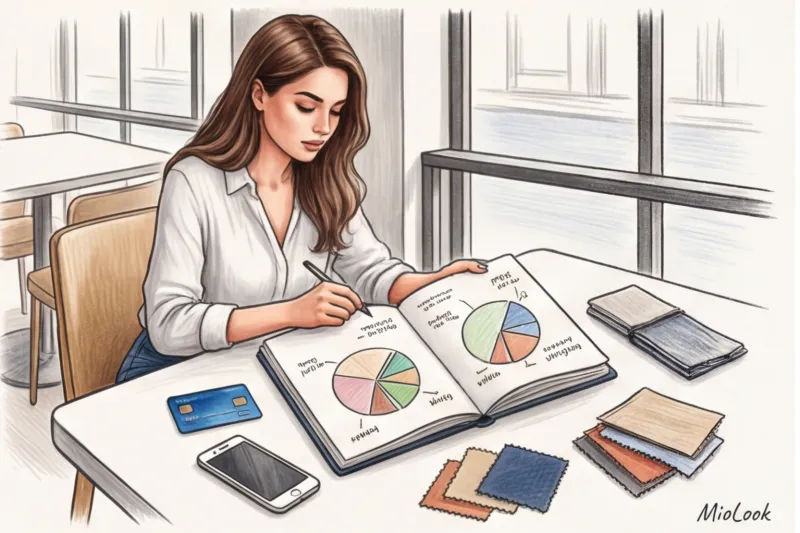
The second most important tool is the Cost-Per-Wear metric. I was once tracking my client's expenses. She bought a high-street acrylic sweater for €30. After two washes, it was covered in pilling, so she relegated it to her home-wear category. The cost per wear was €15. Meanwhile, her €200 cashmere jumper was worn all season (about 50 times) and looked great. Its Cost-Per-Wear was only €4. Calculating the cost of wearing an item — the best cure for impulse buying of cheap clothes.
Your perfect look starts here
Join thousands of users who look flawless every day with MioLook. Digitize your wardrobe now.
Get access — €0.99 onceTop 5 mistakes beginners make when building a database
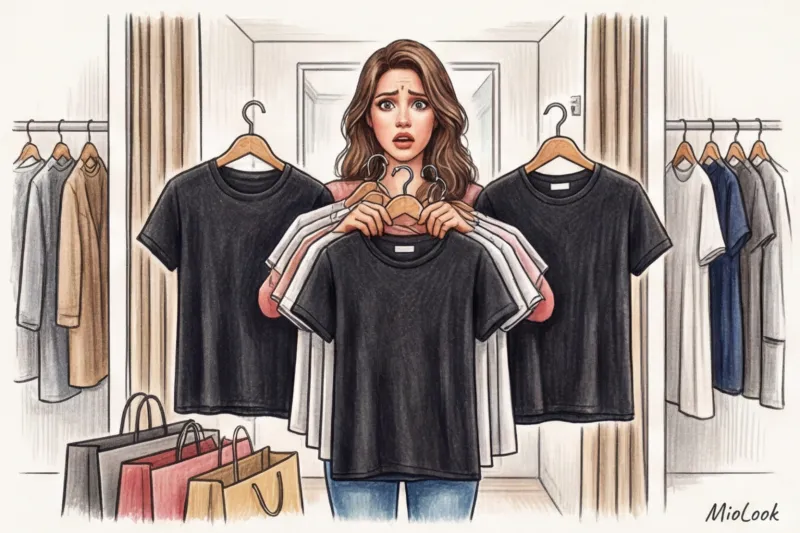
I'll be honest, even stylists make mistakes when they're just starting out. I once bought five identical white H&M t-shirts, thinking I was creating a "universal basic." They lost their shape within a month. Here are the top 5 pitfalls newbies fall into:
- Black turtleneck syndrome. You find a style that suits you and buy five identical items. Your closet is full, but you have nothing to wear—the outfits look cloned.
- Saving on shoes for the sake of quantity of tops. Cheap, uncomfortable shoes will ruin even the most carefully planned look and your posture. Basic shoes in the €100–€150 range will last many times longer than €30 options.
- Ignoring textures. If your entire wardrobe consists of smooth, matte cotton, your looks will be flat and boring. Basics call for a play of textures: smooth leather, textured knits, flowing silk.
- Purchase "for the future". "I'll buy these jeans a size smaller, it'll motivate me to lose weight." This is a surefire way to freeze your budget and ruin your mood. The basics have to work. Today.
- Blindly copying Pinterest. An oversized look that looks incredible on a tall model can visually add 10 kilograms to your figure if you have a different body type and contrast.
Checklist: How to check an item in the fitting room before buying
Basic items are worn most often, so they must undergo strict quality control. In the fitting room, I always make clients do three things.
First, the "three looks" test. Ask yourself, "Can I, right now, in my mind, create three outfits with this item from what's already in my closet?" If the answer is "no, this skirt needs a special top," the item stays in the store. This is a great way to stop buying unnecessary clothes.
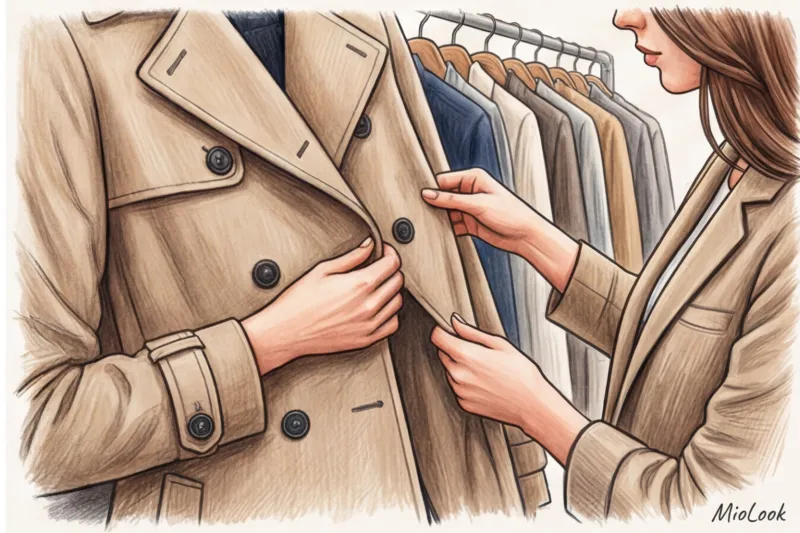
Then, do a physical test. Basic clothes should be comfortable to live in. Sit on a chair, raise your arms, and take a long step. Does your sweater ride up to your ears? Are your pants cutting into your waist? Leave them on. Basic clothes shouldn't require you to be patient.
Lastly, read the label. Avoid 100% acrylic and polyester in close-fitting garments. Look for cotton with a weight of at least 180 g/m² (it won't let underwear show through) or viscose with 5% elastane to maintain shape. Pay attention to the care instructions: if a basic turtleneck requires dry cleaning only, its practicality is nearly nonexistent.
Evolution, not revolution: how to integrate new purchases
Of course, there's a caveat: these tips may not work if you're under acute stress and shopping is a form of therapy. In that case, you risk buying "armor" rather than clothes.
Introducing new basics into your life should be an evolutionary process. Don't try to wear everything new on the very first day. Avoid the shock of a "new you." Start small: wear your perfect new jeans with your favorite old T-shirt. The next day, add a new jacket.
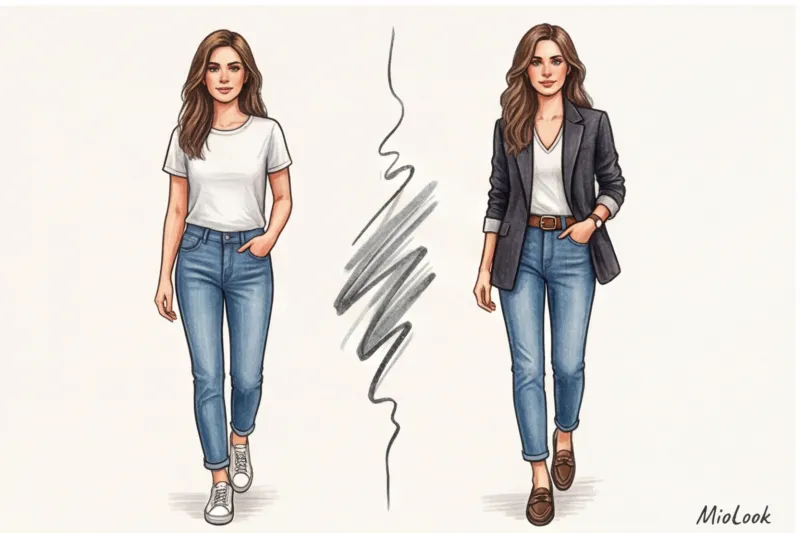
Accessories play a huge role in personalizing a basic outfit. A simple white T-shirt and blue jeans are the canvas. Add a structured leather tote bag, a belt with an accent buckle, and a pair of chunky gold earrings, and the look takes on a whole new meaning.
Remember the most important thing: a basic wardrobe isn't a static museum piece. It's a flexible algorithm that should evolve with your career, weight, and lifestyle. When building it, invest not in abstract lists from the internet, but in your personal, everyday comfort.