The Anatomy of a Breathable Wardrobe: Why Fabrics Are More Important Than Style for Summer Clothing
Imagine: it's mid-July, and the thermometer is a steady 32°C. You step out of your cool office into the scorching heat, and within minutes your luxurious, flowing dress is sticking to your back, and telltale stains are appearing on the fabric. Sound familiar? In 12 years of working as a personal stylist, I've learned one ironclad rule: when the temperature climbs, the right ones fabrics for summer clothes They decide absolutely everything. Style, trends, length—all of these fade into the background in the face of the relentless heat.
Every summer, I see the same thing: clients are buying up voluminous, roomy parachute dresses or wide tunics en masse, sincerely believing that the oversized fit will protect them from overheating. But there's a crucial catch. If this enormous "tent" is made of cheap polyester, you're simply creating a personal mobile sauna around yourself. A roomy cut is absolutely useless if the material blocks air circulation. As a stylist, I always focus on the Mediterranean approach to wardrobe. Look at the women of Naples or Seville—their style is built on the principle of "elegance without sacrificing comfort." They don't strip down to the bare minimum in the heat; they dress appropriately, choosing materials that act as a climate control system. The formula "Linen jacket + silk top + loafers = instant chic" works even in the heat of the moment, if the laws of tissue physics are observed.
Let's delve a little deeper into the physics of comfort. How you feel in your clothes is determined by two basic factors: thermal conductivity (the ability of a material to transfer heat from a hot body to the external environment) and hygroscopicity (the ability to absorb and quickly evaporate moisture). The human body cools itself through the evaporation of sweat. If a fabric is hygroscopic, it draws microscopic droplets of moisture from the skin and transports them to the surface, where they evaporate, removing excess heat.
The textile industry uses a special index called Air Permeability Index. Simply put, it's the volume of air that can pass through one square meter of fabric per second. For good summer linen, this index is off the charts, while for dense polyester, it's close to zero. If you're looking to sift through your inventory and ruthlessly discard non-breathable items, I recommend using smart wardrobe feature in the MioLook app - This really helps to organize the capsule before the onset of hot weather.
The Myth of 100% Natural: When Nature Works Against You
We're used to thinking that salvation lies in the coveted "100% cotton" label. Marketers have been telling us for decades that natural means cool. But this is precisely where the main pitfall of summer shopping lies. Remember: ingredients are only half the truth. Much more important is thread count and type of weaving.
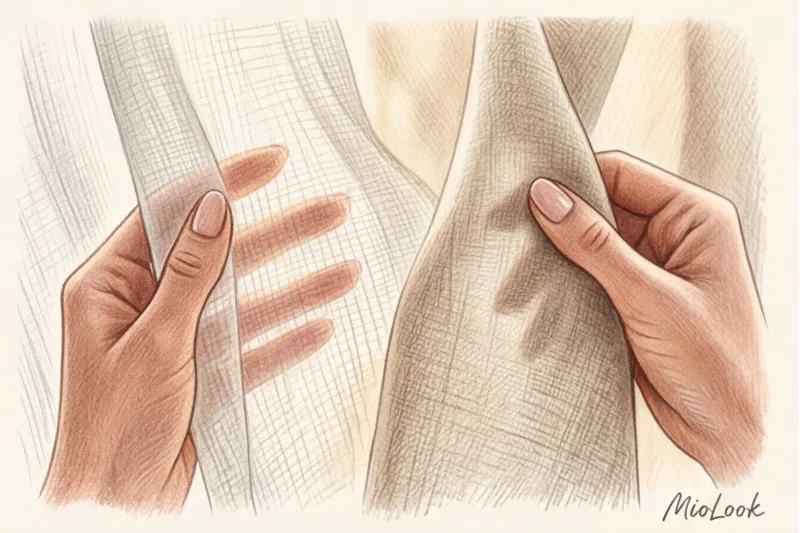
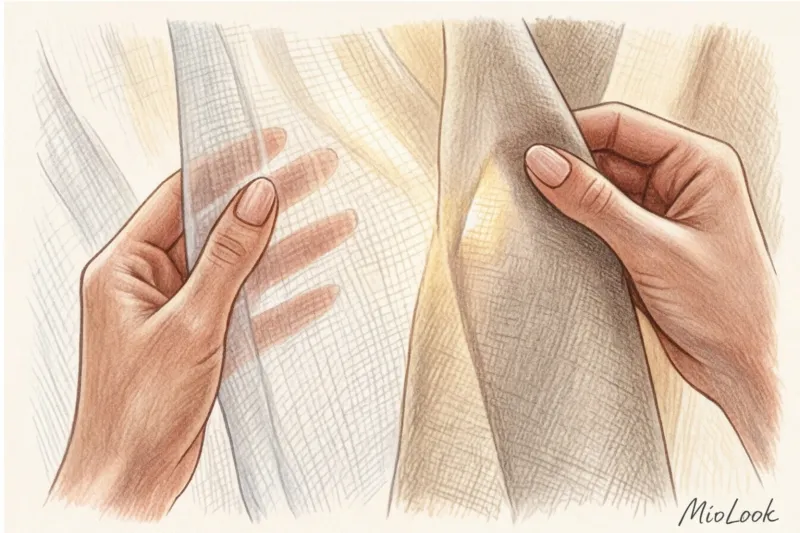
Compare the finest cotton cambric with dense cotton canvas or stiff denim. Both are 100% cotton. But cambric, with its loose, translucent weave, allows the skin to breathe, while in a heavy cotton jacket you'll be toast in ten minutes. Furthermore, dense 100% cotton retains heat far worse than some modern high-tech blends. The heavy fabric physically blocks convection. Air doesn't circulate, sweat doesn't evaporate, and a classic greenhouse effect occurs under the clothing: the temperature rises, and humidity increases.
"Never judge a summer garment solely by the composition on the label. Hold the fabric up to the light: if you can't see the outline of a lamp through the weave, it's not suitable for +30°C, even if it's premium organic cotton for €150."
Incidentally, overly dense, stiff natural fabrics often visually weigh down the silhouette and add volume. I discussed in more detail how texture influences the perception of age and status in my guide about dangerous textures and fabrics that age and cheapen the image.
A blind pursuit of "absolute naturalness" often leads to wet spots on your back and a bad mood. Nature can work against you if the material is woven too tightly. In the following sections, we'll explore which fabrics will help you survive the summer beautifully, maintaining freshness and a flawless silhouette from morning until late evening.
The King of Summer: Linen: How to Wear It Without Looking Wrinkled
Ask any textile engineer why humanity has worn linen for millennia in the hottest places on the planet, and they'll answer with one word: high thermal conductivity. It's pure physics of comfort: linen fiber has a unique ability to rapidly conduct heat away from the body and dissipate it into the environment. When you wear high-quality linen, the air temperature in the microspace between your skin and the fabric drops by 3-4 degrees. That's why, when we discuss the best fabrics for summer clothing, linen always takes the throne.
But whenever I suggest linen items during a shopping trip, I hear the same terrified argument: "Isabella, but in ten minutes I'll look like I slept in these clothes!" And here we need to draw a clear line between Mediterranean elegance and banal sloppiness.
There is a wonderful term in Italian style sprezzatura — the art of looking gorgeous without seeming effortless. The elegant creasing of linen is part of this art. But there's a nuance: the difference between chic and shabby is the density and length of the original fiber. Cheap, loose mass-market linen breaks into small, sharp, chaotic creases that give a garment a chewed-up appearance. Premium, high-density linen (such as Irish or Belgian) forms large, smooth, wave-like folds in key areas—the elbows, the pelvic area. These large creases convey confidence: "Yes, I'm hot, but I can afford this relaxed attitude."

It's important to understand the fabric's architecture: 100% linen is tricky and doesn't suit every silhouette. It works flawlessly in loose, flowing pieces. The ideal scenario for pure linen is tiered sundresses, loose, wide shirts, Bermuda shorts, and roomy palazzo pants. However, for rigid, architectural tailoring (tailoring strict shapes), pure linen is a bad idea.
One of my clients, a partner at a major law firm, once ignored this advice. For an important July court hearing, she bought a stunning fitted jacket with a stiff shoulder and a slim pencil skirt made of 100% dense linen. The idea seemed brilliant: natural composition, a classy texture. But reality proved merciless. Within 40 minutes in a taxi, the skirt had become covered in stiff, horizontal creases, like an accordion, and the narrow sleeve of the jacket had become so misshapen at the elbow that it had lost its shape. She walked into the courtroom feeling completely unsure of herself. The next day, we urgently replaced the suit with a smart blend—it looked like linen but behaved like a flexible suiting fabric.
Tired of unsuccessful summer purchases?
Try MioLook for free: our smart AI stylist will analyze your figure and select the perfect summer looks that will keep you cool in the heat.
Assemble a summer capsuleIdeal blends: linen with viscose, silk and cotton
If the aesthetics of pure linen seem too capricious for your working days, your salvation is smart lens hoods (smart blended fabrics). Modern textile factories create true masterpieces by blending fibers to compensate for the shortcomings of one material with the advantages of another.
Over the years of sorting through my wardrobes, I've come up with three absolutely foolproof formulas for summer fabrics:
- Linen + Viscose = softness and fluidity of the silhouette. Viscose (usually in proportions of 30% to 50%) counteracts the natural dryness and prickliness of linen. The fabric becomes heavier, flows beautifully across the figure, and doesn't stick out. This is the ideal formula for slip dresses, bias-cut skirts, or trousers that should flow elegantly as you walk.
- Linen + Silk = a classy shine for evening outings. Silk adds a delicate, luxurious sheen to the matte surface of linen and significantly increases its tensile strength. Pantsuits made from this blend are an investment (in the mid-up segment, prices typically range from €150 to €350), but they look truly luxurious and are the perfect choice for summer weddings or evening events.
- Linen + Cotton = perfect balance. Cotton makes the fabric more pliable when ironing while maintaining the characteristic texture of linen. An excellent choice for basic summer shirts and shorts.
Finally, I'll debunk the biggest myth: the presence of 10-15% high-quality synthetics (polyester, elastane, or polyamide) in linen is a blessing, not a brand's attempt to save money. In the industry, we call this small percentage the "invisible frame." The synthetic thread acts like a spring: it prevents pants from stretching out at the knees and buttocks by the end of the workday and helps the garment instantly regain its shape after washing. With such a low percentage, synthetics don't contribute to the greenhouse effect, but they save you hours of stress with the steamer in the morning.
Cotton Matrix: Choosing the Right Fabrics for Summer Clothing
Have you ever noticed this paradox: wearing a cotton T-shirt can feel like you're in a sauna even at 25°C, while wearing a shirt made of the same 100% cotton feels comfortable even in the midday heat? A study by the International Cotton Institute (Cotton Council International, 2023) confirms what tailors have known for centuries: the composition on the label is only half the truth. The other, much more important, half is the weave and twist of the threads.
Cotton is a true chameleon in the textile world. It comes in a wide variety of forms: from heavy, windproof denim to weightless, translucent cambric. As a stylist, I often see women suffering in the heat after buying a mass-market item with an overly dense, "crowded" texture, blindly trusting the label stating it's made of natural materials.
Insider tip: How can you tactilely distinguish high-quality summer cotton from cheap cotton right in the store? Run your fingertips over the fabric. Cheap cotton is often treated with starch or silicone impregnations to improve its appearance—it feels slightly "papery" and stiff. High-quality fabric made from two-ply threads, on the other hand, is cool, silky, and elastic to the touch. Try gently tugging the item diagonally: high-quality summer cotton should have micro-elasticity due to the weave itself, even if it contains 0% elastane.
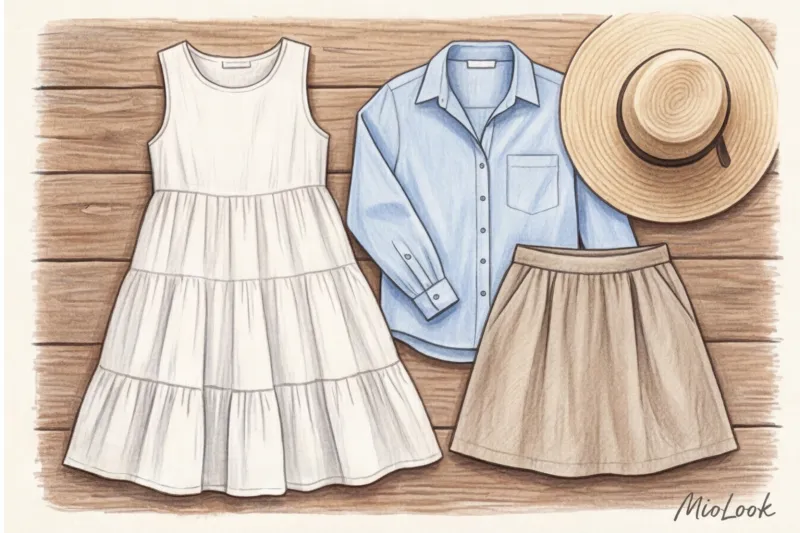
For the beach and vacation, cambric and muslin are ideal choices. Muslin, with its loose, slightly crinkled texture, offers phenomenal breathability. Air literally circulates freely between the threads of the plain weave. Cambric is the aristocrat of summer fabrics: ultra-fine and translucent, it's perfect for creating flowing swimsuit cover-ups or relaxed tunics.
However, there's a significant stylistic limitation here: muslin is absolutely not suitable for the office. Its relaxed, textured casualness at a business meeting will make you look as if you've just risen from a chaise lounge.
For workdays, poplin and satin are the best choices for business summer shirts. Poplin has a tight, finely ribbed weave. It holds its shape well, creating that crisp, fresh look without clinging to the body. Satin, thanks to its twill weave, has a delicate, luxurious sheen that instantly elevates the look. A good basic shirt made of high-quality poplin in the mid-price range will cost you between €70 and €120, making it the best investment in your work wardrobe.
My favorite summer formula for clients: a men's shirt (cotton poplin) + a silk midi skirt + leather loafers = instant chic with zero risk of overheating.
If you find it difficult to incorporate new textures into your everyday looks, I recommend uploading your items to MioLook — a smart algorithm will help you combine formal office poplin with softer elements of your current wardrobe.
The Denim Trap: Alternatives to Your Favorite Jeans at 30°C
According to sales statistics from European brands, jeans remain the best-selling bottoms even in the middle of July. And from a comfort standpoint, this is a colossal mistake. Why is classic denim dangerous in the summer? Technically, classic denim is woven so tightly that it has virtually no thermoregulation. It blocks moisture from wicking away from the body, creating the perfect incubator for a greenhouse effect. If you wear jeans with a weight of 12 oz (3.5 oz), in the heat, they turn into a portable sauna.
What's a great substitute for your favorite blue texture? Meet chambray. Visually, this fabric looks like denim (thanks to the weave of the blue warp and white weft), but breathes like the finest cotton. The secret is that chambray is woven using a plain weave rather than a twill, making it three to four times lighter and highly breathable.
Last year, while putting together a capsule wardrobe for a client ahead of a trip to sultry Rome, we swapped her heavy denim jacket for an oversized chambray shirt (costing around €85). The result? The same casual chic, the ability to tie a stylish knot at the waist, but with absolute comfort for hours-long outdoor excursions.
If you can't live without long pants, a stylish alternative to jeans is wide-leg palazzo pants made of thick yet smooth cotton. Their loose fit creates a layer of air between the fabric and your skin—that life-saving microclimate that acts as your personal air conditioner.
New classics: viscose, tencel, and cupro (artificial does not mean synthetic)
Let's take a quick test. If you see "100% lyocell" or "100% cupro" on the tag of a luxurious summer dress, will you hang it back on the rail thinking, "Just another cheap synthetic?" If so, you're voluntarily depriving yourself of the most comfortable and technologically advanced pieces for a scorching city summer.
There's a profound terminological confusion in the textile industry, which marketers are often slow to clarify. We need to draw a clear line between synthetic and artificial fibers:
- Synthetics (polyester, nylon, acrylic) is made from petroleum products. Basically, it's plastic.
- Artificial fabrics (viscose, tencel, modal, cupro) are made from natural raw materials - wood cellulose (eucalyptus, beech) or cotton fluff.
Yes, the path from wood to the finest thread passes through a chemical laboratory, but at the end we get a material that “breathes” as freely as nature, but has improved, specified properties.
According to the Lenzing Group and research by the Austrian Textile Institute, Tencel (the commercial name for high-quality lyocell) absorbs moisture 50% better than cotton and is a natural antibacterial material.
This means that even after a day in the sun or a long excursion on holiday, Tencel clothing will not develop an unpleasant odor and your skin will remain dry.
A special love of stylists is cupro In professional circles, we call it "vegan silk." It's made from linter—the finest fluff that envelops the cotton seeds, which was once considered a waste product. Cupro is ideal for summer slip dresses and flowing midi skirts. A good basic skirt made from high-quality cupro will cost around €90–€150 in the mid-range segment, but it's worth every penny.

The main magic of these fabrics for summer clothing is their dynamic behavior. Unlike thin natural silk, which can stick uncomfortably to the back in hot weather and highlight the slightest imperfections of the figure, cupro and tencel have a cool touch (cool touch). They are heavier and denser than base silk, so they flow beautifully, creating a luxurious, expensive silhouette that glides delicately over the body without clinging tightly.
My fail-safe formula for a hot evening: A cupro midi skirt + a basic cotton off-shoulder T-shirt + minimalist mules. Looks classy, feels like pajamas.
Try MioLook
for free
Start creating perfect images with the help of artificial intelligence
Get access — €0.99 onceBeware of viscose: how to choose one that won't let you down
But there's a fly in this barrel of cellulose honey, and its name is basic viscose. Despite all its breathable properties, viscose is incredibly difficult to care for. The main problem is shrinkage. Viscose fibers drastically lose strength when wet. If you wash viscose palazzo pants at temperatures above 30 degrees Celsius and spin them at 800 rpm, they will inevitably turn into capri pants. Such items should be washed exclusively on a delicate cycle, or better yet, by hand.
The second hidden trap is hydrophilicity. Viscose eagerly absorbs moisture, and when wet, the fabric instantly changes color, becoming several shades darker. Hidden sweat stains are guaranteed on a solid-color powder, olive, or light gray viscose blouse at 30°C. This is simple physics, and fighting it with deodorants is useless (incidentally, ingrained stains can be extremely difficult to remove later).
Rules for choosing viscose for summer: Use visual camouflage. To hide possible signs of heat, choose crepe viscose (crinkle) or items with a bold print rather than a smooth, solid-color fabric. A small floral pattern (millefleur), abstract geometric print, leopard, or zebra print work flawlessly. A colorful pattern distracts from the viewer's attention: even if the fabric darkens locally from moisture, those around you simply won't notice, and you'll maintain your confidence at any business meeting.
Blended Fabrics: A Stylist's Secret Weapon Against the Greenhouse Effect
Behind the scenes at premium fashion houses, they've long since abandoned the idea of absolute naturalness. If you look at the collections of perfectly tailored brands, you'll rarely find pure, unadulterated materials. The reason is simple: 100% natural materials are perfect for a leisurely beach holiday, but in the realities of a busy city, they often mean stretched knees, faded color, and a downright rumpled look by lunchtime.
This is where the stage comes in Smart Blends Modern textile laboratories have learned to cross-link fibers at the micro level to capture the best of nature and enhance it with chemical advances. In such materials, synthetics don't create a plastic bag effect, but rather act as an invisible architectural framework, supporting the garment's structure.
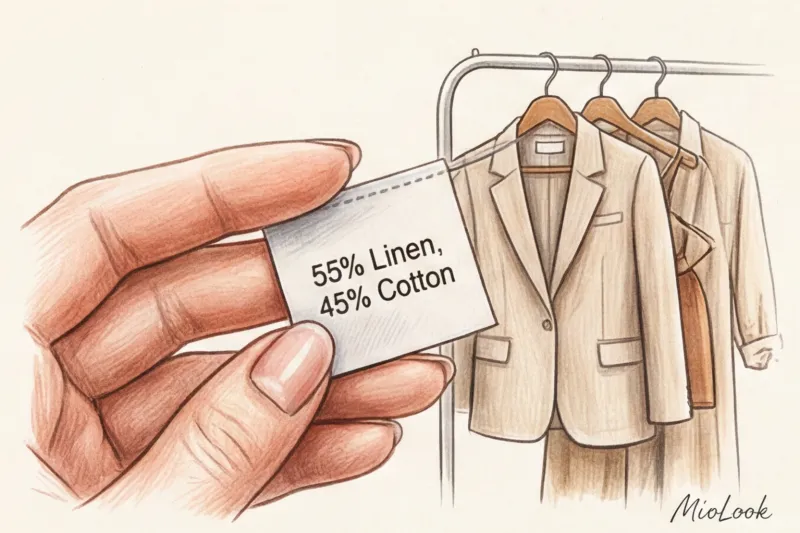
As a stylist, I always check the composition before purchasing a capsule wardrobe for my clients, especially when putting together a business wardrobe for the hot season. My experience working with different body types and dress codes has allowed me to develop a golden formula for the perfect fabric for the summer office. Look for the following proportions on the tags:
- Natural base (70–80%): Cotton, high-quality viscose, or linen. These are responsible for that hygroscopicity and free air circulation. This is your basic built-in "air conditioner."
- Dimensional stability (15–20%): Polyester or polyamide (nylon). This additive literally reinforces the thread. It prevents the fabric from shrinking when washed and prevents deep, unsightly creases in the elbows, groin, and thighs.
- Elasticity (2-5%): Elastane or spandex. A critical element for trousers, pencil skirts, and fitted dresses, allowing the garment to move with you.
Many people are still terrified of the word "polyester" in the composition, considering it a sign of mass-market products. This is a grave misconception. By choosing the right fabrics for summer clothing, you're investing in durability. Why do these items last longer and look more expensive after washing? When subjected to friction, 100% natural thread quickly wears out and becomes covered in pilling. A synthetic core, on the other hand, absorbs the mechanical stress.
Moreover, polyamide fibers retain pigment remarkably well. A dark blue or emerald business suit will remain vibrant even after dozens of washes and long walks in the sun. By comparison, a pure cotton jacket costing €300 may lose its luster and fade at the seams by August, while a well-made blended option from the mid-range (in the €120–150 range) will retain its original elegance for several years.
"A high-quality blended fabric is like the perfect perfume: the base notes set the character, and the synthetic aldehydes make them linger and last. Don't be afraid of 15% synthetics, but be wary of 100% dense cotton without elastane on a hot day."
To avoid getting confused by labels and ingredients, I strongly recommend digitizing your successful finds. When adding a new summer item to MioLook smart wardrobe Be sure to record the fabric composition in the item card. This way, by next season, you'll have clear personal statistics: which blends best withstood the heat and washing at your pace.
When Synthetics Are a Plus: High-Tech Fabrics for Summer Clothing
If I suggest you wear 100% polyester in 90-degree heat, you'll likely shake your head. Our collective memory is rife with the trauma of the '90s: squeaky, electric-shocking blouses that left you suffocated after five minutes. But forget about that. The modern textile industry has come a long way, and today, high-tech synthetics aren't a compromise for poverty, but a conscious choice for luxury brands and a salvation for a dynamic lifestyle.
According to WGSN reports for 2023, the share of technological fibers in everyday summer collections has grown by 40%. This raises a logical question: why is modern, high-quality polyester more expensive than basic cotton? It's all about yarn engineering. Creating a fiber with micropores that wicks away moisture requires colossal investments in R&D. The secret lies in the shape of the fibers themselves—they're not round in cross-section, but have special grooves that literally push moisture out. This is why a technologically advanced piqué polo from Loro Piana or an innovative nylon top from Prada can cost €500–€800, while a regular cotton T-shirt costs only €15. You're paying for invisible climate control for your body.
When we discuss truly functional fabrics for summer clothing, this evolution of sports technology in everyday wardrobes (the athleisure phenomenon) comes to the fore. Clothes originally designed for marathons have been adapted to the urban rhythm. Be sure to pay attention to the labels. Dry-fit , Coolmax and ultra-thin products microfiber Unlike basic cotton, which absorbs sweat and remains damp for hours, creating an unpleasant cold compress on your back, these fabrics act as capillaries. They instantly wick moisture away from the skin and onto the surface of the garment, where it evaporates in minutes.
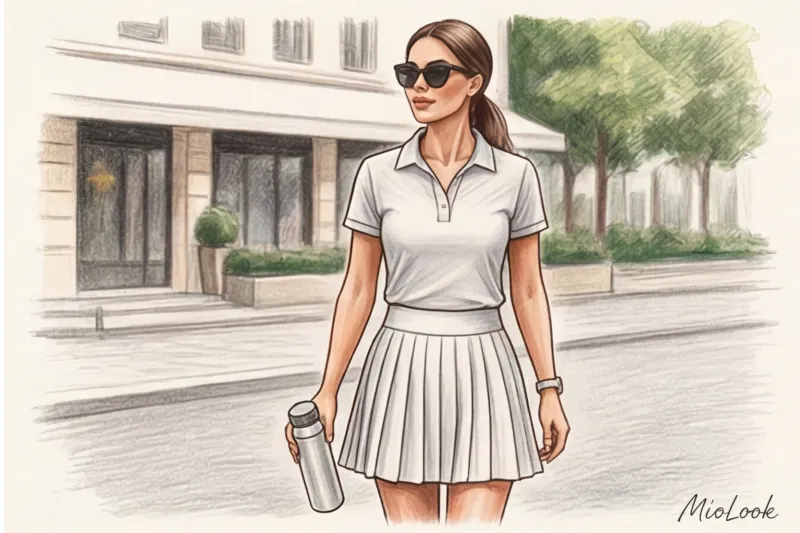
When is this type of clothing indispensable? From my styling experience, I've identified three main scenarios where classic linen or silk are hopelessly outclassed. The first is long flights. Technical microfiber trousers won't stretch out at the knees after 10 hours in a plane seat and won't wrinkle at all, while allowing your skin to breathe freely. The second scenario is a golf course or a respectable country getaway. Here, old-money aesthetics are important, but complete freedom of movement without telltale sweat stains on your back is essential. And finally, the third, most realistic option is active walks with children. When you need to run around a hot playground and then look fresh for lunch at a cafe, a dress made of breathable sports polyester will be your best investment of the season.
Your ideal image
it begins Here
Join thousands of users who look flawless every day with MioLook. Our smart algorithm will help you integrate tech-forward pieces into your basic wardrobe.
Get access — €0.99 onceTo avoid a high-tech piece looking like you forgot to change after the gym, use contrasting textures. Wear a simple Coolmax top under a tailored, lightweight jacket, or pair breathable culottes with elegant leather sandals—this way, you'll strike a balance between absolute comfort and polished style.
Summer Dress Code Without the Pain: Putting Together a Breathable Capsule
The math behind a smart summer wardrobe isn't about an endless supply of T-shirts and shorts, but rather about clever combinations and thermoregulation. Building a summer wardrobe around random purchases is a poor strategy. My tried-and-true formula for a compact yet completely self-sufficient capsule wardrobe includes exactly 10 items.
Here is the perfect constructor: 3 "bottoms" (structured Bermuda shorts or palazzo shorts in heavy linen, relaxed chambray trousers as an alternative to denim and a flowing cupro midi skirt). 5 "tops" (two cotton poplin shirts - formal and oversized, a stately silk top for evening wear, and two lightweight viscose blouses). Completing the architecture 2 dresses: a laconic tencel shirt dress for the city and a weightless muslin one for the hottest days.
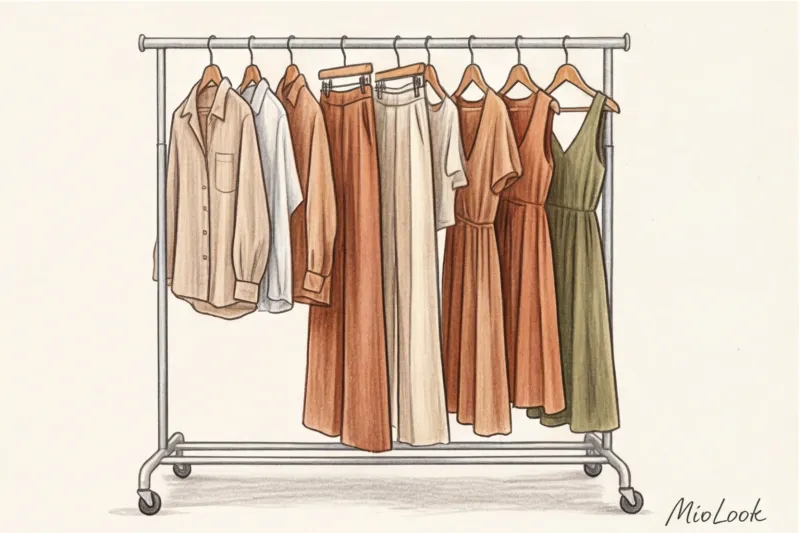
Many people mistakenly believe that layering is exclusively a fall or winter style. On the contrary, in July, the right second layer acts as your personal climate control. The main purpose here is protection from the harsh UV rays on a scorching street and the icy air conditioning in an office or restaurant.
Layer a shirt made of translucent cambric or the finest linen over a silk top. These fabrics create a protective layer of air, preventing your skin from overheating in direct sunlight and protecting your shoulders from drafts. To avoid a heavy look, leave the cape open—this will create a vertical line that visually elongates your silhouette.
Pairing summer fabrics with a business dress code requires pinpoint precision. If your office has a strict, formal protocol (Business Best), pure linen is off-limits due to its natural wrinkling. In this case, your savior will be a fine summer wool (cool wool) or a dense tencel, which visually imitates matte silk but perfectly maintains a crease in trousers.
For Smart Casual, the rules are much more relaxed. Here, my favorite rule of thumb works flawlessly: Linen blend trousers + viscose top + unlined cotton jacket Pay special attention to the last point. The absence of a polyester lining in a jacket is a critical detail. Even the most expensive premium cotton is useless if there's a layer of non-breathable synthetic material between it and your skin. A high-quality deconstructed jacket without a lining typically costs between €150 and €300, but this investment pays off in comfort during the first few days of hot weather.
By the way, if you have any doubts about how these different textures will go together, I recommend uploading photos of your items to MioLook smart wardrobe The app will help you visualize the capsule on your smartphone screen and clearly show you which cotton tops will pair best with your new chambray trousers or cupro skirt.
Insider Checklist: How to Check Summer Fabric Right in the Store
You're standing in the fitting room. You're wearing a stunning pistachio-colored dress, the price tag confidently proclaims its Italian origin, and the salesperson swears it's the perfect choice for a sweltering July. But how can you tell if you're actually looking at the right fabrics for summer wear, and not a pretty trap that will leave you sweating in ten minutes?
Forget blindly trusting marketers. During my shopping support, I always teach my clients one simple algorithm for physically inspecting materials. You can use this checklist today, and it will save you from dozens of unsuccessful purchases.
1. Light Test
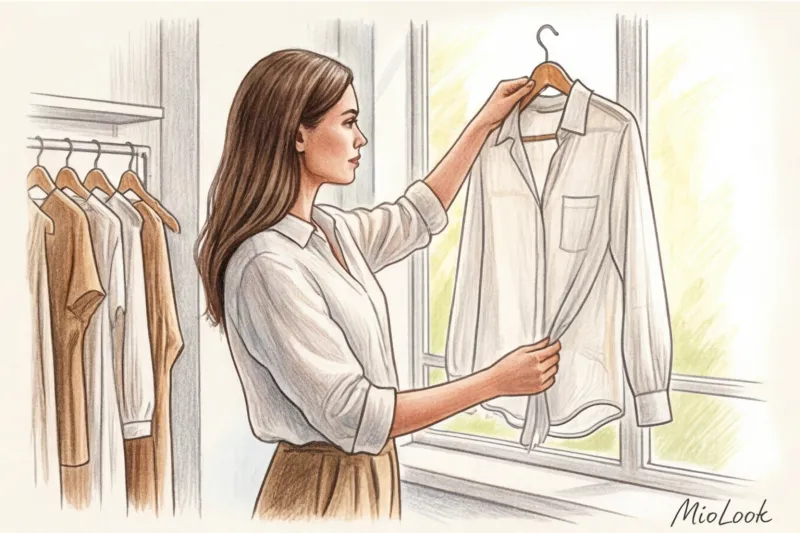
Take the garment and look through it under the brightest light in the fitting room. We're not interested in the dress's transparency (that's a matter of underwear), but in the weave pattern of the threads. If the fabric looks like a solid, monolithic wall, air won't pass through it either. You should see microscopic gaps between the fibers. Exception: This rule does not apply to high-tech sportswear with UPF filters, where thermoregulation is provided by the capillary structure of the fiber, and not by the looseness of the fabric.
2. Tactile cooling test
Our fingertips are too rough to truly appreciate a material's thermal conductivity. Place the fabric against your cheek or the inside of your wrist—the most sensitive thermoreceptors are located there. High-quality linen, Tencel, cupro, or treated cotton will immediately provide a pleasant cooling sensation. While the fabric initially feels neutral or warm, at 30°C (86°F) it will transform into your personal heater.
3. Crease test (ten-second rule)
Gather the edge of a hem or sleeve into a tight fist, hold for exactly ten seconds, and release. It's not whether the item is wrinkled (natural fibers always wrinkle), but how exactly She did it. Fine linen and expensive blends leave behind soft, flowing waves. But cheap viscose or over-dried, low-grade cotton will develop small, sharp creases, reminiscent of a crumpled notebook page. Trust me: such spiky geometric patterns will instantly cheapen even a €500 outfit.
4. Study the lining (the main hidden threat)
Last spring, a new client brought in a luxurious double-breasted jacket she'd bought herself for €300 for a wardrobe review. "Isabella, I don't understand. Linen is supposed to breathe, but it feels like a sauna!" I turned the jacket inside out, and everything fell into place—the lining is 100% polyester. This is the most cynical trick of mass-market brands, and even mid-market ones. A solid polyester layer completely blocks the air circulation of linen or cotton, creating a complete greenhouse effect between the body and the outer fabric. Look for linings made exclusively of viscose, cupro, or thin cotton. And for the height of summer, deconstructed styles (without a back lining) are the ideal choice.
"Summer elegance isn't about being willing to endure discomfort for the sake of a beautiful silhouette. It's about understanding the physics of materials and being able to read between the lines on store labels."
We're wrapping up this guide, but your journey to flawless summer style is just beginning. Once you learn to weed out non-breathable items before you even reach the checkout, the problem of "nothing to wear in the heat" will disappear forever. Opt for Mediterranean relaxation, invest in smart blends, and remember: clothes should serve your comfort, not the other way around. The right fabric is your invisible air conditioner, and now you know exactly how to set it.
To consolidate this skill in practice, I strongly recommend digitizing your most successful and comfortable summer items in smart wardrobe MioLook Analyze the composition of the dresses and blouses that make you feel great, and the system will help you build your next flawless capsule wardrobe based on this proven foundation.
Guide Chapters
Choosing an evening dress for summer: fabric for heat
In a summer evening dress code, plain cotton is out of place, and heavy velvet is a real pain. We're breaking down the best fabrics for a flawless evening out.
Is silk too hot to wear in summer? Stylist advice.
Is it true that natural silk can create a sauna-like effect? We'll explore the physiology of fabrics and learn how to choose the perfect slip dress for a hot summer.
How to wash linen clothes so they don't shrink
Worried about ruining your favorite linen dress after just one wash? Learn the secrets of proper linen care from a professional stylist.
Sun Protection Fabrics: A Guide to UPF Clothing
Regular white cotton provides less UV protection than SPF 10 sunscreen. Learn how UPF protection works and what clothing to choose for a safe summer.
Is polyester okay to wear in summer? A stylist's answer.
We're exploring whether it's worth completely abandoning synthetics in hot weather. Learn how to distinguish cheap polyester from modern, high-tech fabrics.
Which cotton is best for summer: poplin, batiste, satin?
A "100% cotton" label doesn't guarantee coolness in the summer heat. We'll explain how the weave of the yarns affects comfort and how to choose the perfect fabric.
Как выбрать лен чтобы не мялся: секреты смесовых тканей
Идеальный стопроцентный лен без заломов — это миф. Рассказываем, как правильно подобрать смесовую ткань для летнего костюма, чтобы выглядеть статусно даже в жару.
Fabrics that don't show sweat: A summer guide
Conventional summer wardrobe guidelines don't always prevent damp stains. Learn which materials and colors to choose for a flawless look.
Tencel Fabric for Summer: Why It's Better Than Linen
Tired of constantly wrinkling linen? Find out why eucalyptus clothing has become stylists' top secret for a flawless look in the summer heat.
Women's Summer Muslin Clothing: Styling Tips
Muslin is this summer's absolute hit and the perfect solution to the heat. We'll explain how to choose, wear, and care for this season's most breathable fabric.
Breathable fabrics for summer office wear at +30°C
Business dress codes in hot weather require special materials to avoid awkward creases and the greenhouse effect. We'll explore how to maintain status and comfort at 30°C.
Is viscose too hot for summer? A stylist's answer.
Is it true that viscose is too hot in summer? A stylist debunks the main myths about this popular material and explains how to wear it properly in hot weather.
Clothes for chafing thighs in summer: stylist tips
Thigh chafing is a common problem that's related to anatomy, not weight. We'll tell you how to choose a summer wardrobe to eliminate pain while walking forever.