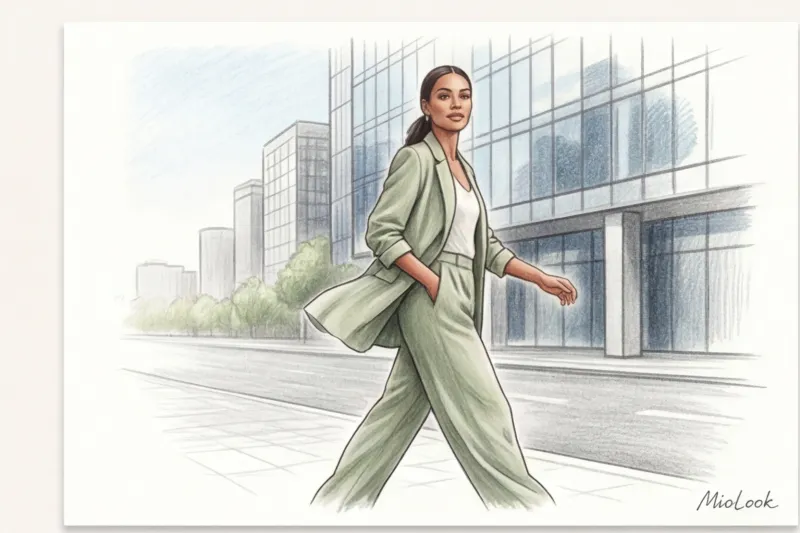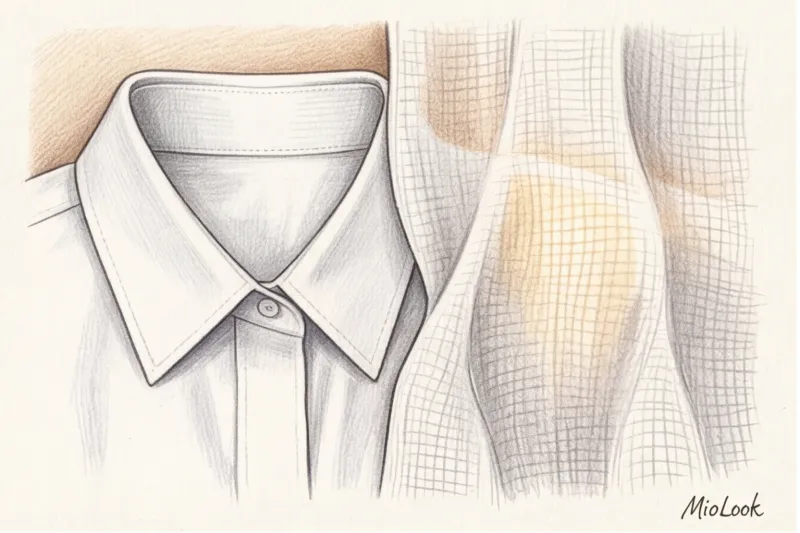
Last summer, my client Elena, the CFO of a major bank, stunned everyone at a challenging board meeting. She had a flawless presentation and a luxurious cream-colored pantsuit for €800. There was just one problem: after two hours of tense negotiations, Elena was physically unable to leave the table. Her 100% linen trousers had developed a disastrous network of creases in the groin area, and the knees had bunched up. The fabric's physical properties had irreparably ruined her expensive look.

When the temperature hits 30°C and corporate protocol demands covered shoulders and strict silhouettes, we often resort to extremes. We either struggle with thick cotton or stock up on sheer beach linen, hoping the boss won't notice the difference. But The best fabrics for summer clothing, as I detailed in our complete guide , operate under completely different laws when it comes to business.
As a colorist and image consultant, I constantly see how poorly chosen formulas can visually "cheapen" a professional's appearance. Today, we'll explore which ones. fabrics for summer office wardrobe will allow you to look like a million bucks without getting heatstroke on the way to the cooler.
Why a strict dress code and 30°C are a conflict of physics and etiquette
Let's be honest: the classic business suit was historically designed for London's cool climate. The tight fit, peak lapels, and sharp creases in the trousers all require fabrics that provide support. But in summer, our bodies crave the exact opposite: softness, heat management, and ventilation.
If you look at the evolution of Queen Letizia's business style , known for her impeccable power dressing, you'll notice an interesting detail. Her summer suits never look lax. The secret lies in understanding two basic textile properties: thermal conductivity and hygroscopicity.
- Breathability — is the ability of a fabric to allow air to pass through (think gauze or loose beach linen). In the office, excessive breathability often means transparency, which is unacceptable.
- Hygroscopicity — the fiber's ability to absorb sweat and quickly evaporate it into the environment. This property is key to summer classics.
The ideal office fabric should do the impossible: be tough on the outside, but perform like high-tech sports gear on the inside.
The main myth: "You should only wear 100% natural fabrics to the office in the summer."
"Buy only 100% cotton, linen, or silk" is the most harmful fashion advice that's been passed around from blog to blog. For a vacation on the Amalfi Coast, yes. For a formal office, a definite no.
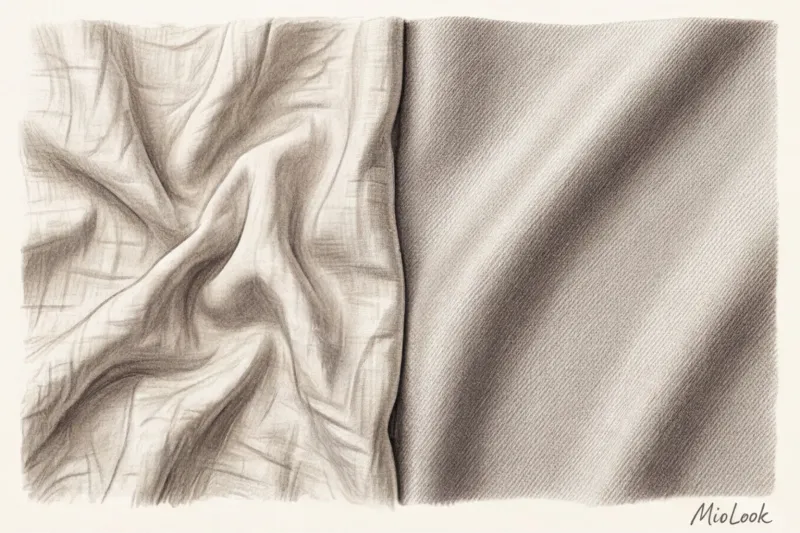
Over 12 years of practice, I have identified a clear pattern for how “pure” natural fabrics behave under 8-hour workday conditions:
"100% natural, pure fabric is a ticking time bomb in an office environment. It takes on a life of its own, not your professional tasks."
- Flax: Thermally perfect, but visually awful. After an hour of sitting at the computer, the pants are covered in deep creases. It doesn't look like "expensive carelessness," but rather like sloppiness.
- Silk: Smooth satin silk is a litmus test for sweat. The slightest disturbance during a planning meeting and dark, damp spots appear under your arms or on your back, taking hours to dry.
- Cotton: Thick poplin (the kind used to make classic shirts) holds its shape well, but in hot weather it acts like a wet compress. It absorbs moisture but releases it very slowly.
Access to MioLook for €0.99 — one-time payment
A smart AI stylist will select the perfect look based on weather conditions and your dress code.
Get access — €0.99 onceCool Wool: The Executive's Secret Weapon
And now the most counterintuitive piece of advice that my new clients find puzzling: In the summer you should wear wool to the office No, I'm not crazy. I'm talking about so-called "summer wool"—tropical wool or fresco.

If you pay attention to the standards of men's classic fashion at the Pitti Uomo trade fair in Florence, you'll see Italian businessmen wearing suits comfortably in August temperatures of 32°C (90°F). The trick lies in the thread technology. Fresco threads are twisted several times more strongly than usual (high-twist). This smooths out the fibers, and micro-holes form between the threads.
According to research by The Woolmark Company (2023), highly twisted wool wicks away body heat 20% more effectively than dense cotton. Wool fiber is also resilient: you can sit cross-legged for three hours, stand up, and your trousers will still have perfectly sharp creases.
Practical advice: When examining the label or consulting with a tailor, look for the GSM (grams per square meter) density. Ideal wool fabrics for summer office wear weigh between 180–230 g/m².
Smart blended fabrics for your summer office wardrobe
Here we come to the main mistake that even fashion influencers make: they confuse artificial and synthetic fabrics.
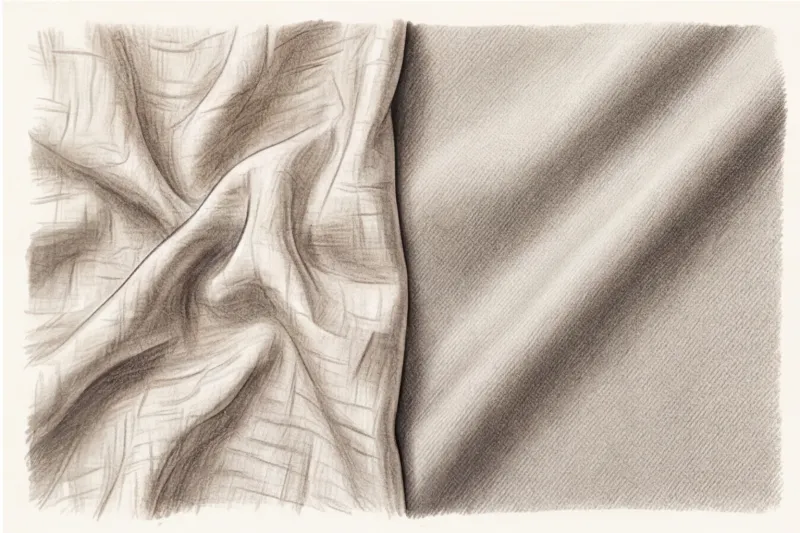
- Synthetics (polyester, acrylic) is made from petroleum products. It is plastic. It does not breathe.
- Artificial fabrics (viscose, cupro, modal, lyocell/tencel) are produced chemically, but from natural raw materials - wood pulp or cotton fluff.
Intelligent fabrics like cupro cool the skin better than natural silk and absorb moisture faster than cotton. But the real magic happens when they're blended.
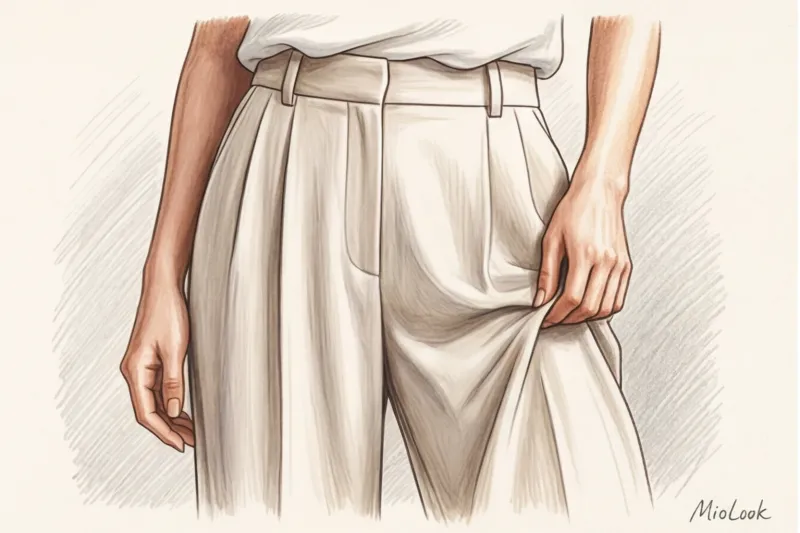
A blend of natural fibers with artificial fibers, or even a tiny amount of synthetics, isn't a brand's attempt to cut corners, but rather a sophisticated comfort technology. Here are the gold standards of blended fabrics I look for for clients in the €150 to €400 price range:
- 50% wool + 30% silk + 20% linen: A masterpiece blend. Linen creates a beautiful, loose texture, silk adds a refined matte sheen, and wool ensures the garment maintains its precise shape.
- Viscose + 3-5% elastane: That same insurance policy against stretched knees on trousers.
- Linen + 20% polyester: Yes, I recommend polyester! Just 20% high-quality synthetic fiber in a linen suit won't turn it into a greenhouse, but it will prevent it from looking like chewed-up paper by the end of the workday.
Lining: Hidden Enemy or Salvation?
Remember this hard and fast rule: even the most expensive and breathable tropical wool jacket will turn into a sweat trap if it has a 100% polyester lining sewn into it. You're literally putting a plastic bag on top of the finest wool.
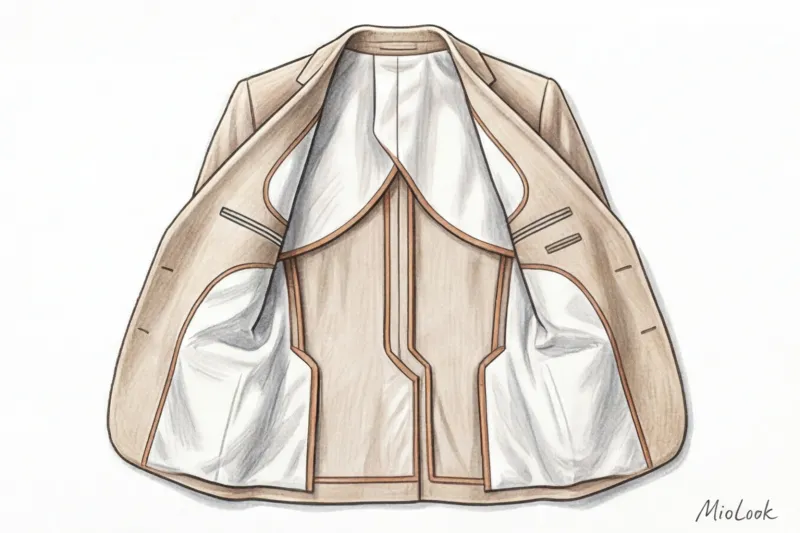
What to do? Turn things inside out right in the fitting room. If the dress code allows it. business casual Look for jackets with a half-lined design. The lining fabric covers only the shoulder blades (so the jacket can slide over the blouse) and the sleeves.
If you're buying an unlined jacket, pay attention to the seams. Premium jackets have all interior seams bound with bias binding (called Hong Kong binding). The lining itself should be made exclusively of viscose, acetate, or cupro—no polyester.
Your perfect look starts here
Join thousands of users who look flawless every day with MioLook. Upload your wardrobe and get ready-made looks.
Get access — €0.99 onceSuitability Test: How to Choose Breathable Fabric Right in the Store
To avoid relying solely on labels, I always teach my clients to perform three quick tests right on the sales floor.
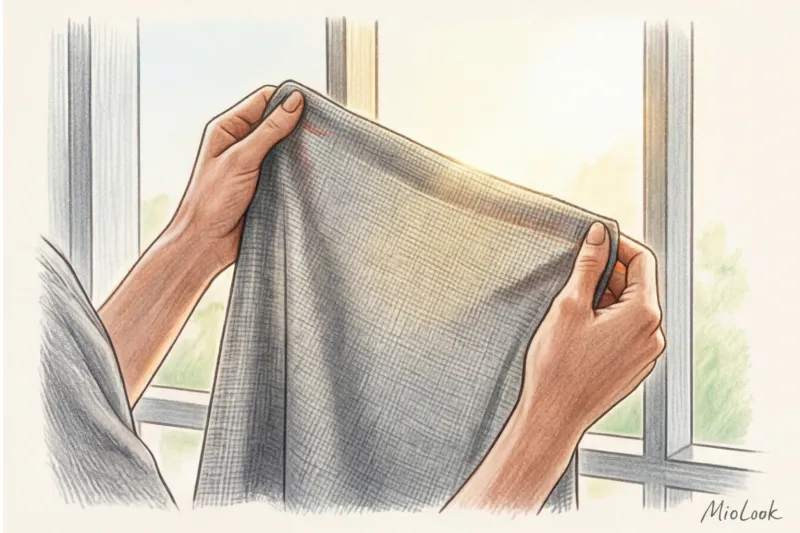
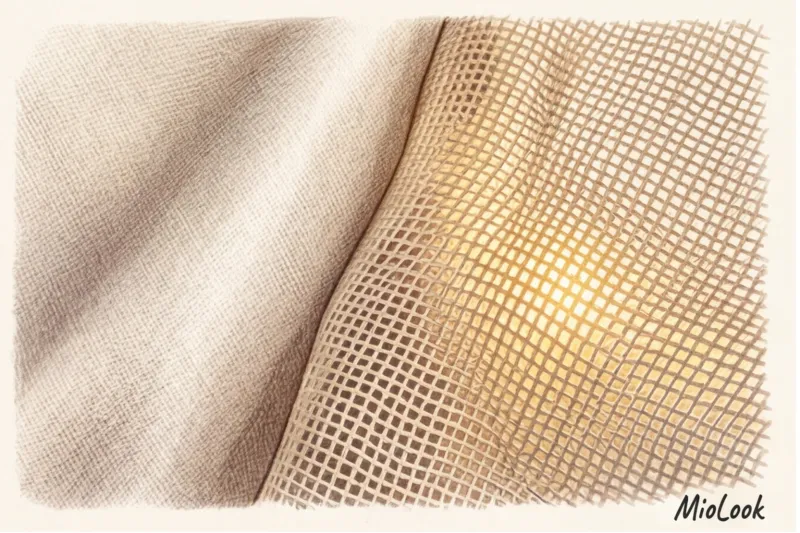
1. Transmission test. Take the hem of a trouser leg or the back of a jacket (without the lining) and hold it up to natural window light—not a store studio lamp! Tropical wool or the right linen blend should show through slightly, with micro-dots. This indicates a porous structure.
A fair limitation: this test does not work well on high-density dark blue and black fabrics; here you will have to rely solely on the composition.
2. Crash test in a fist. Squeeze the edge of the fabric in your fist and hold it for exactly 10 seconds. Release. If the fabric immediately straightens out (or soft creases remain), take it. If the creases remain sharp, like a sheet of paper, the item won't survive even a taxi ride to the office.
3. Micro-drop test. If you're unsure about the absorbency of viscose (especially viscose), discreetly drip a drop of clean water onto the inseam. If the fabric is well-made for summer, the water will immediately absorb and darken. If the drop forms a ball, the fabric has been treated with harsh chemicals or contains too many hidden synthetics.
Stylist Checklist: Putting Together a Breathable Capsule in MioLook
A summer office wardrobe doesn't have to be huge. It's enough to assemble the right basics. My formula for the perfect capsule wardrobe, which we usually integrate into smart wardrobe feature in the MioLook app , looks like this:
- 1 jacket: Tropical wool or silk-linen-wool blend, straight cut, semi-lined.
- 2 pairs of wide trousers: Some are made of thick tencel/cupro (flow beautifully), others are made of blended wool (hold the arrow).
- 3 tops: Dense matte silk (crepe de chine) or high-quality viscose without shine.
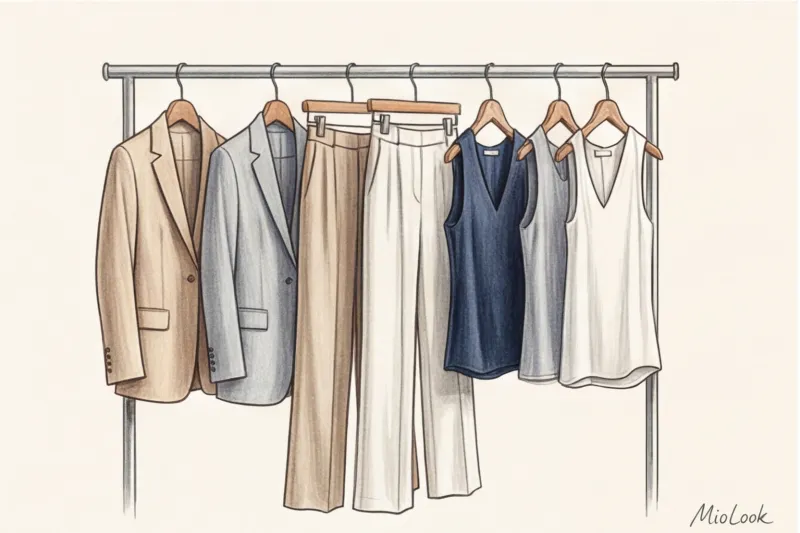
Don't forget about color. According to the Pantone Color Institute, the perception of temperature is directly related to visuals. Black at 30°C looks heavy and inappropriate, even with a strict dress code. Replace it with deep navy, coffee-with-milk, taupe, or pearl gray.
By uploading these basic items to the MioLook virtual wardrobe, you can filter clothes by season in just a few clicks and ask the AI stylist to create an outfit based on a specific weather forecast. This saves up to 20 minutes of your morning routine.
The perfect summer wardrobe isn't a compromise between a dress code and a sweaty nightmare. It's simply the right physics of materials. Invest not in the brand logo on the buttons, but in the "Ingredients" line on the inside tag—and you'll look like a boss who's in control of not only the business processes but also the temperature around them.