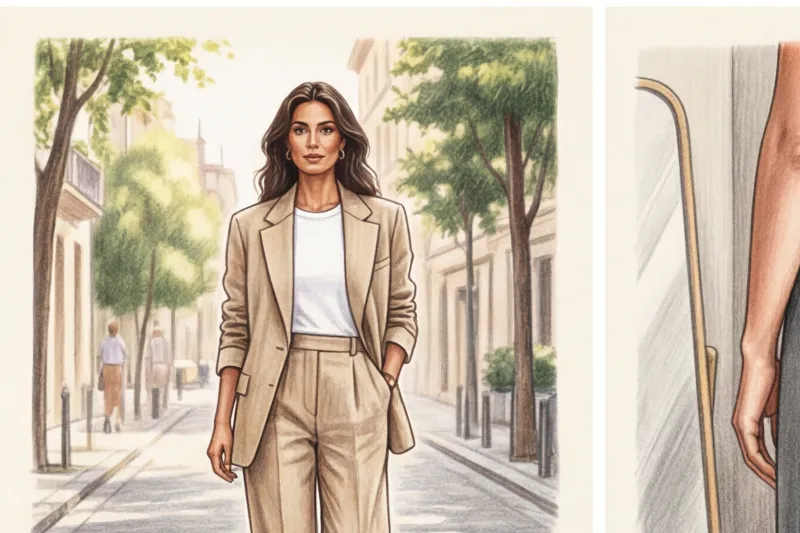
Why a Perfect Fit Matters More Than a Brand: The Mediterranean Style Secret
Have you ever noticed the paradox: one woman in a simple white T-shirt and jeans looks like an heir to an empire, while another in a runway suit looks like she's wearing someone else's? Over 12 years of working as a personal stylist, I've learned an absolute rule: the secret lies not in the price tag, but in how the fabric interacts with your body. It's precisely the right tailoring clothes to fit the figure turns ordinary mass-market products into exclusive items and makes the image sound expensive.
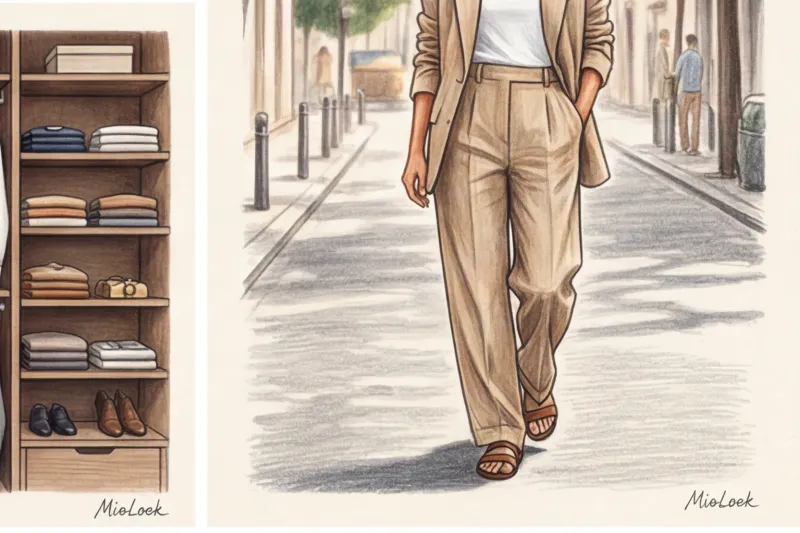
I had a very revealing case. My client bought a Prada skirt for €850, but it kept bunching up in the crotch area—the pattern was designed for a narrower hip. Around the same time, we bought a basic pencil skirt from Zara for €40 and took it to my tailor. For €15, the tailor slightly cinched the waist and adjusted the length to perfectly match the client's natural calf curve. Guess which skirt she wore at a professional conference earned her more compliments? That's right, the Zara one. It's pure style math.
The secret to a luxurious look isn't a logo on the lining. It's the millimeter-by-millimeter precision with which the garment follows the contours of your body.
This is the philosophy of "Bespoke" (custom tailoring), sensibly adapted for everyday life. Most women, unfortunately, simply put on a thing They settle for the average proportions suggested by the factory. But true style begins where you decide. integrate a thing into your silhouette When you collect capsule wardrobe of basic items , remember: in the first case, you serve as a mannequin for clothes, in the second, clothes serve as a luxurious frame for your individuality.
Take a look at the streets of Milan or Florence. Why do wealthy Italian women look phenomenal even in a white T-shirt and classic denim? Their secret is a Mediterranean approach to wardrobe, where "sprezzatura" (the art of studied casualness) is built on the invisible work of tailoring. Their T-shirts don't just hang loose—they're slightly tapered in just the right places. Sleeves are hemmed to reveal slender wrists, and the length of their jeans is precisely tailored to a specific pair of loafers.
Here we come to the main psychological barrier. During wardrobe reviews, I often hear: “If these pants don’t fit me or are bulging in the back, then there’s something wrong with me. I need to lose weight.” Forget this toxic myth! If a garment doesn’t fit well, it’s the garment’s fault, not your body. A good fit isn’t a sign that you have a “non-standard” figure (standards don’t exist). It’s the highest expression of self-respect. And to maintain control over your perfectly customized pieces, I recommend digitizing them through MioLook — so your impeccable, polished wardrobe will always be at hand for creating new looks.
The Anatomy of Mass-Market Clothing: Why Tailoring Is Inevitable
Did you know that the modern size charts of most brands are simply a mathematical illusion? According to global anthropometric studies, the basic size standards that the fashion industry still relies on were developed back in the 1940s and 1950s. They were based on a narrow sample of women (mostly military personnel) and completely fail to take into account modern realities. Today, giants like Zara and H&M create their collections based on the average mannequin. This plastic standard has perfectly symmetrical proportions, which simply don't exist in a real woman.
Each of us has a unique body architecture. Proportions vary enormously: the difference between the waist and hips can be a classic 25 centimeters, or as much as 35 centimeters for those with a pronounced Mediterranean hourglass silhouette. The length of the torso determines the waistline of a dress, and the width of the shoulders dictates whether a jacket will look like a luxurious power suit or a ripped-off robe. A factory pattern is physically incapable of accounting for these variables.
I often see the same thing in fitting rooms: when a garment doesn't fit naturally, a woman tries to solve the problem by pulling on a smaller size to force the fabric to hug her body. This is a fatal styling mistake. The tight fit, due to the fabric's tension, instantly creates horizontal creases ("whiskers" in the groin area) and buttons coming apart at the chest. Paradoxically, trying to squeeze into a size S visually adds a few extra pounds, emphasizing every millimeter of volume. That's why a well-designed fit tailoring clothes to fit the figure — this is not a sign of a non-standard body, but the only way to make mass-market clothes look like luxury custom tailoring.
Access to MioLook for €0.99 — one-time payment
A smart AI stylist will select the perfect look.
Get access — €0.99 onceThe golden rule of stylists: buy at the widest part
So how do you choose the right base for customization? There's a golden rule I constantly repeat to every client: Always buy an item based solely on your widest part In stylistics, we call this the "critical zone."
Every body type has its own unique shape. For a pear-shaped figure, it's the hips; for an inverted triangle, it's the shoulders; for those with a fuller bust, it's the bustline. If a stunning silk blouse from COS fits perfectly at the waist but feels treacherously tight in the shoulders, you don't buy your usual size M. You buy a size L (and sometimes XL) to ensure a flawless fit in the critical area, and then take it to a tailor to have the excess waist trimmed.
"But a bigger size will make me look huge!" is the biggest fear I struggle with. This is a complete myth. Our perception of size is based on the cut lines, not the number on the tag. A body in a loose garment that's been structured with darts to fit your silhouette looks much more graceful than one in tight clothing bursting at the seams.
This is where the "air" rule comes into play. To achieve the effect of luxurious Mediterranean casualness, there must be space between the fabric and the body. My personal fit formula: shirts and blouses need at least 4-6 centimeters of ease at the chest, and classic trousers need 2-3 centimeters at the hips (the only exception is denim with a high percentage of elastane). This airiness allows the fabric to move, creating a beautiful drape and the feeling that this €80 garment was tailored.
By the way, to plan in advance which items of your basics need tailoring and to visualize their compatibility, it is convenient to use MioLook Digitizing your wardrobe allows you to clearly track how the geometry of your outfits changes after proper fitting.
What You Can and Absolutely Can't Re-Sew: An Insider's Guide
A third-generation Milanese tailor I know, Signor Giuseppe, likes to tell his clients: "Clothing is microarchitecture. Before you knock down a wall, make sure it's not load-bearing." And this is the best rule for assessing the potential of an item right in the fitting room.
The foundations of any garment's architecture are built on so-called balance points—the shoulder seams, neckline, armhole line, and central axes. They hold the entire structure together and determine how the fabric falls along the body. A well-designed tailoring clothes to fit the figure It always begins with assessing these basic lines. If the balance is off from the start (for example, the jacket's front panels are L-shaped or the back is raised), the artisan will have to completely disassemble and reassemble the garment. To help you evaluate the cost-effectiveness of the work in the store before the check is processed, I've divided all types of customization into three color zones.
Direct advice from a tailor: when in the fitting room, always turn a potential purchase inside out. The inside will honestly tell you whether there's room to maneuver inside.
Green light (cheap, fast and safe)
These are the adjustments that don't affect the product's "load-bearing walls" and don't require unraveling complex knots. You can confidently purchase an item if it requires:
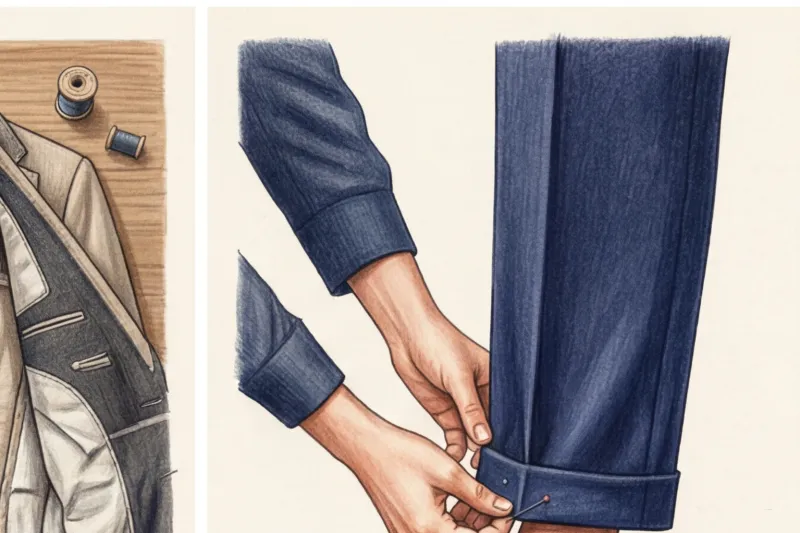
- Shortening the length: Whether it's the hem of a skirt, classic trousers, or the bottom of a fall coat, this is a basic finishing touch that will cost you a modest €15–€25 at a reputable tailor.
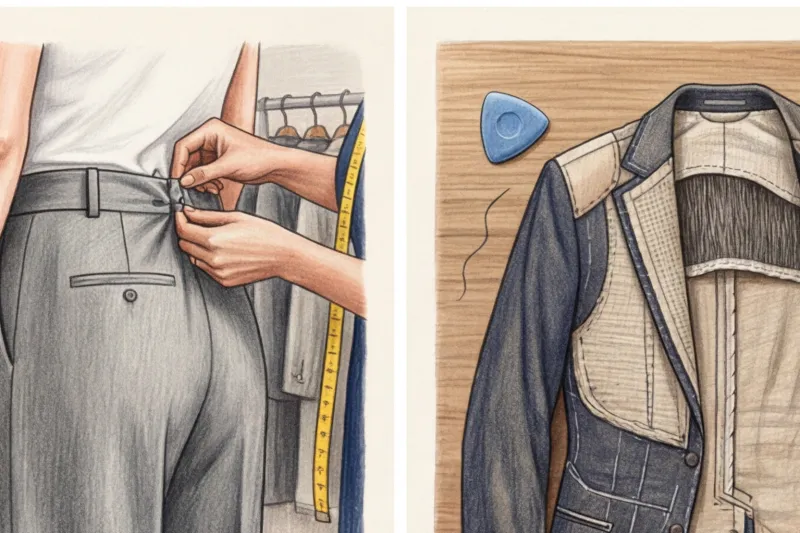
- Sewing in trousers at the waist: If your jeans or palazzos are perfect in the hips (which is the most important thing!) but are treacherously bulging at the waist, a tailor can easily remove an extra 2-4 centimeters along the center back seam. The design will only benefit from this.
- Shortening shirt sleeves: If the cuff with the placket gets in the way, the tailor will simply rip it off, cut off the excess length of the sleeve and sew the cuff back on.
- Correction of bust darts: Deepening the dart a little so that the silk blouse fits better against the ribs is quite inexpensive, but gives a stunning effect of expensive custom tailoring.
Yellow light (can be done, but prepare a budget)
This is where serious structural interventions begin. Only buy this item if you got it at a huge discount on sale, or if it's a unique vintage find you can't resist.
- Changing the width of the trousers: Tapering trousers from the knee or throughout is possible, but this requires simultaneously unpicking the inseam and side seams to maintain the correct leg shape. The cost will be approximately €30–€50.
- Re-cut the armhole: If the sleeve is digging into the armpit, you can sometimes deepen the armhole slightly using the inside seam allowances. However, this is a delicate job that requires pinpoint precision, otherwise the sleeve will begin to twist.
- Sewing along the side seams with transfer of the zipper: It's one thing to simply stitch the side of a straight cotton skirt, but quite another to do so when it has a hidden zipper. The tailor will have to completely rip it out, recut the fabric, and re-sew the zipper. Expect to pay €40 and up for such painstaking handwork.
By the way, when you are doing an inventory and deciding which things to take to the studio and which to get rid of, it is very convenient to use MioLook By digitizing your database, you'll clearly see whether a waist-cinching approach would save your old trousers, or whether they simply don't fit into your current wardrobe.
Red light: Don't buy if it doesn't fit right away
There are some fit defects that will cost more to fix than the item itself, but the end result will still be disappointing. Here are three absolute no-nos that require you to immediately return the item to the store hanger.
1. Shoulder belt of a jacket and coat
Any change in shoulder width is a real disaster for the design of outerwear. To shorten a shoulder by even one centimeter, a tailor must rip open the armhole, remove the sleeve completely, cut off the shoulder pad, shorten the stiff inner padding (which maintains the shape of the chest), and attempt to sew the sleeve back into the already altered cap. Nine times out of 10, the jacket will lose its factory shine, and the shoulder will look homemade and wrinkled.
2. Expansion of clothing (illusion of seam allowances)
"It's a little tight in the hips, but I'll have the tailor take the fabric out of the seams." , is the most typical mistake of fashion optimists. Modern mass-market and even mid-range brands skimp on every square millimeter of fabric. If you look inside the side seams of, say, Zara or Mango, you'll find a maximum seam allowance of 0.5-1 cm, which is also trimmed with an overlock. There's simply nothing left to release. In the premium segment (for example, Max Mara), you can still find generous seam allowances of 2-3 cm, but for a budget of under €200, don't expect miracles.
3. Complex fabrics: velvet, fine silk and jersey
Even if the most basic operation is required, evaluate the material. The finest silk and satin retain the marks left by factory needles forever—if you rip an old seam and move it slightly to the right, the fabric will be left with a perforated track of holes that will ruin the entire look. Velvet and corduroy will reveal old seams with unsightly bald spots and creases in the pile. And attempting to shorten complex textured knits by machine often results in the edge stretching, wrinkling, and cheap ripples.
Perfect Fit Formulas: A Basic Wardrobe Checklist
A 2023 study by the FIT Fashion Institute revealed a startling fact: 82% of women wear pants of the wrong length and jackets with poor shoulder architecture every day. As a stylist, I see this all the time during wardrobe reviews. Many are convinced that high-quality tailoring clothes to fit the figure — it's an intuitive process where the tailor simply "cuts away the excess." In reality, it's strict geometry and an understanding of proportions. Over the years, I've developed a clear checklist for my clients—mathematical fit formulas that transform standard factory-made garments into custom couture.
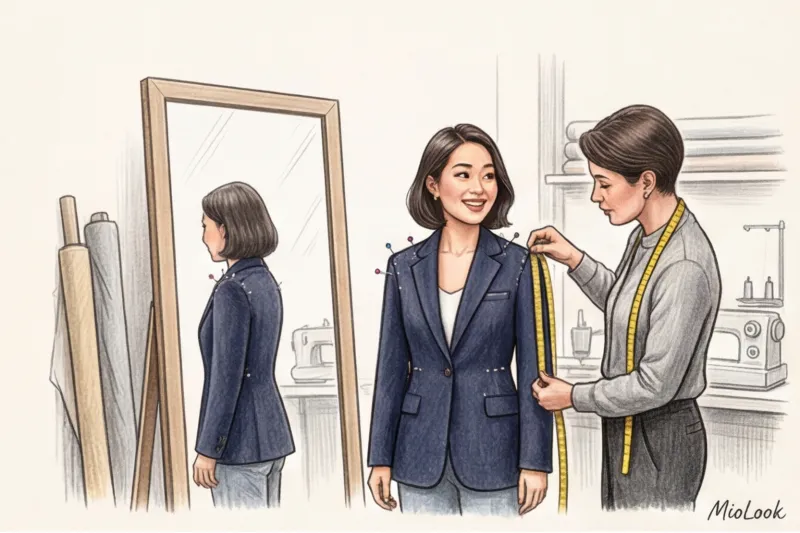
Let's start with the most complex element—the jacket. The design of a proper blazer rests on three key points. First: ideal shoulder point The shoulder seam should end exactly where the natural slope of your arm begins. If it falls lower (and this isn't the intended oversize), you'll look slouched; if it ends earlier, the garment will look too small. Second: waist point The narrowest part of the cut should strictly coincide with your anatomical waist. If the jacket's waistline is too low, your legs will appear shorter by the same amount. Third, my favorite rule of the Italian tailoring school: correct sleeve length The sleeve should end at the wristbone, leaving exactly 1.5 centimeters of shirt cuff visible. This subtle contrast in texture instantly makes the look put together, dynamic, and classy.
Let's move on to trousers, where the most insidious wardrobe mistake lies. Here I must impart a harsh contrasting insight that many initially find difficult to accept: there is no universal length for long trousers. One pair = one heel height.
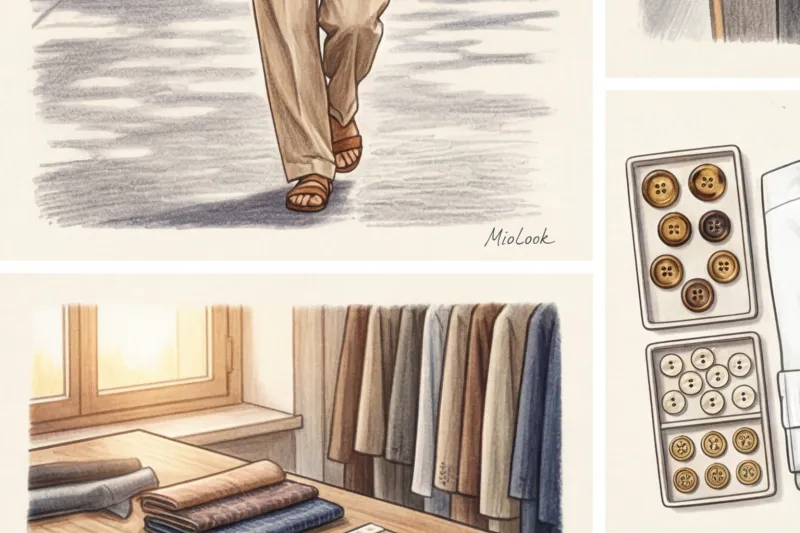
You can't wear the same wide palazzo pants with stilettos today and sneakers tomorrow. If you tailor the length to fit flats, the heels will make the pants look too short. Therefore, the absolute rule of the atelier: a fitting requires the exact footwear you plan to wear with that particular item. Besides length, it's crucial proper fit on the buttocks The fabric should fall smoothly, without tension. If horizontal ray-like folds radiate outward from the center seam (professional tailors call this defect "whiskers"), this is a sure sign that the trousers desperately need a little volume in the hips. Don't try to "let it all out"—only adjust the pattern.
A basic shirt is another item that requires attention. A major concern for those with expressive curves: a garment fits perfectly in the shoulders, but treacherously gaps at the chest. Fixing the problem of gapping buttons costs a maximum of €10–15 at a tailor's, but it will permanently eliminate any stiffness in your movements. Just ask. sew in hidden buttons from the back panel, right between the problem buttons. The second mandatory procedure is back volume correction Mass-market shirts often tuck excess fabric into the back, creating a parachute effect. When you tuck such a shirt into a skirt, a messy bubble of fabric forms at the waist. A couple of neat darts at the back waist will remove the excess bulk and restore your graceful profile.
Managing such a well-thought-out wardrobe is an art form in itself. To avoid having to remember in a rush in the morning which trousers go with your loafers and which with your ankle boots, I highly recommend digitizing your wardrobe. Label items by their function, and putting together outfits will become much easier.
Access to MioLook for €0.99 — one-time payment
Start creating perfect looks with AI and never lose track of your customized items.
Get access — €0.99 onceCustomizing the Base: How to Turn a Simple Thing into a Designer One
There's an unspoken rule behind the scenes at fashion houses: a piece of clothing is worth exactly what its accessories cost. According to analytics Business of Fashion By 2024, fast-fashion brands will spend less than 2% of their cost on buttons, zippers, and hooks. That's why a basic €60 double-breasted jacket often turns out to be a dull plastic circle with rough stamped edges.
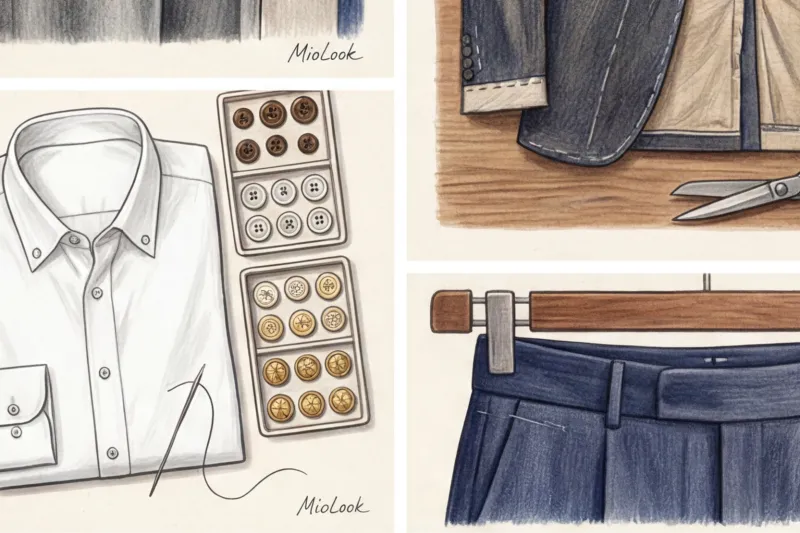
Replacing your hardware is the most cost-effective investment in your style. I call this a "visual upgrade." Buying a set of high-quality hardware will cost you around €15-€30, but it will instantly elevate a garment from mass-market to mid-range. For this trick to work flawlessly, it's important to understand textures. Here are four types of "expensive" buttons worth considering:
- Natural horn: Ideal for trench coats, autumn coats, and heavy wool jackets, horn has a unique natural gradient that cannot be convincingly replicated in plastic.
- Nacre: The perfect companion for basic cotton and silk shirts. It sparkles beautifully in the light, highlighting your face. However, as a professional, I must offer an important warning: natural mother-of-pearl should never be machine washed with harsh alkaline detergents. The chemicals will dull the buttons, make them lose their shine, and cause them to crumble. Only use a gentle hand wash or a delicate cycle with a neutral detergent.
- Covered buttons: They create a cohesive, luxurious silhouette. An excellent choice for flowing viscose suits or midi dresses.
- Vintage Metal: Patinated brass, matte gold, or blackened silver can transform an ordinary tweed cardigan into a piece reminiscent of the archival collections of French fashion houses.
The art of cutting out the unnecessary and building structure
Customization isn't just about adding, but also about ruthlessly removing elements that cheapen an outfit. Elegance abhors fuss. Ever noticed those thin, barely-attached belt loops on the sides of dresses and skirts? Their only function is to hold the flimsy fabric belt that came with the outfit on the store hanger. Feel free to cut them off. The same goes for fake hip pockets, which only add unnecessary bulk and disrupt the hip line, as well as excessive embellishment like weird, fake zippers. The more minimalist the design of a garment, the more expensive it appears.
Another insider trick I love to use on my clients is adding shoulder pads to basic knits and heavy T-shirts. Soft, shapeless cardigans often make the figure look sagging and tired. Adding thin, anatomically correct shoulder pads (just 0.5–1 cm thick) creates a clear horizontal line across the shoulder girdle.
A structured shoulder instantly gathers the silhouette, visually narrows the waist by contrast and makes the posture more confident - this is a fundamental law power dressing.
When you start working so subtly with your basics, your wardrobe turns into a collection of unique, perfectly tailored pieces. To help you remember which jacket you sewed vintage brass buttons on or where you added shoulder structure, I recommend creating a digital catalog. By adding updated items to MioLook , you will be able to visually evaluate how customized elements work in new, more complex sounding kits.
How to find your tailor and write the right specifications
Taking an item to the nearest repair shop in the basement of a supermarket is the quickest way to ruin it. It's important to understand the fundamental difference between a home repair shop and a tailor with a keen eye for contemporary style. The former are excellent at replacing broken zippers and patching jeans. The latter understand how fabric flows dynamically and are able to delicately alter the silhouette's architecture. Risking a quality €150-200 jacket by entrusting it to a tailor with no sense of proportion is simply irrational.
Adjusting clothes to fit your figure — it's always a dialogue between two people. And here I'll share my main rule, developed over years of personal experience working with dozens of tailors. If, during your first fitting, the stylist arrogantly says, "We don't do that," "It's against the rules," or insistently tries to make the item "snugger to highlight your best features," then without further ado, take your order and find another stylist. A professional does not impose outdated patterns on you, but rather realizes your vision of proportions.
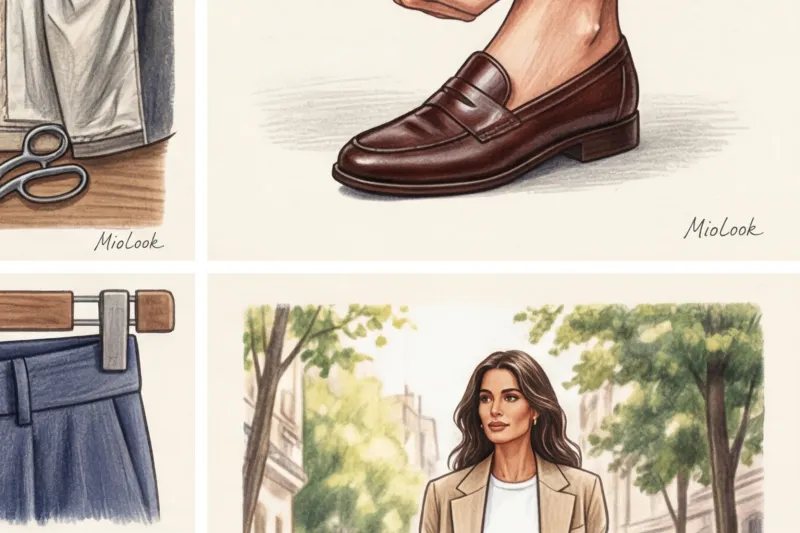
What questions should you ask at the first introductory meeting to check the technician's competence?
- "Can you shorten jeans while maintaining the original factory (boiled) edge?" (This is a basic test of denim technique).
- "How do you work with the lining of a jacket when shortening the sleeve from the top, through the armhole?"
- "Is it possible to remove excess volume only at the waist without distorting the deep tucks on the hips?"
Once you've found your specialist, the fitting preparation stage begins. This is a critical step that many people ignore. You need to come to the studio strictly in the same underwear and the same shoes You plan to wear this item with the right pair. The difference between a smooth, seamless top and a structured push-up bra shifts the center of the bust by 2-4 centimeters, causing your bust darts to be completely out of place. And trying on pants with sneakers guarantees they'll look too short with your favorite heeled pumps.
Finally, you'll need to master the "secret language" of tailors. Old-school tailors are often trained to cut strictly to the figure, eliminating all gaps. To achieve a modern silhouette relax fit (relaxed posture), forget the subjective phrase "make it look good." Operate with dry technical instructions:
"I need at least 4-5 centimeters of ease. Don't take away volume from the hips; we want a straight silhouette, not a tight one. The fabric shouldn't be taut, either when standing or when walking."
If you're unsure whether you've been understood correctly, use the most reliable tool—a reference. Bring another garment that already fits perfectly and comfortably, so the tailor can take measurements from it as a reference.
Your ideal image
it begins Here
Join thousands of users who look flawless every day with MioLook. Digitize your customized database and create stylish combinations in one click.
Get access — €0.99 onceFinancial Math: Budgeting for Fit-Outs vs. Buying New
Let's talk about money frankly. Most women experience significant internal resistance when I suggest taking a newly purchased item to a tailor. It seems highly illogical to pay a tailor when you've already paid the store. However, dry financial mathematics proves the exact opposite.
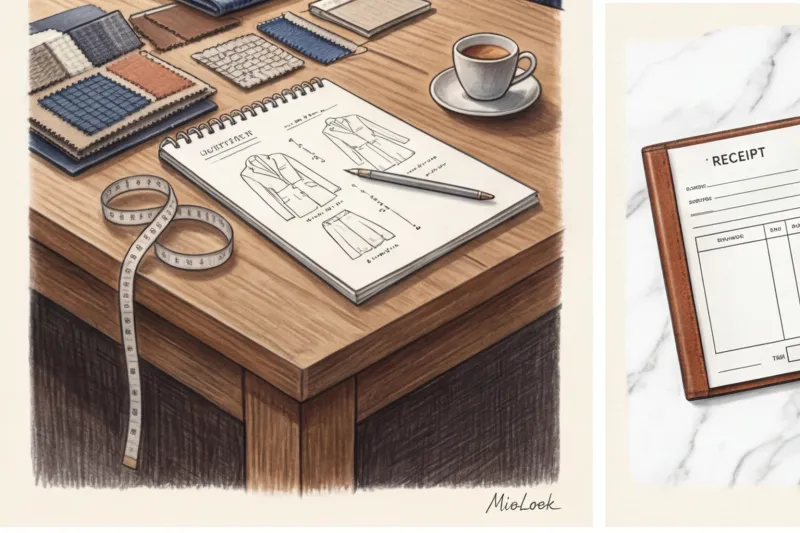
In the professional stylist community, we use the Cost Per Wear (CPW) metric—the cost of one outfit. And for a basic wardrobe, the correct formula is: (Price of the item + Tailor's fees) / Number of wears.
Let's look at a simple example. You're faced with a choice: buy a pair of mass-market trousers for €50 and have them adjusted at the waist for €20, or buy a premium model for €150 that fits "almost right," but still not perfectly. Which is better value? You'll wear the €70 trousers (including tailoring) that follow your body contours at least 50 times per season—their CPW is only €1.40. But the €150 trousers, which are slightly baggy in the back or dig in uncomfortably when you sit down, will end up hanging in your closet after three wears. Their one-time cost is a whopping €50! Adjusting your clothes isn't an "unnecessary expense," but rather your insurance against wasting your capital on hangers.
In 2024, analysts at The Business of Fashion published a detailed calculation of the return on investment for a basic wardrobe. It was found that a classic pantsuit and a straight wool coat, tailored to the individual's body, are worn on average 3.5 times more often than their factory-made counterparts. With daily wear, the investment in a tailor is fully recouped within the second month of active use.
"How much is a reasonable amount to budget for customization?" is the most common question I get during my consultations. I recommend a strict rule to my clients: when setting a seasonal shopping budget, set aside 15–20% of the total for a tailor's services. If you've budgeted €500 for a fall capsule collection, set aside €100 for length adjustments, darts, and replacement of plastic hardware.
To track how this principle works in reality, start digitizing your images using the app MioLook By tracking your appearances, you'll quickly see that the shirts and jackets that have been tailored have the lowest cost per wear.
Finally, let's consider the intangible benefits. A perfect fit is a powerful investment in your professional image and confidence. During important negotiations or interviews, you shouldn't be distracted by a slipping waistband or overly long sleeves. A perfectly tailored suit, with a perfectly placed shoulder line, is subconsciously perceived by others as a marker of high status. A woman who is physically comfortable in her clothes conveys a calm confidence, and this is an asset that can't simply be purchased off the rack at a boutique.
Smart Wardrobe with MioLook: Tracking Your "Perfectly Finished" Items
According to the Global Fashion Agenda 2024 report, we only wear about 20% of our wardrobe regularly. Why? Because the remaining 80% fits "almost okay" but doesn't inspire enthusiasm. However, in practice, I encounter an even more frustrating situation. One of my clients, a top manager at an IT company, spent about €150 on a masterful alteration of trousers and silk shirts. A month later, during a wardrobe review, it turned out that she was still pulling on old, less-than-flattering jeans every morning. The reason turned out to be simple: in the chaos of her physical closet, the perfectly fitting, customized items had simply "lost" on the hangers among dozens of average-fitting ones. When you invest time and money in the perfect fit, you need a system to maximize the Cost Per Wear of each finished garment.
This is where digitalization comes in. To ensure that the results of painstaking work with a tailor don't just sit there, I'm converting my clients' wardrobes into MioLook app As soon as an item returns from the studio with the perfect length and darts, we immediately add it to our virtual closet. My professional life hack: use a tagging system. Label your finalized collection with "perfect fit" or "tailor-made." When you open the app during your morning rush, you'll see not just a cataloged fabric, but your personalized couture collection, guaranteed to fit perfectly.
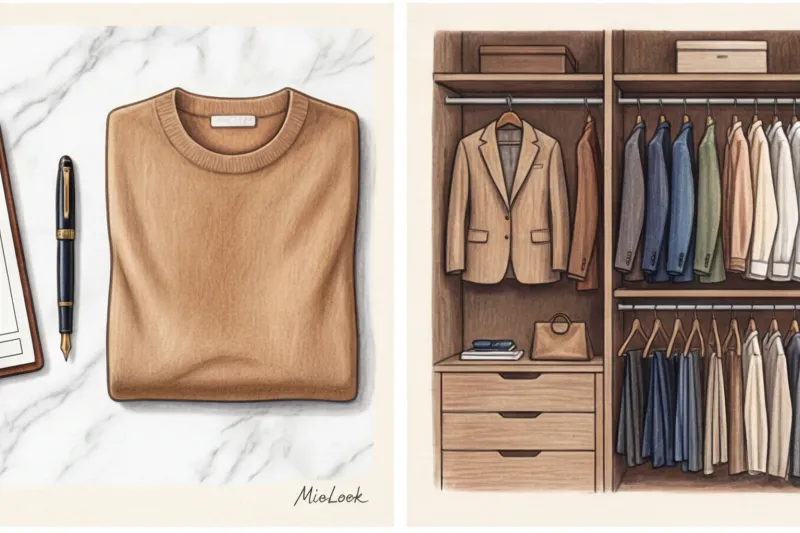
The next strategic step is capsule tracking. A perfectly fitted base is a clean architectural foundation upon which dozens of combinations are built. In the MioLook look-creation function, we combine basic tailored pieces into ready-to-wear looks for different lifestyle scenarios. For example, take those same tailored trousers with a perfect hip line: for the office, we virtually pair them with a cashmere turtleneck and loafers, and for evening, with a silk top and a customized jacket where we've replaced the plastic with vintage brass buttons. By saving these formulas, you get an intelligent style matrix. No stress before an important meeting—you're 100% sure there won't be any unwanted creases.
But theory is dead without practice. So here's your concrete plan of action for the coming weekend. In style circles, we call it a "closet audit." Set aside a couple of hours, put on a stimulating playlist, and pull out all the clothes you've been avoiding for the past six months.
- Step 1: Put on the item. Stand in front of a large mirror.
- Step 2: Use regular office binders or clothespins. Pin any excess baggy material at the waist of your trousers, adjust the hem of your skirt to the desired height, or secure the flared front of your shirt.
- Step 3: Assess the new silhouette. If the pinned fabric suddenly makes the garment look expensive and the body proportions become harmonious, it's time to go to the tailor's.
- Step 4: If, even after a thorough styling with clothespins, the color pales your skin, and the texture cheapens the look, feel free to resell or donate the item. No amount of alteration will save something that's not "yours" from the start.
Tailoring clothes isn't an attempt to correct your flaws. It's about bringing the world around you, embodied in meters of fabric, into respectful alignment with your unique body.
True Mediterranean elegance is based on a fundamental principle: you shouldn't conform to the molds of a factory assembly line. Clothes should serve you. Start small: customize just one favorite piece, integrate it into your smart wardrobe, and I promise you'll never want to settle for the compromise of "well, it fits just fine" again.
Guide Chapters
The item is too big, what can be taken in, and what is better to return?
About 60% of clothing returns are due to sizing errors. We'll discuss with a stylist which garments can be salvaged at a tailor's shop and which are best returned.
Style Secret: How to Properly Deliver Your Clothes to a Dressmaker
The secret to impeccable style lies not in expensive brands, but in a perfect fit. We'll tell you how to prepare for your first visit to the tailor.
Plus-Size Clothing Fit: The Secret to the Perfect Fit
There's no perfect brand for plus-size models, but stylists have a secret. Find out how tailoring can transform mass-market clothing into a premium wardrobe.
Fitting Outerwear: How to Tailor a Coat Without Mistakes
Fitting outerwear requires engineering precision. We explore common mistakes made in tailoring and explain how to alter a coat while preserving its signature silhouette.
How to Take in the Sides of a Dress: Secrets to a Perfect Fit
The secret to a luxurious look lies in the proper fit. We'll explain how to tailor a dress and avoid common tailoring mistakes.
Petite Clothing: Redesigns for Petite Girls
Learn how to buy standard-fit clothes and have them professionally adjusted for petite women. Secrets to the perfect fit for petite women.