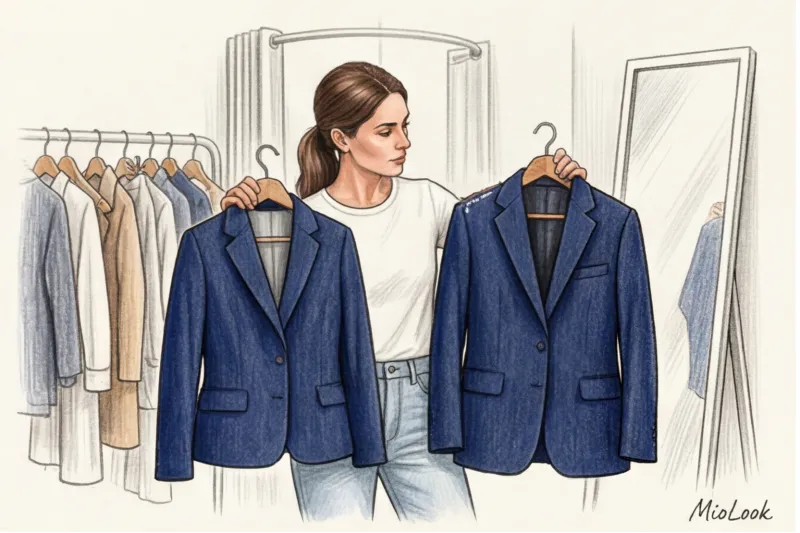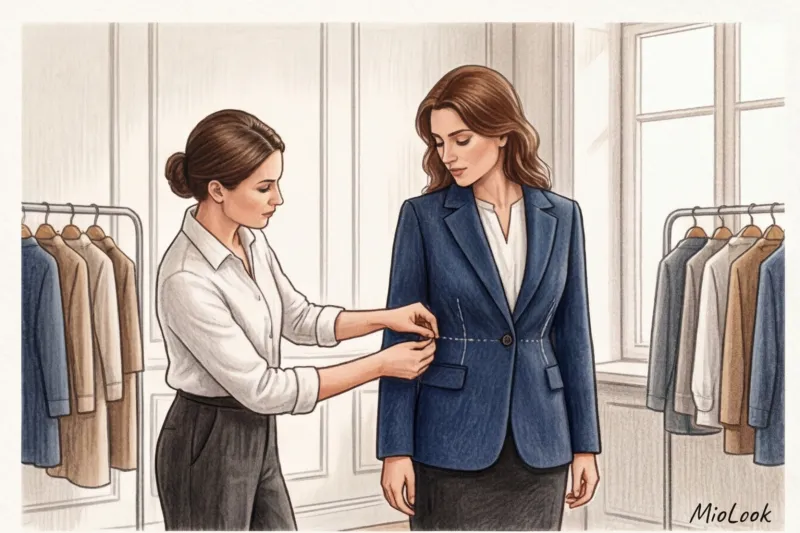
Have you ever wondered why an ordinary H&M shirt fits Italian women on the streets of Milan as if it were custom-made by Loro Piana? The secret isn't an innate sense of style or even a body type. The secret is that an Italian woman doesn't go home after shopping. She goes to a sartoria—to her tailor.
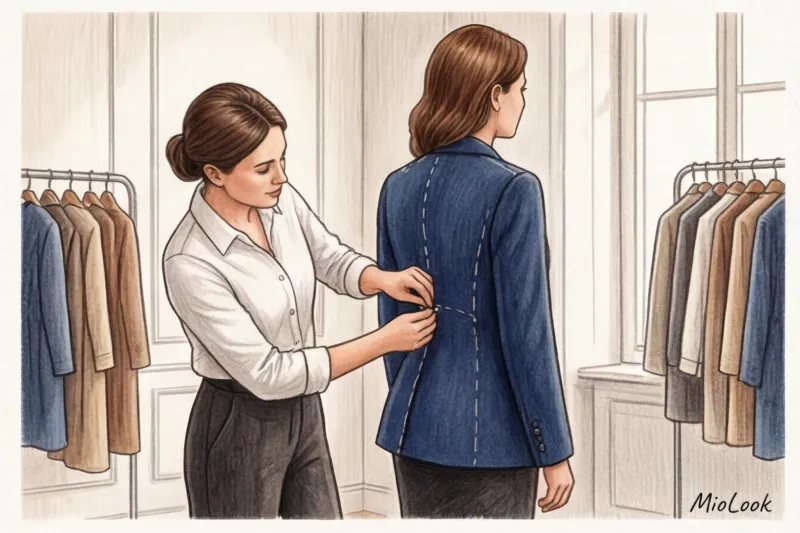
After 12 years of working in the fashion industry and attending dozens of shows from Paris to New York, I've realized one thing: the difference between mass-market and luxury often lies in 2-3 centimeters of fabric in the right places. And that's precisely what How to properly hand over items to a tailor , distinguishes a woman who simply "wears clothes" from a woman who controls her silhouette. We discussed the basic principles of cut architecture in more detail in our complete guide to fitting clothes to the figure.
Mediterranean Secret: Why Fit Is a Styling Essential
Let's do some style math. One of my clients had been dreaming of the perfect pencil skirt for a long time and was ready to pay €850 for a Prada model. Instead, we bought a basic skirt at Zara for €40 and took it to a good tailor. For €15, he deepened the waist darts to accommodate her lower back curve and tapered the hem slightly. The result? The skirt looked like it cost a thousand euros because it was tailored. for her.
This is the phenomenon of Italian style: integrating a garment into your personal silhouette. A tailoring studio isn't a place to "fix things." It's your personal laboratory for creating a prestigious wardrobe. Investing in tailoring a basic item always yields a greater ROI (return on investment) than an impulsive purchase from an expensive brand with average fits. If you want to learn more about how to assemble such basics, I recommend studying The Complete Guide to Creating a Capsule Wardrobe.
Access to MioLook for €0.99 — one-time payment
A smart AI stylist will select the perfect look and suggest which items in your closet need a perfect fit.
Get access — €0.99 onceThe Rule of Three "No's": What a Tailor Can't (or Shouldn't) Fix
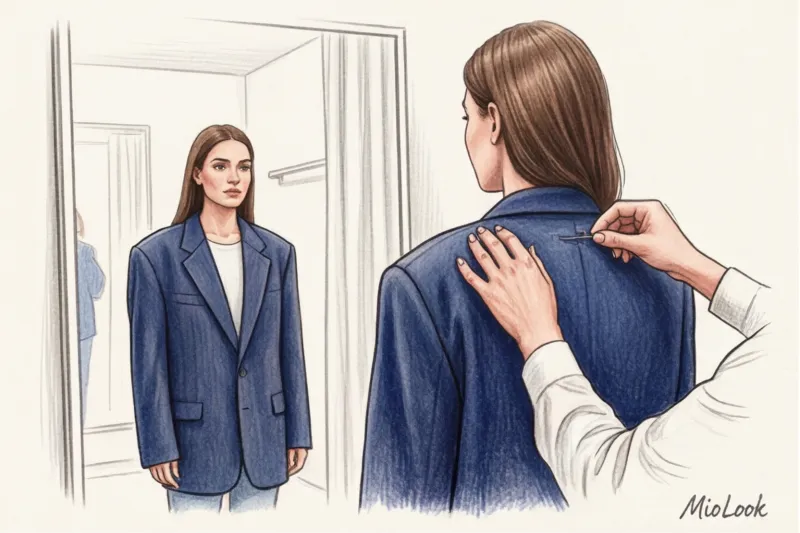
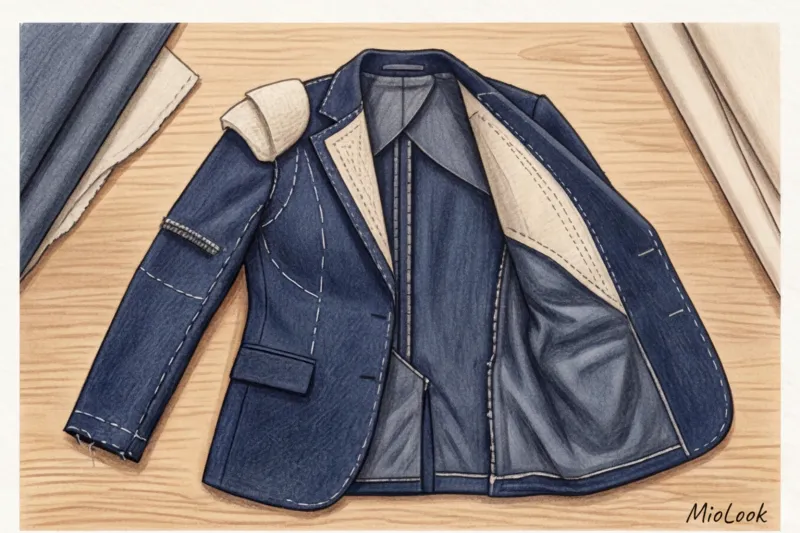
There's a dangerous myth: "A good tailor can tailor anything." As a journalist who has studied the philosophy of bespoke tailoring on London's Savile Row, I can confidently say: a good tailor says "no" more often than not. If a tailor enthusiastically agrees to alter the shoulders of a stiff jacket, take it and run.
"The architecture of a suit is built from the top down. By changing the shoulder line, you destroy the entire balance of the garment: the armhole will sag, the lapel will be askew, the sleeve will fall out of place."
Here are three strict restrictions based on clothing design standards:
- You can't change the shoulder line of a structured jacket. This is especially critical when we choose women's business suit The shoulder girdle is a load-bearing wall. It's impossible to demolish it without destroying the house.
- The armhole cannot be raised. Technical fact: To raise the armhole (make it closer to the armpit for freedom of movement), you need additional fabric underneath. But it's physically not there.
- It is not possible to make an item larger than 2 sizes. The rule for pattern grading states that when you decrease by 3 or more sizes, the proportions shift. Pockets will end up on the back, and darts will move toward the armpits.
Homework: How to Prepare for Your First Visit to the Professional
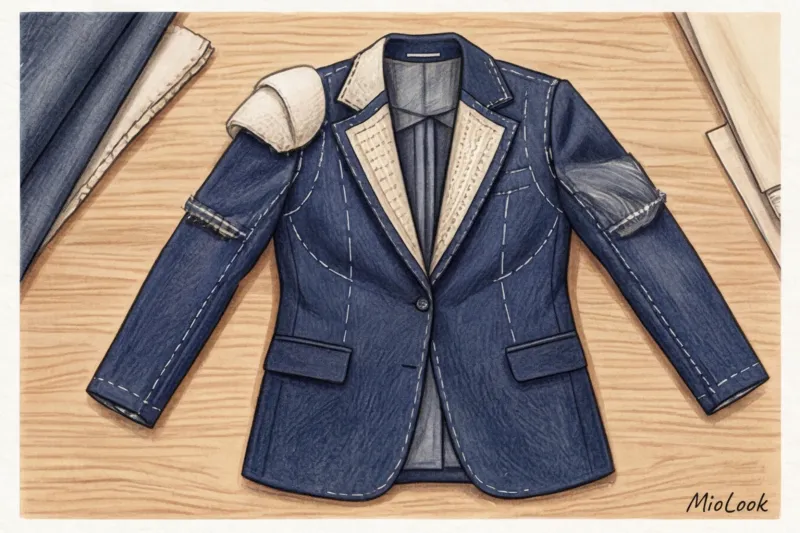
80% of a successful fitting begins at home. Showing up to the tailor "as is" is a fatal mistake for beginners. You should bring your "work silhouette."
The right underwear is the foundation of your fit
I once watched a woman pick up a tailored silk dress from the atelier and cry—the bust darts were 3 centimeters too big. It turned out she'd worn a Brazilian push-up bra to the fitting and a soft bralette to pick it up.
Different bras change the height and circumference of your bust by 2–4 cm. Always wear the bras you plan to pair with the bra you're trying on. As for shapewear, wear them during your fitting. only if you are ready to wear it with this dress every time.
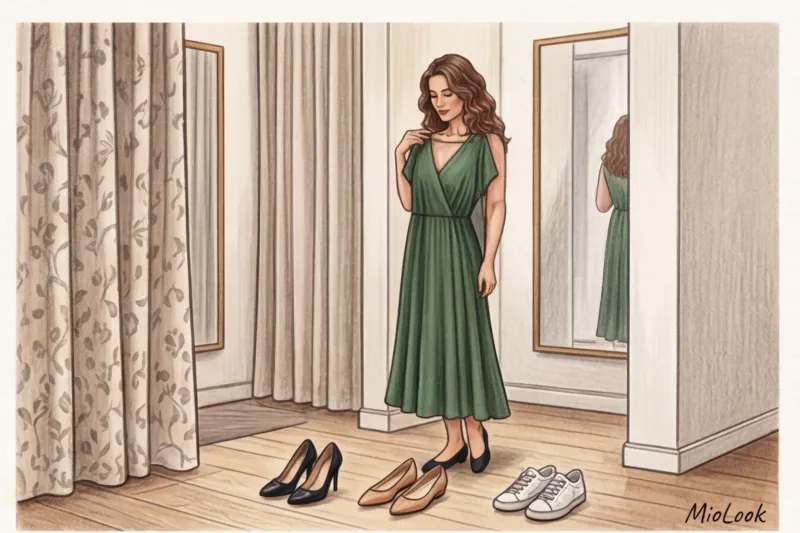
Shoes that dictate proportions
It's time to forget the myth of "one-size-fits-all pants lengths for any heel." Differences in last height dramatically alter the angle of your pelvis and the tension on your hips. The golden rule: bring the exact shoes you'll be wearing with the item to the fitting room. If so, shoes for a business trip When a balance of style and comfort is important, go for these loafers or block-heeled shoes. No "I'll wear heels of about the same height later."
Your perfect look starts here
Join thousands of users who look flawless every day with MioLook. Digitize your wardrobe in minutes!
Get access — €0.99 onceStyle Dictionary: How to Translate Your Desires into Tailor-Language
The biggest pain in the tailor's office is the translation difficulties. You speak in emotional terms ("I want it to be slimming"), but the tailor thinks in geometric terms (darts, seams, allowances). I'll always remember the story of a client who asked the tailor to "just take in the sides of her silk dress." The tailor obediently cut the fabric along the side seam. The result was a dress that was flat as a board, and the pattern of the fabric was distorted.
What should have been said? "Gather volume into the waist darts on the back to accentuate the curve of your lower back, but leave some room at the sides."
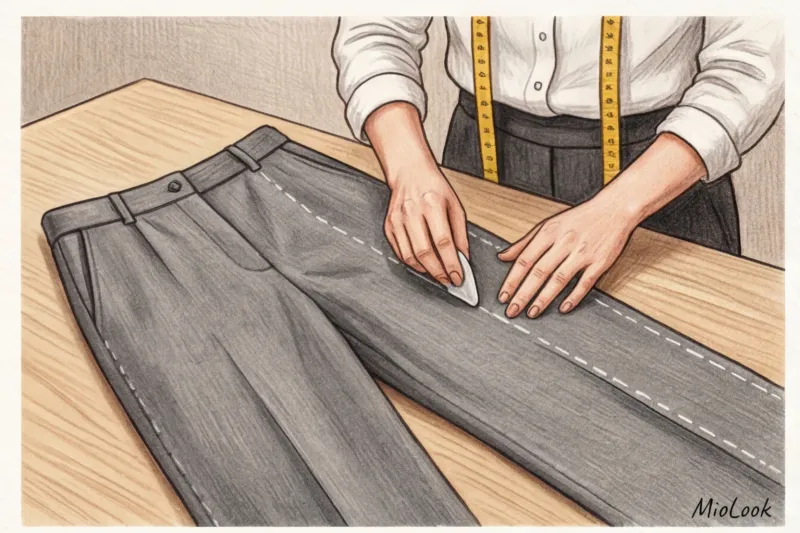
Here is your basic dictionary translator:
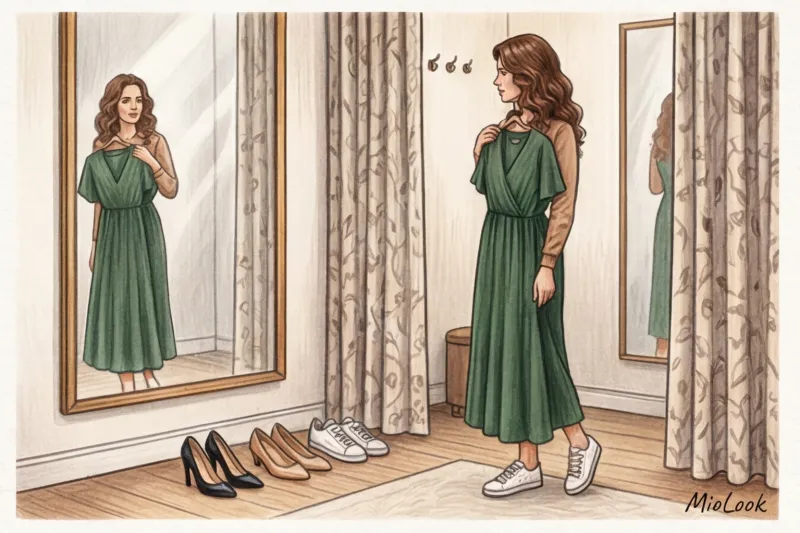
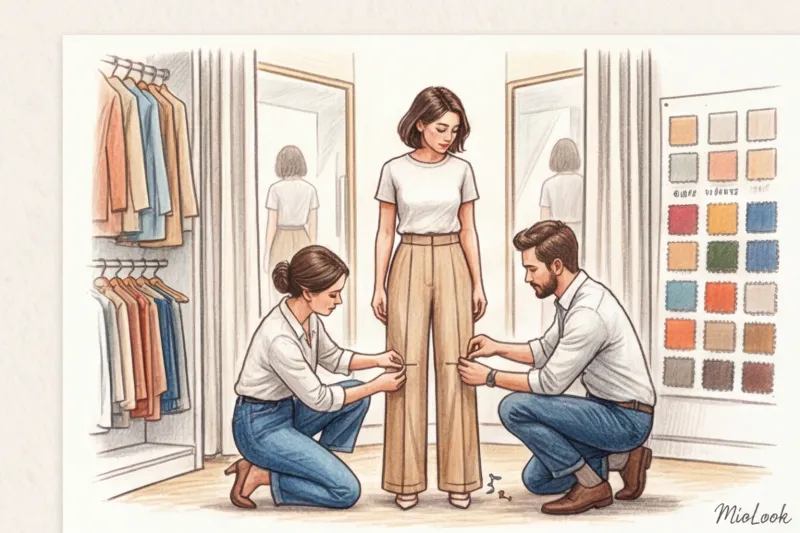
- Instead of "make it narrower in the legs": "Taper from the knee down, leaving a leg width of exactly 18 centimeters at the bottom." (Specific numbers prevent surprises.)
- Instead of "shorten your pants": "Make the length to the middle of the ankle bone with a 4 cm wide English cuff."
- Instead of "remove the bubble on your back": "Adjust the center back seam to accommodate my curve."
Life hack from a stylist: Visualization works better than words. Bring reference photos. Show how the pants fit Rosie Huntington-Whiteley and say, "I need that same amount of freedom in the hips."
In the fitting room: dynamic fit test
Trying on clothes statically in front of a mirror, standing straight with your stomach sucked in, is a form of self-deception. Clothes live in movement. In the old Milanese sartorias, the masters they force clients walk around the room and sit in deep chairs.
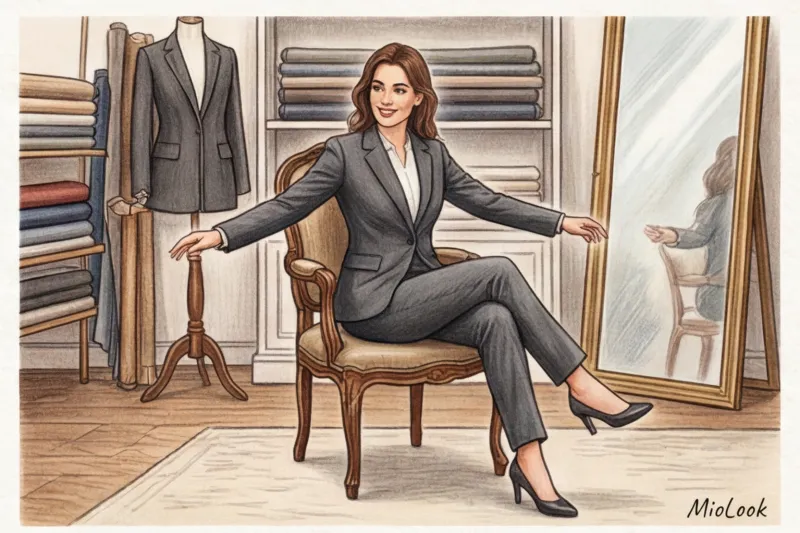
Always perform a dynamic test:
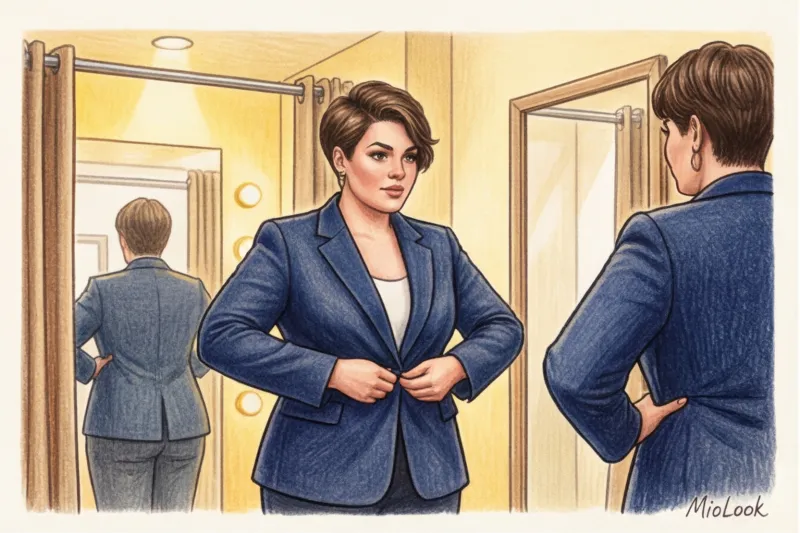
- Stool test: Sit on a chair. Feel the stretch of the fabric in your hips and groin area. If your pants are digging in or your skirt is riding up too high, ask for some room to be released. This is especially important if you're getting a custom fit. office clothes for plus size women , where seating comfort is critical to confidence.
- Hug Test: Cross your arms over your chest, as if hugging yourself. If the back of your jacket is creasing and the sleeves are riding up above your wrist bone, it's too tight.
- Step test: Take a wide step. Does the skirt restrict your movement? Perhaps you should ask your tailor to add a small vent in the back.
Checklist: 4 Questions to Ask Before Leaving an Item
Even with a trusted stylist, you need to discuss technical details beforehand. I always ask these four questions to protect my wardrobe investment:
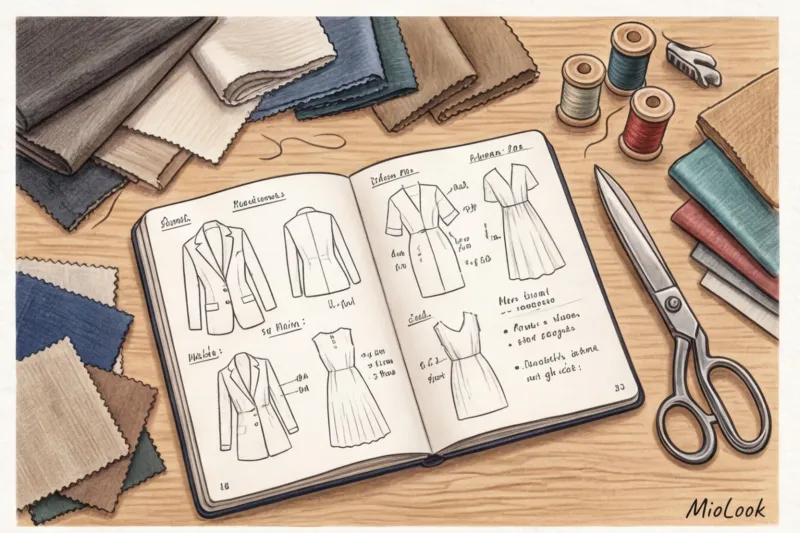
- "How will this tissue behave after the intervention?" This is critical for velvet, satin, and fine silk. Some fabrics can develop punctures from old seams (called "cut-through"). A reputable seamstress will warn you about this.
- "Will there be fabric allowance left over if I gain weight?" In mass-market garments, seam allowances are minimal (around 1 cm), while in premium garments, they can be up to 3-4 cm. Ask your tailor not to trim off any excess fabric when sewing the waist, but to carefully tuck it in. Your figure changes, and your garment should be able to change with you.
- "Is the final WTO (wet heat treatment) included in the price?" Professional seam ironing shapes the silhouette. Without it, the seams will stick out.
- "Can we do a fitting in between?" If you are changing the cut of a complex item (for example, reworking an office dress into an outfit for business dinner ), be sure to ask for a "live thread" fitting (basting). At this stage, you can still reverse everything.
Ready to get started?
Try the MioLook free plan—no commitments required. Upload photos of your items and get personalized style recommendations.
Get access — €0.99 onceConclusion: Your tailor is the chief architect of your wardrobe.
Clothing alterations aren't about fixing something broken; they're about customizing your personal style. In 1947, Christian Dior revolutionized the fashion world with his New Look silhouette, not because he used expensive fabrics, but because his cuts created the perfect proportions for the female body. Your tailor does the same for you, but on a more everyday scale.
Investing in a tailor pays off with repeated wears of a perfectly fitting garment. You'll no longer tug at your skirt, adjust the shoulders of your jacket, or worry about creases in your trousers. Start small: take your favorite, but slightly too long, trousers or a basic shirt to your nearest tailor to have it adjusted at the waist. You'll see how one tailored detail can transform not only your silhouette but also your posture.