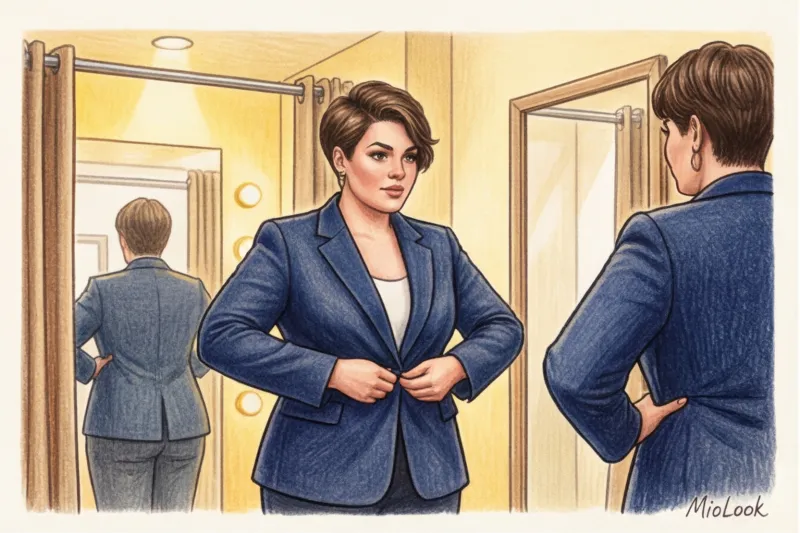
Over 12 years of working as a personal shopper in Europe, I've heard the same phrase hundreds of times: "Nothing in the mass market fits my figure." Curvy women spend years searching for the mythical "perfect brand" that will magically flatter their bust, waist, and hips. I have bad news: such a brand doesn't exist. But I have good news: you absolutely don't need it.
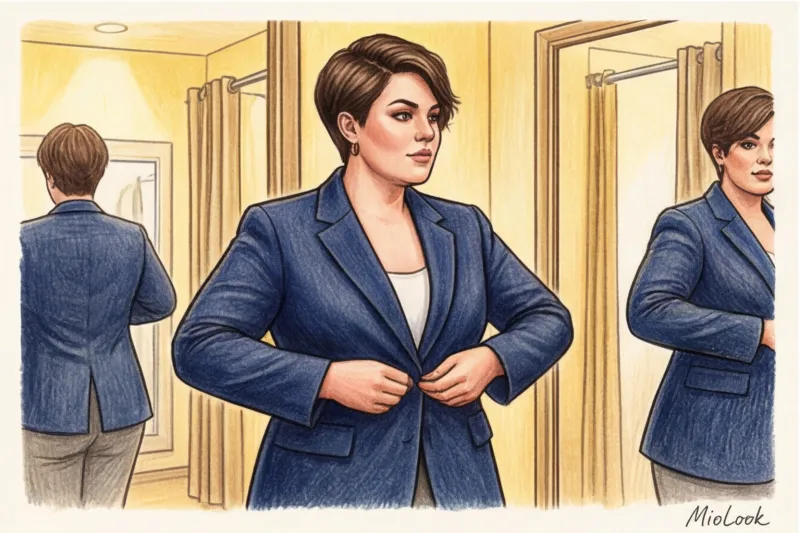
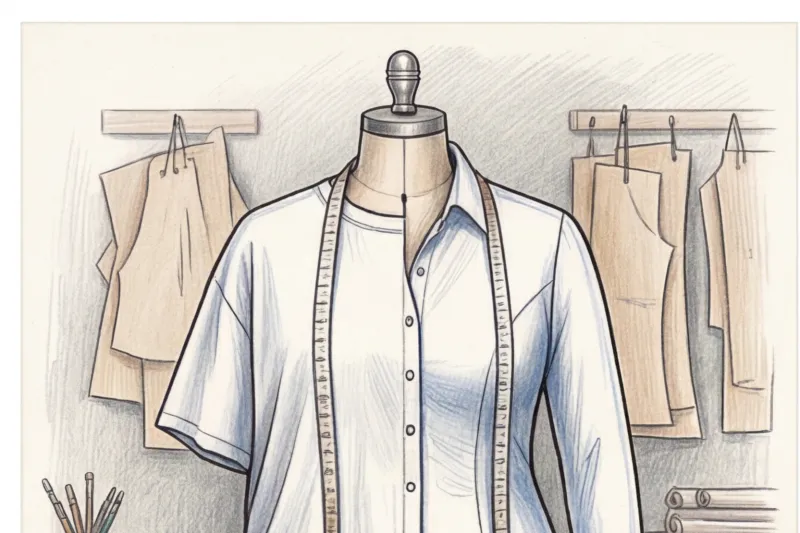
The secret to a high-status wardrobe isn't in the label, but in the geometry. A well-tailored plus-size garment can transform an H&M item into a bespoke piece. We've covered the anatomy of the perfect silhouette in more detail in our the complete guide to the secrets of the perfect fit , and today I'll share my main professional trick. We'll stop looking for clothes in our size. We'll start buying clothes 1-2 sizes bigger and investing €15-30 in tailoring services.
The Anatomy of Mass Market: Why Plus-Size Clothes Fit Poorly From the Start
When I walk the streets of Milan or Paris, my eye automatically detects a factory-made fit. A jacket's flared collar, a creased crotch on trousers, a button pulled tight across the chest—all of these things scream that the garment was put on straight off the hanger.
According to a 2023 WGSN analytical report, approximately 80% of plus-size clothing in the fast fashion segment is created using a primitive mathematical grading method. What does this mean? The factory takes a size M pattern and simply scales it up evenly in all directions to create an XL or XXL. But the real female body doesn't work that way. As women gain weight, their size distribution is uneven: some women's breasts expand, others' stomachs expand, and others' hips expand, while their shoulder width or ankle circumference may remain the same.
That's why you constantly encounter the same problem at Zara, COS, or Mango Violeta: if your pants are too tight at the hips, you can fit two fists through the waist. Change your paradigm. Store-bought clothes aren't finished products. They're semi-finished products, blanks from which you, with the help of a tailor, will sculpt your silhouette.
The golden rule of "widest point"
The biggest shopping mistake is trying to squeeze into your usual size at any cost, ignoring the stretch of the fabric. If a garment is tight where it shouldn't be, it visually adds 5 kilograms to your weight.
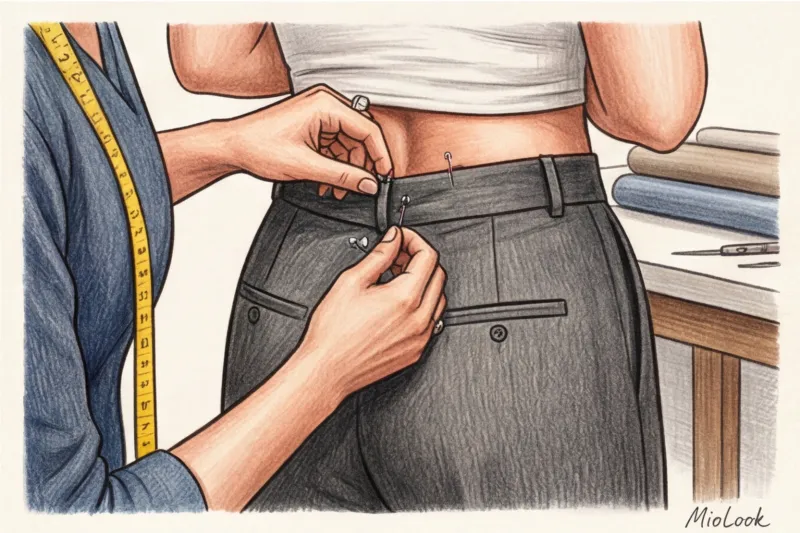
Remember my golden rule: Always buy a garment so that it fits perfectly (with some air!) on the widest part of your body. If you have full hips but a narrow waist, choose pants that fit your hips. If you have a full bust, buy a shirt that doesn't split at the buttons. Everything else—waist, sleeve length, leg width—will be adjusted by a tailor. Yes, you'll have to go up two sizes. Cut off the tag at home if it bothers you. A size is just a number on a piece of cardboard.
Access to MioLook for €0.99 — one-time payment
A smart AI stylist will select the perfect look based on your individual proportions.
Get access — €0.99 oncePlus-size clothing fitting: 5 items you should take to a tailor right away
Not every T-shirt deserves a tailor's makeover. But there's a wardrobe's structural framework—the pieces that shape your silhouette. These are the ones that require customization. In my experience, nine out of ten clients start looking slimmer and more classy once we adjust these basic elements.
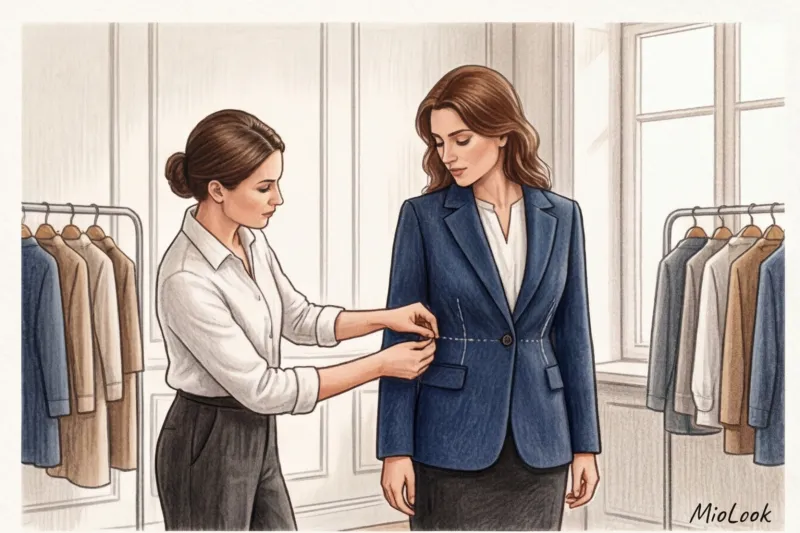
Jackets and coats: shoulder line, armholes and darts
A jacket is the architecture of your body. If you have a full bust, absolutely avoid dropped shoulder styles. They visually transform your upper body into a massive square.
- High armhole: Mass-market clothing tends to feature wide armholes (sleeve openings) to ensure a flattering fit. However, low armholes make your arms appear thicker and your chest wider. A tailor can add a little fabric to the side seam, raising the armhole. This will immediately make your arms look more graceful.
- Waist darts: If your jacket is buttoned at the chest but loose at the waist, ask your tailor to deepen the back or side darts. This will create an hourglass silhouette, even if you have a naturally rectangular figure.
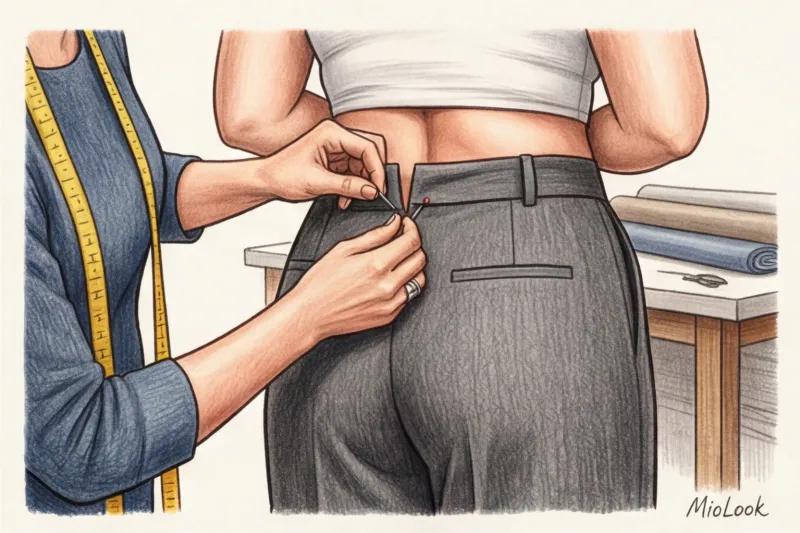
Trousers and jeans: a solution to the problem of the "bubble" on the lower back
That treacherous gap at the back of the waist—the bane of figures with different waist sizes—occurs because factory patterns are cut for flat buttocks.
The waistband darting technique takes an experienced tailor 15-20 minutes. The tailor unpicks the back of the waistband, gathers the excess fabric into two neat darts above the pockets, and reattaches the waistband. The trousers fit like a glove. Also, never neglect the length. Trousers that gather at the ankles shorten the height and make the legs appear larger. The ideal length for straight trousers is 1-1.5 cm from the floor with shoes on.
The Oversized Myth: How Baggy Clothes Add Visual Weight
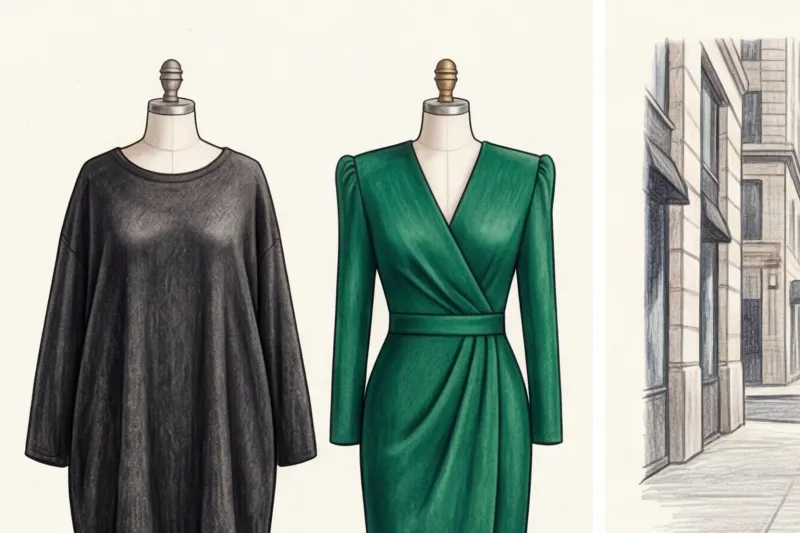
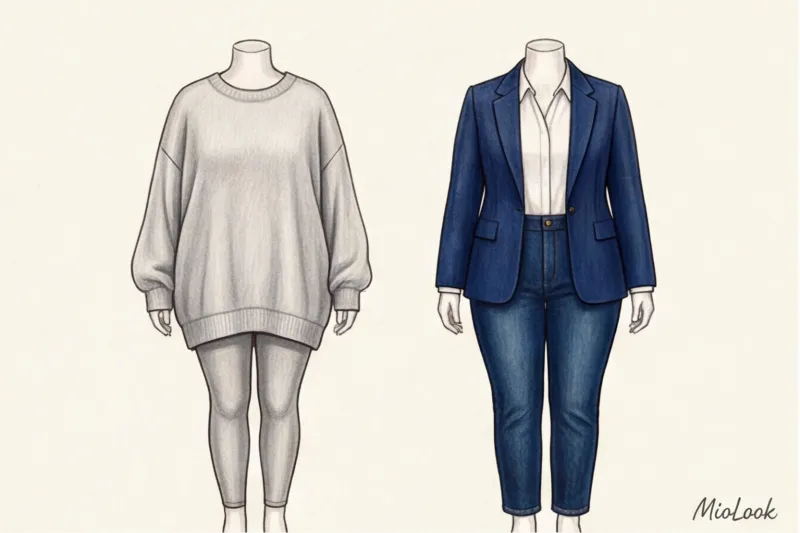
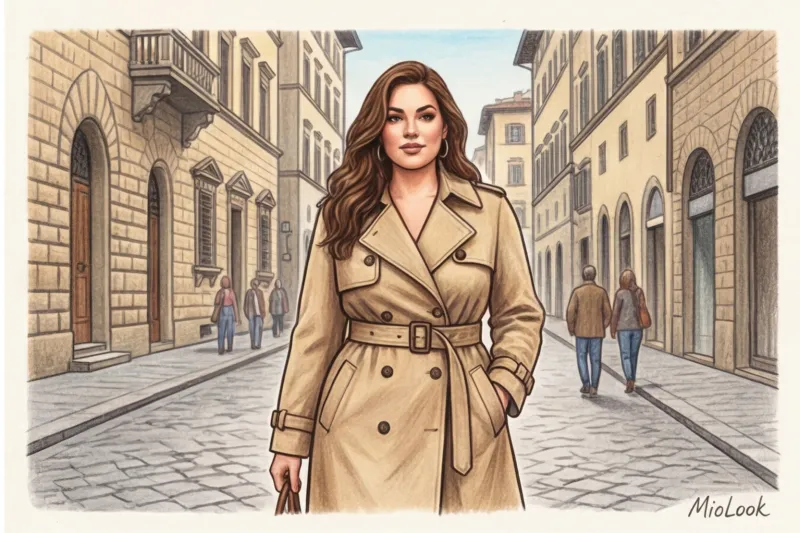
Here I want to dispel one of the most harmful stereotypes. Many plus-size women try to hide their curves in shapeless hoodies, hoodies, and tent dresses. This is a fatal mistake.
Baggy, oversized clothes hide not only problem areas but also your best features: wrists, ankles, the curve of your neck. As a result, others judge your size by the widest point of the robe. You become a monolithic blob.
"The difference between a loose garment and one that's baggy is having clear points of attachment. Clothes should fit snugly through the shoulders and neckline, leaving room through the stomach and hips."
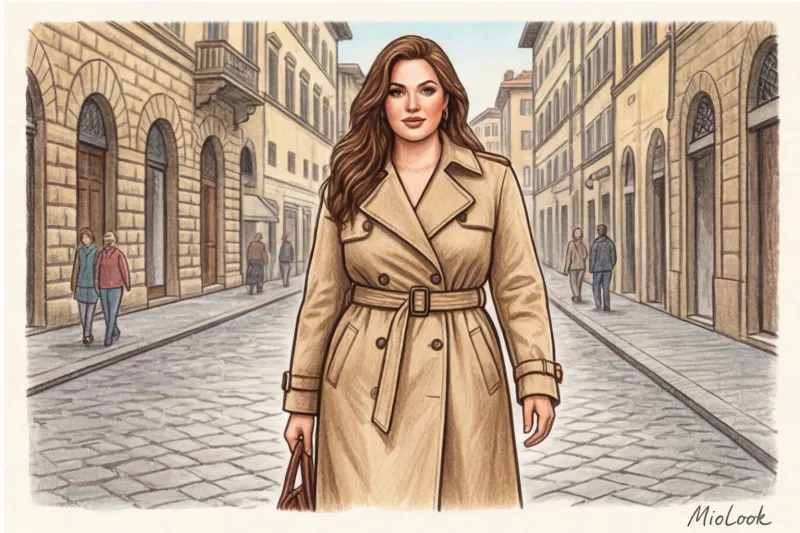
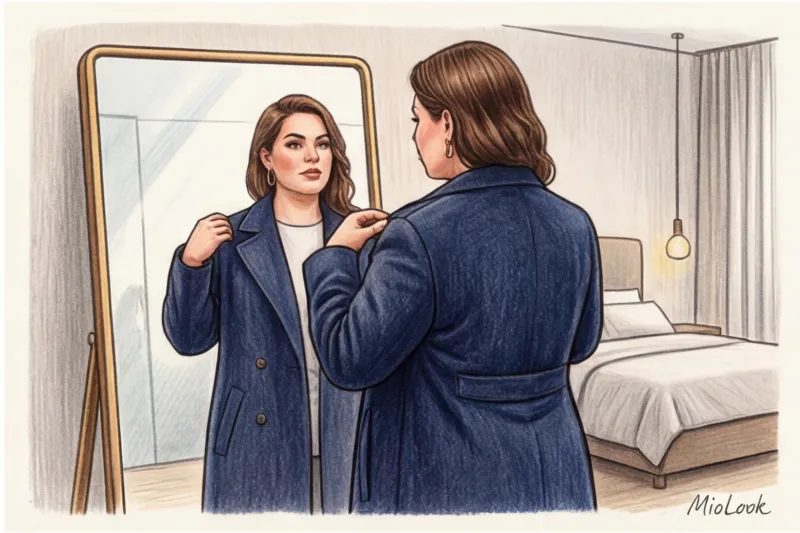
I had a client, Marta, from Munich. She came to see me wearing an oversized cardigan, convinced it was the only way to hide her size 52. We went to H&M Premium, bought a double-breasted wool coat in a size 56 (so it would fit loosely at the hips), and took it to my tailor. He took in the back and slightly tapered the sleeves for €25. When Marta put it on, she cried in the fitting room. The structured shoulder line and clean silhouette visually dropped at least two sizes. The mass-market coat now looked like a Max Mara runway piece.
Your perfect look starts here
Join thousands of users who look flawless every day with MioLook, choosing the right silhouettes.
Get access — €0.99 onceFabrics that are tailor-friendly (and those that are best avoided)
Not every item can or should be altered. If you want your clothes to work for you, pay attention to their composition.
Avoid: Thin viscose jersey, plain jersey (used for cheap T-shirts), and fabrics with more than 5% elastane. These materials don't shape the figure; they cling to it, highlighting every crease in underwear and the slightest unevenness of the skin. Furthermore, thin knits are very difficult to alter—the seams often become wavy.
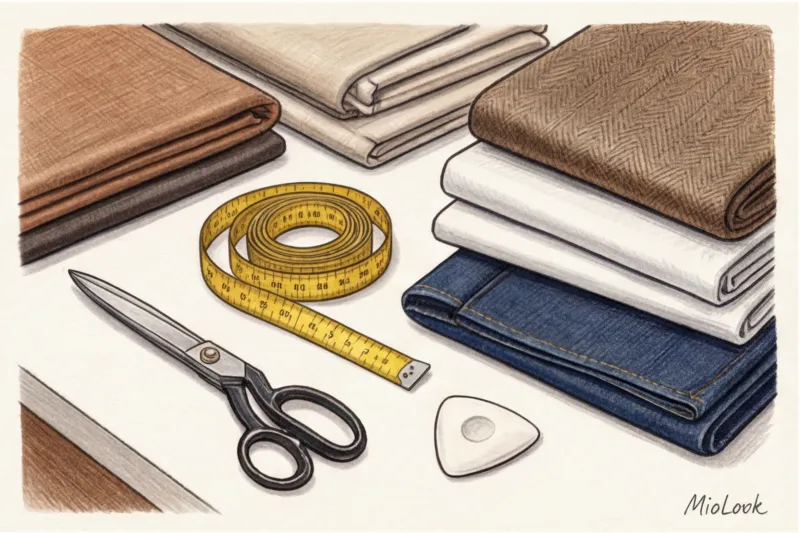
Invest: Shape-holding materials. Heavy cotton (poplin from 180 g/m²), linen with added viscose (to reduce wrinkling), suiting wool, heavy denim without stretch. Stiff fabric acts as a soft corset: it defines the shape rather than being controlled by your measurements. These are the items that are easiest to have adjusted in a tailor's shop. If you want to organize your new, perfectly fitting clothes, I recommend digitizing them through MioLook - this will help you plan your looks in advance and see how structured items fit together.
The Smart Shopaholic's Price List: How Much Does the Perfect Silhouette Really Cost?
I often hear the objection: "Why should I buy something from Zara and pay extra for a tailor? It's expensive!" Let's do the math. You can buy a premium jacket for €400, which still won't fit you perfectly due to the inherent nature of the factory cut. Or you can act like a pragmatic European woman.
An example of a recent purchase I made for a client: a basic Massimo Dutti jacket (€150) + back adjustment and sleeve shortening (€25). Total: €175 for an item that looks like it was made on Savile Row for €800.
Approximate prices for basic atelier services in Europe (may vary depending on the country, but the order of numbers is as follows):
- Shortening trousers/jeans while preserving the factory edge: €10–€15
- Sewing in trouser waistbands (darts): €15–€25
- Tapering a shirt at the side seams: €15–€20
- Jacket sleeve adjustments (without moving the vent): €20–€30
Make it a rule: your shopping budget should always include 10-15% for tailoring services. This is the most profitable investment in your style.
Checklist: How to tell in the fitting room that an item can be saved
Of course, customization has its limits (and this is the very limitation that's important to remember). If an item is too small for you everywhere, a tailor can't perform miracles—fabric can't be plucked from thin air. Here's my checklist, which I use with clients right in the fitting rooms:
- Shoulder seam rule. If your shoulders are too big and the seam is slipping down onto your biceps (and this isn't the design), leave the item at the store. Re-cutting the shoulder seam and armholes is a complex and expensive project that will cost you between €50 and €80. It's not worth it. Your shoulders should fit perfectly from the start.
- Checking fabric stock. If the garment is slightly tight around the hips, turn it inside out. Look at the side seams. If there's at least 1.5–2 cm of fabric allowance on each side, the tailor can "release" the volume and give you the extra 3–4 centimeters of room you need.
- Pin test. Carry a couple of safety pins in your purse. When you put on a dress or jacket that's too tight in the chest but too loose in the waist, simply pin the excess fabric at the back. You'll instantly see the garment's potential. If you like the pinned silhouette, go ahead and head to the checkout.
Stop blaming your body for the unflattering fit of store-bought clothes. Your figure is perfectly normal; the problem lies in the lazy, factory-made patterns of mass-market clothing. Find a good tailor, buy clothes based on your widest point, and you'll forget about the "I have nothing to wear" problem forever.