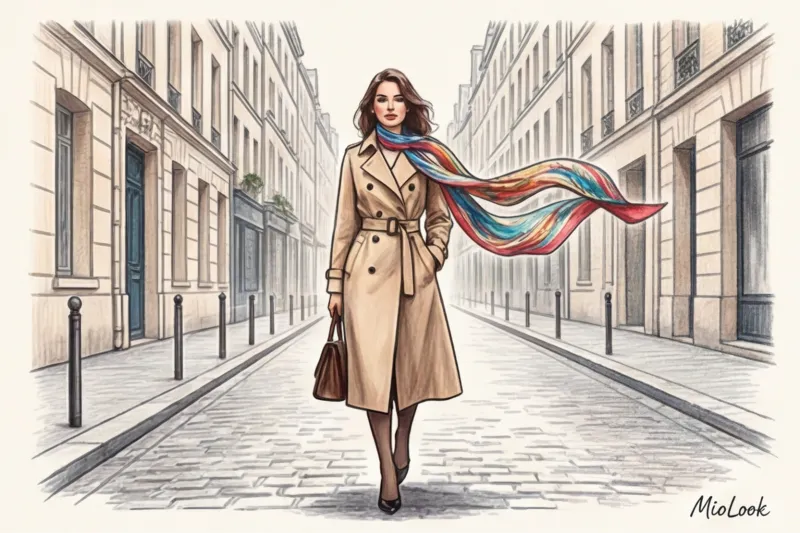
More than an accessory: why a scarf is the architecture of a look
Did you know that just 65 grams of fabric can completely transform your body proportions? That's how much a classic silk bob weighs. In ten years of working as a fashion journalist and analyzing wardrobes, I've realized something paradoxical: women often underestimate this accessory. We buy expensive jackets for a defined shoulder line, but we forget that soft draping works just as well on a silhouette as a rigid tailoring. Many spend hours searching for tutorials. How to tie a scarf beautifully , expecting to find a magical, complex knot, but the secret lies not in the weaving technique at all. The secret is that the scarf is not an addition, but the true architecture of your look.
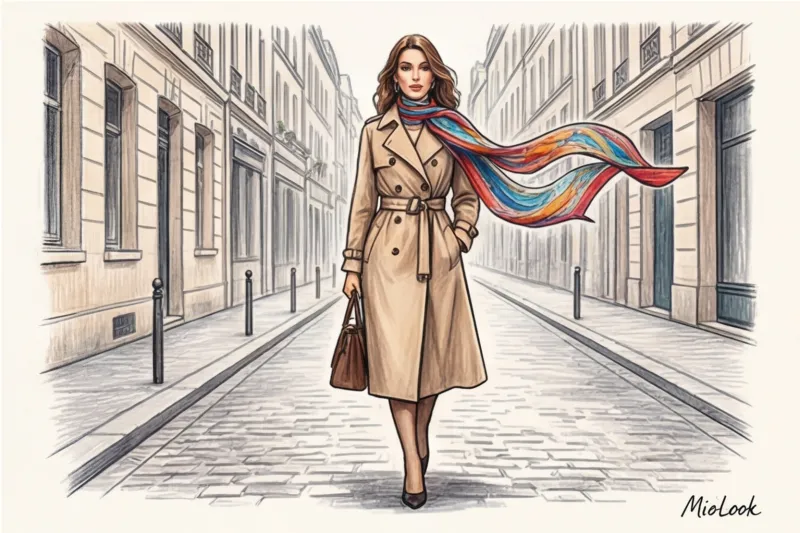
While exploring the closed Hermès archives in Paris (a true holy of holies for any fashion researcher), a curator allowed me to touch vintage pieces from the 1950s. This encounter with dense, almost crisp silk twill transformed my perception. I witnessed firsthand the historical scale: how a purely functional piece of fabric, originally designed to protect the neck from wind and dust in an open car, was transformed into the ultimate status symbol. In the 1970s, Yves Saint Laurent (YSL) made the silk scarf a bohemian marker of intellectual freedom, and Hermès turned it into a veritable fashion currency, comparable to gold (today, rare vintage pieces easily sell at auction for €500 and up).
In modern practical style, a scarf has long ceased to be just a "warm addition." In my experience, it's the most powerful and underrated tool. color correction Have you ever noticed how some trendy clothing shades make your face look tired or highlight the shadows under your eyes? You buy them anyway because the color is trendy, and then the item hangs in your closet for years. A scarf solves this problem in no time. You can wear absolutely any shade, even the most "unusual" one (for example, a complex mustard or pale khaki), if you separate it from your face with the right scarf from your natural palette. This silk or cashmere barrier works like a professional studio reflector—it illuminates the skin with the right pigments, completely neutralizing the impact of an unflattering dress or top color. For example, if you've chosen a formal women's evening pantsuit A deep black color, which can visually add age, is what will save the portrait area.
Moreover, a scarf acts as a focal point, directing the attention of others. There's an unspoken rule in style psychology: we decide where our conversation partner will look. A bright print, a diagonal line of a hanging hem, or a voluminous textured drape at the collarbone instantly catches the eye. You create an artificial center of gravity, distracting attention from areas of the figure you don't want to emphasize. To learn how to manage this complex geometry without mistakes, I always recommend my clients first create combinations virtually—for example, by uploading items to MioLook There you can clearly see how the size and print of the scarf change the overall proportions of the outfit, even before you start experimenting with knots in front of the mirror.
Stylists' secrets: how to tie a scarf beautifully without looking too "uniform"
Backstage at Milan Fashion Week, I regularly observe a curious paradox. Before shows, stylists can spend as much as ten minutes conjuring up a single stole, so that it looks as if the model threw it on in a split second. This effect of controlled randomness is the absolute foundation of modern styling. The key trick I learned from my Italian colleagues is that they never tie the fabric tightly. The knot is formed semi-loosely, and then the folds are carefully pulled out from the inside, allowing air to flow in. Volume appears, and tension dissipates.
There's a persistent myth among my clients: the more complex and intricate the neck design, the more elegant the look. In reality, trying to create a multi-tiered origami knot is a surefire way to achieve the so-called "uniform effect." You start to look like an impeccably dressed flight attendant or bank employee from the 2010s. If you're looking for a way, How to tie a scarf beautifully For everyday life, forget the five-stitch training diagrams. Complexity for the sake of complexity kills the dynamic.
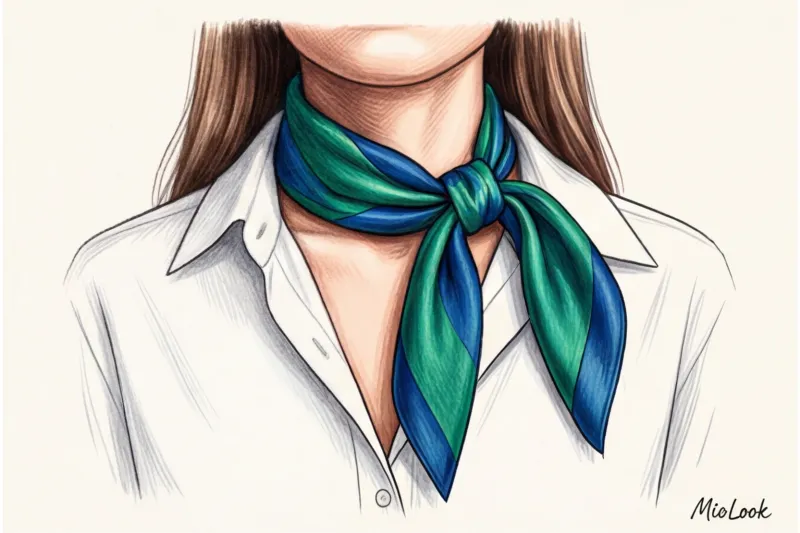
This is where the concept of the notorious “Parisian casualness” comes into play. je ne sais quoi ). As style icon Inès de la Fressange rightly points out, perfect symmetry in a portrait inevitably adds age. Straight, millimeter-precise ends of a scarf visually make the face look more static, emphasizing even the slightest expression lines. My advice: move the knot a couple of centimeters away from the center of the neck. Let one end hang lower than the other. This slight asymmetry creates the illusion of movement, even when standing still.
Access to MioLook for €0.99 — one-time payment
A smart AI stylist will create the perfect look with your accessories.
Get access — €0.99 onceHowever, shape is dictated not only by geometry but also by the physics of the material. What works beautifully on fine wool will turn into an awkward lump on thick silk. Over the years of working with premium accessories (where the price of a classic bob ranges from €250 to €500), I've developed a strict rule: always listen to the fabric.
- Thick silk (twill): It holds architectural folds perfectly. It requires no knots at all—simply thread the ends through a scarf ring or create a single loose overlap. The twill is springy and creates graphic volume on its own.
- Chiffon and viscose Flowing, "liquid" materials. They thrive on draping. These scarves are best wrapped around the neck in loose loops, allowing the ends to flow. Trying to tie them into a tight knot will simply cause the fabric to deflate and look untidy.
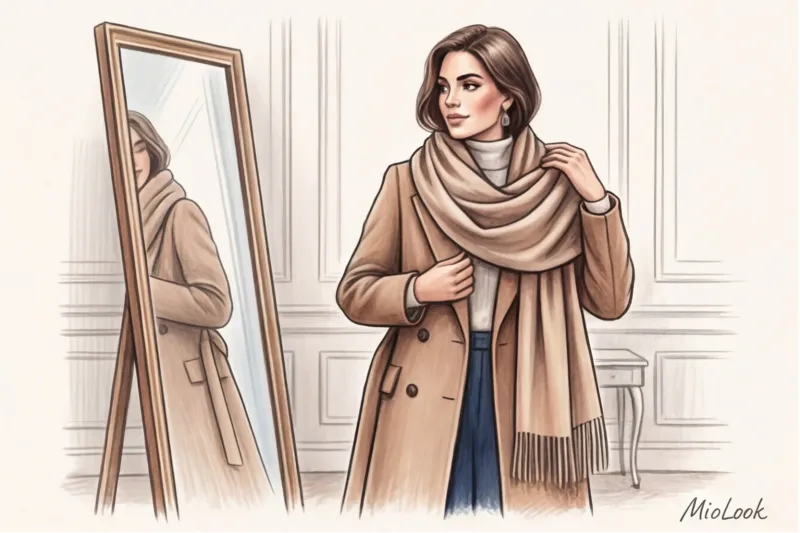
- Cashmere: Requires maximum airflow. Chunky cashmere scarves should never be twisted into ropes. The best technique for them is to casually drape one end over your shoulder, creating a cozy cocoon without any hint of fixation.
Your task is to allow the material to express its character, rather than to break it with complex tying patterns.
Silk Geometry: How Size and Shape Dictate Knotting Techniques
"Camilla, I bought a gorgeous silk dress, but for some reason it's lumpy and doesn't look anything like that elegant, flowing drape I saw on Pinterest." I hear this phrase at almost every other personal consultation. Let me reassure you: the problem isn't a lack of taste, but rather a matter of simple geometry. In the luxury accessories industry, sizing isn't just random lines in a catalog; it's a strict, functional regulation, honed over decades.
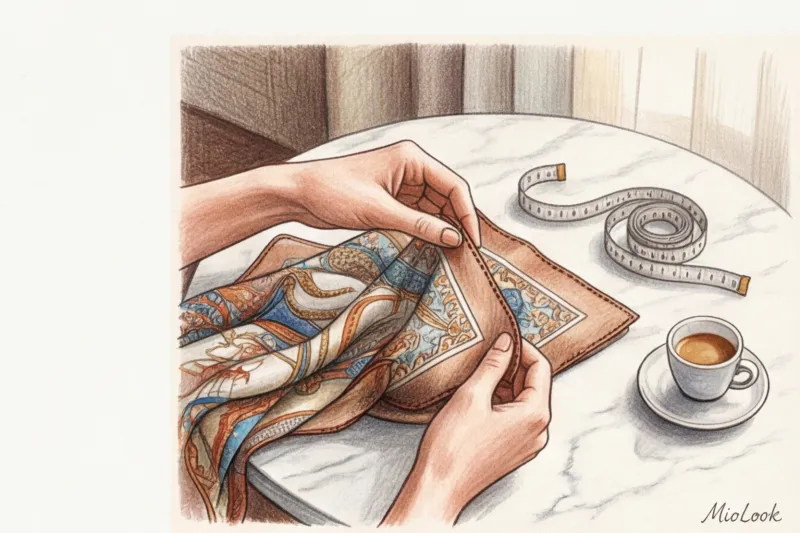
You physically can't make a voluminous French knot from a 50x50 cm piece, and it's awkward to fit a luxurious 140x140 cm piece into a thin choker. Furthermore, the weave density and weight of the fabric vary dramatically across sizes. To understand this system once and for all and stop buying beautiful things that end up sitting in your closet like dead weight for years, let's move from abstract advice to specific centimeters.
Classic bob (90x90 cm): from Grace Kelly to modern catwalks
The 90x90 cm format is the absolute gold standard, once canonized by the House of Hermès, and Grace Kelly made this proportion legendary. It was in this silk bob that the Princess of Monaco gracefully hid her broken arm in 1956, turning a medical necessity into an iconic fashion statement. Why do I always call this size the most attractive investment? With a basic piece made of dense silk twill costing between €150 and €400, you get at least a dozen full-fledged use cases. Twill, thanks to its diagonal weave, holds its shape perfectly and doesn't slip through hair or the smooth fabric of a jacket.
I'll share three foolproof techniques that my clients master in just a couple of minutes in front of the mirror. The first one is base triangle on the chest. The fabric is folded diagonally, the ends are crossed at the back of the neck and neatly brought forward. This is the perfect filler for the V-neck of an unbuttoned white shirt. The second pattern is necklace knot Roll your bob into a narrow strip (stylists call this a "base band"), tie three or four loose knots evenly spaced, and wrap it around your neck. This is a brilliant and easy substitute for chunky metal jewelry, which often clashes with business dress codes.
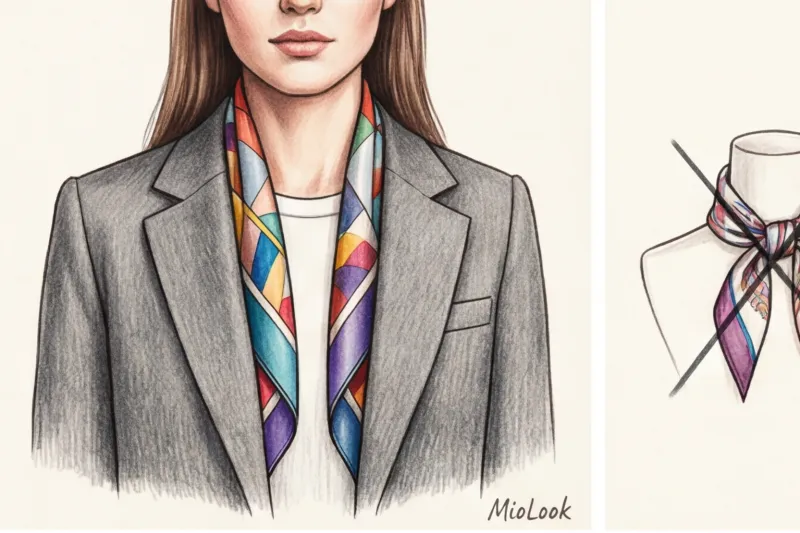
The third, my favorite technique, spied on the Celine shows - draping under the belt Simply drape the unfolded square around your neck, allowing the symmetrical edges to fall freely along the lapels of a classic trench coat or jacket, and secure them with a wide leather belt at the waist. This trick instantly elongates the silhouette, creating two distinct vertical lines and creating a complex, architectural layering without adding a single ounce of bulk.
Gavroche (50x50 cm) and twill: micro-accents
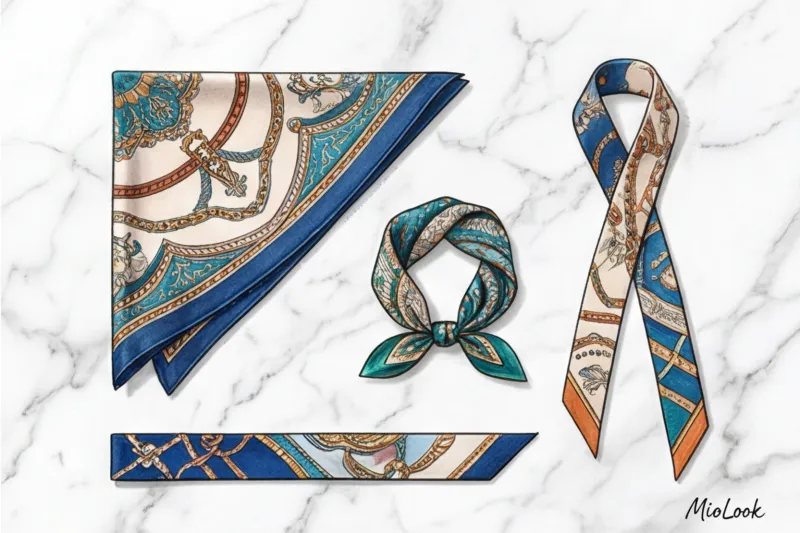
If a 90x90 square is a large-scale canvas, then 50x50 cm (the so-called gavroche) and narrow double-sided silk ribbons (twills, the standard size of which is usually 5x86 cm) are elegant micro-strokes. Last year, research agencies recorded a 34% increase in sales of micro-accessories—modern women are tired of heavy jewelry and are actively seeking weightless alternatives.
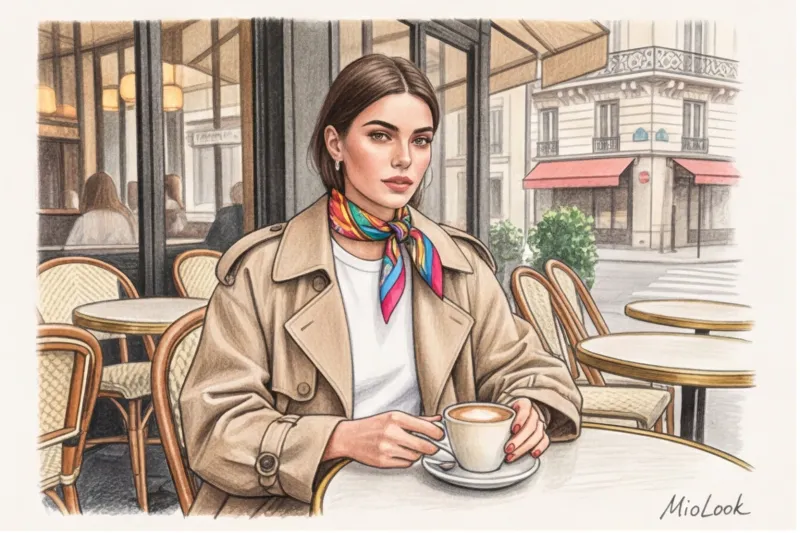
The square gavroche works flawlessly as silk choker Fold it diagonally into a tight strip, wrap it around your neck twice, and tie a tiny knot just to the side, near your collarbone. Unlike metal or velvet, smooth silk doesn't weigh down your jawline or draw unnecessary attention to the signs of aging on your neck. Another practical option is to accent your wrist instead of a bracelet. Wrap the scarf around your wrist and let the short ends hang out boldly. This technique is especially helpful in hot summer weather, when metal watches or bracelets heat up, oxidize, and cause discomfort.
Twilly ribbons (also known as bandeau ribbons) are designed for delicate work with accessories. Integrating twilly ribbon into the handle of a high-status bag solves two problems at once. First, it reliably protects delicate leather (such as sensitive box calfskin) from sebum, hand cream, and moisture from your palms. Trust me, from my experience with leather craftsmen: professional restoration and refinishing of greasy handles will cost you at least €100–150, whereas silk ribbon takes the brunt of the impact and is easily hand-washed. Second, it's a dynamic style. If you find it difficult to imagine how a vibrant ribbon print will pair with your basic wardrobe, I recommend digitizing your items. Upload photos of bags and scarves to the "smart wardrobe" feature in the MioLook app , you can visually try on micro-accents for different looks and evaluate color combinations before leaving the house.
Shawls and voluminous scarves: the art of working with texture
From the finest silk work, we move on to the heavy artillery of the fall-winter season. The standard size of a classic stole is 70 x 200 cm, while the popular blanket scarves can reach a massive 140 x 140 cm. And here we inevitably encounter a major stylistic challenge: voluminous cashmere scarves often transform an elegant woman into a shapeless cocoon.
I'll be honest: on petite women under 160 cm tall, a thick, three-layer wool wrap around the neck looks downright comical. You literally risk drowning in the fabric, creating a "head without a neck" effect, which instantly disrupts all body proportions and makes the silhouette appear flat.
So if you are looking for a way, How to tie a scarf beautifully With a dense texture, your main rule is to minimize the number of layers near the face and let the bulk of the volume flow vertically. My go-to trick for cold weather, which looks elegant even over bulky down jackets, is asymmetrical one-shoulder throw Let one end of the wide scarf hang down in front, right to hip level, and drape the other loosely over your opposite shoulder, creating a soft, casual drape across your chest. To prevent this design from slipping while walking quickly or in gusts of wind, simply discreetly pin the fabric with a small safety pin on the inside of the coat's shoulder seam. The result is warmth, a beautiful, dynamic diagonal, a visually slimming effect, and complete neck mobility.
Anatomy of Style: Choosing a Knot to Match Your Neckline and Body Type
Behind the scenes at European design schools where future stylists are trained, there's a strict maxim: an accessory in a portrait setting isn't decoration, but an architectural element. If the lines of the fabric and the cut of the garment clash, even impeccable cashmere will look out of place. The main rule of proportion is uncompromising: the knot should complement the neckline, not clash with it.
Visual perception researchers have long proven that the human eye detects dissonance in shapes in a split second. A round, three-dimensional knot over an angular, triangular cutout creates visual noise, instantly cheapening the image. It is precisely this professional analysis of cutout geometry that algorithms and stylists use. MioLook when working with personalized recommendations for clients. When thinking about how to tie a scarf beautifully, women often focus solely on the weave technique, forgetting about the "foundation"—the shape of the collar on which the knot will be based. To ensure the accessory works for you, let's explore the anatomy of ideal combinations for three basic scenarios.
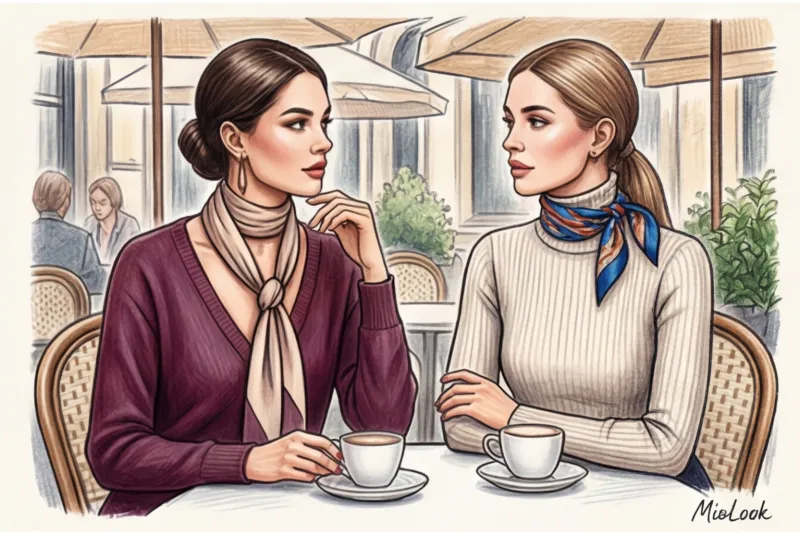
Deep V-necks and shirts
A deep V-neckline is always a stylistic challenge. While it beautifully elongates the silhouette, it also leaves too much air in the portrait area. Without proper shaping, the neckline can look unfinished. The purpose of a scarf in this case is to aesthetically fill the void.
For formal shirts made of heavy cotton, a tie knot or a loose loop is ideal. The geometry of these weaves mathematically precisely follows the shape of the letter V, enhancing the vertical line rather than cutting it. If you wear a high-quality silk top (even a basic one, in the €100 to €150 price range) with a deep neckline, a tightly tied bob around the neck will visually "break" the collarbone line.
My favorite trick, often showcased at Saint Laurent shows, is a knot inside an unbuttoned shirt to create a complex layering effect. In practice, it's easy to do:
- Unbutton the top three buttons of your shirt to create a deep triangle.
- Fold the silk bob diagonally into the base ribbon.
- Wrap around your neck once and tie a neat double knot just above the jugular notch.
- Tuck the ends of the scarf under the collar of your shirt so that the silk just delicately peeks out from under the cotton lapels.
This technique creates an intelligent, slightly masculine chic, in the spirit of Diane Keaton in the cult film Annie Hall, while maintaining a flawless neckline.
Turtlenecks, round necks and closed necks
High turtlenecks, thick turtlenecks, and crew neck sweaters pose the biggest danger of fall-winter styling. Wrapping a bulky scarf tightly over a closed neck creates the infamous "severed head" effect. The neck visually disappears, the chin blends into the chest, and the face appears noticeably wider than it actually is.
Analyzing the street style reports from global trend bureau WGSN for the past season, it's easy to see that the pros are solving this problem by creating an artificial vertical line (elongating the neck) with long, dangling scarf ends.
"The asymmetry and free flow of the fabric draw the viewer's gaze downwards. This not only counteracts the heaviness of the round neckline but also visually reduces a couple of pounds thanks to the clear vertical lines"—this is a basic rule from lectures on visual figure correction, and it works without fail.
Instead of wrapping the fabric around your neck three times, drape the accessory over your head so both ends hang loosely. If it's cold outside and you need extra warmth, make one loose wrap, but be sure to leave the ends asymmetrical—one at your waist, the other just below your chest. If you're wearing a narrow silk twill over a thin turtleneck, tie it in a low knot at chest level, mimicking a long sautoir necklace.
Access to MioLook for €0.99 — one-time payment
Start creating perfect proportions and flawless looks with artificial intelligence.
Get access — €0.99 onceOuterwear: coats, trench coats and jackets
When outerwear comes into play, the stakes are raised. Coats and raincoats have a rigid structure: lapels, shoulder straps, and yokes. A scarf should never deform this carefully crafted structure.
Let's look at a classic technique: how to tie a scarf over a Burberry-style trench coat. The British fashion house has been sharing the same impeccable style for decades, the essence of which is to make the accessory a seamless extension of the coat. Take a long wool-blend scarf and place it around your neck over the raised collar of your trench coat. Cross the ends over your chest (without making a classic knot!) and secure them tightly at the waist with a coat belt. This trick instantly gathers your silhouette, accentuates your waist, and secures the fabric so it can withstand any autumn wind.
For formal double-breasted wool coats, a stole tucked under the coat's lapels (English style) is the ideal solution. A wide piece of cashmere or thick viscose fabric is folded lengthwise, draped around the neck, and its ends are neatly spread across the chest and pressed into the lapels of the buttoned coat. This creates a pop of color in the V-neck and provides excellent insulation without adding bulk.
When it comes to structured jackets, the flat-fit rule applies. Never try to hide a voluminous knot of thick yarn under a fitted blazer. This will inevitably distort the shoulder line, ruin the fit, and create the illusion of a slouched posture. Texture always dictates the rules: dense fabrics remain on the outside or lie flat on the inside, while thin, flowing silks are draped.
7 Trendy Ways to Tie a Scarf in 2024-2025
WGSN's 2024 analysis confirms an interesting shift in consumer behavior: search queries related to styling existing items have overtaken the search for new trends. We've stopped asking ourselves, What buy, and focused on that, How It's about wearing. Today, knowing how to tie a scarf beautifully has evolved from a utilitarian skill into a tool for deeply customizing your look. Forget the boring step-by-step diagrams of the 2000s with their tight rose knots. Modern styling demands airiness, dynamism, and an understanding of context. Let's explore seven key techniques for this and next seasons, focusing on impact and appropriateness.
1. The La Vallière knot (a modern take on YSL)
If you've been following Saint Laurent's latest collections, you'll know that the bourgeois 1970s aesthetic is back in fashion. A lavalier is a loose, slightly drooping bow made of soft silk that should never be tied too tightly (otherwise you'll end up looking like a stern schoolgirl). Keep the loops large and asymmetrical. Vibe: Intellectual sexiness. It's the perfect choice for a date at a wine bar or a theater premiere. It works best when paired with a silk blouse with the top two buttons undone.
2. "Italian loop" with an asymmetrical exit
The classic Parisian loop (where the scarf is folded in half and the ends are threaded through the resulting loop) is hopelessly outdated if the ends hang at the same level. A trendy technique is to pull one edge significantly lower than the other. This diagonal visually elongates the silhouette and trims volume in the portrait area. Vibe: that same Italian one sprezzatura (thoughtful casualness). A surefire choice for a smart-casual office, brunch with girlfriends, or a creative pitch. Throw on a trench coat, and the look is complete.
3. Draping under a jacket belt
One of the most effective power dressing tricks allows you to transform a basic stole into a fully-fledged piece of clothing—something like a vest with an architectural cut.
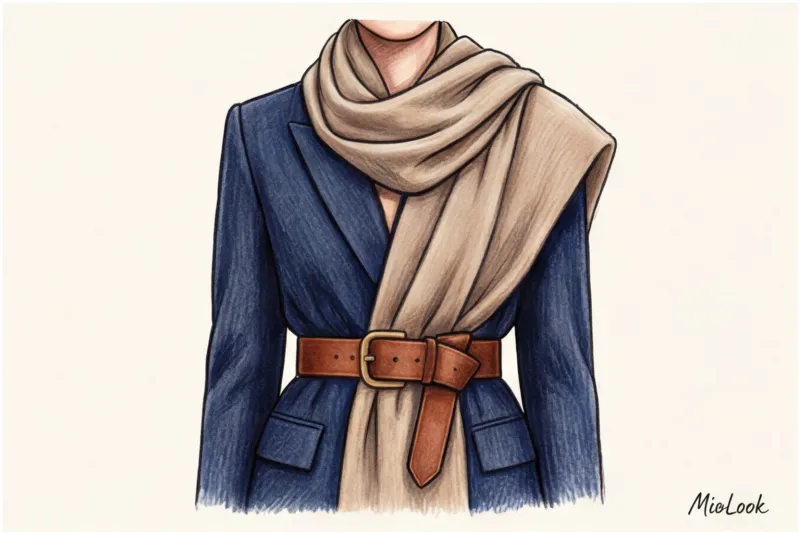
The scarf is draped around the neck so that the wide ends hang evenly down the front of the jacket, and then secured with a stiff leather belt at the waist. Vibe: Authority and structure. This is the perfect outfit for an important presentation, business breakfast, or board meeting. Textured wool fabrics look luxurious, and a scarf starting at €150 can elevate the entire outfit to a premium level.
4. "Fake snood" made from a stole
A trick I learned from Scandinavian street stylers, who skillfully escape the icy winds of Copenhagen. A wide, long stole is wrapped tightly, but without constricting, around the neck several times, with both ends carefully tucked inside the drape. Visually, it looks like a voluminous, one-piece funnel collar in the spirit of Phoebe Philo's minimalism. Vibe: Cozy, cinematic protection. Indispensable for long autumn walks, flights, or trips out of town.
5. Single twist with hidden knot at the back
A supremely clean line, consistently used by The Row stylists. The scarf is wrapped around the neck once, but its ends are tied in a neat, flat knot under the hair or tucked under the coat collar at the back. A perfectly even circle of fabric remains at the front. Vibe: Stealth wealth aesthetic. Suitable for conservative business meetings and situations where simplicity is essential. To help you remember which coat this minimalist knot goes best with, I recommend taking a photo in front of a mirror and saving it. the "smart wardrobe" feature in MioLook This way, you'll build a personal database of ready-made solutions and save time in the morning.
6. Off-center Cowboy Triangle
The traditional bandana knot with the angle forward seems too literal these days. Try shifting the central triangle toward your collarbone a few centimeters to the right or left. This micro-asymmetry instantly adds complexity and daring to the look. Vibe: Dynamic and rock 'n' roll. A great way to take the edge off a strict white shirt for a casual Friday or party.
7. "Cascading Waterfall" for flowing fabrics
A technique for fine chiffon, viscose, or silk, the fabric is wrapped around the neck as loosely as possible, creating a sagging swing (like a cowl neck), and one long end is elegantly draped over the shoulder, where it can be discreetly secured with a brooch. Vibe: Dramatic, fluid elegance. This is a strictly evening, formal option. It looks stunning over a slip dress at a gala dinner, exhibition, or cocktail event.
Common mistakes: what cheapens a scarf look
Nothing ruins a carefully crafted silhouette more mercilessly than one misplaced detail in the portrait area. As a practicing stylist, I regularly encounter the harsh truth: a perfectly tailored jacket or €800 cashmere coat can lose its luster in a second if paired with a poorly chosen accessory. Let's examine the top style crimes that instantly ruin an outfit's status.
The first and most insidious mistake is the tight flight attendant knot, or, as I call it, the "banker at a corporate party" syndrome. When you tie a silk bob into a tight, microscopic knot right under the chin, you optically shorten your neck and add at least five years to your age. It looks forced, formal, and deprives your look of dynamism. By learning the techniques, How to tie a scarf beautifully Always remember the "two-finger rule": there should be air between the fabric and the skin. Modern elegance is based on a slight casualness, not a military bearing.
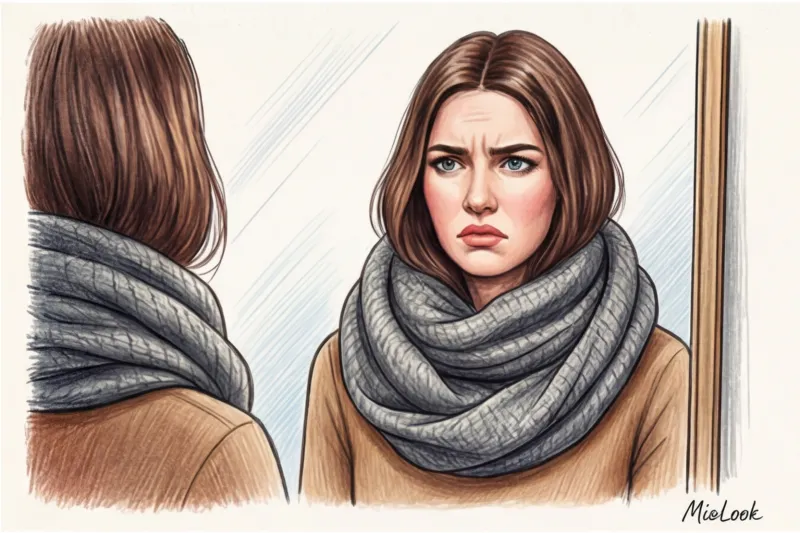
The second absolute no-no is skimping on texture. Cheap polyester, even if it skillfully imitates an expensive twill weave, will give itself away with the first movement. Synthetics are prone to static, cling to hair, are impermeable, and have no volume. Instead of a sculptural drape, you get a dull, flat fabric. It's much wiser to invest €50 to €70 in a high-quality basic scarf made from a viscose-silk blend than to try to tame a 100% plastic one.
The third mistake is related to the distortion of body geometry. When creating a vertical line of color with a stole, many forget to pay attention to the point of attachment. If the ends of your long scarf end exactly at the widest part of your chest or at the line of your active hips, you're creating a horizontal line that visually widens this area. The fabric disrupts the proportions of your figure. The golden rule of styling: the edge of the accessory should end either above or below your natural hips.
Finally, there's the problem of too many accents at once. A complex scarf with a bold print, styled in a fancy knot, is already a powerful solo statement. When paired with chunky chandelier earrings or large geometric clip-on earrings, the portrait area becomes an overcrowded display. Visual noise arises, which can easily overwhelm your conversation partner. If you've chosen an accent silk, let it be the sole star: limit yourself to simple stud earrings or thin, smooth hoops.
Your ideal image
it begins Here
Join thousands of users who look flawless every day with MioLook.
Get access — €0.99 onceUnconventional integration: the scarf as an element of clothing
When shooting cruise collections on the Côte d'Azur, I always take a box of silk bodices with me. When the temperature in Cannes or Antibes rises above 30°C, classic styling rules cease to apply. According to Vogue Runway reports (2023), the integration of silk accessories as full-fledged garments in resort collections has almost doubled. And this makes sense: when we're looking for fresh ideas, How to tie a scarf beautifully , going beyond the usual portrait zone gives the most spectacular results.
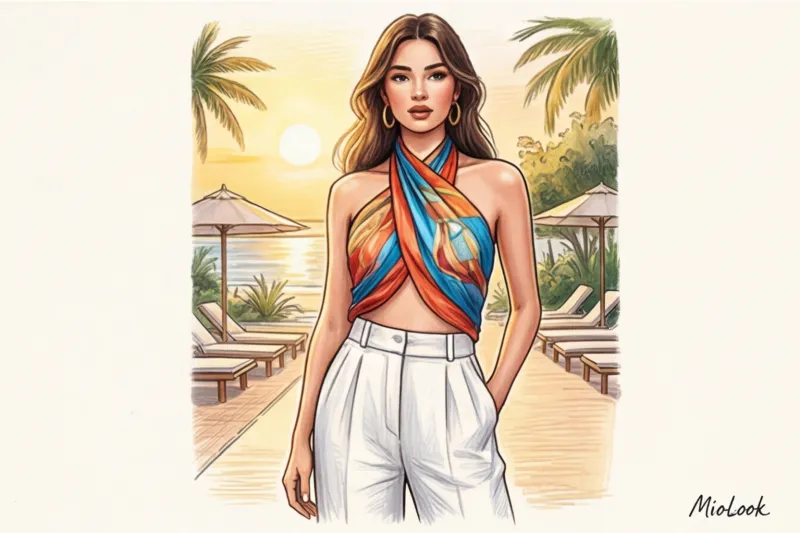
Transforming a 90x90 cm bob into a summer top is a direct nod to the bohemian aesthetic of Saint-Tropez in the 1970s. To create the perfect halter top, fold the scarf diagonally into a triangle. Tie the two pointed ends at the back of your neck, and wrap the wide end around your waist and secure it tightly at the small of your back. For a bandeau look, fold the fabric with a wide ribbon and tie a voluminous knot right at the chest.
Fair warning from my styling experience: this trick works flawlessly on busts up to a C-cup. If you need extra support and hold, use double-sided fashion tape—it's a professional secret that saves models during fashion shows and strong gusts of sea wind.
Another unique technique is to use a long scarf (or a tightly twisted diagonal bob) instead of a belt. The crisp denim of jeans or the flowing fabric of palazzo pants instantly gains movement when you thread silk through the belt loops. While a good entry-level leather belt will cost at least €100–€150, a vintage silk belt bought at a European flea market for €30 will do just as well in accentuating the waist. Just don't try to tie a strict, symmetrical bow. Let the ends fall freely along the hips, asymmetrically, creating a vertical line that elongates the silhouette.
Finally, integration into the hairstyle. A thin, elongated scarf woven into a relaxed braid, or a silk knot securing a low ponytail at the nape of the neck—this is a marker of "quiet luxury," regularly cited at Chanel shows. The smooth texture protects the hair cuticle from mechanical damage (unlike tight elastic bands) and seamlessly ties together the entire color palette of the outfit. To check in advance how a vibrant hair print will complement your jacket or trousers, I recommend uploading a photo of the items to the "smart wardrobe" feature in MioLook This way, you'll create a flawless visual mood board for your look before you even open the closet door.
Checklist: How to put together a capsule collection of scarves and shawls for all occasions
Clients often open their wardrobe drawers to me, filled with dozens of colorful scarves, bought in a fit of spontaneous shopping spree, yet they continue to wear the same black snood day after day. It's a classic paradox of abundance. In fact, to forever solve the problem of how to tie a scarf beautifully for any look, season, and dress code, you don't need an entire shelf. You just need a strict system.
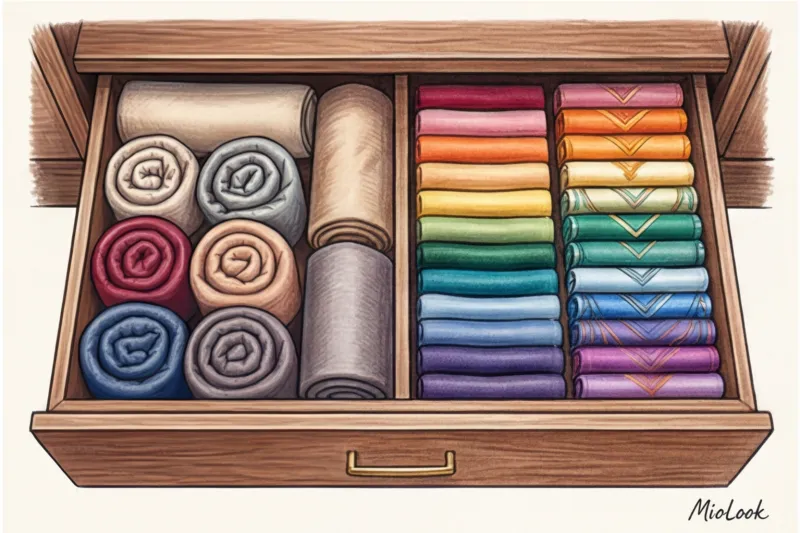
According to wardrobe mathematics, just four carefully chosen items with different physical properties can generate over 20 unique stylistic combinations. My signature formula for a basic capsule wardrobe looks like this:
- One basic solid color cashmere scarf. This is the architectural foundation of your outerwear. Look for flexible knits in shades like camel, mouse gray, or graphite. These tones act as perfect reflectors of light, unlike a dull black, which mercilessly highlights shadows and signs of fatigue on the face. A quality piece will cost between €150 and €300, but this investment will pay off with a decade of impeccable service.
- One bright silk bob with an accent print. Your lifeline for formal looks. When you're wearing a conservative navy blue jacket or an architectural sheath dress, the intricate geometric pattern of a scarf (say, 90x90 cm) becomes the focal point and eliminates boredom.
- One micro-handkerchief (gavroche). The 50x50 cm square is an indispensable tool for delicately integrating into a portrait. It doesn't add unnecessary bulk, fits perfectly into the open collar of a cotton shirt, and instantly elevates a casual denim and white T-shirt ensemble to a level of sophisticated elegance.
- One lightweight stole in a neutral shade made from a blend of silk and linen. An absolute must-have for changeable weather. Linen provides the necessary textured dryness and matte finish, preventing the accessory from looking too "dressy," while silk thread ensures a supple, soft drape.
The secret to a successful accessory capsule lies not in quantity, but in the absence of duplication of functions. Each piece of fabric should fulfill a specific, well-defined purpose in terms of density and coverage.
To help you remember these 20 combinations in your morning rush, I recommend digitizing your micro-capsule. By uploading these four positions to MioLook , you can visually layer them over basic clothes right on your phone, and the algorithm will tell you when it's time to add a bright silk accent to a monochrome sweater.
Conclusion: Your Personal Handwriting
In the sociology of fashion there is a concept sartorial signature — a sartorial or style signature. Fashion historian Valerie Steele often notes in her research that it's repeating, accentuating accessories that create a visual anchor that instantly catches the memory of others. In concluding our discussion of portrait architecture, I want to emphasize one fundamental idea: a scarf is a signature to your look. It's that final touch that elevates a simply worn garment into a meaningful stylistic statement.
Take a look at the absolute titans of the industry. We unmistakably recognize Karl Lagerfeld's silhouette from his signature wide silk pocket squares, which flawlessly concealed his shirt collar and created a graphic black-and-white vertical. And Anna Wintour's strict looks are utterly unthinkable without her masterful ability to layer accessories, where printed fabrics become the focal point of the composition. Their style achieved iconic status not because of an endless pursuit of micro-trends, but because of a manic devotion to a single, perfectly honed detail. They have found their calling card. Your favorite silk or cashmere can work for you with absolutely the same effectiveness.
But how do you find that perfect balance? I encourage you to play mindfully. Set aside a free evening when you're unhurried and don't have to rush to a meeting. Pull out your entire scarf collection, put on a basic white crewneck or a simple jacket, and begin experimenting boldly in front of the mirror. Put into practice the 7 trendy ways to tie a scarf beautifully that we discussed in detail earlier. Observe carefully: how does the geometry of your face change as the knot's asymmetry changes? How does a dense twill hold its shape compared to a flowing chiffon?
My pro tip: never rely solely on memory. Be sure to photograph every successful experiment in natural daylight. To organize these successful finds, upload the resulting selfies to MioLook app Create a separate digital moodboard there, titled "My Knots" or "Neck Architecture." When you have exactly three minutes left before heading out on a foggy November morning, this personalized gallery will save your look from becoming boring.
I had a particularly revealing case. Three years ago, the CEO of a European tech startup approached me. Her business wardrobe was constrained by the rigid boundaries of Scandinavian minimalism, and she felt visually "invisible" at boardroom meetings. We didn't change her suits, but introduced just one constant: a narrow silk twill (costing around €150), which she always tied with a distinctive double knot, slightly offset onto her left collarbone. Six months later, she shared a striking result: investors stopped confusing her with other managers. They started saying, "Oh, that's the girl with the silk ribbon." One small piece of fabric worked more precisely and powerfully than expensive personal branding courses.
Perfect draping doesn't have to be geometrically perfect. It should always convey life, a touch of self-irony, and the dynamism of your movements. The secret of a stylish woman is that her scarf looks as if she threw it on a second before leaving the house, even if she spent a quarter of an hour in front of the mirror beforehand.
Look for that one knot that will become your signature. Develop your keen eye, try mixing contrasting textures, shifting accents, and disrupting classic proportions. Fashion is too serious a tool to be treated without a touch of creative play. And let your accessory always speak for you a little before you even say hello.
Your practical step for today: Take out that scarf that's been sitting on a shelf for over six months. Give it a second chance—integrate it into tomorrow's look in a completely new, unconventional way. Allow yourself this little stylistic daring.
Guide Chapters
How to Wear a Scarf as a Belt with Jeans and Trousers
The era of statement logos has given way to a more sophisticated casualness. We'll show you how to adapt the runway scarf trick to your favorite jeans.
How to Make a Scarf Top: Trendy Stylist Ideas
A silk bob is not only a beach accessory but also a stylish element of an urban wardrobe. We explore advanced ways to transform a scarf into a top with hidden fastening.
How to Wear a Twilly Scarf: 7 Stylish Ways
A thin silk ribbon is a stylist's secret tool that can transform a basic outfit in seconds. We're sharing seven unique ways to style a twill scarf.
Styling Tips: How to Find a Scarf Online Without Returns
Buying a scarf online often ends in disappointment due to color distortion. A colorist shares her secrets for error-free online shopping.
How to tie a scarf on a bag: stylist tips
Personal stylist tips: transform an ordinary bag into a designer masterpiece with a silk scarf. Learn foolproof ways to tie a beautiful knot.
How to Weave a Scarf into Your Hair: Secrets to a Long-Lasting Hairstyle
Tired of your silk scarf constantly slipping out of your hair? Learn professional tips to keep it securely in place all day long.
How to Wear a Scarf with a Trench Coat This Spring
The traditional neck knot is hopelessly outdated. Discover modern and stylish ways to style a silk scarf with a classic spring trench coat.
How to choose a scarf color to suit your face and outfit: stylist tips
A scarf is your personal light reflector, capable of brightening up your face or ruining your look. A stylist's advice will help you choose the perfect shade to complement your outerwear.
How to Wear a Blanket Scarf: An Oversized Styling Guide
A voluminous blanket scarf isn't just a way to ward off the cold; it's also a way to enhance your silhouette. Learn how to style an oversized scarf without complicated knots.
How to Wear a Scarf with a Down Jacket: Styling Tips
Styling tips on how to choose and tie the right scarf to go with a winter jacket. Avoid common mistakes and create a trendy layered look.
How to tie a stole beautifully without complicated knots
Forget complicated patterns and tight knots that only add years to your appearance. We're sharing easy ways to style a stole for an elegant look.
How to tie a headscarf beautifully: stylist tips
A silk scarf is a powerful tool for shaping facial proportions and creating a Mediterranean chic look. We explore the best ways to wear this accessory.
How to Tie a Small Scarf: French Chic
Parisian women know a thing or two about casual style. Learn how to easily and elegantly wear a small scarf to add a touch of true French charm to your look.
How to Tie a Scarf on a Coat: 10 Stylish Ways
A scarf is an architectural element of your look. We explore 10 stylish ways to drape the accessory, taking into account the geometric cut of your coat.