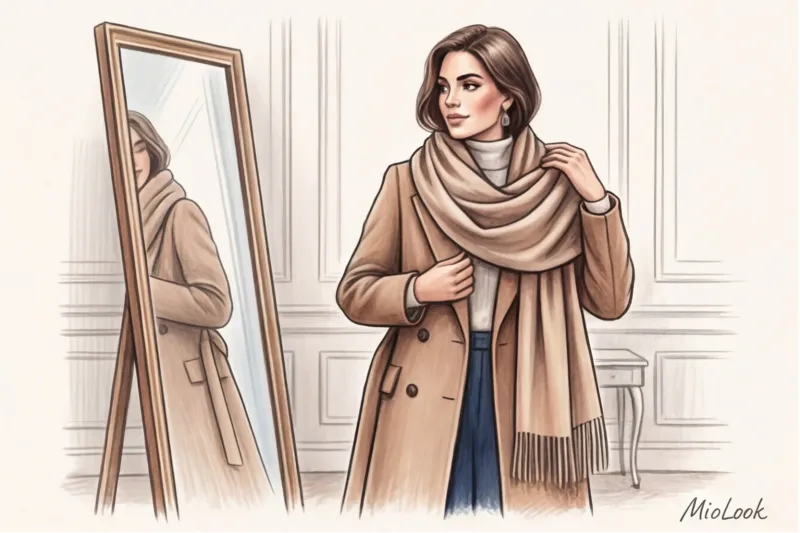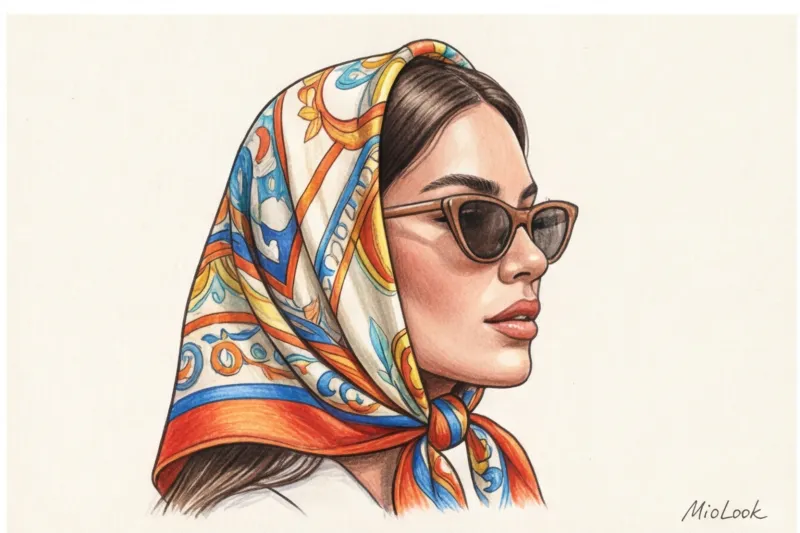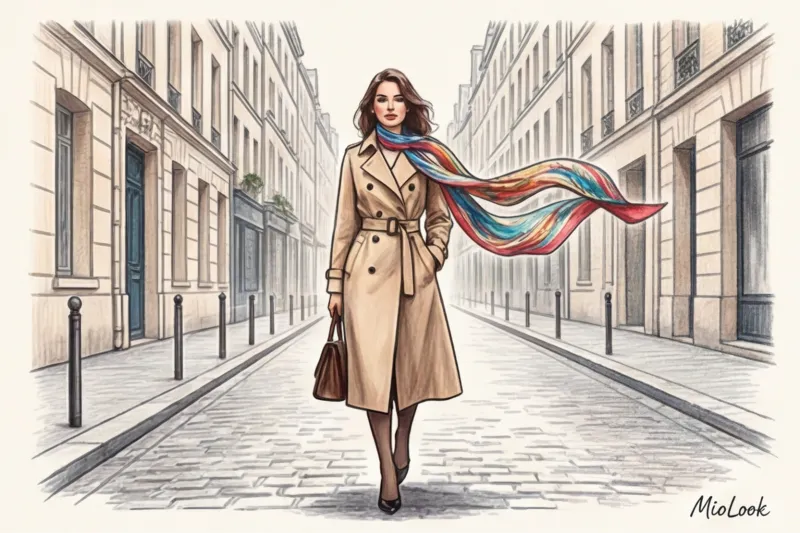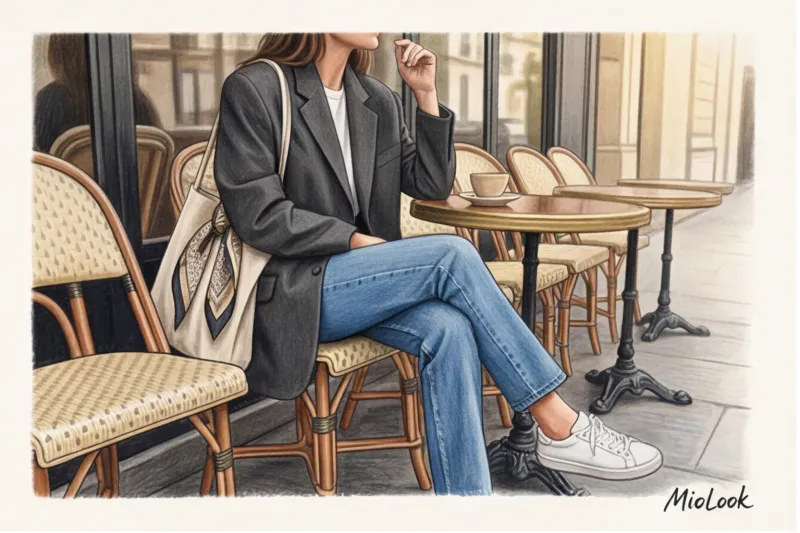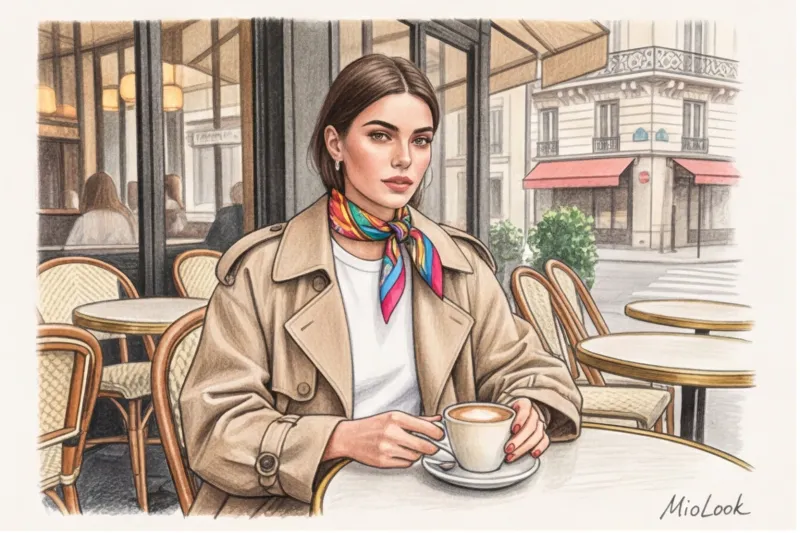
Sitting at a tiny café table in the Marais district of Paris, I can tell a tourist from a local in three seconds, without even looking at their shoes. The secret lies in the neck. The tourist spends twenty minutes in front of the mirror, perfecting the symmetry of a perfect origami knot, and ends up looking like an airline employee on shift. The Parisian throws on silk in the elevator without looking in the mirror, and radiates that same je-ne-sais-quoi - elusive French chic.
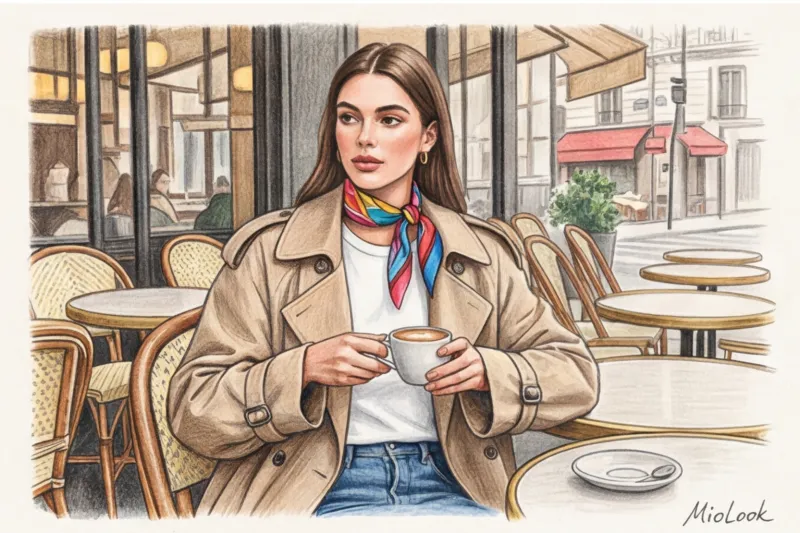
If you've ever Googled how to tie a small scarf, you've probably encountered dozens of complicated patterns: rose knots, braided hair, magnetic rings. Forget them all. True style requires carelessness and an understanding of the accessory's design. I wrote more about how accessories create the geometry of a silhouette in our the complete guide to the art of stylish image Today we'll explore a tiny but powerful tool: the gavroche.
The Anatomy of French Casual Chic: Why We're Wearing Our Bobs Wrong
The main paradox of the small silk square lies in its historical context. Format Gavroche (traditionally 45x45 cm) entered the bourgeois women's wardrobe from the harsh world of men's work uniforms. French workers and railroad workers tied cotton scarves around their necks to protect themselves from coal dust and sweat. This gesture was originally intended to be purely functional, not decorative.
When we try to transform an essentially functional element into a complex adornment, stylistic dissonance arises. At Paris Fashion Week, I constantly see the same trick among glossy editors: they wear luxurious, crisp silk with overly stretched cashmere sweaters (which themselves cost upwards of €400) or vintage men's jackets. This play on contrasting textures deflates the bourgeois arrogance of silk.
Complex, multi-layered knots from the internet are a style killer. The more carefully and perfectly your scarf is tied, the cheaper and more outdated the look. True chic requires subtle asymmetry and the illusion that you've escaped the wind on the banks of the Seine.
Your perfect look starts here
Join thousands of users who look flawless every day with MioLook. Our intelligent AI stylist will help you incorporate silk into your wardrobe.
Get access — €0.99 onceA Stylist's Secret: A Bob as a Powerful Tool for Facial Color Correction
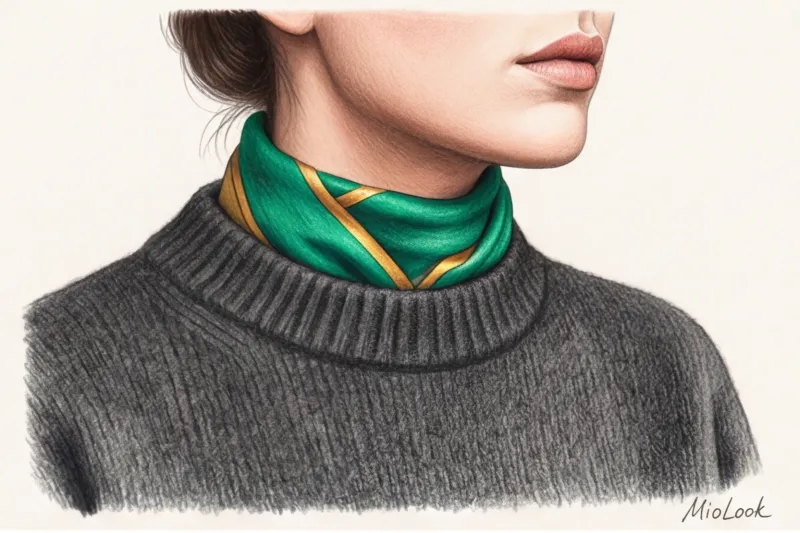
In my practice, I often encounter a common problem: a client buys a gorgeous trench coat in a trendy earthy green or dull gray for €300-€500, but never wears it. Why? "It makes my face look tired," she complains. This is where Johannes Itten's color theory (1961), describing the laws of contrast and reflection, comes into play.
Fabric placed close to the neck acts as a studio reflector, casting a direct shadow of color onto the chin, cheeks, and under-eye area. And here's the stylists' secret: just 15 square centimeters of the right silk near the face can completely change the perception of a 1.5-meter coat of the "wrong" shade.
A small scarf creates an architectural barrier between your skin and the complex color of your outerwear. When choosing a print, don't look at the fabric unfolded. Consider the exact color that will appear against your face when the scarf is twisted. This shade should highlight your eyes or skin tone, neutralizing the impact of an ill-fitting sweater.
How to Tie a Small Scarf: 3 Tips Without Looking Like a Flight Attendant
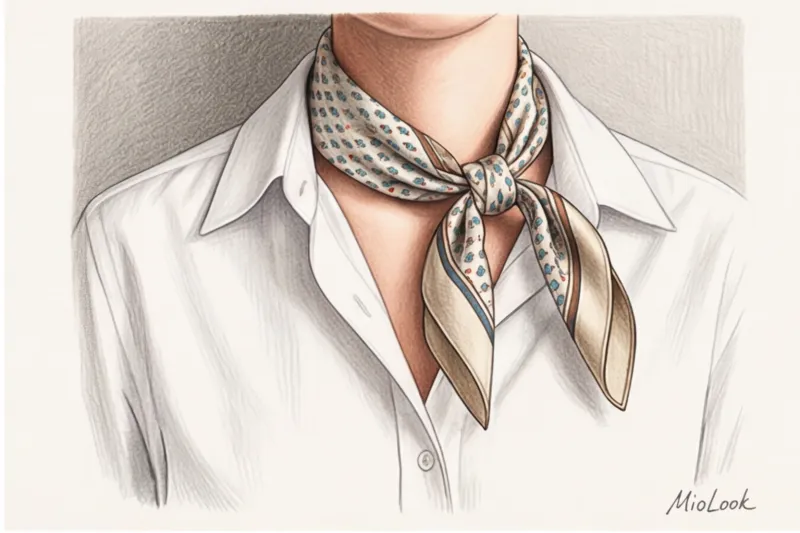
The main rule when working with silk is to fold it diagonally (along the bias). If you fold the scarf parallel to the edges, it will stand up straight. Diagonal folding gives the fabric flexibility, making it pliable and softly contouring to the neck.
Avoid special rings and buckles for small scarves. These accessories add weight and make the look appear ostentatious. Your hands are the only necessary tool. And remember about asymmetry: the knot should always be offset to the left or right of the center of the neck.
Parisian Basic Knot (Le Nœud Simple)
The most popular and natural option for the 45x45 cm size. Twist the scarf diagonally into a loose rope. Wrap it around your neck once (or twice if you have a thin neck and the scarf is slightly larger). Tie a double, but very soft, knot.
The secret lies in the finishing touch: the ends shouldn't lie flat, like a pioneer tie. Ruffle them, letting them stick out in different directions. This adds that rebellious note implied in the name. Gavroche.
Cowboy Diagonal (Bandana Style)
This method is ideal for a 55x55 cm (22" x 22") bandana. Fold the square in half to form a triangle. Place the corner of the triangle in front, cross the ends at the back of the neck, and bring them to the front, tying a neat knot directly over the triangle (or tucked under it).
The perfect style combo: wear this knot with a three-button men's shirt or a basic tee with a deep V-neck. Allow the skin in the neckline to breathe.
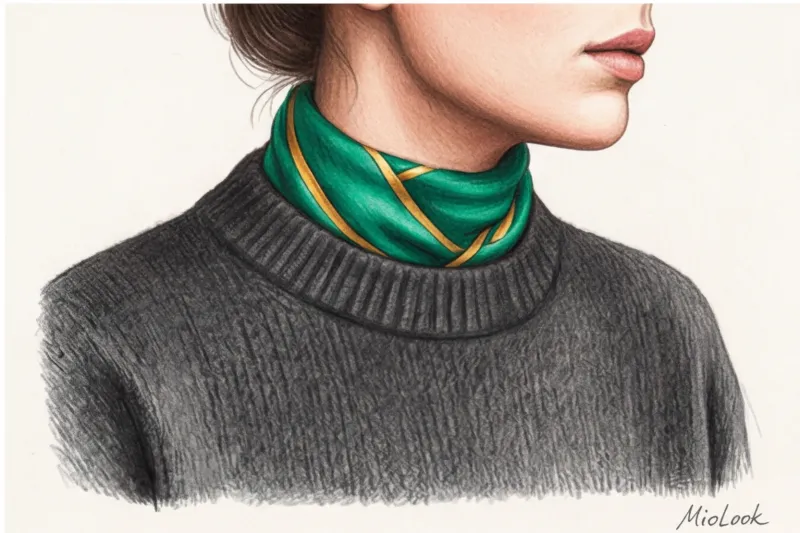
Choker Tie (Necktie)
A minimalist technique for those who don't like unnecessary details at the front. Tightly twist the scarf into a rope-like ribbon. Wrap it around your neck so the knot is at the back, hidden under your hair or the collar of your jacket. The front is left with a smooth, shiny line of silk.
This visual trick optically lengthens the neck and serves as an ideal replacement for a metal necklace in simple looks, adding only a subtle accent of color.
Access to MioLook for €0.99 — one-time payment
A smart AI stylist will select the perfect look for every day and help you create a capsule wardrobe where every item is 100% effective.
Get access — €0.99 onceAtypical scenarios: a small bob beyond the neck
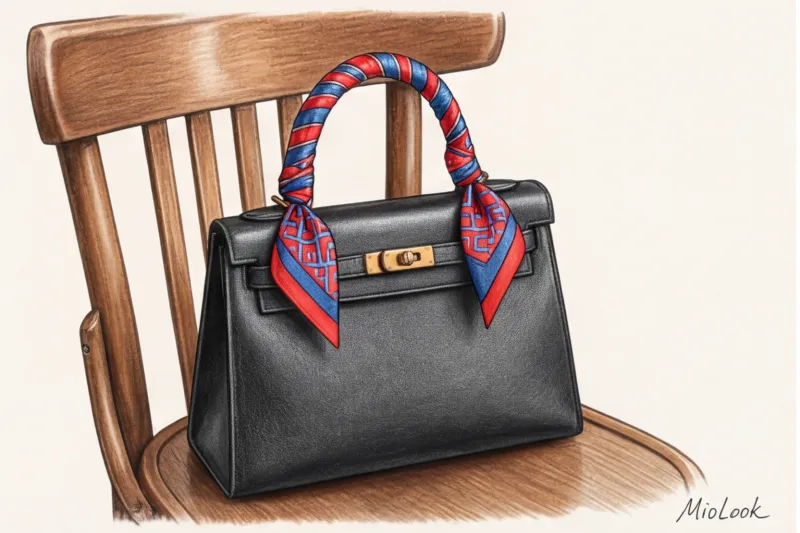
A silk square doesn't have to be confined to your neck. Wrapping it around your bag handle (the twilly effect) serves two purposes: it protects the expensive leather from hand cream and sweat, and allows you to incorporate a pop of color into a conservative outfit. If you tire of the print, the scarf can be removed in a matter of minutes.
Using a square instead of a bracelet is my favorite trick for casual office Fridays. Wrap the scarf tightly around your wrist. It pairs perfectly with basic metal bracelets or laconic women's watches , creating a complex, multi-layered texture on the hand.
Backstage at fashion shows (like Lemaire's), stylists often use silk scarves instead of stiff hair ties. Silk doesn't break the texture of hair strands or leave creases. Weave your bob into a low, messy ponytail or wrap it around a bun for a relaxed, elegant look.
Authenticity in the details: density, roulotte edge and investment
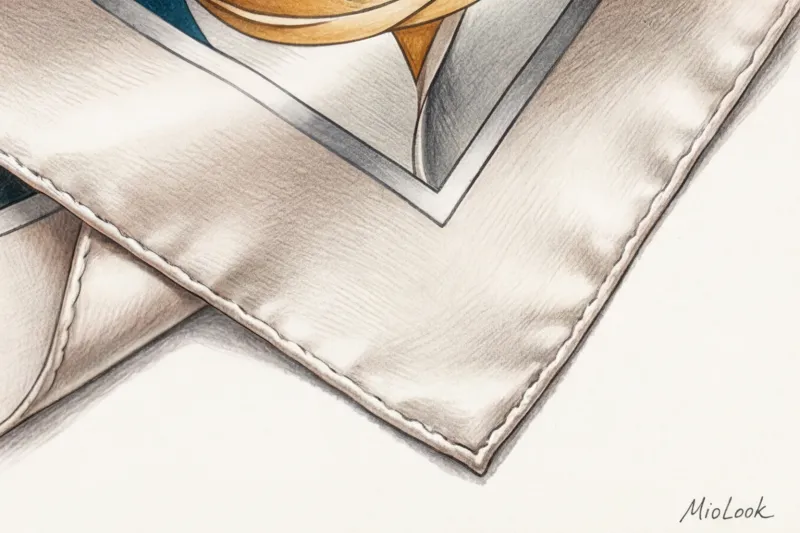
If you want a scarf to work, you'll have to pay attention to the quality of the fabric. While exploring the Hermès archives in Paris, I always remembered their gold standard—the edge. roulotte This is a technology in which the edge of the silk is rolled to the side. facial parts of the scarf and is sewn by hand with tiny stitches.
Machine-made flat stitching instantly cheapens an accessory. A flat-hemmed scarf will never form a beautiful, voluminous wave—it will hang like a dull rag. High-quality silk twill should have a density of 18-22 momme. It produces a characteristic "crunch" in the hand and holds its shape perfectly.
As for investment, you don't necessarily need to buy a new Hermès for €400. Excellent quality vintage silk squares can be found on resale platforms for €100-€150, while mid-range options (like COS or Massimo Dutti) in thick silk cost €40-€60.
Ready to get started?
Try the MioLook plan for free—no commitments required. Organize your wardrobe and create looks in one click.
Get access — €0.99 onceThe biggest mistake: what absolutely doesn't go with a silk scarf
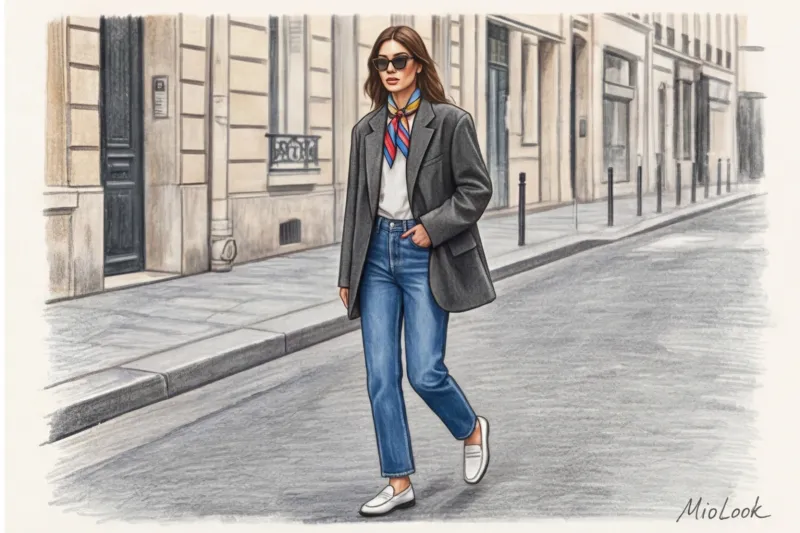
The main pitfall of the silk bob is its "strict protocol." If you wear a silk scarf with a classic, fitted two-piece suit and a white shirt, you'll instantly transform into a bank employee from 2004. It doesn't work. Ever.
To take the arrogance out of a silk scarf, always pair it with a masculine or grunge-inspired piece. The stylist's rule is: wear "expensive" and delicate silk only with "simple" textures. Distressed denim, rough matte leather, textured linen, and chunky knits are the bob's best friends.
Also, avoid pairing a silk scarf with bold lace, ruffles, flounces, and boho-style blouses. This clutter of details creates a stylistic overload. Silk near the face requires a simple background without competing embellishments.
Your action plan: integrating a bob into a modern wardrobe
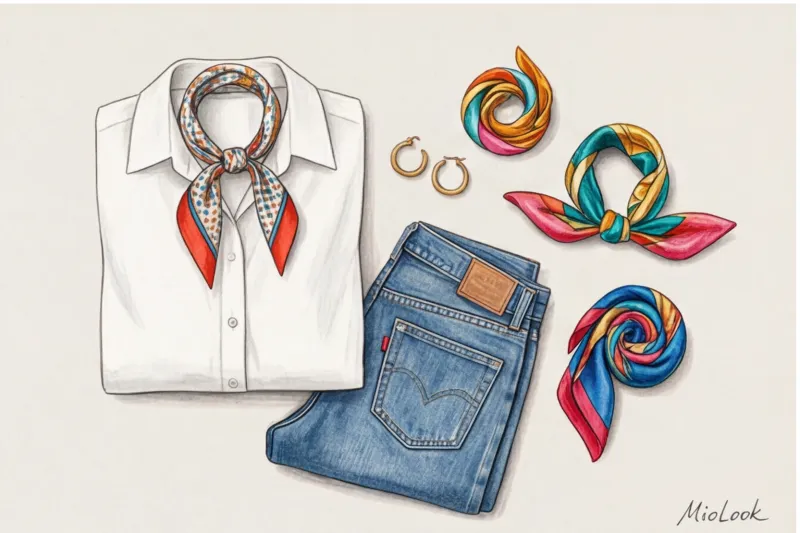
Theory is dead without practice. Here's your step-by-step plan for tomorrow morning to put this knowledge to work for your style:
- Step 1: Inventory. Take out of your closet those colors that you absolutely love on the hanger, but that make your face look pale or tired (that same gray cardigan or mustard jacket).
- Step 2: Find a companion. Choose a bob (45x45 or 55x55 cm) with a print that includes a color that complements your natural coloring (for example, the shade of your eyes) and a base color (white, milky, or dark blue).
- Step 3: Assembling the architecture. Fold a scarf diagonally into a rope, drape it around your neck with a slight asymmetry, and use it as a tie. Layer a complex sweater over it—and check out the magic of color correction in the mirror.
Stop thinking of a tiny scarf as a cute bow from the last century. In the right hands, it's a powerful foundation for a beautiful portrait, saving unfortunate purchases, correcting your complexion, and transforming a basic T-shirt and jeans look into a statement with a French twist.