

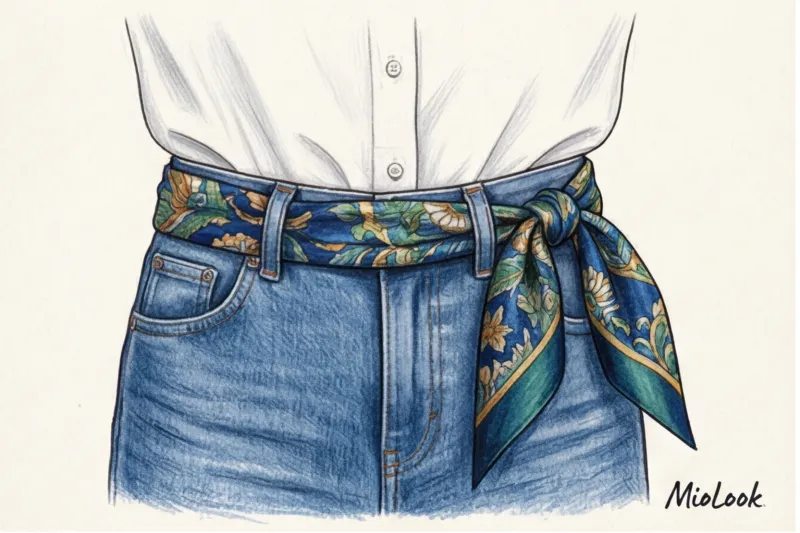
September 2023, Paris. I'm standing at the entrance to the sophisticated The Row show, watching the guests arrive. You know what caught my eye? The absolute silence around the waist. No jingling of heavy metal buckles, no creaking of stiff leather. The editors-in-chief and buyers arrived in vintage Levi's 501 jeans, cinched at the waist with soft silk Hermès scarves. This approach looked so fresh and expensive that I immediately realized: the era of accent logos on belts has finally given way to intellectual nonchalance.
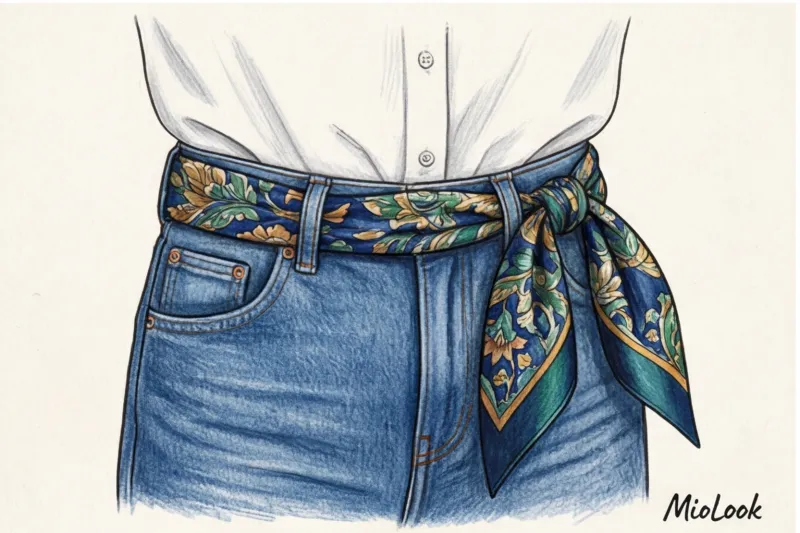
Using a scarf instead of a belt isn't just a way to hold trousers in place. It's a tool for architectural silhouette correction and subtle play of textures. We've covered the historical roots of this technique in more detail in our the complete guide to the art of stylish image , but today I want to talk about the purely practical side of the issue: how to adapt this runway trick to modern thick jeans and strict office trousers, so as not to look like a city madwoman.
The Architecture of Casualness: Why a Scarf Instead of a Belt Became a Marker of Parisian Chic
To understand the mechanics of this trend, one must delve into the archives. In the mid-1970s, Yves Saint Laurent launched a stylistic revolution: he removed the silk bob from the necks of bourgeois women and casually tied it around the waists of models in his famous "Russian Collection" (1976). It was a gesture of freedom, transforming a conservative accessory into a symbol of bohemian chic.
Today, according to the Lyst Index report for the first quarter of 2024, the demand for "effortless chic" (that same effortless look) has reached an all-time high. We're tired of clothes that scream how long we spent getting ready in front of the mirror. A scarf at the waist creates just the right optical illusion.
What's the secret to this illusion? A classic leather belt in a contrasting color works like a knife—it visually cuts your figure in half, creating a rigid horizontal line. This is often detrimental to women with a rectangle body shape. A soft, draped silk belt, on the other hand, draws the eye diagonally (due to the dropped ends) and seamlessly connects the top and bottom of the look without disrupting the proportions.
Anatomy of an accessory: which scarf is ideal for trousers and jeans
In my experience, eight out of ten style failures with this trend are due to poor fabric choice. If you choose cheap, mass-market polyester, it won't just become staticky—its slippery texture will cause the knot to come undone after fifteen minutes of vigorous walking, and the fabric itself will bulge out of the belt loops in untidy bubbles.
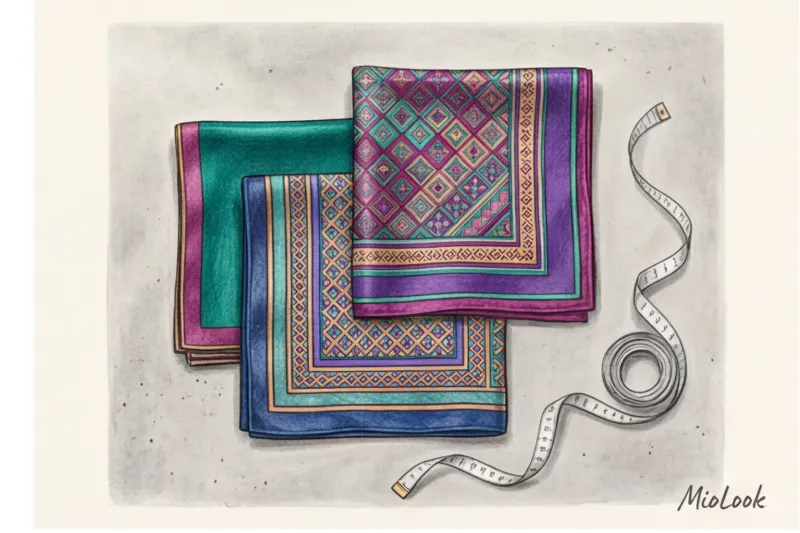
We need silk twill. It's a twill (diagonal) weave fabric used by luxury houses. Its fine ribbing on the surface gives it perfect adhesion—the twill knots "lock" tightly.
"When choosing a waist scarf, pay attention to the thickness, which is measured in momme. The ideal thickness for contact with rough denim is 14–16 mm. Anything thinner (for example, chiffon at 6–8 mm) will tear from friction against stiff belt loops after just three wears."
Don't try to match your scarf to your blouse or shoes—that rule is hopelessly outdated. Let it stand on its own, as a striking accent. In a good vintage store in Paris or Milan, a high-quality square made of thick twill will cost you between €60 and €150, and the investment will pay for itself many times over.
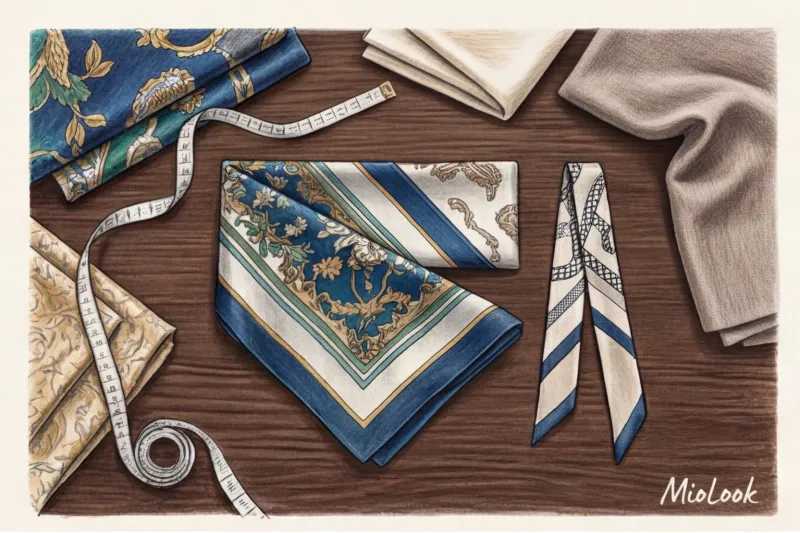
Kare (90x90 cm) or Twilly: what to choose?
Here, I'm going to disagree with half the fashion bloggers on TikTok. Many recommend using twill tape (narrow silk ribbons originally created for bag handles) for belt loops. This is a mistake.
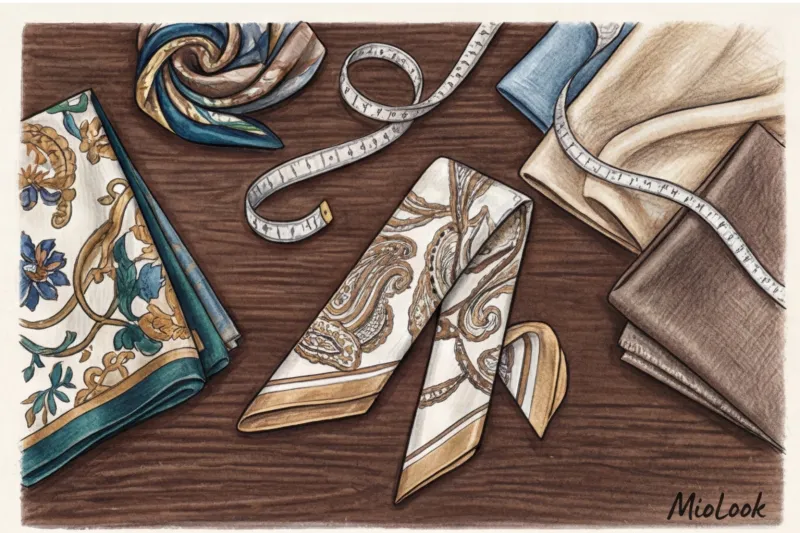
The twilly look is too short. Against the backdrop of wide-leg boyfriend jeans made of thick cotton, the thin ribbon is lost and looks disproportionate. Our choice is a classic 90x90 cm square bob. This size (for waists up to 85 cm) allows for the use of the bias folding technique (pliage de base) to create a voluminous, dense cord that sits securely in wide belt loops.
Don't know what to pair your new accessory with?
Upload photos of your trousers and jeans to MioLook. Artificial intelligence will analyze your wardrobe and suggest dozens of fresh combinations with a scarf.
How to Tie a Scarf as a Belt: 4 Stylistic TricksSave the intricate macrame knots for interior decor. In clothing, the key is movement. Here are four techniques I regularly use on shoots and recommend to my clients.
- Basic training (Pliage de base): Place the scarf inside out. Fold the two opposite corners toward the center until they meet. Then fold the resulting edges toward the center again until you have a strip of the desired width (usually 4-5 cm). Folding on the bias gives the fabric the necessary elasticity.
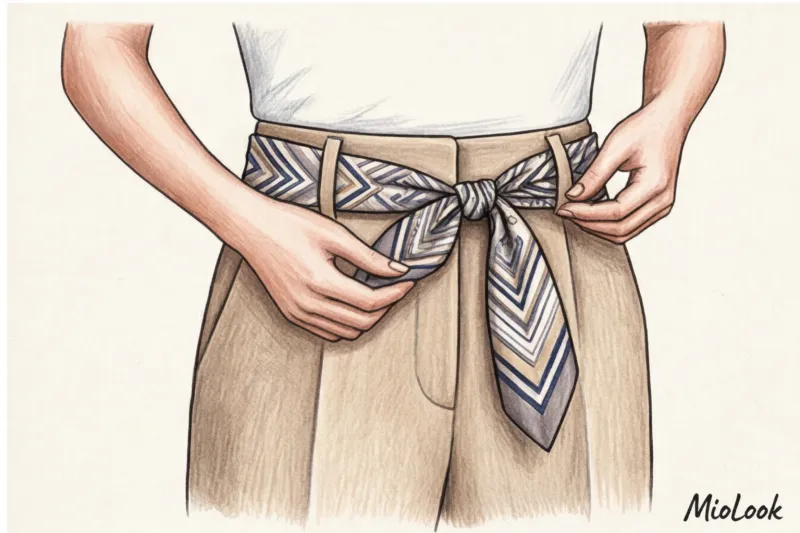
- Technique "French knot on the hip": Thread a folded scarf through all the belt loops, but instead of tying the knot exactly in the center (above the button), move it to the side, right on the hipbone. This asymmetrical accent visually lengthens the legs and eliminates the gift-wrapped look.
- Half-belt technique: My favorite trick for oversized jackets: thread a scarf through only the three front belt loops (from left to right), leaving the ends hanging free. This leaves the back of the trousers clean, while adding a complex textured detail to the front.
- Integration into the skin: If your trousers are a bit big and the silk won't hold them up, take a very thin leather belt (about 1.5 cm wide) and interlace it with the silk cord before threading it through the belt loops. The combination of rough leather and soft silk looks incredibly classy.
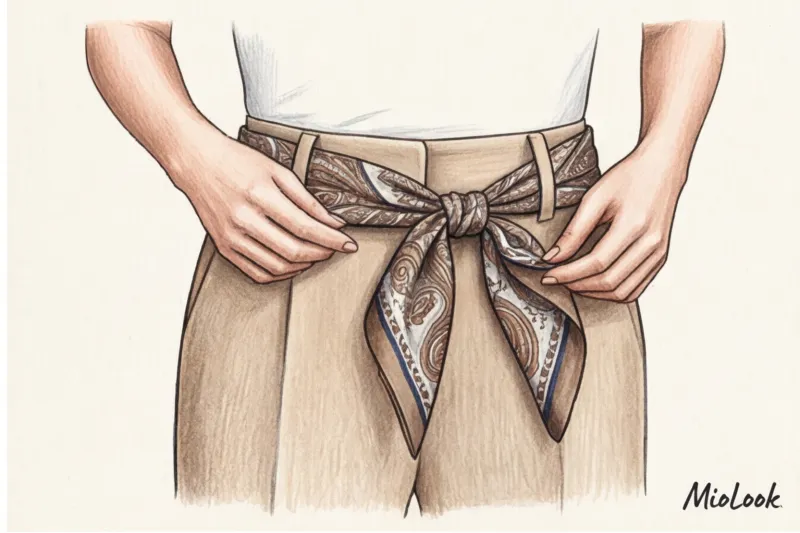
Stylist's secret: Backstage at fashion shows, we often use a black or gold micro-pin. If you're worried about the knot coming undone, simply pin it inside with a pin—it won't be visible from the outside.
Texture Play: Rules for Integrating Silk into Denim and Suiting
The main rule of modern styling, dictated by fashion institutions like WGSN, is a clash of textures. Items shouldn't be too obviously "clashed"; they need a spark.
Jeans (heavy denim):
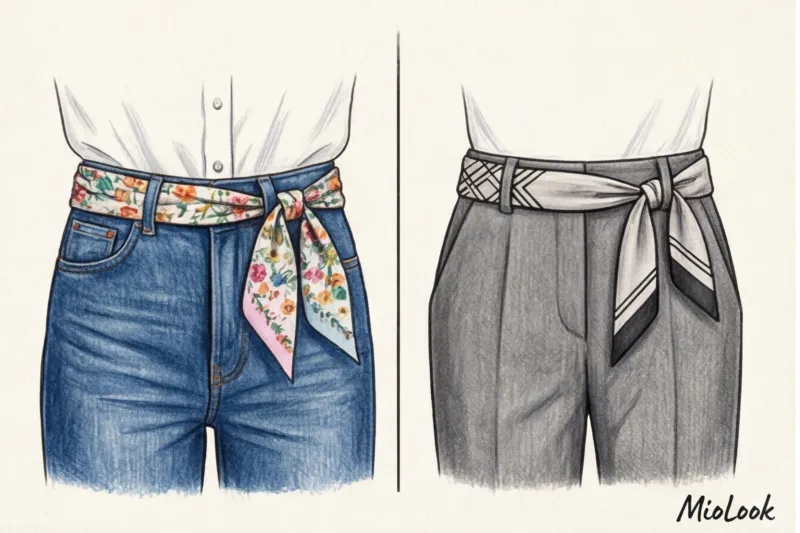
The rougher your jeans (raw denim over 14 oz, frayed edges, distressed), the more refined and "palatial" the scarf print should be. Monograms, chains, and baroque florals against a grunge backdrop of Levi's or Zara create that perfect wow factor. The perfect combo: a white 180 g/m² T-shirt, blue straight-leg jeans, and a bright silk.
Formal trousers:
How to incorporate this trend into the office if you have a smart-casual dress code? Choose a palazzo scarf made of fine wool or suiting viscose from brands like COS or Massimo Dutti. The scarf should be monochrome or in a crisp geometric pattern (stripes, color blocking, polka dots). No tropical colors—only architectural lines. And tuck the ends of the knot inward, creating the effect of a solid fabric belt.
Summer linen trousers:
Silk twill can be too glossy for linen. Matte crepe de Chine or high-quality oversized cotton bandanas work better. Cotton will complement the relaxed, resort-like feel of linen.
Common Mistakes: Why Your Scarf on Your Waist Can Look Ridiculous
Like any strong trend, this technique has its strict limitations. Honesty is a journalist's best quality, so let's figure out when it doesn't work.
Last year, my client Anna (an IT executive) sent me a photo from her fitting room: "Camilla, I tried to replicate a look from Pinterest, but I look like Captain Jack Sparrow." The mistake was complex.
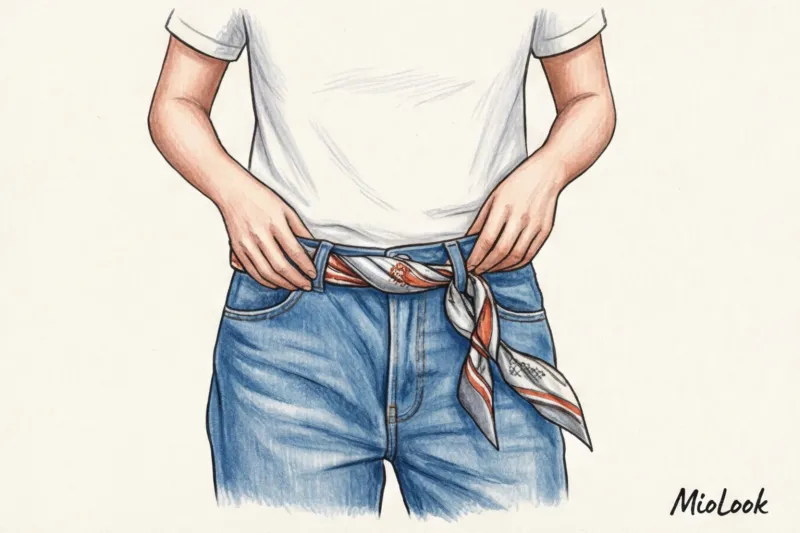
- Violation of proportions: If the ends of the scarf hang below the mid-thigh, they visually cut off the height. The optimal length of the free edges is 10–15 cm.
- Low rise: This is a critical limitation of the trend. A scarf instead of a belt is contraindicated with low-rise jeans. The soft fabric on the hips, combined with an exposed midriff, evokes the 2000s aesthetic at its worst, sloppiest. The trend only works with mid- or high-rise jeans.
- Vinaigrette effect: A scarf is a bold statement piece. If you wear a printed blouse, statement earrings, an elaborate bag, and a silk waistband, the look will fall apart from the overload. Let the scarf take center stage against a backdrop of basic, understated pieces.
Assemble the perfect capsule without mistakes
Use the smart wardrobe planning feature. MioLook will help you avoid the "look overload" effect by choosing harmonious combinations of textures and prints.
Try a smart wardrobeChecklist: How to wear a scarf instead of a belt to the office and on a walk
To reinforce the material, I have compiled two foolproof formulas for you that you can apply tomorrow morning.
Formula 1: For the Office (Smart-Casual)
Dark gray pleated trousers + a heavyweight light blue poplin shirt (tucked in) + loafers + a silk bob with a black and white graphic print, the ends tucked into the belt loops. You look sharp, yet demonstrate a keen understanding of styling.
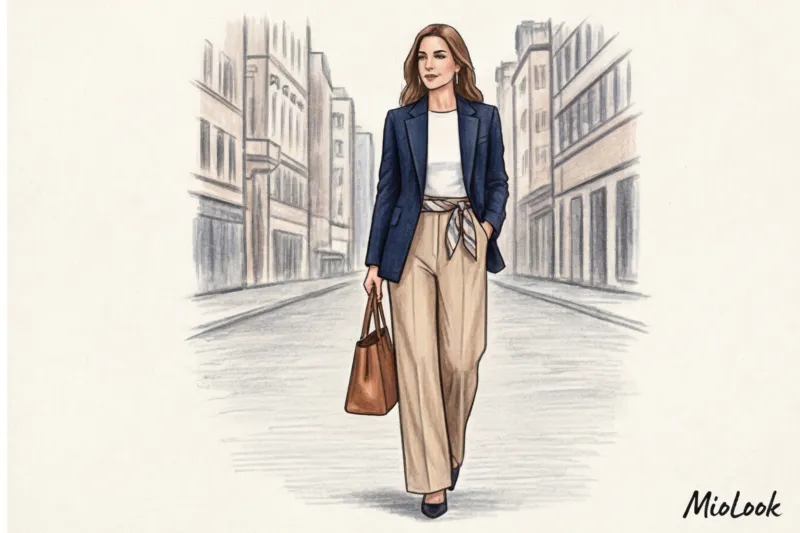
Formula 2: Weekend in the City
Straight-leg blue jeans + oversized cashmere V-neck sweater (tucked in at the front only, French tuck technique) + suede Cossack boots + vintage scarf in a warm shade (terracotta, ocher, burgundy) with loosely dropped edges.
And finally, about practicality. After a whole day in belt loops, silk will inevitably wrinkle. Never iron it! Simply hang it on a clothespin hanger in the bathroom while you take a hot shower. Moist steam will smooth out any creases in natural silk in 15 minutes without any risk of burning the fibers.
Style isn't a collection of expensive items in your closet. It's your personal style, your ability to see the subtle in the familiar. By replacing just one detail—stiff leather with flowing silk—you change the entire geometry of your presence in space. Try it. I promise you'll love this freedom.
Frequently Asked Questions
What dress code suits you?
Find out what style of clothing for work and life perfectly reflects you
About the author
Unlock MioLook
for €0.99
Start creating perfect outfits with artificial intelligence
Get access — €0.99 onceRelated Articles
Stylist Tips: How to Wear a Flattering Oversized Scarf
A voluminous scarf not only provides warmth but also creates an optical illusion...
How to tie a scarf beautifully around your neck: 5 stylish ways
Silk scarves often gather dust in the closet for fear of looking outdated. We ex...
How to Wear a Silk Scarf: Stylish Basic Ideas
A silk scarf is a stylish accessory that can add visual value to an outfit in 30...
How to Make a Scarf Top: Trendy Stylist Ideas
A silk bob is not only a beach accessory but also a stylish element of an urban ...