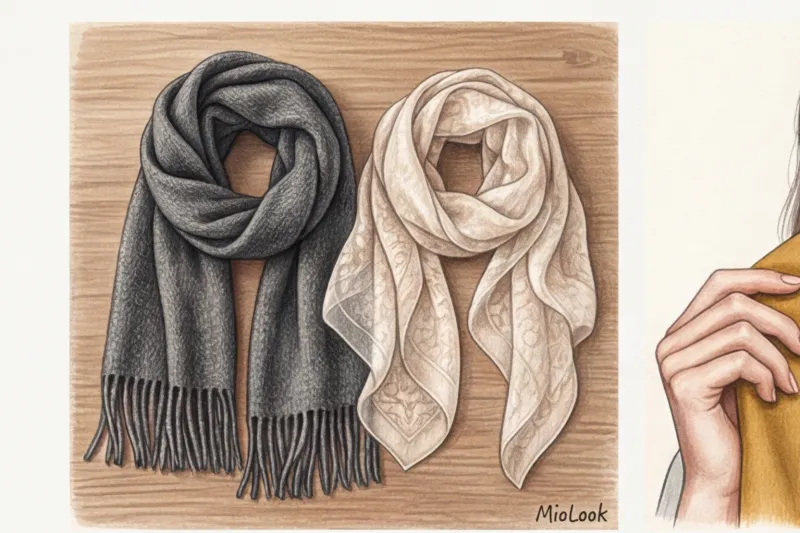
Have you ever ordered a luxurious emerald stole online, only to have it look like something out of a Hollywood movie in the studio photo, only to suddenly turn into a dull green rag upon unpacking it at home, highlighting the dark circles under your eyes? Spoiler alert: it's not about your appearance, and it's not always about the quality of the item.
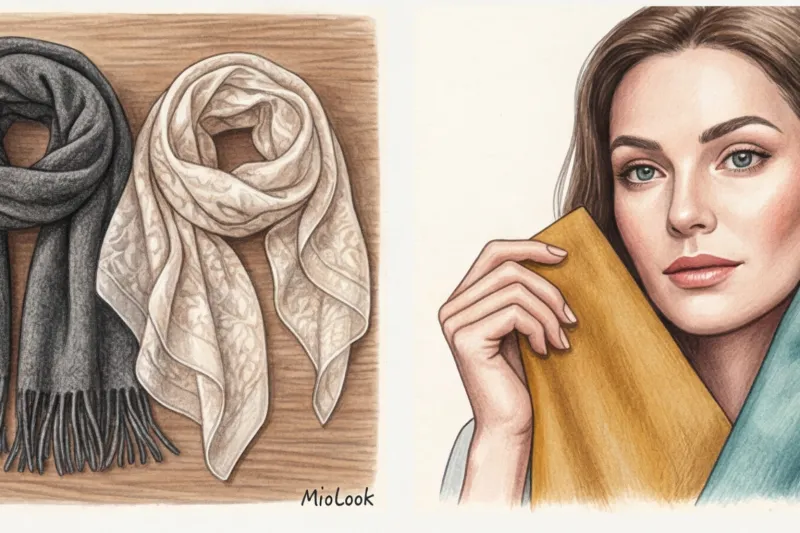
Over 12 years of working as a colorist and image stylist, I am convinced that the question of How to choose a scarf online It doesn't come down to intuition, but to an understanding of the laws of optics and fabric physics. A scarf over your face is your personal ring light, a portable Photoshop, and your primary tool for silhouette architecture.
We have already written in more detail about the mechanics of knots and drapes in our The complete guide "How to Tie a Scarf: The Art of a Stylish Look" But today, I suggest you look at choosing accessories from a different perspective. We'll break down virtual shopping into a precise science, so you can forget about returns forever.
Blind Buying: Why Do We Make Mistakes When Choosing Scarves Online?
According to WGSN, an analytical agency, approximately 40% of accessory returns in online stores in 2024 are not due to defects, but rather due to "color mismatch with skin tone." Why does this happen?
Think of how catalogs for major platforms like Farfetch or brands like Massimo Dutti are shot. The model stands under powerful studio lighting (with a temperature of around 5500K), which "bleaches" and highlights the fabric. In reality, we wear scarves under a gray November sky or the yellowish glow of office lamps. The color that appeared sparkling sapphire on a smartphone screen fades to a dull inky blue on a cloudy day.
The second problem is merchandising tricks. You see a perfectly voluminous knot in a photo of a down jacket with a scarf. What don't you see? A dozen invisible pins on the back of the mannequin's head and the work of an assistant who spent half an hour steaming the folds. On a flat screen, we buy the illusion of density.
Face color correction: how to choose a scarf online to refresh your look
One of my clients recently bought a stunning neon lime sweater from COS (around €120). The color is an absolute hit of the season. But after the first fitting, she texted me in horror: "Darina, I look like I haven't slept in a week and have jaundice."
The item had the tags, but I didn't want to return it. The solution? A classic silk bob in a deep navy blue (Navy Peony), tied around my neck. We created a contrasting barrier between the warm, "poisonous" lime and my cool-toned skin. The blue acted as a filter, neutralizing the yellowness and bringing out my natural flush.
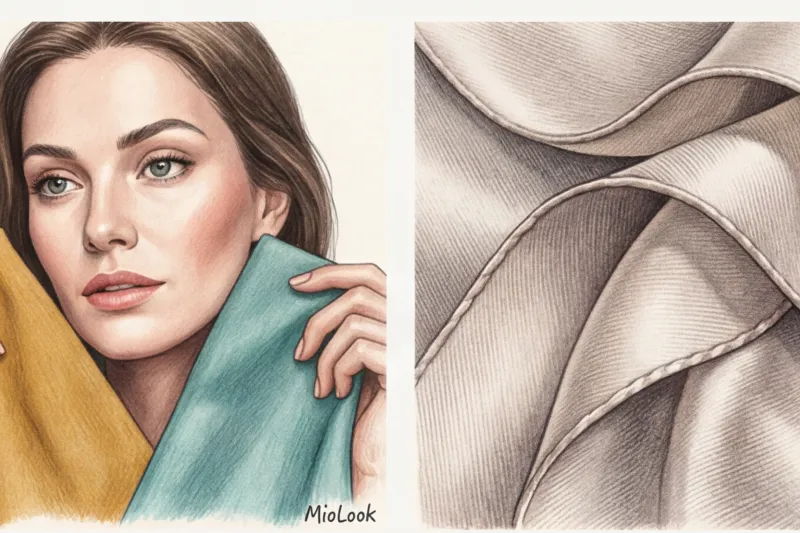
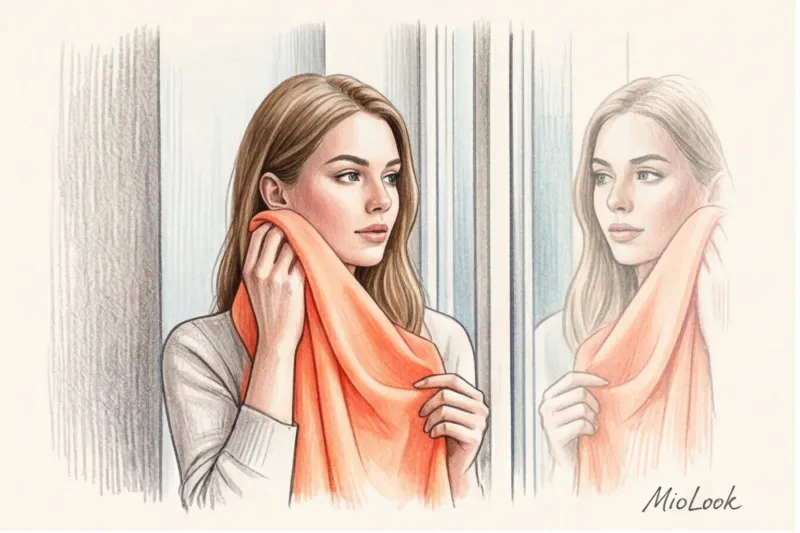
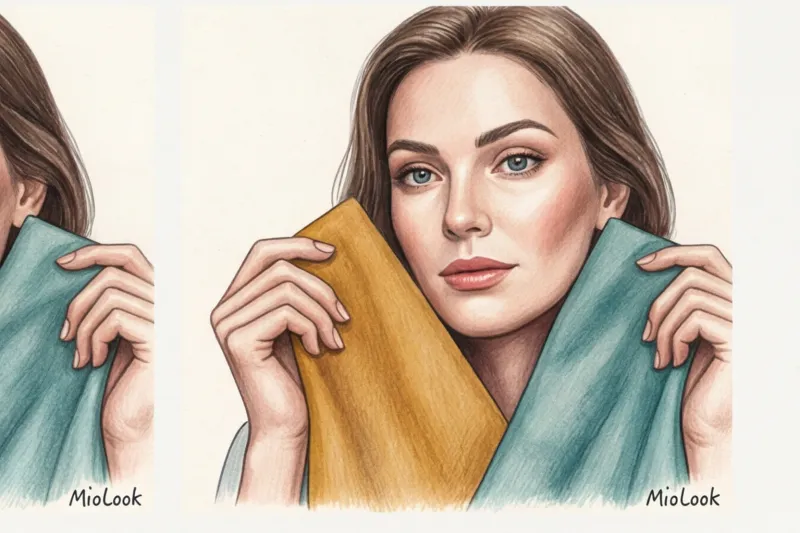
It's pure physics. According to the principles of optical illusions and Johannes Itten's laws of color contrast, a color placed directly next to the face will reflect back onto the skin. If you have a warm complexion (peach skin, golden freckles), a cool, steel-gray stole will visually add an earthy tone. And vice versa.
The Bridge Rule: Why Your Scarf Shouldn't Match Your Coat
Let's bust the biggest style myth once and for all: buying hat, scarf, and gloves sets in the same color is hopelessly outdated and visually cheapens the look. Perfectly matching accessories to your outerwear flattens your silhouette.
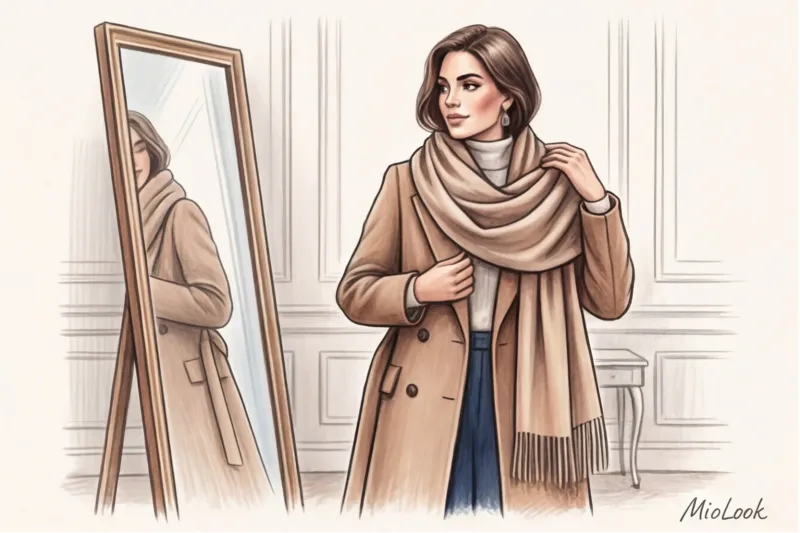
A scarf shouldn't be an extension of your coat. It should act as a contrasting bridge between your natural coloring (eye color, hair color) and your outerwear.
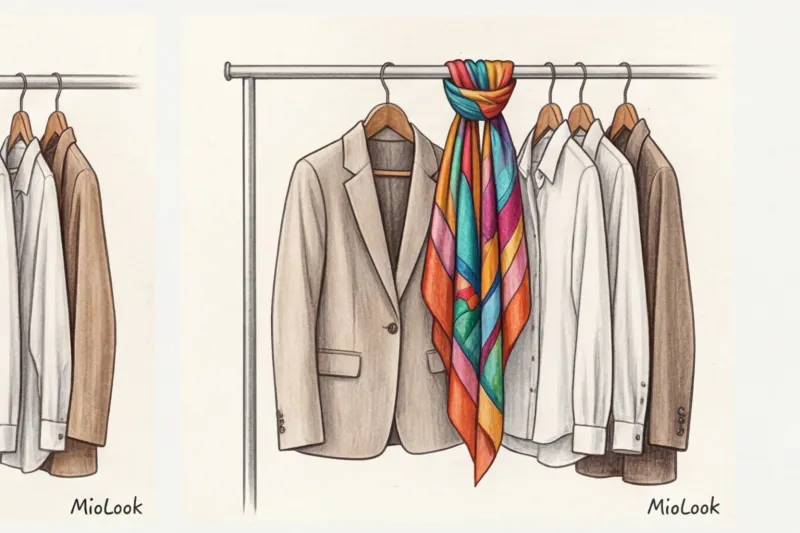
If you're wearing a basic beige coat, don't look for a beige scarf to match. Choose a print in which beige takes up only 10-15% of the surface (the three-shade rule), and the remaining colors complement your makeup, bag, or shoes.
Your perfect look starts here
Join thousands of users who look flawless every day with MioLook, the AI stylist.
Get access — €0.99 onceImage architecture: how to "read" fabric density through a monitor
While poring over the vintage Hermès archives, I realized the magic of a single number. Did you know that a classic 90x90 cm silk square weighs exactly 65 grams? This density of silk twill has been refined over decades.
65-gram silk doesn't hang limply. It has a distinctive "crunch" and maintains its sculpted shape when knotted. How can you tell this from a photo in an online store?
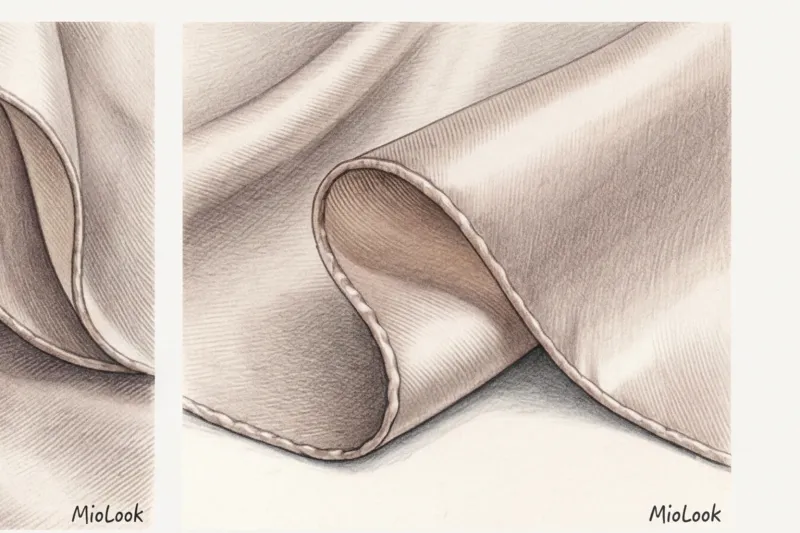
- Use zoom to the maximum: Look for macro photos of the texture. A good silk twill will have a distinct diagonal rib.
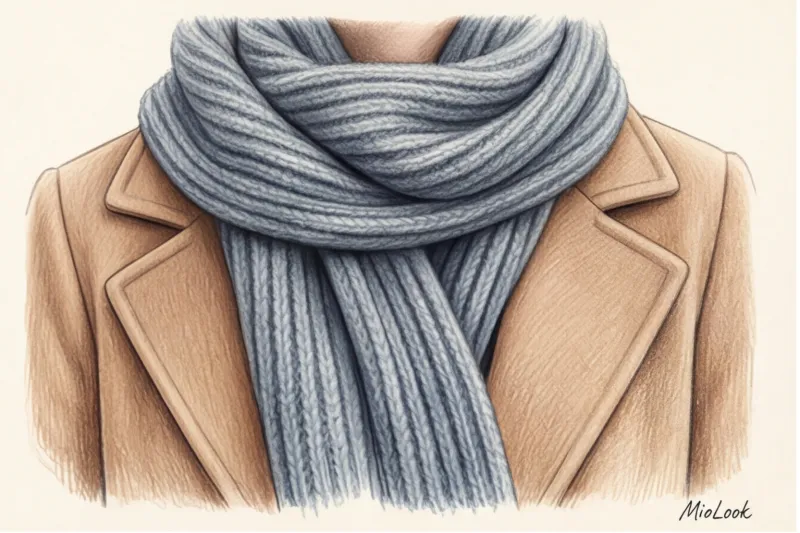
- Look at the kinks: If the fabric falls in sharp, graphic folds on the model, it will hold the architectural knot. If the fabric flows in soft, rounded waves (like viscose or chiffon), it won't make a beautiful bow; it's made for flowing drapes.
- Rate the pile: Cashmere should have a light, luxurious fluff, but if you see hints of pilling in an online catalog photo (where no one has worn the item yet), close the tab.
Virtual Scarf Try-Ons: How MioLook Technologies Are Changing the Game
Why strain your imagination and try to imagine how this brick red color will look on your pale winter skin when you can just try it on?
I have long ago transferred my clients to the "smart wardrobe" feature in MioLook You upload a photo of yourself (preferably in daylight and without harsh contouring), and the AI assistant will apply any texture and color directly to you.
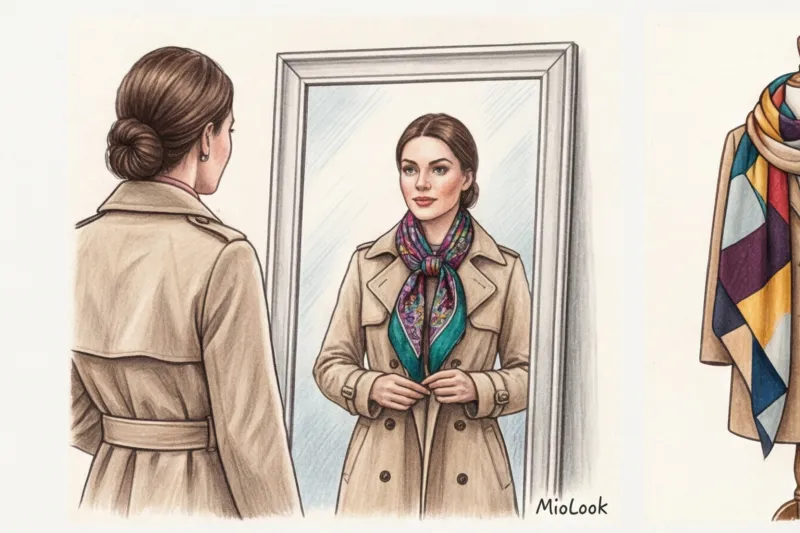
This solves the biggest pain point of online shopping: uncertainty. Algorithms analyze the contrast of your appearance and show you the true picture: whether the shade brightens you up or, conversely, "eats" your face. Furthermore, the virtual fitting room allows you to test the scale of the print, which is critical for proportions.
Access to MioLook for €0.99 — one-time payment
A smart AI stylist will select the perfect colors and accessories to suit your appearance in just a few clicks.
Get access — €0.99 oncePrint scale and body proportions: subtle rules for selection
The scale of the pattern on a scarf can visually alter your size. It's a powerful optical trick rarely covered in fashion magazines.
The rule of proportionality states: The size of the print should be in harmony with the scale of your facial features and height.
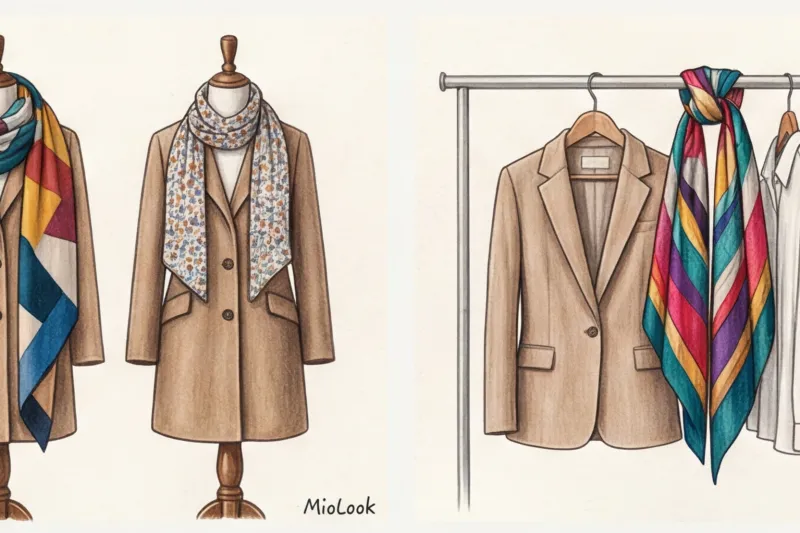
If a petite woman (158 cm tall) wears a stole with giant geometric blocks, the print will literally crush her. Conversely, if a statuesque woman with a curvy figure chooses a scarf with a microscopic floral pattern (millefleur), the contrast with this small print will make her figure appear larger.
Stylist Honesty: I must admit, this advice doesn't work in one case: if you're buying a warm scarf purely for practical purposes and plan to wear it tightly wrapped around your neck, tucking the ends under the collar of a down jacket. In that case, aesthetics take a backseat to insulation. But if the accessory is on display, size is everything.
Checklist: 5 steps before adding a scarf to your online shopping cart
To minimize errors, I've created a strict filter for you. Run any item through it before paying:
- Check the composition. Avoid 100% acrylic in portraits. It statics hair, doesn't provide warmth, and quickly becomes pilled. Look for blends: wool and silk, cashmere and modal, cotton with a weight of at least 180 g/m², or viscose.
- Evaluate the edge of the product. Premium silk bobs always have a hand-rolled edge (rolled over to the right side). Flat-stitched machine stitching indicates a budget-friendly price point.
- Test the color. Upload a photo of the scarf to the MioLook virtual fitting room and overlay it on a photo of yourself without makeup.
- Find the connecting color. The scarf's print should contain at least one shade that's already in your capsule wardrobe. If you buy a piece "in a vacuum," it'll just sit in your closet.
- Check the physical dimensions. Don't trust the photographers! Read the description. A standard bob is 90 x 90 cm. A twill ribbon is approximately 5 x 86 cm. A basic winter scarf should be at least 180 cm, otherwise you won't be able to create an elegant loop.
Ready to get started?
Try the MioLook free plan—no commitment, with access to virtual try-ons.
Get access — €0.99 onceStylist's Summary: A Scarf as the Smartest Investment
A scarf isn't just a piece of fabric to shield your neck from the wind. It's your architecture, a touch of color, and, perhaps, the most cost-effective way to update your wardrobe. By purchasing one high-quality silk or cashmere accessory (from €50 to €150 from mid-range brands like COS or Massimo Dutti), you can completely transform the look of an old coat or formal jacket.
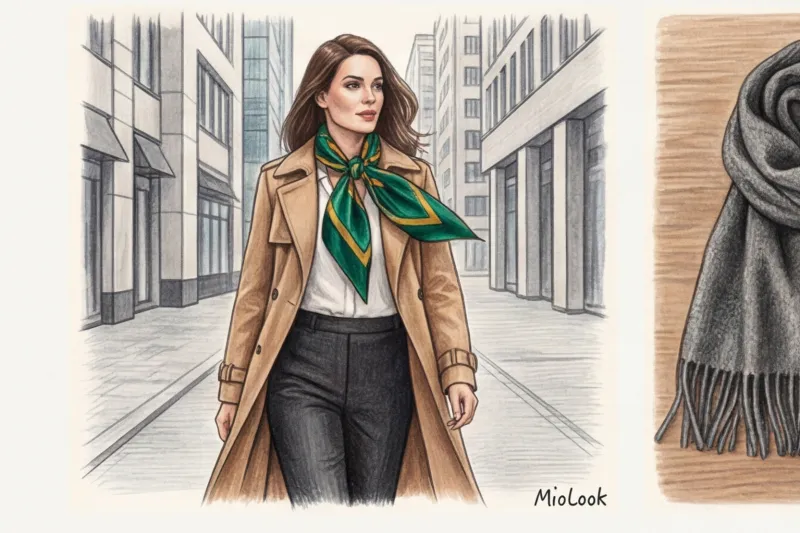
Don't rely on luck when shopping online. Use modern technology to test colors and prints on yourself. Understanding your undertones and trying them on correctly online can save you hundreds of euros in unsuccessful purchases. Treat your accessory selection as an investment in your personal brand—and you'll always look flawless.