Over 12 years of working as a personal stylist in Europe, I've saved dozens of excellent bags from the trash. And no, I didn't send them off for expensive restoration. In most cases, the fix cost around €15 and took exactly two minutes. One of my clients was about to throw out her favorite basic Massimo Dutti tote because the paint on the handles had completely worn off. We wrapped them in thick silk twill, and the bag lasted another three years, garnering compliments around the office.
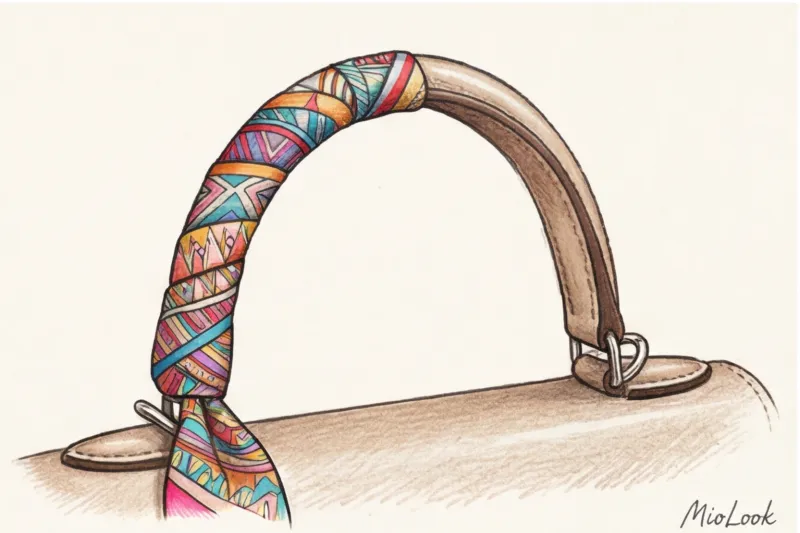
If you're looking for a way to tie a scarf on your bag, forget about the usual bows that sadly droop after an hour. In this article, we'll approach the issue as an engineering challenge. I'll explain how to use fabric geometry to change the accessory's architecture, why different straps require completely different types of silk, and how to secure a knot so it can survive rush hour on the subway.
By the way, if you want to learn how to masterfully handle silk accessories in general, we have written about this in more detail in our The complete guide to the art of stylish scarf styling In the meantime, let's deal with the bags.
Why stylists recommend wearing a scarf on your bag: more than just decoration
Most women think that a silk ribbon on a pen is purely about old-money aesthetics or a nod to Jane Birkin's style. In fact, this technique has a solid, pragmatic basis.
The Hermès artisans who create the iconic Birkin and Kelly bags didn't introduce the twill strap trend for nothing. The main enemies of genuine leather are our own sebum, sweat, and hand cream. Daily contact with our hands destroys the leather's protective coating (especially on the ends of the handles, which are coated with a special paint). In my experience, regular use of silk protectors extends the life of bag handles by an average of 2-3 years.
But here lies the secret the main counterintuitive secret of stylists Everyone's used to thinking that a scarf should match the color of your bag. Forget that rule! A scarf doesn't have to match the leather of the accessory. Its purpose is to complement your facial features, eye color, or shoes. It can (and often should) create a stark contrast with the bag itself. This is exactly how you can integrate a formal black bag into a light, pastel-toned summer wardrobe—just add a light printed silk.
Choosing the Right Scarf: Size, Shape, and Friction Laws
Not every piece of fabric is suitable for your bag. If you use regular shiny satin or smooth rayon, you'll be disappointed: the knot will slip and the wrapping will fall off like an accordion.
You need silk twill (twill weave). If you look closely, you'll see a fine diagonal rib. This texture provides the necessary coefficient of friction. Twill adheres tightly to the smooth leather of the handles, and its knots are voluminous and stiff, as if starched.
"This rule isn't universal. Wrapping the handle won't work if your bag has soft drawstring handles or if it's made of textured raffia. In these cases, friction will work against you, and the scarf will look out of place. Save silk for smooth leather or heavy canvas."
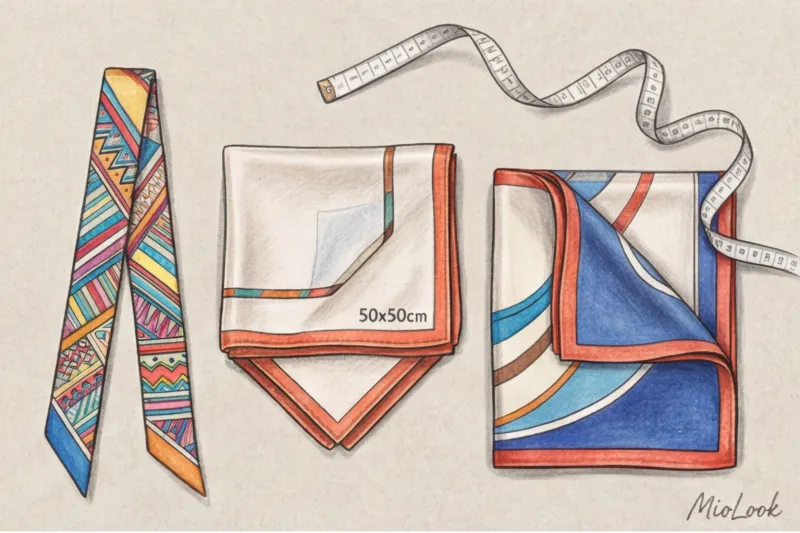
Twilly vs. Carré: Which to Buy?
Different tasks require different geometries:
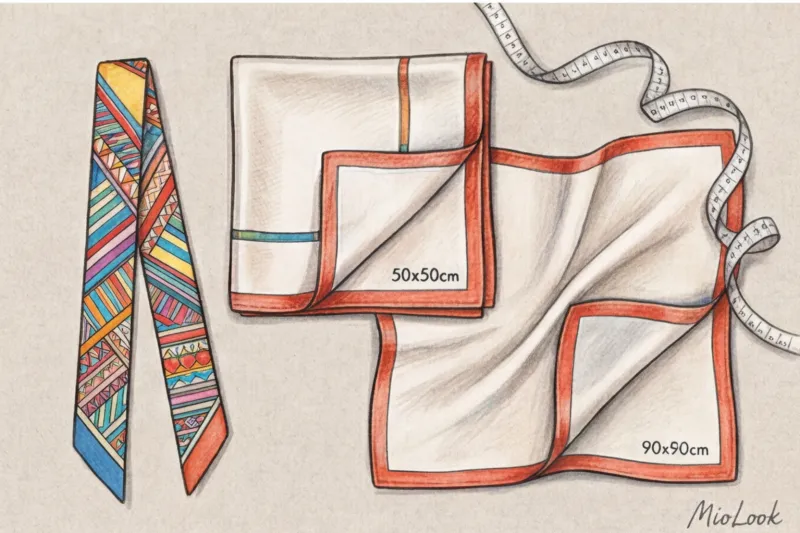
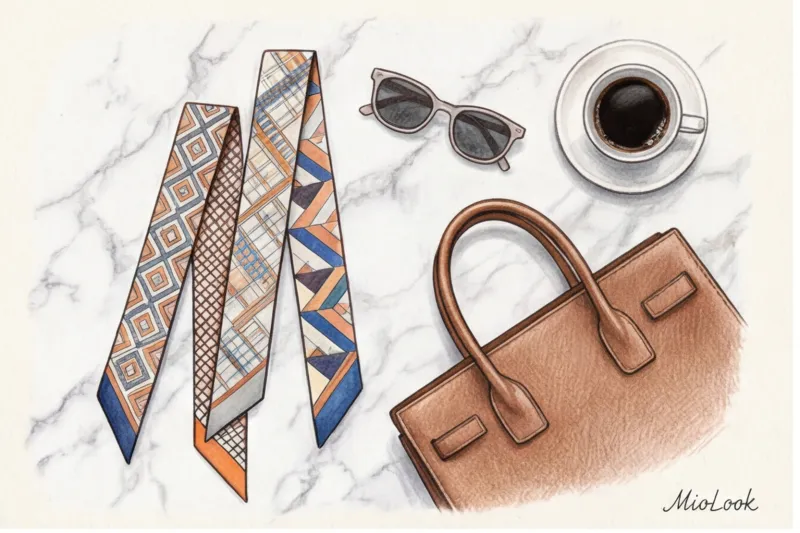
- Twilly (narrow ribbon): The standard size is about 5 x 86 cm. These are the ideal proportions. For a standard rigid handle 30 cm long (like most tote or satchel models), you'll need exactly 86 cm of length to create a tight spiral and leave neat tails.
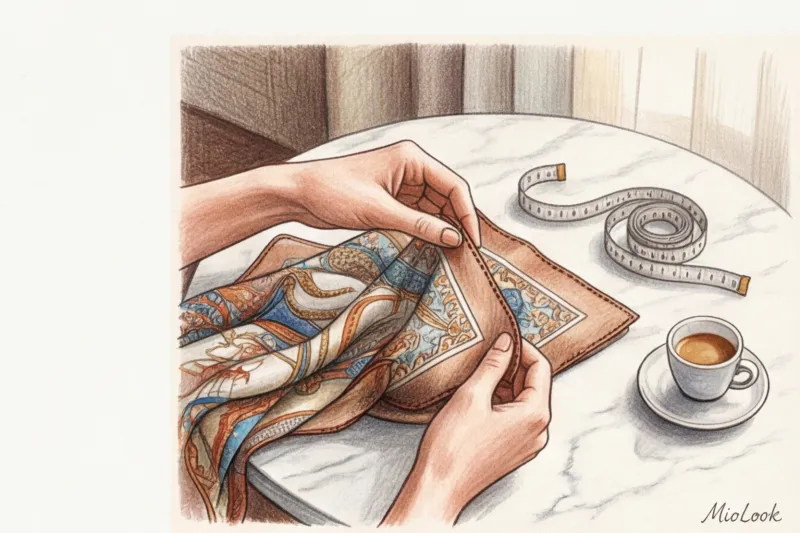
- Square 50x50 and 70x70 cm: Square neckerchiefs. They're not suitable for wrapping, but they're indispensable for creating voluminous architectural bows or silk "roses" at the base of a pen.
- Square 90x90 cm: Too big for decoration. Leave this size for wearing around the neck or use instead of shoulder strap, threading the ends through the side rings of the bag.
Accessory Architecture: How to Tie a Scarf on a Bag Depending on Its Shape
The way you arrange the silk changes the visual weight and geometry of the entire silhouette.
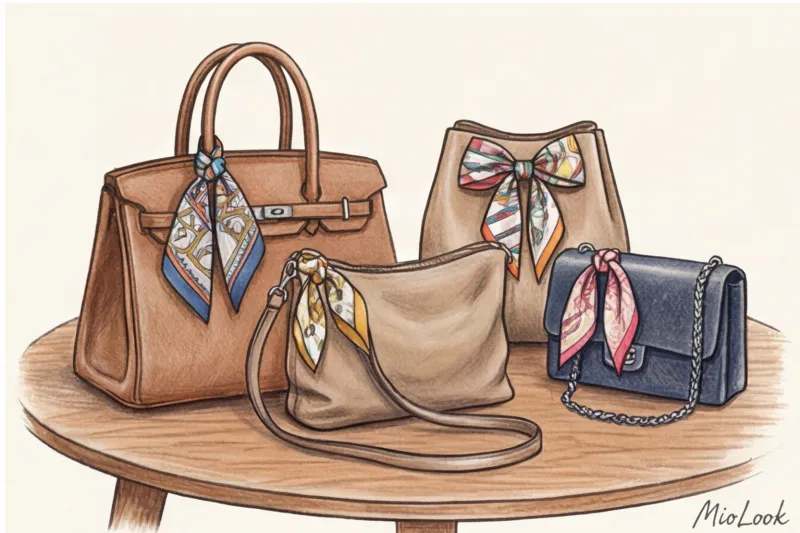
On totes and shoppers with two short handles, the question always arises: should I wrap both or just one? In 2024, the rule of strict symmetry is hopelessly outdated. Wrap only the front handle. This creates a slight, Parisian casualness. If you use a bow, tie it on only one side.
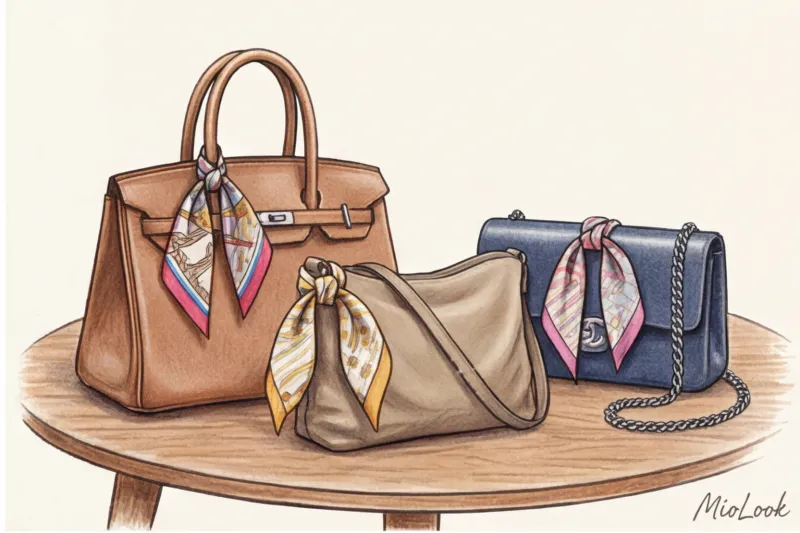
Crossbody bags with a long leather strap require special care. A warning from my practice: Tying a voluminous bow on a long strap at hip level will visually widen your hips by a couple of centimeters. The emphasis should always be shifted toward the base of the bag (the metal fastening ring), positioned just above the waist or near the ribs, without disrupting the proportions of your figure.
Chain bags (in the style of classic Chanel) offer an opportunity for weaving techniques. Thread a narrow twill weave through the metal links of the chain where it rests on the shoulder. This not only looks couture but also physically reduces the pressure of the heavy metal on the collarbone in summer wear.
A smart wardrobe on your smartphone
Not sure what to pair your bag and scarf with? Upload your items to MioLook, and artificial intelligence will create the perfect capsule collections for every day.
Get access — €0.99 onceHow to tie a scarf on a bag: step-by-step instructions with 4 best methods
Let's get down to practice. These four techniques cover 99% of stylistic needs.
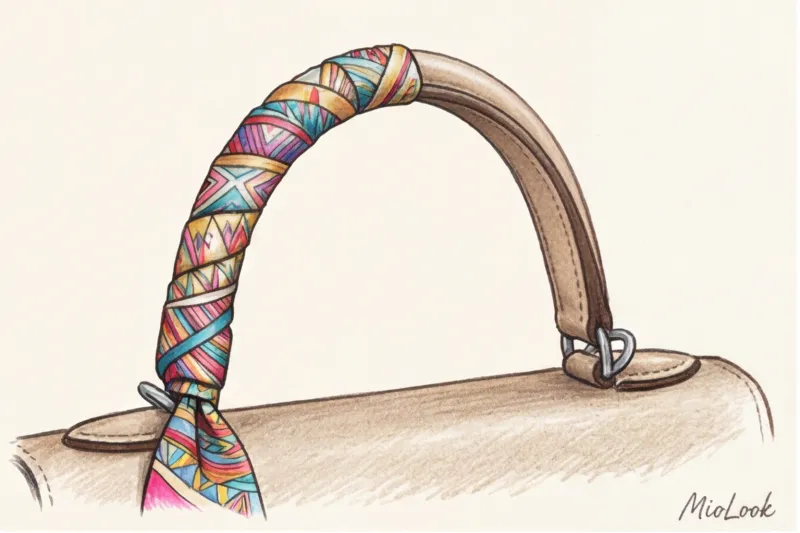
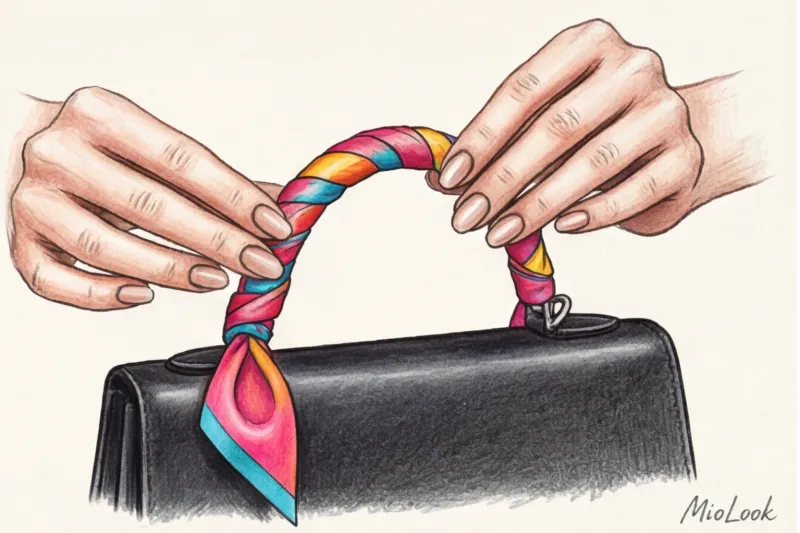
Method 1: French spiral (tight winding)
Perfect for an office dress code, it hides scuffs on the handle. It looks sophisticated and expensive.
- Take the twilly and tie one end to the base of the handle (near the metal ring) with a simple double knot. Leave a tail of 5-7 cm.
- Begin wrapping the handle tightly in a spiral. Each new wrap should overlap the previous one (by about 3-5 millimeters) so that no leather is visible.
- Once you reach the opposite end of the handle, tie the same double knot. Make sure the second tail is the same length (5-7 cm) as the first.
Method 2: The Perfect Bow That Doesn't Hang
A regular bow tied on the handle quickly slips down. The stylists' secret is securing it with hardware.
- Fold the 50x50 cm square diagonally into a narrow strip (or use twill).
- Pass the scarf straight through the metal ring that secures the handle to the middle.
- Tie a classic bow. Secured in a metal ring, it will stay in place and maintain its shape.
Method 3: Silk rose
An architectural and very feminine knot for evening wear (looks great on rigid box bags or clutches).
- Wrap the twill around the base of the handle once.
- Start twisting both long ends together until they become tight.
- Wrap the resulting bundle around its own base, forming a “snail” or “rose”.
- Tuck the remaining tiny ends under the base of the flower and secure.
Method 4: Loopy Loop
A Parisian chic style that's perfect for soft hobo bags, suede shoppers, or relaxed weekend looks.
- Fold the scarf in half to form a loop at one end.
- Wrap around the base of the handle.
- Thread the loose ends through the loop and tighten slightly. Don't straighten the folds—let the fabric lie as naturally and slightly asymmetrically as possible.
Your personal AI stylist
Forget about the "nothing to wear" problem. MioLook will analyze your appearance and wardrobe to suggest looks that highlight your uniqueness.
Get access — €0.99 onceCommon Mistakes: Why Silk Accents Sometimes Look Cheap
Over the years, I've learned one thing: silk is a tricky material. There's a myth that "any scarf makes a bag look more expensive." This is absolutely untrue. Cheap, shiny polyester with a crooked machine stitching along the edge will make even a €3,000 Bottega Veneta bag look cheaper.
Here are the main mistakes that spoil the impression:
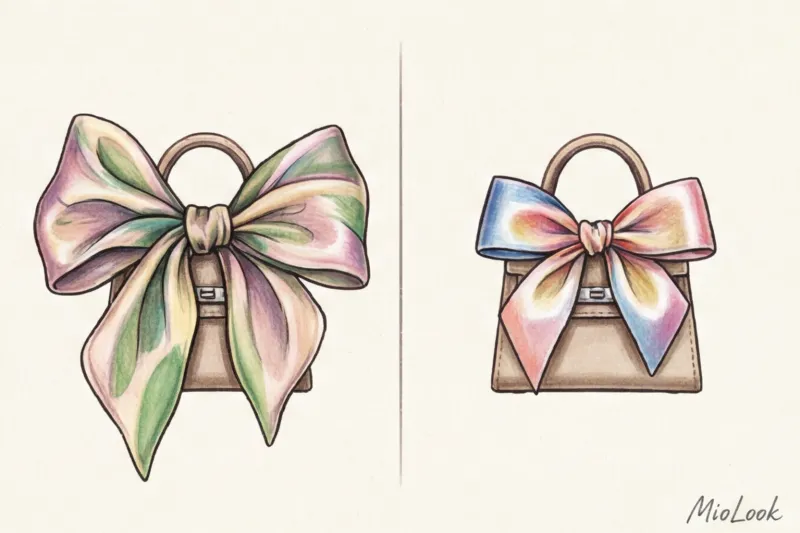
- Violation of proportions. An oversized square scarf tied to a micro bag (like the Jacquemus Chiquito) looks comical. The fabric literally "eats" the accessory itself. Keep it in scale.
- The fabric is too thin. Using chiffon is a bad idea. Chiffon wrinkles quickly, loses volume, and looks like a tired, worn-out rag after just a couple of hours.
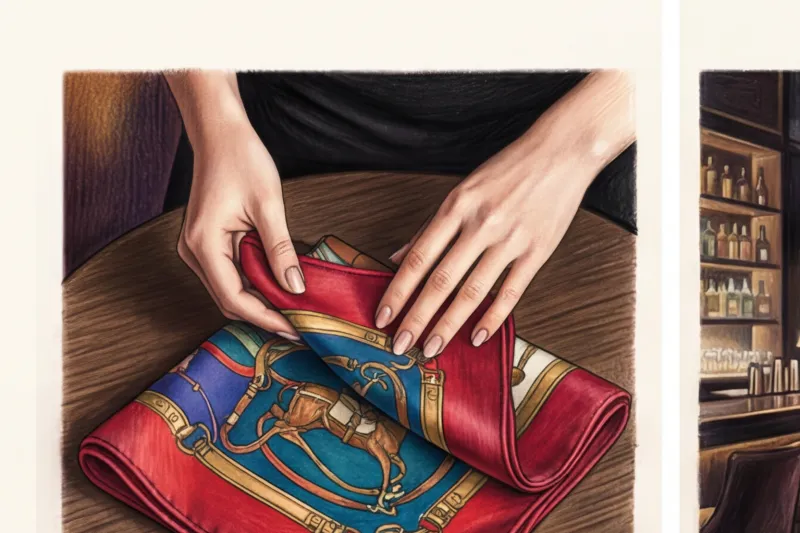
- Stylistic dissonance. A classic silk scarf with monograms and equestrian motifs (in the style of Hermès) on a nylon sports bag or backpack looks out of place. For a sporty chic look, choose cotton bandanas or headbands with geometric, minimalist prints.
- Dirty ends. A handkerchief on your bag handle collects dust from cafe tables, rubs against your outerwear, and soaks up hand cream. It needs to be washed three times more often than the scarf you wear around your neck. Grayed silk ends instantly ruin the look.
Stylist checklist: how to secure a scarf so it doesn't unravel on the subway
We often encounter a problem on fashion shoots: fabric becomes slippery under the spotlight, causing beautiful knots to fall apart. How do we combat this in real life?
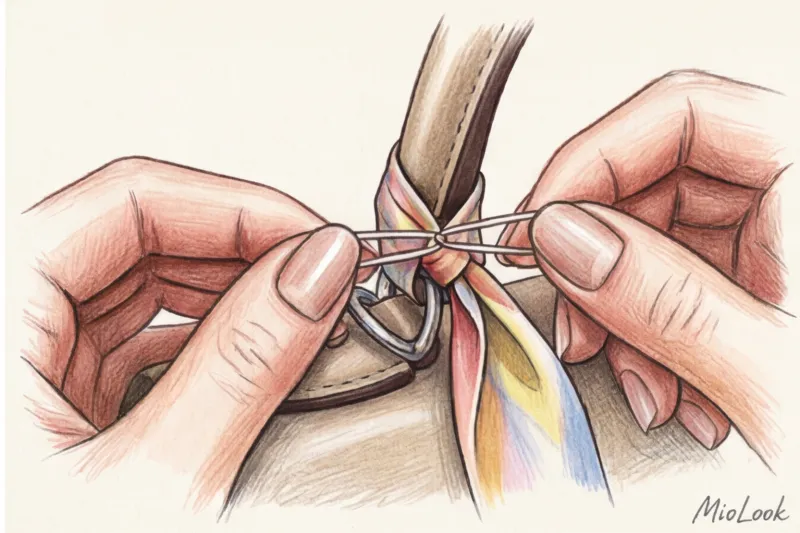
Trick #1: Clear micro elastics.
This is my favorite professional secret. Buy a pack of tiny clear silicone hair ties (they're dirt cheap at any mass-market store). After tying the final knot on your bag handle, carefully slide the tie over the knot. It's completely invisible, but your scarf will never untie itself again.
Trick #2: Double Flat Knot.
If you're not using elastic, never tie a straight, bulky knot. Instead, use a double, flat knot (like a bow tie). It creates less bulk but holds the fabric tension twice as securely.
Trick #3: Double-sided tape for clothing.
If you're wrapping a slippery patent leather pen (which twill can also slip on), apply a tiny piece of special double-sided clothing tape (fashion tape) to the pen itself at the beginning and end of the wrap. It leaves no adhesive residue and won't damage the leather, unlike regular office tape.
And the last rule regarding care. When the season ends and you put the bag in a dust bag for storage, be sure to take off your headscarf Natural leather needs to "breathe." If you leave it tightly wrapped for six months, the leather underneath may change color due to changes in humidity, and the silk itself will take on the smell of the closet.
A bag is your basics, and a scarf is your mood. Don't rush into buying a new accessory for hundreds of euros if the old one is just getting on your nerves. Be pragmatic about your wardrobe: sometimes 15 euros spent on the right piece of silk and five minutes in front of the mirror can refresh your look better than a major shopping spree.