Olfactory Wardrobe: The Invisible Accessory That's More Important Than a Birkin Bag
Have you ever noticed how a truly luxurious look announces itself a second before the person enters your field of vision? Imagine: the door to a conference room opens, and before you even have time to notice the impeccable cut of the jacket or the iconic Birkin bag, the scent fills the space. In 12 years of working as a stylist, I've learned a hard and fast rule: if the scent clashes with the visual, the magic is ruined. Many women spend colossal amounts of money on clothes, but have absolutely no idea... How to choose a perfume to match your clothing style , leaving this crucial detail to chance.
Olfactory style isn't just your "favorite scent." It's a well-thought-out system where scent functions as a fully-fledged element of tailoring. I always tell my clients that true aesthetics require investments in the invisible Why is this so important? The answer lies in neurobiology. Our brain instantly connects olfactory receptors with the limbic system, which is responsible for emotions and judgment. This creates the so-called "halo effect."
According to a study published in the Journal of Cognitive Neuroscience (2023), a correct visual-olfactory match increases the interlocutor's subconscious assessment of the image's value by an average of 40%.
That is, a complex niche fragrance literally makes your basic cashmere sweater look more expensive, while a flat, synthetic fragrance can visually "cheapen" even premium silk from Loro Piana.
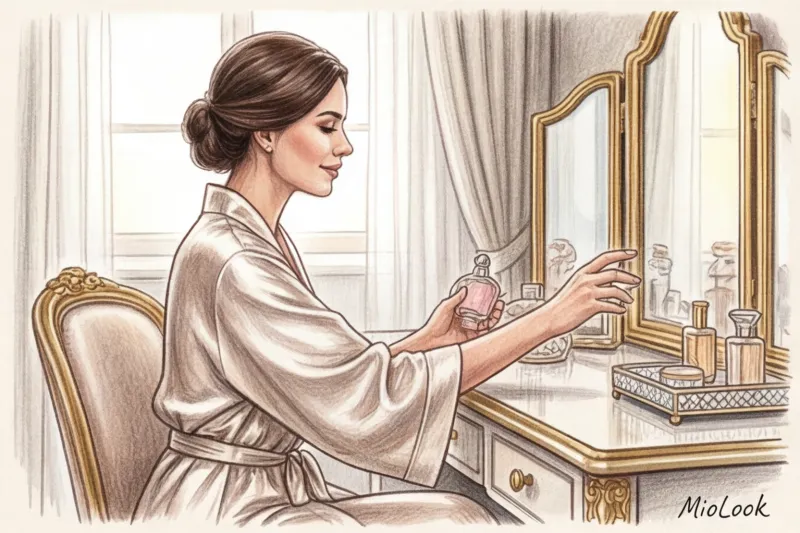
This connection between the visual and the olfactory is not a modern marketing gimmick. Historically, great couturiers created fragrances not as souvenirs to complement their boutiques, but as an architectural extension of their collections. Remember Paul Poiret, who first launched Les Parfums de Rosine in 1911 to accentuate the flowing lines of his oriental silhouettes. And Christian Dior, creating the iconic Miss Dior in 1947 for the New Look show, bluntly declared that fragrance should "jump out of the bottle, like my dresses out of their tailoring trunks." Perfume was conceived as the final, invisible seam, without which a Haute Couture dress was considered incomplete.
Today, as we form our personal clothing style , we must take this synergy into account. One of my clients, a top manager at an international company, couldn't understand for a long time why her strict, architectural Jil Sander suits weren't making the desired impression on her partners. It turned out she was wearing frivolous berry-caramel mass-market suits with them. This created cognitive dissonance: her eyes saw an "iron lady," but her nose detected a "teenage girl." As soon as we replaced it with a strict vetiver with cool woody notes, the perception of her image changed dramatically. We discussed in more detail how to build status through details in the article about Expert image and wardrobe for a personal brand.
By the way, to avoid confusion in combinations of textures and notes, I recommend recording successful olfactory pairings in the app MioLook When creating a look in your smart wardrobe, you can simply note in the description which particular bottle perfectly complements the fabric density and the current mood.
The main rule: how to choose a perfume to match your clothing style based on the texture of the fabrics
How many times have you heard this hopelessly outdated advice: light citrus scents are for the first half of the day, and heavy oriental ones are exclusively for the evening? Forget it. In modern fashion, where the boundaries of dress codes have long been blurred, the rule of hours no longer applies. Today, a top manager can wear a thick, resinous oud to a morning board meeting if she's wearing a menswear suit, and a transparent watercolor fragrance to a gala dinner with a slip dress. If you really want to understand, How to choose a perfume to match your clothing style Stop looking at the dial. Look at the label that lists the ingredients of your item.
The secret of stylists working in the premium segment lies in the concept of synchronization. We match the "weight" of a fragrance not to the weather outside, but to the physical weight, density, and texture of the fabric. It's a counterintuitive approach, but it's what distinguishes a look that simply looks "expensive" from one that conveys impeccable, innate taste.
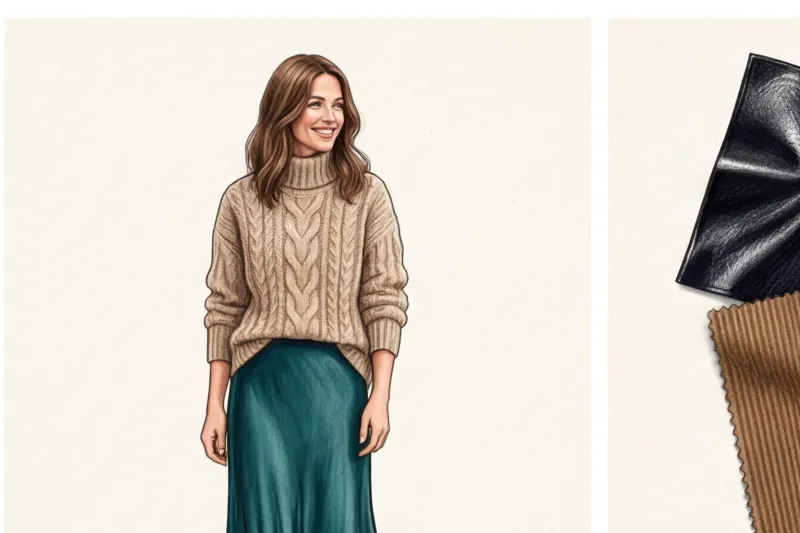
Several years ago, while working on a capsule collection with one of the oldest textile mills in Biella, Italy (the world capital of fine wool), I made a discovery that forever changed my approach to styling. While working with technologists, I learned that fabric fibers interact with perfume oils according to the strict laws of physics. Natural fabrics—silk, cashmere, fine wool—have a porous, breathable structure. They act like a precious sponge, delicately absorbing fragrance molecules and slowly releasing them into space, layer by layer. Natural fibers preserve the architecture of a perfume composition exactly as its creator intended.
Synthetic fabrics, however, act like a blank wall. Polyester, acrylic, or fabrics with a high percentage of elastane are unable to absorb essential oils. They create a slight greenhouse effect on the skin, heat up, and aggressively push out the top notes. Because of this, even a complex, niche composition costing 300 euros can be distorted beyond recognition: becoming flat, garish, or revealing a cheap, plasticky base right from the start. Synthetics cannot preserve the secret of a scent. That's why the foundation of olfactory style is understanding how the texture of your clothing will "hold" the chosen perfume.
Heavy fabrics (cashmere, tweed, heavy wool)
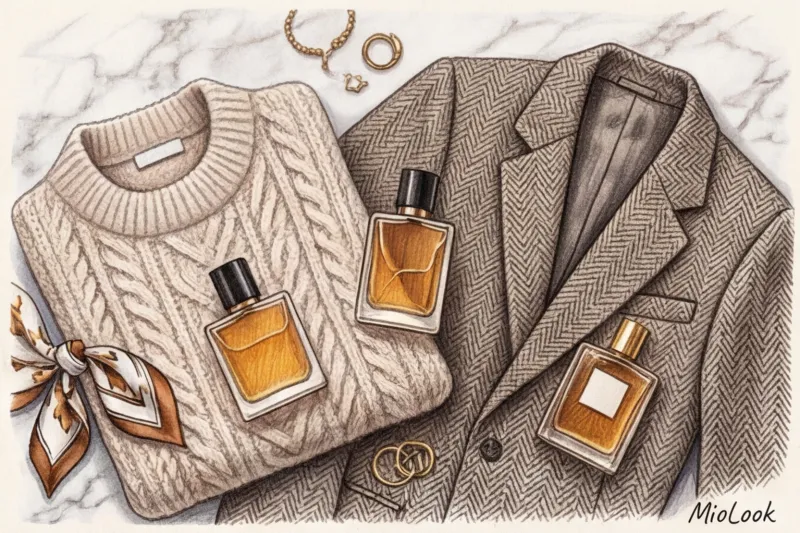
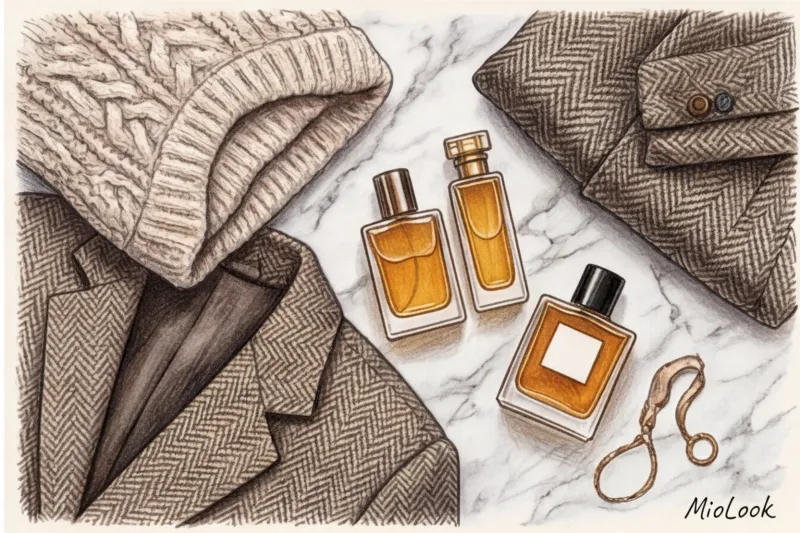
Voluminous, tactile materials require an olfactory equivalent to their physical density. Imagine a luxurious six-layer cashmere sweater or a classic jacket made of textured Scottish tweed. If you apply a light citrusy cologne (for example, with prominent bergamot or lemongrass) under such a garment, the fragrance will simply fail. The physical bulk of the yarn will absorb these fragile, volatile molecules in minutes, and your perfume will disappear without a trace.
Thick fabrics require fragrances that warm and have their own gravitational weight. Ideal choices include deep woody notes, creamy Australian sandalwood, lingering amber, and refined gourmand accords (such as Madagascar vanilla, rum absolute, or tonka bean without excessive confectionery sweetness). These ingredients have large, heavy molecules that can penetrate the pile.
Tweed, with its intricate weave of multicolored threads, resonates beautifully with multifaceted spicy compositions. When the dense wool warms from your body heat, it begins to release these heavy base notes in soft, enveloping waves. A stunning synergy is created: the tactile comfort of expensive cashmere is enhanced by the olfactory warmth of amber, creating an aura of absolute security and status around you.
Flowing and thin fabrics (silk, chiffon, satin)
While cashmere demands warmth and grounding, smooth, flowing fabrics desperately need air. Silk, crepe de chine, chiffon, and satin have a fluidity that glides over the skin with every movement and reflects light. Your perfume should enhance this dynamic, not compete with it.
Try wearing a heavy oriental oud or a dense gourmand with a thin silk blouse, and you'll experience a distinct cognitive dissonance. It will look (and smell) as awkward as wearing chunky mountaineering boots with an elegant evening slip dress. The heavy scent will visually "weight" the fabric, depriving it of its main advantage—weightlessness.
Here, fragrances that create the illusion of coolness and flight come into play. Aldehydes, cool white flowers (jasmine, tuberose, lily-of-the-valley, freesia), and pure "white" musk work flawlessly. Historically, aldehydes were used in perfumery precisely to impart a sparkling effect to compositions, similar to the shimmer of silk threads in the light. When you walk, a silk skirt flowing around your legs, a light floral or musky trail should follow behind it like an invisible, shimmering ribbon. This combination conveys sophistication and that elusive grace that cannot be imitated by visual devices alone.
A smart wardrobe on your smartphone
Not sure which fragrance will pair with your favorite silk dress or tweed jacket? Digitize your wardrobe with MioLook. Our AI stylist will help you create perfect looks based on fabric textures, so you always know what to wear and how to style it.
Get access — €0.99 onceRigid shapes and architectural cuts (leather, thick cotton, denim)
Shapely clothing sets strict boundaries not only for your silhouette but also for your fragrance choices. A heavy calfskin jacket, a starched Egyptian poplin men's shirt, or raw Japanese denim—all these pieces have a distinct character, precise geometry, and uncompromising architecture. Soft fruity, lighthearted berry, or powdery fragrances will seem childish against these backdrops, blurring the strict lines.
Rigid textures require fragrances with an inner core. Classic and modern chypres work flawlessly here. Their sharp, uncompromising base of oakmoss and patchouli rhymes perfectly with the crispness of a starched collar or the peak lapels of a tuxedo.
"Fragrance is the invisible structure of your image. If the cut of your clothes creates spatial geometry, then your perfume should fill that geometry without disturbing its proportions." This is how I explain this principle to my clients when we're putting together a capsule collection for important meetings.
If you want to enhance the boldness of a leather biker jacket, choose compositions with notes of spicy black pepper, dry Haitian vetiver, rich pipe tobacco, or tarred leather. The scent should become your olfactory armor. When you wear a crisp, oversized white shirt made of thick cotton and complement it with crisp, dry vetiver, you convey absolute control, confidence, and unquestionable authority. This is the true magic of an investment wardrobe: every detail, including the invisible ones, works toward a single goal.
Perfume and Personal Brand Archetypes: Fragrances for Experts and Executives
Last year, a client, a senior partner at a major law firm, approached me. We were putting together a wardrobe for a crucial court case, with tens of millions of euros at stake. Her perfectly tailored graphite-colored three-piece Jil Sander suit sat perfectly, projecting absolute competence and toughness. But when she emerged from the fitting room, I detected the thick, caramel-sweet trail of a popular evening cologne. The entire look instantly fell apart. The scent screamed relaxed hedonism, while the suit demanded steely discipline.
This case study brilliantly illustrates how olfactory branding works. When choosing clothes, we consciously or intuitively rely on certain role models. As we discussed in detail in the article "Archetypes in Style," visuals form the first impression, but it is scent that cements it on a subconscious level, confirming or refuting what the eye sees. Let's examine three key archetypes and find the right perfume code for them.

The Ruler Archetype: Distance, Status, and Power
If the foundation of your wardrobe is tailored suits, architectural jackets with accentuated shoulder lines and uncompromising monochrome, your choice is status chypre fragrances The chypre structure, built on the contrast of sparkling bergamot, patchouli and oakmoss, has historically been associated with aristocracy.
Chypres sound dry, prickly and expensive. Compositions such as Eau du Soir from Sisley or classic Chanel No. 19 , act like invisible armor. They don't flirt with others or try to please, but rather establish clear boundaries. The austere chypre, paired with the thick wool of the suit, conveys a clear message: "I make the decisions here."
The Aesthete Archetype: Sensuality and Complex Femininity
For those whose style is built around flowing silhouettes, silk blouses, accent cutouts and deep, rich shades (burgundy, emerald, chocolate), complex floral arrangements Please forget about flat, linear fruit waters - they will cheapen any silk.
An aesthete needs predatory, multifaceted white flowers: tuberose, gardenia, jasmine grandiflorum, or ylang-ylang. Fragrances of the level Carnal Flower from Frederic Malle or Honor Woman Amouage's fragrances (costing around €250–300 per bottle—and trust me, they're worth every penny) perfectly complement the aesthetic of luxurious femininity. They pulsate on the skin, emphasizing the softness of lines, the suppleness of fabrics, and the fluidity of your movements.
The Sage Archetype: Intellectual Minimalism and Old Money
Fine, undyed cashmere jumpers, straight-leg jeans with a proper cut, loafers, and a complete absence of flashy logos—this is the uniform of the "Sage." This archetype abhors any excess or theatricality. The ideal perfume continuation of this aesthetic (which is often referred to today as Old Money style) is intelligent molecular fragrances and compositions with a dominant note of iris.
Iris in high perfumery gives a feeling of expensive grooming, freshly ironed thick fabric and clean paper. Prada Infusion d'Iris or fragrances based on ambroxan (for example, Another 13 Le Labo) sit extremely close to the skin. They don't leave a long, lingering trail that fills the entire office, but they create an aura of ringing purity and calm, unshakable confidence.
"Your perfume shouldn't enter the room before you do. For the Sage archetype, scent is a secret, revealed only to those you've allowed into your personal space."
To avoid making a mistake in choosing an olfactory profile, analyze your closet. What textures and silhouettes do you have? If you find it difficult to objectively assess the proportions and dominant style of your wardrobe, I recommend using MioLook app features By uploading your essentials, you'll immediately see which archetype your look gravitates toward and be able to choose a perfume that will be its perfect, invisible extension.
Mistakes that cheapen your look: When perfume clashes with clothing
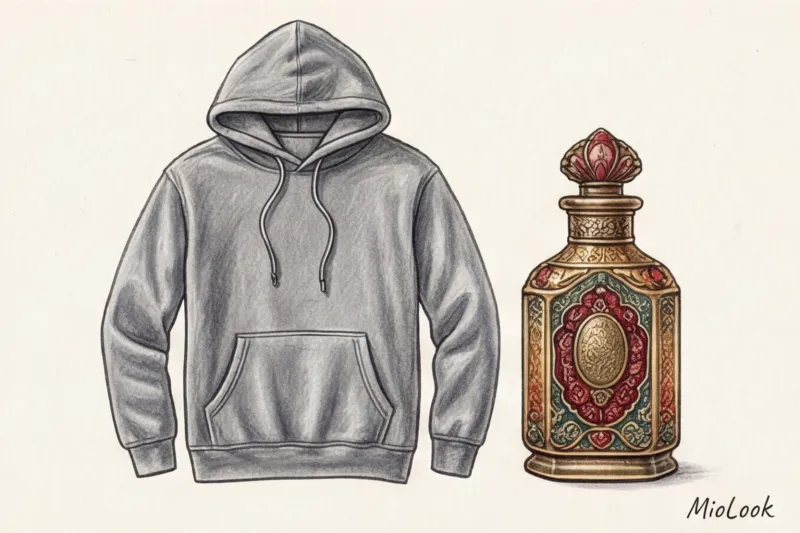
Recently, in the business lounge at Charles de Gaulle Airport, I witnessed a classic scene: a woman in a relaxed gray sweatsuit leaving behind a thick, overpowering trail of heavy Middle Eastern oud. It's a clear example of how the wrong olfactory choice can ruin even the most comfortable aesthetic.
A diffuse, lingering oud paired with a tracksuit or a basic casual outfit is the olfactory equivalent of a diamond necklace worn on a morning jog. When considering how to match a perfume to your outfit, the most important rule to remember is appropriateness. Loud resins, oud wood, and rich spices require an appropriate visual frame: evening silk, thick velvet, or at least an impeccably tailored cashmere coat. Paired with an oversized hoodie, such a perfume doesn't add any status, but rather creates the comical impression of wearing "all the best at once."
A second, equally damaging mistake is wearing overly sweet, "compote-like" fragrances in a strict business dress code. Imagine: you're wearing a perfectly tailored straight-cut jacket and tailored trousers with creases, ready to present your strategy to investors. Suddenly, the room is filled with the scent of cotton candy, praline, and strawberry syrup. Gourmand, overtly edible notes instantly destroy professional distance and deprive your image of authority. They infantilize you. For a business environment, leave these bottles on the shelf and opt for cool irises, green tea, or dry wood.
But the most painful mistake I regularly encounter as a luxury consultant isn't aesthetically pleasing, but the physical destruction of investment pieces. Applying perfume directly to light-colored clothing and delicate fabrics is a crime against your wardrobe.
Alcohol and high concentrations of essential oils (especially in niche perfumes) leave permanent yellow stains on fabric. I once had to declare the "death" of a stunning, heavy silk blouse worth around €800. The client had gotten into the habit of generously spraying her favorite essential oil directly onto the collar. Dry cleaning proved ineffective—the structure of the silk thread was literally burned out by the alcohol, and the oils were permanently embedded in the fibers.
Perfume is even more damaging to organic jewelry. If a drop of perfume falls on natural pearls, their nacre will become permanently cloudy and lose its luster, as acidity and alcohol destroy the calcium carbonate. A good rule of thumb: wear pearls 15 minutes after applying fragrance and allowing it to dry completely.
In the appendix MioLook When we digitize our wardrobes, I always recommend adding a note to the cards for expensive silk items and jewelry: "Wear only after perfume"—this simple habit saves thousands of euros and keeps your investments looking pristine.
Access to MioLook for €0.99 — one-time payment
Start creating perfect looks with AI and keep your investment pieces looking their best.
Get access — €0.99 onceInvesting in Niche Perfumes: How to Build a Basic Olfactory Capsule
When it comes to wardrobe investments, we immediately think of an impeccably tailored trench coat made of thick gabardine, a cashmere coat, or a classic, rigid bag. But for some reason, when it comes to fragrances, many continue to spontaneously buy random bottles. According to McKinsey's Global Luxury Market Report (2024), conscious consumers have begun to apply the "less is more" principle to beauty. And as a stylist working in the luxury segment, I believe this is absolutely the right approach.
Let's apply strict financial metrics to perfumery - cost-per-wear (cost per exit) A bottle of mass-market perfume for 50 euros often requires refilling every two to three hours. Its cheap alcohol base evaporates instantly, leaving a flat, slightly synthetic aftertaste on the skin. In contrast, a bottle of niche perfume for 250 euros (for example, a complex composition from Frédéric Malle or Maison Francis Kurkdjian ) contains a high concentration of natural absolutes and oils. You only need one micro-spray to ensure the luxurious scent lasts on your wool jacket until the next dry cleaning. When calculated per day of use, the more expensive niche always proves more cost-effective, and the scent is incomparably richer.
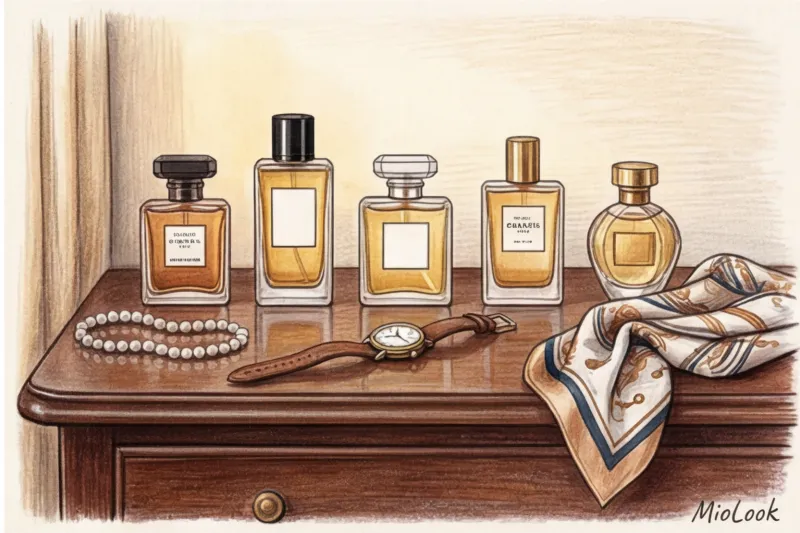
I always insist: you don't need a shelf filled with thirty half-empty glass bottles. You need a well-thought-out perfume wardrobe. Just as we assemble a basic capsule collection of premium pieces, your olfactory wardrobe should be built on a foundation of three or four carefully selected compositions:
- Base (everyday uniform): Your equivalent of a crisp white cotton shirt or a smooth t-shirt. These are scents of cleanliness, well-groomedness, and a "second skin." Look for them in the musky and aldehyde niche (e.g., molecular bases). Escentric Molecules or transparent works Byredo ).
- Office (business dress code): The equivalent of a perfectly tailored wool suit. A discreet, classy scent that maintains its distance without being overbearing. Modern green chypres, dry vetiver, and cool cedar work brilliantly here.
- Evening (tuxedo/silk dress): Your silk tuxedo or slip dress. Time for deep, textured compositions. Thick resins, dark rose with patchouli, delicate oud, or alcoholic gourmand accords.
- Relaxation (weekend): Your favorite chunky knit cardigan. Scents for yourself—soothing lavender, green tea notes, fig, or warm, unconfectionary vanilla for leisurely Sunday brunches.
The secret to truly luxurious minimalism is that the material and olfactory capsules work in absolute synergy. When choosing a cashmere turtleneck in the morning, you intuitively reach for the "basic" bottle with soft woody notes because their textures match.
By the way, to visualize this connection and avoid chaotic purchases, I advise my clients to use smart wardrobe feature in MioLook When you're putting together a seasonal capsule collection in the app, add not only bags and shoes but also a specific fragrance to your mood board. This is incredibly mentally disciplined. You'll immediately see how a crisp chypre perfectly completes a double-breasted coat look, while a light fig scent logically rounds out a linen summer set.
“Perfume is not the finishing touch, it is the first layer of your clothing,” the legendary Serge Lutens once said.
And investing in that invisible first layer should be as thoughtful as investing in the perfect pair of leather loafers.
Dress Code and Perfume Etiquette: From Business Formal to Smart Casual
In Japanese corporate culture, there is an official term sumehara Perfume abuse (スメハラ) is a form of perfume violence. Local HR departments are seriously enforcing contracts banning the use of lingering perfumes in the office, equating an aggressive scent with a violation of personal boundaries. And while the rules are somewhat more relaxed in Europe, the essence remains the same: leaving your perfume in the meeting room after you leave is not a sign of luxury. It's a gross violation of business etiquette.
For a strict dress code Business Formal There's a golden "arm's length rule." Your scent should only be detectable by those close enough to shake hands or exchange business cards. The smooth texture of an expensive Super 150s wool suit and the starched collars of cotton shirts require the same impeccable purity and transparency in its olfactory profile.
The ideal companions for a formal office setting are notes of white and green tea, neroli, petitgrain, and cool citrus. They create an aura of composure without distracting the conversation. When reviewing the wardrobes of top managers in Geneva and Milan, I always select fragrances for the business capsule that convey a sense of status (a good office niche will cost around 150-250 euros per bottle) but maintain absolute subordination.
When we move on to Smart Casual — the style of creative agencies, IT corporations, and relaxed Fridays — softens rigid boundaries. Here, sharp-shouldered jackets are replaced by cashmere cardigans, tailored denim, and suede loafers. This tactile, slightly casual texture allows for some freedom in perfume selection.
In this segment, I recommend emphasizing woody and green notes. Vetiver, cedar, fig leaf, juniper, and galbanum pair perfectly with the softness of casual fabrics. A fresh tree cut or a green leaf crushed between the fingers conveys confidence and creativity without ever causing headaches for colleagues in an open space. By the way, to avoid confusion about which bottle suits a particular look, I advise clients to attach fragrances to capsules directly in the MioLook app - this saves time in the morning getting ready.
Your ideal image begins Here
Join thousands of users who look flawless every day with MioLook.
Get access — €0.99 onceCompletely different laws come into force when it comes to going out in the evening ( Evening Wear ). A tuxedo, a floor-length dress, a velvet jacket, or complex architectural drapery require an olfactory equivalent to their visual drama. Evening is the only time when a long train is not only acceptable, it's essential.
This is the time for complex resins, absolutes, and deep, rich accords. Labdanum, myrrh, tuberose absolute, dark rose with patchouli, or delicately dosed oud. Heavy fabrics like velvet and thick silk perfectly support such compositions, allowing them to unfold slowly and multifacetedly. Imagine a dress made of heavy black satin: a light, citrusy cologne would simply disappear, while lingering amber with notes of cherry pit and tobacco will create a complete, cinematic look.
Checklist: 5 Steps to Creating the Perfect Olfactory Style
Theory without practice is just small talk. Now that you understand the details, How to choose a perfume to match your clothing style , it's time to translate this knowledge into a clear, workable system. As a perfumer friend from Grasse told me: "A scent is a suit that is tailored to the measurements of your real life, not your fantasies about it." To build a flawless foundation, I suggest following five practical steps that I use when working with personal clients.
1. Audit your current wardrobe: identify dominant textures
Open your closet and take an honest inventory. Your task is to determine the percentage of materials. If 80% of your basics are heavy wool, dimensional-resistant cotton, and tweed, you don't need an impressive collection of watercolor colonnettes; they'll simply get lost in the mix. Conversely, an abundance of silk, viscose, and fine knits calls for flowing, diffuse compositions. To visualize this picture, I highly recommend digitizing your basics using MioLook The app will instantly display a breakdown of your wardrobe by fabric, saving you from spontaneously buying a €250 bottle that you won't be able to wear with anything.
2. Lifestyle and dress code analysis: the rule of proportions
The most common mistake I see in practice is investing in a way that doesn't align with a realistic schedule. Create a time chart. If 70% of your week is spent in the office with a business-casual dress code, 20% is spent at home or out and about, and only 10% is spent on social events, your fragrance budget should be allocated accordingly. Buying luxurious, heavy evening essences when you need a flawless, politically correct scent for morning meetings is like freezing your funds.
3. Testing fragrances "in person": the physics of cutting
Never test or buy a perfume to pair with a formal tuxedo or a silk slip dress by showing up at the boutique in jeans and an oversized hoodie. This is the golden rule of style. The cut of clothing changes your posture, your posture, and your sense of self. I always have clients try on the fragrance in the exact capsule they plan to wear it with. Spray the composition on your skin, put on your structured jacket, and live in this duo for at least a couple of hours. Only then will you understand whether the sharp line of your shoulders clashes with the excessive sweetness of the base.
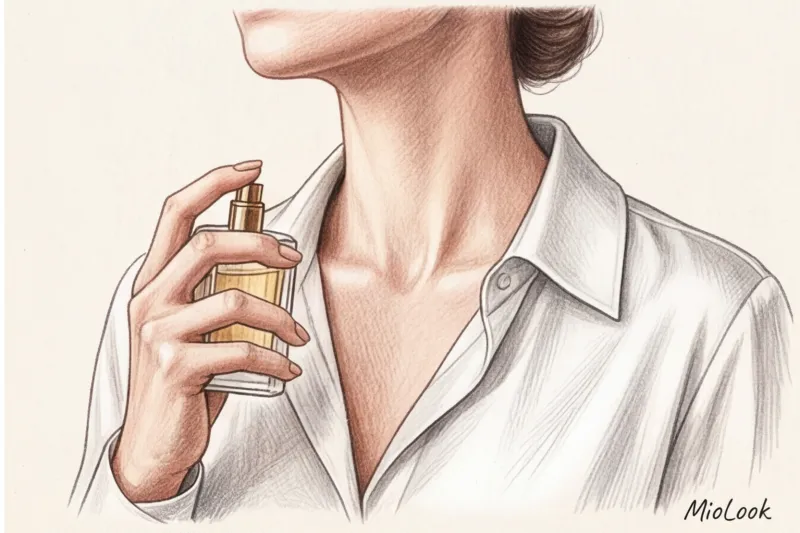
4. Application rules: the architecture of a delicate trail
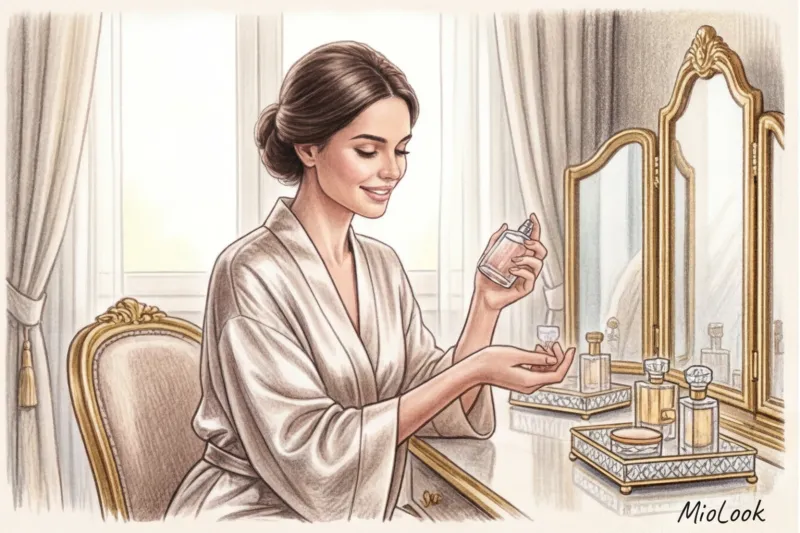
Forget the habit of spraying perfume in a cloud in front of you and stepping into it—for niche compositions, this is a waste of product. To ensure a long-lasting scent without invading someone's personal boundaries, use the technique of concealed application. Apply perfume to your skin with care. under clothes (on the collarbones, solar plexus area or the back of the neck). Body heat will slowly release the notes through the fabric fibers. Another secret trick of Milanese tailors: a single micro-spray onto the silk lining of a jacket or coat. The lining will retain the fragrance base for weeks without staining the outer fabric.
5. Synchronization with the accessory group: the ultimate in aerobatics
Finally, the level for aesthetes involves coordinating your perfume with the metals and leather of your accessories. Warm, gourmand, and resinous scents with notes of amber, tobacco, and cinnamon pair perfectly with yellow gold and brown, cognac, or suede leather belts. Cool molecular compositions, iris, aldehydes, and crisp citrus require a visually cooler palette: silver, platinum, white gold, and austere, smooth black leather. Dissonance at this level is subconsciously perceived by others, like a false note in a perfect symphony.
"Creating an olfactory wardrobe isn't about chasing trendy bottles. It's about fine-tuning your personal brand, where scent becomes a logical extension of cut and color."
Once you complete these five steps, your fragrance will no longer be a random addition. It will become an integral part of your visual calling card. You'll notice how the way others perceive you changes—you'll begin to sound expensive, complete, and absolutely unforgettable. And remember the most important rule of an investment wardrobe: true luxury always whispers, not shouts.
Guide Chapters
Old Mane Perfume: Scents of Quiet Luxury
True luxury never screams. Discover which fragrances embody the Old Money aesthetic and how to choose the perfect perfume for an upscale look.
A clean scent for a minimalist's basic wardrobe.
Perfume is an invisible part of your look that can make or break your style. Learn how to choose the perfect scent for a minimalist wardrobe.
Perfume Wardrobe: How to Create a Basic Capsule Collection
Learn how to choose basic fragrances that will enhance your style without ruining expensive fabrics. We'll explore creating a fragrance capsule without breaking the bank.
The Ideal Office Perfume for Women: Etiquette Rules
In a business environment, your scent speaks louder than words. We'll explore the key rules of perfume etiquette and learn how to choose the perfect fragrance for work.
Can you spray perfume on clothes? How to avoid damaging the fabric
We'll figure out how to properly apply perfume to your favorite items to avoid yellow oil stains. A stylist's real-life tips for preserving fabrics.
Evening Perfumes for Women: Choosing a Scent to Match Your Dress
Perfume is as important an element of an evening look as shoes or a clutch. Learn how to properly coordinate the fabric of your dress and the scent trail.
Leather-scented perfume for women: a perfume to wear with a leather jacket
The wrong perfume can ruin even the most stylish look with a leather jacket. We're exploring the best leather-infused fragrances for bold grunge and rock styles.
Cozy Fall Scents: Perfumes for Sweaters and Cashmere
How to pair perfume with your favorite sweater without ruining the fabric or causing a headache? We'll explore the chemistry of fragrances and choose the perfect scent for cashmere.
Fresh summer fragrances for women with linen and cotton accents
Perfume is an invisible fabric that should match your clothes. We'll explore how to choose the perfect scent for linen and cotton in hot weather.
The perfect perfume for a romantic boho look
Choosing a perfume to pair with a flowing dress is a subtle play on contrasts. Learn how to find the perfect scent that will enhance your style, not overwhelm it.
Perfume for a sporty style: fragrances for sporty chic
The perfect scent works like an invisible jacket, bringing together a relaxed, oversized look. Find out which perfumes pair best with a hoodie and sneakers.
Color olfactory: how to match perfume to your clothes
Perfume can make or break a look. We'll explore the olfactory properties of color and learn how to pair fragrances with your wardrobe.