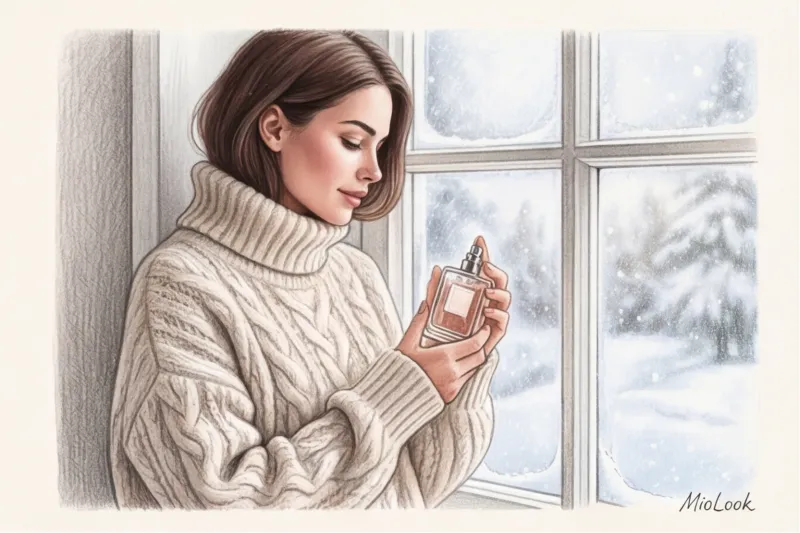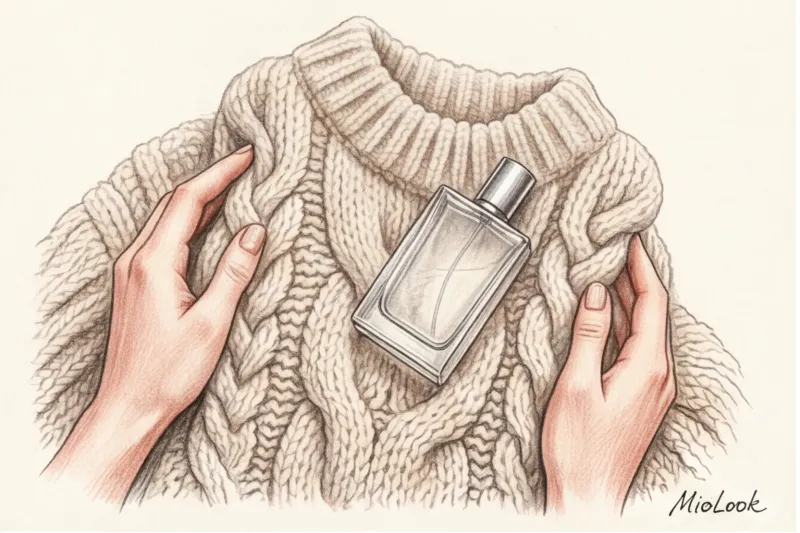
Last November, a client of mine brought me a premium Loro Piana cashmere sweater in tears. The $2,000 garment was hopelessly ruined: a yellowish stain had formed on the collar, and the fabric emanated such a heavy, pungent scent of oriental oil perfume that it was physically painful to be near. She'd simply wanted to add a touch of "winter coziness" to the look and had generously sprayed a thick oud scent on the collar. The oils had destroyed the delicate down, and the dye had reacted chemically with the base perfume.
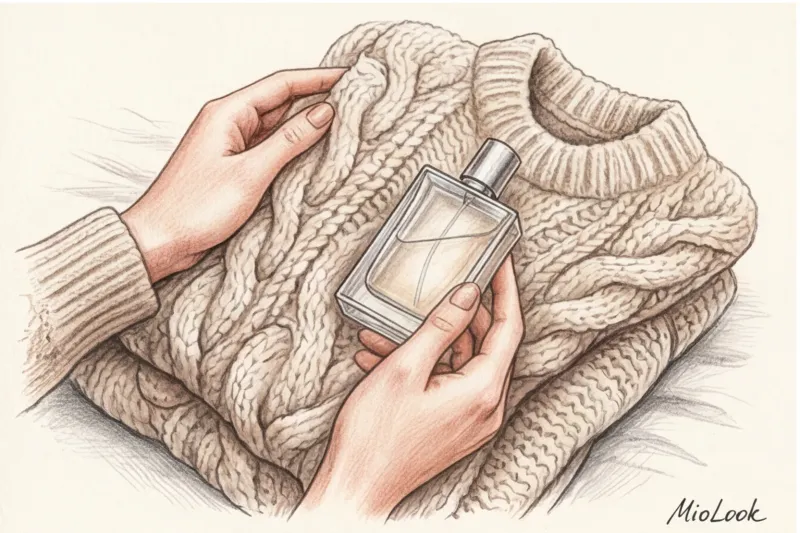
Over 12 years of working as a stylist and textile specialist, I've realized one thing: we spend hours choosing the perfect knit, searching for the right composition, but we completely forget that yarn and perfume are chemical elements that interact. Have you ever noticed how your favorite light perfume suddenly smells flat in November, or how your evening perfume paired with a warm cardigan gives you a headache? When choosing cozy scents for fall, you need to think not only about the notes but also about the materials used.
We talked about image architecture and basic rules in more detail in our A complete guide to choosing a perfume to match your clothing style Today, I invite you to look at perfumery through the eyes of a textile expert: how the porosity of cashmere and coarse wool physically alters the development of notes, and why you should absolutely not wear "heavy" perfume with a thick sweater.
Fabric Texture and Note Release: Why a Sweater Changes Your Perfume
Our brain perceives images in a complex manner. A study published in Journal of Cognitive Neuroscience In 2023, a study demonstrated the so-called cross-modal perception effect: when the visual and tactile texture of clothing matches its olfactory profile (smell), the subconscious assessment of the image's value and status increases by 40%. Conversely, dissonance causes anxiety.
But it's not just a matter of psychology. The physics of the process are such that the same scent will smell completely different on hot skin, smooth silk, and a fluffy wool cardigan.
According to the International Wool Secretariat (Woolmark), natural protein fibers retain fragrance molecules up to 3-5 times longer than cotton or synthetics. Why? Wool fibers are covered with microscopic keratin scales. These act like tiny traps, capturing the heavy base notes of perfume (musks, resins, woods) and "preserving" them. Citrusy top notes fade from wool within minutes, but the base notes stay with you for weeks, even after a light wash.
Fiber Science: Cashmere, Merino, and Synthetics
To get a feel for how the scent will linger, touch your sweater. Different yarns "breathe" and release scent differently:

- Cashmere: It has a plump yet very fine texture. It perfectly absorbs and slowly releases molecular aromas, powdery notes, and pure musks. Cashmere softens any perfume, as if applying a blur filter.
- Fleece: It's highly porous and often has its own subtle animal undertone (especially undyed eco-wool). It eagerly absorbs environmental odors, so it requires strong, "framework" notes—dry wood or spices—to mask the scent of the yarn itself.
- Synthetics (acrylic, polyester): Absolutely smooth plastic fibers. They don't absorb oils. Perfume remains on the surface, evaporates quickly, and due to the lack of air exchange, often becomes acidic or flat.
Access to MioLook for €0.99 — one-time payment
A smart AI stylist will select the perfect look based on the textures of your wardrobe.
Get access — €0.99 onceThe Contrast Rule: The Main Mistake When Choosing a Perfume to Wear with Thick Knitwear
Open any glossy "winter perfume" list, and you'll see the same advice: choose warming, sweet, gourmand scents with notes of vanilla, praline, chocolate, and heavy amber. For me, as a stylist, this is the biggest and most annoying mistake.
Let's think logically. A chunky, oversized wool sweater creates a heavy, massive silhouette on its own. It acts like a thermos, trapping your body heat. Layer an equally thick, sweet, and viscous perfume on top of this dense texture, and you'll get a suffocating effect. The look becomes overloaded, clingy, and visually cheapens.
"My golden rule of contrast: the heavier and denser the texture of your clothing, the more transparent, drier, and more resonant the scent should be. You should add oxygen to the look, not syrup."
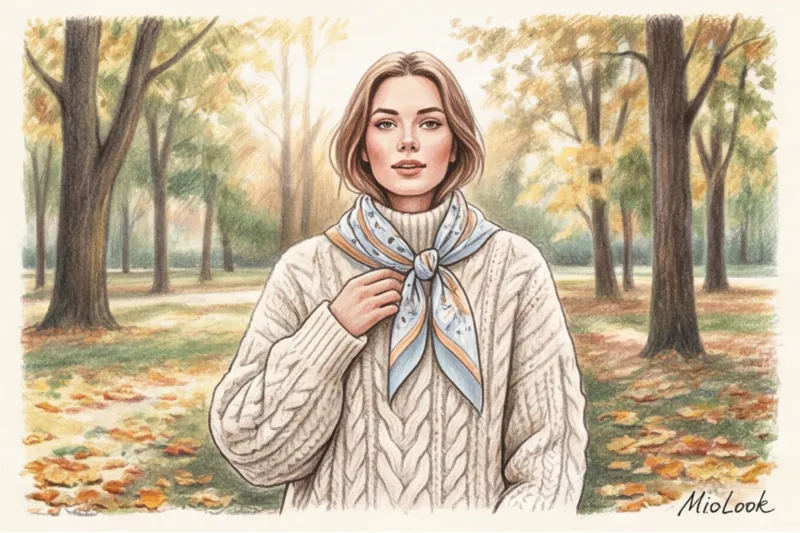
If you're wearing a thick cable-knit sweater, you need a wind-blown scent: aldehydes, ozone, juniper, and cool incense. This olfactory contrast makes the look dynamic and modern. It's as if you've just returned from a frosty walk through a pine forest, not spent the whole day in a pastry shop.
The Perfect Pair: Matching Cozy Fall Fragrances to Your Yarn Type
A general principle of elegant style is that perfume should be an invisible extension of the texture of fabric. We don't simply spray on perfume before going out; we "put on" fragrance as a final layer. Let's explore the specific combinations I regularly use when putting together seasonal capsules for my clients.
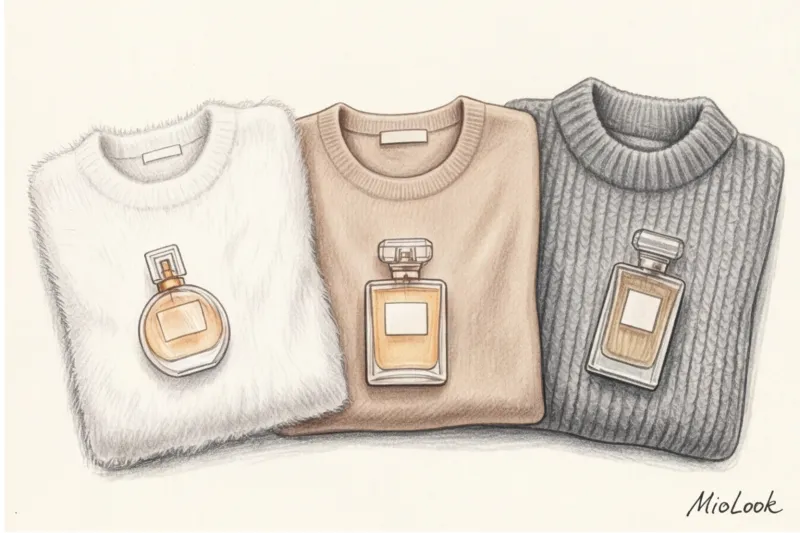
Soft cashmere and fluffy angora
Tactility: cloud, weightlessness, enveloping warmth without heaviness.
Suitable notes: orris root, ambrette, white musk, molecular bases (Iso E Super), sandalwood.
Effect: The scent should blend with the scent of clean, well-groomed skin. The perfume's purpose here is to emphasize the premium quality and delicacy of the fabric. "Second skin" fragrances, which don't have a long sillage but create an intimate cocoon around you, work ideally.
Bulky wool and textured knits (Aran patterns)
Tactility: rustic, dense, protective, slightly prickly.
Suitable notes: dry wood (cedar, vetiver), incense, black pepper, aldehydes, juniper, bitter citrus.
Effect: Adding air and freshness. Crisp woody and spicy notes balance the relaxed silhouette of an oversized sweater, making the look more put-together. This is one of those times when masculine or overtly unisex fragrances can feel incredibly sexy on a woman.
Smooth merino and office turtlenecks
Tactility: smoothness, rigor, second skin, minimalism.
Suitable notes: Black tea, bergamot, fine suede, elegant modern chypres with oakmoss.
Effect: Intelligent sexuality. Smooth knitwear is often used in business attire. Suede and tea notes support this intellectual aesthetic, without distracting colleagues, but creating an aura of confidence.
Your perfect look starts here
Join thousands of users who look flawless every day with MioLook.
Get access — €0.99 onceHow to apply perfume to knitwear without ruining it
Returning to the story of the ruined Loro Piana sweater: the most common mistake is spraying perfume directly on the chest or collar of a wool garment. Alcohol is a harsh solvent. Direct contact with it dries out delicate protein fibers (especially mink, cashmere, and alpaca), making them brittle. Essential oils, meanwhile, leave greasy stains that attract dust.
How to do it correctly?
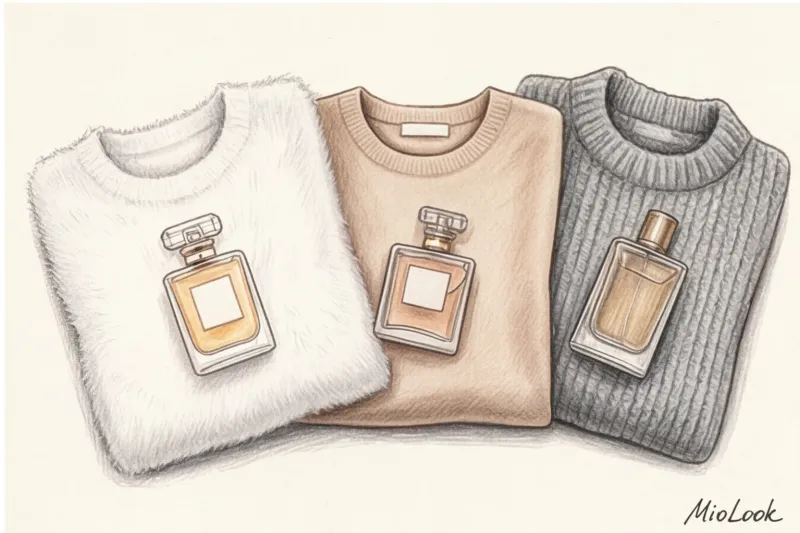
- Cloud method. This is the only safe method. Spray the perfume into the air in front of you and step into the cloud. The micro-droplets will settle evenly on the fibers, preventing a concentrated chemical burn on the fabric.
- Hidden areas. If you like to apply perfume to specific areas, do it on the inside seams of the cardigan or on the lining, if there is one.
- The trick with a square. My favorite French trick: spray the scent on a small silk scarf, let the alcohol evaporate (about 5 minutes), and then tie it around your neck under a wool sweater. Silk releases the scent beautifully, and wool is protected from stains.
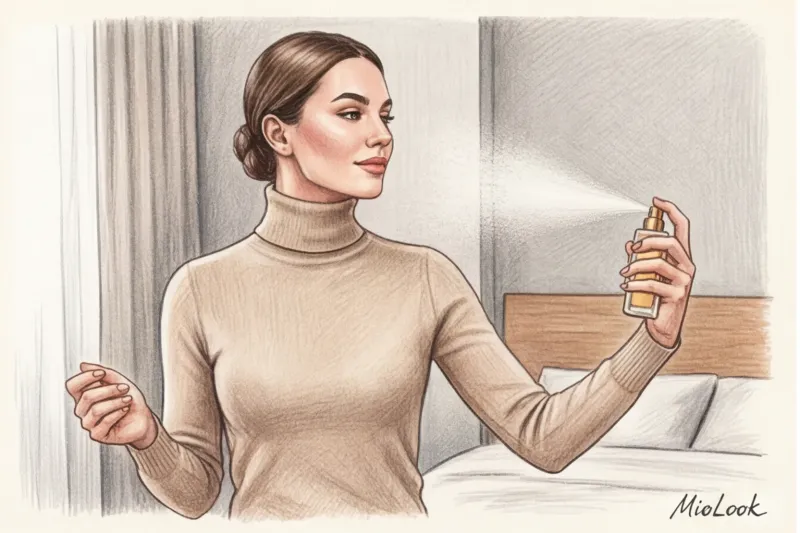
And one more important care tip: never wash a wool garment immediately after wearing it with a strong perfume. Let it hang in the fresh air (on a balcony, in the shade) for at least 24 hours. If you throw a sweater in water mixed with detergent and residual perfume base, the scent can become permanently "welded" into the fibers.
Olfactory Capsule: 5 Directions for Your Fall-Winter Wardrobe
In the appendix MioLook We teach users how to build a capsule wardrobe. But few people know that a perfume capsule follows the same principles. You don't need 20 bottles for the winter. Five carefully chosen fragrances will cover 100% of your needs.
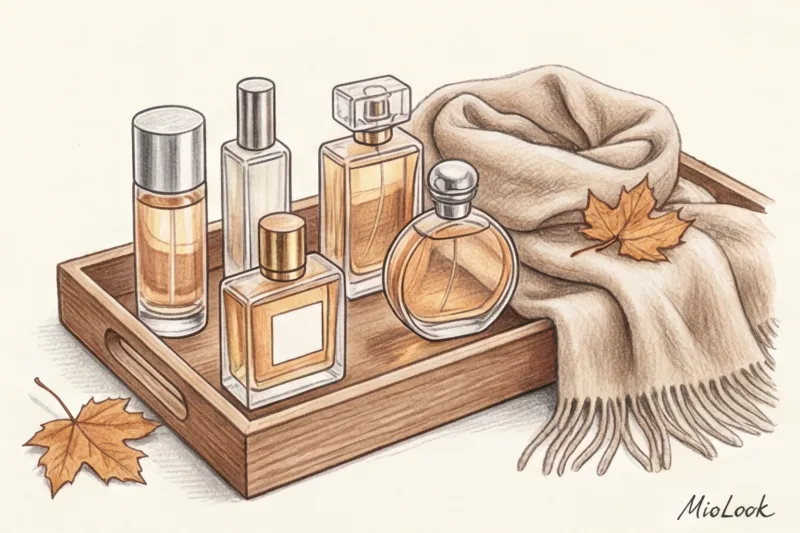
- 1. "Second Skin" — for lazy weekends in a hoodie and joggers made of thick cotton fleece. It's musks, ambroxan, and a light powder. A scent of cleanliness and well-groomedness.
- 2. "Intellectual chic" — for cashmere coats and fine wool suits. Suede, iris, violet. Sounds expensive, understated, and classy.
- 3. "A Walk in the Woods" — for tweed, flannel shirts, and heavy cardigans. Cedar, juniper, vetiver. That same contrasting "air" for heavy fabrics.
- 4. "Modern Classics" — for layered looks with shirts and knitted vests. Chypre, savory patchouli, bergamot. Provides structure and austerity.
- 5. "Evening Comfort" — for fine silk paired with gossamer mohair. Here, and only here, is delicate gourmand flavor appropriate: cherry, tonka bean, rum, vanilla. The fine fabric will withstand this weight.
Ready to get started?
Try the free plan—no commitments. Create your perfect capsule.
Get access — €0.99 onceChecklist: How to Test a Fragrance on Your Favorite Sweater
Never buy perfume blind if you plan to wear it with a specific expensive item. A wrist test in a store won't give you a true picture of how the scent will react with lint. Here's my testing protocol:
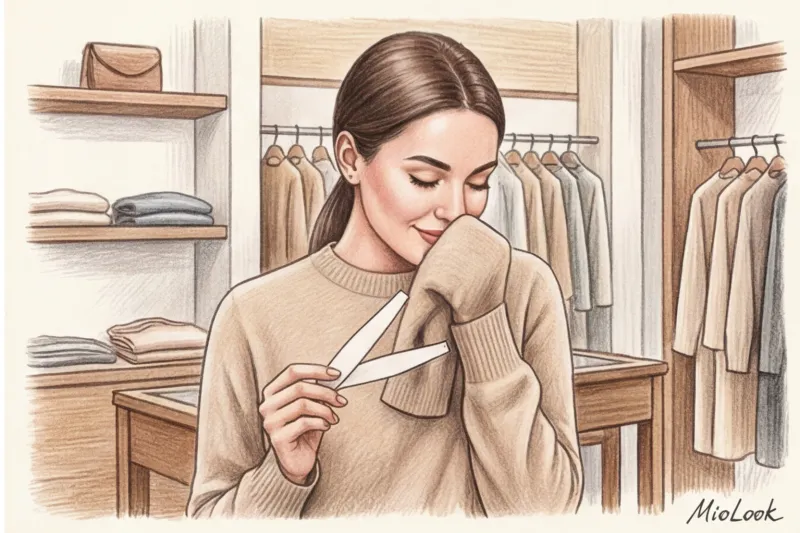
Step 1: At the boutique, apply the fragrance to a paper blotter. Don't smell it right away—wait 10 minutes for the alcohol to dissipate.
Step 2: Place this blotter in your pocket or fold it into a fold of your wool sweater (preferably the same one you plan to wear with the perfume). Leave it for 2-3 hours.
Step 3: Remove the blotter and smell the fabric where it was placed. You'll only detect the base scent—this is how your sweater will smell for the next two weeks.
Let me clarify right away: this test (like my advice above) does NOT work on vintage wool that hasn't been deep cleaned in a while. Natural animal fibers release lanolin over time, and if you apply a modern synthetic musk on top of it, a chemical conflict occurs, resulting in an unpleasant "wet wool" or animal-like smell. In such cases, the item should be dry cleaned first.
Perfume is the invisible tailoring of your look. It can make an inexpensive blended turtleneck look luxurious, or it can turn premium cashmere into something stuffy and indistinct. Invest in your olfactory wardrobe as thoughtfully as you choose the ingredients on your clothing label, and your fall style will be truly impeccable.