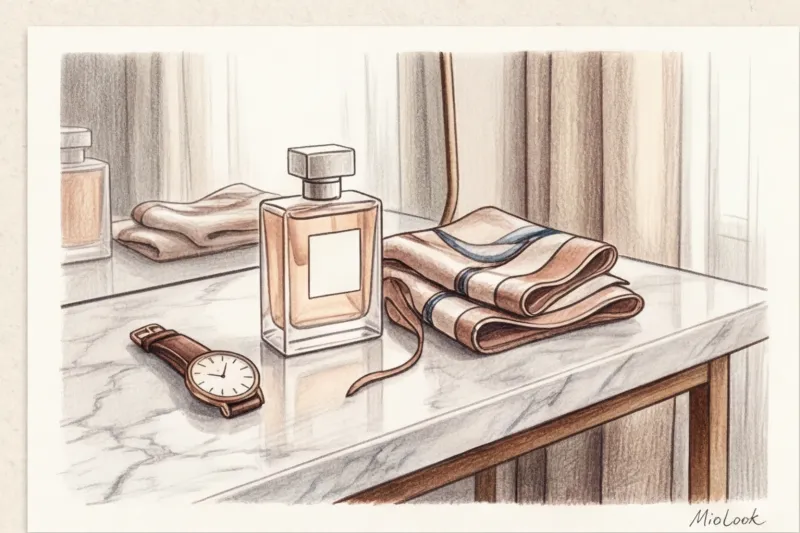
Three years ago, my client Elena, a brilliant M&A lawyer, nearly ruined a multi-million-dollar deal. Her Jil Sander suit was impeccable, and her presentation was meticulously crafted. But there was a catch: before going out, she generously applied Baccarat Rouge 540. In the cramped, stuffy meeting room, the heavy oud scent triggered a severe migraine in a key partner. The deal was postponed, and Elena learned a harsh lesson: in a business environment, your scent speaks louder than words.

As a stylist and colorist, I often see women spend months creating the perfect work wardrobe, only to have it ruined with one accidental spritz. Perfect women's office perfume It's not just "something nice." It's an architectural detail of your image, as important as the thickness of your jacket's fabric or the height of your heels. I discussed how fragrances interact with textures in more detail in our complete guide: How to choose a perfume to match your clothing style: stylist tips.
In this article, we'll explore how fragrance molecules interact with wool and silk, why the scent of "cleanliness" can become a chemical weapon in open spaces, and how to smell so your professionalism is subconsciously conveyed.
The Invisible Dress Code: Why Women's Office Perfume Is Part of Your Reputation
The sense of smell is directly connected to the brain's limbic system—the ancient center responsible for emotions and instincts. While your interlocutor hasn't yet had time to evaluate the stitching on your lapel, their brain has already processed your scent and drawn conclusions: "friend or foe," "confident or fussy," "professional or amateur." This is the classic halo effect in action.
Your olfactory wardrobe is a logical extension of your business attire. The difference between "simply smelling nice" and "smelling classy" is colossal. Sweet vanilla may be incredibly pleasant on a date, but in a boardroom setting, it conveys childishness. Dry vetiver or cool iris, on the other hand, say, "I'm here to solve problems."
Access to MioLook for €0.99 — one-time payment
A smart AI stylist will select the perfect look for the office and important meetings.
Get access — €0.99 onceThe 40-Centimeter Rule: The Basics of Office Perfume Etiquette
According to a 2023 study by the Society for Human Resource Management (SHRM), coworkers' odors are the second-most common irritant in open-plan offices, behind only loud phone calls. To avoid becoming the subject of office complaints, master the concept of a "scent bubble."
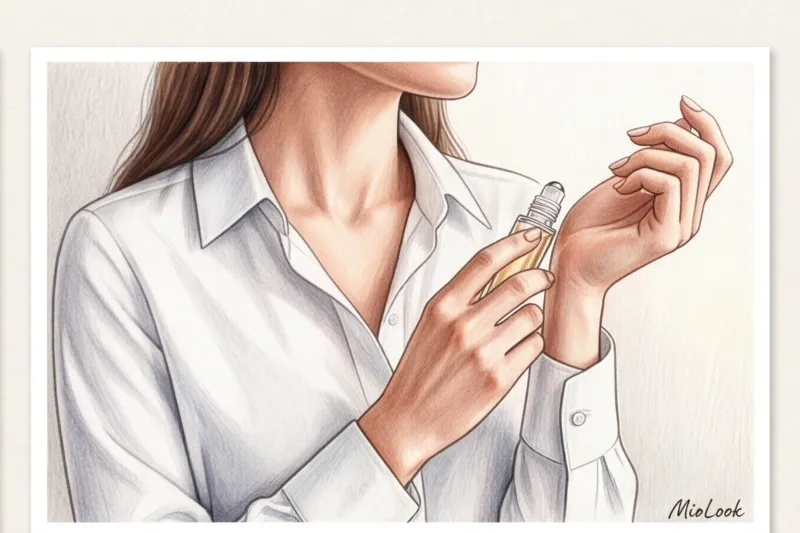
Your perfume bottle in the office should not exceed 40 centimeters—that's arm's length. Only those who approach you to hand over documents or say hello should smell your scent. A long trail (sillage) that follows you down the hallway is absolutely bad form. Aromatic abuse begins where you've already exited the elevator, leaving your scent behind to travel to the next floor.
How to test a cable before going to work
One of the main problems for perfume lovers is olfactory blindness (anosmia). Our brain quickly becomes accustomed to a constant stimulus and "switches it off" to avoid overloading the nervous system. You think the perfume has worn off, so you spray a few more sprays, while your coworkers quietly gasp.
How do you test the intensity? Do a home test: apply the perfume as usual in a closed bedroom, go out for 10 minutes to drink coffee in the kitchen, and then return. If the scent hits your nose when you enter the bedroom, you've overdosed it. Ideally, you should detect just a hint of the scent.
Mistakes that "cheapen" your look: myths about fresh and expensive fragrances
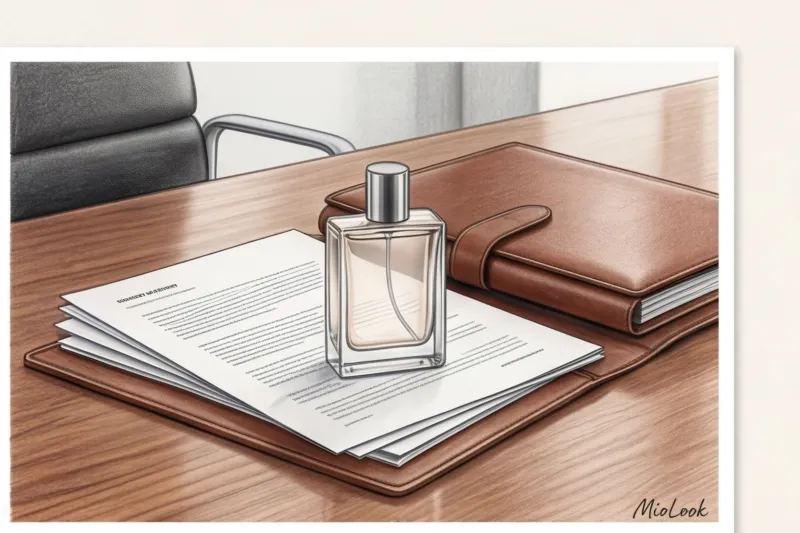
Now let's bust a few popular myths that I constantly hear during consultations.
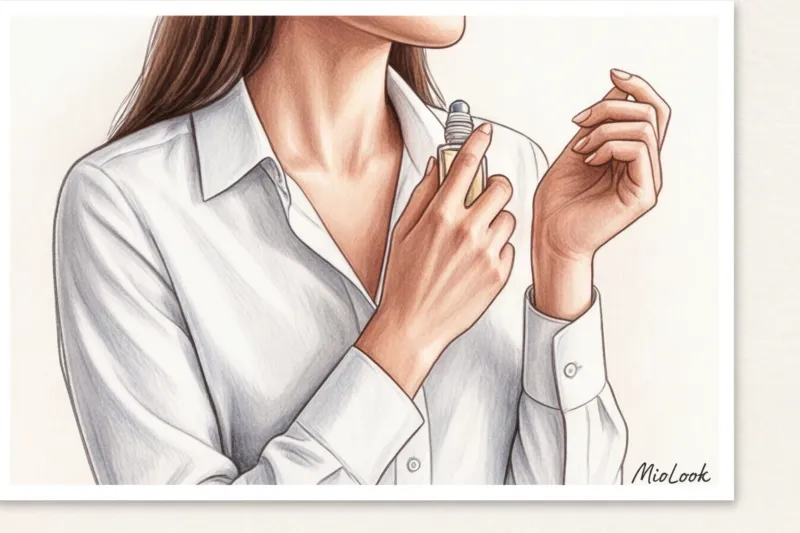
Myth 1: “Cleanliness and laundry detergent” scents are completely safe.
Many people believe that perfumes with the scent of freshly washed laundry (such as popular molecular compositions) are ideal for work. In fact, most of them are based on heavy synthetic white musks. The International Fragrance Association (IFRA) strictly regulates their use, but in the confined, dry, air-conditioned air of an office, these musks don't evaporate but rather "settle," causing a sore throat and a feeling of suffocation in those around them faster than classic floral perfumes.
Myth 2: Expensive niche perfume always sounds prestigious.
It's the "Baccarat Rouge syndrome" or Tom Ford Black Orchid. A complex, lingering fragrance with notes of oud, rich resins, and spices, it's perfect for open spaces and evenings. During the day, paired with a strict business dress code for women This perfume creates severe cognitive dissonance. It's like wearing a diamond necklace over a work shirt—expensive, but completely inappropriate.
Myth 3: Gourmet food attracts people.
Notes of praline, chocolate, caramel, and cotton candy are certainly appealing, but they diminish your perceived expertise. The brain associates edible scents with comfort, childhood, and relaxation. If you're facing a tough budget for a project, the scent of cinnamon rolls won't help.
Your perfect look starts here
Join thousands of users who look flawless every day with MioLook.
Get access — €0.99 onceHow to choose a fragrance to match your business wardrobe and fabrics
In my stylist practice, I had a client ruin a premium silk blouse from Massimo Dutti by spraying it with perfume containing a high concentration of essential oils. It left yellow stains that no dry cleaner could remove. Fragrance should be matched not only to the outfit but also to the texture of the fabric.
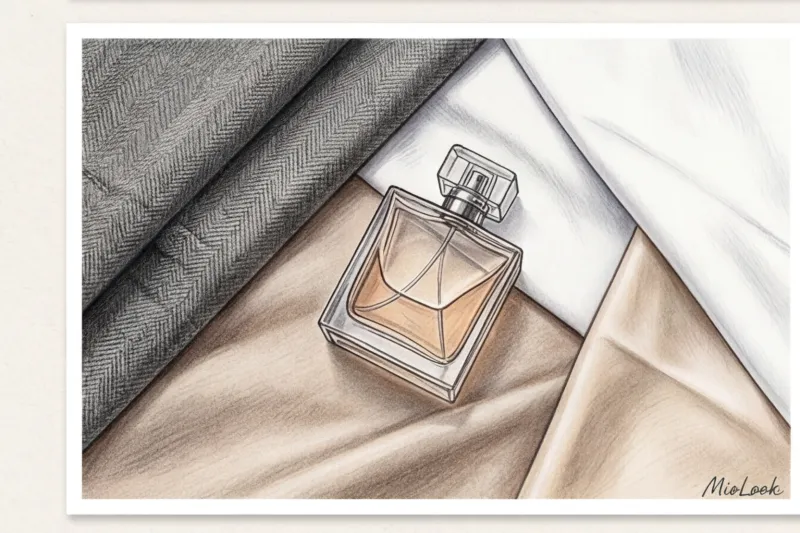
Wool, tweed and cashmere
Natural wool is the perfect scent-holder. Wool fibers are porous, capturing large perfume molecules and holding them for up to 48 hours. If you wear heavy suits, choose dry woody notes (cedar, sandalwood) or orris root. My personal testing showed that the Iso E Super molecule on a basic cotton T-shirt disappears by lunchtime, but on a cashmere sweater, it lingers like a noble tree trunk even the next day.
Silk and cotton
Smooth fabrics (silk, viscose, mercerized cotton) release fragrance much more quickly. A basic white shirt weighing at least 180 g/m² is best complemented with cool, volatile notes: green tea, vetiver, and bitter citrus (bergamot, grapefruit). They create a sense of crisp freshness that perfectly complements the smooth texture.
The Hierarchy of Fragrances: From Open Space to the Executive Office
Context is everything. Your choice of perfume directly depends on the architecture of your workspace and your position.

If you work in Open Space:
Here, maximum delicacy is required. Your best friends are watercolor florals (freesia, peony), green notes (cut grass, fig leaf), and light mineral accords. They create an aura of well-groomed elegance without invading your tablemate's personal space.
If you have a separate office or a management position:
Here you can indulge in fragrances that convey status and create an invisible distance. Classic chypres (with notes of oakmoss and patchouli), dry, unsweetened leather, and suede. Such fragrances work like a well-tailored jacket with a sharp shoulder line. If you have a presentation coming up in front of the board of directors, I recommend checking out our article about clothing for public speaking — there we examine in detail the psychology of status images.
Checklist: How to Properly Apply Perfume Before Going to the Office
Forget the cinematic gesture of rubbing perfume between your wrists—it breaks up the top notes of the composition (especially the fragile citrus). For the office, I recommend the "cloud entry" technique.
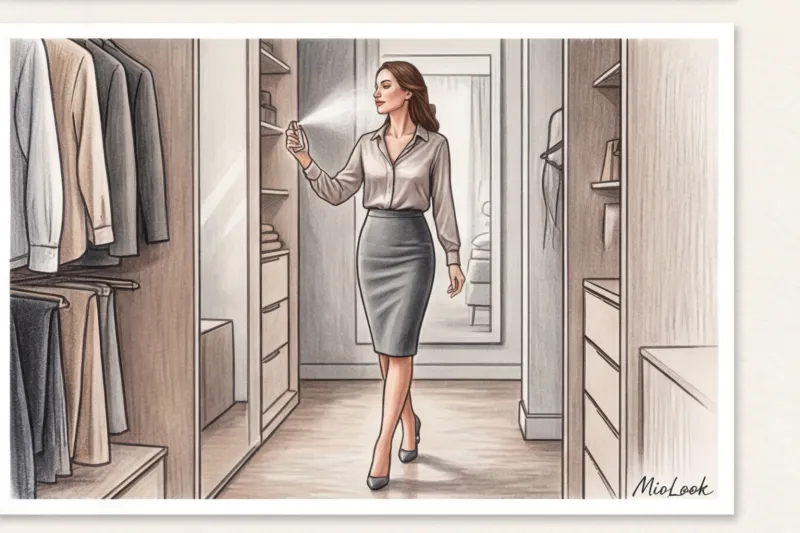
- How to do it: Spray the perfume into the air in front of you (2-3 sprays) and step into the settling cloud. The scent will be evenly distributed through your hair and shoulders in micro-droplets, creating that delicate aura without a suffocating trail.
- Taboo zones: Never apply perfume behind your ears or on the front of your neck before work. Firstly, the blood vessels there are close, the skin is hot, and the scent will evaporate too quickly. Secondly, during a business greeting (when people lean in), you'll literally hit your colleague in the nose with your perfume.
- Alternatives: If you're worried about overdoing it, use scented body lotions from your favorite scented bath line or special hair mists. They contain lower concentrations of alcohol and fragrances.
Fair Limit: To be fair, the "cloud entry" technique doesn't work for all formulas. If you're using light, citrusy colognes or eau de toilettes with a low concentration of oils, spraying into the air is a waste of money. Such light textures should be applied to the back of the neck (under the hairline) or to the crook of the elbow.
Ready to get started?
Try the MioLook plan for free—no commitments required. Create your perfect business wardrobe.
Get access — €0.99 onceA Business Woman's Perfume Capsule: Perfect Notes
If you're just putting together your olfactory wardrobe, focus on these three fail-safe profiles. They work in 99% of office situations, from routine work to important online webinar (where the scent is needed solely for your own mood and confidence).
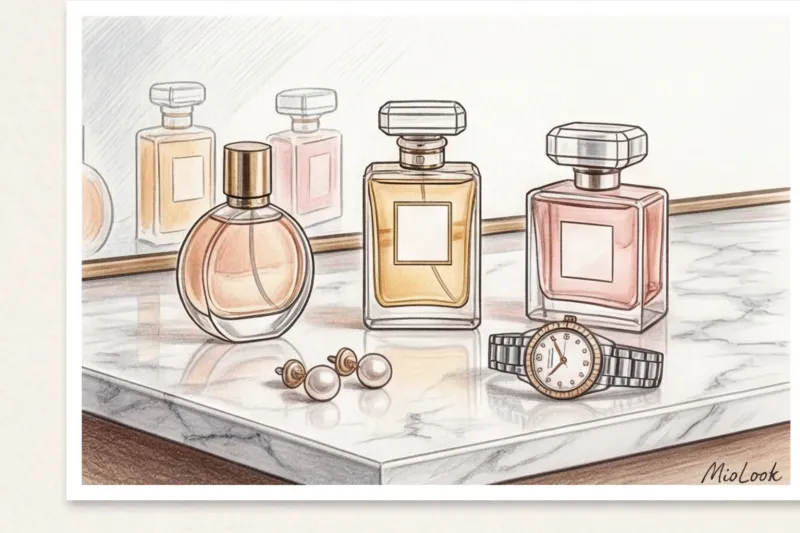
- Orris root (Iris). It's the scent of expensive skincare, cleanliness, and a light coolness. The iris is powdery but not sweet. It creates the perfect businesslike distance—polite but irresistible.
- Vetiver and cedar. Woody notes have long been considered a strictly male domain, but on women's skin they work wonders. They're free of gender stereotypes, offering a dry, collected scent that helps you focus. It's the scent of freshly printed banknotes and expensive pencils.
- Tea and green notes. Green tea, matcha, bamboo, basil. Pure political correctness. These scents convey energy, freshness, and dynamism. An ideal choice for creative agencies and IT companies with a casual dress code.
A well-chosen office perfume works like a perfectly tailored jacket: it pulls your look together, hides minor imperfections, and keeps your back straight. By the way, to ensure your visual wardrobe always matches your olfactory one, I recommend digitizing your items. MioLook app When you see your entire capsule on the screen, choosing the perfect bottle for it becomes a matter of minutes.
The main rule of business perfume is simple: your scent should be your whisper, not your shout. Save the loud statements for your professional results.