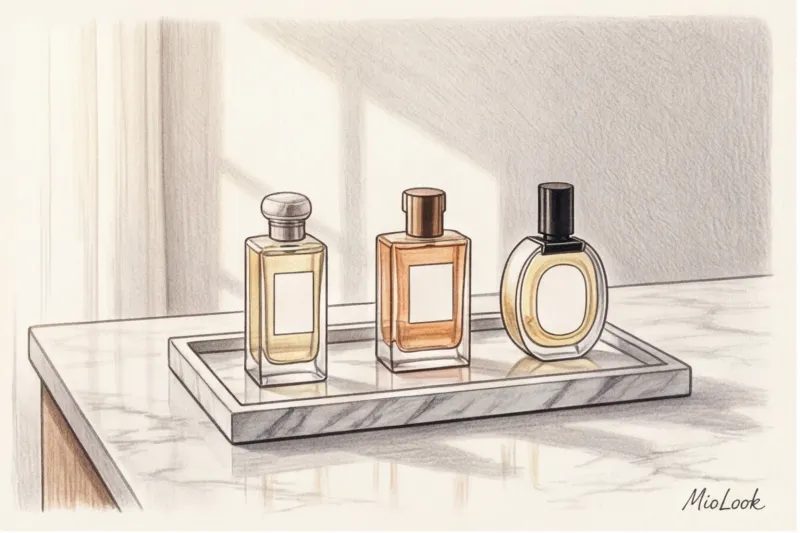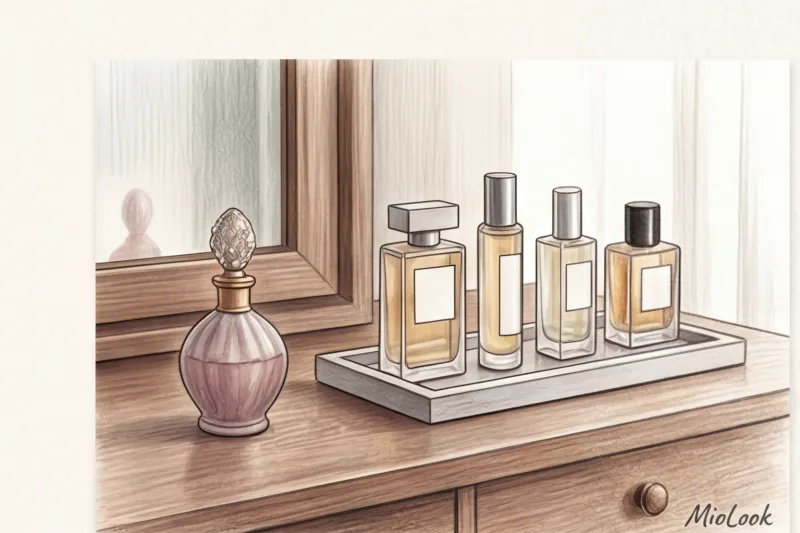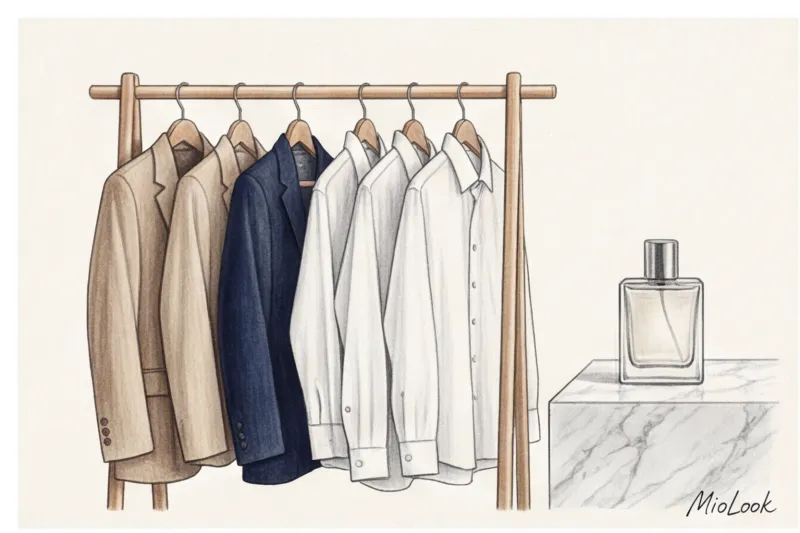
Last month, a client came to me for a wardrobe review. She was wearing a flawless, minimalist look: a perfectly tailored Jil Sander cashmere sweater, straight-leg thick wool trousers, and simple loafers. Visually, it looked expensive and prestigious. But as soon as she got closer, the impression was instantly shattered. She exuded a thick, suffocatingly sweet trail of gourmand perfume with notes of praline and heavy vanilla.
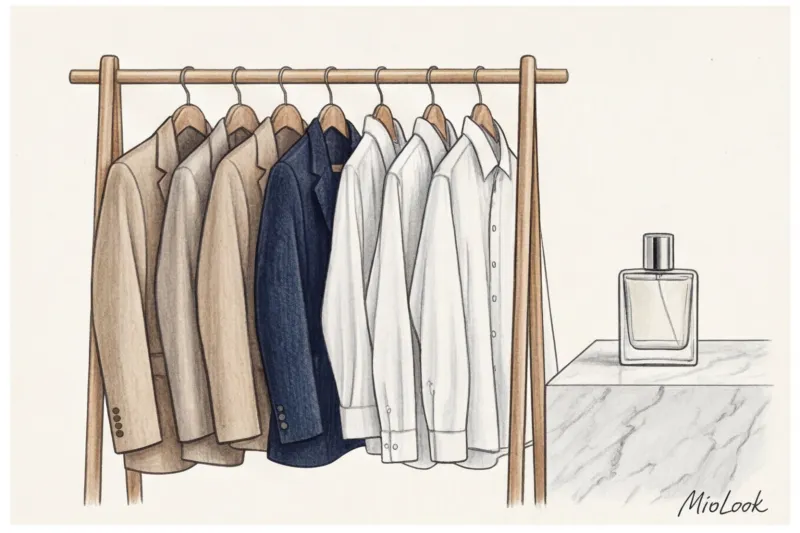
A powerful cognitive dissonance arose. Her brain saw the architectural purity of lines, but her sense of smell screamed, "We're in a pastry shop!" That's when we began working on her olfactory wardrobe, selecting the right perfume smell of purity We talked in more detail about how the brain connects clothing and scents in our A complete guide to choosing a perfume to match your clothing style.
Today I want to talk about perfume not as a collection of pretty bottles, but as a functional tool. Fragrance is the invisible base shirt of your wardrobe. It should structure your look, not overwhelm it.
Olfactory minimalism: why does a basic wardrobe need special scents?
Have you ever noticed how difficult it is to concentrate in a room with loud music playing, flickering lights, and a TV on? The same thing happens to our perception of style. Complex niche perfumes with a 50-note pyramid next to simple cuts create a sensory overload.
According to a study published in Journal of Cognitive Neuroscience (2023), visual-olfactory congruence directly influences how others perceive our status. When the texture of a fabric and the scent profile match (for example, smooth cotton and fresh aldehydes), the perceived value of an image increases by 40%. This is the classic "halo effect" in action.
If your closet consists of Zara, COS, or Massimo Dutti pieces in a neutral palette, you don't need a perfume that screams and enters the room before you do. You need a scent that works as the perfect primer, evening out the background and highlighting the texture of fabrics.
Access to MioLook for €0.99 — one-time payment
A smart AI stylist will create the perfect look and help you integrate fragrances into your capsule wardrobe.
Get access — €0.99 onceWhat is "pure scent perfume" really? (Debunking the myths)
Let's be honest. If you think the perfect clean scent is a lemon-flavored air freshener or a harsh fabric softener, we urgently need to reconsider your perfume habits. Smelling like laundry detergent is flat and cheap.
True olfactory minimalism, as legendary perfumer Jean-Claude Ellena notes, is built on the emptiness and air between notes. Modern "clean" fragrances rarely contain natural citrus at all. Their base is high-tech synthetics: Iso E Super molecules, ambroxan, and cashmeran.
"A minimalist fragrance shouldn't tell a long story with unexpected twists and turns. It should create an aura of comfort that remains consistent from morning to evening."
That's why minimalists avoid the classic perfume pyramid (top notes, heart, base). Who needs surprises when, at 3:00 PM, a fresh opening suddenly turns into a heavy amber base that's completely inappropriate for your white shirt? Pragmatists choose a linear development. The scent's first impression is the same as its eight-hour duration.
From Soap to Molecules: The Evolution of Pure Fragrances
What we consider "cleanliness" has changed dramatically over the past hundred years:
- 1920s – 1950s: The era of aldehydes. The smell of starched collars, expensive soap, and a hot iron.
- 1990s: The era of white musk. The aesthetics of grunge, unisex, and simple white T-shirts (remember the iconic CK One).
- 21st century: Molecular Perfumery. Concept Skin Scent — the scent of your own clean skin, only better. No colors, just synthetic ingredients that create a transparent effect.
Your perfect look starts here
Join thousands of users who look flawless every day with MioLook. Digitize your wardrobe in just a few clicks.
Get access — €0.99 onceThe Anatomy of a Minimalist Perfume: 3 Key Directions
As a practicing stylist, I always match my perfume to the texture of the fabric. It's impossible to wear the same fresh scent with both heavy denim and fine silk. Here are three basic guidelines that will cover 99% of your wardrobe needs.
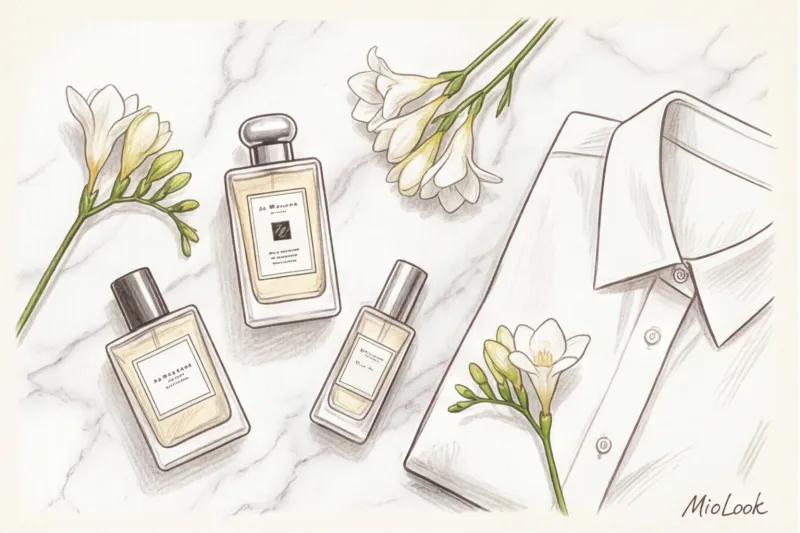
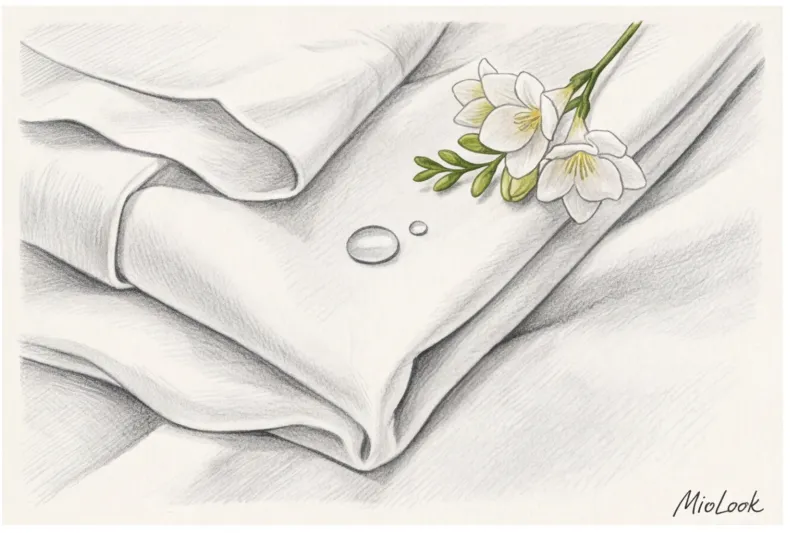
Direction 1: Crisp White Shirt
These fragrances feature notes of modern aldehydes, iris, and neroli. They are cool, detached, and austere. They pair perfectly with heavy cotton (180 g/m² and above), suit wool, and office attire. If you have a challenging interview at an IT company where you need to look put-together but not too formal, this is your choice.
Direction 2: Warm cashmere
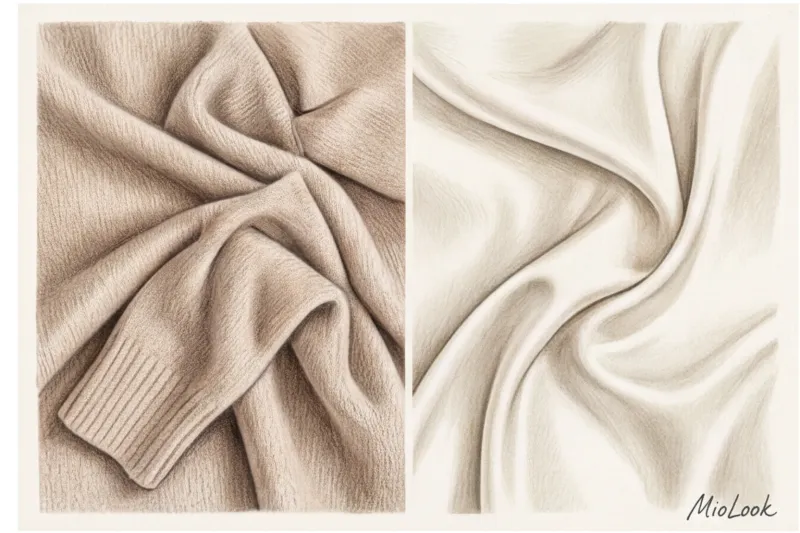
Ambrette, sandalwood, and botanical musks reign supreme here. This clean scent has a fleshy, slightly sweet (but not gourmand!) undertone. It creates an aura of comfort. I recommend it for knitwear, chunky knit sweaters, and relaxed weekend looks.
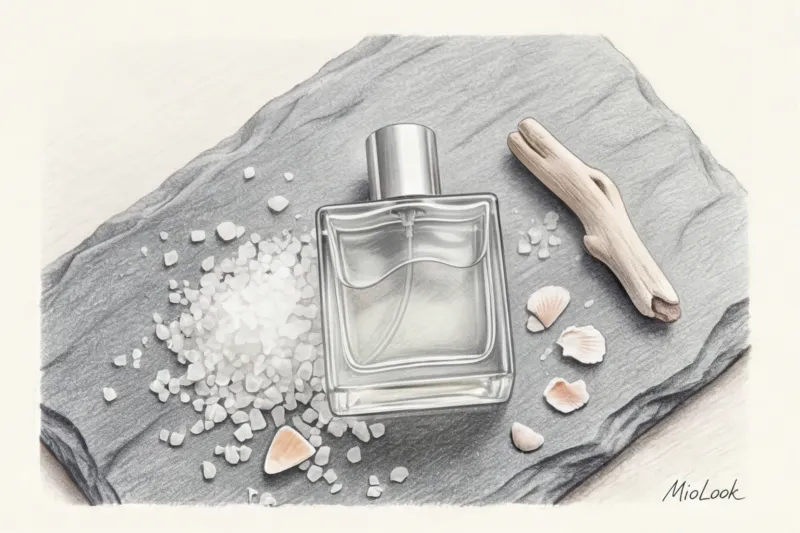
Direction 3: Mineral Purity
Notes of sea salt, wet concrete, ozone, and pebbles. A supremely urban profile. Pairs fantastically with leather jackets, vintage denim, and white sneakers. It's the scent of a clean city after rain, devoid of any romanticism.
Perfume capsule: how many fragrances does a minimalist need?
Having 20 bottles on the shelf is a direct path to decision fatigue (Decision fatigue). Why waste your morning time choosing a perfume when you've already optimized your wardrobe?
I am a supporter of the "three bottle rule":
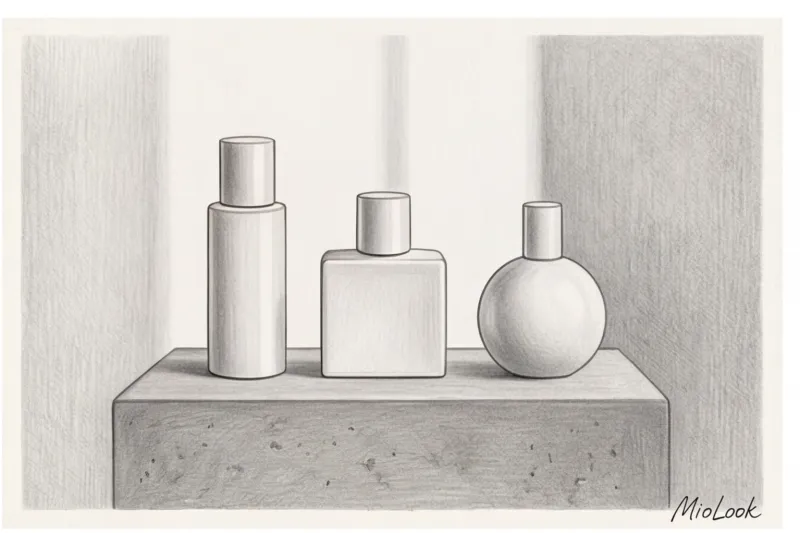
- Base: molecular fragrance for every day (that same skin scent).
- Accent: a slightly more structured perfume for important meetings (for example, with a note of iris or vetiver).
- Texture: An enveloping scent for the evening or weekend (sandalwood or cashmeran).
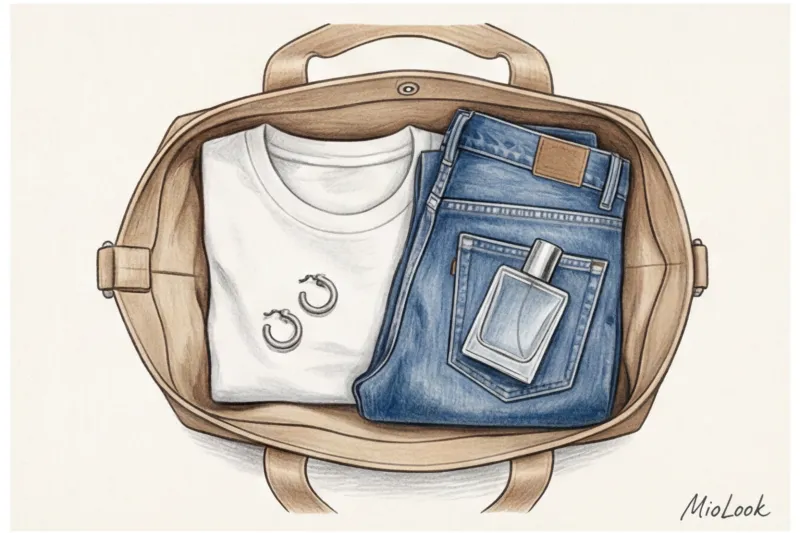
I recently conducted an experiment. I digitized my clothes and perfumes, and for six months I noted what I wore. When I opened statistics in the MioLook app The numbers shocked me. It turned out that 80% of the time, I was reaching for a single bottle of Iso E Super. The rest of the bottles simply collected dust. Since then, I recommend my clients start with just one perfect base scent.
Ready to start digitizing your wardrobe?
Try the MioLook plan for free—no commitments required. Discover which items and fragrances you wear most often.
Get access — €0.99 onceMistakes in selection and application: how not to ruin the look
Even the most delicate, clean scent of perfume can turn into a chemical weapon if used incorrectly. Here are the main mistakes I regularly see.
Mistake 1: Overspraying
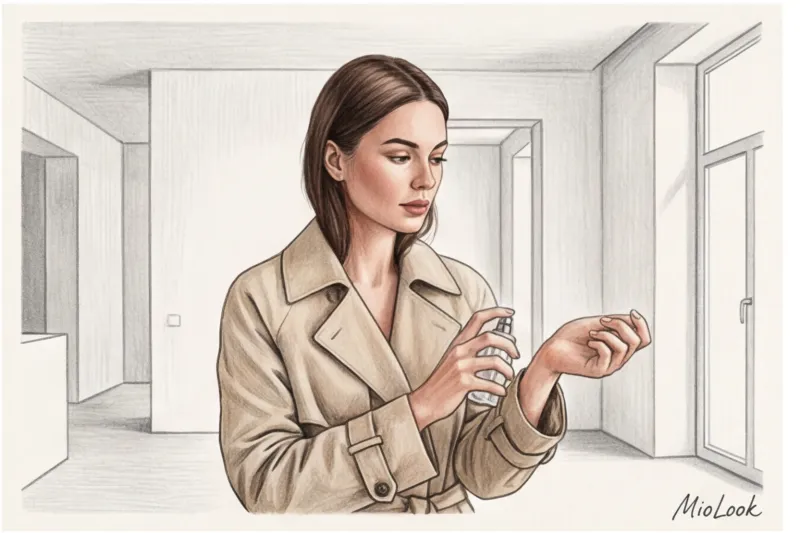
Molecular scents are tricky. Because of their transparency, we often feel like they've worn off after just an hour (this is called olfactory blindness). We reach for a fresh perfume, and eventually, our colleagues in the office start suffocating. The minimalist's golden rule: exactly two sprays. No more.
Mistake 2: Applying to clothing
One of my clients once ruined a luxurious ivory silk blouse by liberally applying oil-based perfume. But it wasn't just the stains. Synthetic molecules (ambroxan, Iso E Super) are "dormant" components. They are activated and released only by body heat. On cold fabric, they smell faintly of chemicals.
Mistake 3: Blindly buying musks
Here I must make an important warning: This rule does not work for everyone. Musks are the most capricious notes in perfumery. On hot skin, they can smell like freshly washed laundry, while on cold skin (or under certain hormonal conditions), they can smell like dirty water or unwashed skin. Never buy pure fragrances based on online reviews—only test them on your wrist.
Checklist: How to Choose Your Perfect Base Fragrance
To find your perfect minimalist fragrance, forget about the blotters (paper strips) in stores. They won't tell you the truth. Use this simple algorithm:
- The "white T-shirt" test. Put on the simplest, high-quality basic item in your closet (for example, a crisp white 100% cotton T-shirt). Spray the fragrance on your neck. Look in the mirror. Do you feel a discordant scent? If the scent seems too dressy, sweet, or heavy for this T-shirt, look further.
- Time test. A true perfume's clean scent should last you through a standard 8-hour workday without turning into a sultry sweetness by evening.
- Train assessment. Minimalism requires respect for others' boundaries. Your scent should only be felt in intimate areas—at arm's length. If you leave the elevator and your scent lingers there for five minutes, that's a failure.
Your perfume isn't just a pleasant scent. It's the invisible architecture of your look, the finishing touch that brings together the textures, lines, and colors of your clothes. Find your perfect molecule of purity, and you'll notice how even the simplest jeans and white shirt will smell like a million bucks.