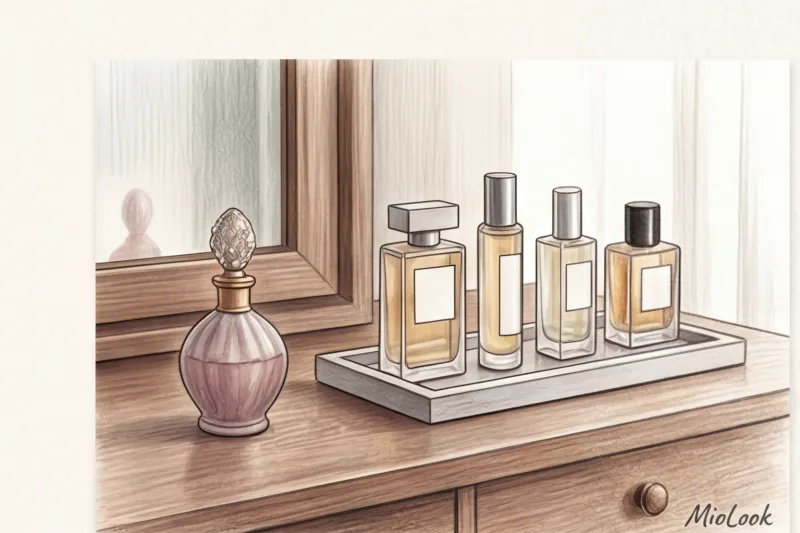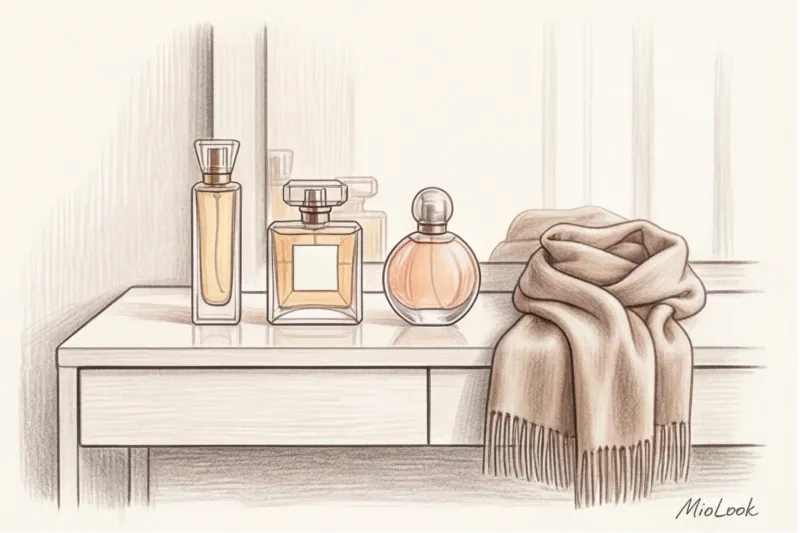
Two weeks ago, a client of mine brought me a thousand-euro Loro Piana silk blouse in tears. The collar had a yellowish, rough stain that three premium dry cleaners flatly refused to remove. The cause of this disaster? One generous spray of her favorite alcohol-based perfume right before leaving the house. The alcohol instantly destroyed the silk's protein structure, and the heavy oils had permanently ingrained the fibers.
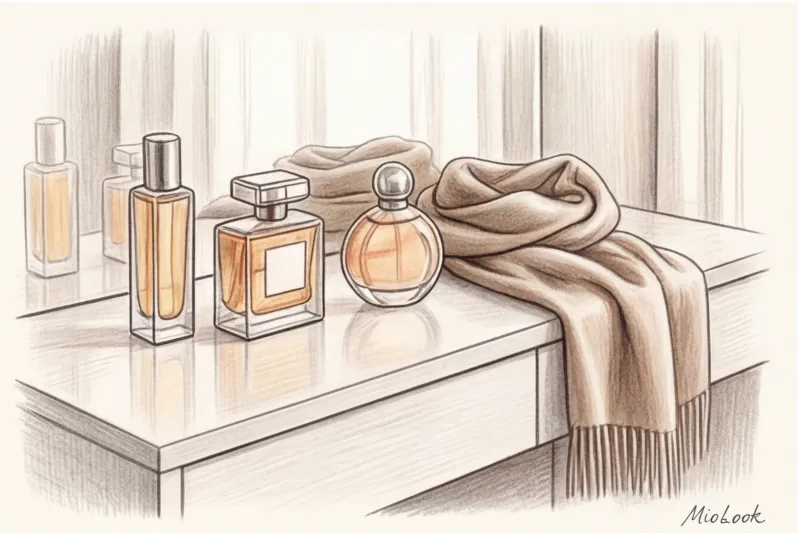
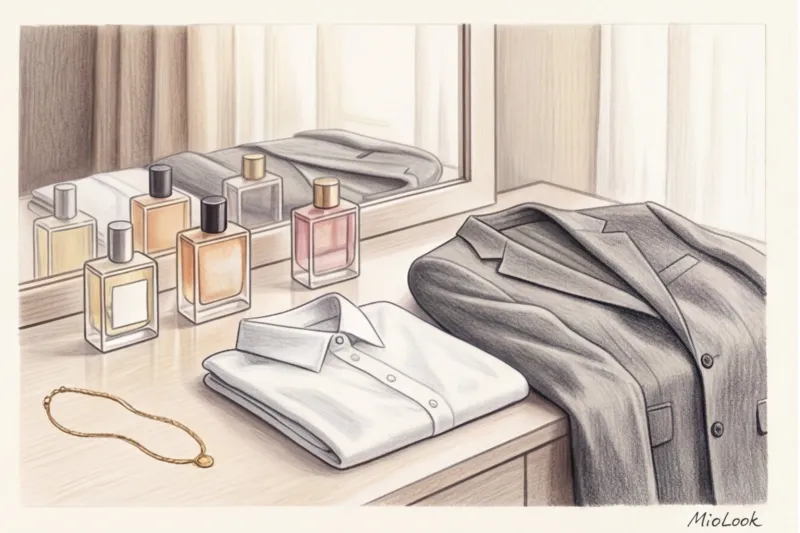
This story is a perfect illustration of why choosing and using perfume should be approached with the same technical precision as caring for cashmere. I often get asked: How to create a perfume wardrobe so that it would work for the image, would not require buying dozens of bottles and would not conflict with clothes.
We have already discussed the neurobiology of smells in more detail in our A complete guide to choosing a perfume to match your clothing style , but today I want to examine this process from the perspective of textile chemistry and wardrobe architecture. Forget the banal division into "day" and "evening" perfumes. We'll build a capsule collection based on fabric textures.
What is a perfume capsule and why the myth of "one scent" is ruining your style
The glossy magazines of the 2000s gave us a beautiful, but hopelessly outdated idea about signature scent — a single signature scent for life, by which you'll be recognized in a crowd. In practice, this is as much stylistic suicide as trying to wear the same black pumps to the gym, a gala dinner, and the beach.
"Wearing a thick oriental perfume with a formal wool suit at a morning board meeting is an olfactory dissonance that literally screams inappropriateness."
Your scent shouldn't cater to your nostalgia. It should cater to your social role at a particular moment in time and the texture of the clothes you're wearing. A recent study Journal of Cognitive Neuroscience (2023) It has proven a striking fact: the right visual-olfactory match (when the scent logically follows the texture and cut of the garment) increases the subconscious assessment of the image's value by 40%. Conversely, the dissonance between a strict cut and a frivolous strawberry spray instantly destroys your credibility as an expert.
Perfume Wardrobe: How to Build a Base of 4 Key Slots
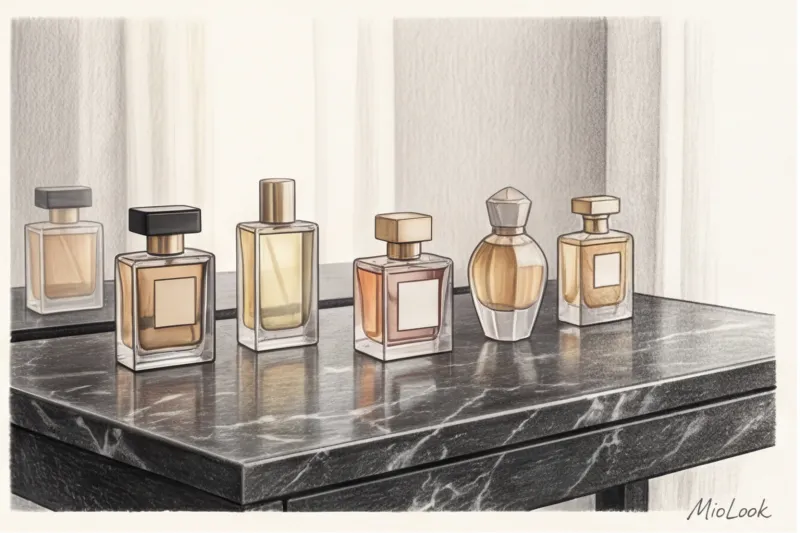
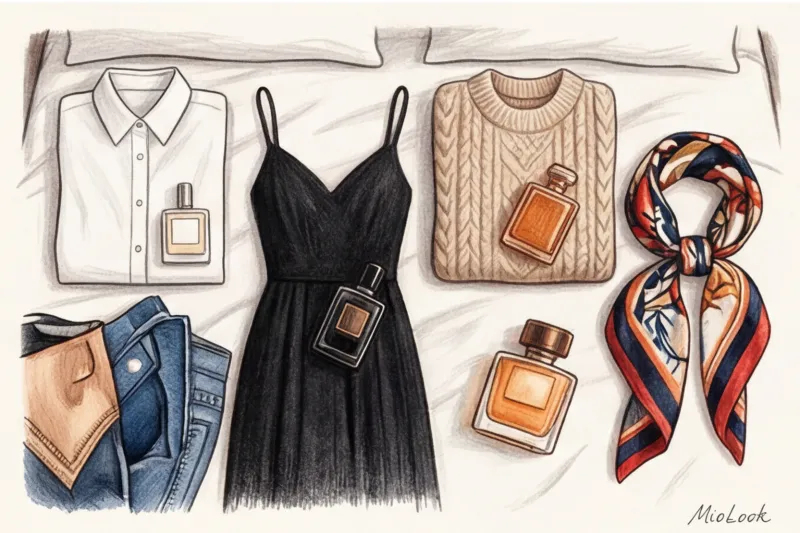
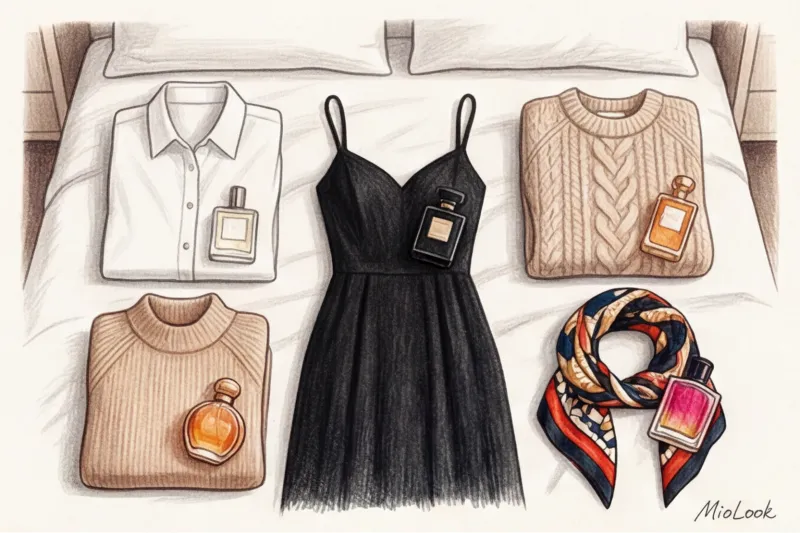
Over 12 years of wardrobe decluttering, I've come up with a formula: a basic capsule of 3-4 fragrances covers 95% of life scenarios. When I help clients get rid of 20 random bottles, we always arrive at this clear structure.
Slot 1: "White Shirt"
This is your work tool. A scent that smells like crisp 180g/m² Egyptian cotton. It doesn't intrude on your colleagues' privacy and creates an aura of cleanliness and composure.
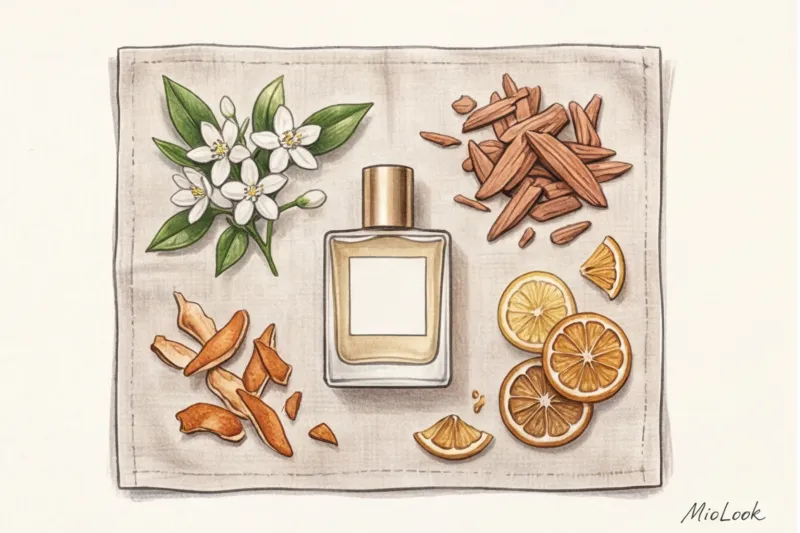
- Notes: aldehydes, bergamot, neroli, white musk, ozone.
- What to wear with: business capsule wardrobe , smooth fabrics, suit wool, poplin.
- Task: convey distance and professionalism.
Slot 2: "Complex Cut"
A prestigious, deep perfume for an evening, important negotiations, or events where you need to occupy space. It's the olfactory equivalent of an architectural jacket or a heavy bias-cut silk dress.
- Notes: oud, patchouli, leather, oakmoss, resins, thick chypres.
- What to wear with: velvet, thick silk, leather, status office wardrobe.
- Task: leave a trail and be remembered.
Slot 3: "Cashmere Sweater"
A fragrance "for yourself." Cozy, tactile, and close to the skin. It doesn't trail for three meters, but rather warms you like your favorite Mongolian cashmere sweater on a chilly weekend.
- Notes: Bourbon vanilla, tonka bean, sandalwood, amber, lactone (milk) accords.
- What to wear with: knitwear, pile fabrics, flannel, denim.
- Task: relaxation and comfort.
Slot 4: "Accent Accessory"
A bold, trendy, or even quirky scent for creative outings. It's your statement bag or statement necklace. What you wear when you want to break the rules.
- Notes: metal, fig, tomato leaf, pepper, mineral accords.
- What to wear with: avant-garde cut, eclecticism, street style.
- Task: show character and experience.
Access to MioLook for €0.99 — one-time payment
A smart AI stylist will create the perfect look and suggest which fragrance will best complement your capsule wardrobe today.
Get access — €0.99 oncePerfume and Fabrics: Secrets of a Textile Expert
As a fabric specialist, I regularly test the interaction of volatile substances with various fibers. Most people don't even realize that the same perfume on polyester and merino wool are two chemically different processes.
Natural wool has a porous, scaly structure (cuticle). It acts like a sponge, absorbing essential oils and retaining them up to three times longer than synthetics. Wool releases its fragrance slowly, allowing base notes (sandalwood, amber) to fully develop. Polyester, on the other hand, has a smooth fiber: perfume literally "rolls off" it, evaporating quickly and often leaving behind a distorted, pungent scent of the alcohol base.
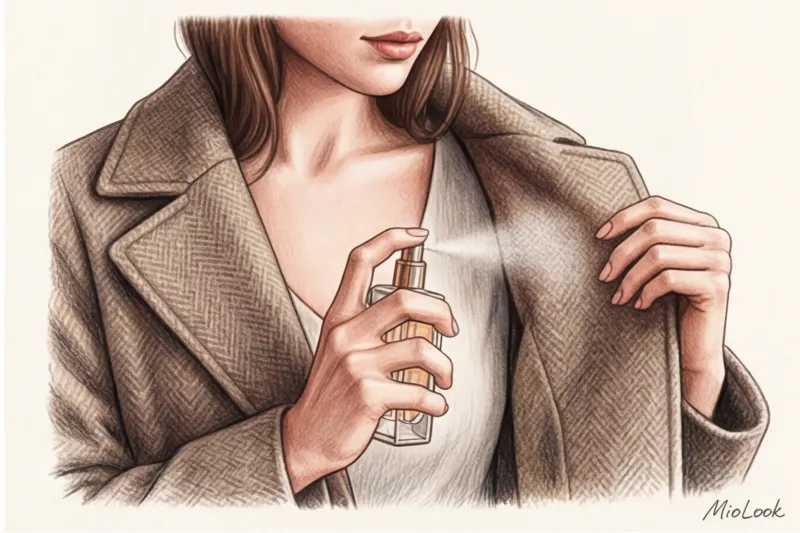
"Never spray perfume directly onto the front of your clothes. It's a surefire way to ruin them and make them smell cheap."
Returning to the Loro Piana story: alcohol (ethanol) is a powerful solvent. When it comes into contact with protein fibers (silk, wool) or artificial fibers (viscose, acetate), it causes micro-burns in the fabric. The dye in this area is washed out, and the fiber permanently loses its shine and elasticity.
Safe application guidelines:
- On the inner seams. Apply perfume to the tight inseams of the hem of your skirt or trousers. The warm air rises, creating a delicate trail.
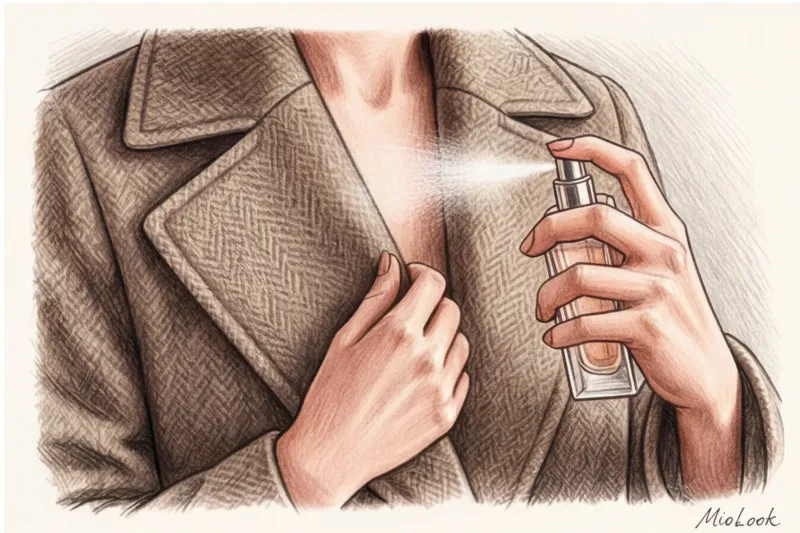
- For lining outerwear. The ideal place for long-lasting perfumes is the area between the shoulder blades on the lining of a jacket or coat (if it is not made of light acetate).
- Only on skin. If you're wearing fine silk, chiffon, or light-colored viscose, apply perfume directly to your skin 15 minutes before getting dressed. Allow the alcohol to evaporate completely.
Important limitation: This method of applying to the lining does NOT work on light-colored fabrics or thin cupro. The oils contained in perfume (especially in niche perfumes, where their concentration reaches 20-30%) will inevitably leave greasy stains.
Sustainability and Consciousness: Quality vs. Quantity
Today, collecting 30-40 bottles on a shelf is a counter-trend. The problem of overconsumption has reached perfumery as well. Fragrances oxidize and deteriorate from light, leaving you physically unable to use them.
As an eco-activist, I urge people to pay attention to ingredients. Many fear the word "synthetic" in perfumes, demanding 100% natural ingredients. But let's face it: modern, safe synthetics, created according to strict IFRA (International Fragrance Association) regulations, are often much more environmentally friendly. Laboratory-produced musk or aldehydes don't require the clearing of acres of rare sandalwood forests or animal cruelty.
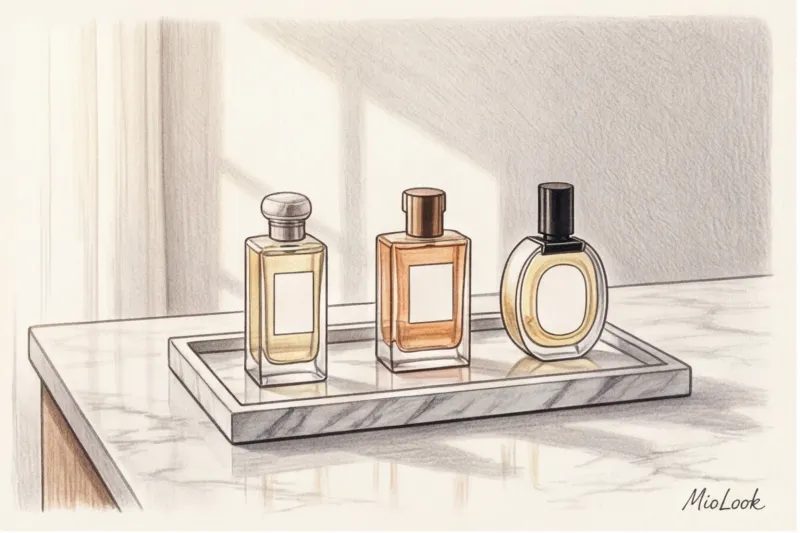
Invest in quality. It's better to buy three bottles of niche or high-quality luxury perfume than ten cheap generics. Budget perfumes (under $30) often suffer from a "flat base"—the top notes are strong for the first 10 minutes to sell you the bottle, but after an hour, a vague scent of cheap musk and laundry detergent lingers on your skin.
Your perfect look starts here
Join thousands of users who look flawless every day with MioLook. Organize your wardrobe mindfully.
Get access — €0.99 onceInstructions: How to assemble a perfume capsule from scratch without spending extra money
During shopping assistance, I provide clients with a strict algorithm that prevents them from impulsively buying new items pushed on them by consultants. Here's how we work.
Step 1: Hard Audit
Take out all your bottles. Ruthlessly discard anything that has changed color, become cloudy, or smells like rancid oil (a sure sign of oxidation). Give away to friends the fragrances you bought in a fit of passion and haven't worn in over a year. Keep only what truly resonates with your current self. capsule wardrobe.
Step 2: Synchronize with invoices
Analyze your closet. What do you have in abundance? If it's smooth fabrics, office shirts, and structured jackets, you'll want cool, crisp scents (citrus, vetiver, tea notes). If your wardrobe is based on chunky knits, soft suede, and relaxed silhouettes, look for woody, powdery, and spicy compositions.
Step 3: The "Three Approaches" Rule
Never buy a fragrance the day you first encounter it. Boutique consultants know how top notes work—they're designed for instant seduction. My testing algorithm:
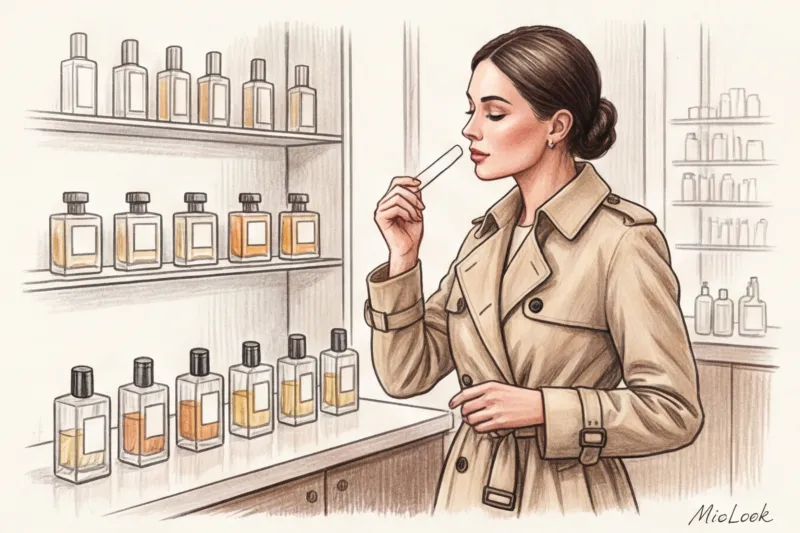
- Approach 1: Apply the scent to the blotter. Label it. Take it home.
- Approach 2: If you still like the base on paper the next day, go back to the store and spray the fragrance on your wrist.
- Approach 3: Live with it for eight hours. Listen to how it sounds in warmth, in the cold, after a cup of coffee. Does it give you a headache? Only if the test is successful should we go to the checkout.
Checklist: Is your olfactory wardrobe ready?
To determine if you've built a working database, ask yourself these 5 self-assessment questions:
- Do I have a neutral scent I can wear to a morning business meeting or on a plane without irritating others?
- Do I have a status perfume that makes me feel confident at an evening event?
- Should I use unscented (or neutral scented) deodorant so it doesn't clash with my perfume?
- Am I storing the bottles properly (in a dark cupboard, away from radiators and bathroom humidity)?
- Do I understand which scent smells better on my wool turtleneck and which on my cotton shirt?
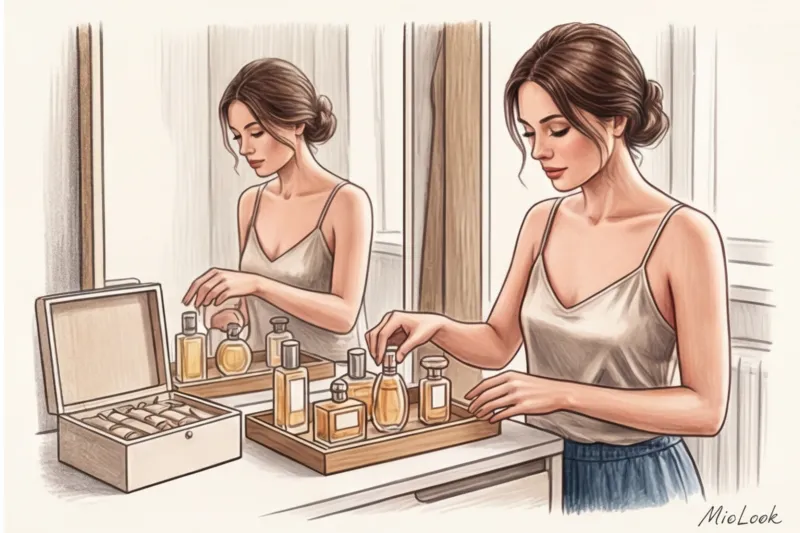
Perfume isn't a way to mask body odor or a way to announce yourself to the entire subway car. It's the final, invisible stitch that brings your look together. Treat it with the same respect you would the cut of your favorite jacket, and you'll notice how the way others perceive your style changes.