What is layering in clothing and why is it a stylist's main tool?
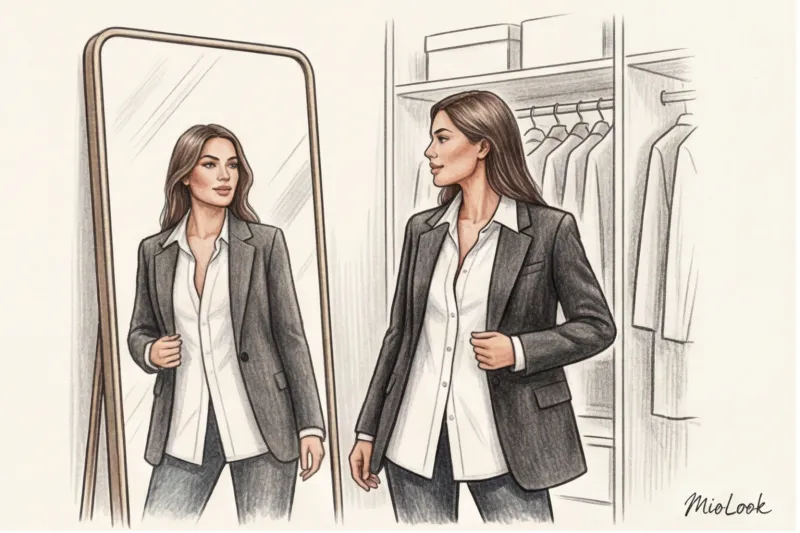
Have you ever noticed how the same basic white shirt looks like boring office attire on one person, but a statement of impeccable taste on another? The difference is rarely hidden in the price of the item itself (a good poplin shirt for €40 and one for €250 often looks similar). The secret is in what's happening around this shirt. Over the years of working in fashion journalism and personal styling, I've come to the conclusion: layering in clothing — this is the very dividing line that separates a simply “dressed” woman from a woman with an individual, meaningful style.
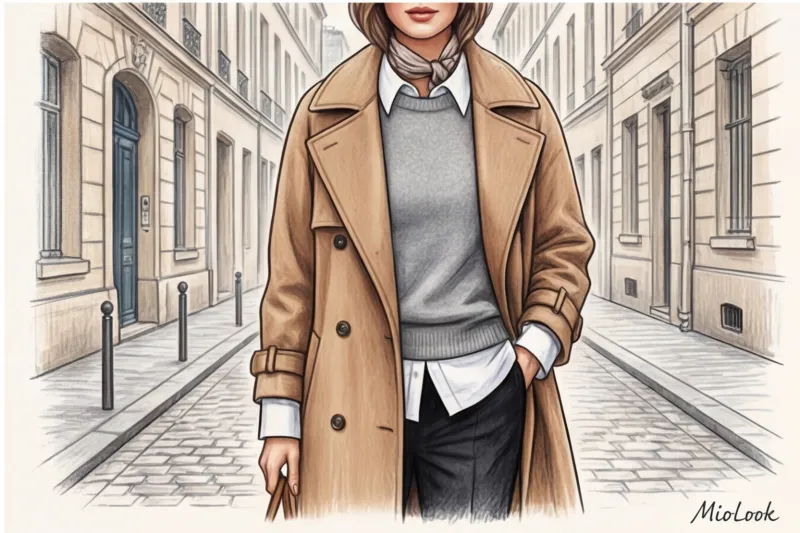
Historically, layering served a purely utilitarian purpose—to protect against the cold and biting wind. But today, warmth has faded into the background, giving way to pure aesthetics. Layering has evolved from utility to art, becoming a key stylistic device of the modern era. We no longer wear a cardigan under a jacket simply to stay warm. We do it to create depth, character, and structure in our look. As analysts at trend bureau WGSN (2024) note, layering allows us to convey our personality's complexity through the visual language of our wardrobe, responding to the demand for intelligent fashion.
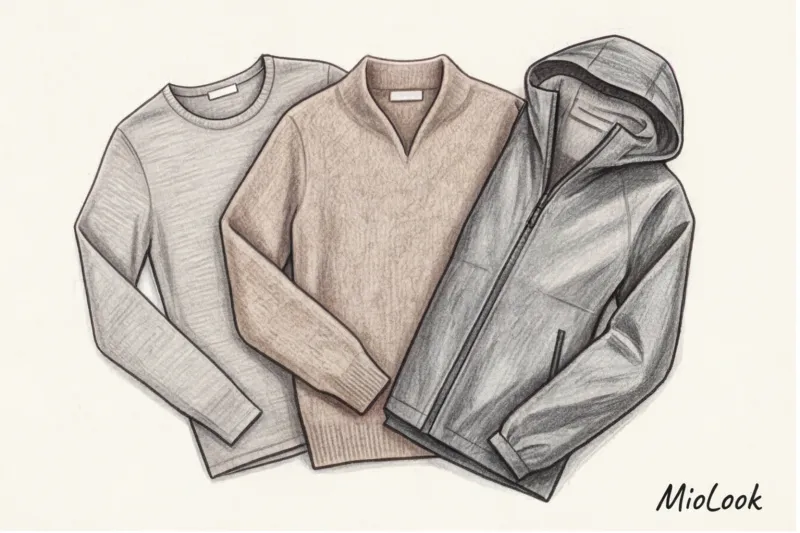
The anatomy of a complex image is based on the psychology of our visual perception: the human eye is lazy, but curious. When we look at a monolithic color (for example, a plain black knit maxi dress), our gaze quickly slides down the figure and immediately loses interest. Why is the eye more interested in “reading” textures? Because our brains enjoy solving puzzles. The sudden clash of smooth silk, fluffy mohair, and crisp matte leather physically captures the viewer's attention. If you've ever tried combine a hoodie with a jacket , you know exactly what I mean: the contrast between the sporty fleece and the formal wool suit creates that very visual dynamic that you can’t get from just one item.
"The secret to a perfect look lies not in the garments themselves, but in the boundaries of their interaction. The way one material is layered on another creates true couture in everyday life."
When working with clients' wardrobes, I often encounter a common misconception: many think layering necessarily means heavy, voluminous pieces layered on top of each other, like a "cabbage" style. In fact, the concept of "micro-layering" reigns supreme in contemporary styling. During Paris Fashion Week, while analyzing the Miu Miu shows, I observed a brilliant stunt by Miuccia Prada. She literally reimagined the idea of layering, turning casually exposed elastic waistbands, the hems of basic T-shirts, and thin collars into a standalone, bold trend.
Micro-layering is when only 2 centimeters of a contrasting cuff or a narrow strip of cotton collar are visible under a voluminous jumper, but they make all the difference. They break up the silhouette, add a casual chic touch, and serve as the perfect color bridge. Even when deciding, How to wear a scarf with a down jacket , we operate precisely on these visible edges of the tissue.
These millimeters act like a mat for a painting: they bring the image together and make it look many times more valuable. To avoid getting lost in your layers and wasting hours on morning fittings, I recommend digitizing your base. You can use smart wardrobe feature in MioLook This allows you to see in advance on your smartphone screen how the collar of a particular blouse will look under the neckline of your favorite sweater, finding that perfect proportion without having to change clothes.
Style Architecture: 3 Fundamental Rules for a Layered Look
At the Paris Institute of Fashion, we were taught the strict physics of fabrics during our design lectures. And it's this physics—not just blindly following trends—that underlies proper styling. Industry professionals use an important technical metric: GSM (Grams per Square Meter, the density of a material). Understanding this principle will forever save you from making unsuccessful combinations.
Why does thin, flowing silk work flawlessly under heavy, textured wool, while fine merino knits worn over dense, starched cotton look sloppy? The answer lies in the strict hierarchy of materials: the outer layer should always "support" the inner layer, not cling to its folds and fittings. If you wear a low-weight jumper over a stiff base shirt, the buttons, collar, and seams of the underlayer will inevitably show through in lumps. This instantly cheapens the look. The gold standard of style architecture: with each layer removed from the body, the density, stiffness, or volume of the fabric should increase.
The Rule of Textures: The Law of Contrast
One of the most common mistakes I see on the street is trying to layer identical materials. A cotton T-shirt under a cotton shirt, worn with cotton pants, turns you into a flat blob. There's simply nothing for the eye to notice.
The secret to luxurious layering is the controlled clash of opposites. Combine matte with glossy, smooth with fluffy, rough with delicate. This contrast is the foundation of The Row and Prada collections. When you juxtapose seemingly incompatible surfaces in a single look, you create visual depth.
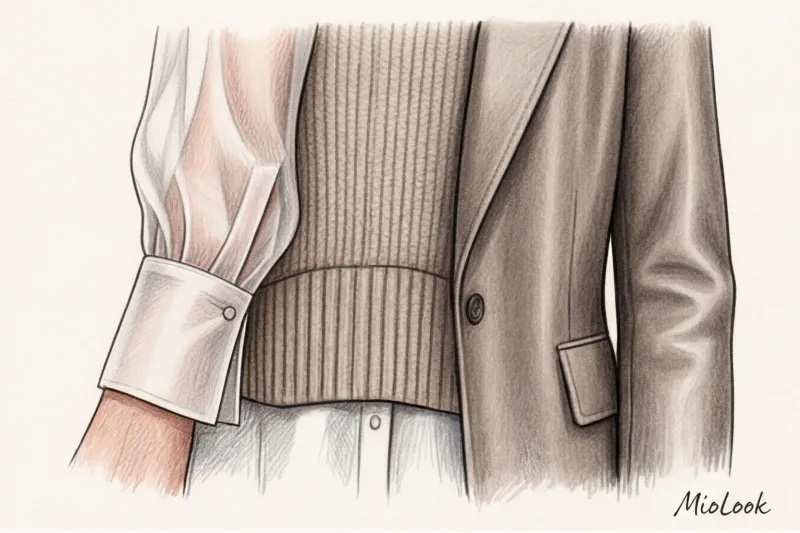
In my practice, I've seen examples of perfect pairings that work like clockwork on any body type: rugged leather and weightless chiffon, cozy fluffy cashmere and flowing smooth silk, thick vintage denim and delicate French lace. Even if your overall budget for the look is a modest €150-200, a clever play of these textures will make the outfit look far more expensive than it actually is.
Access to MioLook for €0.99 — one-time payment
A smart AI stylist will select the perfect look based on your measurements and the items in your wardrobe.
Get access — €0.99 oncePlaying with Lengths: Creating the Right Proportions
Layering is pointless if the hems of your clothes all end at the same length. If your sweater, shirt underneath, and jacket on top are all the same length, you'll create a "roll" effect on your hips, which will visually add a few extra sizes. To avoid this, we use the "ladder rule": each successive layer should be a different length than the previous one.
This principle is easy to scale. You can use the "crop over long" technique—for example, layer a cropped, heavy sweatshirt over a long men's shirt. Or, conversely, hide a "midi under a maxi," with the hem of a silk midi skirt peeking out intriguingly from under a heavy wool maxi coat as you move.
"Perfect layering is never symmetrical. Symmetry makes a look static and boring, while a touch of casualness brings life to it."
Asymmetry here acts as a powerful corrective tool and a way to balance the silhouette. Use a French tuck, tucking the edge of your shirt into the waistband on only one side, or leave the bottom button of your cardigan unbuttoned to allow the fabric to flow in diagonal lines. These diagonals break up the horizontal volume and visually elongate the figure.
Color harmony: gradient or color block
There are two ways to work with color in complex looks: through dramatic color blocking or through delicate shade stretching. For beginners, I always recommend starting with the color "sandwich rule." This is a stylistic technique in which we duplicate shades in different layers to create visual connections. For example: a white T-shirt near the face (the top layer of the "sandwich"), a gray oversized cardigan, blue jeans, and white sneakers (the bottom layer of the "sandwich"). The white color resonates on different levels, and the brain perceives this image as harmonious and complete.
If you find it difficult to keep all these nuances in mind when getting ready in the morning, try image selection function in MioLook It's a great way to practice your visual acuity and lets you see how colors will play out between layers before you even open the closet.
A unique chic is a monochrome layering (a total look). Many are afraid to dress entirely in black, beige, or gray, fearing they'll look bland. And this is true if all the pieces have the same texture. But monochrome becomes a work of art thanks to the varying textures. A black patent leather bag, a black chunky alpaca sweater, black matte wool suit pants, and black suede ankle boots are four different shades of black due to the different ways these materials refract light. This gradient creates a true, quiet luxury.
A basic wardrobe as a foundation for layering
A paradox I encounter in every other consultation: women buy designer statement pieces in the hopes of looking stylish, but end up complaining every day that they have absolutely "nothing to wear." Last month, I audited the wardrobe of a private gallery owner. We pulled out dozens of luxurious jackets, ruffled blouses, and textured coats (many with price tags well over €500), but she was physically unable to create a single, trendy, layered look from them.
The reason was trivial: a complete lack of quality transition layers. Most women can't create that coveted layering look because they lack seemingly boring connecting pieces—the right vests and thin cardigans that tie their base layers and outerwear together.
Top 5 Ideal "Zero" Layers
A complex look always begins with a flawless canvas. Layer zero is the clothing that comes into direct contact with the body. Its main purpose is to define shape and provide comfort without drawing attention to itself. Over the years of styling, I've come up with the ultimate list of five essential items that must be in your closet:
- White poplin shirt: Forget soft linen or flowing silk at this stage. We need a stiff cotton poplin that holds its shape. This is what will give you that crisp collar, graphically peeking out from under the sweater, and the stiff cuffs.
- Turtleneck noodle: Ribbed knit fabric has the perfect amount of stretch. It should fit snugly to the body, allowing a silk shirt to slide easily over it, but still have a dense enough texture to be non-transparent.
- Basic T-shirt: Choose styles with a high cotton content and a density of at least 180–200 GSM. The collar should be round and tight to create a clear border when unbuttoned.
- Longsleeve: Essential for looks that require a playful sleeve length. I always recommend going a size up for long sleeves so the sleeves fall slightly to the wrists—it looks deliberately casual and very stylish when layered over a 3/4-length jacket.
- Body: A technical savior. When layering three items on top, it's crucial that the bottom layer doesn't bunch up at the waist or spill out of the pants every time you bend.
Mid-Layers: The Invisible Glue of Your Bow
If the "zero" layer is the foundation and the outerwear is the roof, then the mid-layers are the walls that hold the entire structure together. They create that sophisticated chic effect. According to research by the Pantone Color Institute, the human eye perceives an image as "expensive" precisely when it perceives complex texture transitions between the base and outerwear.
"Laying without a transition layer is like a sandwich without butter. You're just putting a slice of cheese on dry bread. It's the mid-layer that softens the contrast between a thin T-shirt and a heavy coat."
What works ideally as a transit?
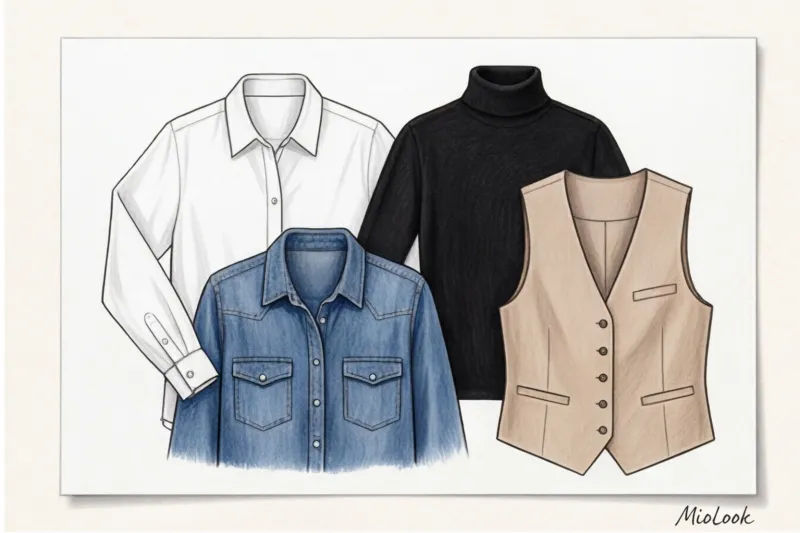
- Suit vests: An absolute must-have for the past few seasons. Worn over a shirt or long-sleeved top, they instantly sculpt the silhouette, adding a touch of formality.
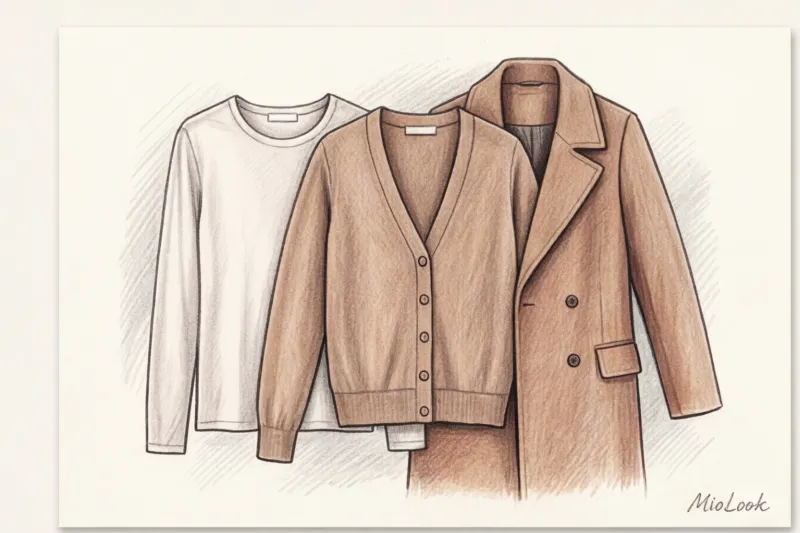
- Fine merino cardigans: Fastened with the two middle buttons over a T-shirt, they create a V-neck, visually elongating your neck before you put on the jacket.
- Thin denim jackets: My favorite cool-weather outfit: a thin, not too bulky denim jacket looks great under a classic wool coat or a loose trench coat, taking the edge off any overly formal look.
To avoid getting lost in endless combinations and to understand exactly which layers you're missing, I strongly recommend digitizing your base. If you upload your basic and transitional pieces to MioLook , the built-in smart algorithm will automatically suggest how to integrate a vest or turtleneck into a dozen different outfits, saving you from morning panic in front of the closet.
Integrating a capsule wardrobe into complex formulas
There's a myth that creating a variety of looks requires a huge wardrobe. In reality, smart layering is pure math. Let's see how 10 well-chosen pieces can create 30 different combinations.
Imagine you have three "zero" layers (a T-shirt, a turtleneck, a shirt), three transition layers (a vest, a cardigan, a denim jacket), two bottoms (jeans and classic wide-leg trousers), and two tops (a blazer and a coat). Because layers can be added together, the number of formulas grows exponentially.
Today you wear a T-shirt + vest + blazer + jeans (4 pieces, casual chic). Tomorrow: a turtleneck + shirt (3/4 unbuttoned) + coat + trousers (4 pieces, business aesthetic). The day after tomorrow: a T-shirt + denim jacket (buttoned) + coat + trousers (a mix of textures). The same basic capsule, filtered through the prism of layering, works with incredible effectiveness. Each new layer multiplies the potential of your closet by two, turning a standard base into a personal style builder.
Debunking the myths: why layering doesn't make you look fat, but slims you down
The most persistent stereotype I have to work with is the panicky fear of extra bulk. Almost every other client confidently declares at the first fitting, "Just don't put too many clothes on me, I'll look two sizes too big." And every time, I have to prove them wrong in practice.
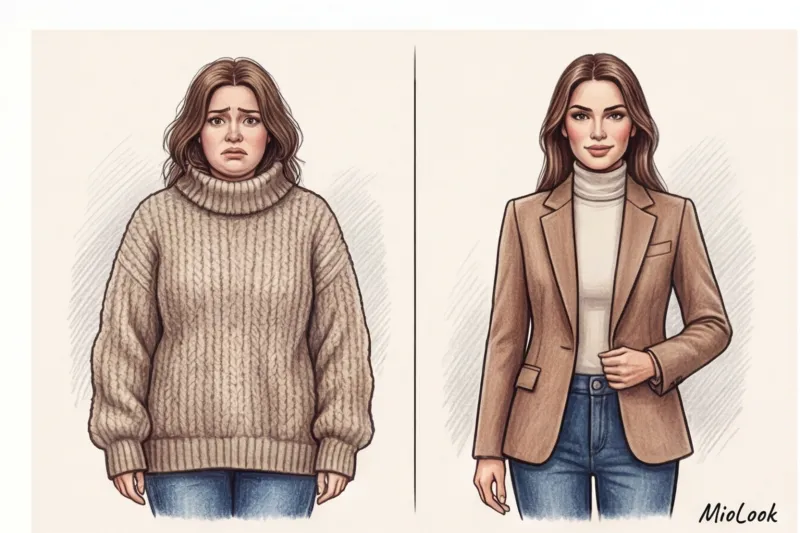
Here lies the main, absolutely counterintuitive insight Style architecture: layering three loose pieces in the right fabrics creates a slimmer and more graceful silhouette than a single tight sweater. When I was creating street style looks during New York Fashion Week, this trick was a lifesaver. A woman with curves in three layers (a silk top, a thin cashmere vest, and a structured menswear jacket) always looks lighter and more dynamic in photographs than a woman in just a bandage dress. Let's break down the physics of this process.
Air as the main corrective tool
The most fatal mistake when creating complex looks is the "everything is tight" rule. If you wear a tight viscose turtleneck and an equally tight, thin cardigan over it, you'll inevitably end up with a "caterpillar" effect. Thin knitwear with no gaps accentuates even the slightest contours of the body, creating telltale horizontal creases and shadows where there aren't any.
The golden rule of styling is: the base layer should have air between the body and the fabric When you choose a slightly loose cotton shirt (even a basic mass-market one for €40-50) instead of a tight-fitting top, you create a completely new contour. Clothing should reshape your figure, not act like a second skin, mercilessly revealing every wrinkle.
Optical illusion: the magic of an unzipped jacket
If you want to visually lose a few kilograms in one minute, you don’t need strict diets – you need geometry. The magic of an unzipped side - This is a powerful optical technique used by all professional stylists.
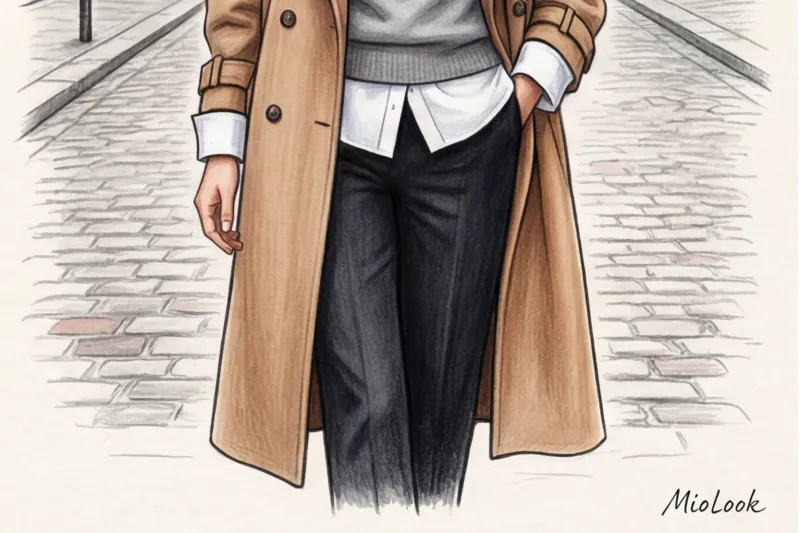
The mechanics of this technique are incredibly simple: when you wear a light-colored base layer and layer a dark blazer or coat over it without buttoning it, you create rigid frames. These vertical lines, created by jackets and cardigans, elongate your height and literally cut off your sides. The human eye perceives your width solely by the light center stripe. As a result, your silhouette appears 30% narrower than it actually is.
Attention Management: Adjusting Proportions
Layering is your personal control panel for someone else's gaze. It allows for precise shifting the emphasis away from the waist or hips with the right lengths You decide where your interlocutor will look.
- Concealing volume in the hips: Never end your top layer at the widest part of your figure. Use a longer base layer (for example, a white untucked shirt that covers your crotch) and a shorter transition layer (a tight crop vest that reaches your natural waist). The viewer's eye will automatically stop at your high waist, ignoring the fullness below.
- Creating a waist from scratch: If you have a rectangular body shape, wear a loose midi dress with a structured jacket over it, cinched with a wide leather belt. A quality belt will cost around €80–€120, but it will tie all the layers together, creating the illusion of a perfect hourglass figure.
Access to MioLook for €0.99 — one-time payment
Start creating perfect layered looks and adjusting your proportions with artificial intelligence. Upload your items, and the algorithm will suggest the most slimming combinations.
Get access — €0.99 onceAs Phoebe Philo once said during her time designing Céline collections, "Clothes should create space for a woman." Layering gives us precisely this safe space—the opportunity to conceal what we're not yet ready to reveal and to construct the ideal architecture of the body using only the laws of physics and texture.
Seasonal layering: from summer heat to winter frosts
Have you ever wondered how fashion editors and influencers survive the February street style craze, when temperatures drop to freezing and the dress code demands impeccable elegance? Watching the guests at the Grand Palais shows, I've long since figured out their strategy. Proper temperature regulation and style aren't just compatible—they work in tandem, if you understand the laws of fabric physics. Every woman's biggest fear in the cold season is looking clumsy and lumpy. But layering solves this problem by using high-tech materials instead of heavy, bulky wool.
The Parisian winter secret, which I actively incorporate into my clients' wardrobes, is micro-layering. The perfect winter look begins with ultra-thin thermal underwear. The legendary Uniqlo Heattech line and similar microfiber designs generate warmth by absorbing body moisture while remaining completely invisible. Over this "zero" layer, layer a super-fine cashmere jumper, followed by a lightweight down vest or a thin quilted jacket (a high-quality basic model can be found in the €50-€120 range). And only then do we throw on a classic, straight coat. This invisible architectural framework retains warmth three times more effectively than a single, thick, chunky knit sweater, keeping your silhouette graceful and delicate.
Summer Layering: Sheer and Airy
As the thermometer climbs, our goals change radically. While we spent winter conserving heat, in summer, layering is essential for ventilation and visual complexity. Research from the Textile Institute (2023) confirms that properly layering lightweight natural fabrics cools the body more effectively than completely exposed skin in the blazing sun.
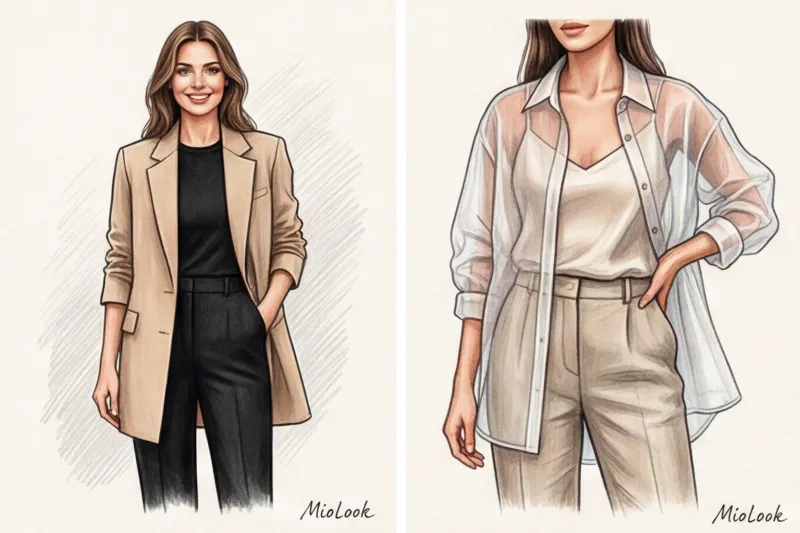
Summer looks are built on optical illusions and airiness. Make liberal use of mesh, stiff organza, crochet lace, and loose linen. My favorite styling trick for hot days, often cited in Prada collections, is an unbuttoned oversized shirt in translucent cotton or cambric, casually draped over a silk top with thin straps or a basic bra. This creates movement while walking and protects the shoulders from sunburn.
"The sheer layers act like filters on a camera lens—they don't hide the base, but rather change its hue and mood, adding cinematic depth to the look."
But what if it's too hot for extra layers? Layering accessories comes into play. If you have a simple "white tank top and linen shorts" formula, layered jewelry can save this boring duo. A combination of three or four thin chains of varying lengths, pendants, and a choker instantly elevates the look from a "going out to buy bread" to a well-thought-out urban outfit. To plan these subtle details in advance and avoid wasting time in front of the mirror in the morning, I create summer capsule collections through MioLook app The smart wardrobe feature allows you to visually layer a shirt over a top or try on fishnet fabric right on your smartphone screen.
Demi-season and winter: hidden layers
During transitional periods—fall and spring—hidden or transitional layers come to the fore. These are elements that are only partially visible, but they make an outfit complete. The most photogenic and easy-to-perform trick, which everyone should try, is the "shirt under a hoodie or sweater" technique.
The trick is in the meticulous attention to detail: the shirt should never disappear completely under the knitwear overlay. Pull out the stiff collar, unbutton and pull the extended cuffs 3-4 centimeters over the sweater sleeves, and be sure to leave some of the hem visible. These contrasting splashes of smooth poplin against a soft fleece or wool background instantly bring together a relaxed look, adding a crisp, graphic quality.
Another classic mid-season look is a structured jacket under a coat or a classic trench coat. However, this poses a serious technical pitfall: ignoring fit allowance. You can't squeeze a double-breasted blazer in a heavy suiting fabric under a slim, tailored mid-season coat. For this complex look to work, the outerwear must have dropped shoulders and at least 5-7 centimeters of room around the chest and armholes. Otherwise, the fabric will bunch up unattractively, leaving you feeling like you're wearing armor. Proper layering always leaves air between the layers—this invisible layer acts as your personal thermostat and guarantees freedom of movement.
Office Dress Code and Layering: Status Without Breaking the Rules
A 2014 Yale University study on the psychology of clothing confirmed a curious pattern: participants subconsciously attributed higher levels of competence, leadership qualities, and creative intelligence to people whose clothing had a complex structure. As a fashion journalist and practicing stylist, I see evidence of this in every meeting with my executive clients.
A crisp gray suit with a basic cotton shirt conveys the message: "I'm a good performer who follows the rules." But add the right architectural touches—for example, by letting out the cuffs or wearing a silk turtleneck under the jacket, not just a shirt, but a suit vest—and the look instantly begins to convey high social status and expertise. Complex, multi-component outfits draw the eye of the interviewer. Subconsciously, such detailing is interpreted as a sign of an analytical mind: if a person is capable of such masterful manipulation of textures, then they are also a master of business processes.
However, fitting complex looks into the strict confines of a corporate environment is a challenge. Smart casual doesn't tolerate bohemian relaxation. The main rule for office layering is rigid structure and a perfect fit. Color discipline plays a huge role in business layering. While in street style we can mix contrasting neon blocks, in the office, status is achieved through tonal composition. Try creating a look in shades. taupe (taupe): a dark gray skirt, a cappuccino cashmere turtleneck, a graphite vest, and a beige checkered jacket. The contrasting textures in similar shades is the pinnacle of corporate styling.
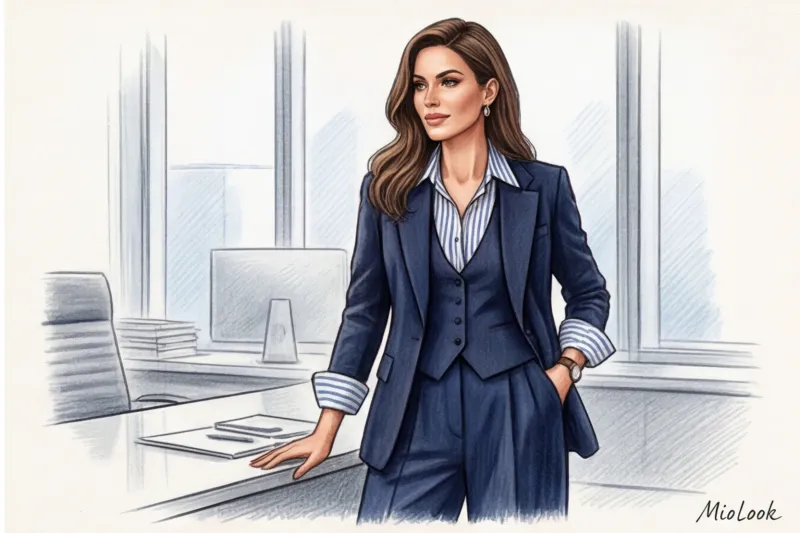
Suit vests have become a true lifesaver for the work wardrobe. In recent seasons, they've gone from a microtrend to a solid staple. They're the perfect transitional piece. You can wear a heavy wool suit vest (excellent basic models are now readily available in the €70-€120 price range) over a tailored shirt, then layer a blazer over it. In offices with powerful radiators, a vest works brilliantly as a standalone top: remove the jacket, and you'll still be formally attired. Important: choose styles with an adjustable tab at the back to control the fit and avoid creating a visual ruffle at the waist.
Your ideal image
it begins Here
Join thousands of users who look flawless every day with MioLook.
Get access — €0.99 onceAnother less obvious but incredibly effective technique is a sweater draped over a jacket. This is the quintessential "old money" aesthetic, perfectly adapted for the office. You take a sharp, structured menswear-style jacket and soften its formality with a thin cashmere sweater, the sleeves casually knotted at the chest. This stylistic maneuver does three things at once: it protects against drafts in the air conditioning, replaces a scarf when going outside, and creates an aura of relaxed confidence. You look like you're planning a country club brunch between meetings.
To be fair, I'll point out an important caveat: the technique of wearing a sweater on your shoulders visually widens your upper body. If you have a full bust or broad shoulders, this trick can throw off your figure's proportions. In such cases, it's better to shift layered accents downwards. To avoid wasting your morning time calculating proportions, I strongly recommend putting together your office capsule outfits in advance. By digitizing your business suits, you can use Smart wardrobe at MioLook This allows you to test new combinations of vests, jackets, and jumpers right on your smartphone screen in just a few minutes, saving your best looks for important work meetings.
Masterclass from a stylist: 5 ready-made formulas that are easy to repeat
A professional stylist's work on a commercial shoot is rarely a chaotic flight of inspiration. In 90% of cases, we use rigorous visual math and proven algorithms that guarantee stylish results. To avoid reinventing the wheel every morning, mastering a few basic techniques is sufficient.
Below are five workflows I regularly compile for my clients. To avoid having to keep these workflows in your head, I recommend digitizing your database in MioLook: the app will automatically start generating similar layered looks for you from the items you already have in your closet.
Formula 1: T-shirt + unbuttoned shirt + loose jacket
An absolute classic of urban casual, where vertical lines play the main role. A basic cotton T-shirt with a minimum weight of 180 GSM sets the tone. An unbuttoned shirt (heavy poplin or flannel work well) is worn over it, and a men's-style blazer completes the look. Two parallel lines formed by the open shirt against the light T-shirt visually trim the sides and elongate the silhouette.
Formula 2: Turtleneck + thick shirt (buttoned halfway) + coat
A favorite technique of creative directors during the minimalist era. A thin, merino wool turtleneck clings to the body, acting as a heat shield. Layer it over a denim or heavy cotton shirt (you can find excellent options from Scandinavian brands in the €80–€120 range). The key: button the shirt exactly to the middle of the chest, leaving the top open to reveal the turtleneck. The final layer is a structured wool coat.
One of the cardinal rules of styling is: the deeper you go with layering, the more control you need to have over the fit of the pieces. A loose cuff or a slouched collar ruins the entire look.
Pro sleeve trick: How can you ensure your shirt cuffs stick out from under your jacket or coat by the perfect 1.5–2 cm all day long? Backstage at fashion shows, we use armbands (special metal or fabric elastic bands for securing sleeves). You place the elastic band on your forearm over the shirt sleeve, pull the fabric up to create a drape, secure the cuff to the desired length, and then cover the cuff with the sleeve of the top layer. No slipping fabric or constant tugging.
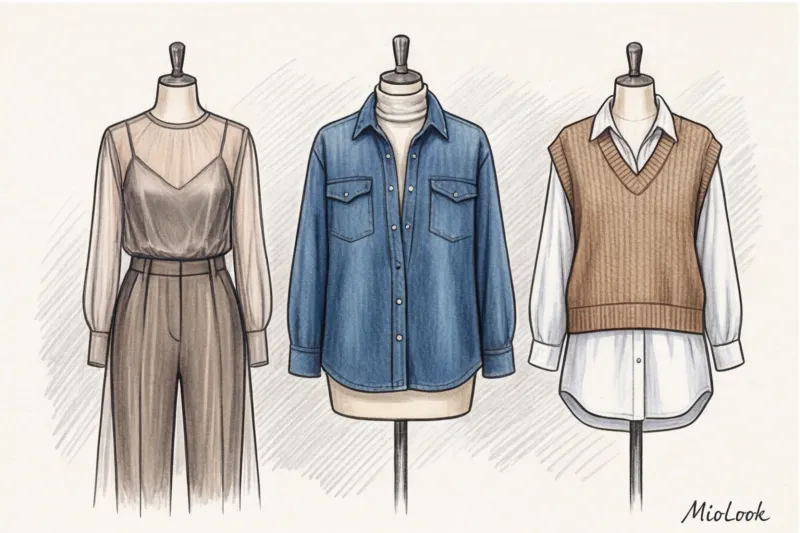
Formula 3: Slip dress + oversized sweater (with a belt) + Cossack boots
A masterpiece of contrasting textures: flowing silk meets coarse knit and rugged leather shoes. To prevent a sweater from turning your figure into a shapeless box, use the hidden belt technique. Place a thin leather belt over the dress at waist level, drape the sweater over it, and carefully tuck the hem under the belt (French tuck). This will maintain proportions while shortening the sweater without adding excess bulk at the hips.
Formula 4: Blouse with active collar/bow + V-neck jumper + blazer
An intelligent aesthetic that evokes preppy style and the Miu Miu shows. The V-neck of the jumper (cashmere or heavy cotton) serves as the perfect frame for the blouse's statement collar—be it sharp '70s-style angles or a voluminous bow. The blazer ties the look together, preventing it from becoming too childish. It's important that the colors of the jumper and blazer be in the same color range.
Formula 5 (Trend): Midi/maxi dress + straight jeans or trousers
A trend from the 2000s is making a comeback, but with a more elegant, Scandinavian twist. A shirtdress or a knit dress with a high slit is perfect for this look. The key is to unbutton the dress from the waist down, revealing straight-leg trousers or denim in the perfect shade of blue. This not only adds a sophisticated geometric touch to the look but also allows you to wear your favorite summer dresses in cooler weather while maintaining total comfort while moving.
The main mistakes beginners make when creating multi-layered bows
Recently, the research department of the London agency WGSN (2024) published a curious report: it found that the main reason why customers reject trendy oversized items isn't the cut, but rather basic discomfort when styling them. Women buy a great blazer in the €150-€300 price range, wear it over a thick jumper, feel uncomfortable, and return the item. This brings us to the most important aspect: safety precautions when constructing complex outfits.
The first and most insidious enemy of the correct silhouette is the armhole of the top layer is too narrow If a basic garment fits too tightly, you're guaranteed to get untidy creases and shoulder discomfort when trying to wear anything thicker than a T-shirt underneath. When I assisted on commercial campaign shoots, our lead stylist always had the models cross their arms during fittings. If a jacket sleeve wrinkled or pulled at the back, the underlayer was ruthlessly replaced. Remember: the armhole of a jacket, trench coat, or coat should always have some air (at least 3-4 centimeters of extra volume) to accommodate the sleeve of a shirt or cardigan without creating a sausage-like effect.
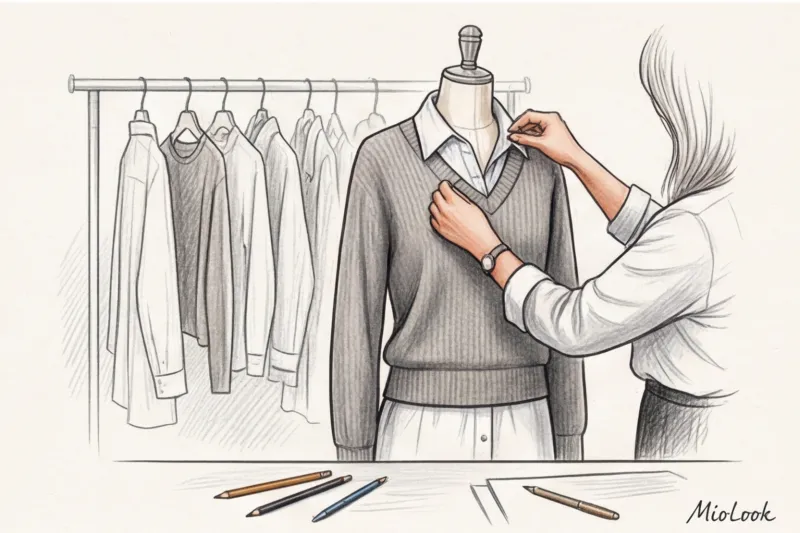
The second trap that newbies regularly fall into is violation of temperature regime (Or trying to wear a warm layer under a lighter one). The physics of fabrics doesn't forgive ignoring gravity. If you wear a bulky, chunky-knit wool sweater under a thin spring coat or a flowing viscose jacket, the top layer will stretch unattractively over the textured base, revealing every knitted bulge. The outer layer should always be denser, stiffer, and visually "heavier" than the inner layer. There are exceptions (for example, deliberately sheer organza over a heavy top), but for a base layer, this rule works without fail.
The third flaw is lack of contrast , which causes textures to merge into a single, shapeless blur. Imagine wearing a matte cotton turtleneck, a matte flannel shirt over it, and then a matte drape jacket. The result? Layering loses all meaning, as the look appears flat, like a cardboard cutout. The human eye craves dynamism and focal points. Be sure to contrast surfaces: matte with glossy (wool and smooth leather), smooth with fluffy (silk and mohair).
The fourth mistake lies in print overload In an effort to complicate an outfit, it's easy to slip into carnivalesque. Yes, the brilliant designer Dries Van Noten masterfully layers plaid with floral patterns, but for everyday wear, the strict rule is "one bold print per look." If your blazer is a vibrant houndstooth or bold stripe, keep the shirt and inner top plain.
Self-checklist before leaving home
I always ask my clients to perform a mandatory two-step test of their assembled kit before they walk out the door.
- Ride comfort test: Raise your arms, take a deep breath, and bend over to grab an imaginary bag. If your armholes are digging into your armpits, your waist buttons are threatening to come off, and your collar is choking your neck, remove a layer. No amount of visual aesthetics can justify stiff body language.
- Visual Balance Test: Take a full-length mirror selfie without posing (the camera is more objective than our eyes). Check: is the difference in length visible? Are the contrasting horizontal lines at the widest part of your hips distorting your proportions?
To make this analytical process easier, I strongly recommend digitizing your belongings. By uploading the database to the "smart wardrobe" feature of the MioLook app , you can virtually layer items on top of each other and identify texture or print clashes before you even take them off the hanger.
In closing, I want to emphasize the most important thing: creating complex silhouettes isn't a math test where you have to incorporate as many variables as possible. Start with two layers. Later, add a textured belt or a sweater draped over your shoulders as a third element. Practice, photograph your successful formulas, and wear what makes you feel absolutely comfortable. After all, the most beautiful finishing touch to any layered look is your confidence.
Guide Chapters
Combining Textures in Clothing: The Rules of Layering
In the age of screens, our bodies are hungry for touch. Learn how to masterfully combine silk, leather, and wool to create deep, layered looks.
Layered Office Looks: A Fun Dress Code
Tired of boring gray suits? Learn how to break the corporate dress code with micro-layering and always look classy.
How to Wear a Corset Over a Shirt: The Layering Trend
Corsets and bras worn over clothing aren't about seduction, but rather complex architecture. We explore the powerful stylistic technique of unconventional layering.
Wearing a Sweater Over a Dress: Secrets to a Perfect Silhouette
Want to wear a sweater over your favorite dress but worried about looking bulky? We'll explore the rules for combining textures and lengths to create a stylish silhouette.
Layering for Petite Women: Elongating Your Silhouette
We're busting the stereotype that petite women shouldn't add volume. We're revealing the secrets of optical illusions that will make you look taller.
Layering in Summer: How to Beat the Heat in Style
We're busting the myth that you need to wear minimal clothing in hot weather. Learn how to use the right fabrics to create stylish layered looks that will keep you cool and fresh.
What to Wear Over a White Shirt: Layering Secrets
A basic white shirt can be the foundation of a stylish layered look if you choose the right fabrics. Learn the engineered approach to creating looks.
What to Wear with a Women's Vest: Layering Guidelines
A vest is the key to a stylish layered wardrobe. We explore the architecture of the perfect look and the stylist's golden rule of three layers.
What to wear with a turtleneck for women: the secrets of layering
A thin, basic turtleneck is the perfect "zero layer" for stylish silhouettes. We'll explore 10 layering ideas that won't add bulk.
Layered Winter Looks: How to Avoid Looking Bulky
How to create a stylish winter wardrobe without looking like a snowman. We explore the rules of smart layering for the changeable urban winter.
Layering for Plus Size Women: How to Avoid Adding Volume
Worried that extra layers will make you look wider? Discover a stylist's secrets to help you visually drop a few sizes without dieting.
The Third Layer Rule: The Secret to a Luxury Look
How can you transform a boring basic wardrobe into a statement outfit with just one piece? We explore the architecture of a stylish look and the secrets of stylists.