A New Era of Styling: How AI Changed the Fashion Game
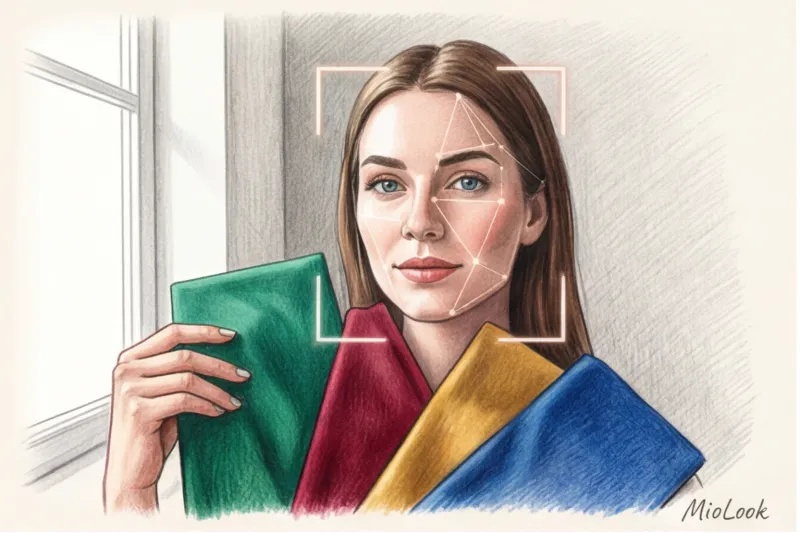
At the last fashion-tech exhibition in Paris, I witnessed a scene that finally convinced me: classic styling will never be the same again. A woman stood in front of a smart mirror, and exactly two seconds later, the system gave her a detailed report—from her body geometry to her personalized palette of harmony. Determine color type from a photo using a neural network capable of doing it faster and, more importantly, more objectively than an experienced colorist with a set of drapery fabrics.
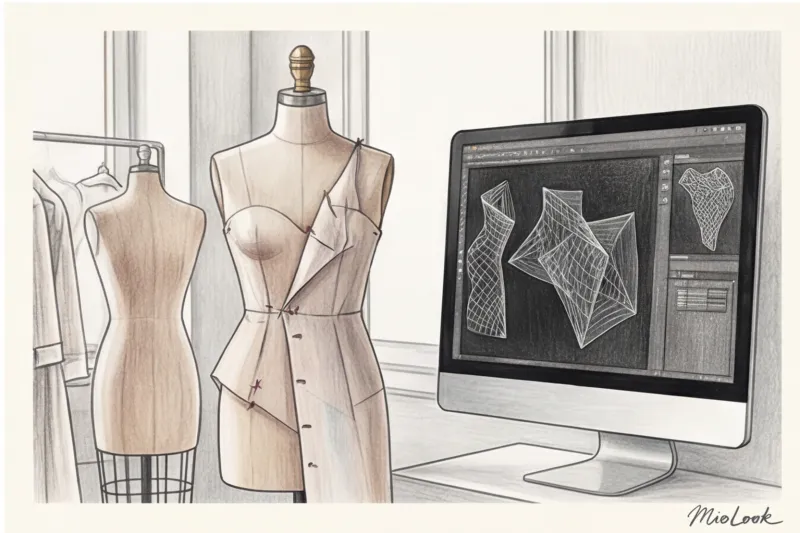
How did the industry get to this point? Think back to 1947. Christian Dior dictated the strict silhouettes of his famous New Look to women. Tailors measured waists with tape measures, physically adjusting each client to a single, couturier-approved standard. For decades, personal style remained hostage to the designer's subjective vision. Today, the paradigm has shifted: we've moved from rigid guidelines to machine learning algorithms. Fashion has become data-centric, focusing on the unique parameters of each individual.
At the heart of this quiet revolution is computer vision technology. How exactly does artificial intelligence "see" us? To a neural network, you're not just "a woman with light-brown hair and an hourglass figure." The algorithm scans a person like a complex mathematical matrix. It builds a map from hundreds of body control points, calculating hexadecimal (HEX) values for skin tone, sclera color, and hair-eye contrast. No guesswork or stereotypes.
"We no longer try to fit a woman into a preconceived trend. Using AI, we take her natural features as a basis and build a wardrobe around mathematically precise geometry." This insight from the recent Vogue Business summit perfectly captures the essence of the new approach.
Over my 10 years in fashion journalism, I've personally witnessed this tectonic shift: from lengthy fitting sessions with pins to instant 3D scanning and AI mapping. This is why the world's leading fashion houses and progressive personal stylists are making neural networks part of their daily routines. Brands as large as the LVMH conglomerate are investing colossal budgets (developing their own AI modules for precise fit costs upwards of €500,000) because the machine eliminates cognitive biases. The algorithm doesn't tire by the end of the workday and doesn't confuse warm undertones with cool ones due to the yellow light in the studio. Studying color correction of the figure , professionals now rely on precise data vectors rather than just intuition.
But most importantly, these technologies have finally emerged from closed corporate labs. A striking example of this democratization of styling is the app MioLook This is a complete integration of in-depth appearance analysis and intelligent personal style management. After uploading a photo, the system mathematically calculates your ideal capsule wardrobe. It automatically filters out items that would distort proportions or clash with your natural color scheme. Knowing your "digital code" allows you to accurately select clothes to suit any requirement, whether it's a strict dress code for a business meeting or a more relaxed look. Clean girl style colors for the weekend.
How does the algorithm work? A neural network can determine a person's color type from a photo in seconds, but what's the secret?
When one of my clients—an architect with stunning porcelain skin and ash-blond hair—sent me the results of her recent color typing with a novice stylist, I was genuinely surprised. The woman, with a pronounced cool undertone, was classified as a "Warm Spring" client simply because she was wearing a mustard turtleneck during the consultation, which cast a yellow tint on her chin. This is a classic cognitive bias: the human eye is deceived by context, lighting, and even personal preferences for certain shades. Today, to Determine color type from a photo using a neural network It takes literally fractions of a second, but behind this speed lies a rejection of human subjectivity in favor of pure mathematics.
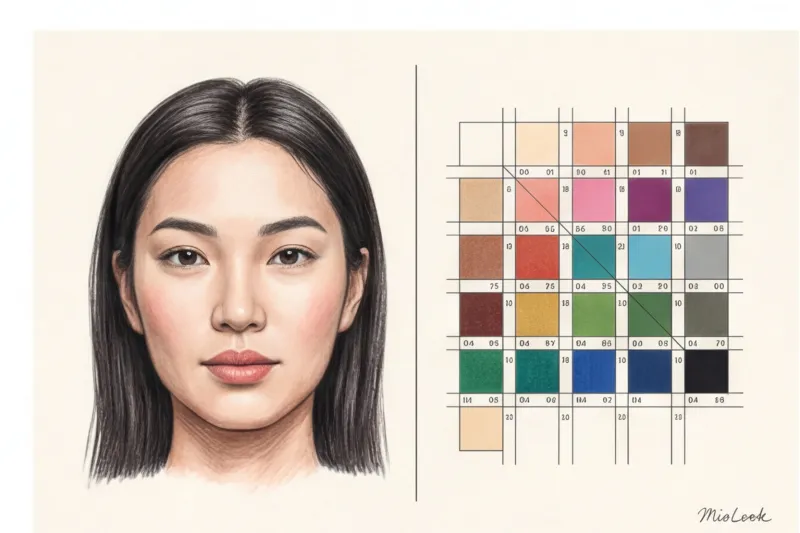
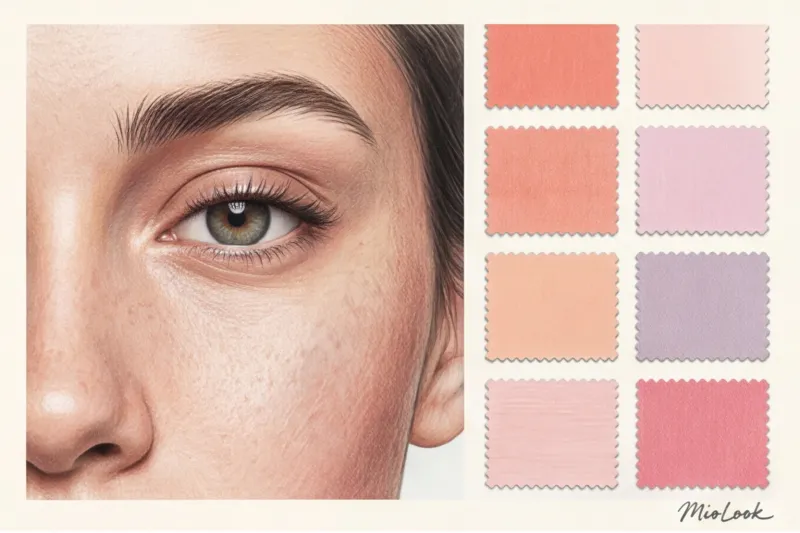
At the heart of AI lies a remarkable synthesis of fashion history and programming. Back in the 1940s, color theorist Suzanne Caygill first linked human pigmentation to the seasons of nature, drawing on Albert Munsell's rigorous colorimetric system. Munsell described any color using three vectors: hue, value, and chroma. Modern algorithms take this legacy and translate it into digital code. To a machine, your seasonal type no longer sounds like a poetic "soft autumn." A neural network sees an array of hexadecimal (HEX) values. For example, your blush is a specific code #F5D0C5, not "peach with a pink tint."
To eliminate errors, the algorithm applies a technical principle pixel sampling The machine doesn't view your face as a single object. It applies a virtual grid to your forehead, cheeks, chin, and neck, randomly capturing tens of thousands of microscopic dots. This process automatically excludes areas with shadows, highlights, or visible makeup. By analyzing these pure pixels, the algorithm calculates the exact percentage of yellow (warm) and blue-pink (cool) pigments in your skin's undertone.
The next, no less important step is contrast analysis. Computer vision calculates the mathematical difference (delta) between the brightness of the sclera (the white of the eye), iris, skin tone, and hairline. This isn't an intuitive "you look bright." It's a precise measurement of the amplitude of light and shadow on a scale from 0 to 100. If the difference between the snow-white sclera and the pitch-black iris is maximal, the algorithm assigns you a high contrast index, which directly influences which prints and color-block combinations will suit you.
"The human eye can distinguish millions of shades, but our brain, to save energy, instantly averages them and matches them to familiar patterns. Machine vision knows no laziness—it reads every pixel individually," researchers noted at the 2023 Pantone Color Institute Symposium.
That's why AI is more accurate than the subjective opinion of a friend or even an inexperienced stylist. The machine is impartial: if your pixels are 68% cool, you'll be classified as cool, even if you've been tanned by the sea and consider yourself "golden." A traditional in-person beauty analysis with a top stylist using test drapes will cost you between €150 and €400, while the algorithm delivers the same mathematical accuracy almost instantly.
Access to MioLook for €0.99 — one-time payment
Harness the power of machine learning algorithms to accurately analyze your appearance and create a capsule wardrobe that perfectly coordinates your every item.
Get access — €0.99 onceAI's Blind Spot: Why Smartphone Cameras 'Lie' to Neural Networks
Despite their computing power, algorithms have their Achilles' heel, and it lies in the devices we use to take photos. Over 12 years of working on fashion shoots, I've learned the most important rule: light and lens are everything. The number one problem for AI is the automatic white balance in our phones.
Modern smartphones (especially the latest generations of iPhones and Android flagships) employ aggressive computational photography. As soon as you press the shutter button, the phone's processor artificially "enhances" your face: adding warmth to make you look healthier, lifting shadows, and smoothing textures. As a result, the camera destroys your true coloring even before the photo reaches the neural network. The analyzer receives not your face, but a retouched version from Apple or Samsung.
The second pitfall is light temperature, measured in Kelvin. The difference is dramatic: popular selfie ring lights often produce a harsh, cold light of around 5500–6000 Kelvin, washing out warm pigments. Office fluorescent lamps (around 4000 Kelvin) give skin a sickly greenish tint. And a gorgeous sunset (around 3000 Kelvin) will bathe even the coldest winter in gold. A neural network will faithfully process the pixels, but if you're exposed to the golden light of a sunset, it will classify you as a "warm" person due to the ambient lighting.
Finally, there are complex phenotypes that even advanced systems stumble over. Olive skin undertones are the most challenging to classify. This is a unique paradox in coloristics: olive skin has a distinct yellowish-green overtone (the visible surface layer), but also a cool, grayish undertone. Earlier generations of algorithms often got confused by this data, classifying such women as either autumn or winter. Only the most advanced AI models have learned to recognize this multi-layered nature by analyzing the depth of light absorption by the skin, not just the surface HEX code.
Body architecture: how neural networks read body type and proportions
Honestly, I've always been quietly infuriated by having to tell a mature, confident woman, "You know, your figure is shaped like a pear." Or an apple. Or an inverted triangle. Reducing the female body to associations with the supermarket fruit section isn't just outdated, it's downright ridiculous. Clothing is designed according to the laws of geometry, not agronomy. And this is where artificial intelligence has brought about a long-awaited revolution.
While Determine color type from a photo using a neural network Perhaps, while analyzing the pixels of the face and neck, working with the figure requires a completely different, spatial mathematics. Modern algorithms have abandoned fruit stereotypes forever. They have been replaced by precise vectors: the degree of linearity (sharpness of angles), the level of roundness (smoothness of curves), and the balance of lengths.
From a flat frame to a volumetric matrix
How does a flat photograph become a template? When you upload a photo, computer vision algorithms don't evaluate your entire silhouette. They construct a complex map from dozens of control points. The AI doesn't just capture the basics of "shoulders, waist, hips." It captures shoulder angle, hip height (high hip or low hip), lumbar arch, and even the muscle definition of your calves.
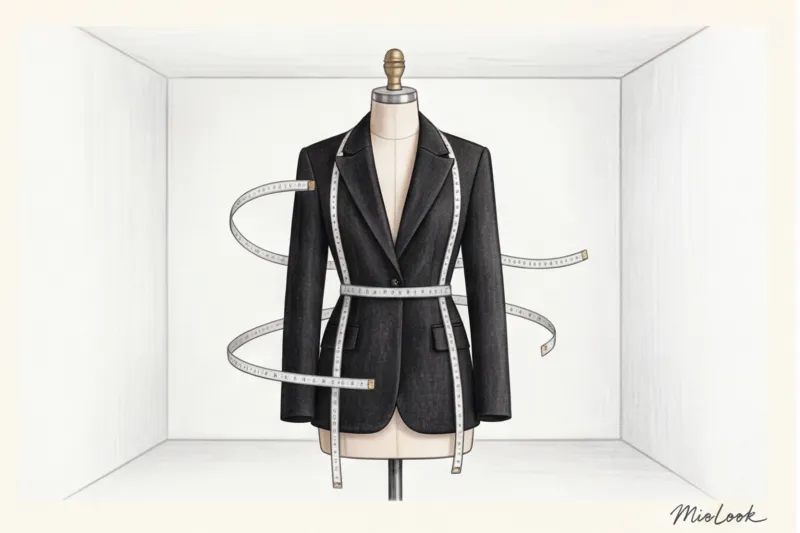
According to a 2023 study by the Fashion Institute of Technology, modern machine vision can translate 2D images into 3D geometry with up to 98% accuracy. The program constructs a virtual cylinder around you, calculating depth and volume where a camera lens sees only a flat surface.
Mathematics of the golden ratio in styling
All brilliant images are based on the golden ratio (1:1.618). The human eye often makes mistakes. We look in the mirror, see what we think is a wide waist, and try to hide it behind bulky sweaters. A machine, however, is devoid of emotion and inhibitions. It analyzes vertical and horizontal proportions mercilessly but objectively.
I had a telling case in my practice. A client purchased a trendy oversized jacket for €250, but it made her look bulky. The human eye of the stylist at the boutique missed a detail that AI would have spotted in a split second: the client's torso was elongated relative to her legs. The jacket disrupted the vertical balance (the 1/3 to 2/3 rule), visually "stealing" her height. In this situation, the algorithm would have instantly suggested a cropped silhouette or extremely high-waisted trousers to restore the Vitruvian harmony.
Digitized by David Kibbie: Bone Structure Analysis
But the most impressive thing is how AI has learned to recognize bone structure. In 1987, David Kibbee revolutionized the fashion world by proposing to classify facial features based on the balance of Yin (softness, roundness) and Yang (hardness, angularity). The problem with Kibbee's system has always been its subjectivity: each stylist interpreted this balance differently.
The neural network solves this problem with ingenious simplicity: it literally "scans" your skeleton. The algorithm ignores weight fluctuations and focuses on the framework: how blunt or sharp are the jaw angles, how wide is the shoulder girdle relative to the size of the hands, and the size of the joints. By separating bone structure from soft tissue, the AI accurately determines whether you need rigid, shape-holding fabrics (gabardine, heavy denim) or whether your architecture calls for fluid silk and drapes.
"The machine doesn't see extra pounds. It sees angles, lines, and directional vectors. It's the most body-positive tool ever created in the fashion industry."
This crystal-clear geometric logic forms the basis of modern fashion-tech products. When you use silhouette selection function in MioLook The app isn't limited to advice from glossy magazines of the 2000s. Its algorithm mathematically eliminates patterns and cutting lines that would conflict with your natural architecture, creating a capsule wardrobe that fits like a custom-made garment.
Micro tip for precision: Algorithms have one blind spot. AI doesn't literally have X-ray vision. If you try to analyze a figure in a bulky hoodie or baggy jeans, the control point matrix will be thrown off. To obtain an accurate architectural code of your body, always wear form-fitting clothing (such as leggings and a top) that contrasts with the background.
A Human Stylist vs. a Neural Network: Results of a Professional Test
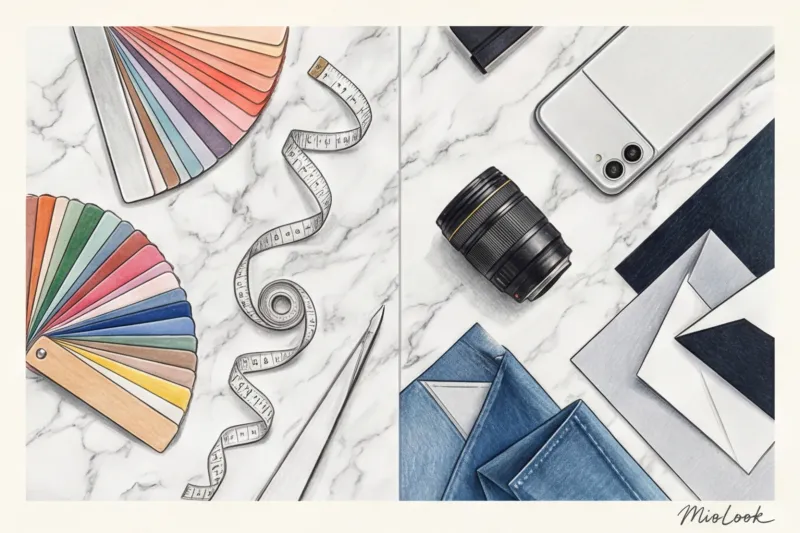
Theory is great, but in styling, I always need clear empirical evidence. Last month, I canceled all studio consultations for two days to conduct an unbiased experiment. I invited 10 of my clients with completely different phenotypes and tested them using the classic draping method (applying test fabrics to their faces one by one). I simultaneously fed their photos into the algorithm. The main question was: is it capable? Determine color type from a photo using a neural network with the same uncompromising precision as a practicing expert with a set of 120 professional directional handkerchiefs (the cost of which, by the way, today starts at €450)?
The results were sobering even for me, someone who professionally studies fashion tech. I clearly identified areas where algorithms are already head and shoulders above humans, and those fragile areas where machines are still powerless.
Where the machine won hands down: cold mathematics
Firstly, the algorithm crushed the classic approach in terms of data processing speed and tolerance for routine. In-person typing of one client takes me between an hour and a half and two hours of intense work in front of a mirror. By the fifth client a day, the eyes inevitably become "blurred," color perception dulls, and the usual physical fatigue from the constant shifting of heavy tissues sets in. The neural network delivered a detailed result in 12-15 seconds for each client.
Secondly, the algorithm demonstrated perfect calculation of body proportions. The machine is immune to optical illusions and social graces: it calculates the ratio of shoulders, waist, and hips with millimeter accuracy. It ignores the way the studio light falls or the client's reflexive stomach contraction in front of the mirror. Artificial intelligence doesn't try to flatter—it produces objective silhouette geometry, completely eliminating human error.
Where Man Wins: The Limits of Digital Code
However, it's too early to celebrate the machines' complete victory. AI is excellent at detecting pigment and angles, but it's completely blind to what truly shapes personal style: charisma, graceful movements, temperament, and lifestyle. This blind spot was most evident in the sixth participant in our experiment.
The neural network brilliantly and absolutely correctly calculated her extremely high contrast. According to the machine code it supplied, dramatic, sharp color-block combinations were ideal: pure fuchsia with jet black, for example. Everything was mathematically flawless. But the algorithm didn't know what I saw: sitting before me was a deeply introverted financial director with a strict corporate dress code.
Her movements were fluid, her manner of speech quiet and measured. The fuchsia suggested by the machine would have simply "devoured" her personality, making her feel uneasy. I had to manually adjust these stylistic vectors: we translated her natural high-contrast into a more aristocratic and calm palette—deep emerald, dark chocolate, and rich navy. The machine provided an impeccable physical foundation, but the subtle psychological adaptation required a living person.
Symbiosis of the Future: Intelligence Plus Empathy
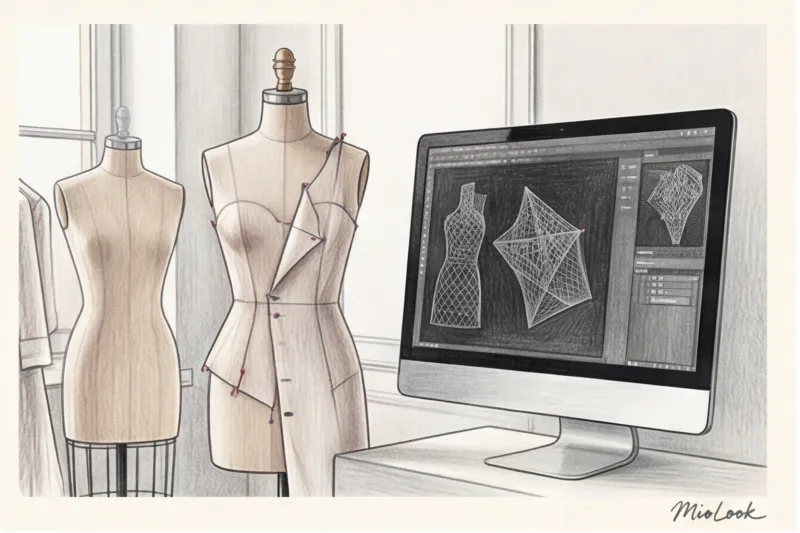
This test finally put everything into perspective. AI won't replace a stylist, but it has already become their primary intellectual tool—the same way 3D modeling programs have become for architects. Digital analysis takes care of all the routine math: the precise calculation of skin tone, contrast levels, and the balance of lengths and widths.
Access to MioLook for €0.99 — one-time payment
Start creating perfect images with the help of artificial intelligence.
Get access — €0.99 onceThis frees up a tremendous amount of time. Today, while conservative specialists continue to spend hours mechanically sorting through color palettes, we can confidently delegate this task. MioLook algorithms This is exactly what the symbiosis of the future looks like: a neural network generates a flawless technical data sheet of your appearance, and you use this pure data to build a wardrobe that harmoniously reflects your unique inner world and social status.
An Expert's Guide: How to Take the Perfect Photo for Accurate AI Analysis
A €1,500 smartphone can easily ruin your digital style profile if you don't know how to use it. Over the years working with fashion-tech startups, I've learned a harsh truth: an algorithm (no matter how advanced) analyzes only what you give it. Engineers call this the "principle of inference." Garbage In, Garbage Out (garbage in, garbage out). To Determine color type from a photo using a neural network She could do it with laboratory precision; she needed a perfect-quality source. And creating it at home is entirely possible if she followed a strict protocol.
Treat this process like taking measurements for a bespoke suit at a tailor's—any carelessness will ruin the final result. Here's my professional checklist for preparing a perfect shot:
- Lighting: strict daylight. Stand facing a window during daylight hours, but avoid direct sunlight. Direct sunlight creates deep shadows on the face and literally "bleaches" your skin tone, artificially reducing your natural contrast. The ideal scenario is soft, diffused light on partly cloudy days. Absolutely avoid artificial lighting: incandescent bulbs at home will add a non-existent warm undertone, while neon office lighting will make your skin look sickly green, turning a warm complexion into a cool olive tone.
- Absolutely clear face. I know how tempting it is to apply even a sheer BB cream or a lightweight under-eye concealer, but stop. Even the lightest foundation contains synthetic pigment that will permanently alter your digital code. The algorithm reads micro-contrasts between capillaries, freckles, natural lip color, and bare skin. Any layer of makeup acts as a blank wall for the AI—the machine will analyze the shade number of your cream, not your actual coloring.
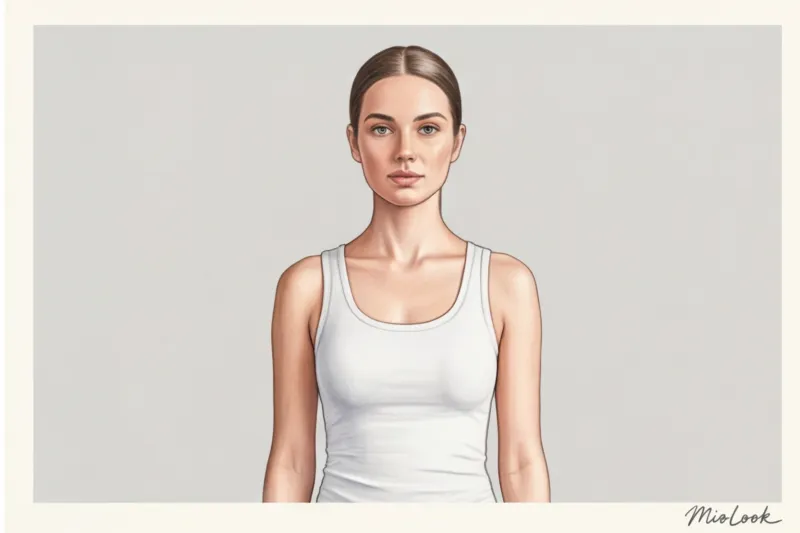
- Correct uniform. For a color analysis, wear a neutral light gray or crisp white top with a very revealing neckline and décolletage. Any turtleneck or bright print will inevitably cast a color reflection on your chin, throwing off the camera's automatic white balance settings. For a body architecture scan, wear tight-fitting clothing (for example, matte black leggings and a basic sports bra). The machine should see the true contours of your silhouette, not the volume of your favorite oversized hoodie.
- Angle and optics: why selfies are strictly prohibited. This is critically important. Never use the front-facing camera to determine your body type! According to mobile photography research (2023), a wide-angle selfie camera lens distorts body proportions by up to 15%. It visually exaggerates the area closest to the lens (usually the head and shoulders) and dramatically narrows the lower body. As a result, the neural network incorrectly diagnoses you as having an "inverted triangle" body shape, even though you actually have a classic "hourglass" shape.
Smartphone optics are unforgiving: even the slightest tilt of the lens changes perspective. To get an objective result, ask your loved ones to take photos with the main camera (without zooming) or use a tripod.
An important posing rule: the lens should be exactly at chest level, and the phone itself should be parallel to the floor, not tilted up or down. Hair should be pulled back at the nape of the neck or tucked behind the ears so it doesn't obscure the line of the shoulders and neck, concealing the true length and shape.
Once you've taken this technically correct photo, upload it to the app MioLook You'll see the difference immediately: instead of abstract fashion advice, you'll receive a mathematically verified palette and selection of styles based on your real, not distorted, personality. This one-time investment—literally five minutes in front of the window—will forever resolve the question of "what really suits me."
From Analysis to Wardrobe: How MioLook Uses This Data
According to a 2023 WGSN analytical report, the average woman regularly wears only 19% of her closet's contents. Why is this? Because knowing your natural shape is only half the battle. The real magic (and the main challenge) begins during shopping, when you have to apply the theory to real-life items.
Before, so that Determine color type from a photo, neural network simply gave you a PDF file with a palette and left you alone with that information. What happens now that the algorithm has detected your cool olive undertone and calculated the dominant straight line in your shoulder girdle? In the ecosystem MioLook This dry data is instantly transformed into an active filter. Your digital appearance matrix becomes an invisible but extremely strict face control for every potential purchase.
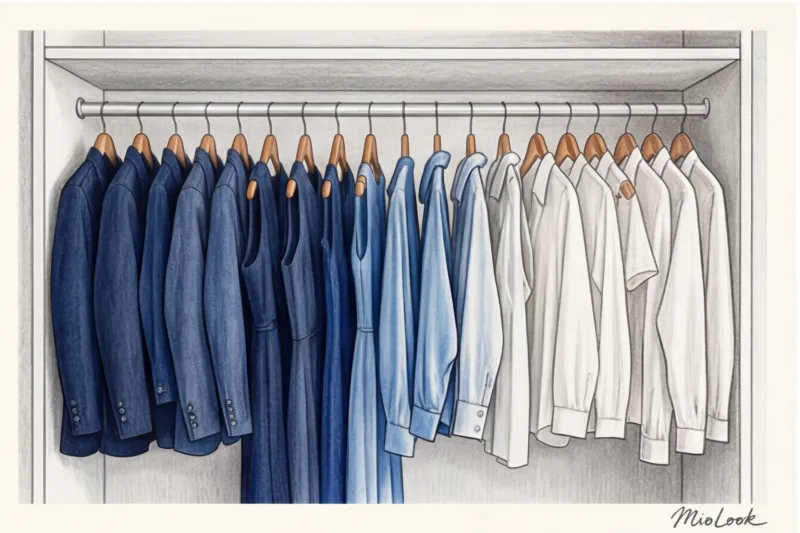
The capsule selection algorithm here operates on the principle of mathematical elimination. It doesn't simply search for "suitable" items for you; it ruthlessly eliminates anything that would visually disrupt your silhouette. If your body geometry (according to the calculated proportions) calls for soft, fluid lines, the AI will block a stiff, architectural jacket made of thick gabardine from your feed—even if it's currently at the peak of runway trends. The neural network compares the HEX codes of your skin with a pixel analysis of garments from catalogs, creating a 100% safe zone where the probability of error is reduced to zero.
Let's talk about money, because the smart wardrobe economy is something I always emphasize in my workshops. Knowing your digital profile is the best way to avoid impulse buying. Think about it: how many times have you bought a "really pretty" blouse on a spontaneous sale for €45, only to have it hang in your closet for years with the tag still on because its color temperature made your face look tired? Using AI turns chaotic shopping into an investment. You stop blowing your budget on compromises. It becomes psychologically easy to justify buying the perfect pair of wool trousers for €180 when the algorithm shows that their Match Score with your current wardrobe is 98%.
But the most captivating step is integrating the obtained parameters with the virtual fitting room. Forget about simply overlaying a flat 2D image of the dress on top of your photo. Modern AI takes into account the physics of materials. When the algorithm "fits" a garment onto your digital avatar, it calculates how heavy, flowing silk will fall across curvy hips, and if it's stiff denim, how it will shape the silhouette. The system combines your individual proportions, the properties of the specific fabric, and the design features of the cut (armhole depth, darts, drape direction), producing the most realistic fit prediction.
Your ideal image begins Here
Join thousands of users who look flawless every day with MioLook. Stop wasting money on things that don't suit you.
Get access — €0.99 onceThe main myths about digital facial analysis
Do you know what unites 90% of women who encounter fashion-tech solutions for the first time? The fear of losing their individuality. We think that soulless code will confine us to rigid boundaries, forcing us to wear only predictable, basic items. But, analyzing the results of implementing algorithms in personal styling, I can confidently say: precise calculations give freedom, not take it away. Let's examine the three most persistent misconceptions that prevent us from trusting technology.
Myth 1: “Your color type changes with age or tanning, and the machine will get confused.”
I often hear the argument: "I came back from vacation with a bronze tan, now I look great in completely different colors!" This is an optical illusion. Your surface melanin level (responsible for tanning) does fluctuate, but your base undertone—the unique ratio of carotene, hemoglobin, and melanin in the deeper layers of your epidermis—is genetically determined and stays with you forever.
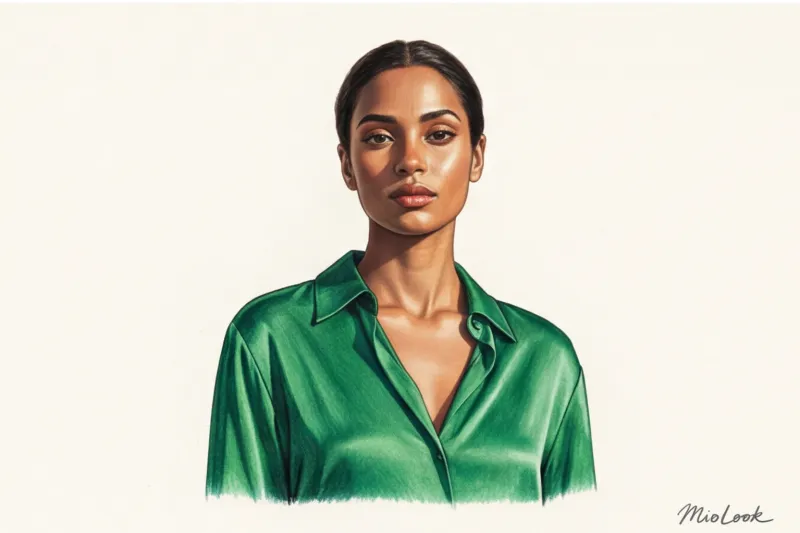
Many people doubt whether it will be possible Determine color type from a photo using a neural network If a woman has gray hair or pigmentation. The answer is: absolutely. A high-quality algorithm doesn't read temporary superficial pigmentation, but rather the systemic temperature of your appearance, translating the colors of your eyes, hair roots, and skin into precise hex codes. Gray hair simply reduces your natural contrast, but doesn't change your cool or warm tone.
Myth 2: "Neural networks restrict and deprive you of creativity."
This is where the most dangerous cognitive bias lies. Analytics isn't a prison cell, it's your canvas. By exploring the mathematical basis of your appearance through MioLook's smart algorithms , you get a palette of absolute harmony. This is insurance against buying yet another "trendy" €300 coat that will leave your face looking sickly sallow and will just hang in your closet.
AI doesn't prevent you from wearing things that aren't in your palette. No one can take away your right to wear a "forbidden" neon sweater. But now you'll clearly understand the physics of the process: a bright, dissonant color simply needs to be pulled down from the face, balancing the portrait area with a complementary scarf or the right neckline. Even Miuccia Prada, known for her love of "ugly chic" and complex color clashes, builds her collections on a mastery of basic color.
Myth 3: "AI is trained only on model parameters and is poor at recognizing plus-size."
If we were talking about the crude technologies of 2018, I'd be the first to agree. The first systems did indeed fail on figures larger than a European size 42. But modern architectures are trained on gigantic, inclusive datasets. According to the Fashion Retail Tech 2024 report, silhouette recognition accuracy for sizes 48 to 60 (EU) has reached 96%.
Computer vision doesn't think in emotional categories like "thin" or "fat." It scans geometry: it measures angles of deviation, proportions of bone structure, and volume distribution. For the algorithm, the luxurious curves of a size 54 are simply a specific set of direction vectors that mathematically require, for example, a fabric with a higher drape density (from 250 g/m²), rather than a shapeless, thin knit.
The paradox of digital styling is that it's precisely this strict, unbiased foundation that allows for the most daring fashion experiments. When you know your rules inside and out, breaking them becomes a true art.
Conclusion: Your Personal Style Code
According to The Business of Fashion's 2024 analytical report, the fashion industry is rapidly moving toward hyper-personalization, and this transition is inextricably linked to computer vision technologies. As a journalist, I can confidently say: we are on the threshold of an era when unsuccessful purchases will simply be nonexistent. Spontaneous spending—whether it's another €150 blouse from a mass-market store or an impulsive purchase of a trendy jacket that then languishes in the closet for years with the tag still attached—will be a thing of the past. Artificial intelligence completely removes the emotional factor from the selection process, leaving behind pure, mathematically accurate logic. Renowned trend-forwarding expert Li Edelkoort recently emphasized: "We are finally moving from the era of mindless accumulation to the era of conscious curation of one's closet.".
Your personal style code should no longer be based on subjective feelings or advice from a consultant in a store. Today Determine color type from a photo using a neural network Capable of a level of precision that even the most trained human eye cannot match. You receive a completely accurate technical analysis: the algorithm calculates your natural contrast level, decomposes your skin pigmentation into RGB color channels, determines your true undertone (without regard for redness or temporary tan), and constructs body geometry vectors. The machine ignores media-imposed beauty standards and works exclusively with your unique architecture.
But how do you translate this raw data into wearable looks? Once you've got this foundation, don't rush off to the mall. My main call to action is to conduct a thorough overhaul of your current wardrobe. To properly implement the results of AI analysis, use the "smart sieve" method:
- Step 1: Color Filter. Pull out all your items and test them against your new palette. Put aside anything that clashes with your contrast ratio. If the algorithm shows that your code relies on muted, complex shades, then you should sell that garish neon sweater on a resale platform without regret.
- Stage 2: Architectural control. Evaluate the cut's geometry. Let's say the neural network has identified a predominance of vertical lines and an elongated bone structure. This means that any items that visually "cut" your figure in half (for example, contrasting wide belts or cropped bolero jackets) are to be avoided.
- Stage 3: Saving the "yellow zone". These are items that aren't perfect in color but fit perfectly. AI will suggest how to adapt them: for example, by shifting the "off" shade away from the face with the right scarf or moving it to the lower part of the silhouette (trousers, skirts), where the color doesn't reflect on the skin.
After such a cleansing, you will be left with only a perfect base. This is where theory meets everyday practice: transfer this digitized capsule to MioLook smart wardrobe The system will remember your parameters and begin to automatically generate images from your existing items, strictly adhering to the specified proportions.
For me, the democratization of styling through AI is the best thing that could have happened to the fashion industry. Technology does what was previously only available to clients of elite Parisian ateliers with bills starting at €5,000: it gives you a deep understanding of your own appearance. The algorithm doesn't try to remake you. It simply gives you personalized instructions on how to showcase your natural complexion to its best advantage and invest in your wardrobe with impeccable planning.
Guide Chapters
Find a similar celebrity by photo for style: neural network
Copying couture outfits is a bad idea. Learn how to use a neural network to find a celebrity lookalike and borrow their everyday style.
Accurate color typing: will a neural network or a stylist do a better job?
For years, fashion relied on human subjectivity, but today AI offers a mathematically precise approach. Find out who can best determine your coloring.
How to determine skin undertone from a photo online using AI
The wrong color of clothing can add years and highlight fatigue. We'll explore how AI algorithms flawlessly find your perfect shade.
How to determine the contrast of appearance online: neural network
Tired of time-consuming fittings? Find out how artificial intelligence accurately calculates the contrast level of your appearance.
How to determine face shape from a photo: a neural network for style
Smartphone cameras distort proportions, causing us to choose the wrong haircut. Find out how AI can accurately predict your true face shape.
Determine your Kibbe personality type from a photo: a flawless neural network
The human eye is the worst tool for self-analysis of appearance. Find out why artificial intelligence is much more accurate at identifying your Kibbe type than experienced stylists.
How to take a photo to determine your AI color type
Artificial intelligence operates on the principle of "garbage in, garbage out." We'll explain how to take the perfect selfie for an accurate AI analysis of your appearance.
Determine your body type from a photo: A neural network to the rescue
The fruit-based body classification system is hopelessly outdated. Learn how modern neural networks can analyze unique body proportions from photographs.
12 Color Types of Appearance: A Photo Test with a Neural Network
Forget about time-consuming fabric fittings at the stylist's. Find out how artificial intelligence can determine your color type in seconds based on just one perfect selfie.