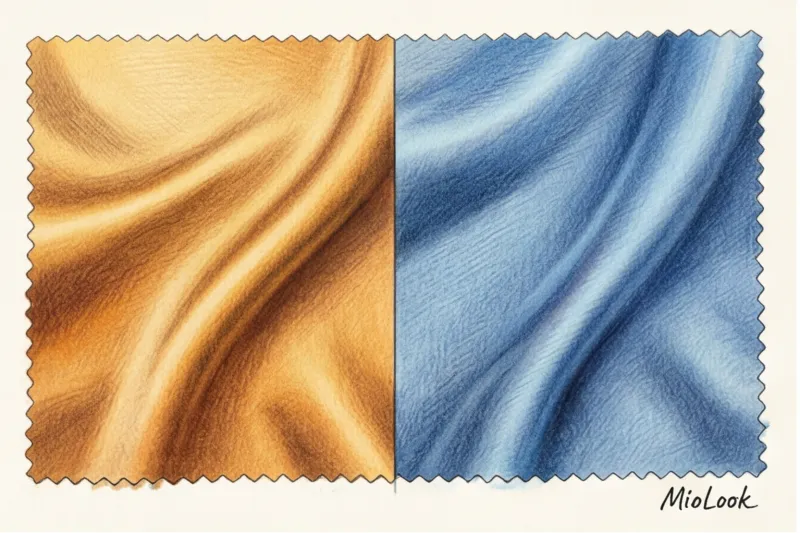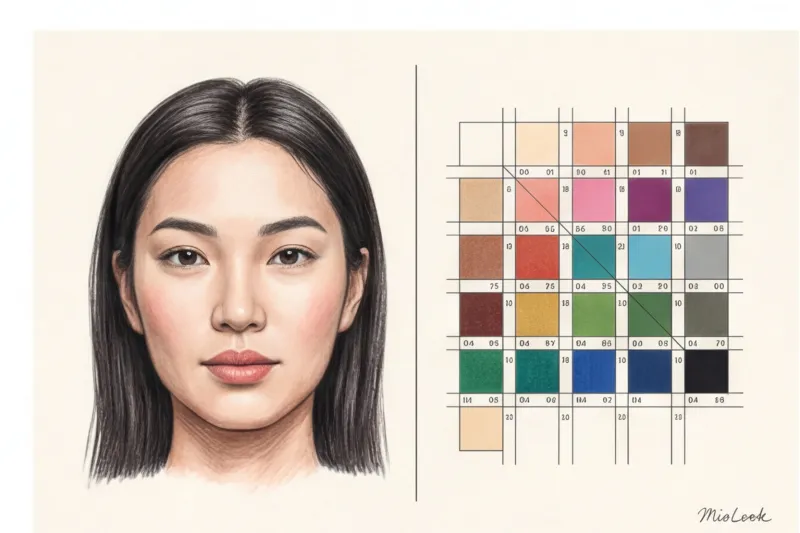
It's a familiar scenario: you buy a luxurious beige trench coat from Massimo Dutti for 150 euros. On the hanger, it looks like the epitome of "quiet luxury," but when you put it on at home, your face suddenly takes on a sickly, sallow, greenish tint. You chalk it up to fatigue, lack of sleep, or poor lighting. But the real reason lies in the physics of color.

As a practicing stylist, I've watched for years as women spend hundreds of euros on things that objectively ruin them. We're used to relying on intuition or grandma's methods, although today Determine your skin undertone from a photo online With the help of algorithms, you can do it in a couple of seconds. We've covered in more detail how technology is changing our approach to shopping in our a complete guide to neural networks in style.
Instead of unscientific tests with wrist veins and foil, let's look at how artificial intelligence uses mathematics (HEX codes and pixel analysis) for error-free typing, and why this will forever solve the problem of unsuccessful purchases in mass markets.
Why the 'Vein Test' No Longer Works: The End of Guessing
If you open any glossy magazine from ten years ago, you'll be asked to look at your veins. Blue means you're "cold," green means you're "warm." Forget it. The popular vein test is a complete myth. The color of the veins we see through the skin depends on the thickness of the epidermis, the depth of the vessels, and the percentage of subcutaneous fat, not on your skin tone.
The human eye is a remarkable, yet easily deceived, instrument. We can distinguish about a million shades, but our brain constantly distorts their perception under the influence of neighboring colors. This is called simultaneous contrast.
"My personal testing in the fitting rooms of Zara and H&M showed that their signature yellowish overhead lighting distorts skin tone perception by 40%. Even I, as a professional, can make mistakes when analyzing a client's appearance under the lights of a shopping mall."
Women with olive undertones suffer especially badly from manual typing. One of my clients spent years stocking up on warm camel and terracotta-colored clothes, sincerely believing she was an "Autumn" due to her slightly yellow skin tone. In reality, her undertone was a neutral, cool olive. The warm beige clashed with her natural pigment, highlighting the circles under her eyes. Once we switched her wardrobe to a palette of icy gray and emerald, she looked like she'd just returned from vacation.
Math Instead of Magic: How AI "Sees" Our Faces
Computer vision doesn't understand what "tired looks" or "poor fitting room lighting" mean. Machine learning algorithms have transformed styling from subjective opinions into an exact science. According to research by WGSN (2024), implementing a data-centric approach to personal styling reduces clothing return rates by 28%.
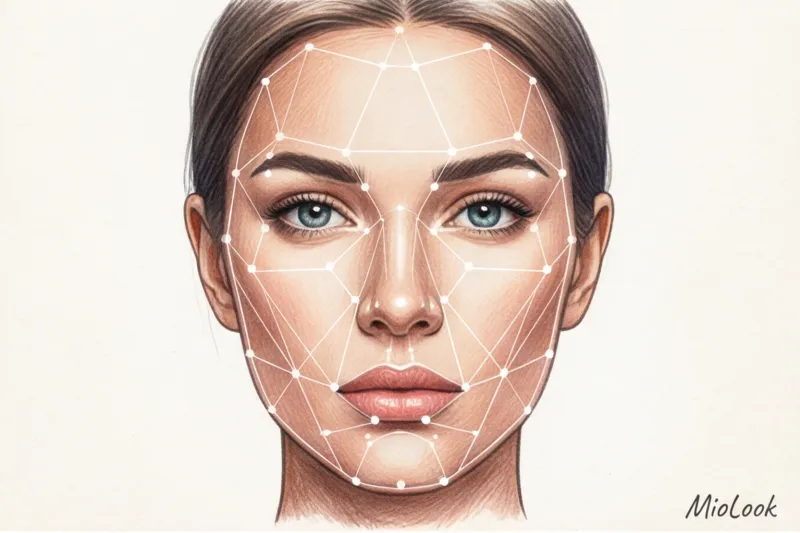
How does this work in practice? When the algorithm receives your photo, it doesn't look at your entire face. It creates a grid of 60-100 control points (forehead, cheeks, chin), intentionally excluding areas with shadows, pigmentation, or localized redness. The AI then analyzes the concentration of three key components of our skin:
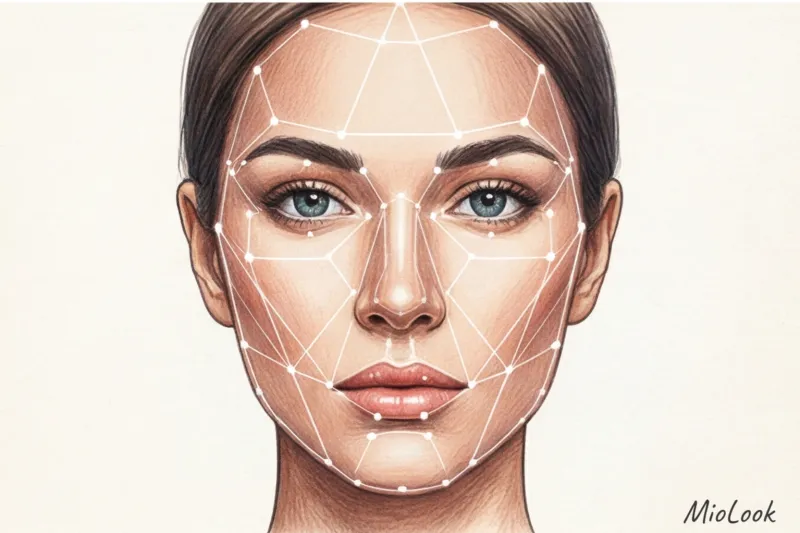
- Melanin (responsible for the depth of tone);
- Carotene (gives a yellowish, warm pigment);
- Hemoglobin (responsible for a reddish, cool or neutral blush).
The system converts pixels into precise HEX codes and places them in the LAB color space (a mathematical model describing all colors visible to humans). The AI calculates the balance of red, blue, and yellow pigments down to tenths of a percent. You can't argue with math.
How to accurately determine your skin undertone from a photo online

Herein lies the key caveat. Artificial intelligence is completely objective, but it is entirely dependent on the quality of the input data. In programming, there's a golden rule: Garbage in, garbage out (Garbage in, garbage out). If you upload a photo taken in a club under a neon light, the neural network will honestly say you're Shrek with a green undertone.
An interesting paradox: a regular selfie by the window is much better suited for analysis than a professional studio portrait. Studio photographers almost always adjust the white balance, add warm filters for a "cozy" look, and retouch natural skin tones. An unfiltered smartphone selfie provides the algorithm with pure information.
Checklist: How to Take the Perfect Photo for a Neural Network
To determine your skin undertone from a photo online without errors, follow these four simple steps:
- Light: Stand facing a window during daylight hours. Indirect light is essential (avoid direct sunlight, which creates harsh shadows and a yellowish cast).
- Face: Strictly no makeup. Remove foundation and even moisturizer and SPF tint—they distort the base pigment.
- Cloth: Wear a basic white or light gray top. Keep your neck and décolletage exposed so the algorithm can compare your facial pigmentation to your body.
- Background: Find the most neutral wall possible. A bright red carpet behind you will reflect color onto your cheeks, which the AI interprets as a warm undertone.
Access to MioLook for €0.99 — one-time payment
A smart AI stylist will select the perfect look based on your true coloring.
Get access — €0.99 onceThree main mistakes in visually determining color type
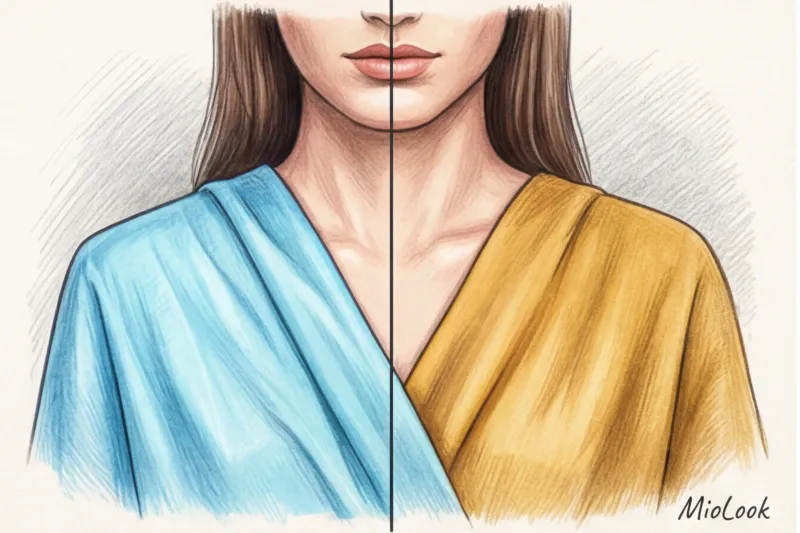
By relying solely on a mirror for judgment, we often make three critical mistakes that cost us the perfect wardrobe. It's helpful to know these to understand how to use them wisely. color correction of the figure.
1. Confusion between surface tone and undertone. Your overtone can change: you might be sunburned, have rosacea, rosacea, or a cold reaction. Your undertone (the base pigment) is genetic and never changes. Reddish cheeks don't make you "cold," just as a deep tan doesn't make you "warm." AI can ignore superficial redness by looking deeper into the pigment.

2. The influence of hair color. Over the years, I've seen dozens of women choose clothes to match their poorly dyed hair, not their skin tone. If a woman with cool undertones dyes her hair a coppery red, her complexion will appear dull. But instead of changing her hair color, she starts buying warmer clothes, making the situation worse. The neural network can't be fooled by L'Oréal dye—it only looks at skin.
3. The illusion of seasonality. Many people think that bright, cool colors suit them in winter against pale skin, while warm bronze tones look better against a tanned body in summer. This is a contrast error. While the degree of contrast in your appearance changes, your temperature remains the same.
From Theory to Wardrobe: What to Do with AI Results
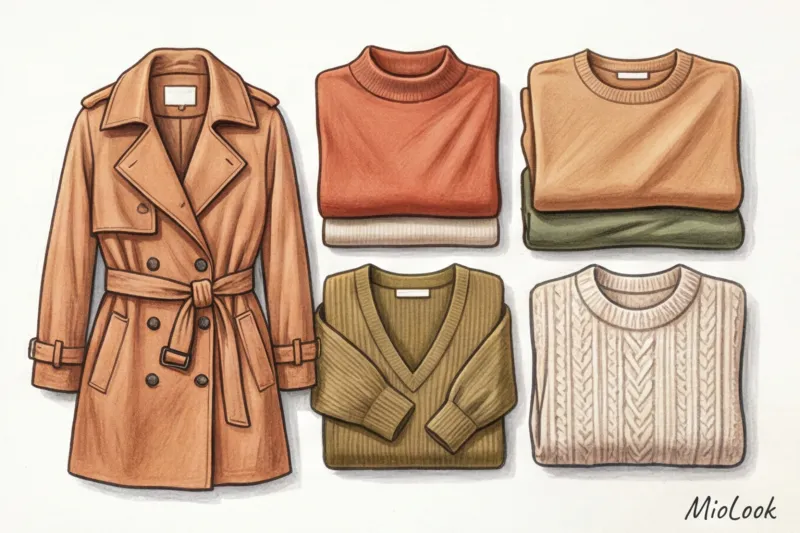
Knowing your undertone isn't a fashion label; it's a built-in AdBlock for your wallet. According to my clients' statistics, avoiding clothes that are a different temperature from yours saves up to 30% of your annual shopping budget. It creates a smart filter in your head. When you walk into a store like COS, where the palette changes every season, you no longer wander between the rails.
The basic rule when creating a capsule wardrobe It sounds simple: like attracts like. Warm undertones need warm shades (mustard, terracotta, olive, warm beige). Cool undertones need cool shades (emerald, fuchsia, icy gray, snow-white).
For example, a basic white T-shirt. There are hundreds of them in the mass market. A woman with a warm undertone needs an ecru or eggshell-colored T-shirt (at H&M, this is often labeled as off-white). A woman with a cool undertone needs a piercing, luminous optical white.
What if I really like something, but it’s not my undertone?
I'm a pragmatist and never force clients to throw away their favorite €200 sweater just because it turned out to be the "wrong" temperature. portrait zone rule Anything that doesn't match your undertone, we simply move away from your face.
Are you absolutely in love with the trendy lime shade, but you're a cool-toned person? Buy lime-green pants, a skirt, a bag, or shoes. If the item is near your face (like that sweater), use a buffer. Wear a white shirt in the right shade under the sweater, tie a matching scarf around your neck, or wear chunky metal jewelry (silver for cool-toned people, gold for warm-toned people). This barrier will break the clash between the fabric color and your skin tone.
Your perfect look starts here
Join thousands of users who look flawless every day with MioLook, choosing clothes to suit their personality type.
Get access — €0.99 onceThe Future of Personal Style: Objectivity Instead of Guesswork
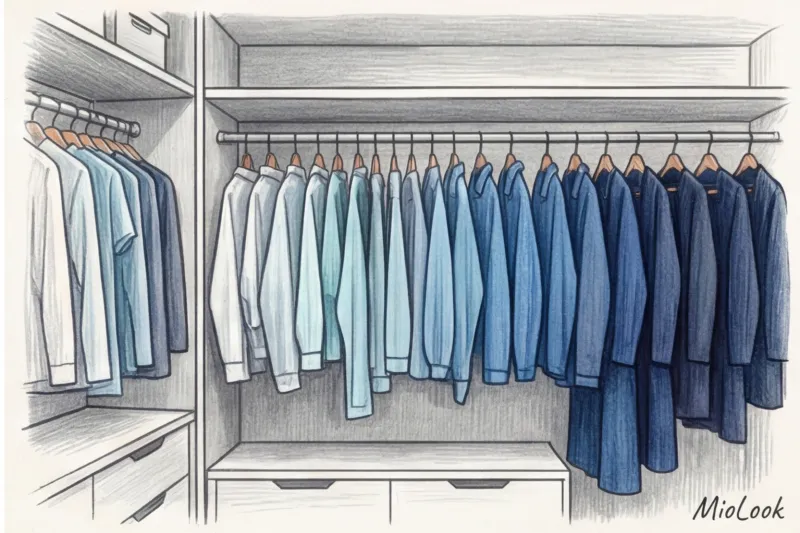
Machine learning is forever changing the fashion industry. We're moving away from guesswork and subjective assessments by boutique consultants to precise, personalized data. Knowing your undertone is just the beginning. By integrating this data with an understanding of your body type and archetype, you can create a wardrobe that works for you 100%.
Technology should be used to truly save you time and money. Stop applying gold to your face in front of the mirror. Take one perfect photo in daylight, upload it to an AI app, and get an objective mathematical result. Then, open your closet and look at it with new eyes. I guarantee you'll immediately understand why that same blouse you bought on sale two years ago never left the hanger.