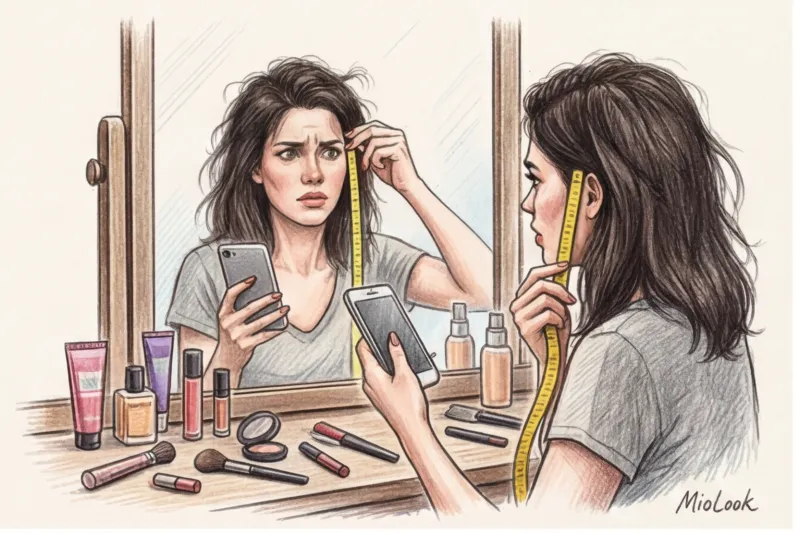
Did you know that almost 80% of women spend their entire lives wearing hairstyles and eyeglass frames that they don't "like" simply because they blindly trust their smartphone's front-facing camera? This is no exaggeration. The story of my client Francesca from Milan is a classic example. She avoided updos for 15 years, absolutely convinced that her face was round because of so-called baby cheeks. When we first performed a digital scan, the system revealed a perfect diamond shape with chiseled, high cheekbones, which she had so stubbornly hidden.
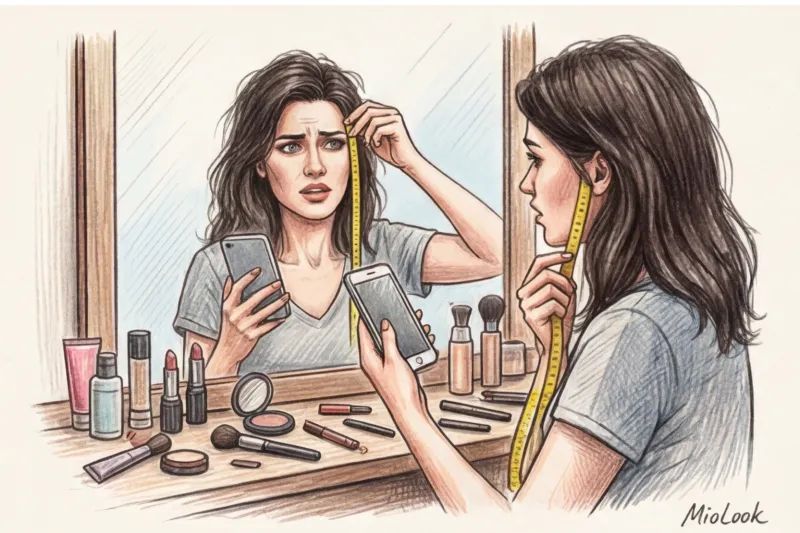
Your selfie and bathroom mirror are blatantly lying to you. Due to lens distortion and our subjective perception of our own insecurities, it's impossible to accurately assess proportions by eye. Today Use a neural network to determine face shape from a photo can be done with mathematical precision, saving us from decades of stylistic errors. We've already covered this shift in the industry in more detail in our complete guide on how Determine color type from a photo: neural network for style analysis Now let's figure out why algorithms see us better than we do, and how this knowledge fundamentally changes the rules of the game.
Why We're Wrong: The Mirror Illusion and the Camera Trick
Remember that old granny trick from glossy magazines in the 2000s? "Stand in front of the mirror, close one eye, and outline your face with red lipstick." I beg you—forget it forever. Due to the parallax effect, microscopic shifts in your posture, and hand tremors, you'll draw anything but your true form on the glass.
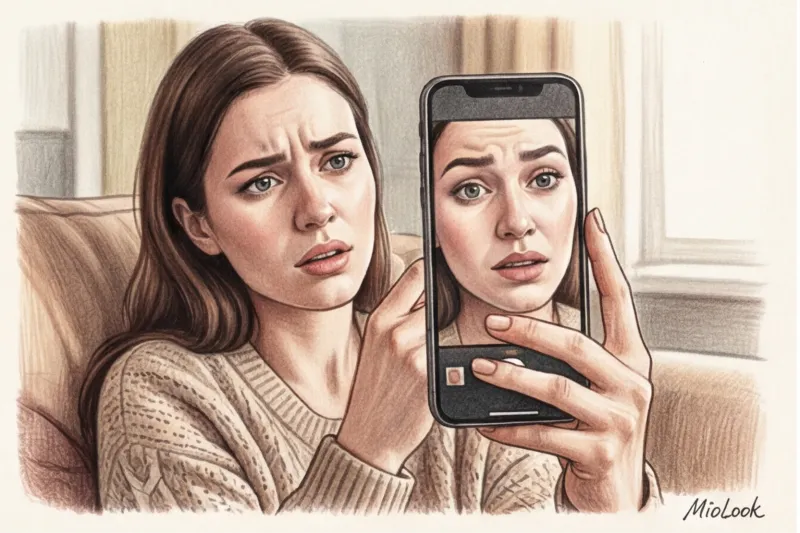
But the main trap lies in our smartphones. The front camera of most modern phones has a focal length of 24–28 mm. According to the laws of optics, such a short-throw lens works like a fisheye lens on a low-end camera. It aggressively elongates the center of the face (visually enlarging the nose by almost 30%!) and mercilessly narrows the edges, pushing the ears and cheekbones into the background. You look at the screen and see an elongated oval with a large nose, although in reality, you may have a harmonious square face.
"The optical distortion of a smartphone distorts facial geometry beyond recognition. We mistake the distorted pixelated image for reality, forming false complexes based on it."
Besides, simple psychology is at work. We focus on what irritates us. A girl with a slightly wider forehead than models will look only at it, ignoring the chiseled jawline. As a result, she diagnoses herself with a "heart" shape, even though by all proportions it's a perfect rectangle. A machine, however, doesn't care about your insecurities—it sees only pure mathematics.
How to determine face shape from a photo: neural networks versus a measuring tape
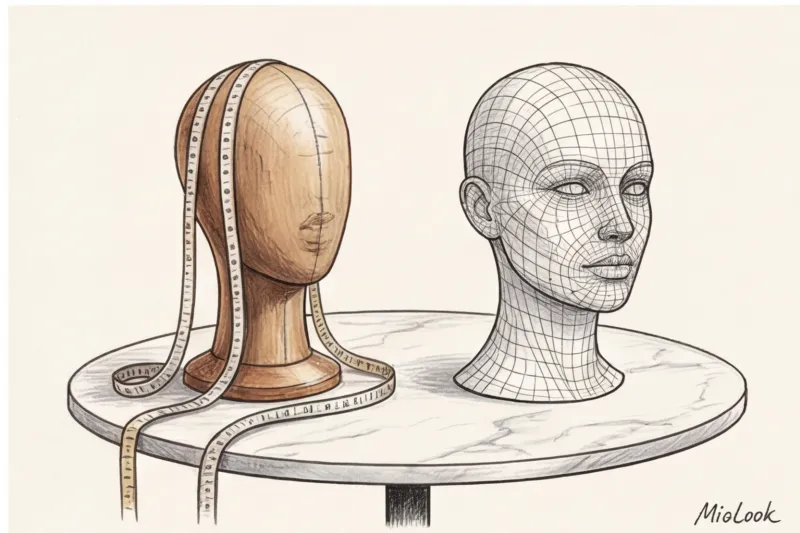
The beauty industry has made huge strides. While we stylists used to arm ourselves with tailor's tape measures and try to calculate proportions manually, that's a thing of the past. As the WGSN study (2024) notes, the introduction of AI scanning and image visualization Reduces the return rate of frames in optical stores by 60%. Why? Because Computer Vision algorithms don't make mistakes.
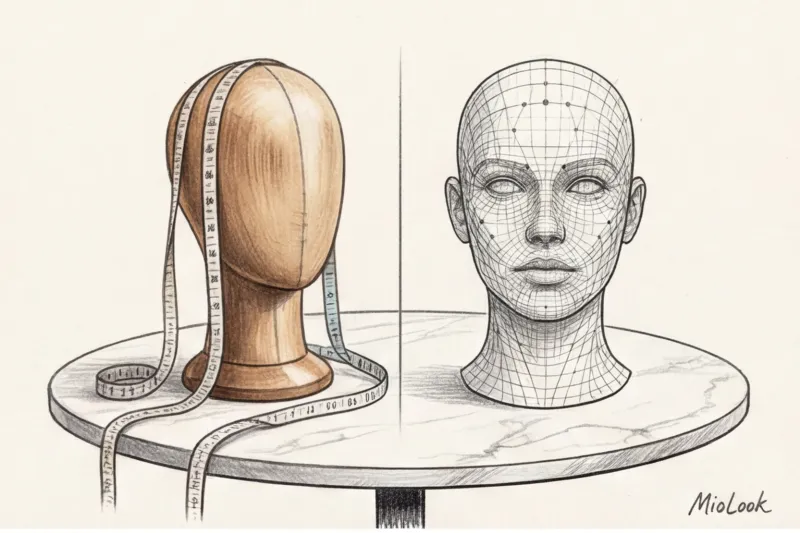
The system works like this: by uploading a photo to AI stylist The algorithm places over 100 biometric landmarks on your face. It measures:
- The exact width of the hairline relative to the jaw.
- The distance between the outer corners of the eyes and the cheekbones.
- The angles of inclination of the lower jaw (they are what distinguish an oval from a rectangle).
- The exact ratio of the length of the face to its maximum width.
The objectivity of AI is that it doesn't rely on harsh contouring or shadows. It's a completely sterile, geometric analysis. For me as a stylist, this was a revelation. I completely stopped guessing and relying solely on my eye during my first meeting with a client.
Access to MioLook for €0.99 — one-time payment
A smart AI stylist will select the perfect look for you based on the precise geometry of your face.
Get access — €0.99 once6 Basic Facial Architectures (And How AI Sees Them)
Let's face it: no face fits perfectly into a single geometric shape. But there are basic architectures—dominant lines—that dictate the rules for choosing accessories. In my experience, every other client confuses their proportions until the algorithm produces precise figures.
Oval and Rectangle: A Play of Proportions
Oval For a long time, it was considered the epitome of harmony due to its mathematical length-to-width ratio of approximately 1.5 to 1. The lines are smooth, and the jawline is gently rounded. If the AI detects you have an oval shape, you're lucky; you can wear almost any frame.
Rectangle The same length (the face is elongated), but with sharp, defined angles of the jaw and forehead. This is where the most common counterintuitive paradox lies: girls with rectangular faces desperately try to hide the sharp angles of their jaws behind a thick curtain of straight hair. This is a huge mistake! Straight hair along the face only emphasizes the geometry, making the jaw appear heavier. Don't hide the angles—sculpt them correctly.
Circle and Square: The Secret of Width
In these two forms, the length of the face is almost equal to its width.
Circle - these are soft lines, where the cheekbones are the widest part, but without sharp transitions. Square - it is the same width, but with a strong, pronounced lower jaw.
My favorite styling formula for a square: Angular face shape + soft, textured curls (beach waves) = perfect contrast Never cut straight, thick bangs on a square face unless you want to look like a stern Lego man.
Heart and Diamond: Focus on the Cheekbones
Heart (inverted triangle) is characterized by a wide forehead that tapers smoothly to a narrow, often pointed chin.
Rhombus (Diamond) — a shape in which the widest points are at cheekbone level, while the forehead and jawline are noticeably narrower. This is the shape AI most often "finds" in those who have always considered themselves round-faced. As soon as we realize we have a diamond-shaped face, we open up the cheekbones and move the volume of the hair down to the neck.
The Perfect Hairstyle Algorithm: From Data to Volume
Once you know the precise architecture, choosing a haircut turns from a lottery into a clear algorithm. The main rule of balance is this: the hairstyle must compensate for what's missing and soften what's excessive.
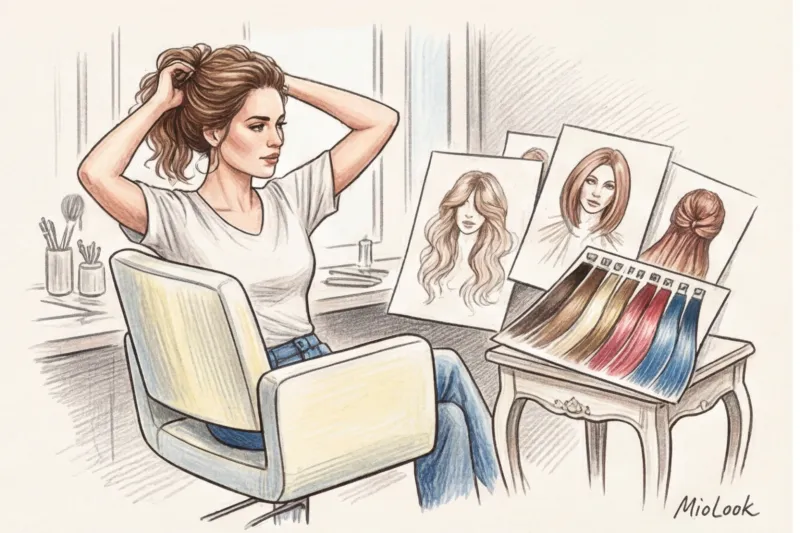
Let's look at specific formulas that work flawlessly:
- For a round face: Asymmetry + volume at the crown + elongated front strands. Your goal is to create a vertical line. A side parting and an elongated bob below the chin work perfectly.
- For a rectangular face: An elongated bob + side parting + soft waves = a versatile recipe. We need to break up the harsh vertical line and add horizontal volume at the cheekbones.
- For the heart shape: A collarbone-length bob with volume at the ends. We want to visually widen the narrow chin, so the entire length of hair should end there.
Fair Limit: AI analysis provides an excellent basis, but this mathematical selection method will NOT work 100% if you have severe natural hair growth asymmetry, complex cowlicks, or very fine hair that doesn't hold volume. The neural network takes into account the hairline, but texture and density must still be assessed by a live professional in the chair.
Your perfect look starts here
Join thousands of users who look flawless every day with MioLook's hairstyle selection feature.
Get access — €0.99 onceOptics of Style: How AI Selects the Perfect Eyeglass Frame
Glasses are makeup you can put on in a second. They're the most powerful tool for correcting facial geometry. And this is where the rule of contrast comes into play: the shape of the glasses should be opposite to the shape of your face.
A round face needs strong, graphic angles (rectangular frames, Wayfarers) to structure the softness. A square face, on the other hand, needs soft curves (aviators, round Lennons) to soften a strong jawline.
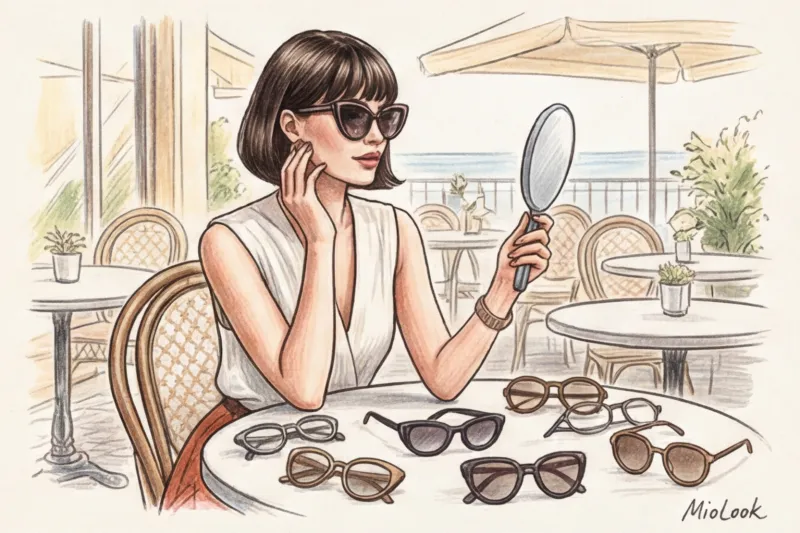
But shape is only half the story. Scale and proportion are everything. Modern neural networks calculate your interpupillary distance (PD) from a photo. This is critically important, because if your eyes aren't exactly centered in the lens (or slightly closer to the bridge of your nose), the frame will look out of place, visually "eating up" your face.
I adore Mediterranean chic—massive, oversized glasses. They're my signature look. But there are pitfalls. For example, the famous "cat-eye" shape. Many consider it universal. However, in my experience, an ill-chosen, overly elongated cat-eye can catastrophically ruin a heart-shaped forehead, making an already wide forehead appear immense. However, this same frame brilliantly saves and balances a diamond-shaped forehead, adding width to the upper part of the face.
A good frame made of high-quality Italian acetate will cost in the range of 150-250 €, and this is the basic element smart wardrobe , where mistakes are costly. That's why AI-powered pre-fitting isn't just a toy, but a way to protect your investment.
Step-by-step checklist: how to prepare photos for accurate analysis in MioLook
To ensure the algorithm doesn't make mistakes, it needs the correct input data. Imagine submitting biometric data for a visa—the rules are roughly the same. Over 12 years of working with digital tools, I've developed the ideal scanning protocol:
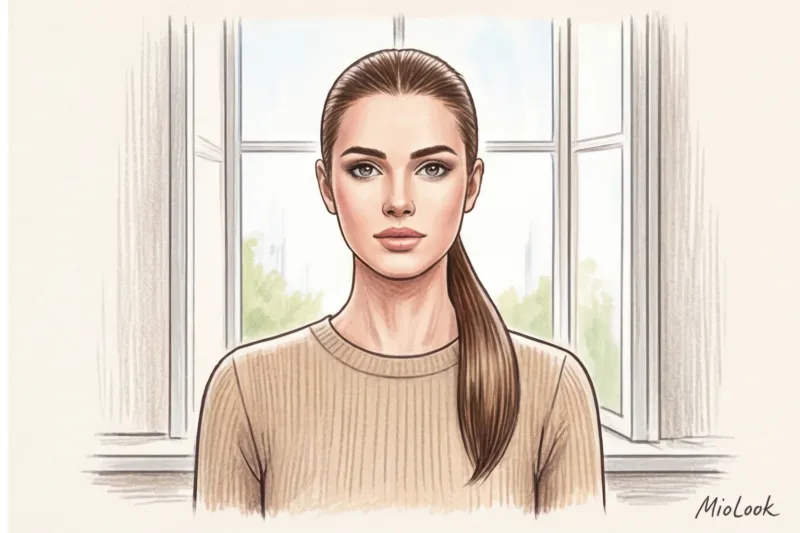
- Lighting: Only even daylight. Stand facing the window, one step away. Avoid side shadows from the lamp or harsh overhead sunlight—this will create the illusion of sunken cheeks or heavy brow ridges.
- Angle: The camera should be exactly at eye level. Hold the phone at arm's length (or better yet, use a tripod or have someone take your photo from 1.5 meters away). Bringing the phone closer to your face creates that optical distortion.
- Preparation: Pull your hair back into a sleek ponytail. Keep your forehead and earlobes completely exposed. Remove glasses and chunky earrings, which could confuse the algorithm.
- Emotion: A completely neutral, relaxed face. A wide smile lifts the apples of the cheeks and changes the jawline, transforming a long face into a round one.
Bottom line: your unique geometry as the basis of style
It's time to stop fighting nature. Your face shape isn't a list of flaws to be quickly contoured with bronzer or hidden behind bangs. It's a magnificent, unique structure that needs to be expertly shaped.
Artificial intelligence isn't a replacement for your own taste. It's a precise, impartial compass that guides your style experiments safely. Stop guessing in the mirror and trying on other people's trends. Take five minutes today: take a perfect photo by the window, upload it to the system, and finally discover your true, stunning appearance.
Ready to get started?
Try the MioLook plan for free—no commitments required. Upload a photo and discover your face shape right now.
Get access — €0.99 once