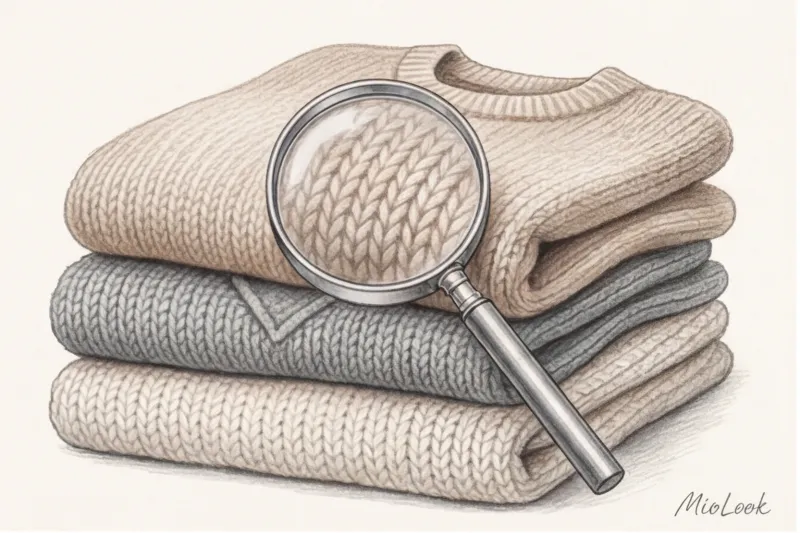
What is a Basic Knitwear Wardrobe: The Architecture of Comfort
Over 12 years of working as a stylist, I've learned one thing: women love buying sweaters, but they're completely unable to integrate them into their looks. Last week, a client brought in a huge bag of clothes to sort and said in despair, "Darina, I've bought my fifth cashmere sweater, but I still have nothing to wear to a meeting without looking like I just got up from the couch." And therein lies the main pitfall of soft textures.
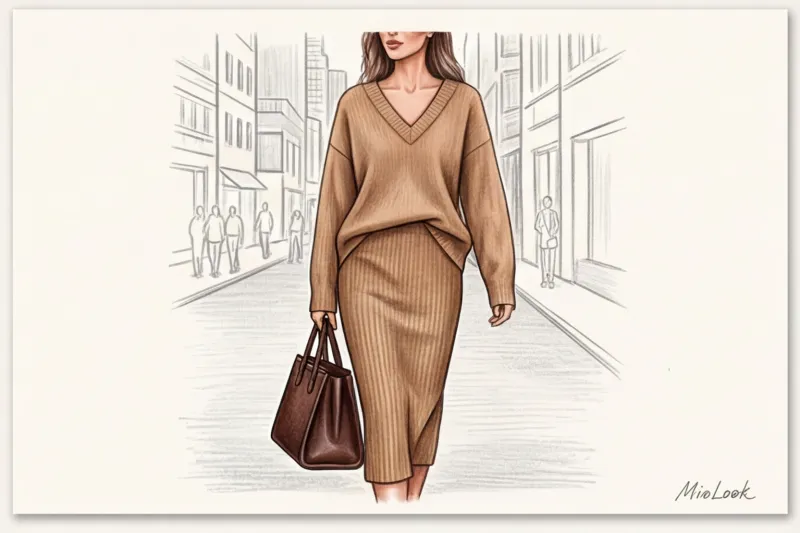
Properly assembled basic knitwear wardrobe It's not a random stack of warm sweaters on a winter shelf. It's a well-thought-out, self-contained ecosystem where each element interacts with the others, enhancing your status and comfort rather than turning your figure into a shapeless cloud.
"The biggest mistake when choosing knitwear is judging it solely by feel. What feels good on the body isn't always flattering. Softness must be combined with shape retention."
In professional circles we often use the term "architecture of comfort" This means we're looking for pieces that offer comfort within a strict form. Loose knitwear that hangs in sad folds on the shoulders and instantly stretches out at the elbows creates that notorious pajama effect (pajama effect). How to avoid the "you're wearing your underwear" feeling? Pay attention to the engineering details: the knit density should conceal the contours of the underwear, the shoulder seam should be perfectly positioned (or clearly dropped, as in an oversized fit—no half measures), and the edges of the garment should have a tight, springy ribbed cuff. Architectural knits hold their shape, creating a clear silhouette.
The world has changed, and we have changed with it. According to McKinsey's 2022 global fashion transformation report, sales of formal suits have not returned to pre-crisis levels since the pandemic. Investing in personal comfort has become the new social norm. A high-quality, smooth cardigan made of thick merino wool or a cashmere polo are now a fully-fledged part of the smart-casual dress code. Paired with pleated trousers, loafers, and a structured bag, they easily pass the strict corporate security check, allowing you to feel as comfortable as at home.
Integration into the rhythm of life: who needs a knitted capsule and why
Whether you freelance, work in a hybrid office, or frequently travel for business, a well-designed knitwear capsule wardrobe can cover up to 80% of your wardrobe needs. On the plane, a thick wool-blend jogger suit won't wrinkle and will protect you from temperature fluctuations, and upon arrival, a jumper from this suit will perfectly complement a formal midi skirt for a business dinner. It's pure functional versatility.
I often say: knitwear is the best style glue. It serves as the perfect link between formal business attire and relaxed street style. For example, a structured ribbed turtleneck instantly makes a look with regular jeans look more expensive and put-together. We covered more about how to combine textures in our guide about denim capsule for every day.
But it's crucial to understand: the basic knit must seamlessly blend with your current wardrobe. Often, the problem isn't a lack of items, but rather that we simply don't see the unobvious combinations in our own closet. To pair a new knitted base with your existing jackets and skirts, I highly recommend digitizing your items. MioLook app The smart look builder feature will help you visualize how a chunky V-neck sweater will pair with your favorite silk skirt before you even pull them off the shelves. If you've never done this before, I recommend starting with our Quick weekend wardrobe digitization plan.
And finally, don't think that such an architectural base requires an exorbitant budget. With a smart approach to composition, a decent sweater that will last for years without losing its shape can be found for €80–€150. The key is to know what elements to pay attention to when buying.
The Anatomy of Ideal Knitwear: Compositions, Textures, and Density
Watching my clients assemble their basic knitwear wardrobe, I constantly encounter an optical illusion. Many believe that to hide their figure's nuances, they need to buy a hyper-voluminous, chunky knit sweater. Spoiler: the laws of physics and textile design work in exactly the opposite way, adding a visual two-dimension difference to the silhouette. The secret to a perfect fit lies not so much in the cut as in the anatomy of the material itself.
Before investing €150–300 in a new jumper, let's understand its DNA. The choice of yarn determines how the garment will perform dynamically. Based on standards The Woolmark Company , which strictly regulate the thickness and quality of the fiber, we can divide the base yarn into four key categories:
- Merino (versatility): Smooth wool up to 24 microns thick. This is your main workhorse. High-quality merino has natural thermoregulation, is non-itchy, and lays down in a perfect, even layer. It's essential for turtlenecks and thin pullovers worn under a jacket.
- Cashmere (status): Luxury that demands respect. Cashmere goat down provides maximum warmth with minimal weight. However, it is extremely delicate, does not hold its shape, and is inevitably prone to pilling in areas of high friction (for example, under a bag strap).
- Cotton (all season): A heavy, smooth, and cool knit. The high-twist cotton yarn holds its shape incredibly well, doesn't overheat in a heated office, and creates a composed, architectural silhouette.
- Alpaca and mohair (texture): Long pile creates an incredibly beautiful, "expensive" glow and a fluffy texture. But be careful: any fuzzy texture acts like an optical magnifying glass, expanding the area it covers.
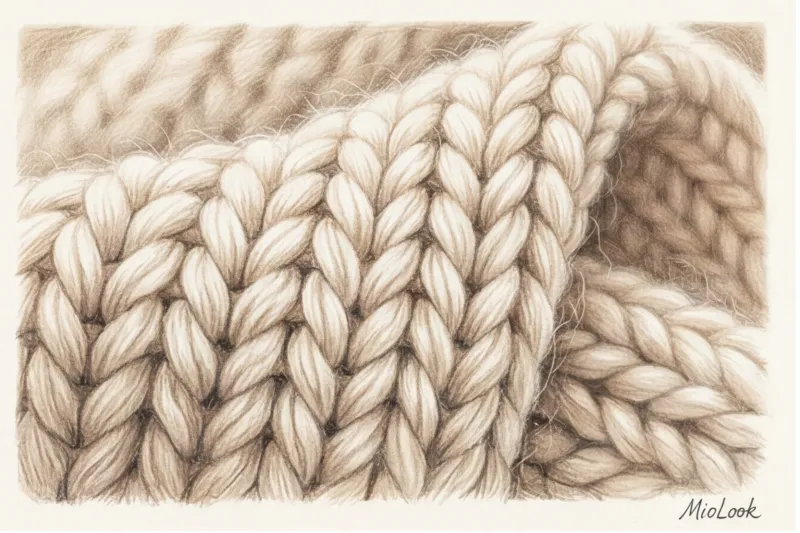
Deserves special attention Gauge (knitting density index) In professional circles, this term refers to the number of stitches per inch of fabric. Gauge is what decides whether your sweater will look more elegant or turn into a textured ball.
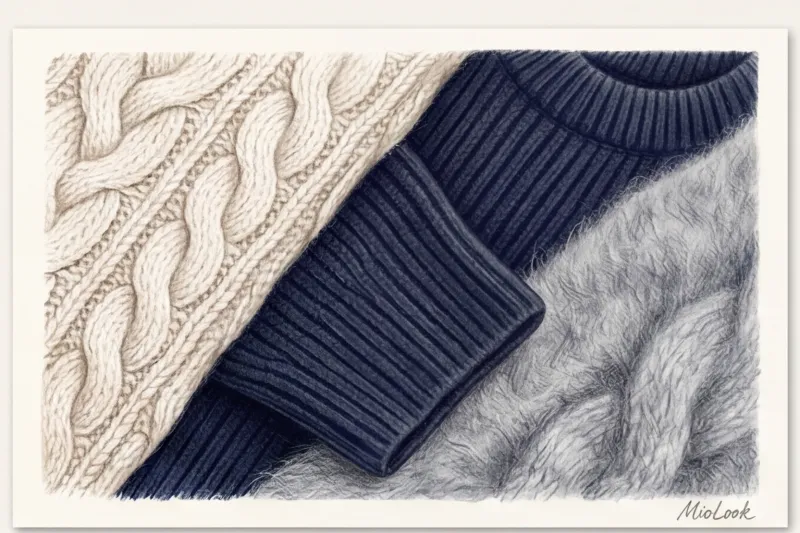
Classical 12-gauge (a fine, smooth knit) creates a flowing fabric that hugs the body. It's a great choice for a base layer, but there's a catch: too-thin knitwear will reveal the contours of lingerie (especially lace) and even the slightest relief of skin. On the contrary, 3-gauge — This is a large, rustic knit with thick yarn. It has its own massive volume and inevitably adds bulk due to the deep shadows in the braiding or English elastic. I recommend using this knit sparingly and only where you really want to add visual mass.
Access to MioLook for €0.99 — one-time payment
A smart AI stylist will select the perfect look based on your wardrobe and body shape.
Get access — €0.99 onceThe Myth of 100% Natural: When Synthetics Save a Thing
"Synthetics are always cheap and bad" is one of the most harmful fashion stereotypes, costing my clients hundreds of wasted euros. In the world of smart clothing design, we use an engineering approach to composition.
Let's be honest: 100% natural yarn is ideal only for loose-fitting garments that flow over the body and don't feel constantly taut. But when it comes to tighter fits or joint areas, pure natural yarn fails miserably.
Take the popular trend of 100% cashmere pants. It sounds like an introvert's dream, but in practice, it's a fashion disaster. Pure down has absolutely no elasticity. Just one sitting in them at your desk or in a taxi will leave you with unsightly "bubbles" at the knees and a sagging in the back. Physics is unbeatable: without a support structure, soft yarn will deform.
This is where technology comes in. Adding 10-15% high-quality polyamide or elastane to knitwear acts as an invisible skeleton. Synthetic yarn has a "memory" effect—it makes stretched wool or cotton spring back, returning to its original shape. If you're looking for a substantial base for active everyday wear (especially trousers, skirts, and fitted turtlenecks), a small addition of synthetics isn't a brand's attempt to save money, but rather a thoughtful way to protect your investment from premature loss of shape.
Formula: 7 elements that make up a basic knitwear wardrobe
Let's play a game: open your closet and count the number of knitwear items. I bet there are more than a dozen. Now count how many of them you regularly wear around town, versus just leaving them at the dacha or at home. The difference in these numbers is the lack of a system. The secret to the perfect capsule wardrobe isn't quantity, but a strict matrix of roles. Each item should fulfill its own engineering purpose: function as a base layer, a midlayer, an accent, or a solo piece. To cover 90% of your daily needs during the cooler season, you'll need just seven well-thought-out items.
The first four elements form your “upper” wardrobe:
- Turtleneck made of fine merino wool (second skin). This is your foundation layer. It absolutely shouldn't be bulky. The ideal basic turtleneck fits the figure, but doesn't dig into the armpits or cling to the stomach with the tension of a drum. Its main function is to act as a companion: under a thick cotton shirt, a jacket, or even a sundress. As a colorist, I recommend looking for options with 15-20% silk (good models can be found in the €60-€90 price range) – they have a subtle, elegant sheen that delicately illuminates the face.
- A voluminous sweater with a V-neck or round neckline. This is your main accent base layer. A crew neck is perfect for layering over a white tee—the peek of white from the neckline instantly adds complexity and freshness to the look. A V-neck serves a different purpose: it visually elongates the neck and allows the shirt collar to hang out beautifully. Choose a tight knit so the sweater maintains its 3D cocoon shape rather than hanging like a shapeless mass.
- Polo jumper or sweater with a half-zip collar. An element that comes from aesthetics old money The sharp corners of the collar add much-needed geometric detail to the soft knit silhouette. This is a lifesaver for those who find regular crew necklines too boring.
- Structured cardigan. This is your perfect replacement for a jacket in an informal environment.
As a stylist, I always teach my clients one strict rule: a cardigan in a basic wardrobe must maintain the shape of the shoulders. If it has a loose armhole, thin material, and hanging pockets, it instantly turns into an "orphan cardigan."
Look for styles made from thick yarns (such as Milano knit), with a clearly defined set-in sleeve cap, or even small shoulder pads. Khaite perfectly defined this aesthetic, and excellent structured versions are now easily found in the mid-price segment, priced between €120 and €200.
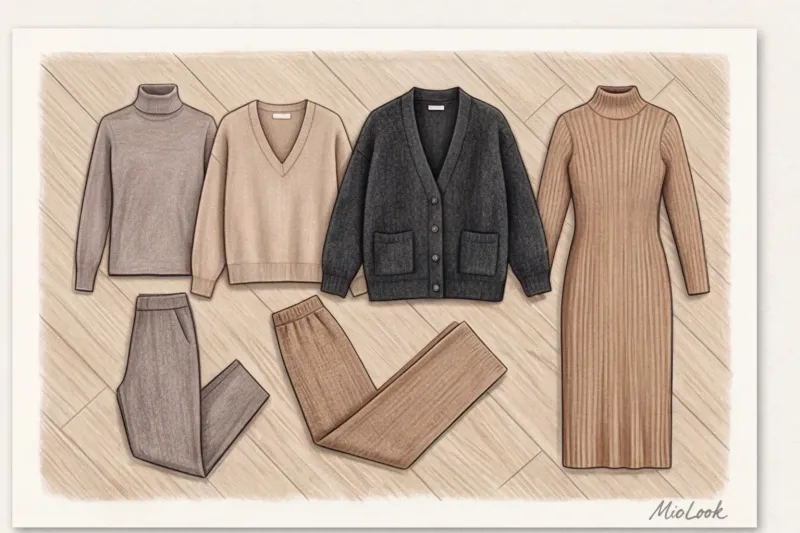
To ensure these tops will actually work with your current wardrobe and not sit as dead weight, I recommend digitizing your basic jeans and trousers in MioLook app The smart wardrobe builder feature will clearly show you whether your wardrobe is working out perfectly or if there's a gaping hole in the matrix.
Knitted bottoms: trousers and skirts with the right fit
Let's move on to the fifth and sixth elements of the capsule. While the tops can tolerate a touch of casualness, the knit bottoms require architectural precision, otherwise they will mercilessly highlight the slightest nuances of the figure and reveal the contours of the underwear.
Thick ribbed knit midi skirts — is a brilliant optical instrument. The texture of the fabric creates a continuous vertical line, which dramatically elongates the figure. The main quality criterion when trying on: the ribbing shouldn't stretch to a smooth surface at the widest parts of the hips. If the lines become distorted and zigzag, the garment is too small; feel free to go up a size.
As for pants, let's settle the eternal debate: joggers vs. palazzo pants. Joggers with elastic cuffs are strictly for the house, the cottage, or walking the dog. They lack an urban aesthetic. If you're looking for knit pants that you can wear to brunch, the movies, or even a creative office, choose only wide palazzo pants or straight pipes. They should have a wide, flat, stitched waistband (without protruding laces!) and be long enough to cover two-thirds of your shoes. Only then will they look classy.
Knitted dress: the solo investment of the season
The seventh and final element of our formula is a knit dress. It's the perfect "solo investment" for those mornings when you have exactly three minutes to get ready but still need to look your best. You don't have to worry about matching your top and bottom; the dress does all the work for you.
Three styles work best in the basic capsule: a midi-length noodle dress, a straight maxi in the spirit of minimalism in Jil Sander, or a laconic A-line silhouette. Avoid unnecessary embellishments, cable knits, or patch pockets—they cheapen the garment and quickly go out of style.
But the most important secret of an expensive image lies in "gap rule" There should always be air between your body and a knit dress—at least 2 centimeters. As soon as the knit becomes too tight and clings to your hips, the garment loses its luster and begins to bunch up in horizontal folds with every step. Don't be afraid to buy knit dresses a size larger than your usual—the loose, heavy flow of the fabric always looks more elegant than a constricting corset.
Color Palette: How Texture Changes the Perception of Shades
At the design institute, during our coloristics lectures, we were taught one golden rule: color doesn't exist separately from texture. When it comes to a basic knitwear wardrobe, many people habitually reach for pure black, believing it to be the most versatile. And they're making a stylistic mistake.
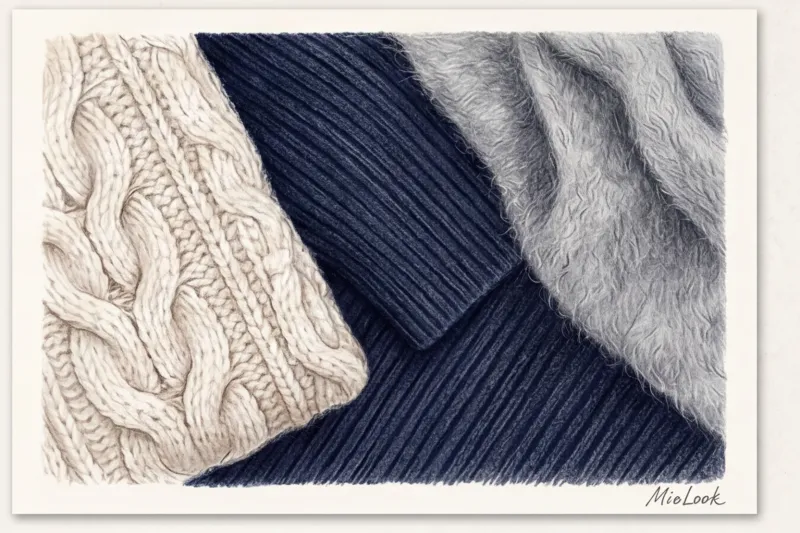
As a certified colorist, I can explain this phenomenon in terms of the physics of light. The fuzzy, matte surface of wool or cashmere acts like a microscopic sponge—it absorbs and randomly scatters light. Because of this, the knit literally "eats" the color, reducing its original contrast and saturation. If you place smooth black silk, a velvet jacket, and a black cashmere sweater side by side, the latter will appear dusty, flat, and more of a dark anthracite. The smooth texture reflects light in a targeted manner, giving the pigment a bottomless depth, while the cashmere's down muffles this light.
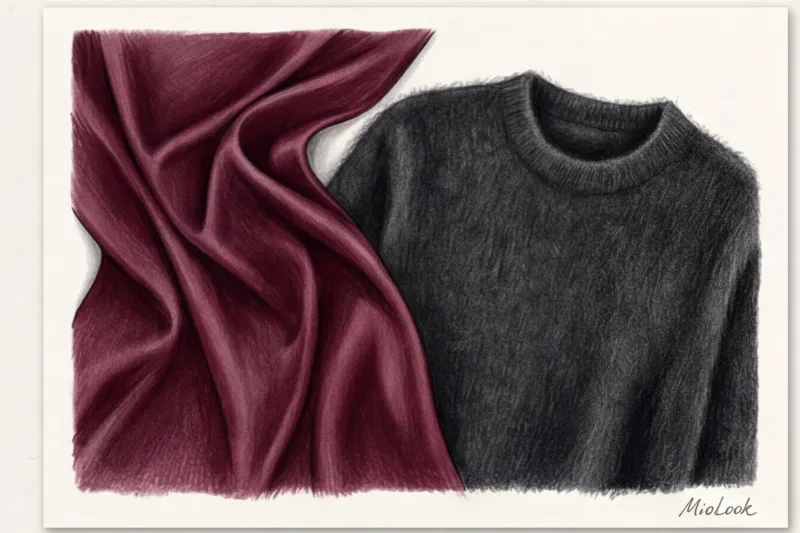
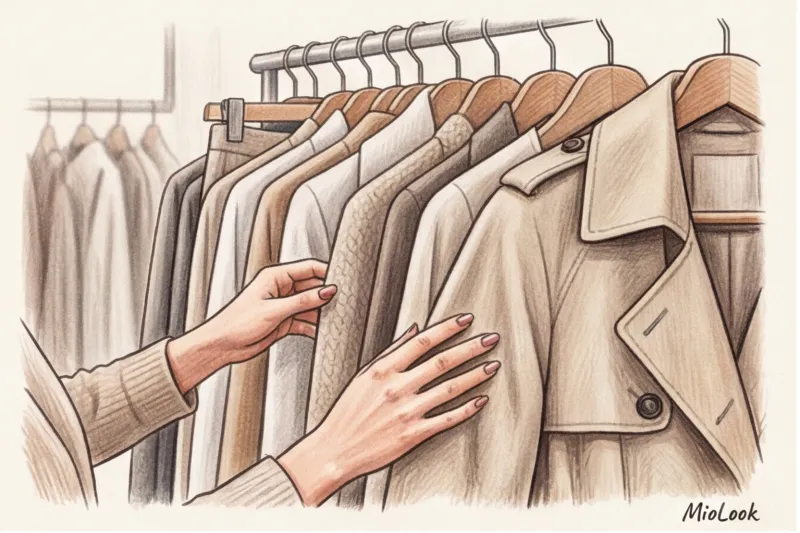
That's why pure black isn't the best investment in basic knitwear. Remember how you felt in stores: often, a dark jumper on the hanger looks washed out even before you try it on. If you want a statement piece, choose complex, mixed shades. Camel, deep chocolate, graphite, milk, and navy blue all reveal themselves phenomenally in this yarn.
- Camel and milky (ecru) They retain the natural warmth of sheep's wool. The dye adheres to them as naturally as possible, without highlighting the redness of the face in the cold, as pure white does.
- Graphite and melange grey — a salvation for lovers of dark palettes. Inclusions of light threads create a 3D effect, making the texture richer.
- Chocolate and dark blue They serve as the perfect alternative to black. A basic dark chocolate-colored jumper for €120 will visually feel like it costs €500, because the brown pigment in the wool creates beautiful golden highlights that flat black simply can't.
Understanding this optical illusion is the key to creating luxurious monochrome looks. A knit monochrome is the height of style, but simply pairing a beige sweater with beige knit pants of the same weight risks creating a sloppy silhouette. To make this look work, use the "texture jump" rule.
Pair matte with glossy. Since the fuzzy texture of a sweater absorbs light, a highly reflective piece would be the perfect pairing within the same color. For example, a fluffy ecru alpaca sweater paired with a smooth satin skirt or heavy denim pants with a subtle sheen. The difference in how the materials reflect light will create that architectural complexity, even if you're wearing very simple pieces.
And be sure to pay attention to the color temperature. All elements of a monochrome look should be of the same warmth. A cool taupe will kill a warm caramel shade, making it look dirty. To avoid making mistakes with undertones when creating such complex ensembles, I recommend running items through a color temperature test. the "smart wardrobe" feature in MioLook — the algorithm will help identify whether the temperatures of items conflict with each other, even at the image planning stage.
Access to MioLook for €0.99 — one-time payment
Start creating perfect images with the help of artificial intelligence
Get access — €0.99 onceStatement Styling: How to Wear Expensive Knitwear
Have you ever noticed how a basic knitwear wardrobe always looks like a million bucks in The Row or Brunello Cucinelli lookbooks, while in real life, a similar jumper often turns your figure into a shapeless cloud? The answer lies not in the price tag (a decent sweater can be found for €80), but in the geometry of the styling. Knitwear is a fluid, relaxed fabric. If you don't define its visual boundaries, the silhouette instantly "blurs."
The main axiom I teach in my personal style workshops is the rule of contrasting textures. Never wear knitwear with knitwear unless it's a designer-designed one-piece suit. Soft knits actively absorb light, so they require opposing materials that reflect it. Smooth leather, flowing cool silk, or crisp raw denim are your best bets. A voluminous chunky knit cardigan over a satin slip skirt will always look far more interesting than paired with knit trousers.
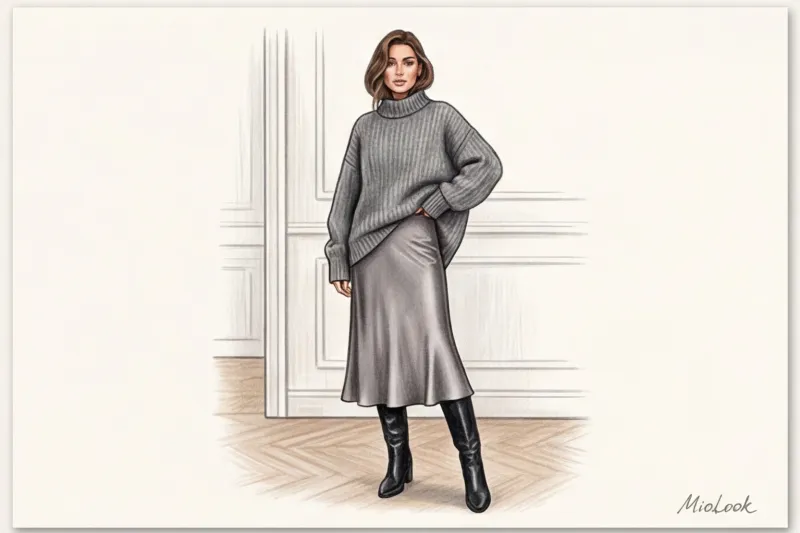
In my image-education practice, I have a visual trick that demonstrates the power of detail. During fittings, we take a basic merino sweater and pair it with wide-leg trousers. In its purest form, this is a classic uniform for a "weekend in the country" scenario—comfortable, but too relaxed. However, add a smooth leather belt at the waist (right over the sweater) and carry a rigid bag—and the look instantly transitions into the "creative office" category. You're not changing the clothes; you're changing their structure by adding a frame.
Remember the formula for a luxurious everyday look: 70% softness + 30% firmness. Without this balance, even premium cashmere risks looking like cozy, but still pajamas.
The second technique that dramatically increases the style level is architectural layering. It's not just a way to stay warm, but a powerful tool for enhancing an outfit. A heavy cotton shirt (made of crisp, shape-holding poplin) worn under a voluminous sweater, with the collar and cuffs exposed, creates the necessary rigid frame around the face and wrists. The reverse scheme works equally effectively: a thin turtleneck worn under a tailored men's jacket. The smooth wool of the jacket disciplines the soft collar of the turtleneck, creating a composed and dynamic silhouette.
Finally, the role of accessories is crucial. The importance of strong lines is paramount: a relaxed knitted outfit literally falls apart when paired with suede Uggs and a shapeless tote bag. Shoes with a sharp, pointed toe (such as Cossack boots, thick leather loafers, or sock-like ankle boots) and a structured bag act as visual anchors, pulling the soft knit look together. To train your eye for such stylistic contrasts, I highly recommend digitizing your pieces and uploading them to MioLook — by putting together outfits in a virtual wardrobe, you'll instantly see where the look lacks a smooth texture and where it lacks strict geometry.
Care and Storage: How to Protect Your Wardrobe Investment
According to a 2023 study by the European Institute of Textile Care, approximately 70% of premium sweaters lose their original appearance within the first year of use. This isn't due to defects or poor-quality raw materials, but to a simple lack of understanding of the basic physics of fiber. A well-crafted basic knitwear wardrobe is a financial investment that can last for decades, provided you avoid three fatal mistakes.
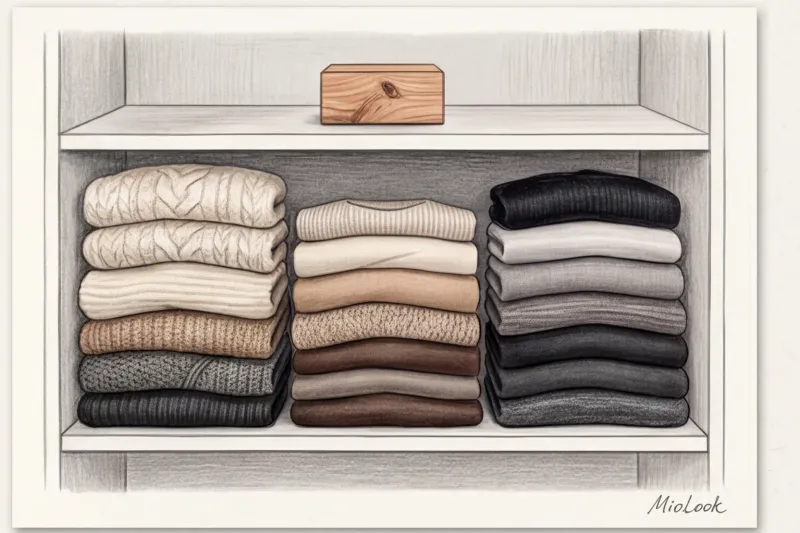
The first and absolutely immutable rule I explain at every wardrobe review: forget about hangers forever. Even if they're expensive, ergonomic cedar hangers or velvet-lined models. Knitted fabric is highly elastic and noticeably heavy. Under the influence of gravity in the closet, loops inevitably stretch, the shoulder line deforms, creating unsightly "loop-outs," and the length of the garment increases by a size or two. The only reliable way to store clothes is folded on shelves or in drawers. I recommend folding bulky cardigans and jumpers using the loose roll method or the classic rectangle, leaving a little "air" between them to prevent the nap from clumping.
The second problem that causes the most stress is pilling. "I bought a sweater for €300, and it fell apart after a week, it's a fake!" — I hear this all the time. Let's examine the anatomy of pilling. Pilling occurs due to mechanical friction, when the shortest fibers of the yarn are pushed to the surface and tangled. This is a completely natural process, which even happens to premium Scottish cashmere where it comes into contact with a bag strap, a seat belt, or a coat lining. Typically, the active pilling phase ends after two or three washes, when all the "loose" short fibers leave the structure of the yarn. Your best ally here isn't a razor (it cuts the yarn itself, thinning the fabric) or a pumice stone, but a high-quality electric pilling machine with a wide blade and adjustable height.
The third and most pernicious myth in the industry is that fine wool can only be dry-cleaned. In fact, the harsh chemical solvents used in dry cleaning mercilessly strip the natural lanolin from the fibers. The yarn becomes dry, stiff, and brittle. The paradox is that water is what releases the fluff in cashmere and merino wool, restoring their pristine softness and volume.
Over the years of working with premium formulas, I've developed the perfect at-home spa care algorithm for knitwear, guaranteed to extend the life of your favorite items:
- Cleansing: Fill a basin with cool water (no more than 30 degrees Celsius) and add a drop of a specialized lanolin-based product or regular baby shampoo (it has the perfect pH balance for hair). Soak the sweater for 10–15 minutes. Never rub the fabric—just gently squeeze it with your hands, like a sponge.
- Rinsing: Change the water to clean water absolutely the same temperature A sharp change in temperature is the main reason why wool shrinks irreversibly.
- Spinning without twisting: Remove the item in a lump. Lay a large terry towel on the table, place the sweater on it, roll them together into a tight roll, and gently press down with all your weight. The towel will absorb up to 80% of the moisture.
- Drying: Lay the item out on a dry towel, strictly on a horizontal surface, away from radiators, giving the sweater its original shape.
"Regular gentle washing only makes high-quality knitwear better—with each contact with water, the yarn fluffs up, becoming softer and warmer."
To avoid getting confused with your care schedule, remembering to clean your clothes from pilling on time and keeping track of which styles you wear most often, I strongly recommend digitizing your capsule in MioLook Visualizing your wardrobe in the app helps you manage your belongings more mindfully and carefully.
Your ideal image
it begins Here
Join thousands of users who look flawless every day with MioLook.
Get access — €0.99 onceChecklist: Building a Basic Knitwear Wardrobe from Scratch
According to statistics from the research agency McKinsey (2024), modern consumers wear an item of clothing on average only 7-10 times before discarding it. For knitwear, this figure is even more dismal: impulse purchases of soft sweaters often end up as dead weight on the shelves. To ensure your basic knitwear wardrobe If you want it to work for you for years, not just until the first wash, you need to approach its formation with cold calculation and a clear strategy.
The first step is a ruthless audit of your current condition: get rid of stretched and pilled items. In my practice, I call this the "survival test." Lay out all your knitwear on your bed and perform a rigorous filtration. Pull the elastic at the cuff or hem: if it doesn't immediately return to its original position, the item has exhausted its structural resource. If a sweater has stretched out at the elbows and the pilling (pilling) can no longer be removed with a special machine, don't delude yourself into thinking "I'll save it for the summer house." This simply transfers clutter from one location to another. Keep only those items that hold their shape impeccably.
For my clients, the audit process always ends with the digitization of surviving positions. After uploading the database to MioLook , you will clearly see your real gaps and stop buying unnecessary duplicates forever.
The second step is to prioritize your purchases wisely: where to start. Don't try to update your entire capsule wardrobe in one season. Your starting capital should consist of just two fundamental pieces: a perfect turtleneck made of fine merino wool and a quality structured cardigan.
Why choose these? A thin, smooth turtleneck is an architectural base layer. It allows you to wear summer silk dresses in winter, and layers flawlessly under tailored shirts, jackets, and oversized sweaters. A thick-knit cardigan serves as a top layer, elegantly replacing a crisp jacket in offices with a relaxed dress code. Only when these two options are met does it make sense to move on to statement jumpers or knit trousers.
Finally, the third and most important rule is to calculate your budget using the cost-per-wear formula. The math behind conscious style is crystal clear. Let's compare two scenarios. You buy one impeccable, heavy sweater for €150, which you'll wear twice a week for three seasons (that's about 150 times). Its real cost is only €1 per time.
The alternative is to buy three mediocre jumpers made of loose acrylic for €50 each. They'll become misshapen and covered in unsightly pilling after just a month of active wear (maximum 10 times each). In this case, the cost-per-wear skyrockets to €5. The numbers speak for themselves: it's mathematically more profitable to buy one sweater for €150 than three for €50.
Beyond the dry statistics, there's also a psychological aspect. When you put on a cheap, shapeless sweater, you subconsciously feel insecure all day long: you tug at the hem, tug at the stretched sleeves, and tuck them under the table during meetings. Is this perceived savings worth your comfort and status?
Your action plan for today:
- Take stock of your shelves now: put aside at least three items that have long since lost their marketable appearance and send them to a textile recycling center.
- Check if you have a quality basic turtleneck in shades of chocolate, graphite, or camel. If not, put it at number one on your shopping list.
- Before your next knitwear purchase, always divide the price by the expected number of garments.
The architecture of comfort abhors fuss. Choose dense textures, carefully read the ingredients on labels, don't be afraid to mix soft yarns with stiff fabrics, and your looks will always exude confidence.
Guide Chapters
Basic Sweater Colors: How to Choose the Perfect Palette
The standard "black, white, beige" rule in knitwear often leads to boring looks. Learn how to choose the perfect palette to suit your appearance.
How to look expensive in knitwear: stylist secrets
Expensive cashmere doesn't always guarantee a perfect look. We'll share some style engineering tips to help you look chic in an ordinary sweater.
What to wear with a knitted suit to look classy
Knit suits aren't just for the home. Discover the secrets to styling soft sets for elegant urban looks with a touch of quiet luxury.
What to wear with a knitted vest: fashionable outfit ideas
A knitted vest is the perfect tool for creating trendy layering. Learn how to transform a boring basic into dozens of stylish looks.
What to wear with a knit dress and how to hide flaws
A knit dress is a powerful tool for visually shaping your figure. Learn the secrets of choosing the right fabric from an experienced stylist.
How to Wear a Cardigan: Creating an Expensive Look
Thin knitwear can ruin even the most stylish outfit. We'll discuss with a stylist how to choose a quality cardigan and what to pair it with.
How to Properly Store Knitwear: A Complete Care Guide
Knitwear isn't just a simple fabric, but a complex, flexible structure. Discover stylist secrets that will save your favorite sweaters from stretching and losing their shape.
What knitwear doesn't pill: choosing the perfect sweater
Buying expensive cashmere doesn't guarantee pilling protection. We'll explore the underlying causes and learn how to choose truly durable knitwear.
How to wear an oversized sweater without looking fat
Why does one oversized sweater make you look slimmer, while another adds extra pounds? Learn the secrets of oversized style from a professional stylist.
What to wear with a women's turtleneck to look expensive
A turtleneck isn't just a boring thermal layer; it's an architectural wardrobe staple. Let's explore how to choose the perfect turtleneck and create classy looks with it.
How to Choose Quality Knitwear: A Materials Guide
A 100% natural composition doesn't guarantee durability. Learn to "read" the fabric itself to prevent your sweater from pilling in a week.