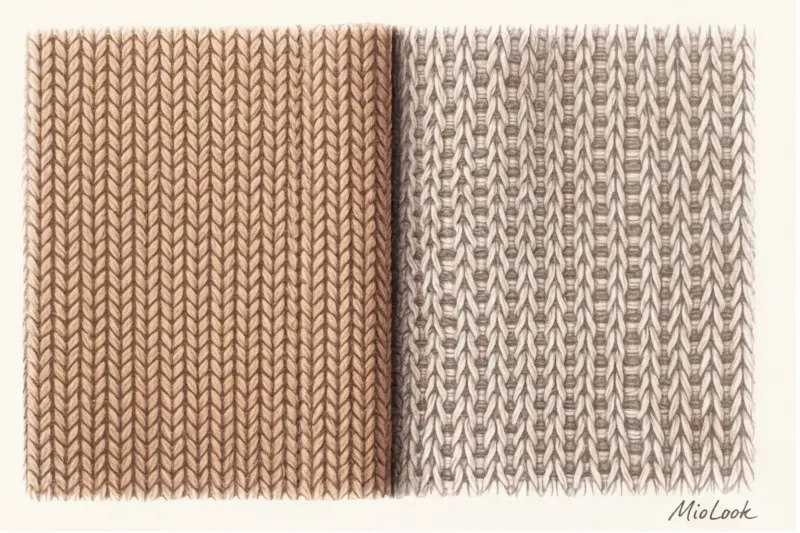
One of my clients, let's call her Anna, once proudly showed me her haul at a sale: five jumpers with the coveted "100% Cashmere" tag. She spent about €250 on everything, happily announcing she'd beaten the system. A week later, we met again. Her "investment" knitwear had developed stiff pills on the sides from her crossbody bag, her elbows had been irrevocably stretched, and her collar had become an untidy billow. Instead of the look of a successful woman, she had the effect of worn-out pajamas.
This story is a classic illustration of the biggest shopping mistake. We're used to blindly believing the ingredients on the label, forgetting that 100% natural ingredients can be of catastrophically low quality. If you want to understand, How to choose high-quality knitwear , you will have to stop reading only the composition and start “reading” the fabric itself.
I talked in more detail about what exactly the base is conceptually built from in our complete guide. A Basic Knitwear Wardrobe: How to Put Together a Capsule Today, we'll delve into materials science. I'll show you the inside story of the industry and explain why sometimes 20% synthetics isn't a brand saving grace, but a brilliant engineering solution that saves your garment.
The Anatomy of the Perfect Sweater: How to Choose Quality Knitwear Beyond the Label
Over 12 years of working at fashion weeks and conducting personal wardrobe reviews, I've developed the concept of "the architecture of comfort." Good knitwear doesn't hang like a shapeless rag; it holds the shape the designer intended—be it the stiff shoulder of a cardigan or the sculpted turtleneck.
The composition tag only tells you the origin of the material. It's silent about three critical parameters that truly determine the status of an item:
- Staple length: The longer the fiber, the fewer ends protrude from the thread. Short fibers (tow) will always be cheaper. These are the ones that tend to come out of the yarn within a few days and form into those unsightly balls. Elite raw materials have fiber lengths of up to 34–36 mm.
- Thread twist: The difference between single-ply and double/quadruple (2-ply/4-ply) is dramatic. A 2-ply sweater is twisted from two strands, making it twice as durable and warm. Single-ply sweaters often warp after the first wash, causing the side seams to sag toward the belly.
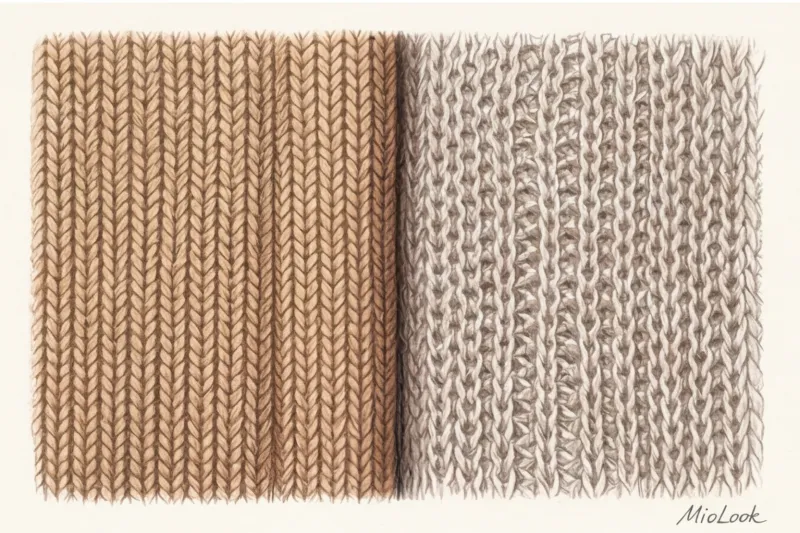
- Tension: Cheap mass-market brands save on raw materials by using a loose knit. On a hanger, the garment looks voluminous, but when held up to the light, it shines like gauze.
"When you buy a low-twist, short-pile sweater, you're not buying clothing, but a subscription to a constant battle against pilling and deformation"—that's what I repeat at every shopping trip.
Cashmere Illusion: An Investment or a Waste of Money?
The fashion industry has sold us the idea that cashmere is the ultimate luxury. But let's be honest: a €50 cashmere sweater is a pitfall of short pile. According to a McKinsey report (2022), the lifespan of such "affordable luxury" has been reduced to 7-10 wears, after which the garment loses its marketability.
According to the strict criteria of the Cashmere and Camel Hair Manufacturers Institute (CCMI), the undercoat (the undercoat, not the coarse outer hair) of Inner Mongolia goats is considered the standard. The thickness of this fiber is a phenomenal 14–15 microns. For comparison, human hair is approximately 70 microns thick.
How to spot a scam in a store? I have a counterintuitive tip. Don't buy extremely fluffy new cashmere.
A brand-new, high-quality cashmere sweater should be quite smooth; its nap develops gradually over several proper washes. If the item already looks like a fluffy cloud in the boutique, it was aggressively combed at the factory (to artificially create the illusion of softness). The threads are already damaged. Such a sweater will become bald and covered in pilling faster than you can carry it to the office.
Noble base: merino, alpaca and mohair
My experience shows that 70% of everyday wardrobes don't require cashmere at all. There are far more practical alternatives that work better, especially if you spend your days in meeting rooms, driving, and at a fast pace.
Merino wool: the workhorse of the office wardrobe
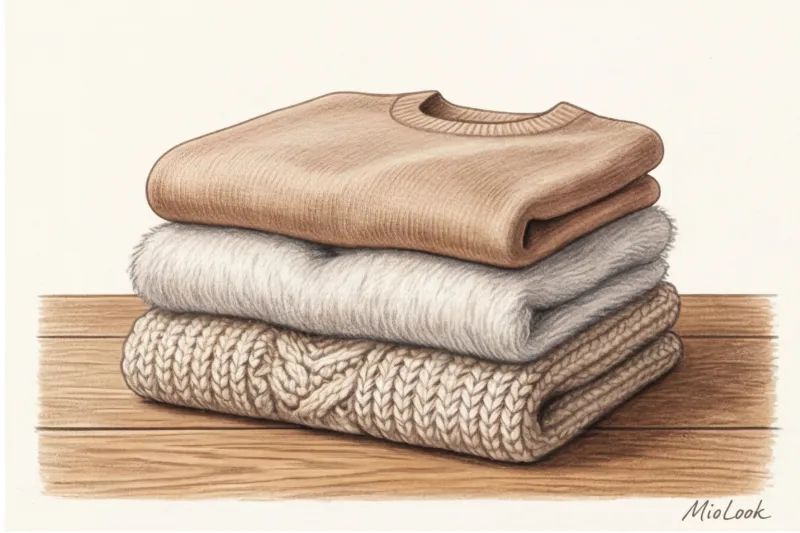
If you see The Woolmark Company certification, that's already a good sign. But look for the label Extrafine Merino The thickness of this fiber does not exceed 19.5 microns—this is the magic threshold. Anything thinner than 19.5 microns is physically incapable of itching, as the fiber bends upon contact with the skin rather than digging into it. This is the ideal material for thin turtlenecks worn under a jacket: it's warm, doesn't add bulk, and is suitable even for those with mild allergies.
Alpaca and mohair: textured accents
Wool Baby Alpaca (the first shearing of young animals) is hypoallergenic, as it does not contain lanolin, and paradoxically is 7 times warmer than sheep's wool due to the hairs being hollow inside.
Be careful with mohair, though. It adds a luxurious texture, but visually adds at least one size. If you have a full bust or broad shoulders, use mohair only in open cardigans to create a vertical line, rather than in turtlenecks.
Access to MioLook for €0.99 — one-time payment
A smart AI stylist will select the perfect look based on your proportions and fabric textures.
Get access — €0.99 onceBlended Fabric Engineering: When Synthetics Are a Blessing
Now let's debunk the main myth propagated by almost every glossy magazine: "Any synthetic material is evil." This is untrue. In textile engineering, there is a clear distinction between functional and cost-cutting synthetic materials.
If you're looking for a structured cardigan jacket (in the Chanel style) that should hold the shape of the shoulders, not pack out at the elbows, and fit like a glove, this is the one for you. necessary Nylon (aka polyamide) or elastane. The optimal ratio is 80% high-quality wool and 15–20% polyamide.
The polyamide in this bond acts like steel reinforcement within a concrete building. It bears the tensile load, while the merino wool provides warmth and tactility.
Bad synthetics: Acrylic and polyester. If you see 50% acrylic, put the item back. Acrylic is a plastic that imitates the bulk of wool. It doesn't retain body heat at all, but it creates a greenhouse effect (you sweat, but you're cold). Furthermore, acrylic is prone to static electricity and attracts dust.
The Saw Effect: The Bitter Truth About Pilling
Let's face it: absolutely any natural knitwear will pill. Even a €1,500 Loro Piana sweater will shed excess fluff within the first few weeks of wear. It's a matter of physics: short fibers are pushed to the surface and curl when rubbed.
The only difference is how the fabric behaves when pilled:
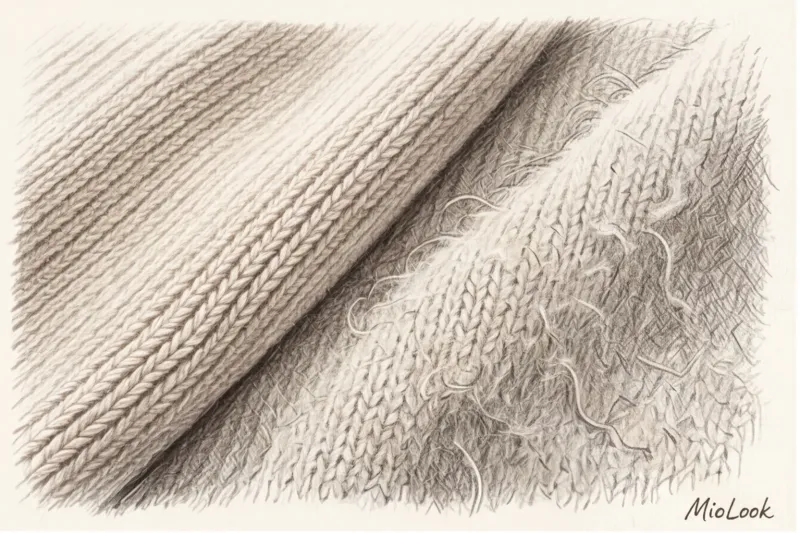
- On good cashmere: The pilling is large and loose, and you can easily remove it with your fingers without damaging the fabric. After a month or two of wear and proper care, the excess fluff disappears, and the garment stops pilling.
- On cheap acrylic or a mixture with polyester: The pellets are small, hard, and cling tenaciously to the fabric (polyester thread is much stronger than wool). If you try to remove one, you'll pull out the entire thread, ruining the texture.
Stylist's Checklist: 5 Tests to Consider Before Buying Knitwear
Enough theory. Here's a practical guide—5 steps I make clients do right in the fitting room. It takes a minute, but it saves hundreds of euros.
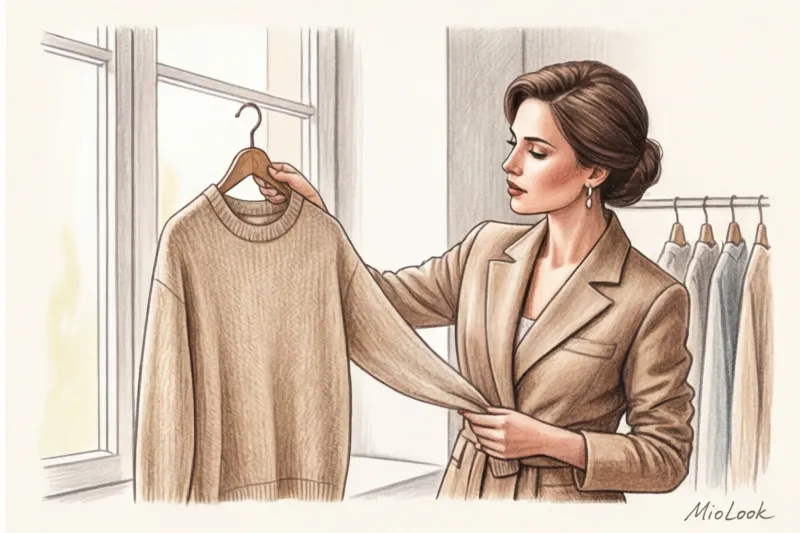
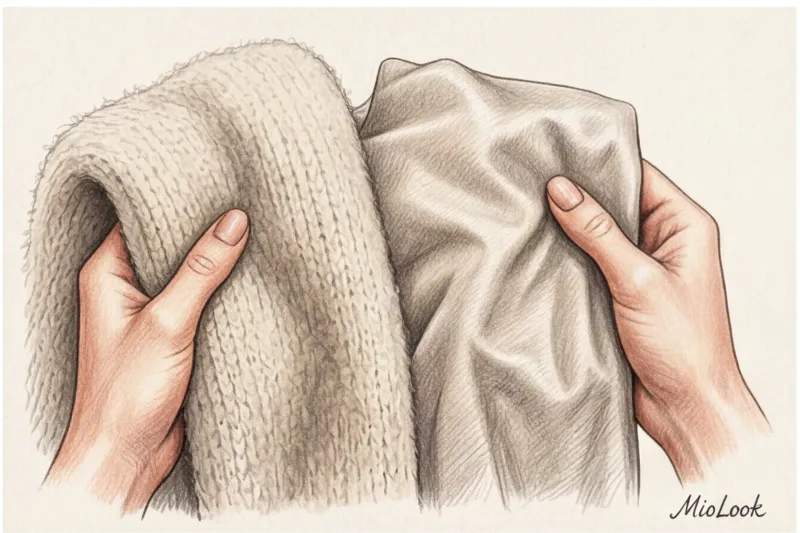
- Light test: Lift the item and hold it up to a light lamp through one layer of fabric. You should see a uniform, dense mesh of stitches. If the light shines through in uneven patches, the thread is poorly twisted, and the item will quickly wear out.
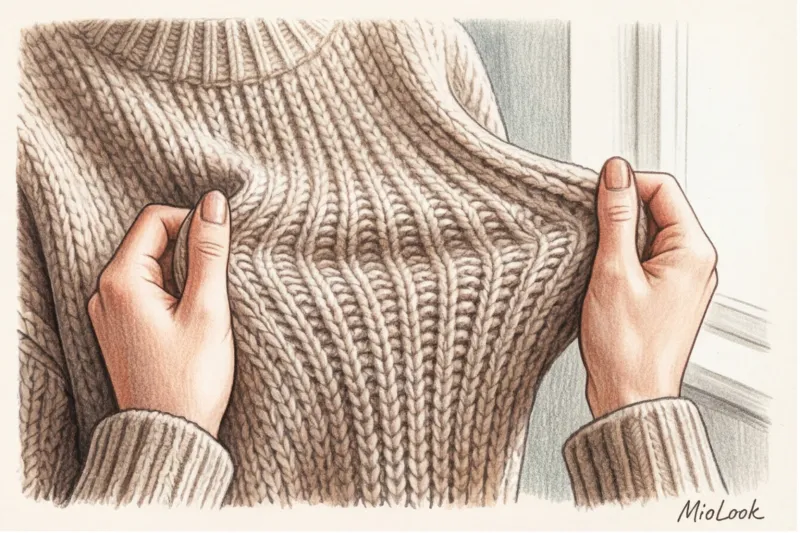
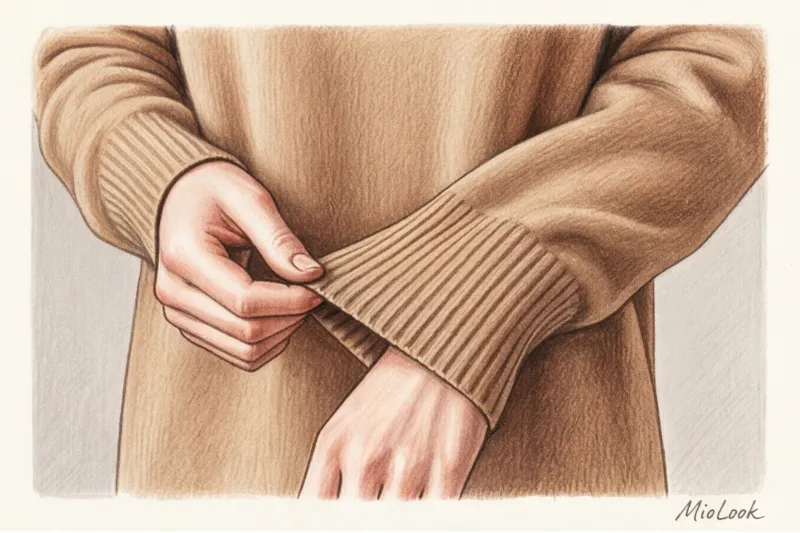
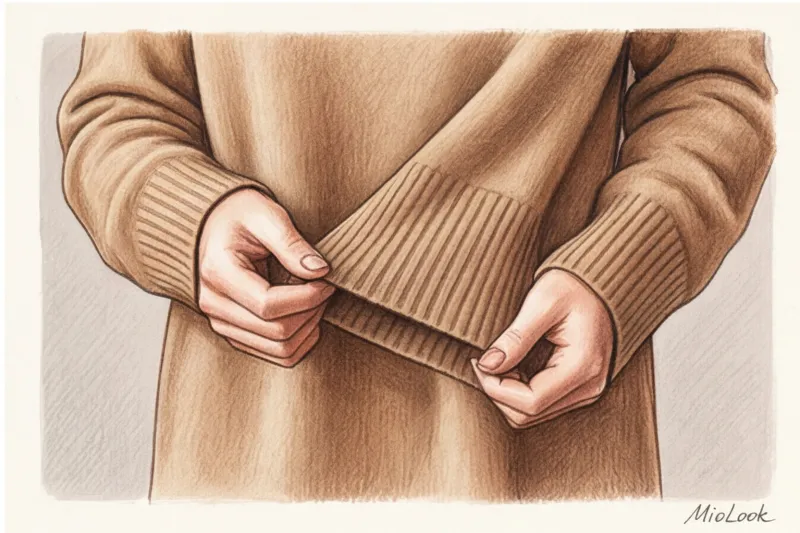
- Spring test (my favorite): Take the elastic on the sleeve cuff, stretch it outward with your fingers, hold for 5 seconds, and then release quickly. High-quality knitwear with the correct twist will snap back to its original shape instantly. If the cuff remains loose and stretched, the sweater is doomed. Disclaimer: this test does not work for overtly summery, lacy items made of cotton or gossamer mohair, as they have a completely different structure.
- Friction test: Fold the edge of the sweater over and gently rub the fabric against itself for about ten seconds. If fluff immediately forms on the surface, the fiber is too short.
- Seam test: Check the shoulder line. High-quality sweaters often have a thin silicone or cotton band sewn in there to prevent stretching. Look at the collar—it should be stitched on loop-to-loop, not simply overlocked.
- Tactile test for "fatness": Run your dry palm over the wool. Good merino or cashmere, not over-dried with chemicals, will leave a subtle, waxy softness (due to the natural lanolin). Acrylic and poor-quality wool will have a distinctive squeak under your fingers.
Your perfect look starts here
Join thousands of users who look flawless every day with MioLook Digitize your knitwear and create capsule collections in one click.
Get access — €0.99 oncePreserving Architecture: Golden Rules of Maintenance
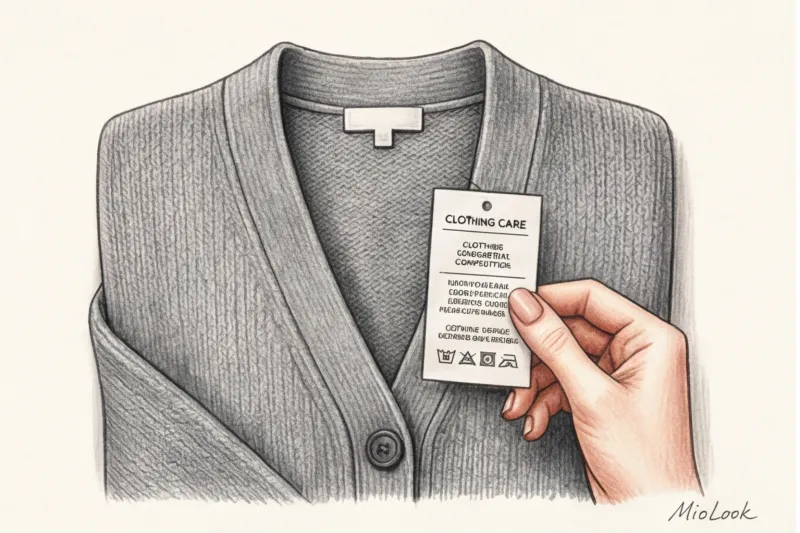
Buying the perfect item is half the battle. I've seen luxury cardigans destroyed in a single wash. The longevity of your knitwear essentials depends 80% on your wardrobe routine.
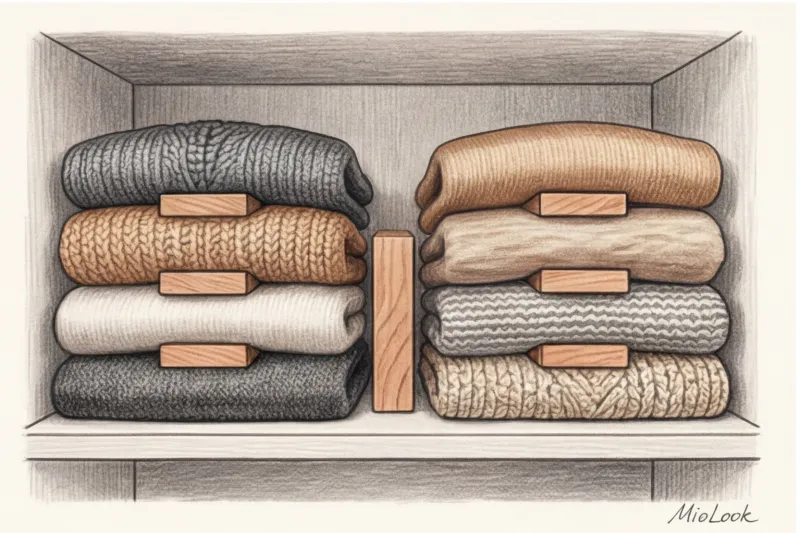
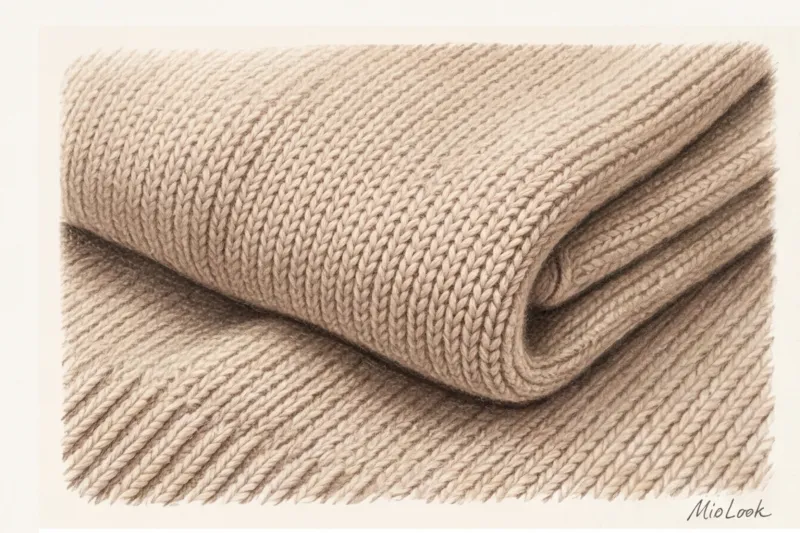
Remember the main thing: Hangers are the number one enemy of knitwear. The yarn stretches under its own weight, creating unsightly "ears" on the shoulders. Any knitted fabric should be stored folded and placed on a shelf.
When it comes to washing, the main cause of wool shrinkage isn't hot water per se, but sudden temperature changes. If you wash in 30°C water and rinse in ice-cold water, the fibers will experience shock and shrink (felting). The temperature should be consistent throughout the process.
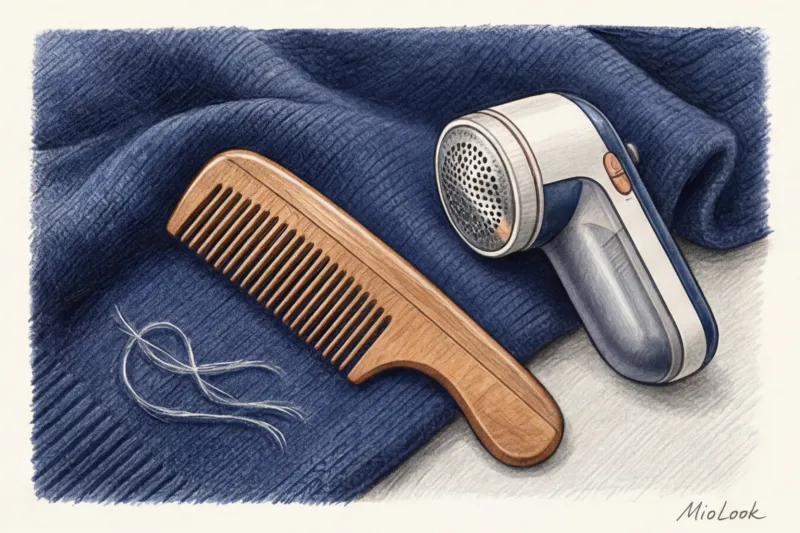
To care for the surface, have two tools in your arsenal. An electric clipper is ideal for dense merino and smooth blends. However, for delicate cashmere or fluffy alpaca, use only a special wooden comb—it doesn't cut the threads, but gently combs out only the hairs that have already separated from the base.
Ultimately, your wardrobe isn't a warehouse of random purchases, but a toolbox of self-expression. Spend money on the density of the fabric and quality of the materials, not on brands. These hidden details are what make a garment fit like a dream, day after day. And to ensure your investment in quality knitwear is fully realized, upload your ideal sweaters and cardigans to the app. MioLook — a smart algorithm will help you create dozens of new looks with one right basic item.
", "tags": ["knitwear", "capsule wardrobe", "cashmere", "style", "clothing care", "shopping", "basic wardrobe"] }