
The Evolution of Women's Business Attire: From Uniform to Tool of Influence
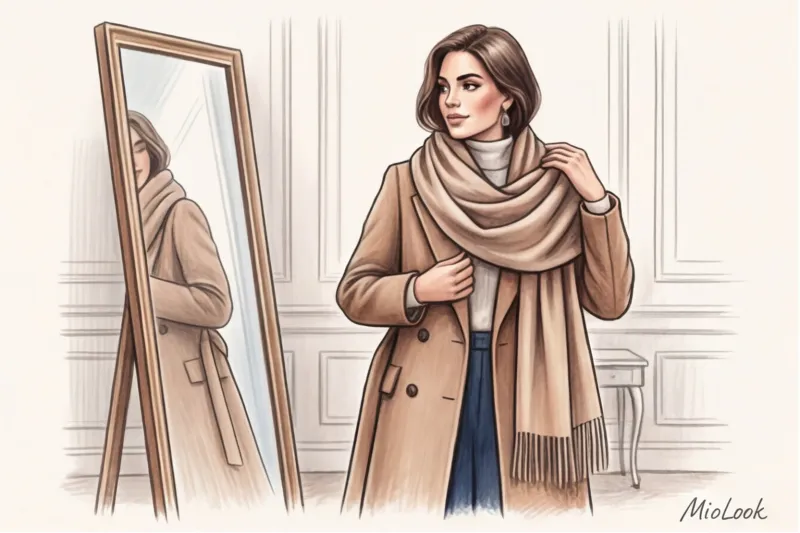
Over 12 years of working as a stylist for female executives, I've removed hundreds of stiff, uncomfortable sheath jackets from clients that restricted their movement. It used to be thought that to succeed in the corporate world, a woman had to literally encase herself in armor. But today, a well-designed business style clothing for women — it's no longer an attempt to squeeze into a man's game. It's your main strategic asset and a powerful non-verbal elevator pitch.
The era of aggressive power-dressing The 80s and 90s, with their exaggerated shoulder pads and deliberately rugged silhouettes, are gone forever. We no longer need to mimic men to have a voice in the boardroom. The rigid uniform has been replaced by "quiet luxury" and millimeter-precise styling. Feminine authority is now conveyed through architectural yet supple cuts—for example, flowing suits made of heavy silk crepe or jackets made of premium fine wool that respect the body's lines without clinging.
"Your clothes speak for you before you even speak. They're a statement of your ambition, wrapped in the texture of the fabric and the precision of the stitching."
The importance of this visual message is supported by the numbers. A large-scale study Center for Talent Innovation (now Coqual), dedicated to the concept Executive Presence (executive presence) has proven a harsh corporate truth: appearance acts as a ruthless primary filter. Experts have found that presentability and style weed out candidates even before their actual professional skills are assessed. If you're dressed in cheap, shiny polyester or a suit that's tight in the shoulders, your brilliant financial strategy will be viewed through a prism of doubt about your status.

This has become especially acute in the post-pandemic era of hybrid work. With some meetings taking place on Zoom and others in the office, the business dress code hasn't disappeared; it's become less formulaic, but much more demanding regarding the quality of materials. Today's hybrid office blurs rigid boundaries: classic suit trousers are now legally mixed with grained leather loafers and simple jumpers. But this relaxed appearance is deceptive—the simpler the uniform, the more expensive the execution. I discussed how to balance this balance without losing professionalism in more detail in my article about business casual for women.
To manage this new, more refined dress code and avoid wasting mornings trying to pair a tailored blazer with knitwear, a systematic approach is needed. One of my regular clients, a top manager at an IT company, radically solved the packing problem: we transferred her entire closet to digital. By uploading basic items to MioLook smart wardrobe She prepares capsules for the week ahead. This allows her to invest her morning time in preparing for difficult negotiations, confident that her appearance has already boosted her credibility.
Psychology and Status: Why Your Image Is a Business Investment
Have you ever noticed how your posture and even the timbre of your voice changes when you put on a perfectly tailored jacket made of thick fabric? This isn't esotericism, but a scientifically proven phenomenon, known in psychology as enclothed cognition (embodied cognition). In a renowned study from Northwestern University (USA), scientists demonstrated that the physical quality and symbolic meaning of our clothing literally transform our cognitive abilities. When you wear a suit associated with high status and competence, your brain becomes more alert, you make decisions faster, and your skills in complex negotiations reach a whole new level.
In the upper-class corporate world, status isn't conveyed by flashy logos. True luxury is conveyed through subtle cues that others perceive subconsciously. Chief among these is the uncompromising distinction between natural and synthetic fibers.
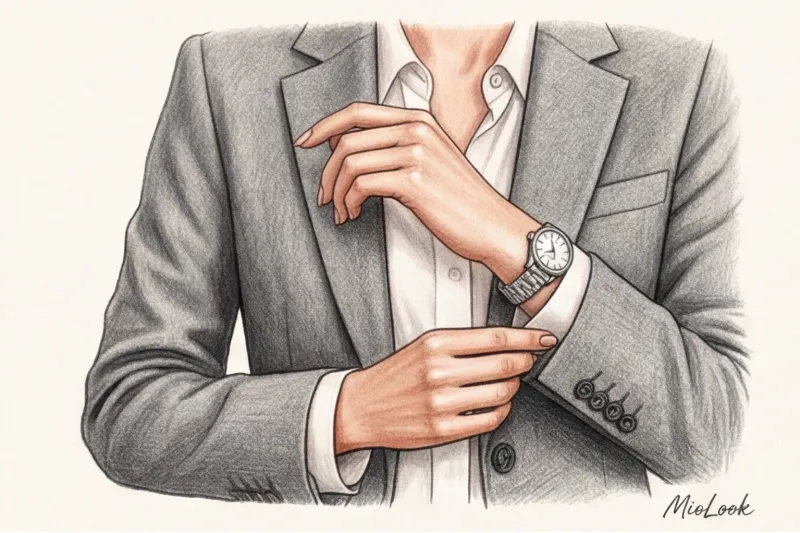
A silk blouse flows and reflects light differently than polyester. Cheap synthetics not only look flat but also treacherously retain odors, inevitably compromising your body temperature mid-day. The second most important factor is a perfect fit. Standard mass-market sizing is designed for an average figure, which simply doesn't exist in nature. A gap between the jacket collar and neck, a stretched armhole, or an incorrect sleeve length immediately betray a compromise. Therefore, a tailor-tailored garment (a perfect fit) always outperforms an expensive but baggy brand-name original.
Buying cheap work clothes isn't a savings measure, but a double loss: both financial and reputational. Your appearance is a nonverbal promise of the quality of your professional skills.
Here we come to the concept Cost-Per-Wear (CPW) Or "cost per outing"—the key tool for a financially savvy business wardrobe. Let's calculate the real ROI (return on investment) using outerwear as an example.
Take a classic Max Mara camel coat made of premium wool and cashmere. Yes, the initial investment is around $2,500. However, the brand's cut remains timeless for decades, and the quality of the fabric allows it to last at least five years with proper care. Wear it 100 times per season for five years, and you'll earn a CPW of just $5 per wear.
Now let's look at a mass-market alternative: a $200 coat made of a blended fabric with a high percentage of acrylic. It will pill, lose its shape in the shoulders, and look sloppy after just one season. Over the same five years, you'll be forced to buy five such coats, spending $1,000. The difference in cost seems to favor the cheaper option, but the image math works differently: for those five years, you'll look like a compromise every day, conveying to clients and partners a habit of skimping on the most important things. Your business capsule is as much a business asset as a specialized education. Invest in it wisely.
Access to MioLook for €0.99 — one-time payment
A smart AI stylist will select the perfect business look for every day and help you put together a stylish capsule wardrobe for important meetings.
Get access — €0.99 onceOffice Dress Code Levels: A Corporate Standards Navigator
Recently, the CFO of a large technology holding company approached me with a request for a complete wardrobe overhaul. The trigger was an unpleasant but revealing situation: on Friday, officially considered "casual Friday" at the company, the chairman of the board unexpectedly convened an in-person board meeting with key investors. My client arrived at the office wearing a relaxed oversized cashmere sweater and straight-leg jeans. The investors, however, had arrived from their own meetings wearing formal suits.
"I physically felt my authority dwindle with each passing minute as I described budgets worth tens of millions of euros in a sweater more suited to Sunday brunch," she confessed to me. This incident perfectly illustrates a fundamental rule: failing to "read" a company's unspoken culture and the context of the situation is a direct threat to your career.
Be underdressed (Dressing too simply) at a critical moment means voluntarily renouncing visual dominance. Your clothes convey frivolity where absolute seriousness is required. But the opposite situation is also true, when you overdressed (dressed too smartly or formally for the given environment) creates an awkward distance. Imagine an IT director in a three-piece suit at an internal hackathon—she would look alien and unapproachable.
With the team working on a hybrid schedule, moving between home Zoom, coworking, and glass-paned conference rooms, understanding the unspoken rules has become more difficult. business style clothing for women Today, it's the ability to delicately navigate between strictness and comfort. To avoid getting lost in corporate standards, I recommend relying on three basic levels.
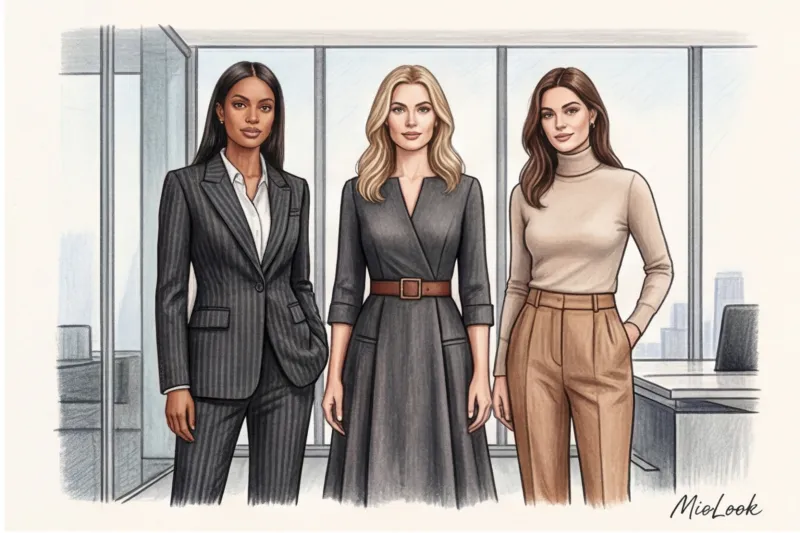
Business Formal and Boardroom: Top Management Level
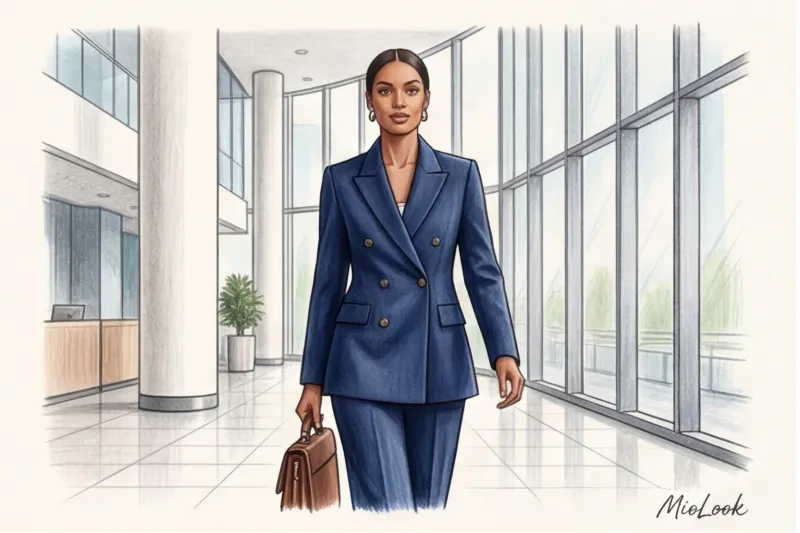
When the stakes are at their highest—merger negotiations, court hearings, boardroom meetings—Business Formal, or, as it's often called in business circles, Boardroom Dress Code, comes into play. There's no room for self-expression through extravagant tailoring. This is a realm of pure, absolute power, expressed through the quality of fabric and uncompromising lines.
Boardroom rules are strict. They always require full suits (jacket and trousers, or jacket and skirt, all in the same fabric). Shoes must be strictly closed: no open toes, low-cut heels, or sandals, even if it's 30°C outside. Classic pumps with a 5-7 cm heel or elegant handmade Oxfords are ideal. The color palette is kept as muted as possible. Deep navy, graphite, charcoal, and cool taupe convey stability and reliability better than words.
In this segment, status is determined not by logos, but solely by fit. That's why Bespoke (custom tailoring from scratch) or Made-to-Measure Made-to-measure tailoring (using ready-made patterns) is the undisputed gold standard. A suit should fit like an architectural design. The fabric is Super 120s spun wool, with a natural silk lining and horn buttons. The slightest creases in the sleeves or the wrong length of the trousers immediately reveal the production line. Invest in the right cut, and it will pay off with your first successful sale.
Business Professional: Confident Expert Standard
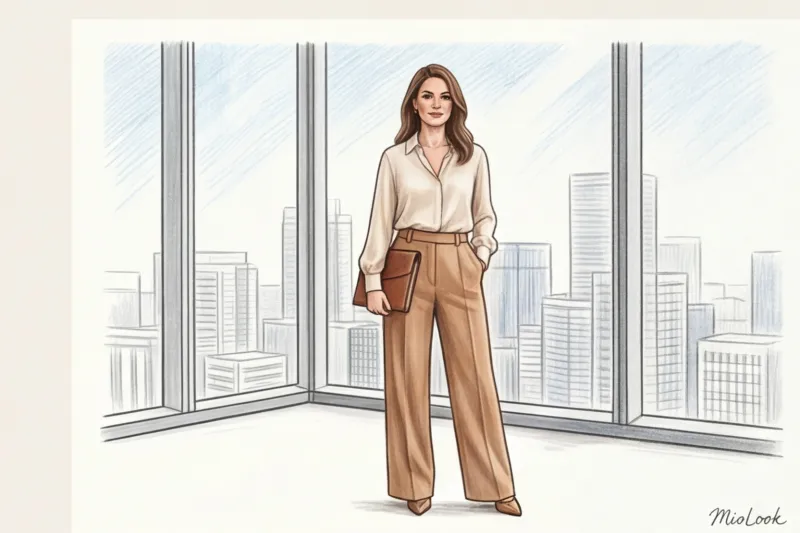
This is the traditional daytime dress code for most conservative offices, banks, and consulting agencies. Unlike the Boardroom, you're no longer required to wear a tailored suit, but the level of professionalism remains high. This is a field for intellectual stylistic play.
The basis of Business Professional is the so-called separates (separate elements) that combine flawlessly. For example, a structured jacket in thick wool paired with a pencil skirt in a contrasting fabric, or a perfectly tailored sheath dress with a fitted blazer. The color palette is expanding: emerald, deep burgundy, muted mustard, and pastel tones are all acceptable.
The psychological challenge at this level is to balance authority and approachability. You should appear as a competent expert, someone your subordinates feel comfortable approaching for advice. This effect is achieved by softening textures. Swap a stiff cotton shirt for a crisp silk blouse with a soft collar, or choose a fine merino jacket over a heavy tweed.
Managing such a wardrobe manually and keeping all the combinations in mind can be difficult. To avoid standing in front of an open closet in the morning, my clients digitize their clothes. If you upload basic skirts, trousers, and blouses to the "smart wardrobe" feature in MioLook , the algorithm will automatically analyze colors and textures, suggesting dozens of new combinations for Business Professional from what's already hanging on your hangers.
Smart and Business Casual: The Dangerous Comfort Zone
This is perhaps the most insidious level of dress code of all. The word "casual" itself is often perceived as a license for casual casualness. However, make no mistake: the word "business" still comes first in this format.
This is not weekend wear. Distressed denim is strictly prohibited, even if it's a Maison Margiela collectible, as are loose knits that lose their shape after a couple of hours of wear, crop tops, and any footwear that even remotely resembles beachwear.
How do you elevate a relaxed look to a professional level? The secret lies in a strong structure. For example, you could wear straight-leg, unworn dark blue jeans and a basic white T-shirt made of heavy cotton, but be sure to top it off with a structured blazer with sharply defined shoulders.
In relaxed looks, it's the statement accessories that do all the work of maintaining your authority. Add a sturdy tote bag in smooth Italian leather (which doesn't sag when you set it down on a table) and premium shoes—classic penny loafers in polished calfskin. These composed, solid shapes act as anchors, preventing your silhouette from slipping into casual sloppiness.
"Never confuse comfort with casualness. In business, casualness should be calibrated to the millimeter. Even if you're wearing a basic cardigan, the quality of its yarn and fit should speak volumes about your status more than any logo."
Wardrobe Investment Portfolio: What You Shouldn't Skimp On
If your closet were a real brokerage account, many women would be deep in the red due to the abundance of "junk stocks." When creating a status wardrobe, the 80/20 rule works reliably: exactly 80% of your budget should go to the 20% of items you wear every day and that form the structural framework of your look. Buying fifteen occasional blouses instead of one perfect jacket is a surefire way to morning neurosis in front of your open closet. A well-designed business style for women is based on a clear understanding of what is an asset and what is a liability.
Let's talk about toxic assets—the tissues that sabotage your success and literally cheapen your professional weight. Rule number one: avoid thin viscose in waistbands (trousers and skirts). This material tends to develop treacherous creases the moment you get into a taxi. By the time you arrive at the boardroom, you'll look like you slept in it. But the absolute anti-leader of the corporate world is cheap 100% polyester.
A scientific fact rarely mentioned by stylists: low-quality synthetic fibers have oleophilic properties. They don't just make you sweat; they act like a sponge, attracting and permanently trapping skin oils and bacteria. You can wash such an item daily, but by 3 p.m. in a stuffy conference room, it will begin to smell stale. Save pure synthetics for the gym. Your best bet is cool wool, dense silk, cupro, and blended fabrics where synthetics (no more than 15-20%) are added solely for durability.
The Ideal Women's Business Suit: The Anatomy of the Cut
When you're sitting at a negotiating table, your interlocutor sees only your profile. That's why the shoulder line of your jacket is your primary visual anchor of authority. If the shoulder seam slips down or wrinkles, you appear smaller, weaker, and less confident. A straight, well-defined shoulder instantly pulls your silhouette together and conveys control of the situation.
"The difference between a suit that just fits you and one that works for you is hidden from view. It's the architecture of the inner layers that distinguishes mass-market fashion from fine tailoring."
As an expert raised on the traditions of Italian tailoring, I owe it to myself to explain the difference between two jacket-making techniques. Cheap jackets are made using fused fabric. When exposed to dry cleaning or even rain, this fused fabric begins to bubble at the lapels, ruining the garment forever. A true investment is a jacket with canvas interlining made of horsehair and cotton. With the warmth of your body, the canvas literally "memorizes" the contours of your ribcage and fits like a glove. The suit becomes your second skin.
The mathematics of trouser cut is equally important. Remember the golden rules of trouser length (trouser breaks) depending on your footwear:
- For wide palazzo heels: A “full break” is required - one full fold of fabric in the front, while the back edge of the leg should be exactly 1-1.5 cm from the floor.
- For classic straight trousers with an arrow: A "half break" (a light touch of the shoe with a minimal fold) is allowed.
- For cropped cigarette trousers with loafers: The ideal length is "no break" when the edge ends exactly at the ankle bone, without touching the shoe.
Important warning: Never wear the same wide-leg trousers with 10cm heels and flat Oxfords. You'll either rip the hem, turning it into fringe, or hopelessly distort the proportions.
As for color palette, it's time to abandon the belief that a basic business suit must be black. Charcoal and deep navy are infinitely superior to black for daytime wear. Black is a flat color; it absorbs light, erases the texture of expensive fabrics, and, unless it's pure premium wool, looks cheap. Dark blue, on the other hand, adapts to any lighting, makes the face look fresher, and conveys absolute nobility.
Digitize your investments
Store your best outfits, track their cost per outing (CPW), and plan looks for important meetings with the MioLook smart wardrobe.
Get access — €0.99 onceStatus Accessories: Silent Markers of Your Level
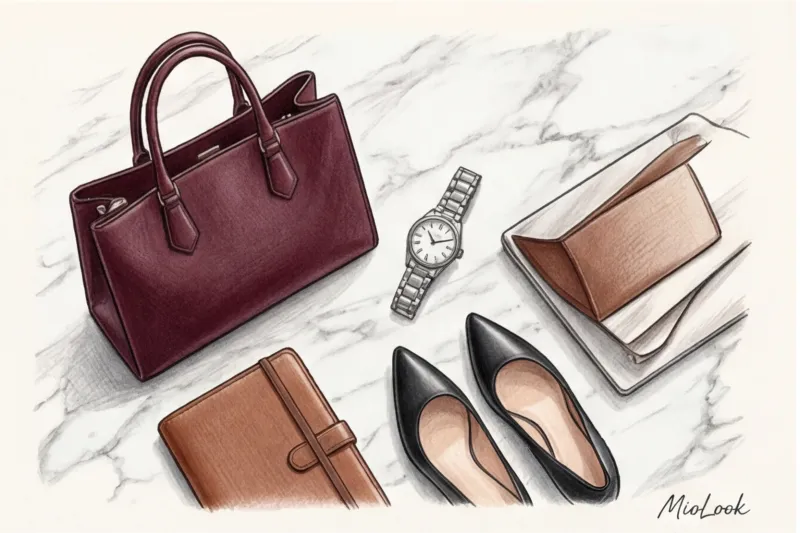
There's an unspoken rule in the upper echelons of business: you can wear a simple $60 dress from Zara, but if you accessorize it correctly, the entire look will feel like it's worth thousands of dollars. This brings us to the "Holy Trinity" of corporate style: a structured leather bag, a luxury watch, and impeccable shoes.
Your work bag isn't just a laptop case; it's a metaphor for your organization. Soft, shapeless hobo bags or flimsy fabric shoppers are unacceptable. An investment bag has an architectural shape, a rigid base, and should stand upright on a desk without collapsing into a shapeless heap. Look for dense, vegetable-tanned leather—it develops a beautiful patina over time, while cheap polyurethane coatings crack and peel.
In an age where you can check the time on a microwave oven screen, classic watches with hands have become a pure, refined status symbol. If corporate regulations require you to wear a smartwatch (common in the IT sector), immediately replace the factory-installed silicone strap with a Milanese steel or high-quality leather one. But nothing has the same gravitas as a steel or bimetallic mechanical watch. Simple models reminiscent of classics like the Cartier Tank or Jaeger-LeCoultre Reverso demonstrate your appreciation for heritage and authenticity.
And the last thing I pay obsessive attention to when auditing clients' wardrobes is the hardware. It's the hardware that reveals a garment's true value faster than the tag. Avoid overly shiny, overtly yellow zippers, chunky buckles, and garish brand logos plastered all over the garment. Cheap alloys oxidize and become covered in micro-scratches within the first week of wear. Hardware on truly prestigious pieces is always delicate—matte metal, brushed brass, or palladium plating without ostentatious monograms. Remember: true, quiet luxury doesn't need subtitles or flashy logos.
The Main Myths of Business Style That Are Ruining Your Image
Did you know that the human eye can distinguish approximately 10 million shades, but it's the color we consider the safest and most universal that most often betrays us? We're accustomed to believing rules that have been passed down from one fashion magazine to another for decades, never adapting to reality. As a result, women's business attire often turns into a dull, uninspired uniform. Let's examine three fundamental misconceptions that are long overdue for abandonment.
Myth 1: Black is always appropriate and looks expensive.
Ask any corporate employee about the basic office color, and nine out of ten will immediately name black. From a color and optical perspective, this is a fatal mistake. Deep black has the insidious property of absorbing light, causing even the slightest lint, dust, and creases in the fabric to instantly become visible.
The harsh truth is that a black suit only looks truly luxurious if the fabric is of phenomenal quality. Unless your jacket is made from premium Super 150s wool, which costs €800 or more, it will likely look flat and cheapen the look.
Instead, opt for shades of dark navy, rich chocolate, or graphite. Dark blue acts as a powerful optical reflector: it illuminates the face, makes the whites of the eyes appear brighter, and, according to research by the Pantone Color Institute, conveys calm and maximum trust. Note: high-ranking politicians almost never wear pure black during the day.
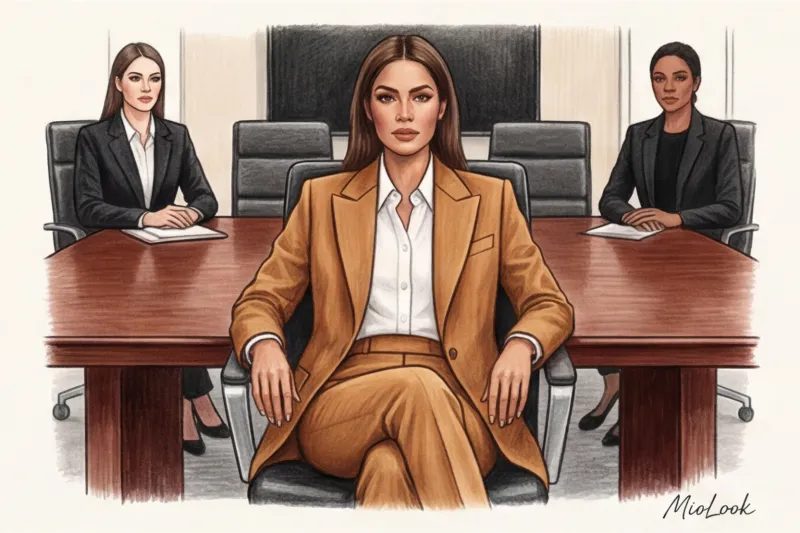
Myth 2: Femininity and softness are inappropriate in the office
For many years, it was believed that achieving success in the corporate world required literally encasing oneself in rigid, masculine armor. However, authority is no longer measured by the width of one's shoulder pads. Modern business protocol allows for the integration of silk, soft drapes, and elegant colors without sacrificing an ounce of professionalism.
The secret lies in the carefully crafted contrast of textures. Try wearing a crisp, well-structured suit, but instead of a crisp men's shirt, opt for a blouse made of thick, matte ivory silk with a delicately draped collar. This tactile softness of the fabric doesn't detract from your competence; on the contrary, it conveys a relaxed confidence. A surefire trick is to use deep, jewel-toned silk tops (emerald, sapphire, ruby) as a base layer under tailored wool jackets.
Myth 3: To avoid repeating yourself, you need a huge wardrobe
The fast fashion industry has conditioned us to the toxic idea that showing up to the office in the same outfit twice a week is bad form. In the reality of an executive capsule wardrobe, the opposite is true. A woman's true status is expressed not by the number of hangers, but by the impeccable co-ordination and premium quality of a small selection of items.
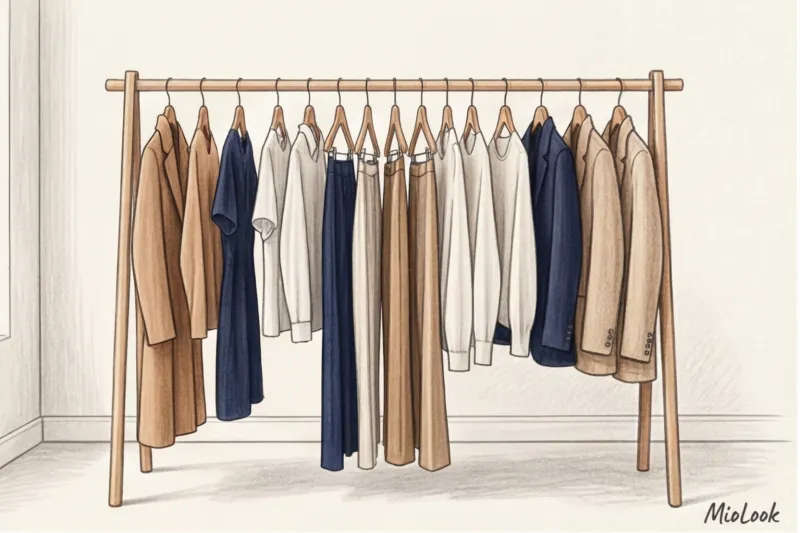
The math behind a functional wardrobe is incredibly pragmatic: you only need 3-4 ideal bottoms (pants of the right length, a pencil skirt) and 6-8 versatile tops (silk blouses, cotton shirts, fine cashmere knits), plus 2 basic jackets. This formula is guaranteed to yield over 40 unique combinations. To easily navigate this builder, I recommend using the virtual wardrobe feature in MioLook — the app lets you digitize your belongings and generate new business looks in just a few clicks. Leave morning stress in the past: your time is too valuable to waste on mulling over an overflowing but dysfunctional closet.
Modern Etiquette: Unspoken Details and Taboos
Even a perfectly tailored $3,500 jacket from The Row instantly loses its status if it's accompanied by one misstep. In a corporate environment, grooming is the first layer of your wardrobe. No status statement will work if the basics are ignored: hair should be immaculately clean (no messy, hasty buns), a fresh manicure without chips, and makeup subtle. Your face should project freshness and energy, highlighting the architecture of your cheekbones and an even skin tone, not demonstrating a familiarity with the latest social media trends.
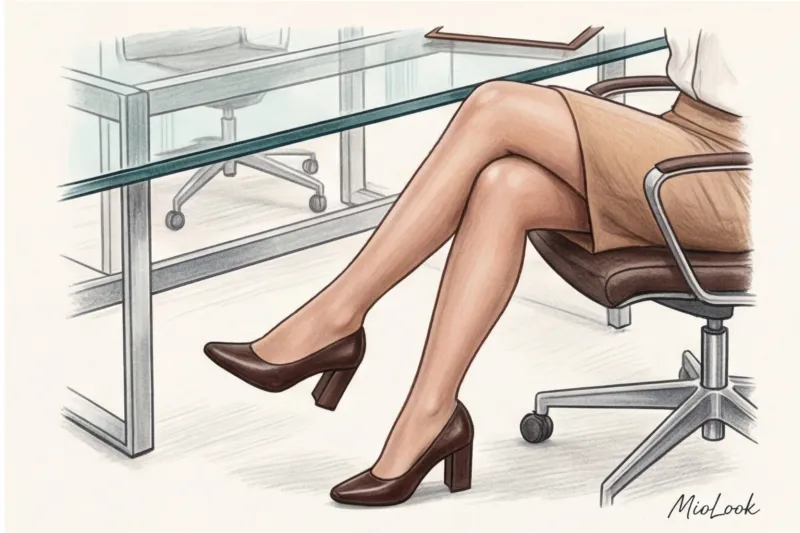
In conservative financial and legal niches, bare legs remain an absolute taboo, even at +30°C. The rule of high business etiquette is unforgiving: tights must be exclusively matte, between 8 and 15 DEN, and match your natural skin tone perfectly. No fake tan or, worse, Lycra shine. Legs should look bare, yet strictly adhere to protocol.
Before leaving the house, I always make my clients take a "sit test." Remember, business attire for women is a dynamic test. Sit on a chair in front of a mirror: your skirt shouldn't ride above mid-thigh, and the buttons on your silk blouse shouldn't treacherously part at the chest with the slightest breath. To avoid gaps in the portrait area, always use double-sided tape. What seems flawless in front of the mirror often falls flat at the negotiating table.
Perfume is a separate risk area. In the office, there is a strict "arm's length rule": your scent (its sillage, or sillage ) should only be felt by those who physically intrude into your personal space. Heavy oud, oriental, or sweet gourmand compositions should be reserved for the evening. During the day, molecular perfumes or subtle citrus accords that won't trigger migraines in your coworkers are your companion.
My main insider trick was born after a real-life disaster before an investment pitch in London, when the speaker's stockings split and his espresso spilled five minutes before going on stage. Since then, every client of mine has kept an "emergency capsule" in her desk drawer: a lint roller, clear nail polish (instantly stops runny noses), a portable mini steamer, and a spare pair of opaque tights.
To get ready every morning without panicking and know exactly which shoes and skirts passed the "squat test," I recommend recording successful formulas. You can take photos of your finished looks and save them in MioLook — this way, your phone will turn into a personal assistant that remembers every detail of your landing.
Your ideal image
it begins Here
Join thousands of users who look flawless every day with MioLook.
Get access — €0.99 onceAdapting business style to different niches
On Tuesday, I'm choosing a wardrobe for the CFO of a major investment bank, and on Wednesday, for the CMO of an international advertising agency. Their clothing budgets may be identical down to the penny, but their business style clothing for women will speak completely different visual languages. What's seen as a sign of reliability and stability in one industry will immediately betray your inflexibility and out-of-dateness in another. Properly adapting a corporate wardrobe is less a matter of fashion and more a matter of strategic social mimicry.
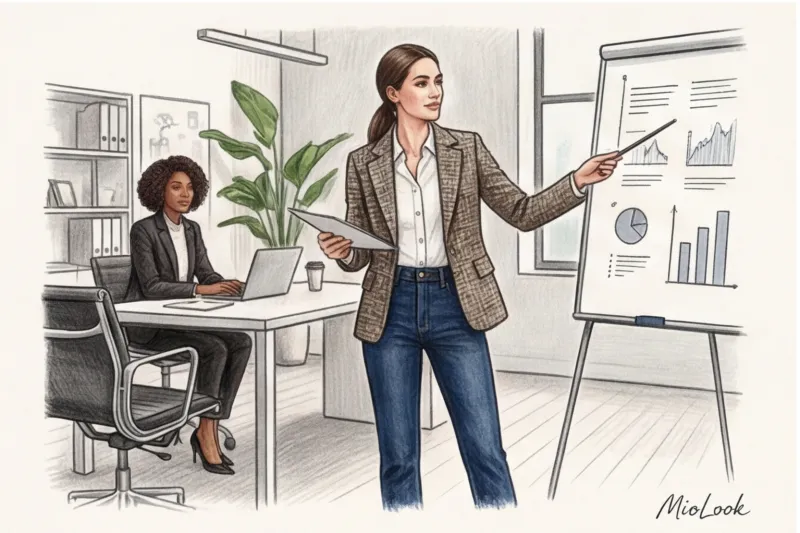
Law and Finance: Maximum Conservatism and the Highest Level of Tailoring
In banking, law, and government, your clothing must convey exactly one emotion: the absolute security of your client's assets. Uncompromising conservatism reigns supreme here, where high-end tailoring reigns supreme. Forget logos, mixed prints, and experimental cuts. Invest in muted shades (navy, graphite, deep burgundy) and exceptional fabrics, like fine Super 150s suiting wool. A perfectly tailored three-piece suit from Giorgio Armani or a laconic sheath dress with a jacket from The Row They'll demonstrate your membership in an elite club better than any business card. In these industries, clothing is like a strict suit of armor, protecting multi-million dollar deals.
IT and technology: "elevated casual" and the ban on snobbery
If you show up to a board meeting at a tech company in a formal suit, you'll be considered an outsider. In the IT sector, overly formal attire is perceived as a lack of mental flexibility and a sense of distance from the team. The concept of "elevated casual" works flawlessly here. A formal jacket looks out of place, so we replace it with unstructured, tightly knit cashmere cardigans or loose jackets without a sharp shoulder line. Straight-leg dark jeans with no fraying, a basic silk T-shirt, and €800 suede loafers create the perfect image of a successful visionary—someone who no longer needs to prove anything to anyone through complex tailoring. Smart, relaxed style has become the main symbol of real power here.
Creative Industries: Avant-garde Design as a Marker of Innovation
For galleries, architectural firms, PR, and the fashion sector, the classic office standard is professional suicide. If you sell creativity, your appearance must clearly demonstrate innovative thinking. We maintain the required level of professionalism, but we achieve it not through classics, but through complex deconstruction and avant-garde silhouettes. An asymmetrical skirt hem from Dries Van Noten , a jacket with exaggerated shoulders or architectural shoes with a recognizable split toe in the style Maison Margiela — these are your working tools. You convey a clear message to your client: "I know the classic rules of the game, but I have the courage and expertise to break them effectively." In this niche, your style literally becomes part of your portfolio.
Before creating a capsule for a new position or an important meeting, analyze not only the company's official charter but also the public appearances of its top management. A safe rule: your image should be exactly half a step more formal than what the company's CEO wears at industry conferences.
Checklist: Audit Your Business Wardrobe in 30 Minutes
When a new executive client comes to me, we never start with shopping. We begin with a ruthless inventory. According to a 2023 study by Bain & Company, approximately 70% of the items in the average professional's closet are not worn regularly, creating visual clutter and the illusion of choice. Business attire for women abhors chaos. For your wardrobe to function like a Swiss watch, it requires regular maintenance. I give my clients exactly 30 minutes for an initial inventory using my signature three-step system.
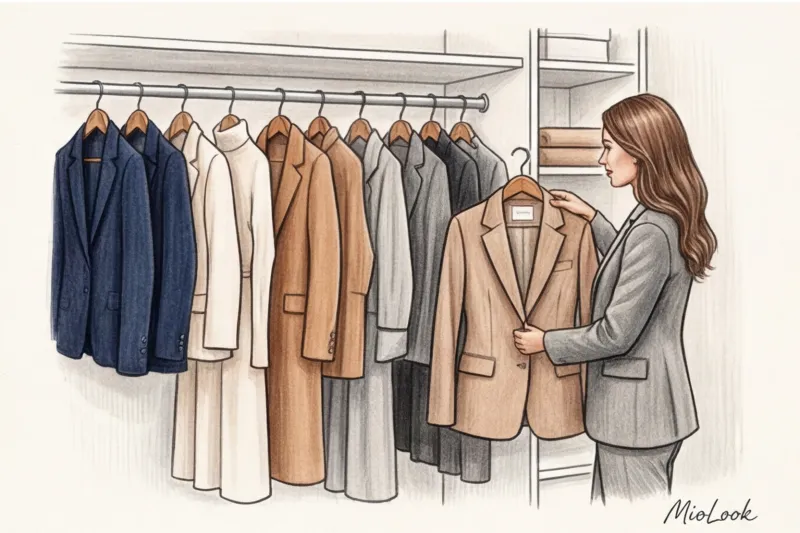
Step 1: Hard State Filter
Inspect each item in bright daylight. In a corporate environment, nothing is more damaging to status than untidiness. Your eyes may be glazed over, but your interlocutor will immediately notice the following signs of wear:
- Pilling: Especially in areas prone to friction (armpits, sides, inner thighs on trousers). If even a lint trimmer can't save a cashmere sweater, its time is up.
- Color loss: dark blue wool fading on the shoulders from hangers or whitish seams on black trousers.
- Shoe wear: Worn heels, worn toes, creases in the leather. Even €700 Gianvito Rossi pumps lose all their credibility if the heel is scratched on a storm drain grate.
Step 2: A Honest Landing Test
Try on items that raise doubts. Work clothes should pass the flow test. Does the fabric pull at your shoulders when you type? Do the buttons on your silk blouse come apart at the chest (that telltale gap ), when do you bring your hands together?
"Anything that requires you to constantly control yourself—tugging at your hem or sucking in your stomach—isn't professionally appropriate. It steals your focus, which should be on business tasks."
Put on a skirt or pants and sit down. If the waistband digs into your body, restricting your breathing before an important presentation, or the hem of your skirt rides unacceptably high, that's not your style. The ideal fit requires at least 1.5–2 centimeters of ease.
Step 3: Capsule Mathematics
Now let's move on to the ROI (return on investment) of your wardrobe. Apply the "one to three" rule: with each piece of clothing (pants, skirt), you should be able to create at least three completely different office outfits.
Take gray wool trousers. Can you wear them with a crisp white shirt, a soft cashmere turtleneck, and a structured jacket in a contrasting color? If only one specific top goes with a skirt, it's not an investment, but a liability. To visualize this process and avoid having to keep formulas in your head, my clients use MioLook — You upload photos of your items, and the smart wardrobe feature instantly shows you how many real combinations are hidden in your closet.
Action plan: what to throw away, sew, and buy
After a thirty-minute audit, you should have three stacks in front of you:
- Scrap or recycling: Items with stubborn stains, misshapen collars, and cheap synthetic sheens. Part with them without regret.
- In the studio: Items made from high-quality fabrics (wool, silk, heavy cotton) lack literally millimeter precision. Adjusting the length of trousers to a specific heel height or tailoring a €400 jacket at the waist is a smart investment. Adjusting a €30 polyester blouse is an economic crime.
- Strategic shopping list: This is where any gaps you've identified are noted. You'll realize that instead of a dozen white shirts, you're critically missing a quality leather belt or a structured tote bag.
Your work wardrobe isn't just a collection of fabrics on hangers. As we've seen, it's your professional armor, your nonverbal pitch, and your tool of influence. By stopping treating business attire as a boring uniform and starting to invest in it wisely, you'll reap invaluable dividends: unwavering confidence in any boardroom.
Guide Chapters
Elegant hairstyles for the office every day
Office hairstyles are a powerful tool of influence and a key part of a professional image. Learn how to frame your face and look professional.
Office and Work Jewelry: Business Style Rules
Chunky bracelets can ruin an important presentation, while simple earrings can emphasize professionalism. We'll explore the rules for choosing business accessories.
Perfect daytime makeup for the office in 10 minutes
Effective makeup isn't about covering up flaws, but rather a strategic tool for influence. Learn how to create a flawless business look in just 10 minutes a day.
Business Style Colors: Rules and Psychology
Color in a business wardrobe can shape up to 70% of first impressions. Learn how to use shades to command attention and conduct successful negotiations.
What to wear to a New Year's corporate party for women: tips
A corporate event is an extension of your business image, not an excuse to dress up. Learn how to choose a stylish and appropriate look for a work event.
Can you wear jeans to the office? A stylist's secrets.
Secrets to creating a business look with denim from a stylist with 12 years of experience. Learn how to choose the perfect jeans for a commanding presence.
Women's Document and Laptop Bag: Review
The right work bag is the key to staying focused and successful at business meetings. Read our review of the best laptop and document bags.
Women's Office Shoes: Stylish and Comfortable
An office worker takes up to 6,000 steps per workday. We'll explain how to choose the right shoes to keep your feet light until the evening.
Women's Business Pantsuit: Styling Tips
Forget boring black uniforms. Learn how to choose the perfect pantsuit that will highlight your status and individuality.
Office wear for plus-size women: how to build a wardrobe
Forget shapeless cardigans! We're talking to a professional stylist about how to create a stylish business wardrobe for women over 50.
Winter Office Wear for Women: Warmth and Style
Forget shapeless sweaters that ruin a business silhouette. We'll show you how to look classy and stay warm in the office with thin layers.
What to wear to a job interview for a girl: the best looks
First impressions are everything. We'll show you how to use the right cut and color psychology to create a look that will win you an offer.
Business style for women over 40: status and elegance
Tired of formal suits that make you look older? We'll explore how to create a classy office wardrobe through the lens of proper tailoring and high-quality fabrics.
10 Taboos: The Main Mistakes in Business Attire
Your professionalism can be questioned due to poorly chosen clothing. We explore 10 hidden office style traps that are ruining your status.
Summer Office Style for Women: Looks for the Heat
How to maintain visual authority while navigating between the scorching streets and the freezing office? Discover the secrets of the perfect and practical summer wardrobe.
Business Casual Style for Women: Rules and Looks
We'll discuss the main mistakes in women's business attire with a stylist. Learn how to look classy without sacrificing comfort.
Strict dress code for women: Business Formal style
True business formality is a tool of influence, not a boring uniform. Learn how to create a prestigious image for important business negotiations.
Capsule Wardrobe for the Office: Stylist Tips
Forget about uncomfortable white shirts. Learn how to put together a modern work capsule outfit that will enhance your status and keep you comfortable all day long.