
An office worker takes an average of 4,000 to 6,000 steps per workday. Imagine walking almost 4 kilometers, maneuvering between conference rooms, a water cooler, the director's office, and a business lunch. And all this time, your foundation is your shoes. Properly chosen women's shoes for the office It's not just a strict dress code element, but a biomechanical tool. It directly impacts your posture, energy level, and that "leader confidence" at the end of a 10-hour work marathon.
If you are just starting to build your professional wardrobe, I recommend you take a look at our A Complete Guide to Business Attire for Women , where we analyze the entire architecture of a look in detail. Today, we'll shift the focus from purely visual choices ("what color is trending now") to textile expertise and last construction.
By the way, if you want to take a systematic approach to planning your looks, try MioLook — a smart AI stylist will help digitize your clothes and suggest which shoes work best with your favorite pantsuits.
The Architecture of the Perfect Pair: What Makes Shoes Truly Comfortable
When we talk about premium quality, we're not talking about a logo on the insole, but about the hidden engineering. An ill-fitting shoe literally ruins your appearance: when your foot is cramped or unsupported, your center of gravity shifts. You start slouching, your steps become heavy, and your face unconsciously reflects discomfort. It's hard to convincingly defend a quarterly report when your fingers are cramping.
The anatomy of a quality shoe rests on three pillars:
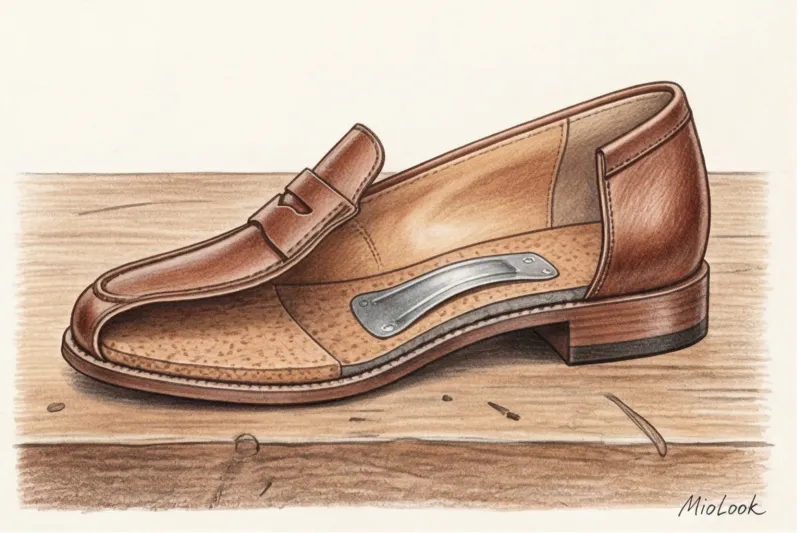
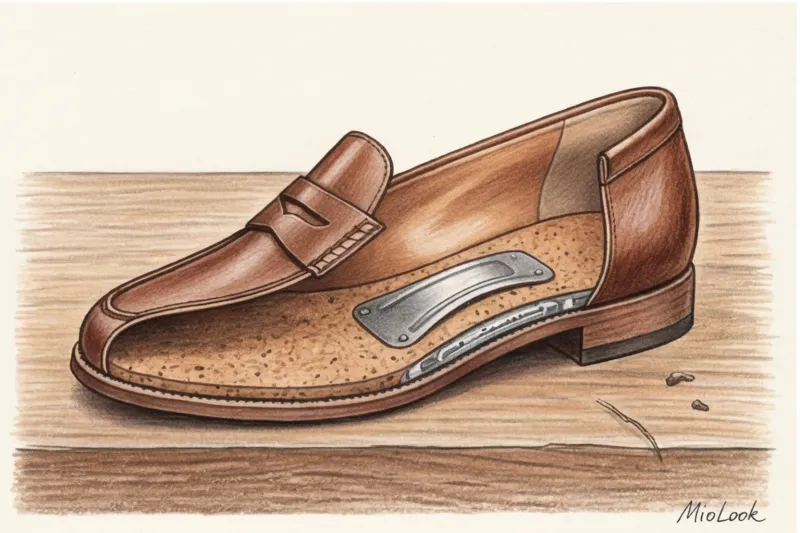
- Instep support (instep support) — a metal or hard plastic piece inside the sole. It supports the arch of the foot and prevents the shoe from deforming under your weight.
- Molded hard heel counter - fixes the heel, preventing micro-slips that lead to blisters and rips in tights.
- Shock-absorbing insole — ideally with the addition of a layer of foam latex or cork under the leather covering, which absorbs the shock load when walking on hard office porcelain stoneware.
"I had a telling case with a client, the CEO of an IT startup. She complained of chronic lower back pain during long meetings. We simply swapped her soft ballet flats for structured loafers with a metal shank and an anatomical last. Three weeks later, the pain was gone. Shoes are the foundation of your back," says Sophia Müller.
Materials play an equally important role. Polyurethane (PU leather) creates a greenhouse effect inside the shoe. This increases the temperature of the foot, causing the leather to swell, and friction to increase significantly. Look for shoes made from vegetable-tanned leather. This process, unlike chrome tanning, keeps the pores of the leather open. According to standards Leather Working Group (LWG) Certified vegetable-tanned leather is not only more environmentally friendly, but also has a unique property: under the influence of your body heat, it takes the anatomical shape of your foot within a couple of days.
The Flat Sole Myth: Why Classic Ballet Flats Are Bad for Your Posture
Now let's address one of the most dangerous fashion myths: the absolute belief that flat shoes are the healthiest alternative to stilettos. Have you ever noticed how your feet burn and your calves ache by the evening after a day in soft ballet flats?
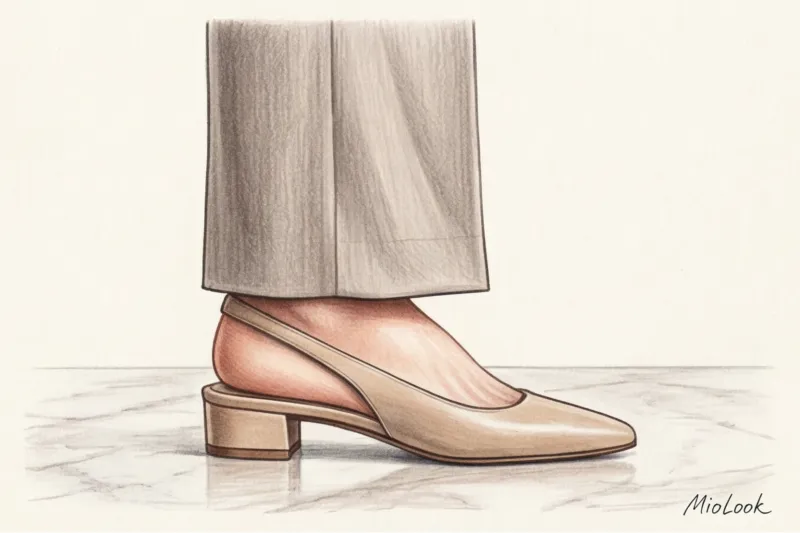
It's all about biomechanics. Shoes with a "zero drop" (where the heel and toe are level) cause tremendous strain on the plantar fascia when walking on flat, hard surfaces. As a result, you risk developing plantar fasciitis. Furthermore, constantly wearing flat shoes overstretches the Achilles tendon.
The American Podiatric Medical Association (APMA) provides a clear recommendation: the optimal heel lift height for back and foot health is between 1.5 and 3 centimeters. This slight difference relieves pressure on the lower back and ensures proper foot roll during stride.
Of course, there is an exception to this rule. When it does NOT work: If you have specific medical conditions (such as limb shortening or complex foot deformities) that require the use of custom orthotic insoles in zero-drop shoes. But for 95% of women, a micro heel will be a lifesaver.
Your perfect look starts here
Join thousands of users who look flawless every day with MioLook. Digitize your wardrobe in minutes.
Get access — €0.99 onceWomen's Shoes for the Office: 4 Timeless Basic Styles
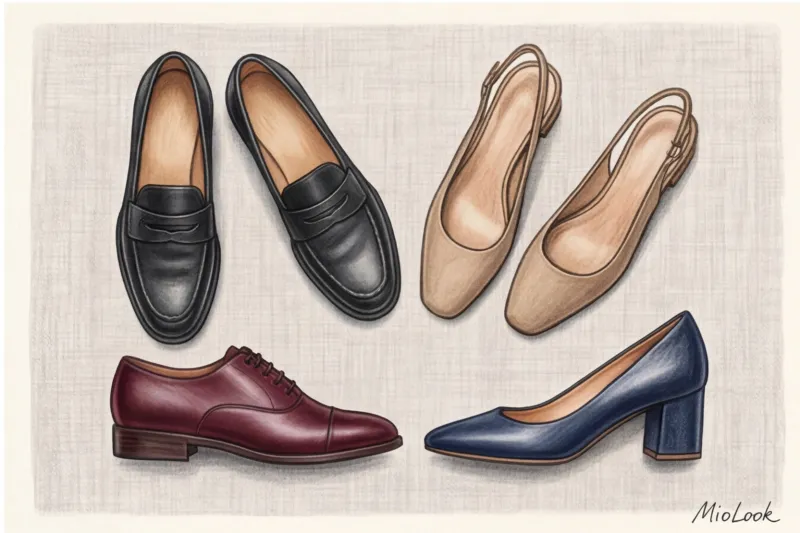
Modern business casual for women has undergone a major transformation. We've moved away from the rigid power dressing of the '80s in favor of functional, intelligent elegance. If you want to invest in a capsule collection that will cover all your office needs, you'll only need four pairs.
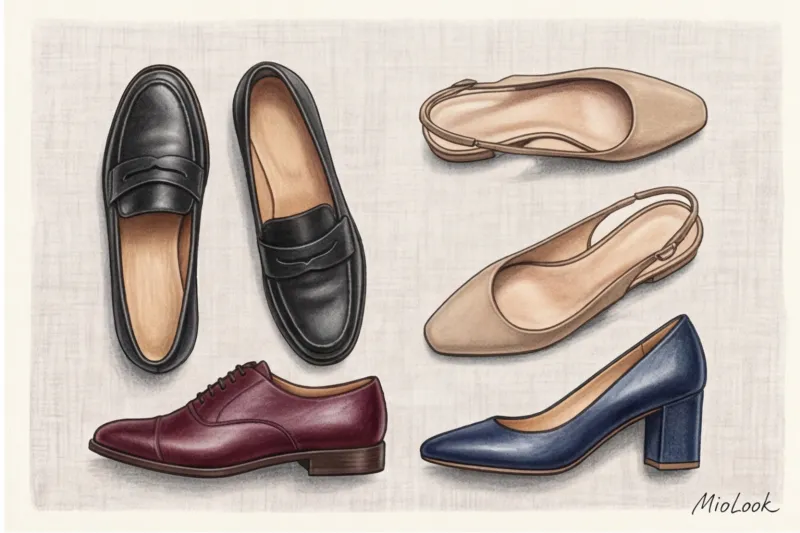
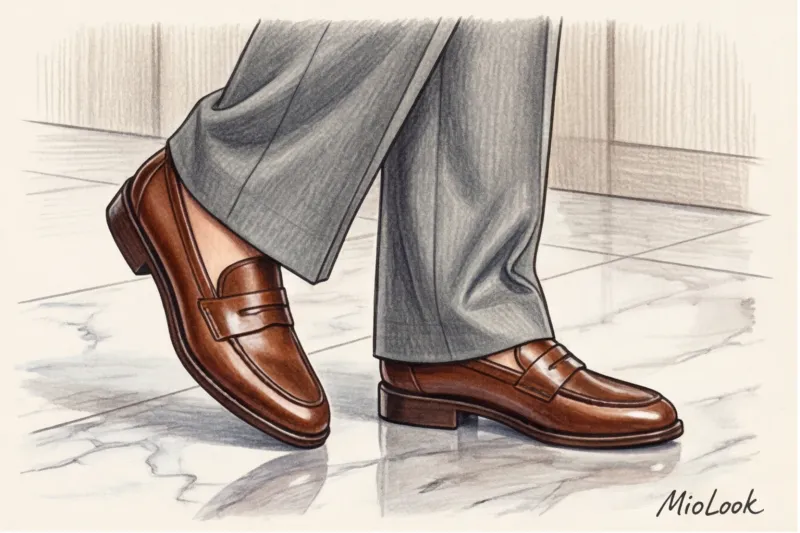
- Loafers (penny or tassel). This is a masculine classic that paradoxically adds femininity through contrast. Choose thick leather: the loafer shouldn't be as soft as a slipper. Smooth calfskin or water-repellent suede are great for grounding overly romantic blouses and adding weight to cropped trousers with a crease.
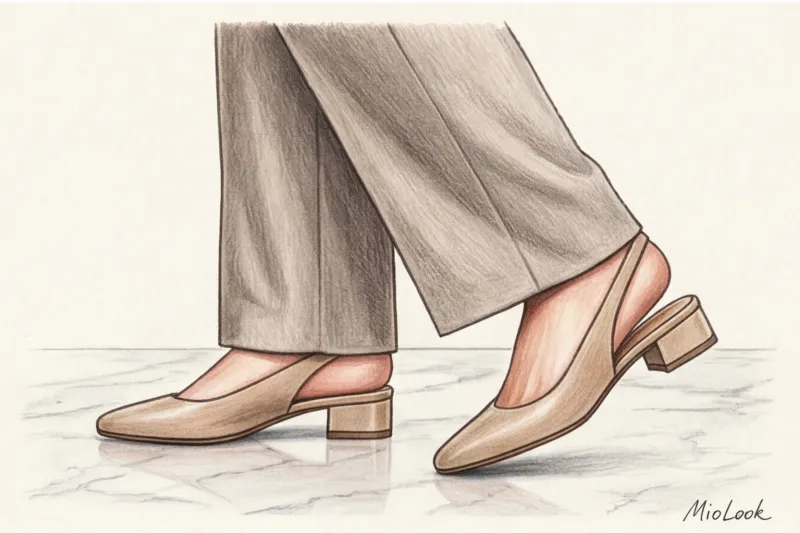
- Slingbacks with a micro-heel (kitten heel). A modern, more dynamic alternative to classic stiletto pumps. The open heel visually lightens the look, and the 3-4 cm heel allows you to run up and down the stairs without getting out of breath. Ideal for warmer weather or offices with strong heating.
- Oxfords and brogues. Closed lacing and a crisp shape make this the perfect choice for days when you need to project maximum poise, authority, and competence. The perfect pairing for a tailored three-piece suit.
- Pumps with a stable block heel. Save stilettos for evening wear. For work, a square, architectural heel of up to 5-6 cm is needed. This provides sufficient support so that the foot doesn't balance on every uneven surface.
How to choose the right toe box
The shape of the cape is not just a design detail, it is your non-verbal message to colleagues and partners.
- Sharp Cape: Conveys dynamism, aggressiveness, and leadership. Ideal for negotiations where you need to push through your decision. Visually lengthens the legs.
- Square Cape: Stability, solidity, and a creative approach. An excellent choice for architects, lawyers, and financial analysts.
- Almond-shaped cape: A timeless classic. It demonstrates diplomacy, gentleness, and a willingness to compromise. It suits any dress code.
Stylist's Checklist: How to Check the Quality of Shoes in a Store
The average shopper looks at the color and price tag. I teach my clients to evaluate shoes like engineers. Before taking a pair to the checkout, do a quick inspection.
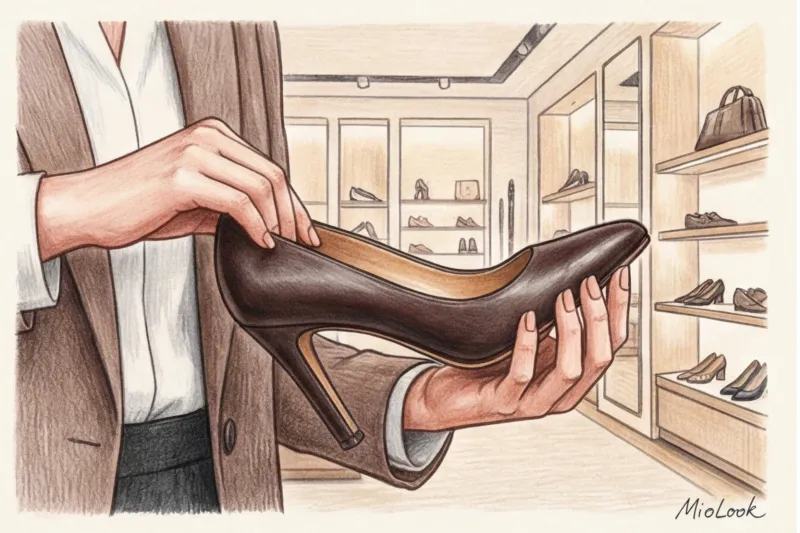
1. Flexion test. Take a shoe and gently bend the toe upward. The shoe should bend. only In the front third (at the metatarsophalangeal joint, where your toes bend). If the shoe folds in half exactly down the middle, there's no arch support, and your foot will collapse. If it doesn't bend at all (like a wooden block), you'll be unable to walk by evening due to strained ligaments.
2. Method of attaching the sole. Check the edge. See traces of toxic glue? Keep the pair. Quality shoes are always stitched. Look for a Goodyear welt or a Blake stitch. Yes, these pairs are more expensive, but they are repairable. A repair shop can replace a worn sole while preserving the upper.
3. Twisting test. Try twisting the shoe slightly around its axis (like wringing out a towel). A quality pair with a shank will resist twisting in the center. This ensures that your foot won't twist on uneven surfaces.
4. Tactile test of the lining. The inside of the shoes should be made exclusively of natural light-colored leather (to avoid staining the tights). Run your fingers along the seams inside—they shouldn't stick out or scratch.
Pro tip: If you're trying on shoes at a multi-brand boutique, look at the creases on the pairs others have tried on before you. If a deep crease forms right in the center of the toe or digs into the toes, the last is improperly designed. A proper crease is always soft and runs strictly horizontally along the natural flexion of the foot.
Sneakers and the Office: The Fine Line of Smart Casual in 2024
We can't ignore the reality. In IT companies, creative agencies, and even some banks, sneakers have become the norm on Fridays. But there's a huge difference between the running shoes you wear to the gym and the shoes you wear to smart casual wardrobe.

The requirements for "office" sneakers are more stringent than for dress shoes. They are always minimalist: no neon accents, mesh, chunky running soles, or flashy logos on the side. The ideal choice is tennis-style sneakers made of smooth matte leather (white, beige, navy, graphite).
The secret to a stylish look with sneakers in the office lies in the rule of contrast. If you're wearing casual shoes, your outfit should be as structured as possible. Sneakers with jeans and a hoodie are a casual look. Sneakers with a heavy wool pantsuit, a tailored blazer, and a crisp white shirt create a confident, modern business look.
Ready to get started?
Try the free plan—no commitments required. Upload photos of your belongings, and AI will create a capsule for your workweek.
Get access — €0.99 onceSustainable Fashion: How to Care for Business Shoes
As a proponent of sustainable fashion, I always rely on the cost-per-wear formula. According to a McKinsey study on the circular economy (2024), high-quality leather loafers for $250, with proper care, will last at least five years. They cost you about $50 per year. Meanwhile, a $70 polyurethane pair from a mass-market store will lose its shape after eight months of daily wear, forcing you to buy a new one. The math behind conscious consumption is clear.
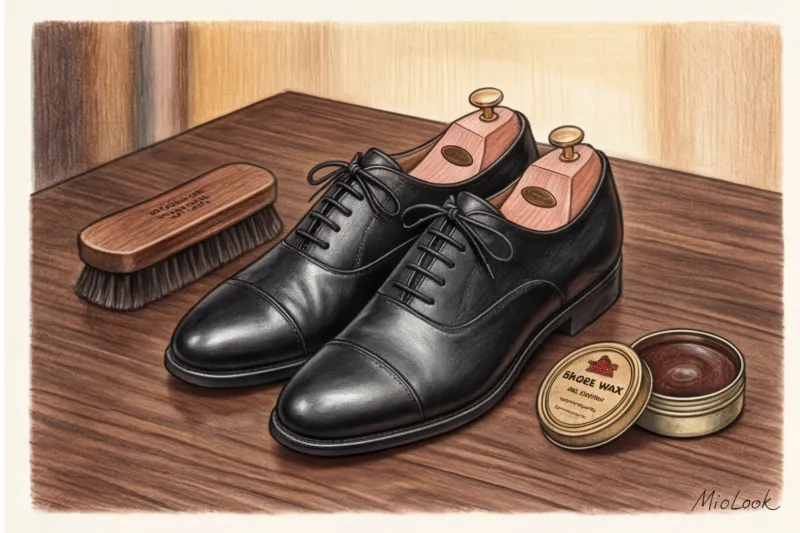
But longevity requires the right routine. Here are three rules that will save your investment:
- Cedar tree shapers. Insert them into your shoes the second you take them off. Why not plastic? Unvarnished cedar instantly absorbs excess moisture accumulated during the day, deodorizes the leather, and smooths out micro-creases while the shoes are still warm.
- The 24-hour rule. No pair of shoes (even your favorite ones) should be worn two days in a row. Genuine leather needs exactly 24 hours to dry completely and regain its shape. Alternate at least two basic pairs.
- Nutrition, not shine. Throw away silicone-impregnated sponges. Silicone clogs the pores of the skin, preventing it from "breathing," and over time, it dries out, becoming covered in cracks. Use only natural moisturizers and hard carnauba wax to protect your nose and heels from scratches.
Shoes are the one item of clothing you shouldn't skimp on, because you're skimping on your health. The right pair can not only elevate your silhouette and add a touch of class to even the simplest outfit, but also conserve your energy. Take stock of your shoe closet today: check the flexibility of the soles, the presence of arch support, and the quality of the materials. Keep only what works for your comfort and professionalism, not against them.