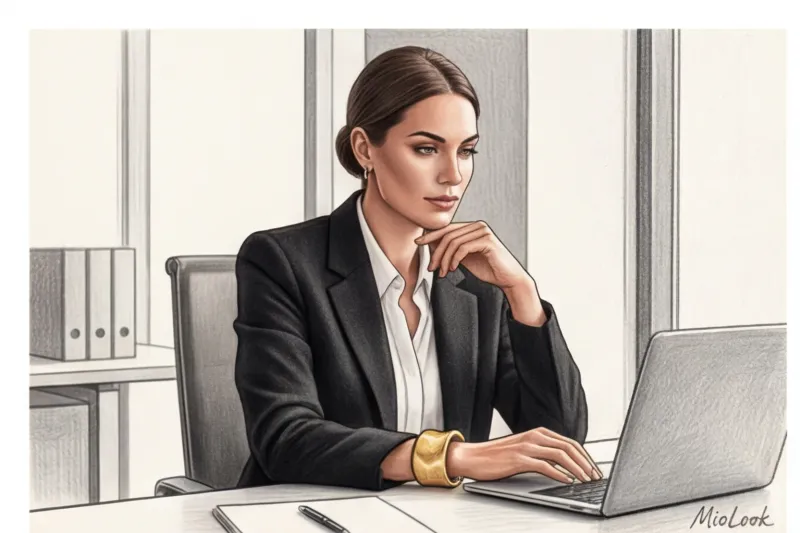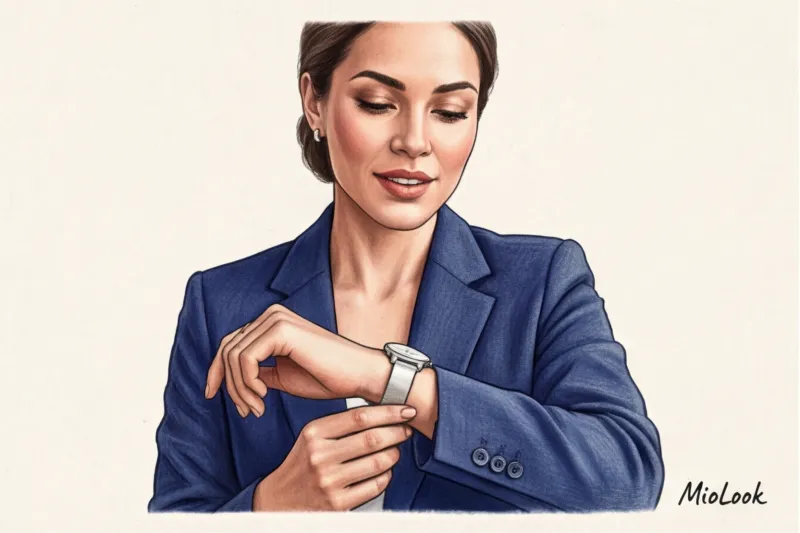
A year ago, my client, the CFO of a large IT company, failed to defend her annual budget to the board of directors. The numbers were perfect, the presentation flawless. But every time she gestured vigorously, proving the profitability of a new project, her massive metal bracelets clanged loudly against the aluminum casing of her MacBook. Instead of delving into the EBITDA, the stakeholders stared at her wrists, irritated by the incessant acoustic noise. This case perfectly illustrates the main rule: properly selected decorations for the office and work — this is not just the final touch of an image, but a full-fledged tool for managing attention.
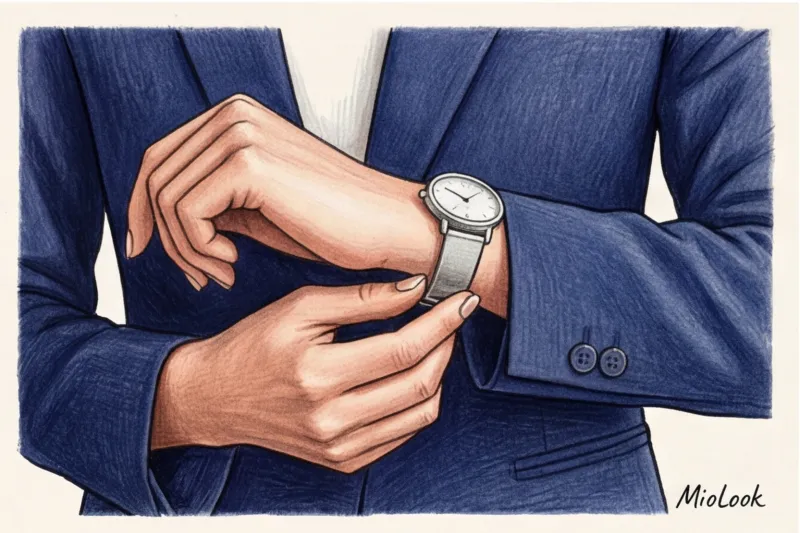
Over 14 years of working as a personal stylist, I've learned a clear truth. In a business environment, accessories either enhance your credibility or destroy it faster than a poorly worded email. We've already covered the basic rules for creating a work wardrobe in more detail in our The Complete Guide to Business Attire for Women , and today we will take a detailed look at the jewelry component.
Accessories and Executive Presence: Why Office and Work Decorations Are More Than Just Decor
For a long time, business dress codes were viewed as a strict uniform, where any slight deviation was equated with unprofessionalism. Today, the paradigm has shifted: the buttoned-down suits of the 1990s have been replaced by the concept of "quiet luxury" and individuality. However, freedom of expression in the office has its limits, defined by the term "executive presence."
A study by the Center for Talent Innovation (Coqual, 2023) revealed a startling statistic: 68% of HR professionals and senior managers admit that visual filters (including inappropriate accessories) can eliminate a candidate for a leadership position before they even have a chance to demonstrate their hard skills. Your clothes and accessories speak for themselves before you even open your mouth.
To avoid making mistakes with the number of details, I always recommend the classic "13 dots" rule to my clients. How does it work?
- Each visible element of your clothing (jacket, skirt, blouse) is 1 point.
- Each accessory (watch, ring, earrings, glasses, belt) is also 1 point.
- Bright lip makeup or an accent manicure also add 1 dot.
For Business Formal attire, the total number of points shouldn't exceed 11-13. For Smart Casual, 14-15 points is acceptable. If you're wearing a three-piece suit, buckled shoes, glasses, a watch, a couple of rings, and a layered necklace, you've already crossed the line into visual noise. Your look is "shouting" and should speak in a calm, confident tone.
Access to MioLook for €0.99 — one-time payment
A smart AI stylist will select the perfect look for the office, taking into account your dress code and body type.
Get access — €0.99 onceAttention Architecture: How to Control Your Interlocutor's Gaze with Accessories
Have you ever noticed how, during important negotiations, you're involuntarily distracted by the person constantly twirling a chunky ring or fiddling with a necklace? Jewelry acts as focal points. Wherever you place the accent, your partner will look.
This is especially true in the era of Zoom conferences. When we communicate via video, our image is reduced to a portrait. If you're wearing massive, sparkly chandelier earrings, they'll steal 80% of the attention. The person you're talking to will be staring at their facets rather than listening to your report.
Portrait Zone: Earrings and Neck Jewelry
Earrings are the most important accessory in a career woman's wardrobe. They are closest to the eyes, meaning they directly contribute to maintaining eye contact. During tough negotiations, I always recommend wearing simple earrings made of smooth metal or pearl studs. They highlight the face without stealing the focus.
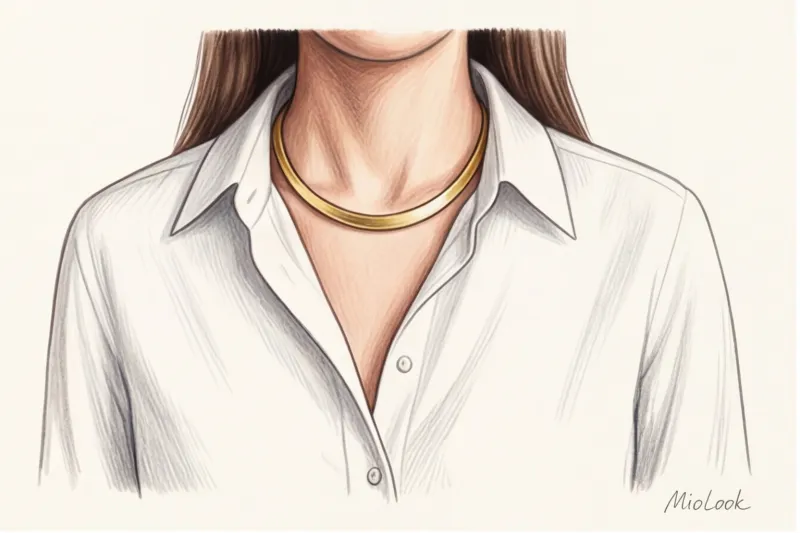
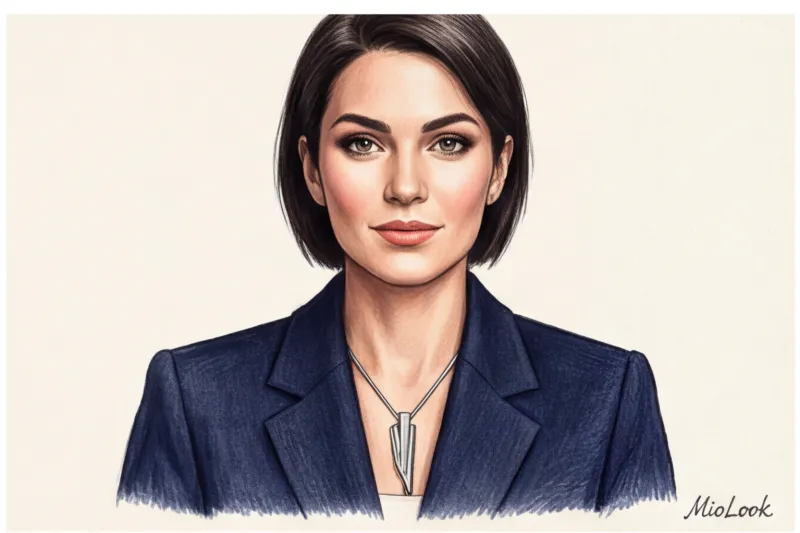
Rigid geometry works with neck jewelry. The V-neckline of the blouse, complemented by a thin chain pendant, vertically elongates the silhouette and makes the neck appear longer. But there's a major pitfall here that's often overlooked: The pendant shouldn't end right at the cleavage. Otherwise, you'll draw a male colleague's gaze to your cleavage with your own hands. The optimal chain length for the office is 40-45 cm, so the pendant rests on the collarbone.
Gesture Zone: Rings, Watches, and Bracelets
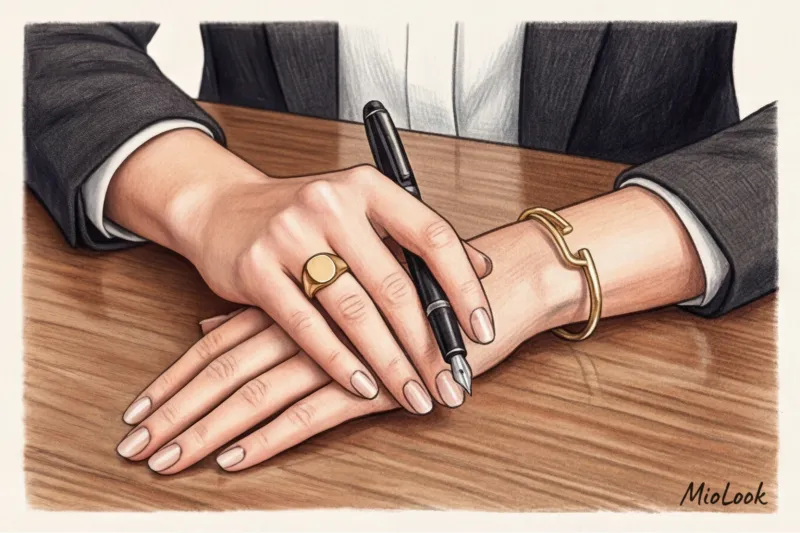
Our hands are constantly in motion. We point to charts, hand over documents, and type. Therefore, the main requirement for hand jewelry is absolute silence and a snug fit. Modern etiquette allows for mixing metals (gold and silver) in a single look. According to a 2024 analytical report by the Lyst platform, demand for bimetallic jewelry has grown by 40%. If you're worried about making a mistake, consider ready-made designs inspired by the Cartier Trinity or watches with a bracelet that combines steel and gold.
The myth of "safe" pearls and outdated rules of business etiquette
If you open any style guide from twenty years ago, you'll inevitably be advised: "Wear a short strand of small round pearls—it's classic." As a practicing stylist, I can tell you straight: in 2024, this rule is hopelessly outdated.
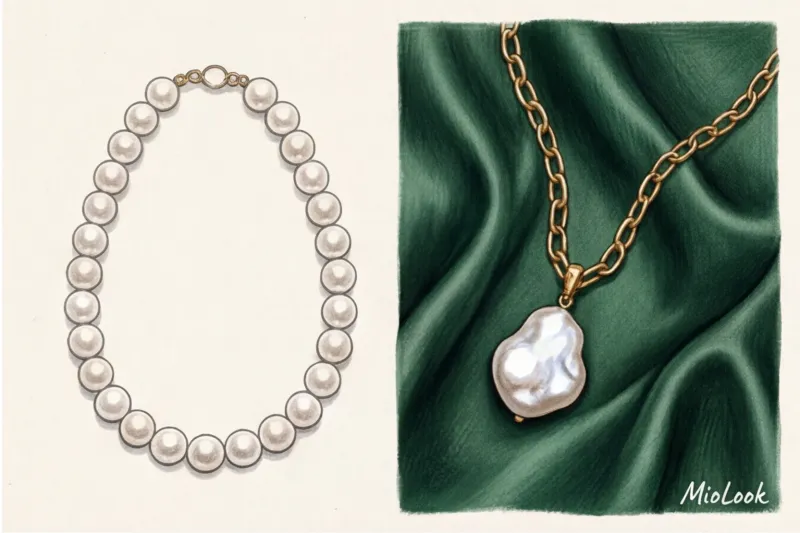
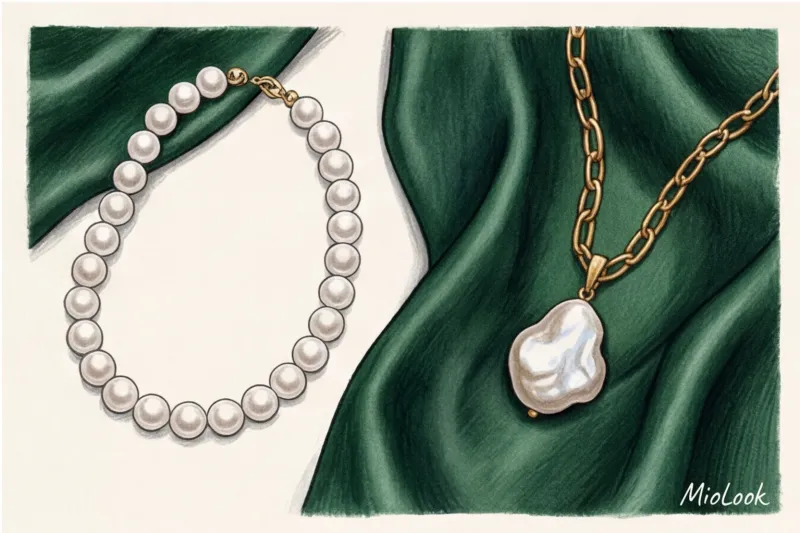
A perfectly round, symmetrical pearl necklace paired with a classic jacket instantly adds years to your appearance. It creates an unpleasant "mothball effect," making your look creaky and conservative. We live in a dynamic world where excessive formality conveys rigidity.
"Switch out round beads for irregularly shaped baroque pearls. Their asymmetry breaks up the strict geometry of a business suit, adding a modern and vibrant touch while maintaining a high-status feel."
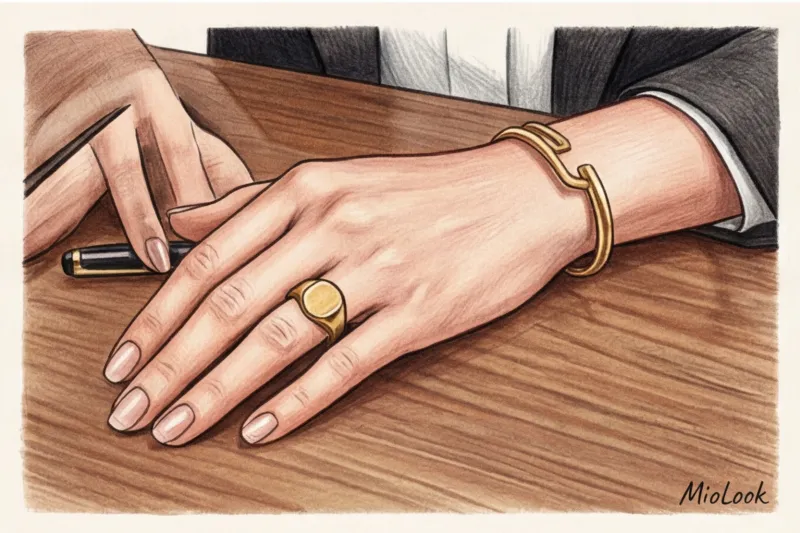
Another myth is the categorical ban on statement jewelry in the office. Many believe that only invisible strings and tiny rings are appropriate for work. In fact, a single large, architectural signet ring made of smooth metal or a sculptural brooch on a jacket lapel looks ten times more prestigious than a scattering of thin, barely noticeable rings on every finger. This is the very "quiet luxury" that defines a personal brand. You can read more about how details reveal your level in the article about status accessories for an expert.
Your perfect look starts here
Finding it difficult to judge whether your look is too busy? Upload your jewelry to the MioLook virtual jewelry box, and AI will help you create the perfect office combinations.
Get access — €0.99 onceEssential Jewelry Capsule: Investing in the Right Jewelry for the Office
I recently put together a basic jewelry capsule collection for a top manager at a major European bank. Our goal was to cover 100% of work-related situations—from routine meetings to signing international contracts. We cleverly divided the budget: 70% went on a premium Swiss watch with a leather strap, and the remaining 30% on affordable but high-quality gold-plated architectural jewelry (brands like COS, Massimo Dutti, and Agmes).
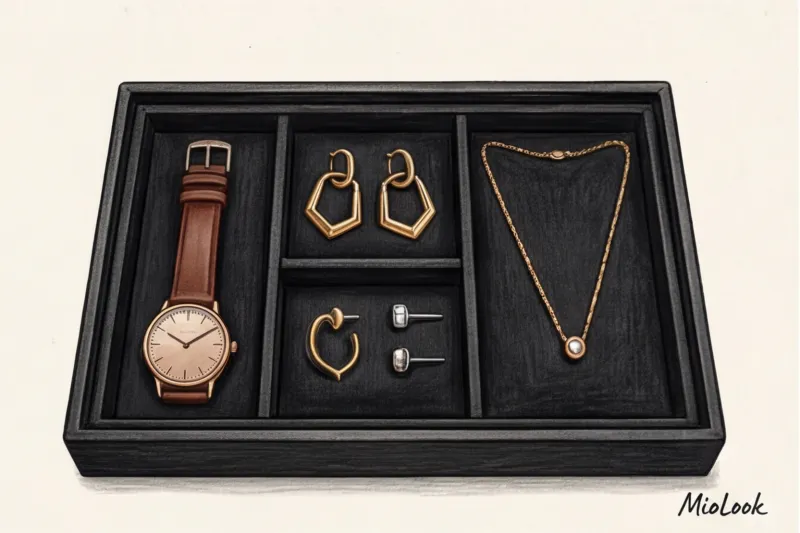
The capsule wardrobe principle works perfectly with jewelry, too. You don't need a huge jewelry box. Just 5-7 pieces are enough:
- Status watch. This is the key marker of a business person. For a formal dress code, a smooth leather strap (black, cognac, or navy blue) is ideal. For smart casual, a matte-finished metal bracelet is ideal. Avoid too many rhinestones on the dial—this devalues the look.
- Stud earrings. Matte metal, small baroque pearls or laconic diamonds/cubic zirconia up to 0.3 carats.
- Structural chuppahs (hoop earrings). Opt for a medium size (up to 2-2.5 cm in diameter) and a wide, puffy shape instead of the thin wire rings associated with 2000s R&B style.
- Geometric necklace or pendant on a chain. Flat snake weave or medium thickness anchor chain.
- A sleek signet ring or a minimalist track. In the office, there is a three-ring rule: a wedding ring, an engagement ring, and an accent ring on the other hand.
An important limitation I should mention: Architectural minimalism doesn't work for everyone. If your appearance is built on soft lines (for example, according to Kibbe's typology, you're a Romantic), the harsh, chopped geometry of metal may look out of place on you. In this case, replace angles with smooth lines—drop shapes, molten metal, ovals.
Hidden Traps: What Jewelry Should You Absolutely Avoid Wearing to Work?
Let's return to the story we started with. There are certain categories of jewelry that have the potential to ruin your career, even if they cost a fortune.
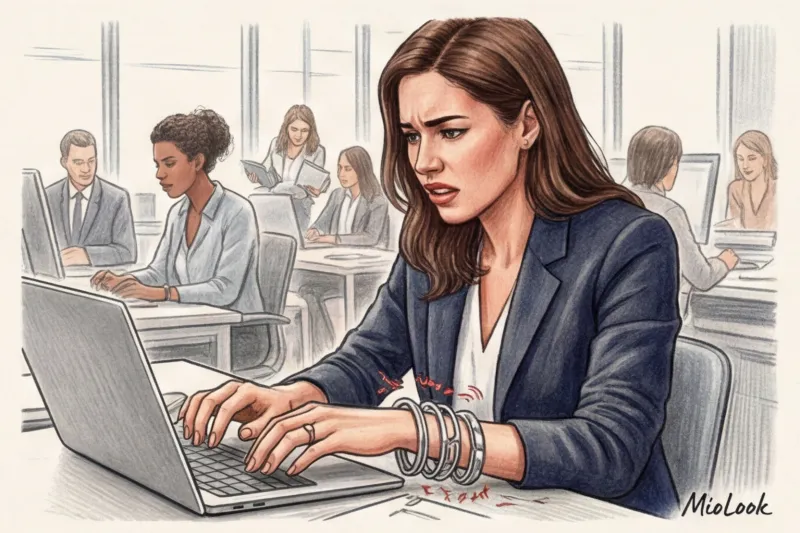
Acoustic garbage. Any chandelier bracelets with charms, multi-tiered jingling chains, or heavy pendants that bang against the table. If you can't type a message silently on your keyboard, take it off immediately.
Excessive romanticism and infantilism. Hearts, butterflies, cats, scatterings of pink crystals. No matter how serious a professional you are, childish symbols on your face subconsciously diminish your expertise. People find it harder to entrust million-dollar contracts to someone with glittering enamel strawberries in their ears.
Too personal to show. Religious symbols (large crosses, crescents, Stars of David) and esoteric paraphernalia (amulets, large zodiac signs) should remain concealed. The office is neutral territory.
Cheap fittings. Peeling rose gold, greening copper, cloudy plastic. I always tell my clients: it's better to buy a high-quality surgical steel or rhodium-plated brass bracelet for $50 than to wear a fake diamond necklace.
Ready to get started?
Try the MioLook plan for free—no commitments required. Organize your wardrobe and find the perfect jewelry to complement every outfit.
Get access — €0.99 onceStylist Checklist: Final Look Check Before Leaving the House
Before leaving the house, I recommend running through a quick checklist of your look. It only takes 15 seconds.
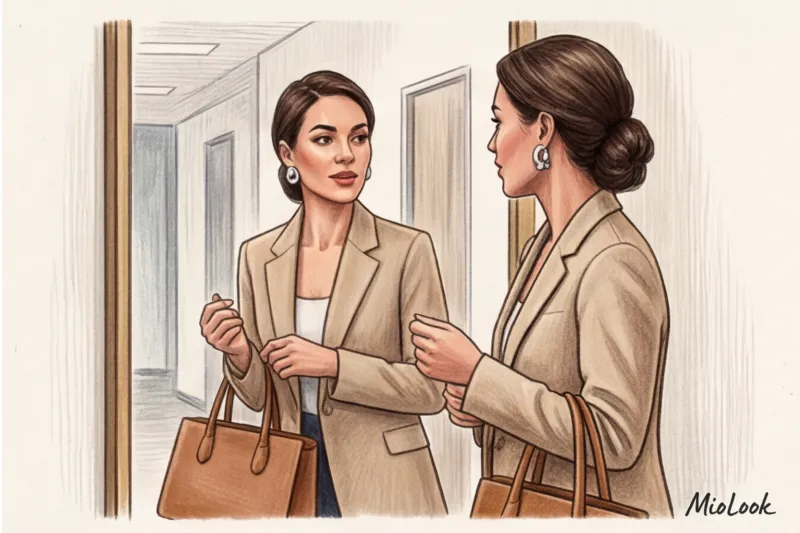
First, conduct comfort test Look around. Is your necklace catching on the collar of your silk blouse? Are your earrings getting tangled in your loose hair? Your work clothes should be your armor, not a source of irritation.
Secondly, do relevance test Is the sparkle level appropriate for the time of day? Classic etiquette dictates wearing exposed diamonds (especially large ones) only after 5:00 PM. During the day, their brilliance looks inappropriately pretentious. Replace them with the refined shine of smooth gold or matte silver.
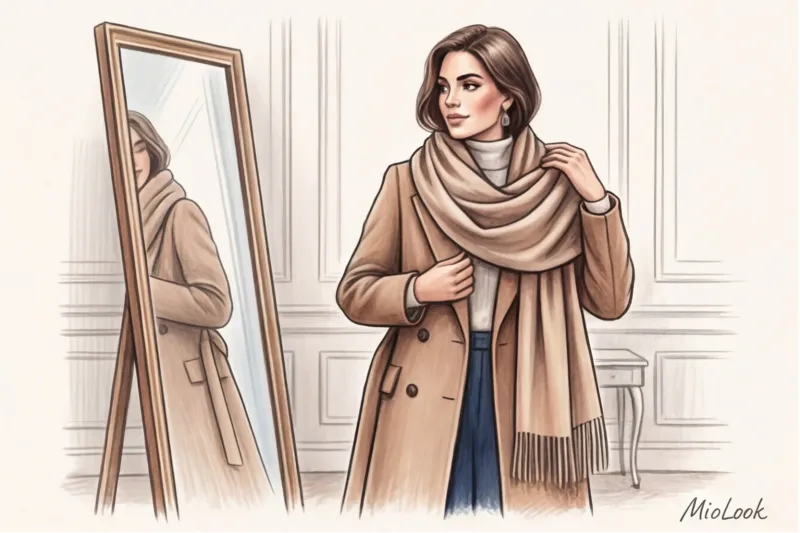
And finally, use my adapted Coco Chanel rule: "Take off not the last piece of jewelry you put on, but the one that catches your eye first in the mirror." If you look at your reflection and see a huge brooch first and your face second, the balance is off. Your jewelry should frame your professionalism, elegantly emphasizing your status, but never overshadow your personality or your words.